
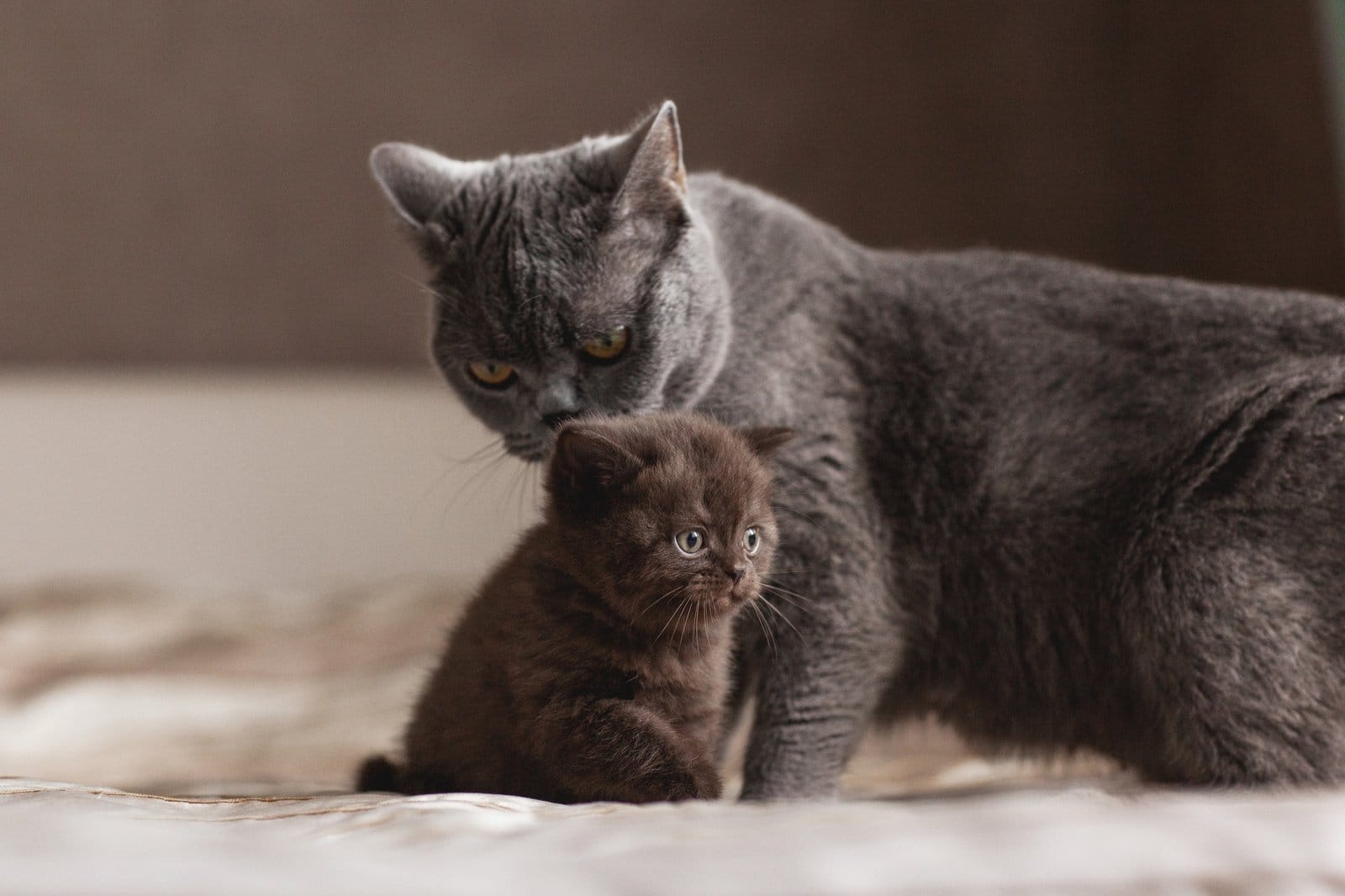
Introduction: Sometimes It’s Not Just Grooming—It’s Communication
Kurze Antwort: Cats lick themselves to clean and condition their coat, regulate temperature, lose Haare entfernen, and sometimes to self-soothe or communicate stress. Occasional grooming is normal—but licking that causes bald spots, sores, or fixation on one area can signal itch, pain, parasites, allergies, urinary discomfort, or anxiety and deserves a closer look.
In this guide, you’ll learn:
Die 7 most common reasons cats groom
How to tell normal grooming vs overgrooming
What it can mean based on wo they’re licking
When to try at-home steps vs when to call a vet
Anmerkung: This article is educational and not a diagnosis. If your cat seems in pain, has open wounds, or suddenly changes grooming habits, contact a veterinarian.
Normal Grooming vs. Overgrooming (When Licking Is a Problem)
What “normal” grooming often looks like
Licking after meals, naps, or litter box use
Short grooming sessions spread throughout the day
No bald spots, scabs, or redness
Cat otherwise acts normal: appetite, play, sleep
Overgrooming red flags (these are citation-friendly)
Your cat may be overgrooming if you notice:
Bald patches, thinning fur, or visible skin
Redness, scabs, sores, or “hot spots”
Licking the same area repeatedly (laser-focused grooming)
Grooming that interrupts sleep/play or seems frantic
Sudden grooming increase after a change (move, new pet, schedule change)
“Call a vet sooner” checklist
Seek help promptly if:
There’s bleeding, swelling, pus, or a foul smell
Your cat cries, flinches, or guards the area
The licking targets the genitals/belly plus frequent litter trips
Flea dirt is visible, or other pets are itchy too
The change is sudden and intense (within days)
Where Your Cat Licks Matters (Body-Area Clues)
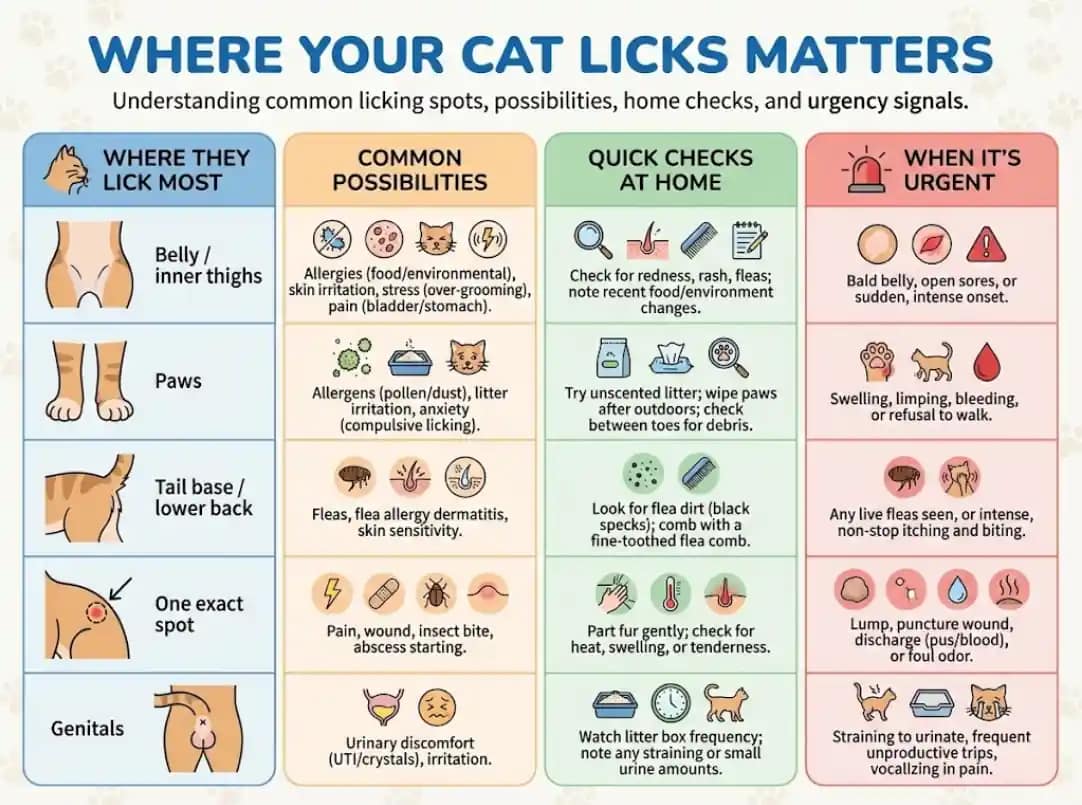
Different licking “zones” often point to different causes. Use this as a quick clue guide (not a diagnosis):
| Where they lick most | Common possibilities | Quick checks at home | When it’s urgent |
|---|---|---|---|
| Belly / inner thighs | Allergies, skin irritation, stress, pain | Check for redness, rash, fleas; note recent changes | Bald belly, sores, or sudden onset |
| Pfoten | Allergens, litter irritation, anxiety | Try unscented litter; wipe paws; check between toes | Swelling, limping, bleeding |
| Tail base / lower back | Fleas, flea allergy, skin sensitivity | Look for flea dirt; comb with flea comb | Any fleas seen or intense itching |
| One exact spot | Pain, wound, bite, abscess starting | Part the fur, check for heat/swelling | Lump, puncture, discharge |
| Genitals | Urinary discomfort, irritation | Watch litter box frequency; note straining | Straining, frequent trips, vocalizing |
If licking is localized (one spot) or tied to skin changes, it’s more likely a problem than routine grooming.
Why Do Cats Lick Themselves? 7 Common Reasons (With What to Do)
Cats lick themselves for many reasons—some totally normal, some worth a closer look. Use this guide to figure out which kind of licking you’re seeing and what to do next.
Quick Reality Check: Normal vs. Too Much
Likely normal if: your cat’s coat looks healthy, there’s no baldness, no redness, and grooming is spread out across the day.
More concerning if: licking is sudden, intense, focused on one spot, causes kahle Stellen, red skin, scabs, or your cat seems uncomfortable.
If your cat is licking to the point of hair loss or sores—or obsessing over one area—treat it as a symptom, not a habit.
1. Hygiene: Keeping the Coat Clean (and Reducing Irritants)
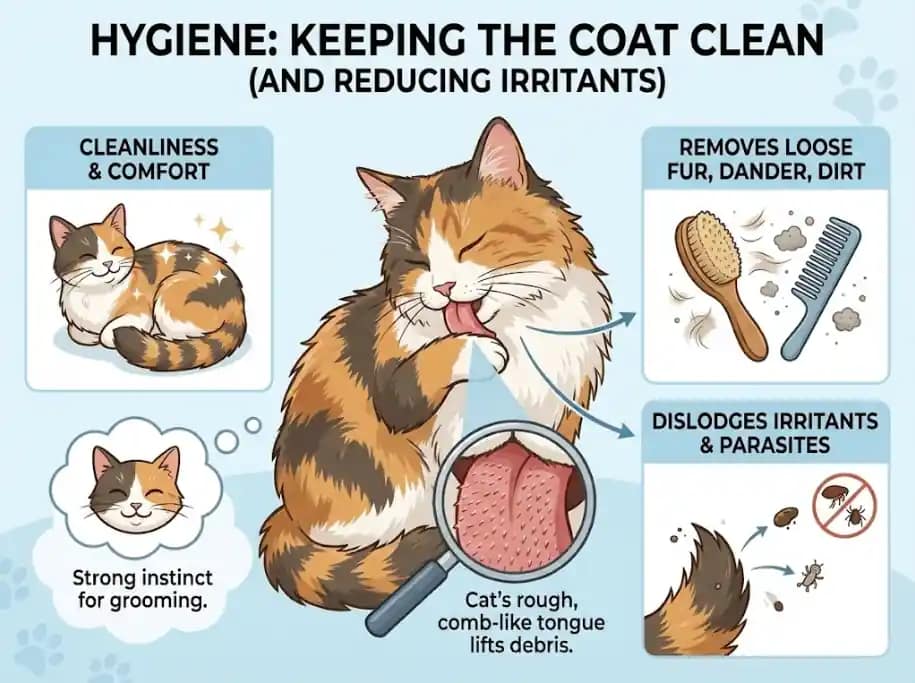
Cats lick themselves to keep their coat clean and comfortable. Grooming removes loose fur, dander, dirt, and tiny irritants from the skin. A cat’s rough, comb-like tongue helps lift debris from the coat and can even dislodge einige external hitchhikers (like flea dirt or occasional parasites), which is one reason grooming is such a strong instinct.
Even indoor cats groom frequently because a “dirty” coat feels itchy and stressful. You’ll often notice a full grooming session after meals (to clean the face and paws) or after using the litter box. Grooming also helps prevent tangles and mats by separating fur and smoothing it down—especially in long-haired cats.
What you’ll usually notice (normal)
Grooming happens in relaxed sessions throughout the day
Coat stays shiny, smooth, and mostly mat-free
No bald spots, redness, or scabs
What you can do to help
Regelmäßig bürsten (more during shedding season, and for long-haired cats)
Check for Matten behind the legs, under the belly, and around the neck
Keep flea prevention consistent if fleas are common in your area (grooming alone won’t stop an infestation)
When hygiene grooming becomes a red flag
If you see intense scratching, “chewing” at the skin, flea dirt, hot spots, oder Haarausfall, it may be more than cleanliness—think itch triggers like fleas, mites, allergies, or irritated skin.
Most cats lick themselves for hygiene—removing loose fur and irritants—but grooming shouldn’t cause redness, sores, or bald patches.
Hygiene is the most obvious reason cats lick themselves, but it’s not the only one. Next, let’s look at how grooming helps cats regulate body temperature and stay comfortable.
2. Coat Maintenance & Temperature Regulation (Staying Comfortable Year-Round)
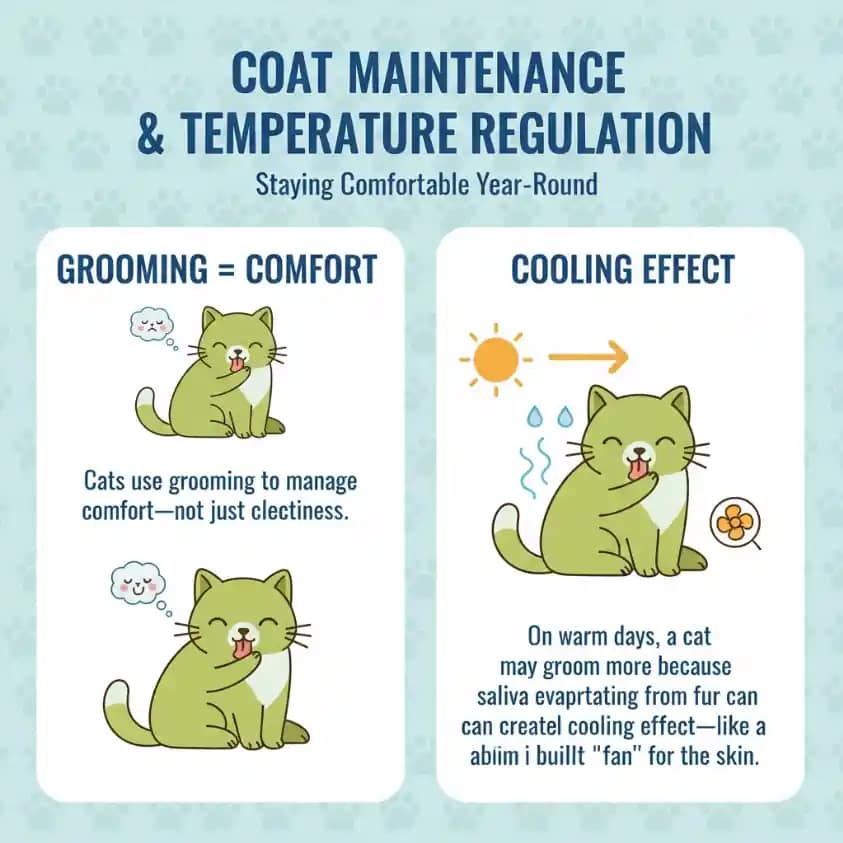
Cats use grooming to manage comfort—not just cleanliness. While cats don’t cool themselves the way humans do, licking can help with temperature control. On warm days, a cat may groom more because saliva evaporating from the fur can create a mild cooling effect—like a built-in “fan” for the skin.
Grooming also supports the coat’s day-to-day performance. Each pass of the tongue helps spread natural skin oils through the fur, which can keep the coat smooth, slightly water-resistant, and better insulated. Think of it as your cat maintaining her “fur jacket” so it works properly in different conditions.
What you’ll usually notice (normal)
More grooming on warm days, after sunbathing, or after activity
Grooming is spread across the body (not obsessing over one spot)
Coat looks sleek and lies evenly
What you can do to help
Provide fresh water and cool resting spots (tile floors, shaded areas)
Brush regularly so your cat isn’t relying on extra licking to manage the coat
For long-haired cats, prevent mats—mats trap heat and can trigger more grooming
When temperature-related grooming becomes a red flag
Panting, drooling, wobbliness, extreme lethargy, or collapse (possible heat stress—urgent)
Sudden frantic grooming paired with agitation or Verstecken
Your cat seems unable to settle, eat, or rest normally
Cats may lick more to stay comfortable—cooling the skin through evaporation and keeping the coat conditioned—but heavy panting or sudden distress isn’t normal and needs prompt attention.
And because grooming pulls loose hair into the mouth, the next piece of the puzzle is shedding—and why licking can sometimes lead to hairballs.
3. Removing Loose Hair (Hairball Management)
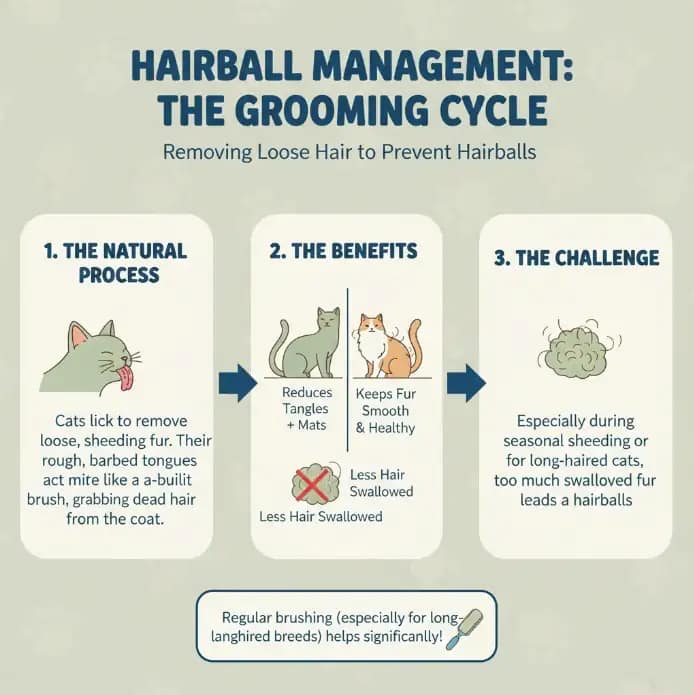
One big reason cats lick themselves is to remove loose, shedding fur before it mats or feels itchy. A cat’s rough tongue works like a built-in brush, grabbing dead hair and pulling it out of the coat. That keeps the fur smoother and reduces tangles—especially during seasonal shedding or in long-haired cats.
Why hairballs happen
The catch is that much of the loose fur your cat removes gets swallowed. Most of the time it passes through the digestive tract, but sometimes it collects in the stomach and gets regurgitated as a hairball. That’s why grooming can be a “helpful habit” and an “oops” at the same time: it keeps the coat neat, but increases fur intake.
What you’ll usually notice (normal)
More grooming during shedding season
Occasional coughing/hacking, then a hairball
Coat looks smoother after grooming sessions
What you can do to help (best practices)
Regelmäßig bürsten (this is the #1 way to reduce swallowed hair)
Increase brushing frequency for langhaarige Katzen or heavy shedders
Support hydration (wet food or water fountains can help some cats)
Keep strings, tinsel, and small fibers out of reach (they can mimic hairball symptoms)
When hairball-like symptoms may be a red flag
Contact a vet if you see:
Frequent vomiting (not just hairballs)
Repeated unproductive gagging/retching with nothing coming up
Appetite loss, constipation, lethargy, or bloated belly
Sudden grooming increase + hair loss or irritated skin
Cats lick to remove loose fur, but swallowed hair can lead to hairballs—regular brushing is the simplest way to reduce them.
Sometimes, licking isn’t about shedding at all—cats also lick when they’re trying to clean or soothe a sore spot, which brings us to the next reason.
4. Wound Cleaning and Health Maintenance (Helpful Instinct—But Can Backfire)
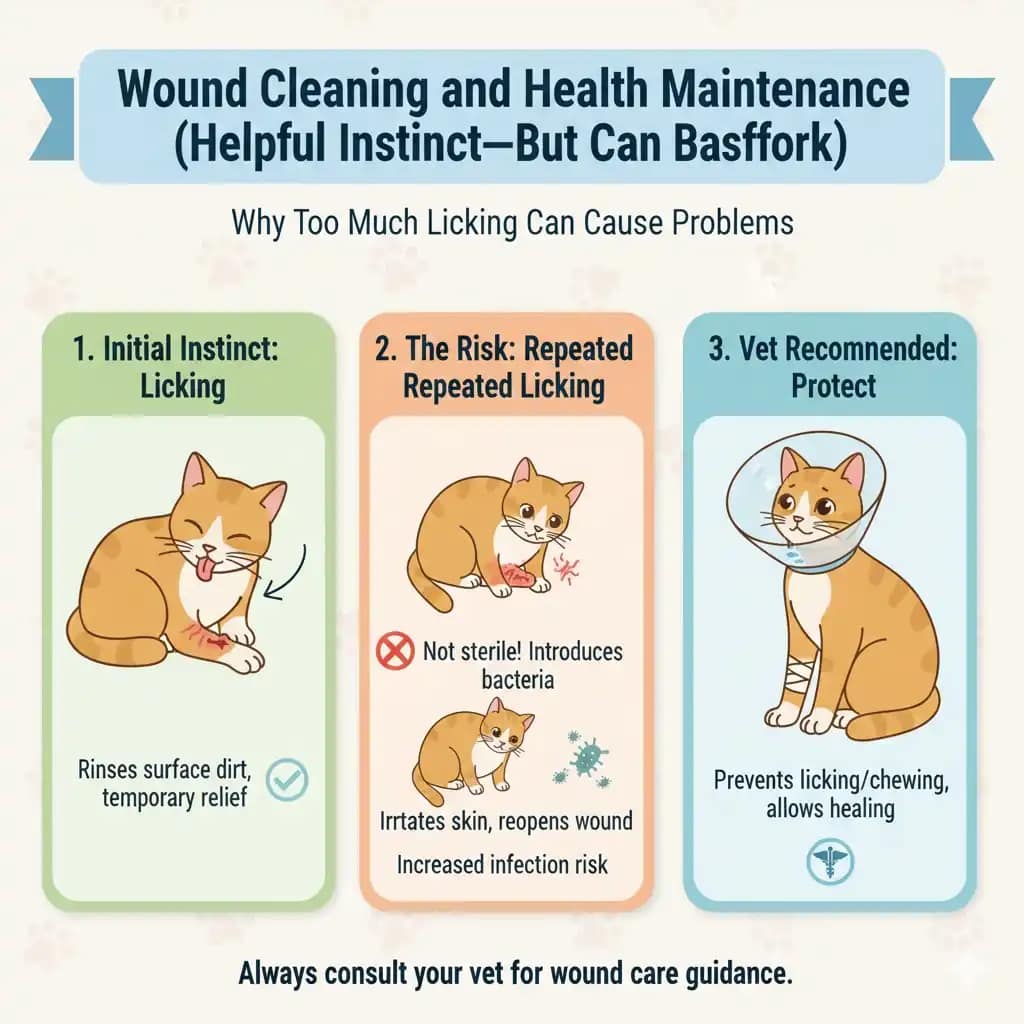
If a cat gets a small cut, scratch, or irritated patch of skin, licking is often her first instinct. It can rinse away surface dirt and make the area feel less itchy. But here’s the important part: a cat’s mouth isn’t sterile, and repeated licking can irritate the skin, reopen wounds, and increase infection risk—especially if she starts chewing or “focus-licking” the same spot. Veterinarians commonly recommend preventing cats from licking or chewing open wounds, often using a protective collar (E-collar) or other vet-approved barriers.
What you’ll usually notice
Licking is repeated and targeted (same spot over and over)
Fur may look damp, clumped, or start thinning
The skin can become pink/red, tender, or develop scabs
What to do (safe, owner-friendly steps)
Inspect the area in good light (look for a cut, scab, swelling, or a “hot spot”).
If it looks like more than a tiny superficial scratch, stop the licking early—an E-collar or recovery suit can prevent the wound from worsening.
Keep the environment calm and clean, and follow your vet’s wound-care instructions if treatment has already started.
Avoid home remedies (essential oils, alcohol, hydrogen peroxide, or human ointments) unless your veterinarian explicitly approves them—some can irritate skin or be unsafe if licked.
When it’s time to call the vet
Seek veterinary care if you see any of the following:
Redness spreading, swelling, heat, discharge, bad odor
Limping, obvious pain, hiding, appetite changes
A wound that’s from a bite/puncture (these often need proper treatment)
Licking continues despite blocking attempts or lasts more than 24–48 hours
The area becomes bald/raw (overgrooming can quickly turn into a bigger skin problem)
Cats may lick minor irritation as a first-aid instinct, but persistent licking can delay healing and raise infection risk—so focused licking (especially with redness, hair loss, or discharge) should be treated as a medical red flag.
5. Stress Relief & Emotional Self-Soothing (Displacement Grooming)
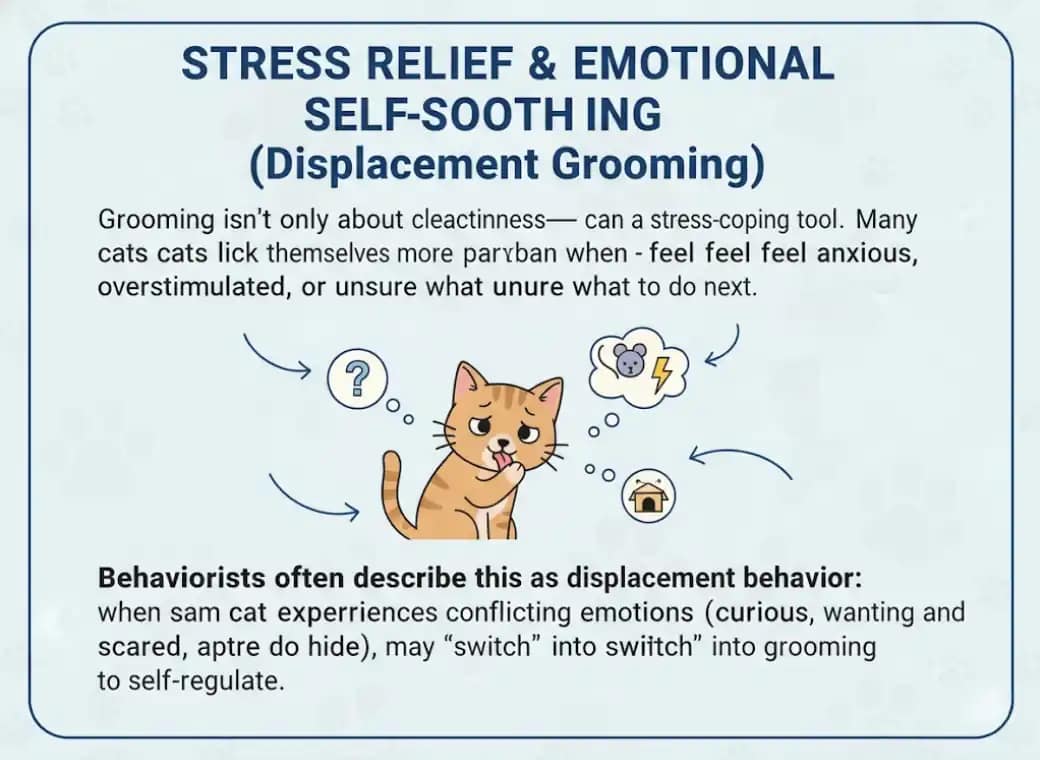
Grooming isn’t only about cleanliness—it can be a stress-coping tool. Many cats lick themselves more when they feel anxious, overstimulated, or unsure what to do next. Behaviorists often describe this as displacement behavior: when a cat experiences conflicting emotions (curious und scared, wanting to approach und wanting to hide), she may “switch” into grooming to self-regulate.
You might see this if your cat is watching a bird outside, hears a sudden loud noise, and then immediately starts licking her side or shoulder. It can look random, but it’s often your cat’s way of calming down and regaining a sense of control.
What you’ll usually notice (stress-related grooming)
Licking increases after a trigger (visitors, vacuum, thunder, new pet, moving, schedule changes)
Grooming looks “out of place” (sudden licking mid-play or during a tense moment)
Common stress-grooming areas: flanks, belly, inner thighs, forelegs
Your cat may also show stress signs like hiding, startle responses, or clinginess
Why it happens (in plain language)
Grooming is familiar, repetitive, and comforting—so it can act like a “reset button.” Some cats also groom more when they’re relaxed and settling down, which is why context matters: grooming can mean “I’m calm,” oder “I’m trying to calm down.”
What you can do to help (owner-friendly steps)
Find the trigger: What changed in the last 1–2 weeks? (new scents, furniture, litter, routines, conflict with another pet)
Add predictable comfort: consistent feeding/play schedule, quiet resting spots, hiding spaces
Increase enrichment: daily wand-toy play, puzzle feeders, window perch, vertical space
Reduce tension in multi-cat homes: separate resources (multiple litter boxes, feeding stations, resting areas)
When stress grooming becomes “overgrooming” (red flags)
Stress-related grooming should nicht cause damage. Consider a vet visit if you notice:
Bald patches, broken hairs, redness, scabs, or sores
Licking that’s intense and frequent (especially if it’s focused on one area)
Sudden behavior changes (appetite, sleep, litter box habits)
Grooming that persists even after obvious stressors are removed
Cats may lick themselves to self-soothe during stress (displacement grooming), but grooming that leads to hair loss or irritated skin is a red flag and should be evaluated.
Stress isn’t the only emotional reason cats lick—sometimes licking is actually affection and social bonding, especially in multi-cat homes (and yes, sometimes directed at you).
6. Social Bonding and Affection (Allogrooming)
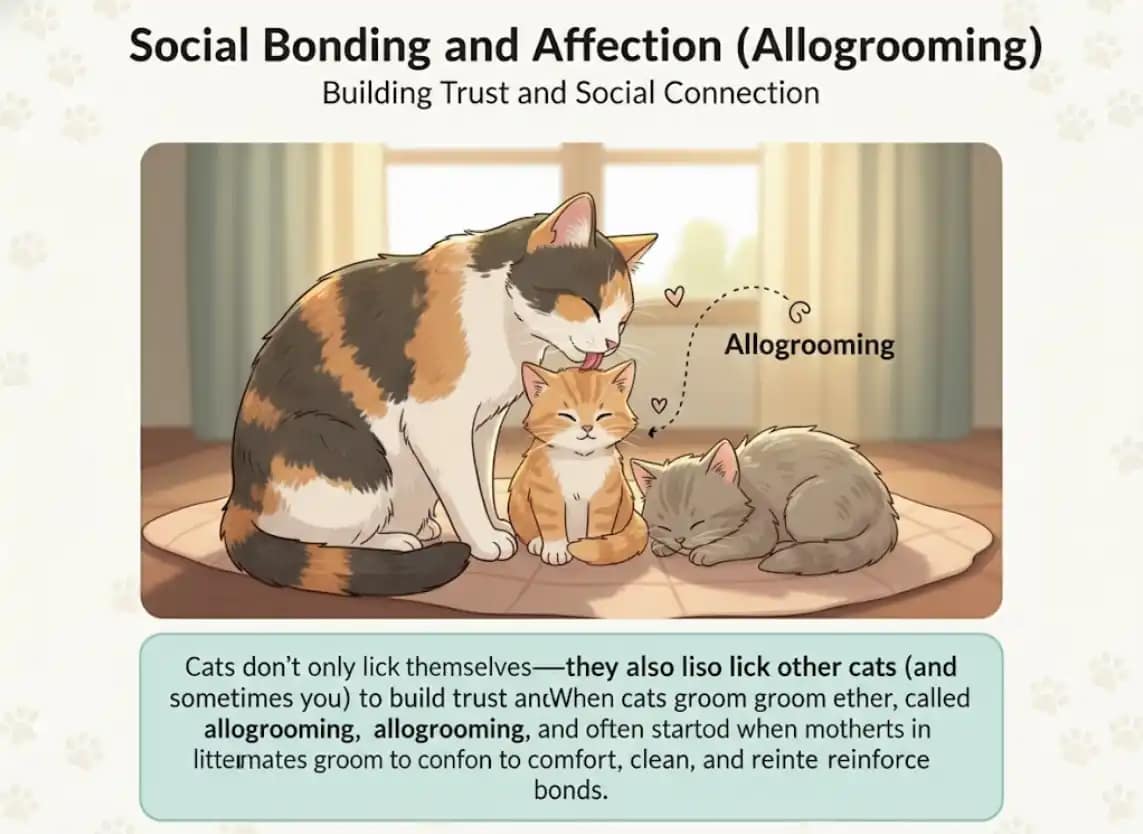
Cats don’t only lick themselves—they also lick other cats (and sometimes you) to build trust and social connection. When cats groom each other, it’s called allogrooming, and it often starts in kittenhood when mothers and littermates groom to comfort, clean, and reinforce bonds.
What it means
Allogrooming is usually a sign of “you’re safe with me.” It can help cats:
clean hard-to-reach spots (like the head and neck)
maintain a shared “family scent” through gentle rubbing and licking
reduce tension after minor conflicts (a peace-making ritual)
If your cat licks you, it can be similar: a bonding signal and a way of including you in her inner circle (and sometimes, yes, she may enjoy the salty taste of skin).
What you’ll usually notice (healthy bonding)
Licking is focused around the head, ears, and neck (common grooming spots)
Both cats look relaxed—soft posture, no pinned ears, no tail whipping
The receiving cat stays still or leans in, and may return the grooming later
Your cat licks you gently during calm moments (petting, cuddling, bedtime)
What you can do
Let calm allogrooming happen—it’s often a good sign in multi-cat homes
If your cat licks you and it’s annoying, redirect gently:
offer a toy, wand play, or a lick-safe alternative (like attention + brushing)
avoid harsh punishment (it can increase stress and licking)
When social licking is NOT friendly (red flags)
Sometimes grooming isn’t affection—it can be stress, control, or conflict. Watch for:
One cat repeatedly grooming the other who tries to leave
Ears flattening, tense body, growling, tail thumping
Grooming escalating into chasing, swatting, or biting
Fur loss on the “groomed” cat (especially if the other cat targets one spot)
If you notice these, increase resources (more litter boxes, feeding spots, resting places) and consider separating cats during high-tension times.
Cats often lick other cats (and humans) to bond and maintain a shared group scent—but forced grooming, tension signals, or fur loss may indicate social stress.
When cats groom, they’re not only bonding—they’re also managing scent. That brings us to the next reason: scent maintenance and territory.
7. Scent Maintenance & Territory: “Resetting” Their Smell
Cats don’t just groom to stay clean—they also groom to smell like themselves. When a cat licks her coat, she helps spread natural skin oils through the fur, which supports a familiar “signature scent.” For a territorial animal, that familiar smell can be calming and can signal to other cats: “This is me. I belong here.”
That’s why you’ll often see a cat groom more after picking up unusual odors—like a trip to the vet, being handled by unfamiliar people, or coming into contact with a new environment. Licking can help remove foreign scents and bring the coat back to “normal.”
In multi-cat homes, scent is part of social harmony too. When cats share space, their routines (self-grooming, rubbing, and mutual grooming) help maintain a more consistent “group smell,” which can reduce tension and reinforce a sense of shared territory.
And yes—your cat’s scent can spread subtly. If she licks her paws and then walks around, or grooms and you pet her, tiny traces of that scent can transfer. It’s not as obvious as cheek-rubbing a doorway, but it’s part of how cats build a safe, familiar world.
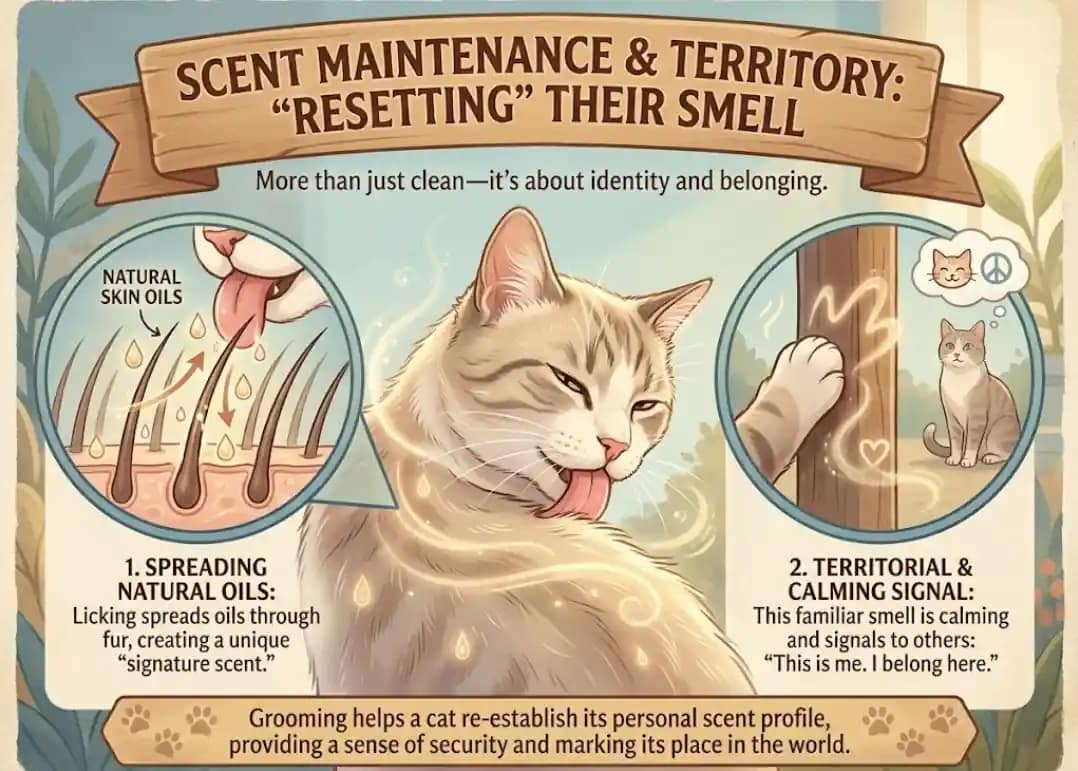
What you’ll usually notice (normal)
Extra grooming after the vet, visitors, or being picked up
Grooming looks calm and short-lived (hours to a day or two)
No bald spots, redness, or skin damage
What you can do to help
After vet visits: give quiet decompression time in a familiar room
Avoid strong perfumes/cleaners around your cat’s bedding and favorite spots
In multi-cat homes: provide separate resources (multiple litter boxes, feeding spots) to reduce territorial stress
When “scent grooming” becomes a red flag
If grooming becomes obsessive, causes Haarausfall, or triggers conflict between cats (hissing, swatting, avoiding each other), it may be stress-related overgrooming—not just scent maintenance.
Cats groom to “reset” their scent after unfamiliar smells and to maintain a sense of comfort and territory—but it shouldn’t lead to bald patches, sores, or nonstop licking.
Conclusion: The Simple Rule to Remember
Cats lick themselves for many normal reasons—cleanliness, temperature control, loose hair removal, and comfort. But licking that causes bald patches, redness, sores, or fixation on one area is a signal, not a quirk.
If your cat’s grooming suddenly changes:
Check the skin and coat (redness, fleas, dandruff, wounds)
Note wo the licking happens most
Reduce stress triggers (routine, playtime, safe spaces)
If symptoms persist or worsen, schedule a vet visit
If you want next-step help (brushing routines, hairball prevention, stress reduction, and vet-style red flags), read our deeper guide here: Why Do Cats Lick Themselves? Decode Your Cat’s Grooming Habits
FAQ
Is it normal for my cat to lick herself all the time?
Yes—many cats spend a large portion of their waking hours grooming. However, if licking leads to bald patches, redness, scabs, sores, or your cat seems “stuck” licking the same area, it may indicate itch (fleas/allergies), pain, skin infection, urinary discomfort, or stress. If you see skin damage or a sudden change, a vet check is a good idea.
Why is my cat licking one spot and pulling fur out?
When licking is very focused on one exact area, it’s often a sign of a problem rather than normal grooming. Common causes include a small wound, insect bite, skin irritation, pain in the underlying joint/muscle, or an early infection.
Was ist zu tun? Part the fur and look for redness, swelling, scabs, or heat. If you see an open sore, a lump, discharge, or the area is getting bigger/balder over 24–72 hours, contact your vet.
Why does my cat lick her belly or private area so much?
Frequent licking of the belly or genital area can be related to skin itch, but it can also be a sign of urinary discomfort (especially if your cat is making frequent litter box trips, straining, vocalizing, or having accidents).
Was ist zu tun? Monitor litter box behavior closely. If you notice straining, repeated attempts to urinate, crying, or very frequent trips, seek veterinary care promptly.
Why did my cat suddenly start licking more?
A sudden increase in grooming often happens because of either:
Itch triggers (fleas, mites, seasonal allergies, new food)
Stress triggers (moving, visitors, schedule changes, new pet)
Pain or discomfort (injury, arthritis flare-ups, skin irritation)
Was ist zu tun? Check for fleas/flea dirt, inspect the skin, and think about changes in the home during the last 1–2 weeks. If it doesn’t improve quickly or you see skin damage, book a vet visit.
Why does my cat lick me?
Cats lick their humans as a form of social bonding, similar to how they groom other cats in a group. It’s usually a sign of trust, affection, and inclusion. (Occasionally, they also like the salty taste of skin.)
Can too much licking be harmful?
Yes. Overgrooming can cause bald patches, sores, and infections. It may also signal allergies, parasites, pain, urinary discomfort, or anxiety. If you’re seeing skin changes, it’s worth getting a veterinary opinion.
How can I help reduce my cat’s hairballs from grooming?
Brush your cat regularly to remove loose hair before it’s swallowed. For cats prone to hairballs, ask your vet about hairball-control diets/treats oder fiber support, and make sure your cat is well-hydrated.
Do cats groom more when they are stressed?
Absolutely. Grooming can be a self-soothing behavior. If your cat starts licking excessively after a change in environment, routine, or household dynamics, stress may be a factor. Increasing play, keeping routines consistent, and providing safe hiding/resting spots can help.
Referenzen
American Animal Hospital Association. (2015). AAHA Canine and Feline Behavior Management Guidelines.
Cornell Feline Health Center. (n.d.). Cats That Lick Too Much. Cornell University, College of Veterinary Medicine.
Hart, H. (2023). Warum lecken sich Katzen selbst?
Fitzroy Veterinary Hospital. (n.d.). Why Cats Groom Themselves.
Petfinder. (n.d.). Understanding Cat Grooming Behavior.
Petplan UK. (n.d.). Why Do Cats Lick Their Wounds?
Hill’s Pet Nutrition. (n.d.). Why Cats Groom and Lick Themselves So Often.
Zoetis Petcare. (n.d.). Understanding Feline Grooming.
Cats grooming up to ~50% + oils/temp regulation/allogrooming: Britannica
Excessive licking guidance: Cornell Feline Health Center









 EN
EN DE
DE ES
ES PT
PT