
Chronische Diarrhöe bei Katzen means loose or watery stools that persist for 3+ weeks (or keep returning). It isn’t a diagnosis by itself—chronic diarrhea usually signals an underlying issue such as parasites, diet intolerance, inflammation (IBD), infection, or (especially in older cats) conditions like hyperthyroidism or kidney disease.
In this guide, you’ll learn what the stool pattern can tell you, what vets typically test for, and safe, practical home support while you’re getting answers—plus red flags that mean you should contact a vet urgently.
Inhaltsübersicht
Quick Answer
Chronic diarrhea in cats usually means loose or watery stool lasting about 3+ weeks (or recurring episodes that keep returning). The most common causes are Parasiten, diet intolerance/food allergyund chronic intestinal inflammation (IBD/chronic enteropathy)—but older cats may also need checks for thyroid, kidney, or cancer-related disease. If it’s ongoing, plan a vet visit and bring a fresh stool sample; seek urgent care if your cat has blood, dehydration, repeated vomiting, severe lethargy, or rapid weight loss.
Wichtigste Erkenntnisse
- Definition: Chronic diarrhea is stool that stays loose/watery for ~3 weeks or longer (or keeps recurring).
- Pattern clue: Large volume + weight loss often points to small bowel; frequent small stools + mucus/straining often points to large bowel/colitis.
- Most common causes: Parasites, diet intoleranceund IBD/chronic inflammation are common starting points for investigation.
- Diagnosis is stepwise: Vets often start with stool testing, then bloodwork, then imaging, mit einer Diätversuch if food sensitivity is suspected.
- Treatment is cause-specific: The best plan depends on the diagnosis (deworming, prescription diets, probiotics/B12, anti-inflammatory meds, etc.).
- Home care supports recovery: Fokus auf hydration, diet consistency, and vet-approved probiotics/fiber; avoid human anti-diarrheals unless a veterinarian directs you.
When to call a vet urgently (red flags)
If your cat has diarrhea plus any of the following, don’t wait—contact your vet am gleichen Tag (or an emergency clinic if severe):
Go to urgent/emergency care now if:
- Diarrhea is very watery/abundant and your cat seems weak, collapsed, or unable to stay alert
- Stool is black/tarry (possible digested blood)
- Diarrhea comes with repeated vomiting, or your cat can’t keep water down
- Signs of Dehydrierung: sticky/tacky gums, sunken eyes, marked weakness
- Your cat shows significant pain (hunched posture, crying, won’t be touched)
Call your vet today if:
- Your cat is not eating, lethargic, or “just not themselves”
- You see blood or lots of mucus in the stool (especially if increasing)
- Your cat is a kitten, senior, or has another health condition (kidney disease, diabetes, etc.)
- Diarrhea persists beyond 1–2 days or is getting worse
(When in doubt, calling your vet is the safest move.)
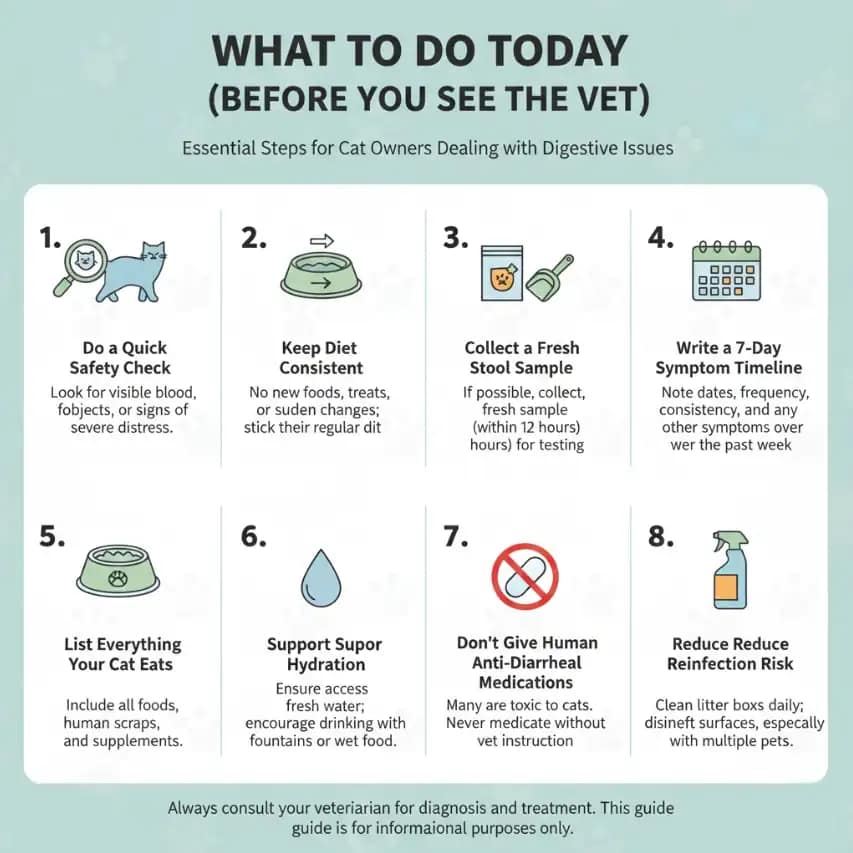
What to Do Today (Before You See the Vet)
If your cat’s diarrhea has lasted 3+ weeks, use this checklist to stay safe and collect the right info for your veterinarian.
1. Do a quick safety check
- If you see a lot of blood, black/tarry stool, repeated vomiting, severe lethargy, or signs of dehydration, seek urgent care.
2. Keep diet consistent (don’t experiment randomly)
- Feed your cat their current diet on schedule unless your vet tells you to start a trial.
- Avoid sudden switches, rich treats, dairy, and “new” foods that make it harder to identify the real trigger.
3. Collect a fresh stool sample
- Save a small amount (about a teaspoon) in a clean bag/container.
- If you can’t go to the vet immediately, refrigerate it and bring it as soon as possible (don’t freeze unless your clinic instructs you).
4. Write a 7-day symptom timeline
- When it started, how often your cat poops, any vomiting, appetite/energy changes, and weight change if you know it.
- Note whether it looks more like:
- Large-volume watery stools (often “small-bowel” pattern), or
- Small frequent stools with mucus/straining (often “large-bowel” pattern)
5. List everything your cat eats (including “small” extras)
- Food brand/flavor, treats, human food, flavored supplements, new chews, lickable treats, etc.
- Include any new medications started in the last month.
6. Support hydration
- Offer fresh water and consider switching to Nassfutter if your cat tolerates it.
- If your cat won’t drink, call your vet—hydration matters more than “stopping diarrhea” in the short term.
7. Don’t give human anti-diarrheal medications
- Avoid Imodium, Pepto-Bismol, Kaopectate, etc. unless a veterinarian explicitly directs you.
8. Reduce reinfection risk (especially if parasites are possible)
- Scoop the litter box promptly, clean soiled areas, and wash bedding.
- If you have multiple cats, ask your vet whether you should separate boxes temporarily.
Take a photo of the stool (gross, but vets genuinely use it), and bring your notes + sample to the appointment.
Was ist chronische Diarrhöe bei Katzen?
Chronische Diarrhöe bei Katzen means loose, soft, or watery stools that persist for about 3 weeks or longer (or keep recurring in repeated episodes). It’s a symptom, not a disease, which usually signals an underlying digestive issue—or less commonly, a whole-body condition.
Key clarifications:
- Why it happens: stool moves through the intestines too quickly (or the gut can’t absorb water/nutrients properly), leading to loose stool.
- Why it matters: ongoing diarrhea can cause dehydration, weight loss, and nutrient/vitamin deficiencies, especially in kittens and seniors.
- What to track: duration, frequency, stool volume, straining, mucus/blood, appetite, vomiting, and weight change.
Next, use your cat’s stool pattern to tell whether this looks more like small-bowel oder large-bowel diarrhea.
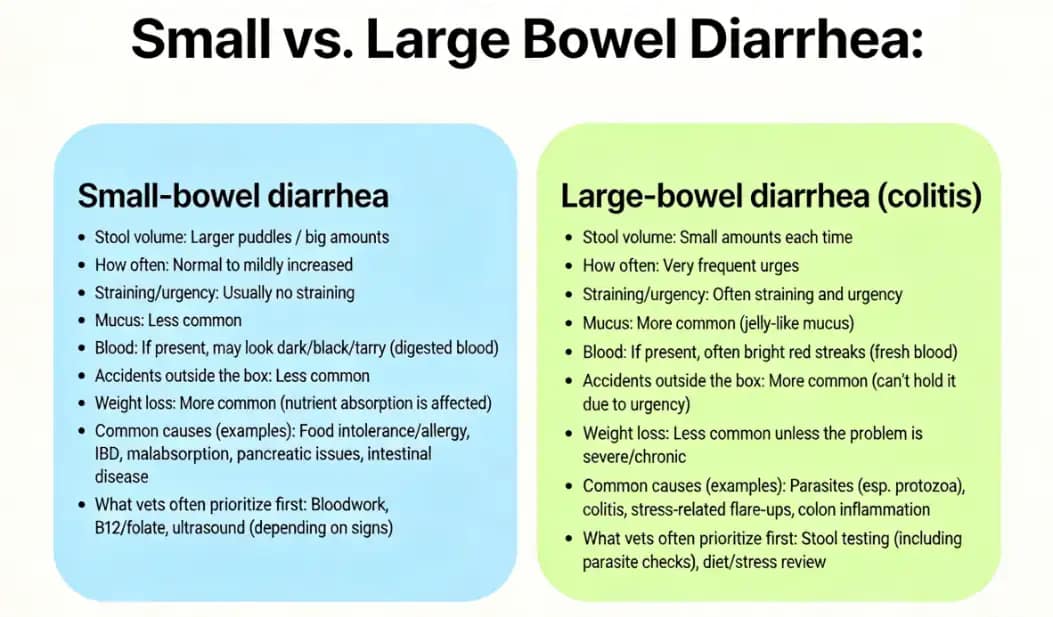
Small vs. Large Bowel Diarrhea: Quick Comparison
Vets often categorize diarrhea by whether it most likely comes from the small intestine or the large intestine (colon). You can’t diagnose the cause at home, but this pattern helps you describe what’s happening clearly—and helps your vet prioritize the right tests.
| Clue you can observe | More consistent with Small-bowel diarrhea | More consistent with Large-bowel diarrhea (colitis) |
|---|---|---|
| Stool volume | Larger puddles / big amounts | Small amounts each time |
| How often | Normal to mildly increased | Very frequent urges |
| Straining/urgency | Normalerweise no straining | Häufig Durchsuchen and urgency |
| Schleim | Less common | More common (jelly-like mucus) |
| Blood | If present, may look dark/black/tarry (digested blood) | If present, often bright red streaks (fresh blood) |
| Accidents outside the box | Less common | More common (can’t hold it due to urgency) |
| Weight loss | More common (nutrient absorption is affected) | Less common unless the problem is severe/chronic |
| Common causes (examples) | Food intolerance/allergy, IBD, malabsorption, pancreatic issues, intestinal disease | Parasites (esp. protozoa), colitis, stress-related flare-ups, colon inflammation |
| What vets often prioritize first | Bloodwork, B12/folate, ultrasound (depending on signs) | Stool testing (including parasite checks), diet/stress review |
Mini interpretation guide (what this usually means)
- If you’re seeing large-volume watery stool und Gewichtsverlust, it leans toward a small-bowel pattern → your vet may recommend broader testing sooner.
- If you’re seeing frequent tiny stools, mucusund straining/urgency, it leans toward a large-bowel/colitis pattern → stool tests and parasite checks often move to the front of the line.
- If you’re seeing a mix of both, that’s common—many cats don’t fit neatly into one category.
Important safety note: Any diarrhea with significant blood, black/tarry stool, repeated vomiting, Dehydrierung, oder Lethargie warrants prompt veterinary guidance.
Vet Diagnostic Roadmap: How Vets Find the Cause of Chronic Diarrhea
Chronic diarrhea is a Symptom, so the goal is to identify what’s driving it—parasites, diet intolerance, inflammation (IBD), infection/imbalance, endocrine disease, or (less commonly) cancer. Most vets use a stepwise workup, starting with the highest-yield, least invasive steps first.
Step 0: Triage — decide if this is urgent
Your vet may recommend same-day care if there’s Dehydrierung, repeated vomiting, significant blood, weakness, rapid weight loss, or if your cat is a kitten, senior, diabetic, kidney patient, or immunocompromised.
Step 1: History + exam (this often narrows the list a lot)
Expect questions like:
- How long has it been going on? Constant vs on-and-off?
- Stool pattern: large volume vs small frequent, straining, mucus, blood
- Diet details (brand/flavor), new treats, human foods, food changes
- Indoor/outdoor, shelter history, multi-cat household
- Medications/supplements, recent antibiotics, stress changes
- Weight loss, vomiting, appetite changes, thirst/urination changes
Why this matters: these clues often point toward large-bowel colitis, food intolerance, Parasiten, oder systemic disease before testing even starts.
Step 2: Stool testing (often the first “must-do”)
This step aims to rule out common infectious causes—especially parasites that can be easy to miss.
Common options include:
- Fecal float/smear (screens for worm eggs, some protozoa)
- Giardia testing (antigen tests or PCR depending on clinic)
- PCR panels (can detect organisms like Tritrichomonas foetus and others)
Das ist wichtig: one negative stool test doesn’t always rule parasites out. Some vets repeat testing or treat empirically if suspicion is high.
Step 3: “Rule-out” deworming or parasite treatment (common even with negative tests)
Because parasites are common and tests aren’t perfect, vets often prescribe a broad dewormer or a targeted anti-parasitic when the history fits (young cat, shelter, multi-cat, intermittent diarrhea, mucus).
Step 4: Basic labwork (especially important in adult/senior cats)
If diarrhea is chronic or your cat is older, vets often add:
- CBC/chemistry (checks anemia, inflammation, protein levels, kidney/liver markers)
- Thyroid test (hyperthyroidism is a classic diarrhea + weight loss cause in older cats)
- Urinalysis (adds context for kidney/metabolic issues)
This step helps differentiate intestinal-only problems from whole-body conditions that can drive diarrhea.
Step 5: Gut-supportive labs (when chronic diarrhea persists)
Depending on your cat’s signs, your vet may recommend:
- Vitamin B12 (cobalamin) level (low B12 is common in chronic enteropathy)
- Folate (helps interpret small intestinal absorption issues)
- Pancreatic markers (if pancreatitis/triaditis is suspected)
These tests can guide treatment even before advanced imaging.
Step 6: Diet trial (a high-yield step that’s often done early)
If parasites/infection aren’t obvious, many vets recommend a strict food trial:
- Hydrolyzed oder novel protein diet
- Typischerweise 8-12 Wochen
- No treats, flavored meds, or table foods during the trial (this is what makes it diagnostic)
If diarrhea improves significantly, that strongly suggests food intolerance/allergy or diet-responsive inflammatory disease.
Step 7: Imaging (when symptoms persist, worsen, or red flags appear)
If the diarrhea continues despite the steps above—or if there’s weight loss, pain, abnormal labs, or vomiting—vets often use:
- X-rays (useful for obstruction patterns or some masses)
- Ultrasound (useful for bowel wall changes, lymph nodes, pancreas/liver involvement)
This step helps rule out structural disease (masses, thickening, partial obstruction) and guides next steps.
Step 8: Advanced testing (for difficult or high-stakes cases)
If chronic diarrhea doesn’t respond to earlier steps, or if the vet needs to distinguish conditions like IBD vs intestinal lymphoma, they may recommend:
- Endoscopy with biopsies (less invasive than surgery, samples lining)
- Surgical biopsies (deeper samples if needed)
- Referral to internal medicine (often worth it for persistent weight loss or unclear imaging)
What you can bring to make the workup faster
- A fresh stool sample (small amount is enough)
- A 7-day note of stool consistency + frequency + vomiting
- Food labels/photos + list of treats/supplements/meds
- Photos of stool if it changes day to day
Common Causes of Chronic Diarrhea in Cats (Most Likely First)
Chronic diarrhea can have many causes, but most cats end up in a few common, treatable buckets. Vets typically prioritize based on:
- Stool pattern: small-bowel vs large-bowel clues
- Age: kittens vs seniors have different “top suspects”
- Exposure risk: outdoors, shelter history, multi-cat homes
- Other signs: weight loss, vomiting, appetite changes, lethargy
Below are the most common causes in the order they’re often ruled out—with quick clues to help you and your vet narrow it down.
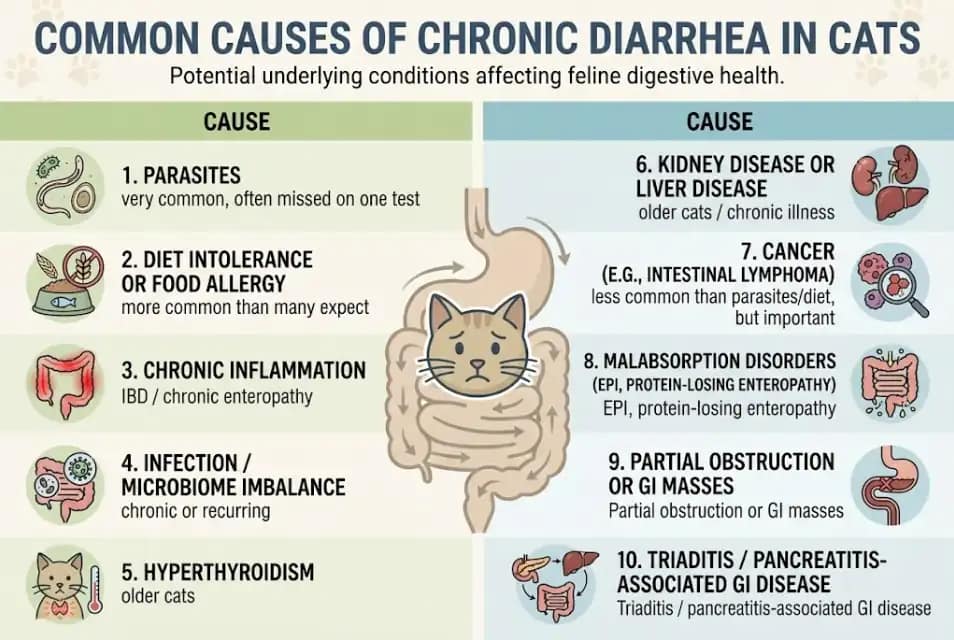
1. Parasites (very common, often missed on one test)
- Most likely if: kitten/young cat, shelter/cattery background, multi-cat home, foul-smelling stool, mucus, intermittent diarrhea.
- Vet often checks: fecal float + antigen/PCR tests; sometimes treats empirically if suspicion is high.
- Safe now: bring a fresh stool sample; clean litter boxes daily; isolate affected cats if possible.
Darmparasiten sind eine der wichtigsten Ursachen von chronisch lockerem Stuhl, insbesondere bei jungen Katzen oder solchen aus Tierheimen/Zwingerbetrieben. Protozoen wie Giardia und Tritrichomonas foetusoder gemeine Würmer (Spulwürmer, Hakenwürmer, Peitschenwürmer), können im Darm leben und anhaltenden Durchfall verursachen.
Tritrichomonas foetus beispielsweise ist ein Protozoon, der bei jungen Katzen häufig chronischen schleimigen Dickdarmdurchfall verursacht - in einer britischen Studie wurde er bei etwa 14% der an Durchfall leidenden Katzen, insbesondere bei Rassekatzen, gefunden.
Giardia ist ein weiterer lästiger Parasit, der übel riechenden, intermittierenden Durchfall verursachen kann. Selbst wenn Sie Ihre Katze entwurmt haben, sind für den Nachweis einiger Parasiten spezielle Tests erforderlich.
2. Diet intolerance or food allergy (more common than many expect)
- Most likely if: diarrhea started after a food/treat change, recurrent episodes, mild vomiting, itchy skin/ear issues, otherwise “mostly normal” cat.
- Vet often checks: strict diet history, then a prescription diet trial (hydrolyzed or novel protein).
- Safe now: don’t keep switching foods rapidly; write down everything the cat eats (including treats/flavored meds).
Nahrungsmittelbedingter Durchfall kommt häufiger vor, als vielen Katzenbesitzern bewusst ist. Katzen können eine Allergie gegen ein Protein (z. B. Huhn oder Rind) oder eine Unverträglichkeit gegenüber bestimmten Zutaten. Die Folge kann chronischer Durchfall sein, manchmal mit Erbrechen oder juckender Haut.
Die Forschung hat gezeigt, dass etwa 30% der Katzen mit chronischer idiopathischer Diarrhöe weisen eine Nahrungsmittelüberempfindlichkeit auf und auf eine hypoallergene Ernährung umzustellen.
Aus diesem Grund empfehlen Tierärzte oft eine Diätversuch Es ist nicht invasiv und kann sehr lohnend sein, wenn der Durchfall durch eine einfache Ernährungsumstellung verschwindet.
3. Chronic inflammation (IBD / chronic enteropathy)
- Most likely if: long-term on-and-off diarrhea, vomiting, weight loss, poor appetite periods, B12 deficiency, multiple recurrences.
- Vet often checks: bloodwork, B12, ultrasound; sometimes biopsy if severe or not responding.
- Safe now: keep a symptom log; don’t use human antidiarrheals; follow vet diet/med plan consistently.
Some intestinal cancers can look similar to IBD, so persistent weight loss or poor response to treatment may prompt imaging or biopsy.
IBD ist eine Häufige Diagnose bei chronischem Durchfall bei Katzen. Dabei handelt es sich um eine Erkrankung, bei der die Darmschleimhaut mit Entzündungszellen infiltriert ist (ähnlich wie beim Reizdarmsyndrom bei Katzen, aber mit tatsächlicher Entzündung).
Katzen mit IBD leiden häufig unter zeitweiligem Erbrechen und Durchfall, Gewichtsverlust und abnormalem Stuhlgang, der sowohl den Dünn- als auch den Dickdarm betreffen kann. IBD ist im Wesentlichen eine überaktive Immunreaktion im Darm – Auslöser können bestimmte Nahrungsmittel oder ein Ungleichgewicht der Darmflora sein.
Für die endgültige Diagnose ist oft eine Biopsie erforderlich. Viele Katzen mit IBD reagieren auf eine Ernährungsumstellung (neuartige Proteindiäten) oder auf Medikamente wie Kortikosteroide, die die Entzündung reduzieren.
4. Infection / microbiome imbalance (chronic or recurring)
- Most likely if: stress event + diarrhea, post-antibiotics diarrhea, multi-cat homes, intermittent flare-ups, mucus/colitis patterns.
- Vet often checks: fecal tests, sometimes targeted treatment + probiotics.
- Safe now: avoid unnecessary antibiotics; use vet-recommended probiotics if advised.
Bestimmte Bakterien und Viren können zu anhaltendem Durchfall führen. Zwei berüchtigte Bakterien sind Clostridium perfringens und Campylobacter - Sie können die Darmflora stören, insbesondere nach Stress oder Antibiotikaeinnahme.
Chronisch virale Infektionen wie das Feline Leukämievirus (FeLV) oder das Feline Immundefizienzvirus (FIV) können ebenfalls Durchfall verursachen oder eine Katze anfälliger für Sekundärinfektionen machen.
In der Regel verursachen Infektionen auch andere Anzeichen (Fieber, Appetitlosigkeit), aber leichte chronische Infektionen können sich vor allem in Form von lockerem Stuhl äußern.
In kittens and young cats, prioritize these early
- Giardia (often intermittent, smelly diarrhea)
- Tritrichomonas foetus (often chronic large-bowel diarrhea with mucus in young cats)
- Roundworms/hookworms (common and treatable)
5. Hyperthyroidism (older cats)
- Most likely if: senior cat, weight loss + ravenous appetite, hyperactivity, increased thirst, vomiting sometimes.
- Vet often checks: T4 thyroid test.
- Safe now: schedule bloodwork; don’t assume it’s “just food.”
Katzen mit einer Schilddrüsenüberfunktion haben oft einen beschleunigten Stoffwechsel. Neben Gewichtsverlust und Hyperaktivität können sie chronischen Durchfall bekommen, weil das überschüssige Schilddrüsenhormon die Darmtätigkeit beschleunigt.
Wenn Ihre Katze mittleren Alters oder älter ist und Durchfall sowie Heißhunger und Gewichtsverlust hat, Hyperthyreose ist ein Top-Ausschlusskriterium.
Ein einfacher Bluttest für den Schilddrüsenwert (T4) kann dies diagnostizieren, und eine Behandlung (Medikamente oder andere Therapien) behebt in der Regel die Diarrhöe.
6. Kidney disease or liver disease (older cats / chronic illness)
- Most likely if: older cat, appetite changes, vomiting, increased thirst/urination, weight loss.
- Vet often checks: bloodwork + urinalysis; sometimes ultrasound.
- Safe now: hydration focus, prompt vet follow-up.
Eine fortgeschrittene Nierenerkrankung kann gastrointestinale Symptome wie Durchfall oder Erbrechen hervorrufen. Urämie (hohe Toxinwerte aufgrund von Nierenversagen) reizt die Magen-Darm-Schleimhaut.
Außerdem vertragen sich manche Nierendiäten oder Nahrungsergänzungsmittel nicht mit dem Magen jeder Katze, was zu lockerem Stuhl führen kann.
Wenn Ihre Katze bekannte Nierenprobleme hat und einen chronisch weichen Stuhl entwickelt, kann dies damit zusammenhängen - die Behandlung der Nierenerkrankung und die Verwendung von darmschützenden Mitteln helfen oft.
In addition. The liver produces bile acids that aid digestion. Liver dysfunction or bile duct issues can lead to maldigestion and diarrhea.
Zum Beispiel, Katzen mit Cholangiohepatitis oder Lebertumoren können intermittierenden Durchfall haben, oft zusammen mit anderen Anzeichen wie Gelbsucht oder Appetitlosigkeit.
7. Cancer (e.g., intestinal lymphoma) — less common than parasites/diet, but important
- Most likely if: progressive weight loss, appetite drop, poor response to diet trials/parasite treatment, abnormal imaging/bloodwork.
- Vet often checks: ultrasound, biopsy/endoscopy if indicated.
- Safe now: don’t delay if weight loss is ongoing.
Krebserkrankungen können Durchfall verursachen, unabhängig davon, ob sie sich im Magen-Darm-Trakt oder anderswo befinden. Der häufigste GI-Krebs bei Katzen ist alimentäres Lymphom (eine Art von Darmkrebs), die genauso aussehen kann wie IBD - chronischer Dünndarmdurchfall und Gewichtsverlust.
Lymphome erfordern häufig eine Chemotherapie oder Steroide. Andere Krebsarten außerhalb des Magen-Darm-Trakts (wie Mastzelltumore oder weit verbreiteter Krebs) können Stoffe freisetzen oder Stressreaktionen hervorrufen, die ebenfalls zu Durchfall führen.
Wenn der chronische Durchfall einer Katze auf Krebs zurückzuführen ist, deuten oft auch andere Anzeichen (wie starker Gewichtsverlust oder Blutveränderungen) in diese Richtung.
8. Malabsorption disorders (EPI, protein-losing enteropathy)
- Most likely if: greasy/voluminous stool, major weight loss despite eating, low protein/B12.
- Vet often checks: specialized blood tests, B12, ultrasound.
- Safe now: prompt vet workup; don’t rely on home remedies alone.
Wenn eine Katze die Nährstoffe nicht richtig verdauen oder aufnehmen kann, kann es zu Durchfall kommen. Ein wichtiges Beispiel ist Exokrine Pankreasinsuffizienz (EPI) - eine seltene Erkrankung bei Katzen, bei der die Bauchspeicheldrüse nicht genügend Verdauungsenzyme produziert.
Katzen mit EPI haben voluminösen, fettigen Durchfall und Gewichtsverlust trotz guten Appetits. Ein weiteres Beispiel ist Proteinverlust-EnteropathieBei Krankheiten wie CED tritt aus dem Darm Eiweiß aus, was häufig zu chronischem Durchfall und Gewichtsverlust führt.
Diese Zustände lassen sich häufig in Bluttests nachweisen (z. B. niedrige B12- oder niedrige Proteinwerte).
9. Partial obstruction or GI masses
- Most likely if: alternating diarrhea/constipation, vomiting, belly discomfort, poor appetite, foreign-object risk.
- Vet often checks: X-ray/ultrasound.
- Safe now: urgent vet visit if vomiting/lethargy occurs.
Manchmal kann eine teilweise Verstopfung des Darms (z. B. durch das Verschlucken eines Fremdkörpers oder einen Polypen/Tumor im Darm) zu intermittierendem Durchfall führen. Durch die Verstopfung kann zwar ein Teil des Stuhls abfließen, aber der Darm wird gereizt oder es kommt zu einer teilweisen Maldigestion.
Katzen mit einer Obstruktion können abwechselnd unter Durchfall und Verstopfung leiden oder auch erbrechen. In diesem Fall ist eine bildgebende Untersuchung (Röntgen oder Ultraschall) wichtig, um eine physische Blockade auszuschließen.
10. Triaditis / pancreatitis-associated GI disease
- Most likely if: vomiting + poor appetite + diarrhea, recurring flares, ultrasound findings, B12 issues.
- Vet often checks: bloodwork, ultrasound, pancreatic/liver markers, B12.
- Safe now: follow vet diet/med plan; consistency matters.
Katzen neigen in einzigartiger Weise zu einer kombinierten Entzündung von Darm, Leber und Bauchspeicheldrüse - ein Dreiklang von Problemen, der (praktischerweise) als triaditis. Chronischer Durchfall bei Katzen mit Triaditis wird in der Regel von Erbrechen und Appetitlosigkeit begleitet.
Im Wesentlichen handelt es sich um eine Kombination aus IBD, Pankreatitis und Cholangitis (Entzündung der Gallenwege). Die Behandlung der Triaditis erfordert oft einen vielschichtigen Ansatz (Ernährungsumstellung, B12-Spritzen, entzündungshemmende Medikamente usw.), aber ihre Erkennung erklärt, warum manche Katzen so viele GI-Symptome gleichzeitig aufweisen.
Diese Liste ist nicht erschöpfend (andere seltene Ursachen sind Pilzinfektionen), FIP die granulomatöse Darmläsionen hervorrufen, usw.), aber das sind die Schwergewichte. Die gute Nachricht: Viele dieser intestinale Ursachen können behandelt oder kontrolliert werden einmal identifiziert.
Most cats with chronic diarrhea fall into the “common bucket” (parasites, diet intolerance, inflammation). The goal is to rule out the easy, treatable causes first, then escalate testing if the diarrhea persists or your cat is losing weight or acting unwell.

Katze Durchfall Behandlung Optionen
Chronic diarrhea has two parallel goals:
- Make your cat stable and comfortable (firm stool, prevent dehydration, protect the gut).
- Treat the underlying cause (parasites, diet intolerance, IBD, thyroid/kidney disease, etc.) so diarrhea doesn’t keep returning.
What changes stool fastest vs what treats the cause
Here’s the key idea: some steps can improve stool within days, but they may not “cure” the problem unless the root cause is addressed.
| Goal | What often helps fastest | Typical time to notice change | What it nicht solve |
|---|---|---|---|
| Stabilize stool / reduce urgency | Diet consistency, vet-approved probiotics, hydration support, fiber if large-bowel pattern | 24–72 hours (sometimes longer) | Won’t fix parasites, endocrine disease, tumors |
| Treat the cause | Deworming/anti-parasitics, strict diet trial, anti-inflammatory meds (IBD), thyroid/kidney management | Days → weeks (diet trials often 8-12 Wochen) | May not “look better” immediately |
*Every cat is different. If you see blood, dehydration, repeated vomiting, severe lethargy, or rapid weight loss, don’t wait—contact a veterinarian urgently.
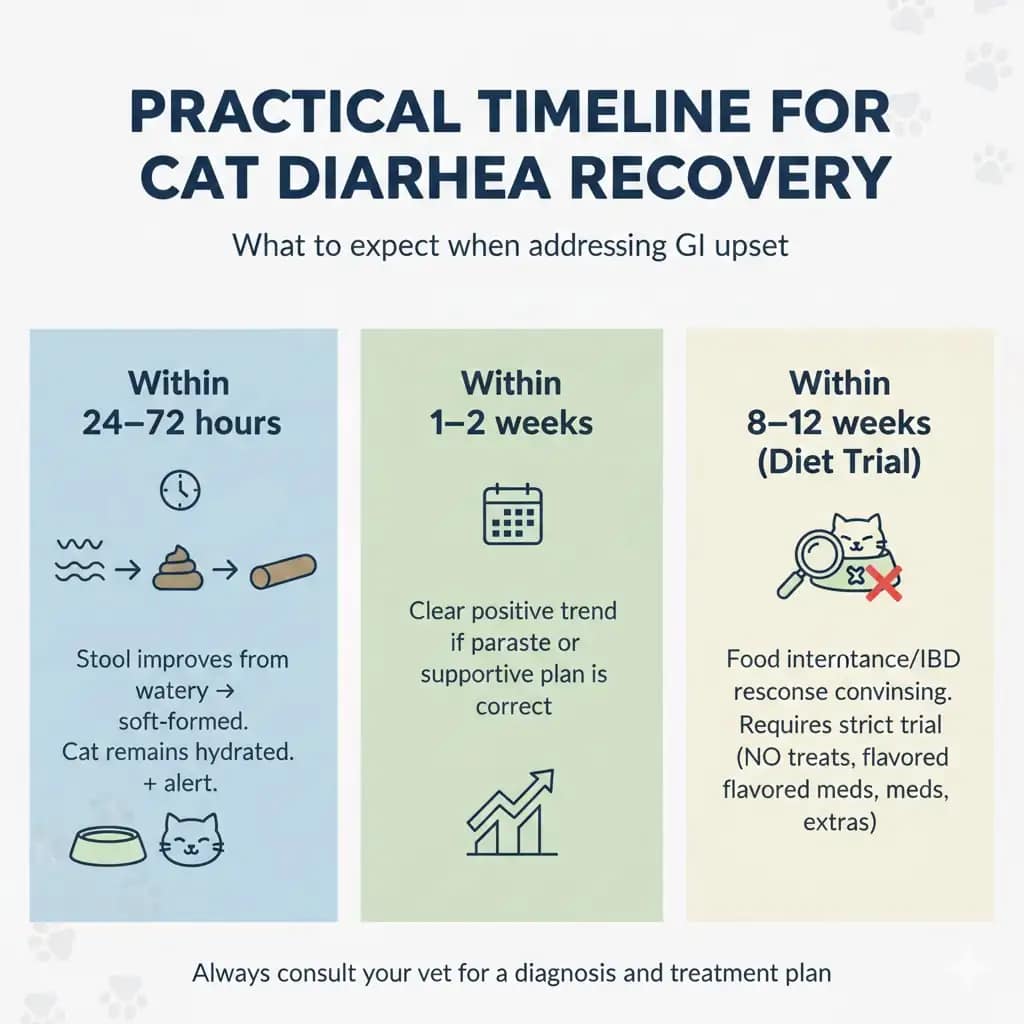
A practical timeline (so you know what “working” looks like)
- Within 24–72 hours: you’re looking for stool to move from watery → pudding-like → soft-formed, and for your cat to stay hydrated and bright.
- Within 1–2 weeks: you should see a clear trend if a parasite plan or supportive plan is correct.
- Within 8–12 weeks (diet trial): this is when food intolerance/IBD diet response becomes convincing—only if the trial is strict (no treats, flavored meds, or food extras).
Wenn Ihre Katze blood, dehydration, repeated vomiting, lethargy, or rapid weight loss, skip the “wait and see” window and contact a vet urgently.
Wenn Sie sich überfordert fühlen oder eine Schritt-für-Schritt-Anleitung speziell für Katzeneltern suchen, sind Sie bei uns genau richtig. Schauen Sie sich unseren ausführlichen, praktischen Leitfaden an, der speziell für Katzenhalter entwickelt wurde: Behandlung von Katzendurchfall: Leitfaden für Katzeneltern
The main treatment strategies by category
Entwurmung und Antiparasitika
If tests show (or strongly suspect) parasites, your veterinarian will prescribe medication to eliminate them. Common options may include Fenbendazol (used for Giardia and some worms) and Praziquantel (tapeworms). For Tritrichomonas foetus, veterinarians may use a specific prescription medication such as ronidazol.
Because parasites can be hard to fully rule out (shedding can be intermittent), vets sometimes recommend empirical deworming even if an initial fecal test is negative—especially in kittens, shelter cats, or multi-cat homes.
- When it’s used: parasite risk is high, stool tests suggest parasites, or the diarrhea pattern fits common parasite causes.
- What improvement looks like + timing: if parasites are the main driver, stool often improves within 3–7 days, sometimes up to 1–2 weeks depending on the organism and treatment plan.
- If there’s no improvement: ask your vet about repeat stool testing / PCR (including Giardia/Tritrichomonas where relevant) and whether the next step should be a Diätversuch or broader workup.
Diätetische Therapie
Diet changes are a cornerstone of chronic diarrhea care—but they’re used in two different ways:
- Diet for faster stool support: gentle digestion and more consistent stool (often days to 1–2 weeks)
- Diet as a root-cause test/treatment: proving and managing food intolerance or IBD (often weeks; a convincing trial is usually 8-12 Wochen)
Highly Digestible, Low-Fat/High-Fiber Diet (support-focused)
This approach (often a veterinary GI diet) is designed to be gentle and easy to absorb. Fiber can help regulate stool consistency and can support beneficial gut bacteria.
This may be used for cats with “sensitive stomach,” mild pancreatitis concerns, some infections/imbalances, or chronic diarrhea where a gentle baseline diet is needed while diagnostics are underway.
Unlike dogs, many cats don’t require aggressively low-fat diets unless pancreatitis is a factor—but a highly digestible formula is commonly tried early because it’s easy on the gut.
Novel Protein or Hydrolyzed Protein Diet (cause-focused)
This is often recommended for suspected food intolerance/allergy oder IBD.
A novel protein diet uses a protein your cat hasn’t eaten before (e.g., rabbit, duck, venison—availability varies). A hydrolyzed diet uses proteins broken into smaller fragments to reduce immune triggering.
For many cats, a strict trial (no treats, no flavored toppers, no “just a bite” of other foods) for 8-12 Wochen can lead to major improvement if food intolerance is the cause. Blood tests for food allergies in cats are not very reliable, so the diet trial is often the most meaningful proof.
If a cat has large-bowel signs (mucus/urgency/straining), your vet may recommend adding a small amount of soluble fiber (like canned pumpkin or psyllium) to an appropriate complete diet—but do this only with guidance so the diet stays balanced.
Any diet change should usually be introduced gradually over 7–10 days unless your veterinarian instructs otherwise.
- When it’s used: as early supportive care, and/or as a diagnostic tool for food intolerance/IBD.
- What improvement looks like + timing: consistency alone may improve stool within 3–7 days, but a true food-response usually becomes clear over weeks—and a valid trial is typically 8-12 Wochen.
- If there’s no improvement: avoid switching foods repeatedly. Confirm the trial was truly strict, then ask your vet whether to change diet type (novel vs hydrolyzed) or escalate testing (bloodwork/imaging/IBD evaluation).
Probiotika und Darmzusätze
Probiotics may help some cats with chronic diarrhea by supporting a healthier gut microbiome. Vets often recommend feline-specific probiotic powders or pastes that can be mixed into food.
Think of probiotics as stool-support helpers, not a standalone cure—especially if the underlying cause is parasites, endocrine disease, or chronic inflammation.
Another supplement that may be needed is Vitamin B₁₂ (Cobalamin). Cats with chronic enteropathy can have low B₁₂, which may worsen appetite and GI function. Veterinarians may recommend injections or high-dose oral B₁₂ depending on the case.
- When it’s used: alongside diagnostics, during diet trials, after antibiotics, or with chronic enteropathy/IBD plans.
- What improvement looks like + timing: some cats show stool improvement in 3–7 days, others take 2-4 Wochen. B₁₂ support often helps energy/appetite over weeks.
- If there’s no improvement: review whether the root cause is being treated (parasites/diet/IBD/systemic disease) and ask your vet if further testing is needed.
Unterstützende Pflege
Never give human anti-diarrheal medications to cats unless your veterinarian explicitly instructs you. Products like Imodium (loperamide) oder Pepto-Bismol can be dangerous for cats, and slowing the gut can be risky if an underlying condition needs urgent care.
With chronic diarrhea—especially if severe—supportive care may be needed to prevent dehydration and keep your cat comfortable. Flüssigkeitstherapie may be recommended if your cat is dehydrated (sometimes subcutaneous fluids are used under veterinary direction).
Vets may occasionally prescribe medications to support the gut (for example, protectants or targeted therapies), but these are usually adjuncts. The long-term solution is still diet strategy, parasite control, and inflammation/systemic disease management when indicated.
- When it’s used: when dehydration risk is present, stool is very watery/frequent, or comfort support is needed while diagnostics are underway.
- What improvement looks like + timing: hydration support can improve energy quickly; stool typically improves as the trigger is controlled (often days, sometimes longer).
- If there’s no improvement: persistent severe diarrhea despite supportive care is a reason to escalate diagnostics (repeat stool tests, bloodwork, imaging, and possibly specialist evaluation).
Tipps für die häusliche Pflege von Katzen mit chronischer Diarrhöe
Dealing with chronic diarrhea isn’t just a veterinary journey—it’s also about daily home management. There’s a lot you can do to keep your cat comfortable and support recovery.
Think of yourself and your vet as a team: your vet provides the medical plan, and you provide consistent support at home to maximize success.
Home care goals (what you’re trying to accomplish)
- Prevent dehydration and keep your cat eating
- Reduce gut irritation by avoiding sudden changes
- Support stool formation with vet-approved diet/probiotics/fiber
- Track symptoms clearly so your vet can diagnose faster
What to do today (quick checklist)
- Keep food consistent (unless your vet has started a diet trial).
- Encourage hydration (fresh water + wet food if appropriate).
- Scoop the litter box more often and consider an extra box nearby.
- Start a simple daily log (template below).
- If your cat seems worse, call your vet—don’t wait it out.
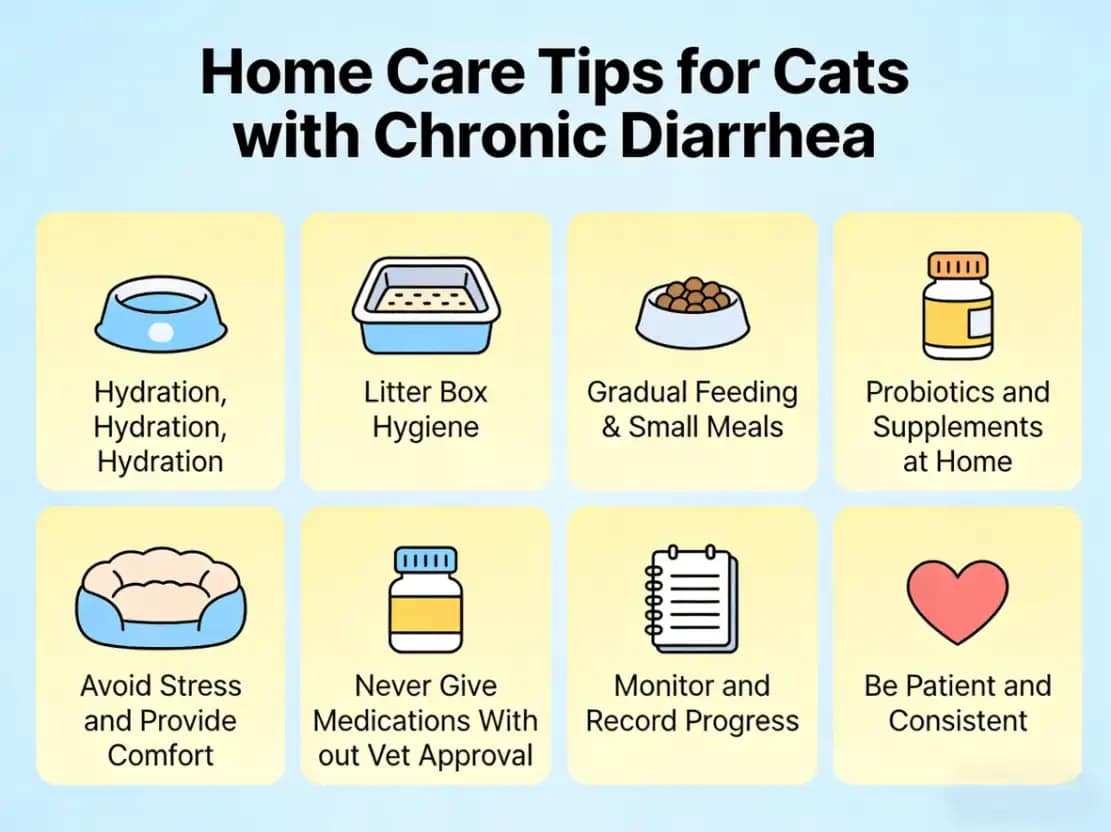
Hydratation, Hydratation, Hydratation
Was ist zu tun?
- Behalten Süßwasser available in multiple places.
- Try a cat fountain (many cats drink more from moving water).
- If your vet agrees, offer more moisture-rich meals (wet food or adding a little water to food).
Why it helps
Diarrhea causes fluid and electrolyte loss. Even mild dehydration can worsen appetite, energy, and recovery.
Watch for (call your vet)
Sticky or dry gums, weakness, sunken eyes, or your cat refusing to drink.
Hygiene in der Katzentoilette
Was ist zu tun?
- Scoop frequently and keep the box besonders sauber (diarrhea can cause urgency).
- Add an extra litter box closer to where your cat spends time to prevent accidents.
- Verwenden Sie unscented, soft litter to reduce irritation.
- If your cat has long hair, consider a sanitary trim to prevent stool sticking.
Why it helps
A clean, easy-to-reach box reduces stress and helps your cat maintain good litter habits—even when they feel urgent.
Watch for
Straining, frequent tiny stools, or accidents outside the box that suddenly worsen (these can signal large-bowel irritation or worsening discomfort).
Schrittweise Fütterung und kleine Mahlzeiten
Was ist zu tun?
- Angebot kleine, häufige Mahlzeiten instead of one or two large meals.
- Serve food at Raumtemperatur (some cats do better than with cold food).
- Keep the diet steady day-to-day unless your vet has instructed a specific diet trial.
Why it helps
Smaller meals are easier to digest and may reduce intestinal overload.
Avoid
- Sudden food changes
- Too many treats “to tempt appetite” (often makes diarrhea worse)
Probiotika und Nahrungsergänzungsmittel zu Hause
What to do (vet-guided)
- If your vet recommends it, use a katzenspezifisches Probiotikum daily.
- If prescribed, give Vitamin B₁₂ (Cobalamin) as directed (low B₁₂ can worsen gut healing).
- If your vet approves fiber: start very small and increase slowly.
Common vet-approved fiber options
- Plain canned pumpkin (not pie filling)
- Psyllium husk (often used for large-bowel diarrhea)
Why it helps
Probiotics can support healthier gut bacteria, and fiber can help normalize stool consistency in some cats—especially with large-bowel patterns.
Watch for
Gas, worsening stool, or reduced appetite after adding fiber (pause and ask your vet).
Stress vermeiden und Trost spenden
Was ist zu tun?
- Keep routines stable: same feeding time, same litter box location, same sleeping area.
- Provide a quiet resting spot and minimize big environmental changes if possible.
- Offer gentle comfort—snuggles, brushing, calm play—based on what your cat enjoys.
Why it helps
Stress can trigger or worsen diarrhea in sensitive cats, so a calm environment supports gut recovery.
Niemals Medikamente ohne Genehmigung des Tierarztes verabreichen
Das ist wichtig: Do nicht give human anti-diarrheal medications unless your vet explicitly instructs you.
That includes Imodium (loperamide), Pepto-Bismol (bismuth subsalicylate), Kaopectate, and similar products.
Cats process drugs differently than humans (and even dogs), and some medications can be unsafe or toxic. If you want to do more than diet + probiotics + hydration, ask your vet about feline-safe options.
Fortschritte überwachen und aufzeichnen
Tracking symptoms helps you see what’s improving—and gives your vet the exact information needed to adjust the plan.
What to track daily (60 seconds)
- Stool: formed / soft / watery
- Frequency: how many bowel movements
- Add-ons: blood, mucus, straining
- Appetite + energy
- Any vomiting
Template 1: 7-Day Stool & Symptom Log (copy/paste)
| Datum | Stool (formed/soft/watery) | # BMs | Blood/mucus? | Straining? | Vomiting? | Appetite | Energie | Food/treats | Anmerkungen |
|---|
Template 2: Bring-to-the-Vet Checklist (copy/paste)
Bring these to help your vet diagnose chronic diarrhea faster:
- A fresh stool sample (small amount is enough)
- Food label/photo: exact brand + flavor, treats, toppers
- List of medications, supplements, flea/tick products
- Die 7-day log (above)
- Any recent changes: new pet, boarding, moving, stress events
- Photos of stool (gross, but genuinely helpful)
- Weight changes you’ve noticed
Be Patient and Consistent
Chronic conditions improve gradually—overnight fixes are uncommon. Follow your vet’s plan closely:
- Finish prescribed medications even if stool improves early.
- Keep the diet strict during trials (no treats unless approved).
- Give changes time to work—diet trials often take weeks, not days.
When home care isn’t enough (call your vet promptly)
Contact your vet if:
- Diarrhea persists despite steady home care for 3–5 days
- Your cat is losing weight
- You see Blut, black/tarry stool, or significant mucus
- There’s Erbrechen, refusal to eat, or obvious abdominal pain
- Your cat is a kitten, senior, or has chronic illness (kidney disease, diabetes, etc.)
Schlussfolgerung
Chronic diarrhea in cats—loose or watery stools that last 3+ weeks or keep coming back—is a Symptom, not a diagnosis. The most common underlying causes include Parasiten, diet intolerance/food allergyund chronic intestinal inflammation (IBD/chronic enteropathy), though older cats may also need screening for thyroid, kidney, or intestinal disease.
The fastest way to get answers is a step-by-step plan with your veterinarian: track stool changes, bring a fresh stool sample, and follow the recommended workup (often stool testing, basic bloodwork, and sometimes a structured diet trial). While you’re sorting out the cause, focus on hydration, diet consistencyund vet-approved supportive options like probiotics or fiber—never human anti-diarrheal medications unless your vet specifically directs it.
Most importantly, don’t wait if you notice blood in the stool, repeated vomiting, dehydration, severe lethargy, rapid weight loss, or if your cat is a kitten or senior. With timely veterinary care and consistent home support, many cats can return to comfortable, healthy bathroom habits.
If you’re feeling overwhelmed, you’re not alone. Your veterinarian is your best partner—and many cat parent communities can help you feel supported while you work through the process.
Brauchen Sie mehr Hilfe?
Want a complete, practical hub on feline diarrhea—symptoms, urgent warning signs, vet testing, safe home care, and prevention?
Read next: Katzendurchfall: Alles, was Sie wissen müssen
Unter SnuggleSoulsUnser Team hat es sich zur Aufgabe gemacht, Ihnen bei der Lösung dieser realen Probleme zu helfen, anstatt Ihnen nur Informationen aus dem Lehrbuch zu geben. Wir sind bei jedem Schritt für Sie und Ihre katzenartigen Familienmitglieder da.
FAQ
Woher weiß ich, ob der Durchfall meiner Katze chronisch ist?
Diarrhea is usually considered chronic when loose or watery stools last 3 weeks or longer, or keep returning in repeated episodes. Chronic diarrhea suggests an underlying issue (like parasites, diet intolerance, or intestinal inflammation) rather than a one-time upset stomach. If it has lasted more than a few days—or your cat is a kitten, senior, or losing weight—schedule a vet visit.
Was sind die häufigsten Ursachen für chronische Diarrhöe bei Katzen?
Zu den häufigsten Ursachen gehören Parasiten (especially in young cats), diet intolerance/food allergy, chronic intestinal inflammation (IBD/chronic enteropathy)und infection or gut microbiome imbalance. In older cats, vets also commonly check for Hyperthyreose, Nierenerkrankungund manchmal intestinal cancer. Stool pattern (small-bowel vs large-bowel) plus basic tests usually narrows this quickly.
Wann sollte ich mit meiner Katze zum Tierarzt gehen, wenn sie Durchfall hat?
Go to the vet am gleichen Tag if there’s Blut, repeated vomiting, marked lethargy, dehydration, belly pain, or your cat can’t keep water down. If your cat otherwise seems okay but diarrhea lasts more than 48–72 hours, or keeps recurring, book an appointment. If diarrhea reaches the 3-week mark, it’s chronic and should be evaluated.
Kann ich meiner Katze Medikamente für Menschen gegen Durchfall geben?
No—don’t give human anti-diarrheal medicines unless your veterinarian specifically tells you to. Some products (including common options like loperamide/Imodium or bismuth/Pepto-Bismol) can be unsafe for cats or can mask symptoms while the real cause worsens. Ask your vet for cat-safe options instead.
Welche Futtermittel helfen gegen chronischen Durchfall bei Katzen?
There isn’t one “best food” for every cat—diet choice depends on the cause. Vets commonly use a strict diet trial mit einer hydrolyzed oder novel-protein diet for 8-12 Wochen when food intolerance/IBD is suspected, or a highly digestible GI diet when the gut needs rest. Avoid frequent food switching; change diets only with a plan, and keep treats/flavored add-ons out during a trial.
Helfen Probiotika Katzen mit chronischem Durchfall wirklich?
Probiotika kann helfen some cats by supporting a healthier gut bacterial balance, especially alongside diet management. Choose a cat-specific product and give it consistently for 1–2 weeks to judge response. If diarrhea worsens, your cat refuses food, or there are red flags (blood, vomiting, lethargy), stop and contact your veterinarian—probiotics don’t replace diagnosis.
Ist chronischer Durchfall bei Katzen ernst zu nehmen?
Yes—ongoing diarrhea can cause dehydration, weight loss, and nutrient deficiencies, and it can signal problems like parasites, chronic inflammation, endocrine disease, or more serious illness in older cats. If diarrhea is persistent or recurring, the safest approach is a vet workup (often starting with stool testing and basic bloodwork) so the underlying cause can be treated.
Wie lange dauert es, bis chronische Diarrhöe bei Katzen geheilt ist?
The timeline depends on the cause. Parasite-related diarrhea may improve within days to 1–2 weeks after correct treatment, while diet-related cases often require several weeks (and a full 8–12 week diet trial) to confirm improvement. Conditions like IBD may need long-term management. If there’s no improvement within 1–2 weeks of a vet-guided plan, follow up.
Kann Stress chronischen Durchfall bei Katzen verursachen?
Stress can trigger or worsen diarrhea in sensitive cats, especially large-bowel/colitis-type symptoms. However, diarrhea that persists beyond a few days—or keeps returning—shouldn’t be assumed to be “just stress,” because parasites, diet intolerance, and inflammation are also common. Reduce stressors, keep diet consistent, and involve your vet if symptoms continue.
Referenzen
Tricounty Tierklinik. (n.d.). Chronische Diarrhöe bei Katzen - Überblick. Abgerufen von https://tricountyah.com/pet-health/chronic-diarrhea-cats/
Small Door Veterinary. (n.d.). Diarrhöe bei Katzen. Abgerufen von https://www.smalldoorvet.com/learning-center/medical/diarrhea-in-cats/
VCA-Krankenhäuser. (n.d.). Tests für Durchfall. Abgerufen von https://vcahospitals.com/know-your-pet/testing-for-diarrhea
Marks, S. L. (2020). Erbrechen. In . Innere Medizin für Kleintiere (6. Aufl.). Elsevier. Abgerufen von https://pmc.ncbi.nlm.nih.gov/articles/PMC7161394/
Laflamme, D. P., & Xu, H. (2024). Diätetische Behandlung von Katzendiarrhöe: A review of the evidence. Zeitschrift für Katzenmedizin und -chirurgie, 12(1), 44. Abgerufen von https://pmc.ncbi.nlm.nih.gov/articles/PMC11104099/
PetMD. (2024, April 9). Katze Diarrhea Treatment. Abgerufen von https://www.petmd.com/cat/general-health/cat-diarrhea-treatment
LolaHanf. (2025, 5. März). Cat Diarrhea Home Remedy. Abgerufen von https://lolahemp.com/blogs/cat-health/cat-diarrhea-home-remedy
VCA-Krankenhäuser. (n.d.). 8 Hausmittel gegen Durchfall und 2, die für Ihr Haustier gefährlich sind. Abgerufen von https://vcahospitals.com/shop/articles/8-home-remedies-for-diarrhea-and-2-that-are-dangerous-for-your-pet
Tams, T. R. (2011, Oktober 1). Umgang mit IBD und Durchfall bei erwachsenen Katzen. DVM360. Abgerufen von https://www.dvm360.com/view/managing-ibd-and-diarrhea-adult-cats-proceedings
BluePearl Veterinary Partners. (2020, 21. September). Darm-Check: Praktische Behandlung von entzündlichen Darmerkrankungen. Abgerufen von https://bluepearlvet.com/medical-library-for-dvms/gut-check-practical-treatment-of-inflammatory-bowel-disease/
Companion Animal Parasite Council (CAPC). (2025, 7. Februar). Trichomoniasis. Abgerufen von https://capcvet.org/guidelines/trichomoniasis/
PetMD. (n.d.). Beste Katzen-Probiotika. Abgerufen von https://www.petmd.com/cat/vet-verified/best-cat-probiotics
IBDKitties.net. (n.d.). Probiotika. Abgerufen von https://www.ibdkitties.net/supplements/probiotics/
Merck Veterinary Manual. (n.d.). Unterscheidung von Dünndarm- und Dickdarmdurchfall. Abgerufen von https://www.merckvetmanual.com/multimedia/table/differentiation-of-small-intestinal-from-large-intestinal-diarrhea
Capital Home Veterinary Care. (n.d.). 6 Anzeichen dafür, dass Ihre Katze sofort einen Tierarzt aufsuchen muss. Abgerufen von https://www.capitalhomevetcare.com/blog/6-signs-your-cat-needs-to-see-a-vet-immediately/
Tierärztliches Zentrum Autumn Trails. (2023, 4. Dezember). 5 wirksame Behandlungsansätze zur Behandlung von Katzendurchfall. Abgerufen von https://autumntrailsvet.com/5-effective-treatment-approaches-for-managing-cat-diarrhea/
VCA-Krankenhäuser. (n.d.). Bauchspeicheldrüsenentzündung bei Katzen. Abgerufen von https://vcahospitals.com/know-your-pet/pancreatitis-in-cats
Der Katzendoktor. (n.d.). Bauchspeicheldrüsenentzündung. Abgerufen von https://thecatdoctor.co.uk/cat-health/pancreatitis/
Total.vet. (n.d.). Was sind die besten Probiotika für Katzen mit Durchfall?. Abgerufen von https://total.vet/probiotics-for-cats-with-diarrhea/
Maddie's Fund. (n.d.). Auswirkungen einer probiotischen Behandlung auf Katzen, die in ein Tierheim kommen. Abgerufen von https://www.maddiesfund.org/probiotic-treatment-on-cats-entering-a-shelter.htm
MDPI. (n.d.). Auswirkungen von Saccharomyces cerevisiae DSM 34246 (Canobios). Abgerufen von https://www.mdpi.com/2306-7381/12/1/44#:~:text=boulardii%20plays%20a%20significant%20role,microbiota%20%5B1%2C5%5D.
Scribd. (n.d.). Purina Kot-Scoring-Tabelle. Abgerufen von https://www.scribd.com/document/768462369/fecal-chart
VivaPets. (n.d.). Stress bei Katzen: Symptome, Ursachen und vom Tierarzt empfohlene Behandlungen. Abgerufen von https://vivapets.com/article/2428/stress-in-cats-symptoms-causes-and-vet-recommended-treatments
ExpertCatCare. (n.d.). Warum hat meine Katze Durchfall? Ursachen, Diagnostik, Behandlung. Abgerufen von https://www.expertcatcare.com/article/why-does-my-cat-have-diarrhea-causes-diagnostics-treatment





 EN
EN DE
DE ES
ES PT
PT