

Wiederkehrender oder anhaltender Durchfall bei einer Katze muss tierärztlich abgeklärt werden, auch wenn die Katze zwischen den Schüben relativ wohl zu sein scheint. Mögliche Ursachen reichen von Parasiten und ernährungsbedingten Problemen bis hin zu Darmentzündungen und anderen Erkrankungen. Wenden Sie sich bitte umgehend an einen Tierarzt, wenn die Katze geschwächt ist, wiederholt erbricht oder das Fressen verweigert. essen, Gewicht Verlust, Verdacht auf Dehydrierung, Blut oder schwarzer Stuhl. Probieren Sie nicht immer wieder neue Hausmittel aus.
Dieser Leitfaden dient lediglich zu Informationszwecken und kann keine Diagnose für Ihre Katze stellen. Ein Tierarzt benötigt die Krankengeschichte der Katze, die Untersuchungsergebnisse und manchmal auch mehrere Tests, um die Ursache zu ermitteln und eine Behandlung festzulegen.
Inhaltsübersicht
- Wann gilt Durchfall bei Katzen als chronisch oder wiederkehrend?
- Wann erfordert chronischer Durchfall eine sofortige tierärztliche Behandlung?
- Was kann bei Katzen zu chronischem Durchfall führen?
- Was sollte ich vor dem Tierarzttermin beobachten?
- Welche Untersuchungen könnte ein Tierarzt ansprechen?
- Was sollte ich zu Hause vermeiden?
- Wie kann ich meine Katze unterstützen, während ich den tierärztlichen Behandlungsplan befolge?
- Schlussfolgerung
- Häufig gestellte Fragen
- Referenzen
Wann gilt Durchfall bei Katzen als chronisch oder wiederkehrend?
Durchfall sollte abgeklärt werden, wenn er anhält, immer wieder auftritt oder mit Veränderungen des Gewichts, des Appetits oder des Verhaltens einhergeht. Warten Sie nicht eine bestimmte Anzahl von Tagen ab, bevor Sie anrufen, wenn die Katze unwohl wirkt.
| Muster | Wie das aussehen könnte | Nächster Schritt |
|---|---|---|
| Beharrlich | Der weiche oder wässrige Stuhlgang hält an, ohne dass sich die Situation wieder normalisiert | Einen Termin beim Tierarzt vereinbaren |
| Wiederkehrend | Der Stuhlgang normalisiert sich, doch dann tritt der Durchfall immer wieder auf | Führen Sie einen Zeitplan und vereinbaren Sie einen Untersuchungstermin |
| Progressiv | Die Anfälle treten häufiger auf, sind wässriger oder gehen mit anderen Symptomen einher | Rufen Sie umgehend den Tierarzt an |
| In zeitlichen Abständen mit Gewichtsverlust | Die Katze wirkt zeitweise ganz normal, verliert aber nach und nach an Gewicht oder Kondition | Lassen Sie lieber eine tierärztliche Untersuchung durchführen, anstatt immer wieder neue Fütterungsversuche durchzuführen. |
| Plötzlicher schwerer Anfall im Rahmen eines chronischen Krankheitsverlaufs | Neue Schwäche, Erbrechen, Blut, schwarzer Stuhl oder Nahrungsverweigerung | Suchen Sie dringend tierärztlichen Rat |
Cornell erklärt, dass Durchfall viele mögliche Ursachen haben kann, und rät zu einer umgehenden tierärztlichen Behandlung, wenn er anhält oder mit Appetitlosigkeit, Lethargie oder Erbrechen einhergeht.1 Eine Katze kann ein langwieriges Problem haben, auch wenn manche Stuhlgänge normal aussehen.
Was eine einzelne aktuelle Folge betrifft, so ist die allgemeine Ratgeber zu Durchfall bei Katzen kann nützliche Hintergrundinformationen liefern. Auf dieser Seite geht es um Durchfall, der anhält oder immer wieder auftritt.
Wann erfordert chronischer Durchfall eine sofortige tierärztliche Behandlung?
Auch chronischer Durchfall kann zu einem Notfall werden. Die Dauer mindert nicht die Bedeutung neuer schwerwiegender Symptome.
| Was dir auffällt | Empfohlene Antwort |
|---|---|
| Zusammenbruch, starke Schwäche, Atembeschwerden oder Unfähigkeit, zu stehen | Suchen Sie einen tierärztlichen Notdienst auf |
| Wiederholtes Erbrechen, Unfähigkeit, Wasser bei sich zu behalten, oder ausgeprägte Dehydrierung geben Anlass zur Sorge | Dringende tierärztliche Versorgung aufsuchen |
| Blut im Stuhl oder schwarzer, teerartiger Stuhl | Rufen Sie dringend einen Tierarzt an |
| Fressverweigerung, rascher Gewichtsverlust, starke Lethargie oder schmerzhafter/geschwollener Bauch | Wenden Sie sich umgehend an einen Tierarzt |
| Sehr junge, ältere, untergewichtige oder gesundheitlich geschwächte Katzen mit Durchfall | Verwenden Sie einen niedrigeren Schwellenwert für den Aufruf |
| Anhaltender weicher Stuhlgang bei ansonsten stabilem Zustand | Einen Untersuchungstermin vereinbaren und Änderungen nachverfolgen |
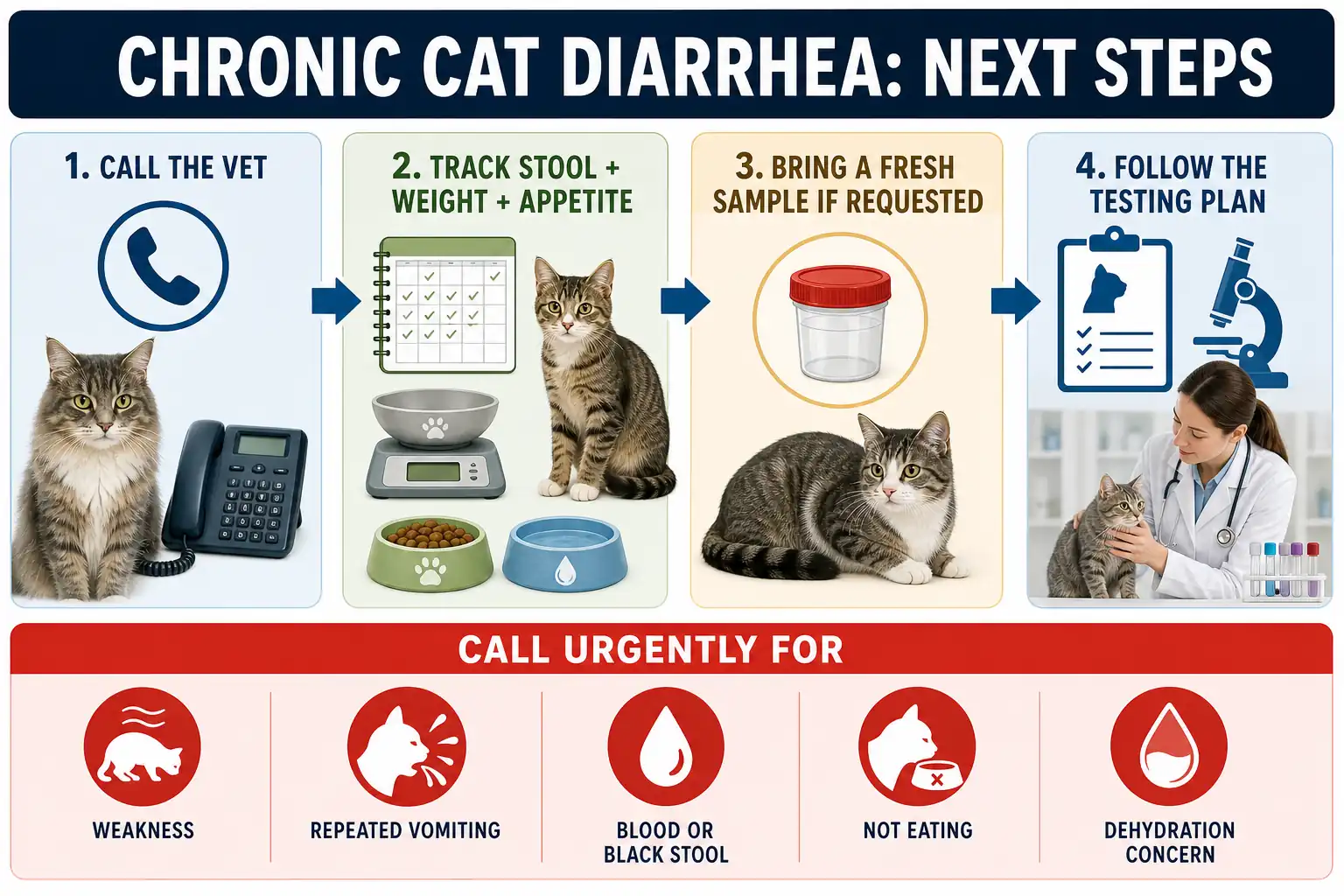
Gehen Sie nicht davon aus, dass Blut harmlos ist, nur weil es schon einmal aufgetreten ist. Das Farbkarte für Katzenkot kann Ihnen zwar dabei helfen, zu beschreiben, was Sie sehen, doch das Aussehen des Stuhls allein reicht nicht aus, um die Ursache oder die Dringlichkeit zu bestimmen.
Was kann bei Katzen zu chronischem Durchfall führen?
Chronischer oder wiederkehrender Durchfall ist ein Symptom, keine Diagnose. Verschiedene Erkrankungen können zu Hause ähnliche Symptome zeigen, weshalb eine Beurteilung allein anhand des Stuhls oft zu einer wirkungslosen oder unsicheren Behandlung führt.
| Ursachenkategorie | Beispiele oder hilfreicher Kontext |
|---|---|
| Parasiten | Spulwürmer, Hakenwürmer, Giardia, Kokzidien und andere Magen-Darm-Parasiten |
| Ernährungsbedingte Probleme | Plötzliche Umstellungen, Nahrungsmittelunverträglichkeiten, ungeeignetes Futter, Überfütterung oder unausgewogene Ernährung |
| Infektion | Bestimmte bakterielle, virale oder sonstige Infektionserkrankungen |
| Darmentzündung | Chronische entzündliche Erkrankungen des Magen-Darm-Trakts |
| Erkrankung außerhalb des Darms | Erkrankungen der Bauchspeicheldrüse, der Leber, der Schilddrüse oder anderer Organsysteme |
| Wirkungen von Medikamenten oder Nahrungsergänzungsmitteln | Verschreibungspflichtige Medikamente, nicht zugelassene Nahrungsergänzungsmittel oder immer wieder angewendete Hausmittel |
| Organische oder schwerwiegende Erkrankung | Fremdkörper, Veränderungen im Darm oder Krebs, je nach Katze |
Cornell weist darauf hin, dass Magen-Darm-Parasiten Symptome wie Durchfall verursachen können und dass eine genaue Identifizierung wichtig ist, da sich die Parasiten hinsichtlich Diagnose, Behandlung und Vorbeugung unterscheiden.2 In der Übersicht von Merck werden außerdem ernährungsbedingte, infektiöse, entzündliche, obstruktive, toxische und sonstige Ursachen für Magen-Darm-Erkrankungen beschrieben.3
Aufgrund dieser Vielzahl an Möglichkeiten sind übrig gebliebene Antibiotika, willkürlich verabreichte Entwurmungsmittel oder wiederholte Futterumstellungen kein adäquater Ersatz für eine gründliche Abklärung. Eine Behandlung, die bei einer bestimmten Ursache wirkt, kann bei einer anderen Ursache wirkungslos oder ungeeignet sein.
Was sollte ich vor dem Tierarzttermin beobachten?
Ein klarer zeitlicher Ablauf hilft dem Tierarzt, den Verlauf nachzuvollziehen und die ersten Untersuchungen auszuwählen. Halten Sie die Fakten fest, anstatt selbst zu versuchen, die Ursache zu diagnostizieren.
Behalten Sie folgende Details im Blick:
- wann der Durchfall begann und ob er jemals vollständig abgeklungen ist
- Anzahl der Stuhlgänge und ob Stuhldrang oder Pressen auftritt
- Konsistenz, Farbe, Schleim, Blut oder schwarzes Aussehen des Stuhls
- Erbrechen, Appetit, Flüssigkeitsaufnahme, Harndrang, Energie und Verstecken
- Körpergewicht und etwaige Veränderungen des Körperzustands
- derzeitige Ernährung, Leckerlis, kürzlich vorgenommene Ernährungsumstellungen und mögliches Futtersuchen
- Medikamente, Nahrungsergänzungsmittel und bisherige Behandlungen
- Parasitenprophylaxe, Entwurmung, Reisen, Aufenthalt im Freien und Kontakt mit anderen Tieren
- ob andere Haustiere oder Personen im Haushalt Magen-Darm-Beschwerden haben
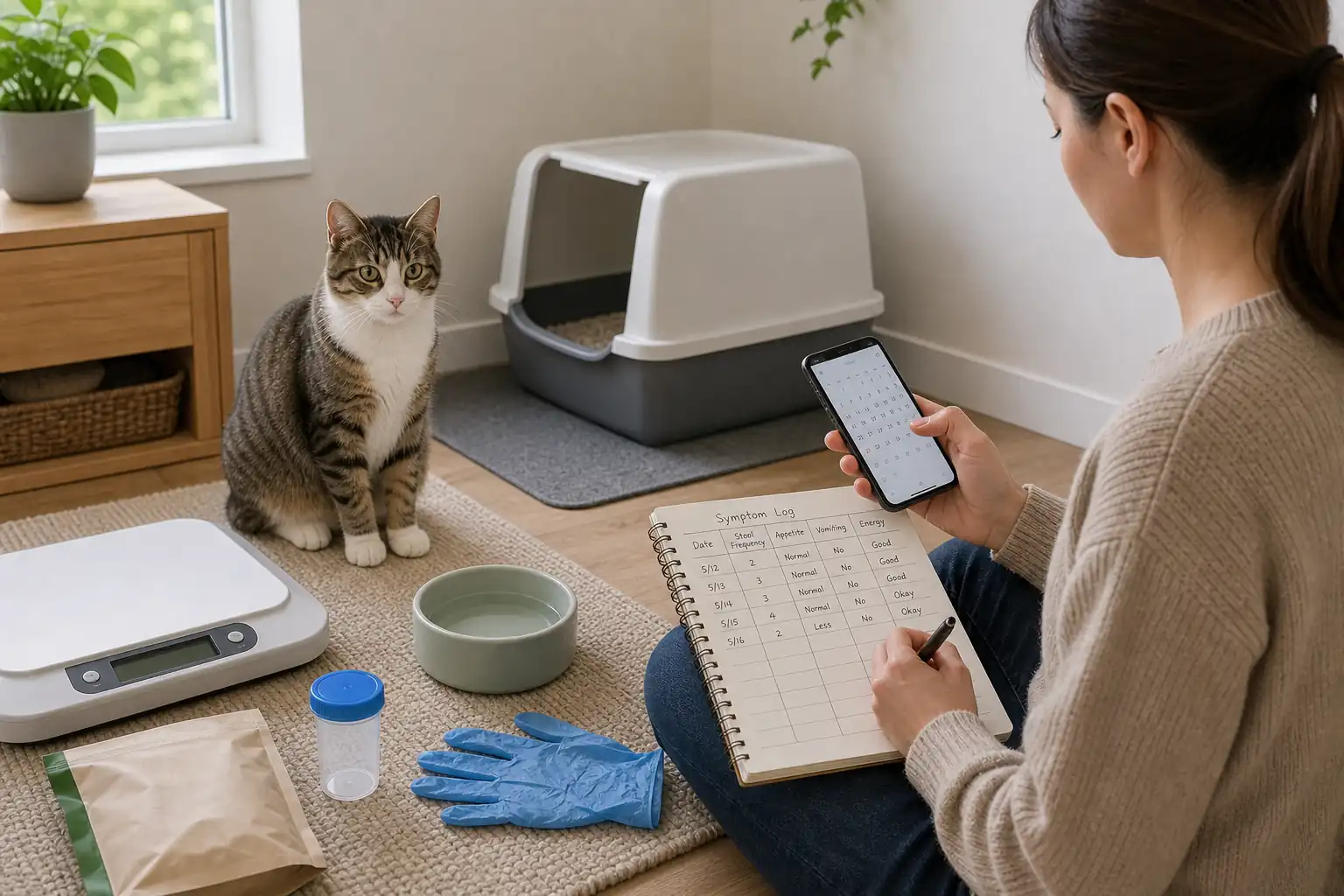
Fragen Sie in der Klinik nach, ob eine frische Stuhlprobe benötigt wird und wie diese entnommen, aufbewahrt und transportiert werden soll. Zögern Sie die dringende Behandlung nicht hinaus, während Sie versuchen, eine solche Probe zu beschaffen. Bringen Sie gegebenenfalls Verpackungen oder Fotos von Lebensmitteln, Nahrungsergänzungsmitteln und Medikamenten mit.
Nutze die SnuggleSouls Rechner für Körperzustand und Gewicht Um Beobachtungen zu organisieren, wenden Sie sich jedoch bei unerwartetem Gewichtsverlust an einen Tierarzt. Auch plötzliches Verstecken oder Zurückziehen kann von Bedeutung sein; der Leitfaden zu warum Katzen sich verstecken kann Ihnen helfen, die Veränderung zu beschreiben, ohne sie zu diagnostizieren.
Welche Untersuchungen könnte ein Tierarzt ansprechen?
Der Untersuchungsplan hängt vom Zustand der Katze ab Alter, Anamnese, Untersuchung, Schweregrad und bisherige Befunde. Chronische Magen-Darm-Beschwerden erfordern manchmal eher eine schrittweise Abklärung als einen einzigen, endgültigen Test.
Mögliche Schritte sind unter anderem:
- körperliche Untersuchung, Beurteilung des Flüssigkeitshaushalts und Überprüfung des Körpergewichts
- Stuhluntersuchung auf Parasiten oder andere Auffälligkeiten
- Blut- und Urinuntersuchungen
- Tests unter Berücksichtigung von Alter, Reisegeschichte, Exposition oder regionalen Risiken
- Auswertung der Fütterungsanamnese oder eine vom Tierarzt angeleitete Diätstudie
- bildgebende Verfahren wie Röntgenaufnahmen oder Ultraschall
- weitere Untersuchungen des Magen-Darm-Trakts
- Überweisung, Endoskopie oder Biopsie, sofern erforderlich
Der Tierarzt beginnt möglicherweise mit den gängigen oder dringenden Diagnosemöglichkeiten und passt den Behandlungsplan je nach Ergebnissen und Ansprechen an. Ein negativer Test bedeutet nicht immer das Ende der Abklärung, und eine vorübergehende Besserung bestätigt nicht zwangsläufig die Ursache.
Halten Sie die Nachsorgetermine ein und teilen Sie mit, ob sich Stuhlgang, Appetit, Erbrechen, Gewicht und Energieverbrauch verändert haben. Wenn der Tierarzt eine Diätprobe empfiehlt, befolgen Sie die Anweisungen genau; ungeplante Leckerlis oder zusätzliche Futtergaben können die Auswertung der Ergebnisse erschweren.
Was sollte ich zu Hause vermeiden?
Vermeiden Sie wiederholte Behandlungsexperimente, die Veränderungen verschleiern, Schaden anrichten oder die Auswertung der Anamnese erschweren können. Wenden Sie sich an den Tierarzt, bevor Sie Ihrem Tier etwas verabreichen, das Durchfall stoppen soll.
Nicht tun:
- ein Medikament gegen Durchfall für Menschen verabreichen
- Antibiotika-Reste oder Medikamente eines anderen Haustiers verwenden
- Entwurmungsmittel ohne tierärztliche Anleitung wiederholt verabreichen
- Fasten Sie eine Katze nicht, es sei denn, ein Tierarzt weist Sie ausdrücklich dazu an
- immer wieder abrupt die Ernährung umstellen
- Kürbis, Probiotika, Nahrungsergänzungsmittel, Kräuter, Öle oder selbst zubereitete Mahlzeiten als Ersatz für eine Diagnose einsetzen
- Wasser ohne tierärztliche Anweisung zwangsverabreichen oder mit einer Spritze verabreichen
- die Behandlung hinauszögern, weil die Katze zwischen den Anfällen normal wirkt
Die Ernährung kann Teil der Behandlung sein, doch der richtige Ernährungsplan hängt von der vermuteten Ursache und den Ernährungsbedürfnissen der Katze ab. Allgemeine Grundsätze zur Futterauswahl finden Sie unter So wählst du gesundes Katzenfutter aus. Verwenden Sie keinen allgemeinen Artikel zum Thema Ernährung als Ersatz für eine verschriebene therapeutische Diät.
Wie kann ich meine Katze unterstützen, während ich den tierärztlichen Behandlungsplan befolge?
Halten Sie sich genau an den Plan, behalten Sie die Routine bei und melden Sie Änderungen umgehend. Eine gute Unterstützung zu Hause erleichtert die Beurteilung der Behandlung und Nachsorge, ohne dass neue Maßnahmen erfunden werden müssen.
Zu den praktischen Unterstützungsmaßnahmen gehören:
- Geben Sie verschriebene Nahrung oder Medikamente genau nach Anweisung.
- Stellen Sie stets frisches Wasser bereit und beobachten Sie die Trink- und Urinausscheidung.
- Messen Sie die Mahlzeiten ab und notieren Sie den Appetit.
- Halten Sie die Katzentoiletten sauber, damit Veränderungen im Stuhlgang leichter zu erkennen sind.
- Verhindern Sie, dass betroffene Haustiere gemeinsame Katzentoiletten oder Fressnäpfe nutzen, wenn der Tierarzt eine Trennung empfiehlt.
- Waschen Sie sich nach dem Reinigen des Katzenklos die Hände.
- Notieren Sie Stuhlgang, Erbrechen, Gewicht, Energie und etwaige Nebenwirkungen.
- Wenden Sie sich an die Klinik, falls sich der Zustand der Katze verschlechtert oder die Anweisungen schwer umzusetzen sind.
Handelt es sich bei der betroffenen Katze um ein Kätzchen, befolgen Sie die vorsichtigeren Empfehlungen in der Ratgeber zu Durchfall bei Kätzchen während die tierärztliche Versorgung organisiert wird. Bei Kätzchen kann sich der Gesundheitszustand schneller verschlechtern als bei gesunden erwachsenen Tieren.
Schlussfolgerung
Chronischer Durchfall bei Katzen ist kein Zustand, der auf unbestimmte Zeit mit wechselnden Hausmitteln behandelt werden sollte. Der sinnvolle nächste Schritt ist eine systematische tierärztliche Untersuchung, gestützt auf einen klaren Zeitplan, genaue Angaben zur Fütterungs- und Medikamentenhistorie, Gewichtskontrollen sowie alle von der Tierarztpraxis angeforderten Proben.
Beobachten Sie die Katze als Ganzes, nicht nur das Katzenklo. Eine Katze, die an Gewicht verliert, sich erbricht, das Futter verweigert, geschwächt oder dehydriert ist, Schmerzen hat oder Blut bzw. schwarzen Stuhl ausscheidet, benötigt schnellstmögliche medizinische Versorgung. Sobald eine Behandlung begonnen hat, sind Konsequenz und Nachsorge unerlässlich, da verschiedene Erkrankungen ähnliche Veränderungen im Stuhlbild verursachen können.
Häufig gestellte Fragen
Wie lange darf eine Katze schon Durchfall haben, bevor es zu lange ist?
Wenden Sie sich an einen Tierarzt, wenn der Durchfall anhält, wiederholt auftritt oder zusammen mit anderen Symptomen auftritt. Wenden Sie sich früher an einen Tierarzt, wenn Erbrechen, Appetitlosigkeit, Schwäche, Gewichtsverlust, Anzeichen von Dehydrierung, Blut im Stuhl oder schwarzer Stuhl auftreten.
Kann chronischer Durchfall bei Katzen durch das Futter verursacht werden?
Ja, ernährungsbedingte Probleme sind eine Möglichkeit, aber sie sind nicht die einzige Ursache. Vermeiden Sie wiederholte, ungeplante Futterumstellungen und fragen Sie den Tierarzt, ob ein strukturierter Fütterungsversuch sinnvoll ist.
Sollte ich meiner Katze bei chronischem Durchfall Probiotika geben?
Verabreichen Sie ein bestimmtes Produkt nur, wenn Ihr Tierarzt es für Ihre Katze und im Rahmen des Diagnoseplans empfiehlt. Probiotika sind kein Ersatz für die Abklärung von anhaltendem oder wiederkehrendem Durchfall.
Können Parasiten bei einer Wohnungskatze wiederkehrenden Durchfall verursachen?
Je nach Vorgeschichte und Kontaktmöglichkeiten der Katze kommen Parasiten weiterhin als mögliche Ursache in Frage. Anstatt zu raten, kann ein Tierarzt geeignete Kotuntersuchungen und eine entsprechende Behandlung empfehlen.
Was soll ich zum Tierarzt mitbringen?
Bringen Sie eine Zeitleiste der Symptome, Angaben zu Ernährung und Medikamenteneinnahme, Gewichtsaufzeichnungen sowie gegebenenfalls Fotos mit; eine frische Stuhlprobe sollten Sie nur dann mitbringen, wenn die Klinik dies ausdrücklich verlangt und Ihnen Anweisungen zur Handhabung gibt.
Warum bessert sich der Durchfall meiner Katze zunächst, tritt dann aber wieder auf?
Wiederkehrender Durchfall kann viele Ursachen haben, darunter eine unvollständige Heilung, anhaltende Exposition, ernährungsbedingte Faktoren oder eine Grunderkrankung. Ein Tierarzt benötigt das vollständige Krankheitsbild und die Untersuchungsergebnisse, um die Ursache einzugrenzen.
Referenzen
[1] Cornell Feline Health Center. Diarrhöe.
[2] Cornell Feline Health Center. Magen-Darm-Parasiten bei Katzen.
[3] Merck Veterinary Manual. Erkrankungen des Magens und des Darms bei Katzen.
 EN
EN DE
DE ES
ES PT
PT