
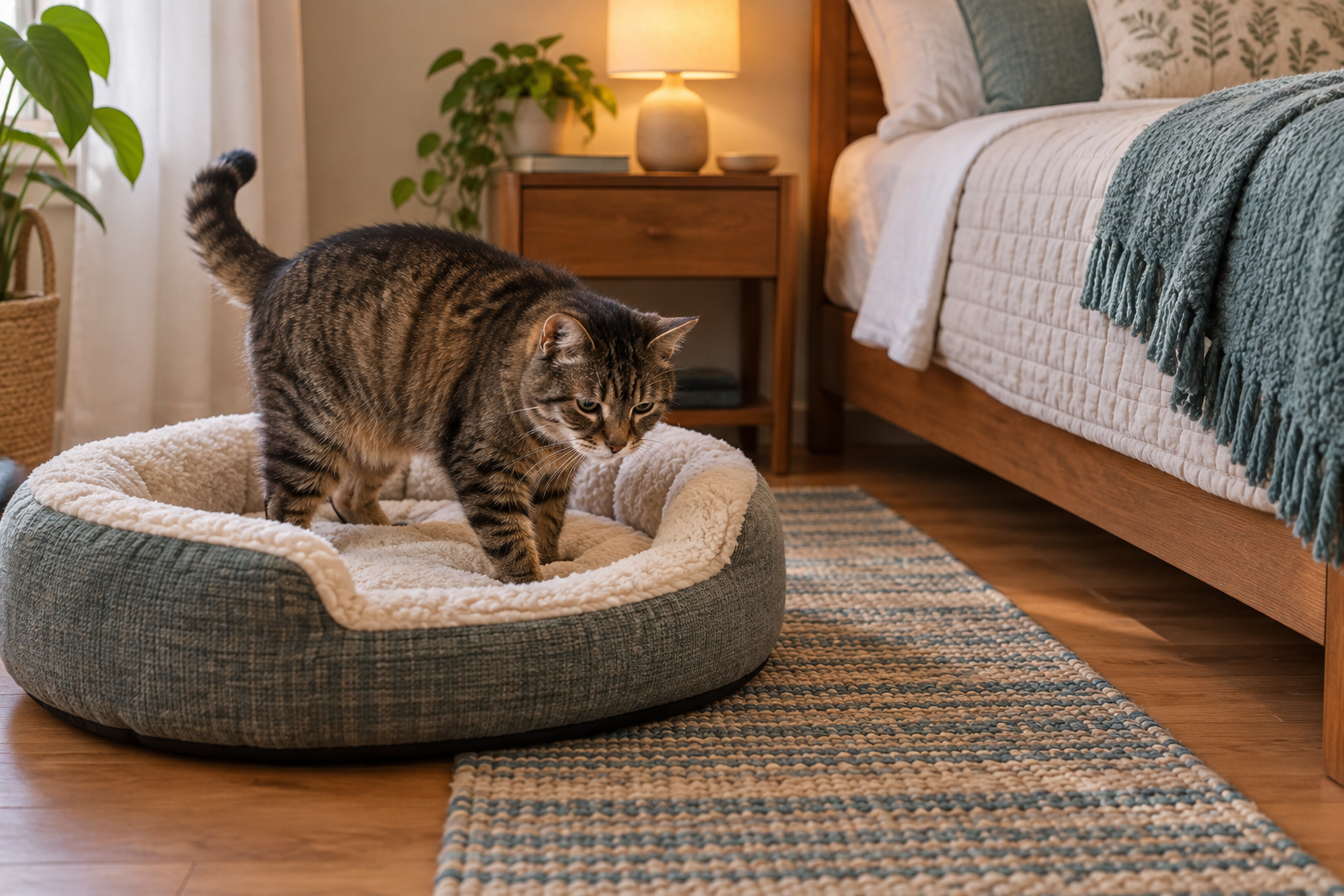
A senior cat who circles once or twice before lying down is often doing a normal comfort check: turning, sniffing, pressing the bedding, and choosing the safest body position. The pattern deserves more attention when it is new, repetitive, one-sided, frantic, painful-looking, or paired with confusion, stumbling, nighttime distress, appetite changes, or litter box changes.
Cats have always been particular about rest. Older cats can be even more careful because their joints, vision, balance, confidence, and sleep-wake rhythm may be changing. The goal is not to diagnose your cat from one bedtime habit. It is to notice whether the circle still looks like a relaxed settling routine or whether it has become a health clue worth discussing with your veterinarian.
This guide explains the normal reasons senior cats circle before lying down, the pain and cognitive clues to watch for, how to make the resting spot easier, and what to track before you call the vet.
Índice
- Why do senior cats circle before lying down?
- When is the circle a normal comfort routine?
- What pain or arthritis clues can change the pattern?
- Could cognitive dysfunction or neurologic disease cause circling?
- How can you make the resting spot easier tonight?
- What should you track before calling the vet?
- When should you call a veterinarian urgently?
- Conclusion: Respect the ritual, watch the change
- Perguntas frequentes
- Referências
Why do senior cats circle before lying down?
Senior cats often circle before lying down because they are checking comfort, footing, scent, temperature, and body position. A slow turn or two before settling can be a normal cat habit, especially if your cat then lies down easily and rests normally.
Think of the circle as a short pre-rest inspection. Your cat may be testing whether the bed is stable, whether the blanket bunches under stiff paws, whether the room feels safe, and which side of the body is most comfortable today. Some cats also knead, sniff, paw at the bedding, or rotate until their back is protected by a wall or cushion.
Age matters, but age itself is not a diagnosis. Cornell notes that older cats may show physical and behavioral changes, including altered grooming, hearing changes, eye changes, arthritis, disorientation, and reduced ability to adapt to household changes 3. If you are unsure where your cat sits in senior life stages, the SnuggleSouls calculadora de idade do gato can add context, but behavior changes still deserve individual attention.
The most useful question is not, "Is circling bad?" It is, "Is this my cat's usual settling routine, or has something changed?"
When is the circle a normal comfort routine?
The circle is more reassuring when it is brief, relaxed, predictable, and followed by comfortable rest. A cat who turns once or twice, kneads the bed, tucks in, and sleeps normally is usually showing a bedding preference rather than an emergency.
More reassuring patterns include:
- The circling has happened for years and looks the same.
- Your cat can stop, lie down, and get up without struggle.
- The movement is not always in the same tight direction.
- Your cat's face, breathing, appetite, and litter box habits look normal.
- The behavior happens mostly around soft beds, blankets, or favorite sleeping places.
- Your cat remains responsive if you speak gently.
The circle can also be practical. A senior cat may turn until sore hips are supported, until paws land on the best traction, or until a warm patch feels right. If the pattern is relaxed and your cat otherwise acts like themselves, you can support it by keeping favorite rest spots stable and easy to enter.
Watch the whole sequence. A normal comfort circle usually has a beginning, middle, and end: approach the bed, turn, settle. A concerning circle may look stuck: repeated loops, pacing away and back, inability to lower the body, crying, staring, bumping, or seeming unsure where to go.
What pain or arthritis clues can change the pattern?
Pain, arthritis, stiffness, dental disease, weakness, or a tender body area can make a senior cat circle longer before lying down. The cat may be trying to find a position that does not pull on sore joints, press on a painful side, or require a hard crouch.
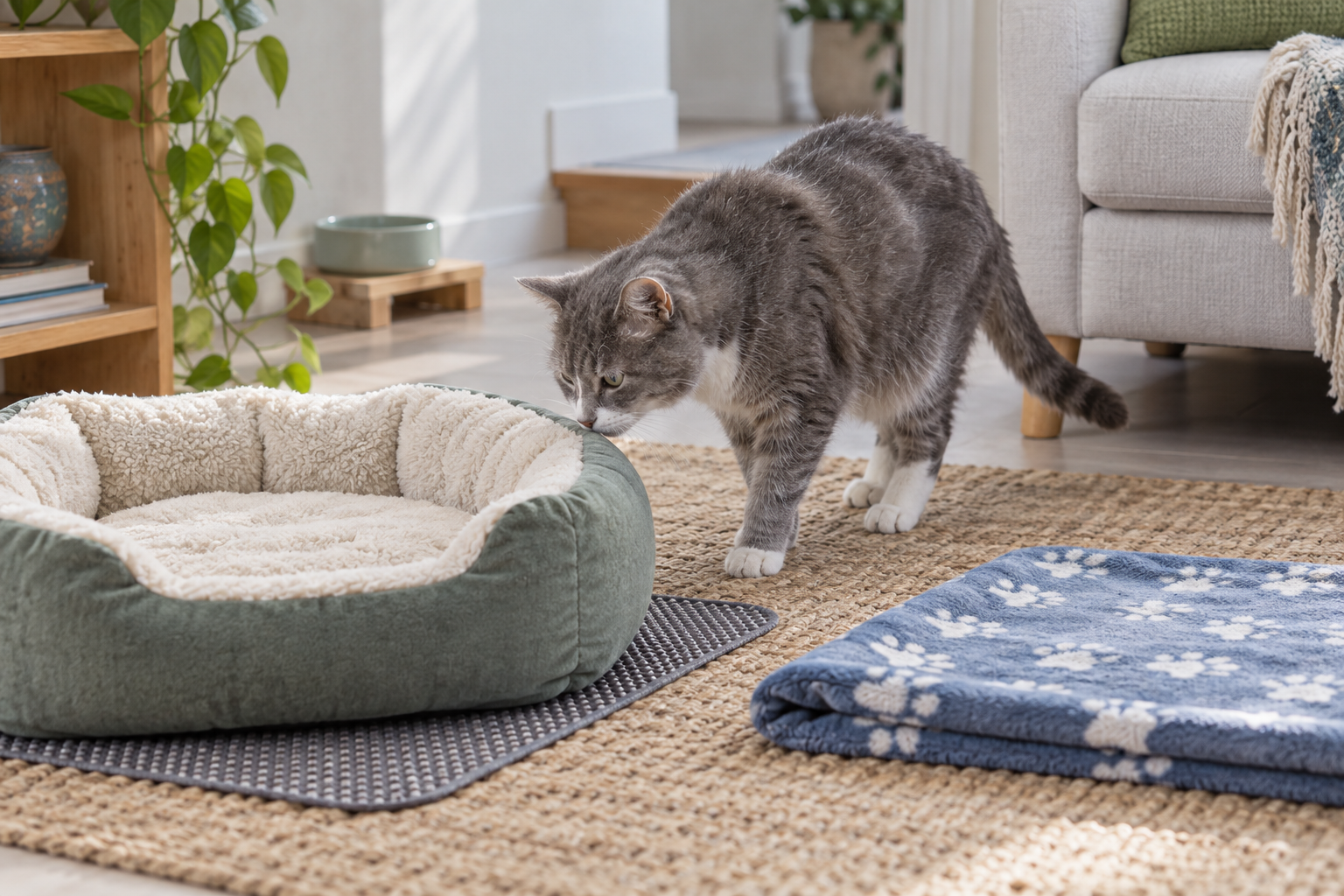
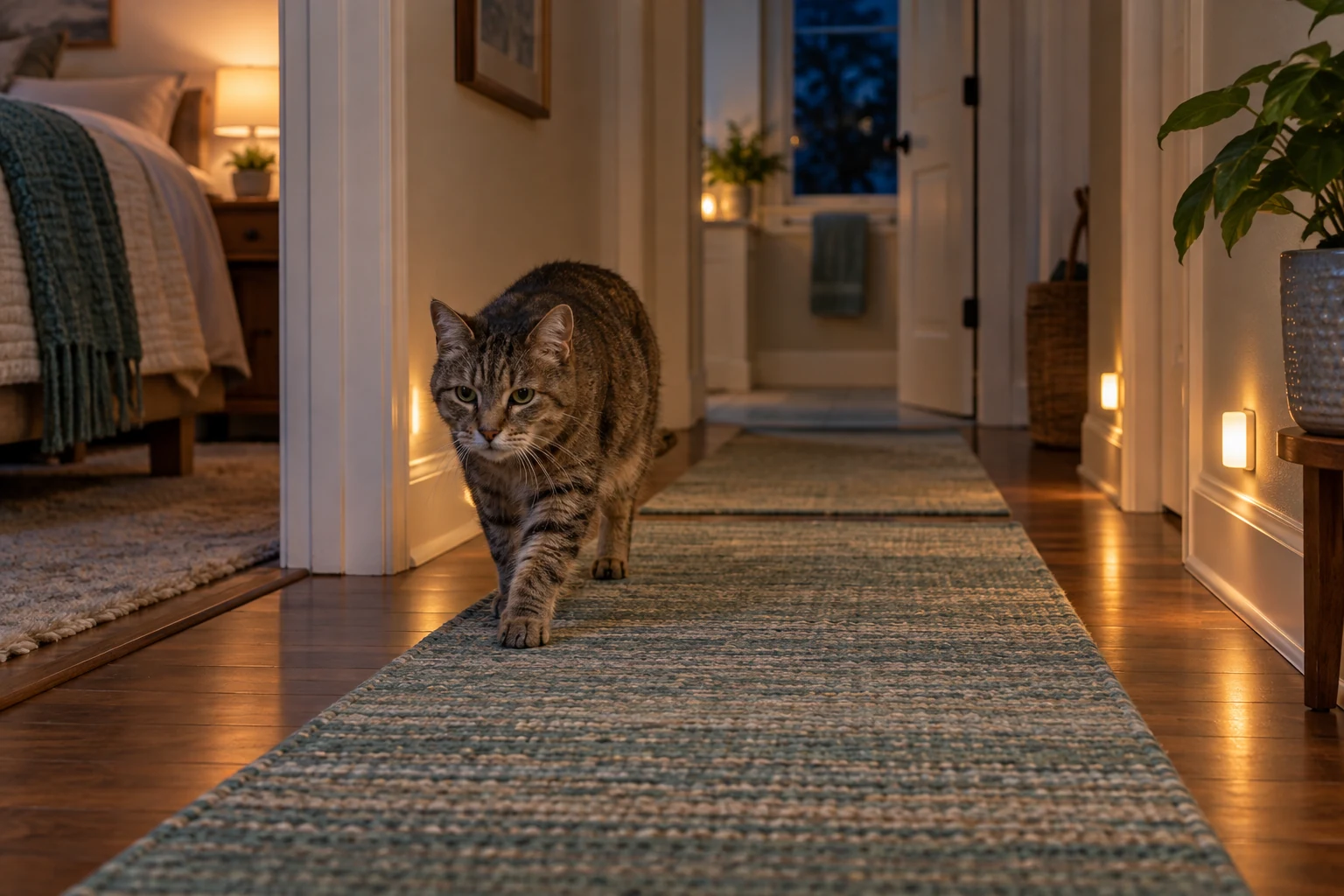
A low, supportive bed with steady footing can make the pre-rest circle easier for a stiff senior cat.
Cornell explains that degenerative joint disease, or arthritis, is common in older cats and that many arthritic cats are not obviously lame, but may have trouble reaching litter boxes, food, or water when jumping or stairs are involved 3. AAHA and AAFP guidance for senior cats similarly notes that degenerative joint disease or muscle weakness may first appear as reduced jumping or climbing, changed resting locations, and other subtle behavior changes 4.
Circling before rest can fit that pattern. A cat may still walk, eat, and greet you, but hesitate before lowering into a bed because the shoulders, elbows, spine, hips, knees, or hocks are uncomfortable.
Look for these pain-related clues:
| O que você percebe | O que isso pode significar | O que fazer em seguida |
|---|---|---|
| Circles longer before lowering the body | Stiffness, soreness, or bed discomfort | Offer lower, softer, steadier rest spots |
| Pauses with front paws in the bed but back feet outside | Hind-end stiffness or uncertainty | Add a flatter bed with non-slip footing |
| Chooses the floor instead of a favorite sofa | Jumping or landing may hurt | Review sinais de artrite em gatos idosos |
| Flinches, growls, or avoids petting before rest | Pain, fear, or touch sensitivity | Avoid probing the area and call your vet |
| Squinty eyes, tense muzzle, or low head posture | Possible pain clue | Use o cat grimace scale as an observation aid |
The Feline Grimace Scale was developed and validated to help assess acute pain in cats by looking at facial features such as ear position, eye tightening, muzzle tension, whiskers, and head position 5. It is not a home diagnosis tool, but it can help you notice when a cat's face and behavior both look different.
Do not give human pain medicine, leftover medication, or supplements without veterinary guidance. Senior cats often have hidden kidney, liver, heart, thyroid, dental, or blood pressure issues that affect which options are safe.
Could cognitive dysfunction or neurologic disease cause circling?
Yes, but the pattern matters. Cognitive dysfunction, sensory decline, vestibular problems, neurologic disease, high blood pressure, pain, and metabolic illness can all change how a senior cat moves, rests, or navigates. A bedtime circle is much less concerning than repeated circling that looks stuck, confused, one-sided, or disconnected from resting.
Cornell lists cognitive dysfunction signs in older cats such as spatial disorientation, altered sleep-wake cycles, staring at walls, changes in food and water interest, house soiling, and loud nighttime vocalization 1. The same Cornell guidance also notes that some unusual behaviors may come from painful long-term conditions or diseases common in older cats, not cognition alone 1.
Merck's neurologic evaluation guidance says signs of nervous-system dysfunction can include circling, weakness, falling, stumbling, rolling, or loss of coordination, and that a veterinary neurologic exam evaluates mentation, cranial nerves, gait, posture, reflexes, and other functions 2. That does not mean every pre-nap turn is neurologic. It means circling deserves more urgency when it is paired with abnormal awareness, balance, or movement.
Use esta comparação:
| Padrão | More reassuring | Mais preocupante |
|---|---|---|
| One or two turns on the bed | Settles and sleeps normally | Cannot seem to stop circling |
| Direction | Varies naturally | Always tight circles to one side |
| Awareness | Responds to voice and touch normally | Seems lost, blank, or hard to interrupt |
| Movimento | Smooth and familiar | Stumbles, falls, head tilts, or drifts |
| Contexto | Only before lying down | Happens in open rooms, corners, or along walls |
If your cat also follows walls, compare the pattern with the SnuggleSouls guide to a senior cat walking along walls. If your cat circles into corners and then seems unable to turn around, the guide to a senior cat getting stuck in corners may fit better.
How can you make the resting spot easier tonight?
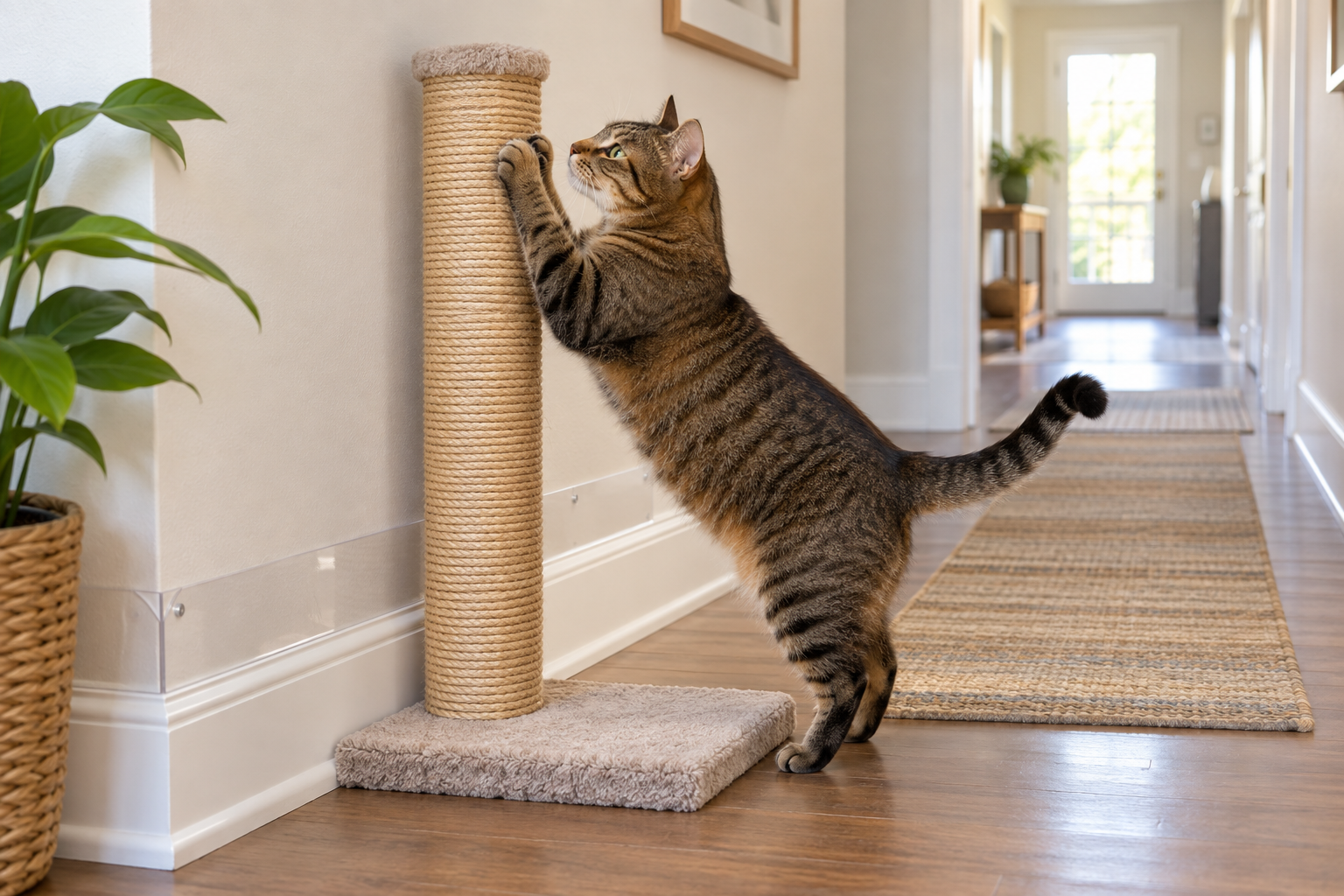
Make the resting spot lower, steadier, warmer, and easier to enter without jumping. These changes do not replace a veterinary check when signs are new or concerning, but they can reduce strain while you observe the pattern.
Start with your cat's favorite place rather than forcing a totally new bed. Senior cats often rely on routine and familiar scent. If the current bed has high bolsters, slick fabric, or a deep center that is hard to climb out of, place a lower supportive bed nearby and let your cat choose.
Try this senior-friendly rest setup:
- Place the bed on a non-slip mat or low-pile rug.
- Choose a bed with a low entry edge and enough room to turn around.
- Keep one side near a wall or stable furniture if your cat likes a protected back.
- Add a washable fleece layer that does not bunch under the paws.
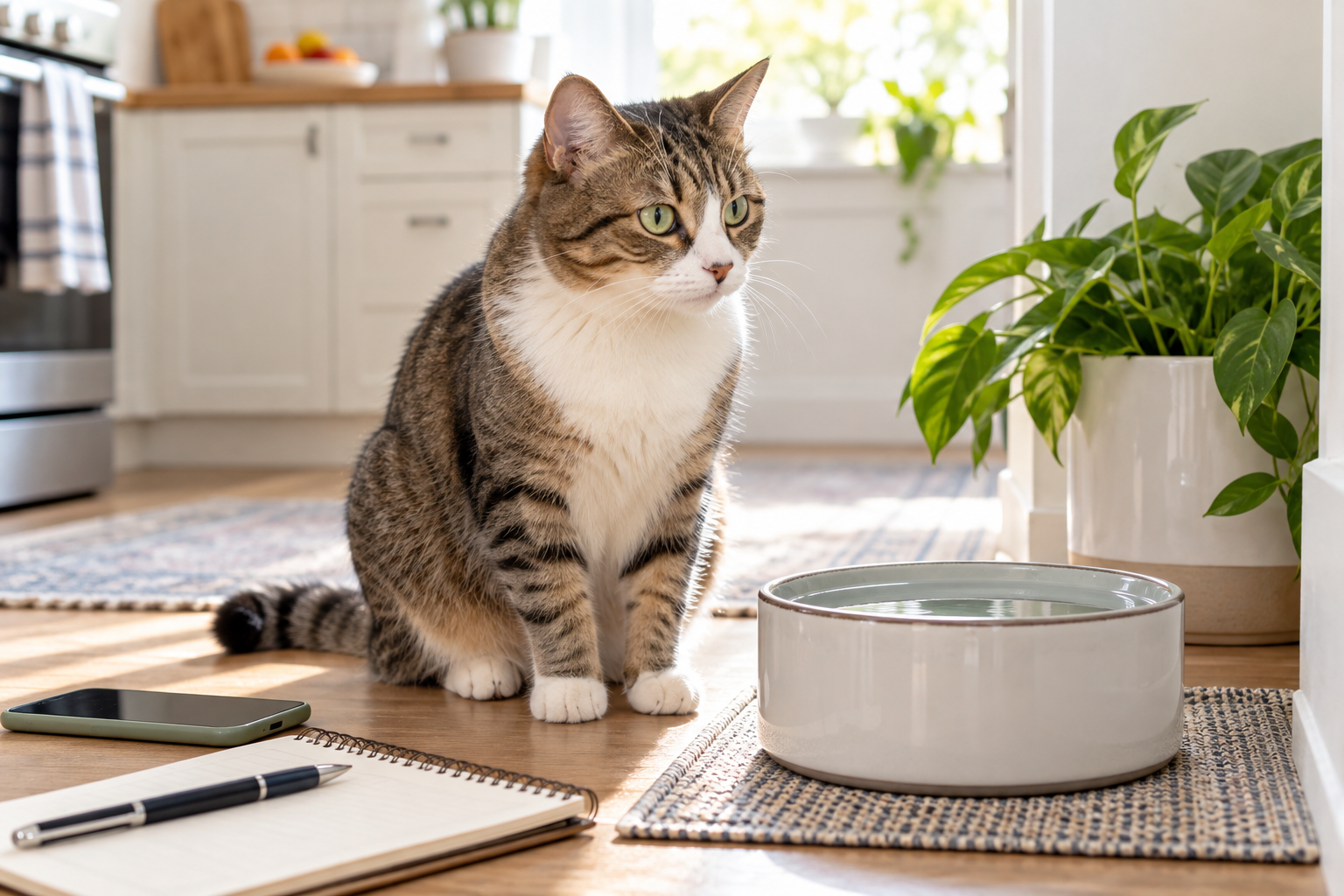
- Keep food, water, and litter within a comfortable route on the same level.
- Add a soft nightlight for evening navigation.
- Use ramps or sturdy steps for sofas and beds your cat still wants to reach.
- Keep loud appliances, busy doorways, and pushy pets away from the sleep zone.
If your cat has known stiffness, pair this with SnuggleSouls' guide on how to como ajudar um gato com artrite em casa. For the bedroom specifically, a senior cat bedroom arthritis-friendly setup can help you think through bed height, rug placement, water access, and nighttime movement.
Avoid changing everything in one afternoon. For a cat with vision, hearing, or cognitive changes, a sudden room redesign can increase stress. Improve the chosen route and bed first, then watch whether the circling becomes shorter and more relaxed.
What should you track before calling the vet?
Track the circling pattern, not just the fact that it happens. A short log or video can help your veterinarian tell a comfort habit from pain, disorientation, or neurologic change.
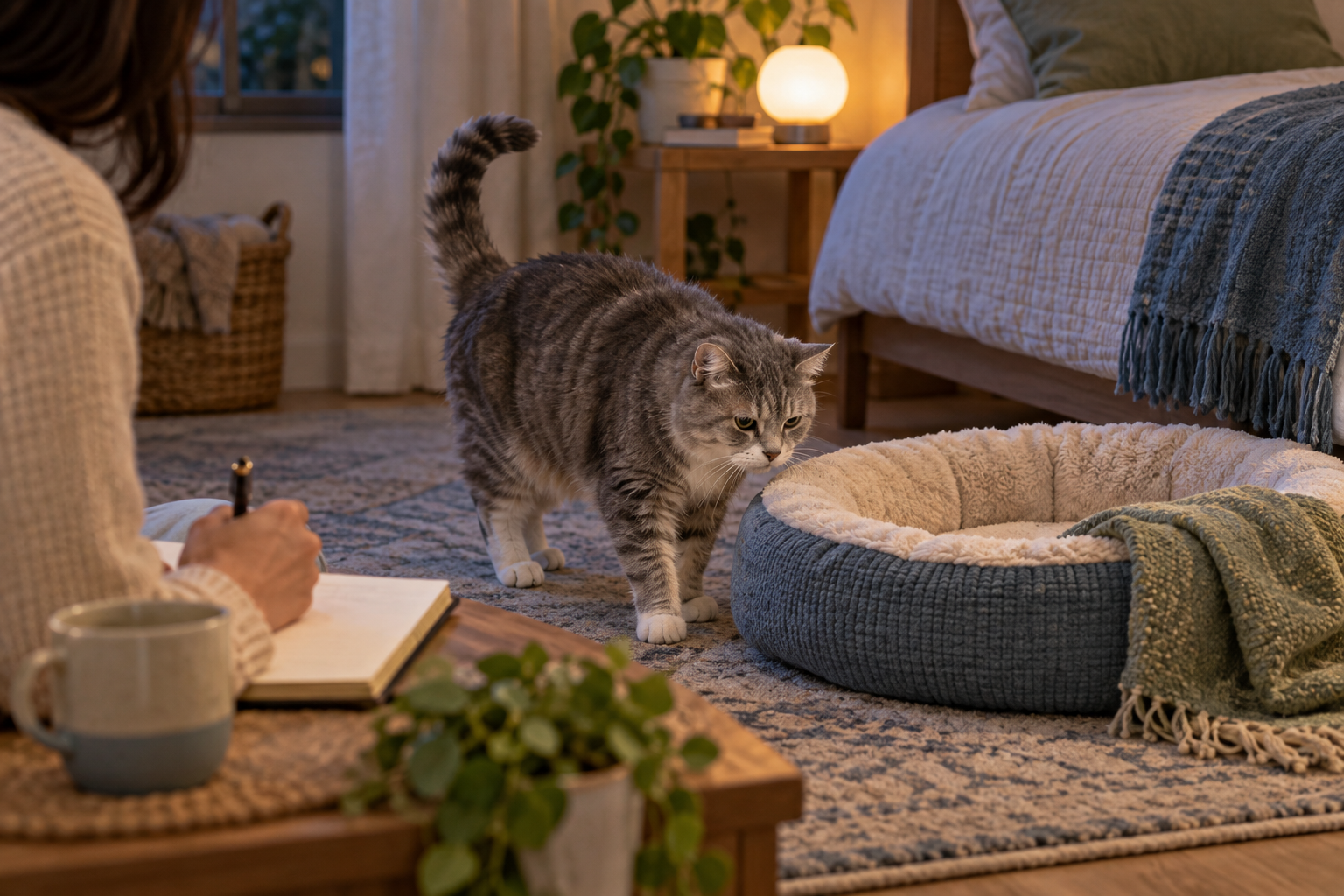
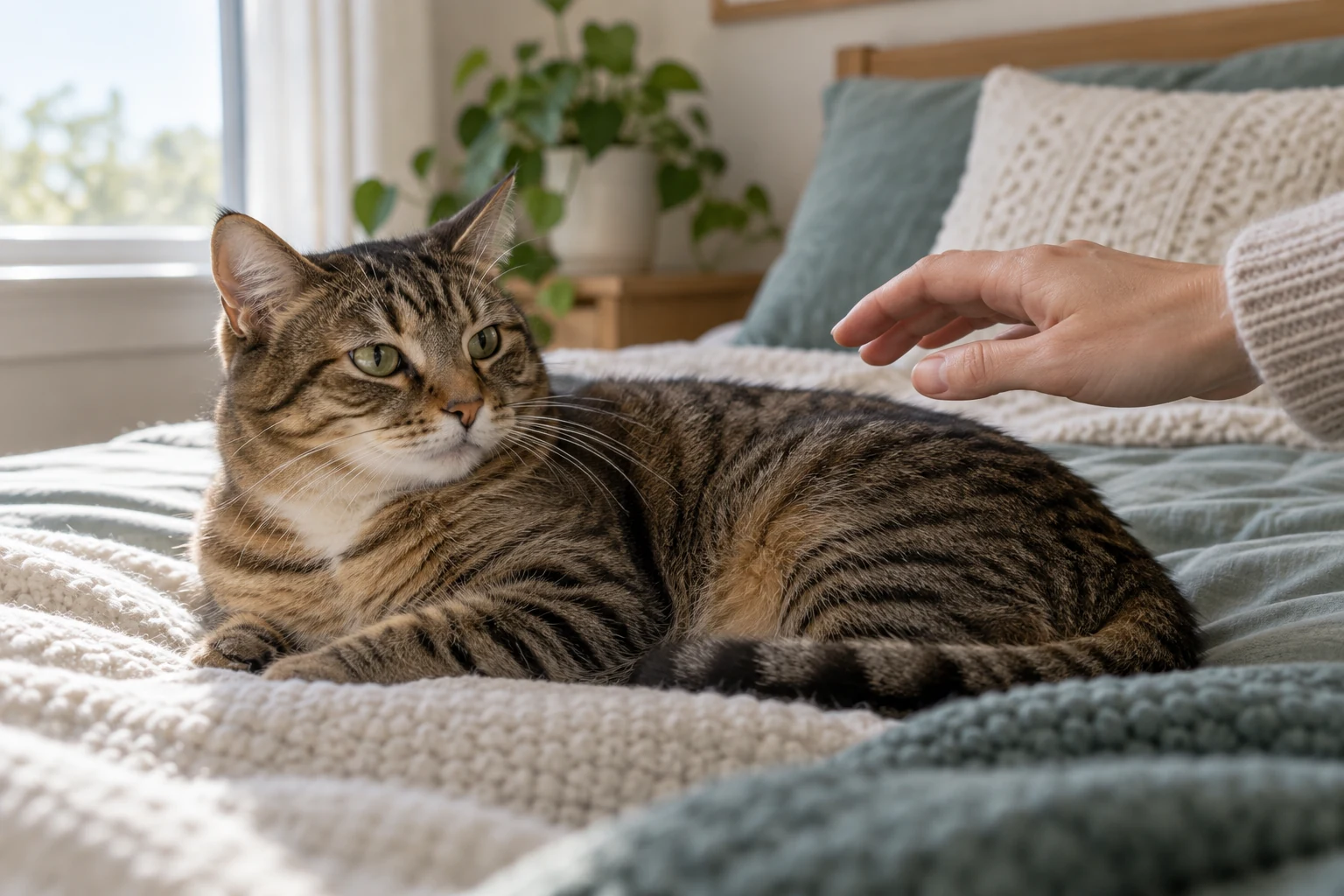
Short notes and calm videos help your veterinarian tell a bedtime ritual from pain, disorientation, or neurologic change.
You do not need perfect data. A few clear observations are usually more useful than a long anxious narrative. If signs are urgent, skip the tracking period and call right away.
Use this simple log:
| Detail to track | Examples to write down | Por que isso ajuda |
|---|---|---|
| Frequency | "Once before naps," "every bedtime," "10 minutes at night" | Separates ritual from repetition |
| Direction | Left, right, varies, or always one way | Tight one-sided circling is more concerning |
| Sinais corporais | Stiff, hunched, low head, limping, falls, smooth | Helps screen pain and neurologic clues |
| Awareness | Responds to name, seems confused, stares, yowls | Supports cognition and sensory discussion |
| Rest result | Settles normally, gets up again, avoids bed | Shows whether comfort is the problem |
| Other changes | Appetite, thirst, litter box, vomiting, weight, grooming | Connects the behavior to whole-cat health |
| Video | 10-20 seconds in good light | Lets the vet see gait and route choice |
Bring the notes to your appointment along with your cat's age, medications, supplements, diet, known diagnoses, recent household changes, and whether the behavior started suddenly or gradually. If nighttime vocalization is part of the pattern, compare your notes with the SnuggleSouls guide to cat yowling at night.
The most helpful video shows the whole sequence: your cat approaching the bed, circling, trying to lower the body, settling or failing to settle, and walking away if that happens. Do not chase your cat for footage. Film calmly from a distance.
When should you call a veterinarian urgently?
Call a veterinarian promptly if the circling is new, worsening, prolonged, one-sided, painful-looking, or paired with appetite, litter box, balance, vision, breathing, seizure, collapse, or awareness changes. Seek emergency care if your cat seems suddenly neurologic, cannot walk safely, cannot urinate, or declines quickly.
Senior cats can hide illness, and subtle behavior changes may be the first clue. Cornell warns that owners should not assume changes in an older cat are simply untreatable old age; any change in behavior or physical condition should alert you to contact your veterinarian 3.
Treat these signs as urgent:
- Sudden repeated circling, head pressing, head tilt, seizures, collapse, or severe weakness.
- Falling, rolling, stumbling, one-sided circling, or loss of coordination.
- Sudden blindness, bumping into familiar objects, very dilated pupils, or painful-looking eyes.
- Straining to urinate, crying in the litter box, or producing little to no urine.
- Refusing food, repeated vomiting, severe diarrhea, dehydration, or rapid weight loss.
- Trouble breathing, open-mouth breathing, blue or pale gums, or extreme lethargy.
- Crying, growling, hiding, aggression, or flinching that suggests significant pain.
For mild but new circling, schedule a non-emergency visit and bring your log. Your vet may want to check pain, joints, eyes, blood pressure, dental health, neurologic signs, body weight, hydration, and age-related disease markers. The right plan depends on the whole cat, not the circle alone.
Conclusion: Respect the ritual, watch the change
A senior cat circling before lying down is often performing a normal comfort ritual. If the motion is brief, relaxed, and followed by easy rest, support the habit with a low bed, steady footing, familiar scent, and a predictable route.
At the same time, a changed circle can be valuable information. Longer circling, repeated loops, one-sided movement, hesitation to lower the body, pain signs, confusion, nighttime distress, appetite changes, or litter box changes deserve veterinary guidance. Your job is not to diagnose arthritis, cognitive dysfunction, or neurologic disease at home. It is to notice the pattern, make rest easier, and get help when the ritual stops looking comfortable.
Perguntas frequentes
Is it normal for an old cat to circle before lying down?
Yes, it can be normal if your cat turns once or twice, looks relaxed, and settles comfortably. It is more concerning if the circling is new, repetitive, one-sided, frantic, painful-looking, or paired with confusion, stumbling, appetite changes, or litter box changes.
Why does my senior cat circle more at night?
Night circling may happen because your cat is stiff after sleep, navigating in lower light, or trying to find a comfortable position. It can also connect to cognitive changes, pain, vision changes, or nighttime restlessness, especially if your cat also yowls, paces, stares, or seems disoriented.
Can arthritis make a cat circle before resting?
Yes. Arthritis or muscle weakness can make it harder for a cat to lower the body, choose a side, or climb into a bed. A lower supportive bed, non-slip mat, and easier route can help, but new stiffness or pain signs should be checked by a veterinarian.
What is the difference between circling before lying down and neurologic circling?
Pre-rest circling usually happens only around a bed and ends with your cat lying down. Neurologic circling is more likely to be repeated, hard to interrupt, one-sided, or paired with stumbling, falling, head tilt, weakness, seizures, confusion, or abnormal awareness.
Should I stop my cat from circling before bed?
Do not interrupt a relaxed comfort routine. Instead, make the bed easier to enter and watch for changes. If your cat seems stuck, distressed, painful, confused, or unable to settle, call your veterinarian and share a short video if you can capture one calmly.
Referências
[1] Cornell Feline Health Center. (2024). Cognitive Dysfunction. Faculdade de Medicina Veterinária da Universidade de Cornell
[2] Manual Veterinário da Merck. (2024). The Neurologic Evaluation in Cats. Manual Veterinário Merck
[3] Cornell Feline Health Center. (n.d.). The Special Needs of the Senior Cat. Faculdade de Medicina Veterinária da Universidade de Cornell
[4] AAHA and AAFP. (2021). Behavior and Environmental Needs: Senior Cats. American Animal Hospital Association
[5] Evangelista, M. C., Watanabe, R., Leung, V. S. Y., Monteiro, B. P., O'Toole, E., Pang, D. S. J., & Steagall, P. V. (2019). Facial expressions of pain in cats: the development and validation of a Feline Grimace Scale. Relatórios científicos
 EN
EN DE
DE ES
ES PT
PT