
AAHA / WSAVA RER formulaSee the method and assumptions
Instant calorie budgetWorks with or without food labels
Keep a usable planFree to save, print, or download
Calculate daily calories & meal portions
Enter your cat’s weight to see daily and per-meal kcal immediately. Add food labels below whenever you want exact gram or can amounts.
How many calories does a cat need per day?
Daily calorie needs depend on body weight, neuter status, life stage, and activity. Click any weight row in the charts below to load that starting estimate directly into the calculator.
Start with weight, then choose one profile
The calculator estimates resting energy requirement (RER) as 70 × weight in kg0.75, then applies one profile factor. For example, a healthy 4.5 kg (10 lb) neutered adult has a starting estimate of 260 kcal/day using the 1.2 factor, while an inactive adult of the same weight needs about 216 kcal/day (1.0 × RER).
Growing weaned kittens require roughly 2.5 × RER to fuel rapid tissue growth, though needs taper as they approach adult size around 10–12 months. [1]
Not sure of your cat’s exact life stage? Check our Cat Age Calculator or track weekly weigh-ins in the Cat Weight Tracker.
Enter your cat’s weight in the calculatorAdult cat calorie chart: 2–9 kg (4.4–19.8 lb)
| Cat weight | Inactive / indoor1.0 × RER | Neutered adult1.2 × RER | Intact / active1.4 × RER |
|---|---|---|---|
| 118 kcal | 141 kcal | 165 kcal | |
| 160 kcal | 191 kcal | 223 kcal | |
| 198 kcal | 238 kcal | 277 kcal | |
| 216 kcal | 260 kcal | 303 kcal | |
| 234 kcal | 281 kcal | 328 kcal | |
| 268 kcal | 322 kcal | 376 kcal | |
| 301 kcal | 362 kcal | 422 kcal | |
| 333 kcal | 400 kcal | 466 kcal | |
| 364 kcal | 436 kcal | 509 kcal |
Rounded AAHA formula examples for healthy adult cats at ideal body condition. For weight-loss plans, ask your veterinarian for a specific daily kcal target.
Growing weaned kitten calorie chart (0.5–3.5 kg)
| Kitten weight | Typical ageApproximate | Resting (RER)70 × kg0.75 | Growth target2.5 × RER |
|---|---|---|---|
| ~4–5 weeks | 42 kcal | 104 kcal | |
| ~8–9 weeks | 70 kcal | 175 kcal | |
| ~3 months | 95 kcal | 237 kcal | |
| ~4 months | 118 kcal | 294 kcal | |
| ~5 months | 139 kcal | 348 kcal | |
| ~6–7 months | 160 kcal | 399 kcal | |
| ~8–10 months | 179 kcal | 448 kcal |
Applies to weaned kittens eating complete growth-stage food. Neonatal or bottle-fed kittens require a veterinarian’s feeding schedule. See our Kitten Weight Chart.
How much wet and dry food should I feed my cat?
Split the calorie budget after treats, then convert each food’s share using its own label. Equal calories from wet and dry food do not mean equal grams.
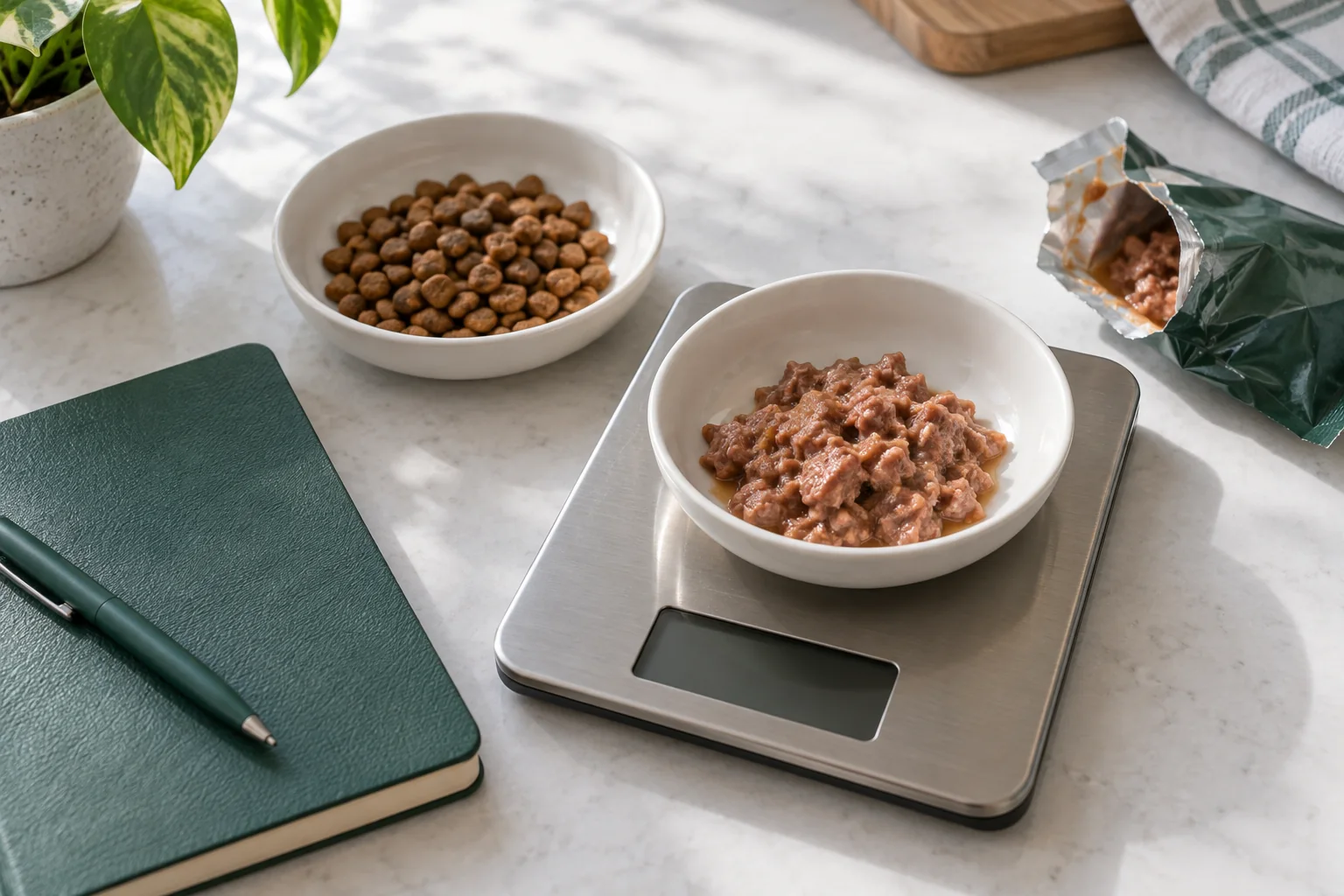
Select that option in Step 3 of the calculator. The tool uses the selected food’s exact label rather than a generic scoop estimate.
A complete wet + dry feeding example
Demonstration only. A 200 kcal target and the labels below are examples, rather than your cat’s feeding recommendation.
- Total daily budget
- 200 kcal
- Treats reserved (10%)
- −20 kcal
- Calories left for meals
- 180 kcal
With a 50% wet / 50% dry split, each food supplies 90 kcal/day.
Dry food
Label: 4,000 kcal/kg
4 kcal per gram
Wet food
Label: 85 kcal per 85 g pouch
1 kcal per gram
Calorie check: 90 wet + 90 dry + 20 treats = 200 kcal/day. At two equal meals, serve 45 g wet food and 11.25 g dry food per meal.
How do I turn food label calories into grams, cans, or cups?
Look for “Calorie content” or “Metabolizable energy (ME)” on the packaging. Match the unit exactly, and use the manufacturer’s net weight for a can, pouch, or cup. [2]
Illustrative label, not a product recommendation
Calorie content (ME)
- Energy by weight
- 4,000 kcal/kg
- Energy by volume
- 400 kcal/cup
- Weight per cup
- 100 g
These sample values describe the same food: 4 kcal/g. Cup weights differ between products.
Choose the format printed on your package
- kcal/kg or kcal/100 g
- Enter the calories and choose the matching unit. The calculator converts them to kcal per gram.
- kcal/can or kcal/pouch
- Enter the calories per container and its net food weight. A different can size needs its own label values.
- kcal/cup
- Enter calories per cup and that recipe’s grams per cup. If the manufacturer does not provide the weight, request it before converting to grams.
Changing brands or recipes? Keep the calorie target under review and recalculate the grams using the new label. The same scoop or bowl weight can supply a different number of calories. See the portion-switching guide.
A feeding calculation you can check
Every result includes the calorie budget, food-label conversion, and portion breakdown. Use the method below to understand the assumptions behind your plan.
Formula and profile choices
RER = 70 × weight in kg0.75. The daily estimate is RER × one profile factor. Adult defaults use the lower end of AAHA’s published ranges: 1.2–1.4 for neutered adults and 1.4–1.6 for intact adults. Actual needs should be reviewed through body weight and body condition monitoring. [1]
| Profile used in this tool | RER factor |
|---|---|
| Neutered adult | 1.2 |
| Intact adult | 1.4 |
| Inactive / obesity prone adult | 1.0 |
| Growing, weaned kitten | 2.5 |
A veterinarian’s target bypasses the formula. Body condition is used to guide the appropriate pathway; this tool does not infer an ideal weight or prescribe a calorie deficit.
Portions, extras, and cost
Food budget = daily calories − treat calories. Each food receives its chosen share of that budget. Grams per day = allocated calories ÷ kcal per gram. Per-meal amounts assume an equal split across the selected number of meals.
Treats, toppers, and other extras count toward total intake. AAHA recommends that complete and balanced food supply at least 90% of calories, with treats and other extras at 10% or less. Check each food’s nutritional adequacy statement for the appropriate life stage. [2]
Food cost = grams per day ÷ total pack grams × pack price. The 30-day figure excludes treats, waste, and future price changes.
Who should use a veterinarian’s target?
Cats with medical conditions, nonideal body condition, prescribed weight change plans, pregnancy, or nursing need an individual feeding target. The kitten estimate is for weaned, growing kittens and requires growth monitoring.
Plan privacy and control
No account is required. “Save on this device” stores your plan in this browser, with controls to load or delete it. Copy, text download, and print give you a record for daily care or a veterinary appointment.
Read the site privacy policyPrimary sources
- AAHA Nutrition and Weight Management Guidelines: energy requirement calculationsRER formula, feline profile factors, and individual adjustment.
- AAHA: feeding plans for healthy cats and dogsCalorie accounting, complete and balanced food, treats, and monitoring.
- WSAVA Global Nutrition Guidelines and assessment resourcesNutrition assessment and body condition resources.
Put your feeding plan into practice
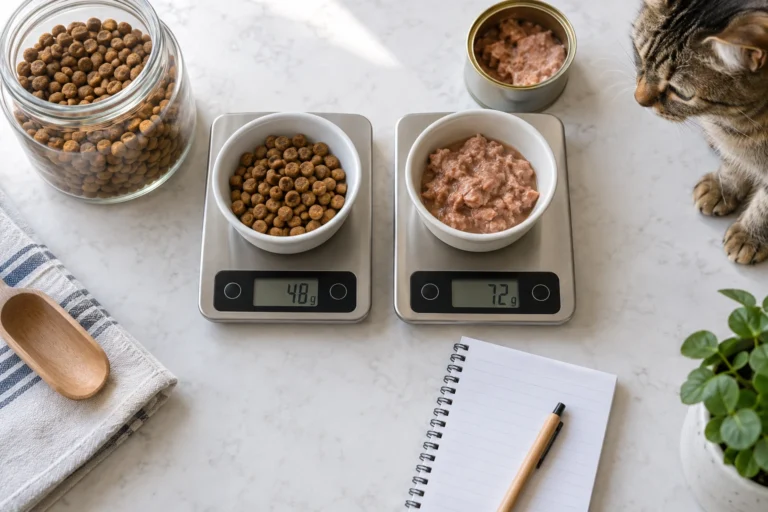
Switching cat food? Recheck the portions.
Learn how a new recipe’s calorie density changes the grams you serve.
Read the portion-switching guideBuild a wet and dry feeding routine
Make the calorie split work with meals, treats, and daily care.
Understand the label beyond calories
Read energy units and nutritional adequacy before comparing recipes.
Check your cat’s body condition
Use body condition observations to prepare a clearer discussion with your veterinarian.
Cat calorie and feeding questions
How many calories does a 10 lb (4.5 kg) indoor cat need?
A healthy 10 lb (4.5 kg) neutered indoor cat typically starts around 260 kcal/day (1.2 × RER), or about 216 kcal/day (1.0 × RER) if very sedentary or prone to weight gain. Monitor body condition and adjust with your veterinarian.
How much wet food should a cat eat a day?
Divide the calories allocated to wet food by the package’s calories per can or pouch. For example, 180 kcal allocated entirely to a food with 90 kcal per can equals two cans per day. Treats and dry food use part of the same daily budget, so subtract their calories first.
How much dry food should I feed my cat in grams?
Divide the calories allocated to dry food by kcal per gram. A label of 4,000 kcal/kg means 4 kcal/g, so 180 kcal allocated entirely to that food equals 45 g per day. Use a digital kitchen scale rather than a measuring cup for accuracy.
Is this a kitten calorie calculator too?
Yes. Select Weaned kitten, still growing (2.5 × RER) or click a weight in the kitten chart above. Growth needs shift quickly as kittens gain weight, so re-weigh every 1–2 weeks and confirm portions with your veterinarian.
Can I use this cat calorie calculator for weight loss?
Use a daily calorie target supplied by your veterinarian, together with the foods they recommend. Select Use a calorie target from my veterinarian to convert that prescribed number into exact grams without adding a maintenance multiplier.
Does a 50/50 wet and dry split mean equal food weight?
No. It means equal shares of meal calories after treats. Because dry kibble is roughly 3–4× more calorie-dense per gram than wet food, equal calories result in a much larger gram weight of wet food than dry kibble.
What should I do if the package only gives kcal per cup?
Enter kcal/cup and the manufacturer’s grams per cup for that specific recipe. Do not use another brand’s cup weight, as kibble size and density vary widely.