
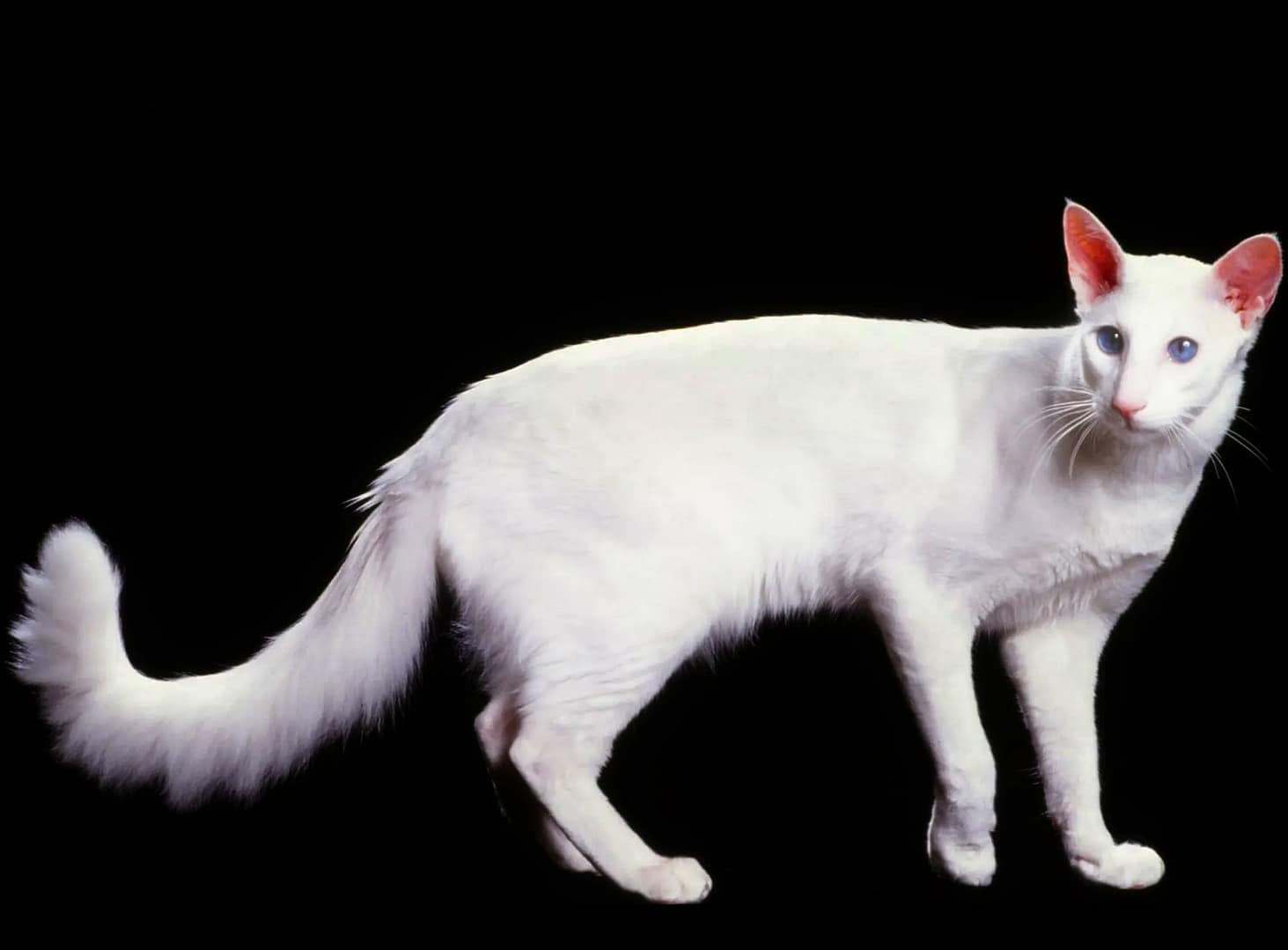
O Gato javanês (also called Colorpoint Longhair) is a Siamese-type, medium-longhaired, colorpoint cat closely tied to the Balinesa. In some registries (like CFA), “Javanese” refers to Balinese-type cats in non-traditional point colors such as lynx, tortie, and red/cream points.
Índice
Visão geral da raça
| Característica | Descrição |
|---|---|
| Personalidade | Extrovertidos, curiosos e afetuosos. Altamente sociável e apegado ao seu pessoal, muitas vezes seguindo os donos por toda parte. |
| Tipo de carroceria | Esguio, de ossos finos, mas musculoso, com uma longa tubular corpo e pernas longas. Elegante e de constituição atlética. |
| Peso | ~5–12 pounds (2.3–5.4 kg) as adults (males tend toward the higher end). Small to medium size overall. |
| Região de origem | Estados Unidos (América do Norte) - desenvolvido pela primeira vez por criadores na década de 1970; recebeu o nome da ilha de Java, embora não seja de fato de lá. |
| Tempo de vida | Approximately 10–15 years on average, with good care. Some may live longer. |
| Tipo de casaco | Pelagem simples, sedosa e semi-longa (sem subpêlo), rente ao corpo. Cauda emplumada; mínimo emaranhamento. |
| Cores da pelagem | Variedade de ponto colors beyond the traditional Siamese range – e.g. red, cream, cinnamon, fawn, smoke – often in lynx (tabby) or tortie point patterns. Always with darker “points” (face, ears, legs, tail) on a lighter body. |
| Nível de derramamento | ☆☆☆☆ (Muito baixo) |
| Afeto para com os seres humanos | ⭐⭐⭐⭐⭐ (Extremamente alto) |
| Dificuldade de atendimento | ⭐⭐⭐☆☆ (Moderado) |
Javanese Cat (Colorpoint Longhair): 1-Minute Summary
O Gato javanês (often called Colorpoint Longhair) is a Siamese-type, medium-longhaired colorpoint cat known for being extremely affectionate, social, and talkative. Many people describe them as “gatos de velcro” because they follow their humans from room to room and want to be involved in everything.
Quick reality check: the name doesn’t mean they come from Java. “Javanese” is a registry/branding term tied to the Balinese/Siamese family—not a geographic origin.
Key takeaways
- Best for people who want a high-interaction companion (not a “low-attention” cat)
- Baixa queda and relatively easy coat care (single coat, less matting)
- Most confusion comes from registry naming (Javanese vs Balinese vs Oriental Longhair)
Javanese vs Balinese: Naming & Registry Confusion (Explained Simply)
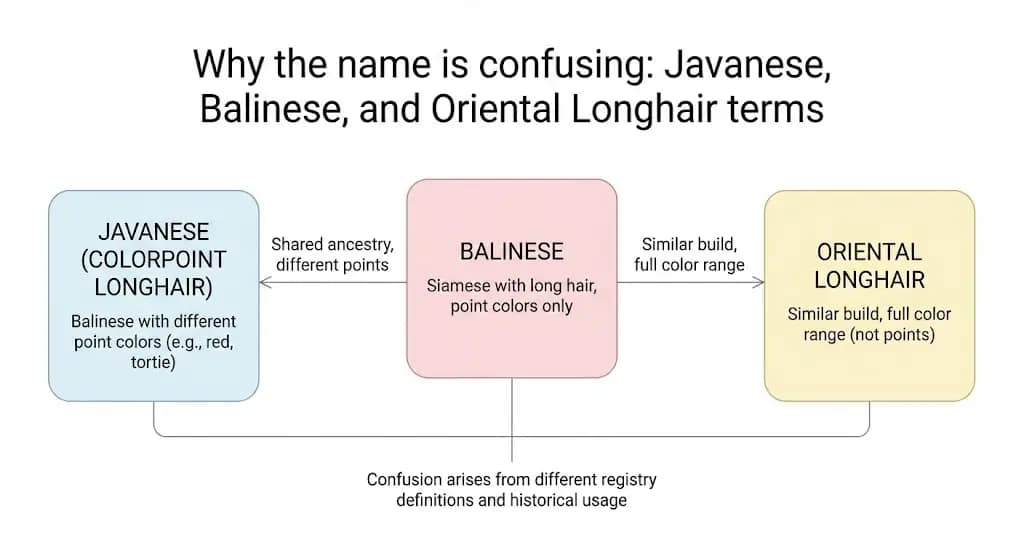
If you’ve heard multiple definitions of “Javanese cat,” you’re not alone. The name is used differently depending on the cat registry and region, which is why search results often disagree.
The short answer
In many modern contexts, “Javanese” is essentially a Balinese/Siamese-type cat with medium-long hair and “extra” point colors (like red/cream, lynx/tabby points, or tortie points). The cat’s look and personality are very similar to Balinese; the label mainly reflects color divisions and registry terminology.
Why the definition varies
- Registry terminology changes over time. Some organizations historically used “Javanese” as a separate label, then later grouped it under Balinesa as color divisions.
- Regional naming differs. In some regions, the name “Javanese” has been used for cats that people elsewhere call Oriental Longhair (a related but not identical type), which adds confusion.
How to use this guide
This article focuses on the “Javanese” most people mean in English-language searches:
- Siamese-family / Oriental-type build
- Colorpoint pattern (darker points + lighter body)
- Silky semi-long coat
- Social, intelligent, often vocal temperament
Tip for readers: When browsing breeders or registries, ask what the cat is registered as (Balinese vs Javanese vs Oriental Longhair) and what point colors/patterns are recognized under that registry.
História da raça
O Javanese cat (often called Colorpoint Longhair) é um modern, North American-developed member of the Siamese/Balinese family. Breeders in the late 1970s wanted to keep the sleek Siamese-type body and affectionate temperament while expanding the range of colorpoint (“points”) colors and patterns beyond the traditional palette.
To do this, breeders worked with closely related Siamese-family lines—most commonly Balinese, Siamese, and Colorpoint Shorthair—to produce longhaired colorpoint cats in colors such as lynx (tabby) points, tortie points, and red/cream points.
A quick timeline (why the “Javanese” label changes)
- 1979 (CFA): Non-traditional point colors were accepted under the name “Javanese.”
- 1986 (CFA): The Javanese achieved status de campeonato completo in CFA competition.
- 2008 (CFA): CFA breeders voted to merge Balinese and Javanese into a single breed with separate divisions, which is why you’ll often see Javanese described as a Balinese “division” or color class rather than a fully separate breed today.
Other registries organize things differently. For example, TICA treats the Balinese as part of the Siamese breed group and recognizes a wide range of colors and patterns (including lynx and tortie points)—so cats that CFA readers might call “Javanese” are often simply “Balinese” in those systems.
Finally, some organizations (especially outside North America) have used “Javanese” to mean something closer to Oriental Longhair, which is why the term can look inconsistent across international sources.
Conclusão: Javanese cats are purpose-bred Siamese-family colorpoints developed in North America, and the name reflects registry history and color classification, not a natural origin from Java.
Sources (registry references):
- Cat Fanciers’ Association (CFA): Javanese breed article; Balinese breed page (history + 1979/2008 notes)
- Associação Internacional de Gatos (TICA): Balinese breed profile (colors/patterns)
- Congresso Mundial de Gatos: Javanese classification notes (international naming variance)
Physical Characteristics (Appearance)
At a glance: O Javanês (Colorpoint Longhair) has the same sleek, Oriental/Siamese-type build as the Balinese—long, refined lines with firm muscle underneath a silky semi-long coat. (In CFA terminology, Javanese is treated as a Balinese “Javanese Division”—the type is the same; the big difference is color variety.)
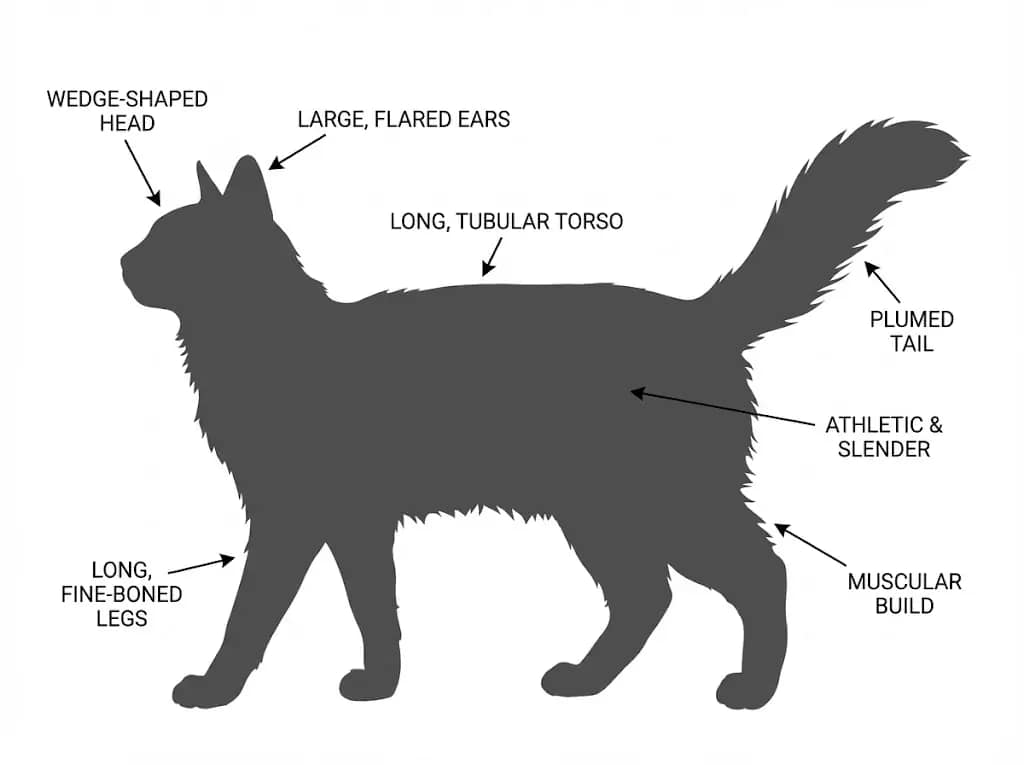
Body type: long, tubular, fine-boned—but athletic
Javanese cats are medium-sized, svelte, and elongated, often described as having a tubular torso with shoulders and hips continuing the same sleek lines. Although they look delicate, the breed standard emphasizes a cat that feels strong, lithe, and muscular in the hand—“elegant refinement” with real athletic power.
Suas pernas são long and slim, com hind legs higher than the front, which contributes to that poised, floating gait and impressive jumping ability.
Head, ears, and eyes: the classic “total wedge”
The head forms a Cunha longa e afunilada—straight lines from the nose flaring out to the ear tips to create a clean triangle (“total wedge”).
Ears are one of the most striking features: grande, largo na base, and set to continue the wedge line for an alert, modern look.
For the pointed (SI/BA-type) Javanese, eyes are almond-shaped, slightly slanted, and a vivid blue is expected in breed standards.
(Note: If you see “Javanese” used for non-pointed Oriental Longhair lines in some regions, those cats may have green eyes—this is one reason the name can be confusing.)
Coat: silky, close-lying, and usually low-matting
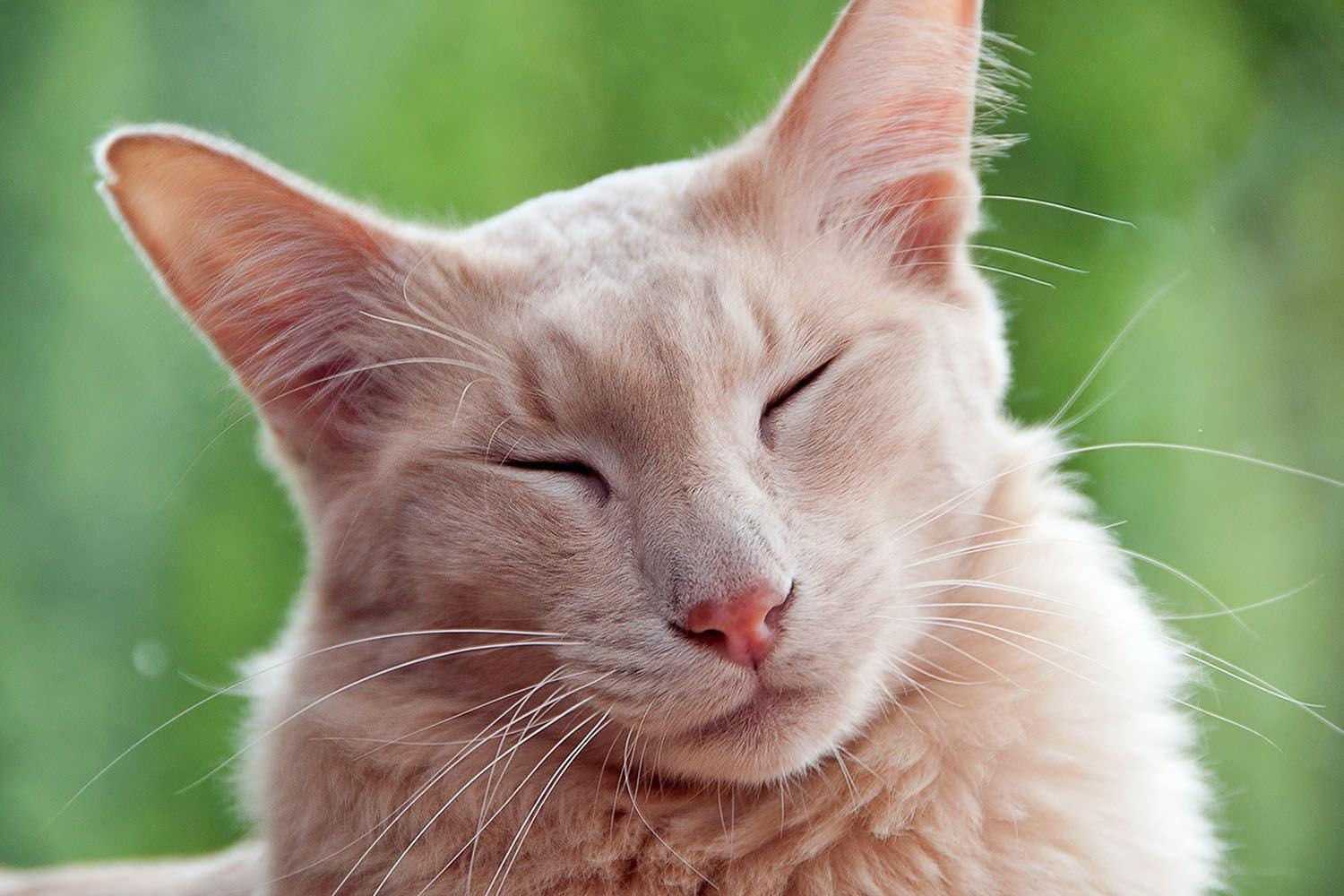
The Javanese coat is semilongo, fine and silky, and lies close to the body, so the cat keeps a sleek outline rather than looking fluffy. The longest fur is on the tail, forming a showy plume.
Coat layering is described slightly differently by organizations, but the practical takeaway is consistent for owners: it’s generally easy-care e menos propenso a emaranhar than many longhaired breeds. CFA’s standard specifically calls for sem subpêlo felpudo (a definite double coat is penalized), while TICA describes a silky coat that’s easy to maintain.
Color and pattern: classic “points,” with a wider palette
Like Siamese-family cats, Javanese have colorpoint contrast—a lighter body with darker “points” on the face mask, ears, legs/feet, and tail. Standards emphasize clear definition e contrast between body and points.
Where Javanese stands out is the expanded point-color range recognized by some registries. In CFA’s Balinese show standard, the “Javanese Division” includes additional point colors (for example red, cream, cinnamon, fawn) and also allows patterns such as lynx (tabby) points e parti-color/tortie-style points.
Comportamento e personalidade
Javanese cat temperament at a glance
Javanese cats are known for being people-focused, playful, intelligent, and communicative—a classic “gato de velcro” that wants to participate in daily life. The Cat Fanciers’ Association (CFA) describes Javanese as active, playful, extremely affectionate, and intelligent, with a strong preference for staying close to their humans.
Affection and attachment
If you want a cat that “keeps you company,” the Javanese is a great match. Many will follow you from room to room, hop into your lap quickly, and seek out touch and attention as part of their normal routine. Breed descriptions from CFA also emphasize that Javanese typically want to be on/near their people (lap, shoulder, and often the bed if allowed).
Owner tip: This closeness is adorable, but it also means Javanese are usually happiest in homes where someone is around often (or where they have another friendly pet companion).
Intelligence and trainability
Javanese tend to be curious problem-solvers. Many learn household routines quickly and may investigate cabinets, drawers, or food storage if they’re bored or motivated. CFA notes that Javanese are intelligent and have been known to learn fetch and other tricks (especially when rewarded).
Enrichment ideas that match their personality
- Short, frequent play sessions (wand toys, chase games)
- Puzzle feeders and “find the treat” games
- Clicker training for simple behaviors (sit, high-five, leash comfort)
Social with family, kids, and other pets
Well-socialized Javanese are typically extrovertido e amigável com as pessoas, and many do well in busy households. Because they’re closely related to Balinese/Siamese-family cats, registry descriptions of those sister breeds consistently emphasize a social, high-interaction nature and strong preference for company.
What this means in real life: with respectful handling and gradual introductions, many Javanese integrate well with children, other cats, and cat-friendly dogs—but they usually don’t enjoy being ignored for long stretches.
Vocal, but often “softer” than Siamese
Javanese are often described as talkative—they may chirp, meow, and “comment” when they want attention or interaction. CFA specifically mentions that Javanese do talk and have a variety of voices depending on what they’re communicating.
If you’re worried about volume, it helps to know that their close relatives (Balinese) are commonly described as less vocal than Siamese and sometimes having softer voices, which lines up with many owner experiences of Javanese being chatty without always being as loud as a classic Siamese.
Care Guide (Diet, Exercise, Enrichment, Grooming & Mental Stimulation)
Diet (healthy weight + happier behavior)
Javanese cats are active, social, and often food-motivated—so the goal is a feeding routine that supports lean muscle, stable energy, and good habits.
1. Choose a complete, life-stage diet
Pick a completo e equilibrado cat food that matches life stage (kitten/adult/senior). Pet nutrition organizations note that reputable standards (like AAFCO/FEDIAF) guide nutrient targets by life stage, and “all life stages” foods are formulated for growth/reproduction (often more calorie-dense).
2. Use measured meals (not unlimited refills)
Rather than leaving food out all day, start with measured daily portions and adjust based on body condition and your vet’s guidance—this aligns with veterinary nutrition guidance emphasizing individualized plans and routine nutritional assessment.
3. Treats: keep them small
A common evidence-based rule is to keep treats to ~10% or less of daily calories to avoid unbalancing the diet and unintentionally driving weight gain.
4. Feed the “cat way” (small meals + foraging)
Cats are natural hunters and often do better when they can eat small meals and “work” for some food (foraging/hunting games), especially in indoor settings. Feline feeding consensus guidance highlights strategies like foraging and multiple small meals to support wellbeing and reduce issues linked to stress or overeating.
Easy upgrades (high impact)
- Split the daily portion into 2–4 smaller meals (or use an automatic feeder).
- Use um puzzle feeder a few times per week (even for wet food).
- In multi-pet homes, offer separate feeding stations to prevent competition and stress.
Exercise (burn energy, prevent boredom behaviors)
Javanese cats are athletic and people-oriented, so exercise should be interactive (not just “toys lying around”).
Daily exercise targets
- Aim for 2 play sessions/day (10–20 minutes each), adjusting to age and fitness.
- Use toys that mimic prey: wand toys, lightweight balls, chase toys.
- If you use a laser pointer, end with a physical toy “catch” and/or a small meal so the hunting cycle feels complete.
Make your home a cat gym
Environmental needs guidelines emphasize providing cats with environments that reduce stress and support natural behaviors—vertical space is a major win.
- Add a tall cat tree, shelves, or window perches.
- Rotate toys weekly to keep novelty high.
Leash training
Many Javanese enjoy harness walks because they’re curious. Start indoors, go slow, and only do supervised outdoor time.
Environment & Enrichment (the “anti-stress” setup)
Because Javanese cats bond strongly with humans, enrichment isn’t optional—it’s preventive care.
A widely used framework for feline wellbeing is the AAFP/ISFM “environmental needs” approach, which centers on providing safe spaces, key resources, play/hunting opportunities, positive human interaction, and respect for the cat’s senses (like scent).
Practical enrichment checklist
- Safe zones: quiet sleeping spots, covered beds, hideaways
- Resources in multiples: 1+ litter box per cat + 1 extra; multiple water/food stations
- Foraging: puzzle feeders, treat trails, “find it” games
- Social needs: scheduled cuddle/play time (especially if you’re away often)
If you’re gone most of the day, consider:
- a compatible pet companion (when appropriate), and/or
- timed feeders + enrichment stations + a predictable routine
AAFP guidance also supports enrichment as a way to reduce stress-related and unwanted behaviors in indoor cats.
Grooming (low maintenance, but don’t skip the basics)
Javanese cat coats are typically easier than many longhaired breeds because they’re silky and less prone to heavy matting—but routine care still matters.
Casaco
- Brush 1–2×/week (more during seasonal sheds).
- Focus on friction areas: behind ears, underarms, base of tail.
Dental care (big quality-of-life factor)
Many Siamese-family cats are prone to dental disease, so home care pays off. AAHA dental guidelines emphasize the importance of home oral hygiene and ongoing preventive care (and note that successful periodontal outcomes often require consistent home care).
- Start slowly with pet-safe toothpaste; aim for frequent brushing (daily if possible).
- Ask your vet about professional dental exams/cleanings and VOHC-accepted products as add-ons.
Ears + nails
- Check ears weekly; clean only if you see wax/debris (and only with cat-safe products).
- Trim nails every 2–4 weeks, and keep scratching posts available.
Mental Stimulation (a must for “Velcro + genius” cats)
Javanese cats are bright and social. When understimulated, they can become noisy, clingy, or mischievous—so mental stimulation is behavior prevention.
Simple mental enrichment ideas
- Clicker training (sit, high-five, target touches) + tiny food rewards
- Food puzzles or scatter feeding (indoor “hunt”)
- Rotate “special toys” (only available during playtime)
- Short, frequent interaction bursts (2–5 minutes) throughout the day
Health Concerns (Common Risks in Javanese / Balinese-Type Cats)
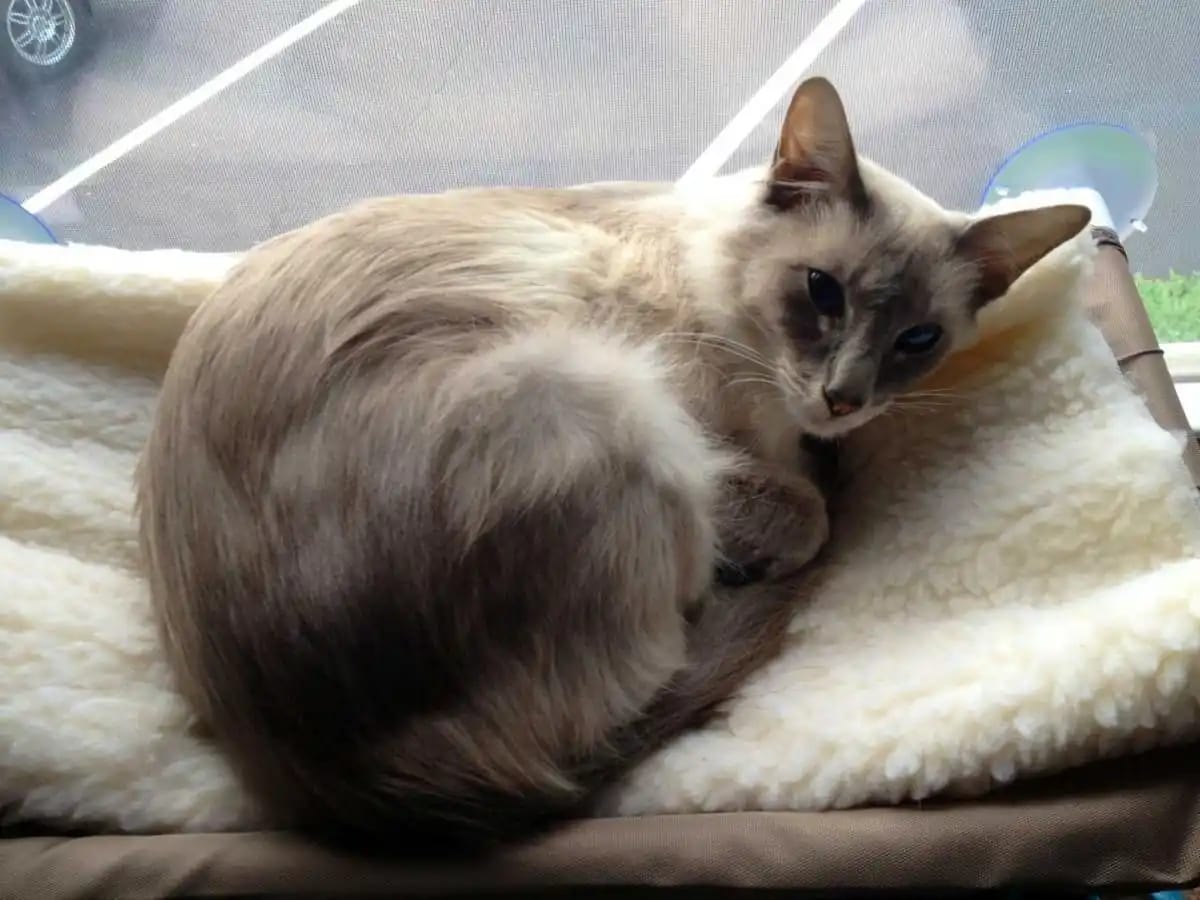
Most Javanese cats live long, healthy lives, but as part of the Siamese/Balinese/Oriental family, they may be more likely than average to experience certain inherited or breed-associated issues—especially amyloidosis, progressive retinal atrophy (PRA), and dental disease.
This section focuses on what owners can watch for, plus which screenings to ask a breeder or veterinarian about.
Importante: This is general education, not a diagnosis. If your cat has breathing trouble, sudden weakness, or sudden vision changes, treat it as urgent and contact a vet.
Quick table: symptoms, tests, and prevention
| Condição | What you may notice (owner-friendly signs) | What a vet uses to confirm | Practical prevention & management |
|---|---|---|---|
| Eye conditions (strabismus & PRA) | Strabismus (crossed eyes) is often present in Siamese-type lines and may be stable; PRA can start as night-vision issues, bumping into objects in dim light, or dilated pupils. | Full eye exam; for PRA, retinal exam ± specialized testing; some genetic tests exist for certain PRA variants (breed/line dependent). | Strabismus: if it’s been present since kittenhood and unchanged, many cats adapt; new/sudden strabismus in an adult should be checked promptly. PRA: no cure, but cats often do well with home adaptations; ask breeders about eye history and screening. |
| AA Amyloidosis (liver/kidney involvement) | Can be vague early: weight loss, poor appetite, lethargy; depending on organ affected, signs may progress. In Siamese/Oriental lines, deposits often involve the liver. | Bloodwork + urinalysis; imaging as needed; definitive diagnosis may require advanced testing. | There’s no single at-home prevention, so focus on (1) choosing breeders who track health in their lines, and (2) routine wellness exams with baseline labs. |
| Heart disease (HCM / cardiomyopathy) | Many cats show no symptoms early. Possible signs later: fast/labored breathing, lethargy, collapse; blood clots can cause sudden hind-limb weakness/pain. | Echocardiogram (heart ultrasound) is the key test for diagnosing cardiomyopathy and assessing severity. | Ask breeders if breeding cats receive periodic echo screening (especially if there’s family history). |
| Dental disease (periodontal disease & tooth resorption) | Bad breath, drooling, red gums, pawing at mouth, dropping food, chewing on one side. Tooth resorption can be doloroso and surprisingly common. | Oral exam; dental X-rays are often needed to detect resorption below the gumline. | Best prevention is tooth brushing (daily ideal) + routine dental checks/cleanings as advised. |
| Respiratory issues (feline asthma / bronchial disease) | Coughing, wheezing, rapid breathing, “hunched” posture during an episode, open-mouth breathing (emergency). | Diagnosis is clinical + imaging and rule-outs; there is no single definitive test. | Long-term control often uses anti-inflammatory therapy (including inhaled or oral corticosteroids) and sometimes bronchodilators. Avoid triggers (smoke, dusty litter, strong fragrances). |
| Joint issues (arthritis; sometimes hip dysplasia) | Reduced jumping, stiffness, less play, slower stairs, escondido more. Arthritis can be subtle. | Exam + history; imaging when needed. | Keep an ideal weight, provide ramps/soft bedding, and ask your vet about pain control or joint support if signs appear. |
| Congenital deafness (mainly in white/blue-eyed cats) | Not responding to sound; startled when approached; very deep sleep. Risk is much higher in all-white cats with blue eyes. | BAER hearing test (vet specialist test). | If a kitten appears deaf, test early and adapt the home (hand signals, vibration cues, safe indoor environment). |
Essa raça é ideal para você?
Javanese cat (often described as Colorpoint Longhair and closely tied to the Balinese/Siamese family) are typically active, playful, extremely affectionate, and very people-focused—the kind of cat that wants to be on your lap, shoulder, or following you around the house.
They also tend to be tagarela and can be demanding about attention, so lifestyle fit matters.
Quick decision: best match vs not ideal
| Best match if you… | Not ideal if you… |
|---|---|
| Want a very affectionate, interactive companion that seeks closeness daily | Are away from home for long hours most days (they often dislike being left alone) |
| Enjoy a cat that may “talk” to you and communicate often | Need a very quiet pet or a calm, low-social-demand household |
| Can provide daily play + enrichment (climbing, puzzle toys, interactive time) | Prefer a “low-engagement” cat that mostly entertains itself |
| Want a low-shedding longhair-type coat with easier upkeep (silky single coat, minimal shedding/matting) | Expect a truly “hypoallergenic” cat (no breed is guaranteed allergy-safe) |
| Have a family or other pets and can do proper introductions (often fits well in family life) | Want a strictly independent, “seen-not-heard” cat |
First-time cat owners: can it work?
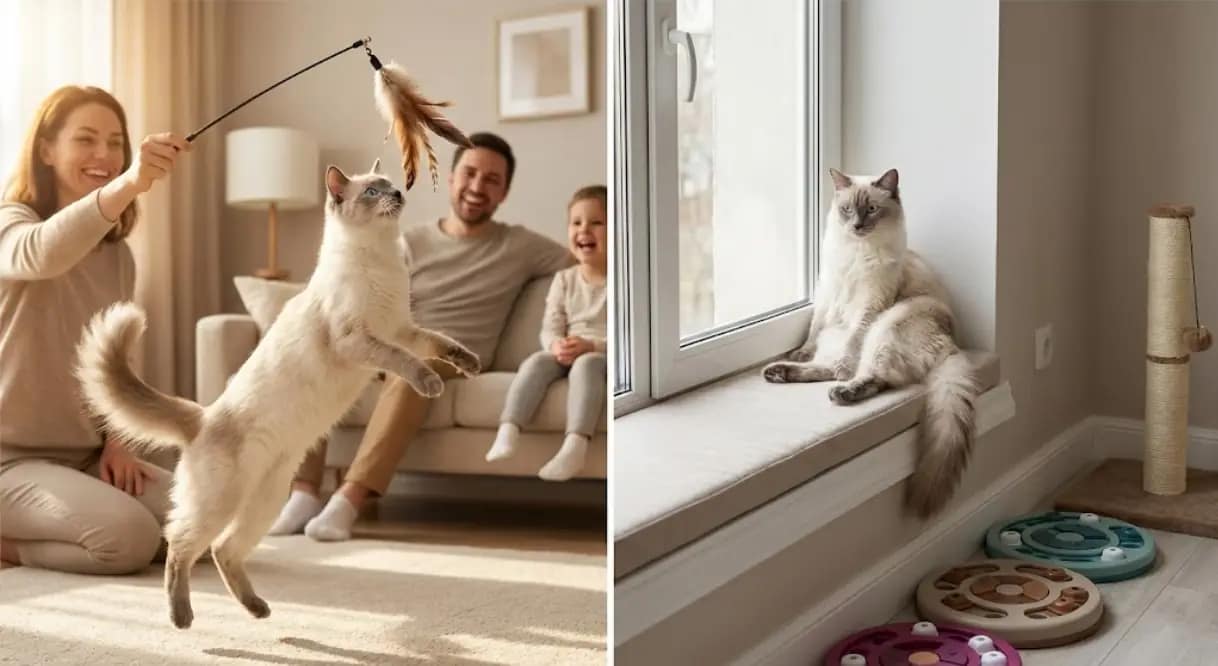
Maybe—if you want a social, involved cat. Javanese/Balinese-type cats are often smart and responsive, but they usually do best with owners who enjoy training, play, and frequent interaction.
If you’re new to cats e you’re away a lot, consider adopting an adult cat with a known temperament or plan for extra companionship and enrichment.
30-second self-check (honest answers)
If you say “yes” to 3 or more, you’re likely a great match:
- Eu posso dar two short play/interaction sessions daily most days.
- I don’t mind a cat that’s vocal and communicative.
- I want a cat that’s emotionally close and follows me around.
- My home has espaço vertical (cat tree/shelves) and enrichment.
- I’m okay with a cat that may struggle if left alone for long periods.
PERGUNTAS FREQUENTES
Os gatos javaneses são bons animais de estimação?
Sim, eles são carinhosos, inteligentes e leais. Ideal para donos que desejam um companheiro interativo.
Os gatos javaneses gostam de ser segurados? ou acariciado?
A maioria gosta! Eles gostam de proximidade física e geralmente sentam no colo ou dormem ao seu lado.
Quão vocais são os javaneses? gatos?
Bastante vocal, embora um pouco mais suave do que o siamês. Eles "conversam" com você regularmente.
Os gatos javaneses precisam de muito aliciamento?
De forma alguma. Sua pelagem de camada única é fácil de manejar com escovação semanal.
Os gatos javaneses são hipoalergênico?
Nenhum gato é hipoalergênico, mas o javanês solta menos pelos e pode ser mais fácil para quem sofre de alergias.
Qual é a diferença entre um Javanês e um gato balinês?
Principalmente as cores da pelagem. Os javaneses são gatos balineses com cores de ponta não tradicionais (por exemplo, vermelho, creme, tortie, lince).
Fatos bônus
Não de Java
Apesar do nome, os gatos javaneses nunca viveram em Java. A raça foi desenvolvida nos EUA e no Canadá. O nome foi escolhido para complementar o nome da raça balinesa (Bali e Java são ilhas próximas uma da outra) - uma referência à herança oriental em vez da origem real.
Raça anterior Status
O javanês teve um pouco de crise de identidade. Em um determinado momento, a CFA o reconheceu como uma raça distinta (separada do balinês), mas depois reverteu essa decisão. Hoje, a CFA considera o javanês apenas uma classe de cor do balinês. Se você pesquisar alguns pedigrees, poderá encontrar gerações mais antigas rotuladas como javanesas, mas seus descendentes agora registrados como balineses.
Casaco de Muitos Cores
O CFA já listou 24 variações diferentes de pontos de cor para gatos javaneses, além disso para as quatro cores balinesas (siamesas). Essa extensa paleta significa que os Javaneses/Colorpoint Longhairs têm, sem dúvida, uma das mais variadas gamas de cores de qualquer raça de gato.
Saltos Capacidade
Os gatos javaneses são incríveis saltadores. Eles são conhecidos por saltarem para o topo de portas ou para prateleiras altas com facilidade. Nenhum lugar em sua casa está realmente fora do alcance de um javanês determinado! Fornecer poleiros altos é quase uma obrigação, ou então espere que eles criem seus próprios poleiros acessando móveis altos.
Alimentos Amantes
Muitos javaneses são obcecado por comida. Eles costumam ter um apetite intenso e miarão para pedir petiscos ou tentarão provar a comida humana. De fato, o amor deles por comida é tão notório que os donos precisam cuidar da dieta deles. Um benefício peculiar disso: a motivação alimentar facilita o treinamento, pois eles fazem de tudo por um petisco favorito!
Gatos de velcro
Um apelido que às vezes é dado aos javaneses (e balineses) é "gato de velcro", devido ao fato de que preso a você eles gostam de estar. Não se surpreenda se o seu javanês o seguir até o banheiro, subir na sua mesa enquanto você trabalha e, em geral, ficar a poucos metros de você o tempo todo. Eles simplesmente adoram seus humanos.
Falante e compreensivo
Os javaneses costumam conversar com seus donos. Os entusiastas juram que esses gatos podem praticamente "responder" às suas palavras com miados diferentes. Embora seja discutível o quanto eles entendem, sua capacidade de resposta dá a deliciosa impressão de que eles compreender a fala humana ou, pelo menos, estão tentando sinceramente! Eles certamente entendem o tom e responderão ao seu nome ou a uma conversa carinhosa.
ÚnicoCasaco Vantagem
Como os javaneses têm apenas uma camada de pelagem, eles produzem menos alérgenos através da pele e também não têm tantas bolas de pelo (já que ingerem menos pelo ao se limparem). Nenhum gato é realmente não alergênico, mas o javanês frequentemente aparece em listas de raças mais "amigáveis à alergia" por esse motivo.
Raros Gema
Os gatos javaneses são relativamente raros. Talvez você não encontre um em um abrigo local (embora sempre valha a pena verificar os grupos de resgate!). Às vezes, os criadores os vendem por um preço mais alto devido à sua raridade e à criação especializada. Essa raridade pode fazer com que os proprietários de javaneses sintam que têm uma joia especial escondida no mundo dos gatos.
Parte do Oriental Família
O javanês faz parte de um grupo maior de raças, geralmente chamado de Família oriental - incluindo siamês, balinês, oriental de pelo curto, oriental de pelo longo, colorpoint de pelo curto, etc. Todos compartilham um ancestral comum, o siamês. Isso significa que se você gosta de uma dessas raças, talvez goste das outras também, pois elas têm tipo e temperamento semelhantes (com pequenas diferenças, principalmente na pelagem e na cor).
Referências
Christmann, Karen; Harr, Barbara (2012) [1993]. "Artigo sobre a raça: Javanês". CFA.org. Associação de criadores de gatos. Archived from the original on October 29, 2012. Retrieved July 13, 2018.
"Comparações de raças - Balinês - Congresso Mundial de Gatos". www.worldcatcongress.org. Recuperado em 18 de agosto de 2023.
"Gato javanês". www.cfa.org. Recuperado em 18 de agosto de 2023.
Helgren, J. Anne (1997). "Javanês". Enciclopédia Barron de Raças de Gatos: Um Guia Completo para os Gatos Domésticos da América do Norte. Série educacional da Barron. ISBN 978-0-7641-5067-8..
Alderton, David (1992). "Balinês/Javanês". Em Negus, Daphne (ed.). Gatos. Série "Eyewitness Handbooks". Dorling Kindersley (DK) / Houghton Mifflin. ISBN 978-1-56458-073-3..
Somerville, Louisa (2007). O guia definitivo para raças de gatos. Edison, Nova Jersey: Chartwell Books. p. 44. ISBN 9780785822646. Há muita confusão em torno do uso desse nome no mundo dos gatos, embora ele seja sempre usado para descrever gatos de tipo distintamente oriental. Ele foi adotado simplesmente por causa da tradição que cresceu de usar os nomes de países e ilhas do sudeste asiático para outras raças orientais, como o siamês e o balinês.
"Sobre os balineses". CFA.org. Associação de criadores de gatos. 2018. Arquivado from the original on July 13, 2018. Retrieved July 13, 2018.
Schneck, Marcus; Caravan, Jill (1990). Fatos sobre gatos. Barnes & Noble Livros. ISBN 978-0-88029-558-1.








 EN
EN DE
DE ES
ES PT
PT