
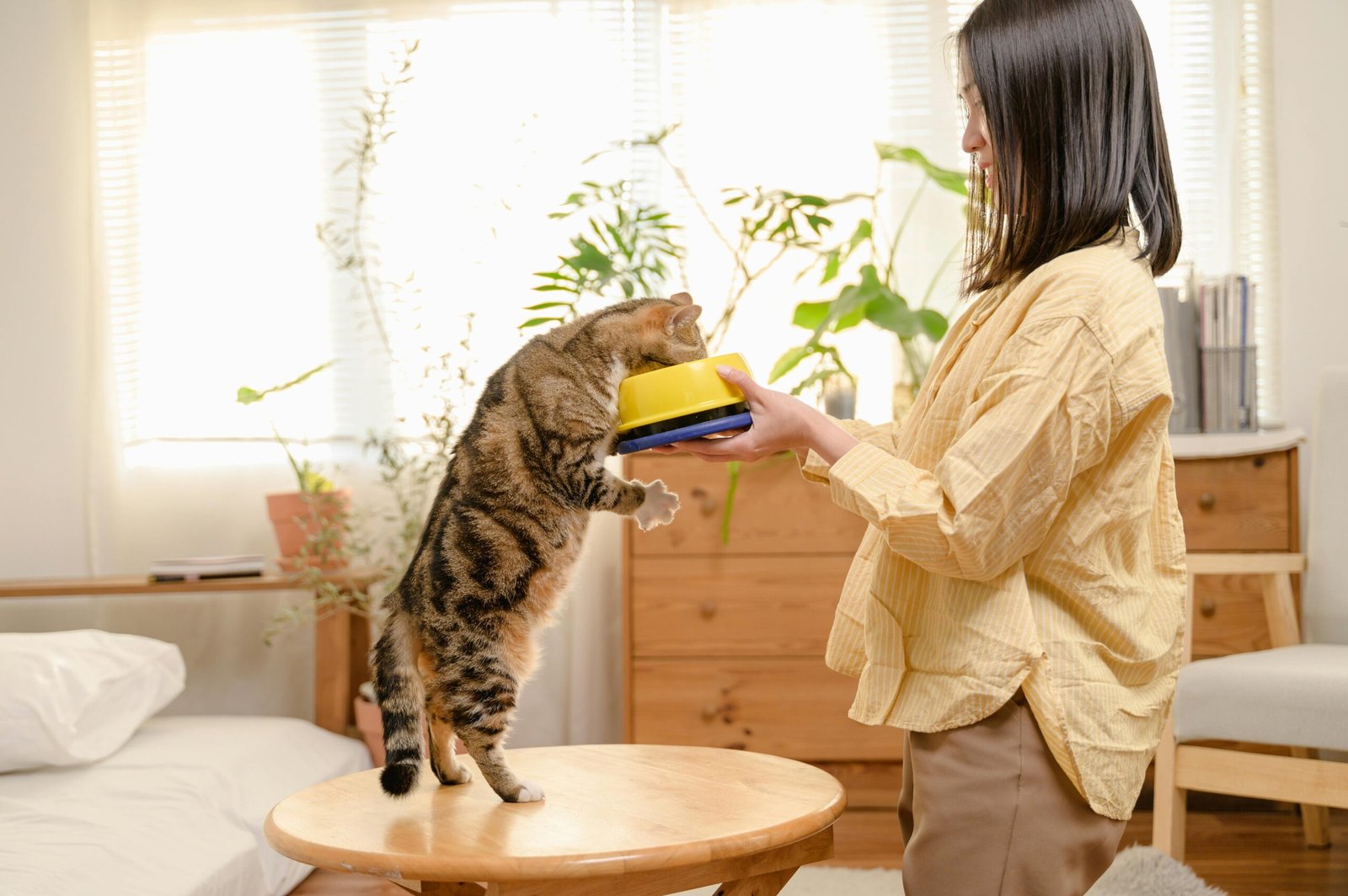
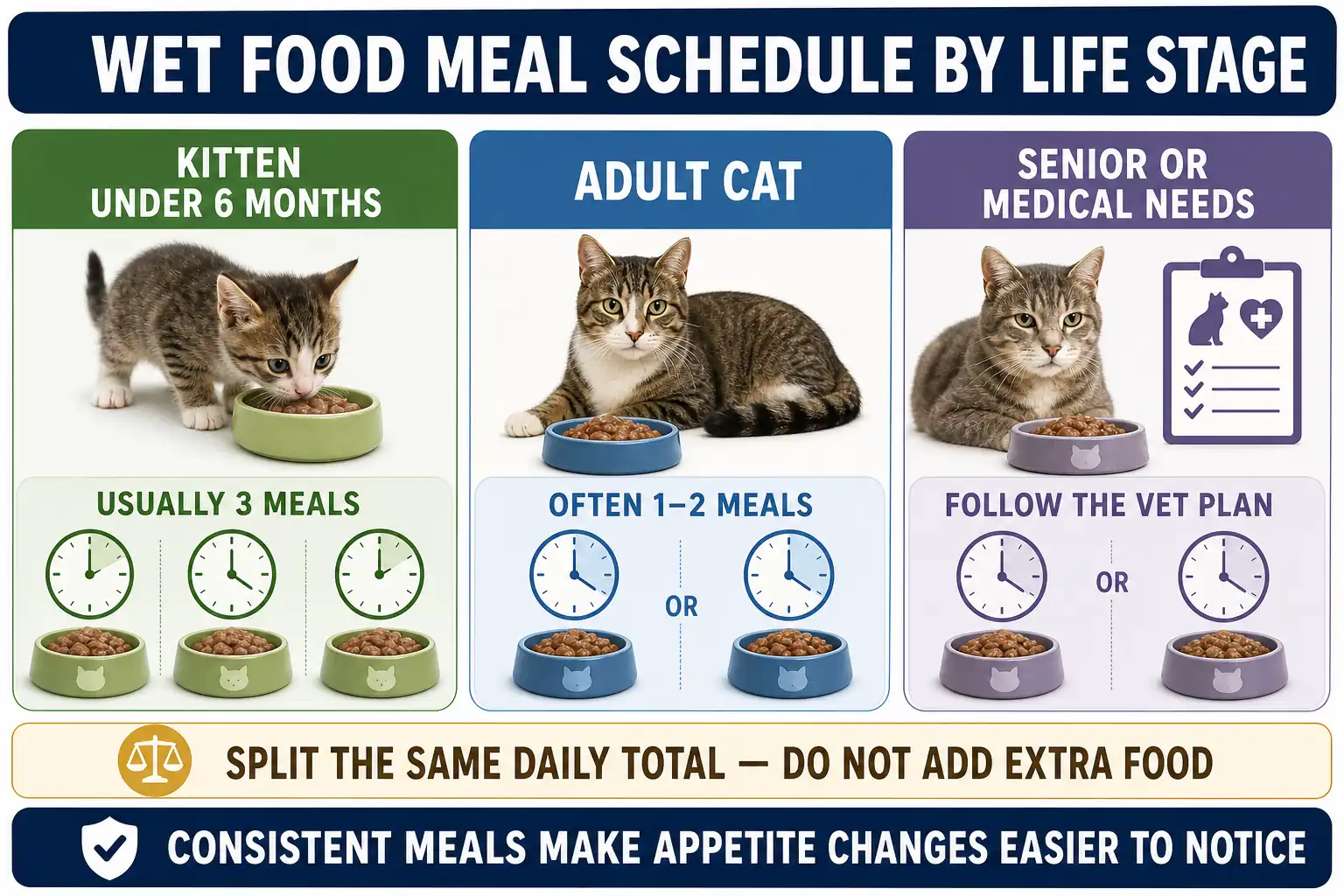
Most healthy adult cats can be fed wet Lebensmittel once or twice a day, while kittens under about six months usually need three meals daily. The best schedule divides the cat’s already-calculated daily food total into consistent meals. Alter, appetite, household routine, body condition, and medical needs can change the ideal frequency.
This guide is educational. Follow your veterinarian’s schedule for kittens with growth concerns, cats with medical conditions, cats on therapeutic diets, and cats with sudden appetite or weight changes.
Inhaltsübersicht
- How many times a day should a cat eat wet food?
- How often should kittens eat wet food?
- Is once-a-day wet food feeding enough?
- How do I build a practical wet-food schedule?
- How does mixed wet and dry feeding change the schedule?
- How long can wet food stay in the bowl?
- When should I call a veterinarian about eating patterns?
- Schlussfolgerung
- Häufig gestellte Fragen
- Referenzen
How many times a day should a cat eat wet food?
For many healthy adult cats, one or two measured wet-food meals per day can work. Feeding twice daily is often convenient because it spreads the daily total across morning and evening and makes appetite changes easier to notice.
| Katze oder Situation | Praktischer Zeitplan für den Start | What matters most |
|---|---|---|
| Kitten under about 6 months | Usually 3 meals daily | Growth needs, small stomach, and veterinarian guidance |
| Older kitten from about 6 months to 1 year | Often 2 meals daily | Continue food labeled complete and balanced for growth |
| Gesunde erwachsene Katze | Often 1-2 measured meals daily | Maintain the correct daily total and body condition |
| Ältere Katze | Often 1-2 meals, adjusted as needed | Monitor appetite, weight, muscle condition, and health |
| Cat on a therapeutic diet | Follow the veterinarian’s plan | Medication, disease, and diet instructions may affect timing |
| Cat that prefers small meals | Divide the same daily total into more portions | Do not add extra food simply because meals are smaller |
Cornell notes that kittens up to six months may do best with three meals daily, while cats from six months to maturity and many adults generally do well with twice-daily feeding.1 These are useful starting patterns, not rigid rules for every cat.
How often should kittens eat wet food?
Young kittens generally need more frequent meals than adult cats because they are growing and have smaller stomachs. Use a complete-and-balanced kitten food and review growth, appetite, and body condition with a veterinarian.
A practical kitten schedule
| Lebensphase | Example daily rhythm |
|---|---|
| Weaning or very young kitten | Follow a veterinarian or experienced rescue’s individual feeding plan |
| Kitten under about 6 months | Breakfast, midday meal, and evening meal |
| Kitten about 6-12 months | Often breakfast and evening meals, if growth and intake remain appropriate |
| Approaching adulthood | Ask when to transition from kitten food and reassess portions |
Do not simply feed an adult portion more often. Kittens need food formulated for growth, and their total daily amount changes as they grow. If a kitten refuses food, seems weak, vomits, has diarrhea, or is not gaining appropriately, contact a veterinarian promptly.
The SnuggleSouls guide on Wann sollte man von Kätzchenfutter auf Katzenfutter umsteigen? can help you prepare for the transition, but your veterinarian should guide unusual growth or appetite patterns.
Is once-a-day wet food feeding enough?
Once-daily wet-food feeding may be workable for some healthy adult cats if the meal provides the correct daily amount, the cat eats comfortably, and the food is not left sitting out unsafely. Many households and cats find two smaller meals more practical.
Consider splitting the daily amount when:
- the cat leaves part of a large meal uneaten
- the food dries out before the cat finishes
- the cat eats too quickly and then appears uncomfortable
- a second meal makes medication or monitoring easier
- the cat becomes highly food-focused between meals
- you need a clearer way to notice appetite changes
Meal frequency alone does not solve vomiting, persistent hunger, weight change, or illness. If your cat regularly vomits, refuses food, loses weight, or acts unwell, contact a veterinarian instead of repeatedly changing the schedule.
How do I build a practical wet-food schedule?
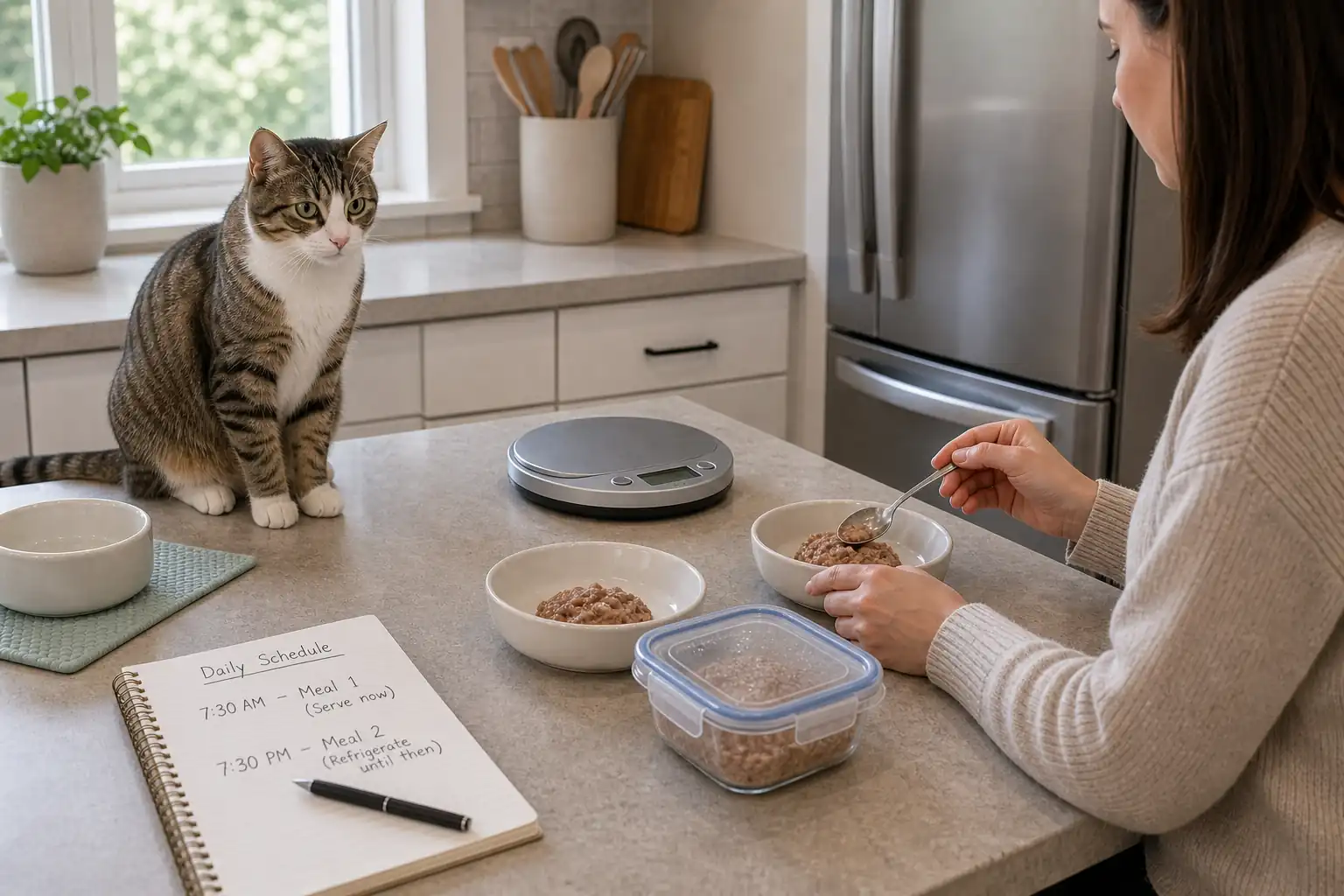
First determine the correct daily total, then choose meal times your household can follow consistently. A reliable schedule is better than a complicated plan that changes every day.
- Calculate or confirm the cat’s total daily food amount.
- Choose one, two, or more meal times appropriate for the cat.
- Divide the same daily total across those meals.
- Measure portions rather than estimating by bowl appearance.
- Serve food fresh and remove uneaten food according to the product directions and room conditions.
- Record appetite or leftover changes.
- Reassess weight and body condition regularly.
| Daily routine | Example schedule |
|---|---|
| Two-meal adult schedule | Half the daily wet-food total in the morning and half in the evening |
| Three-meal kitten schedule | Divide the daily kitten-food total across morning, midday, and evening |
| Small-meal schedule | Divide the same daily total into several measured portions |
| Variable work schedule | Use consistent anchor meals and plan safe refrigeration or supervised serving |
For the calculation that comes before scheduling, use wie viel Nassfutter man einer Katze geben kann. That page converts a daily Kalorien target into cans or pouches; this page focuses on when to serve that total.
How does mixed wet and dry feeding change the schedule?
Mixed feeding still uses one daily calorie budget. Wet food and dry food should not each be fed as a full daily ration.
One practical pattern is:
- measured wet-food meal in the morning
- measured dry-food portion used in a puzzle feeder or timed feeder
- measured wet-food meal in the evening
Add the calories from both formats and treats. If you introduce wet food without reducing the dry-food portion, the cat may gain weight even though each food is nutritious on its own.
For help balancing formats, see Nassfutter vs. Trockenfutter. For the complete daily amount across all foods, use Wie viel Futter braucht eine Katze?.
How long can wet food stay in the bowl?
Wet food is perishable and should not remain at room temperature indefinitely. Follow the product’s handling instructions, consider room temperature, and discard food that has become unsafe, contaminated, dried out, or unappealing.
Use these practical habits:
- serve a portion the cat is likely to finish
- use a clean bowl for each fresh meal
- cover and refrigerate unused food promptly according to the label
- use clean utensils rather than returning a used spoon to stored food
- do not mix fresh food into an old, unwashed bowl
- discard questionable food instead of relying on smell alone
FDA explains that pet-food labels include directions and other information needed to use the product appropriately.3 Die SnuggleSouls Leitfaden zur Lagerung von Nassfutter für Katzen covers storage in more detail.
Avoid using a single universal time limit without considering the package instructions and room conditions. Food spoils faster in warm environments, while some feeders are specifically designed to keep portions chilled.
When should I call a veterinarian about eating patterns?
A schedule problem should improve when the routine becomes consistent. A sudden or persistent appetite change, weight change, or illness sign needs veterinary attention rather than endless meal-timing experiments.
Contact a veterinarian if your cat:
- suddenly refuses food or eats much less than usual
- loses weight unexpectedly or fails to grow appropriately
- repeatedly vomits or develops persistent diarrhea
- seems weak, painful, unusually sleepy, or withdrawn
- struggles to chew or appears painful while eating
- drinks or urinates much more or less than usual
- remains intensely hungry despite an appropriate measured intake
- has a medical condition or therapeutic diet that may affect timing
Cornell emphasizes that feeding decisions should consider life stage, health, and body condition.2 WSAVA also treats nutrition and body-condition assessment as routine parts of veterinary care.4
Nutze die SnuggleSouls Rechner für Körperzustand und Gewicht to organize observations, but do not use it to delay a veterinary assessment when the cat is unwell.
Schlussfolgerung
For most healthy adult cats, feeding wet food once or twice daily can work; kittens usually need more frequent meals. The strongest schedule is not the one with the most meals. It is the one that consistently divides an appropriate daily total, keeps food fresh, fits the cat’s life stage, and makes appetite changes easy to notice.
Choose a routine you can maintain, measure every portion, and adjust only after checking body condition and the total daily intake. When appetite, weight, digestion, or health changes, involve your veterinarian instead of assuming a different meal time will solve the problem.
Häufig gestellte Fragen
Is it okay to feed a cat wet food twice a day?
Yes. Two measured wet-food meals are a practical schedule for many healthy adult cats, provided the combined meals equal the correct daily amount.
Can I feed my cat wet food only once a day?
Some healthy adult cats can do well with one wet-food meal, but two smaller meals may be easier to finish and monitor. The correct daily total and food safety matter more than the meal count alone.
How often should a kitten eat wet food?
Kittens under about six months commonly need three meals daily. Very young kittens, kittens with health concerns, and kittens that are not growing appropriately need individualized veterinary guidance.
Can I leave wet food out all day?
No. Wet food is perishable. Follow the product’s handling instructions, consider room temperature, and remove food that has been left out, contaminated, dried out, or become unappealing.
Should senior cats eat more frequent meals?
Some senior cats prefer smaller frequent meals, but others do well with one or two meals. Monitor weight, muscle condition, appetite, and health, and ask a veterinarian about persistent changes.
Does feeding more often mean feeding more food?
No. More meals should divide the same appropriate daily total. Adding a new meal without reducing the other portions increases daily calories.
Referenzen
[1] Cornell Feline Health Center. Wie oft sollten Sie Ihre Katze füttern?.
[2] Cornell Feline Health Center. Die Fütterung Ihrer Katze.
[3] US-Behörde für Lebens- und Arzneimittelsicherheit (FDA). Etiketten für Tierfutter – Allgemeines.
[4] Weltverband der Kleintierärzte. Globale Ernährungsrichtlinien.
 EN
EN DE
DE ES
ES PT
PT