
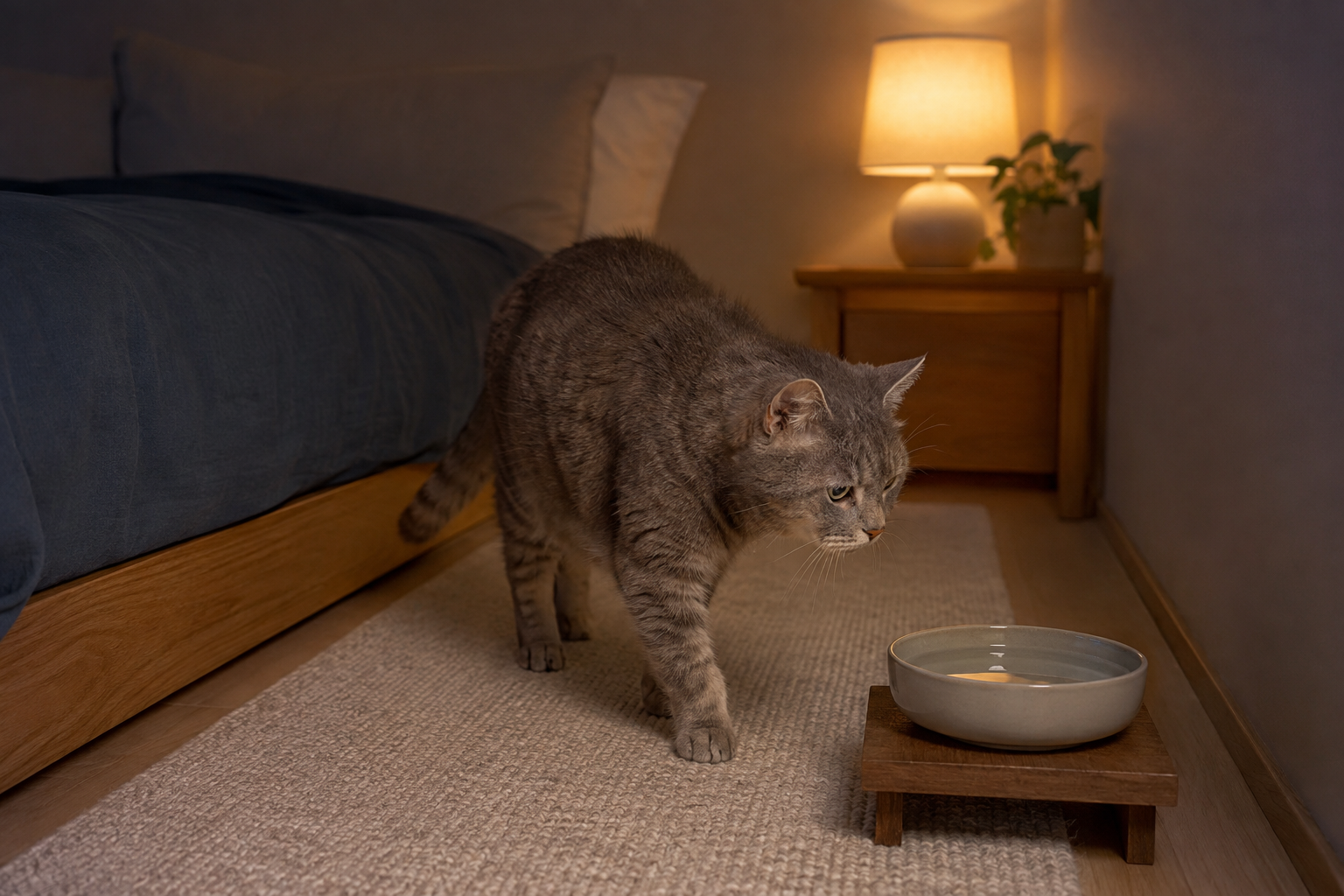
A senior cat who drinks at night needs water close enough to reach without jumping, slipping, or choosing between pain and thirst. Set up a shallow, stable bowl on a nonslip surface, keep the path softly lit, and treat any sudden change in thirst, urination, appetite, or mobility as a reason to call your veterinarian.
Older cats often look normal until a daily task becomes too hard. Cornell notes that arthritis is common in older cats and may make it difficult to reach food, water, and litter boxes, especially when jumping or stairs are involved 1. The goal of a bedroom water station is simple: make drinking easy during the stiffest hours of the day, while giving you better clues about whether your cat is moving, drinking, and eliminating normally.
This guide focuses on bedroom water access at night. For the broader room setup, pair it with SnuggleSouls' senior cat bedroom arthritis-friendly setup guide.
Inhaltsübersicht
- Is water access at night different for senior cats?
- Where should you place bedroom water for an older cat?
- What bowl height is easiest for a stiff senior cat?
- How do you build a safe night path to water?
- What hydration clues should you track?
- When should drinking changes trigger a vet call?
- What should you avoid around senior cat water stations?
- Conclusion: Put water where your cat can reach it safely
- Häufig gestellte Fragen
- Referenzen
Is water access at night different for senior cats?
Yes. Night water access is different because senior cats may wake up stiff, navigate in dim light, and avoid stairs or slick floors they handled easily when younger. A bowl in the kitchen may technically be available, but it is not helpful if your cat must jump down, cross slippery flooring, pass another pet, or climb stairs to drink.
Cornell's older-cat care guidance says food, water, and litter boxes should be easy to reach, and that some older cats benefit from bowls in more than one place 2. That advice matters at night because older cats may be less confident after sleep, especially if arthritis, vision changes, kidney disease, or weakness is involved.
Think of bedroom water as a low-effort resource, not a luxury. It should let your cat wake up, take a few stable steps, drink, and return to rest without a hard decision.
Where should you place bedroom water for an older cat?
Place water near your cat's usual sleeping area, but not so close that bedding, litter, food, or foot traffic makes the station stressful. A good starting point is a quiet wall or corner within a short, straight walk from the bed your cat actually uses.
Use this placement check:
| Placement question | Better answer | Warum das wichtig ist |
|---|---|---|
| Can the cat reach it without jumping? | Yes, from the floor or a low bed path | Reduces joint strain after sleep |
| Is the floor stable? | Rug runner, nonslip mat, or low-pile carpet | Helps stiff paws and hips feel secure |
| Is it away from the litter box? | Separate by as much space as the room allows | Cats often prefer key resources apart |
| Can another pet block it? | No narrow doorway or one-way corner | Senior cats may avoid conflict at night |
| Can you see whether water changed? | Bowl is easy to check each morning | Helps track patterns without hovering |
If your senior cat also struggles to reach the litter box at night, keep water and toileting access in the same planning zone without crowding them together. SnuggleSouls' guide to multiple litter boxes for senior cats can help you think through floors, distances, and backup spots.
The AAFP/ISFM environmental guidelines explain that cats need accessible environmental resources such as food, water, toileting areas, resting areas, and safe places, and that meeting those needs supports welfare and reduces stress-related problems 5. For a senior cat, accessibility means the resource is usable when the cat is tired, stiff, and alone in the room.
What bowl height is easiest for a stiff senior cat?
The easiest bowl height is the one that lets your cat drink with a relaxed neck and steady paws. For many senior cats, that means a shallow bowl on the floor or on a very low, stable riser, not a tall stand.
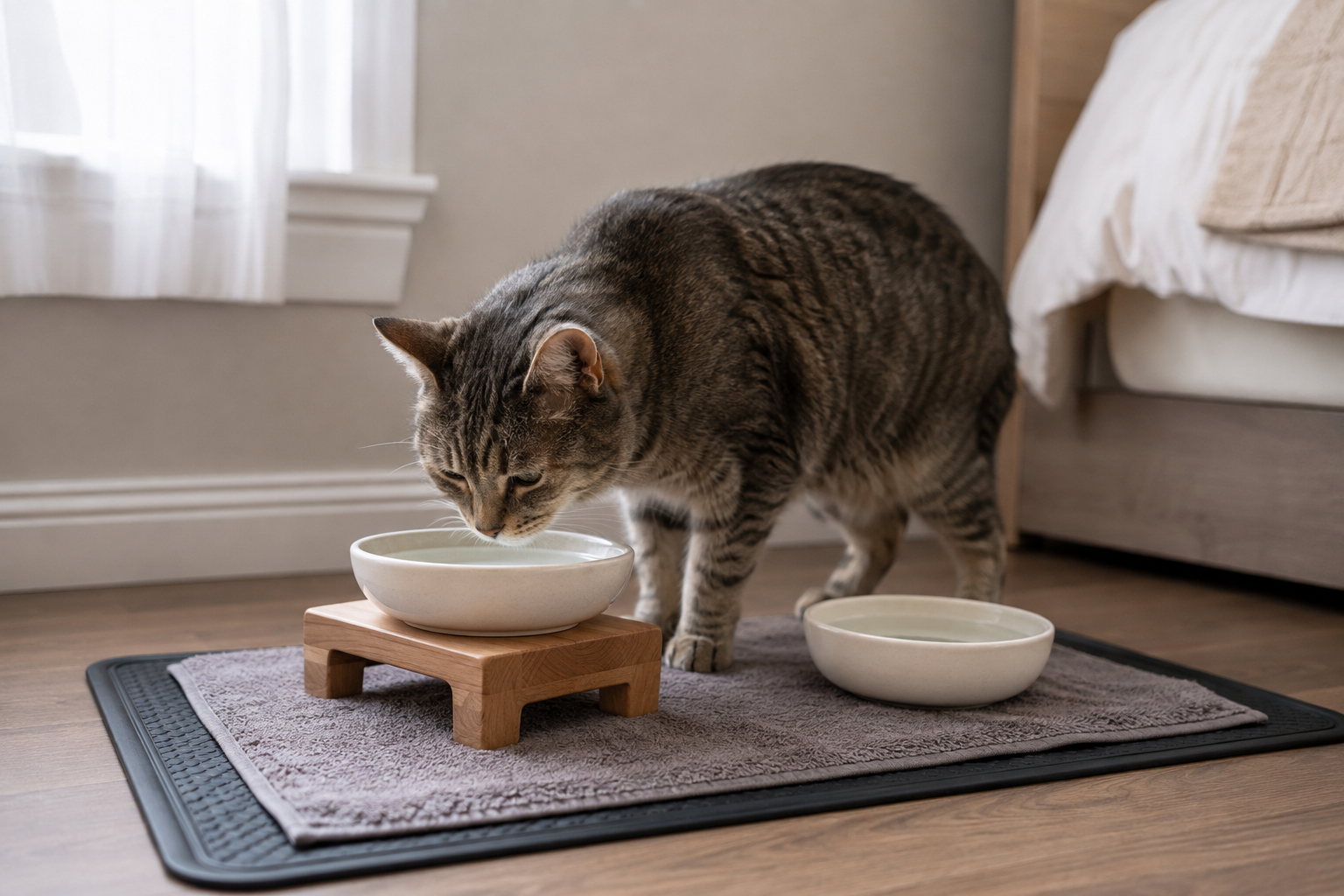
Start low. A small riser may help a cat who dislikes deep crouching, but too much height can force the shoulders, elbows, neck, or back into an awkward position. The bowl should never wobble, slide, tip, or require your cat to stretch upward. If you test a raised bowl, keep a floor-level bowl nearby so your cat can choose.
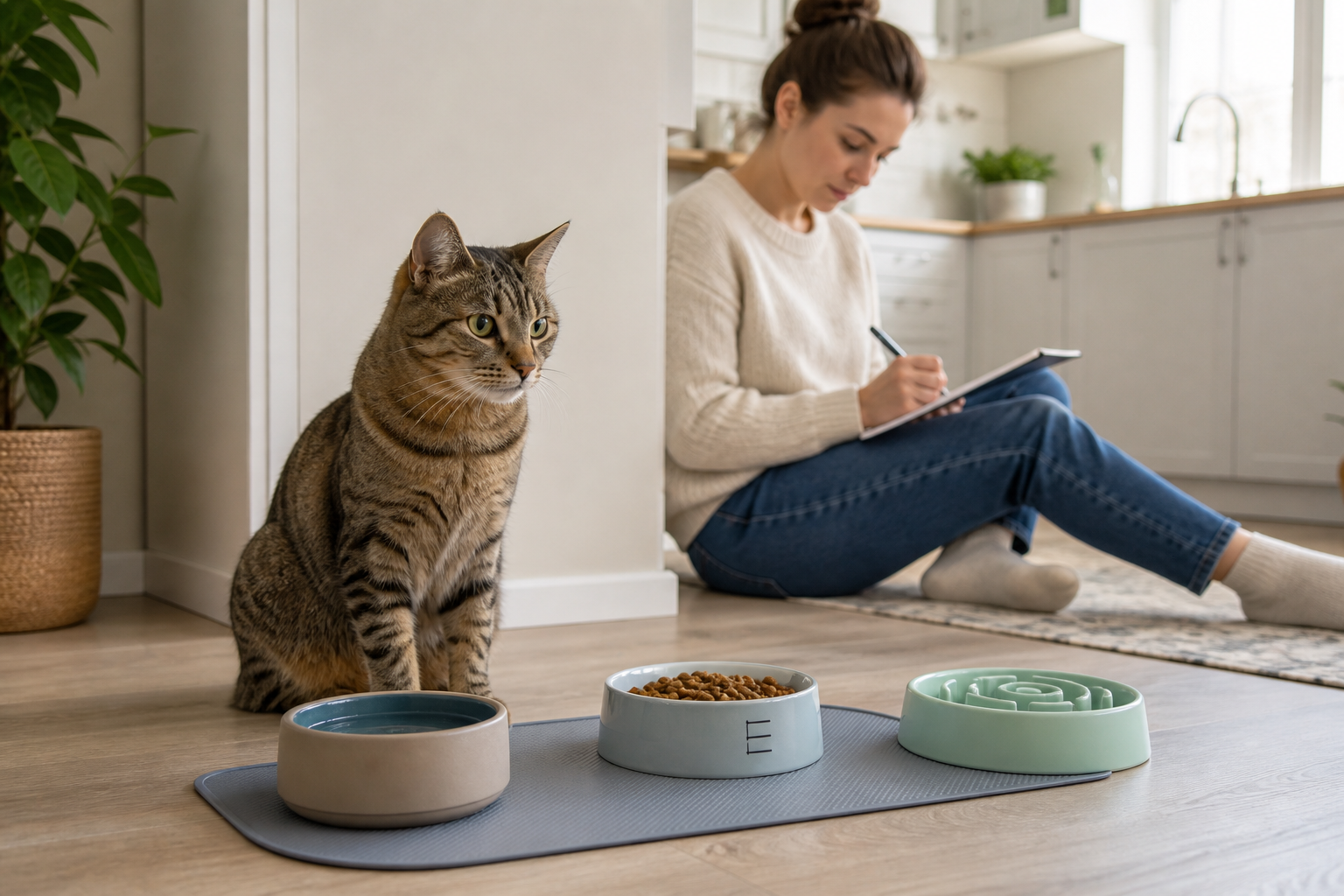
Good senior-cat water bowls are:
- Wide enough that whiskers do not press hard against the sides
- Shallow enough for easy drinking and easy cleaning
- Heavy or rubber-backed enough not to slide
- Placed on a waterproof nonslip mat
- Washed daily so water stays appealing
- Easy for you to refill before bedtime
Avoid assuming one product solves the problem. Watch your cat's body. If they brace their front legs, twist sideways, drink less, or avoid the station, the height, surface, location, or bowl shape may be wrong.
How do you build a safe night path to water?
Build the path as if your cat will use it half-asleep: short, visible, nonslip, and free of surprises. The path matters as much as the bowl because a perfect water station is useless if your cat must cross slick flooring or dodge clutter to reach it.
The 2021 AAHA/AAFP Feline Life Stage Guidelines note that senior cats may benefit when resources are increased so they do not have to move as far to reach food, water, or a litter box 4. That does not mean placing bowls everywhere. It means putting the right resources where your individual cat can use them comfortably.
A practical night path includes:
- A flat rug runner or nonslip mats from sleeping spot to water.
- A soft night light that shows the route without startling your cat.
- No laundry piles, loose cords, bags, shoes, or storage bins in the route.
- Enough width for your cat to turn around without backing up.
- A second route out if another pet can block the doorway.
For cats with arthritis, combine this water route with the broader steps in SnuggleSouls' guide to help an arthritic cat at home. If the same bedroom route also leads to a litter box, a low-entry litter box for senior cats may reduce the chance that your cat drinks but then avoids toileting because the box is too hard to enter.
What hydration clues should you track?
Track water changes together with litter box output, appetite, weight, vomiting, energy, and mobility. Drinking more or less is not a diagnosis by itself, but it is a useful clue when the pattern changes.
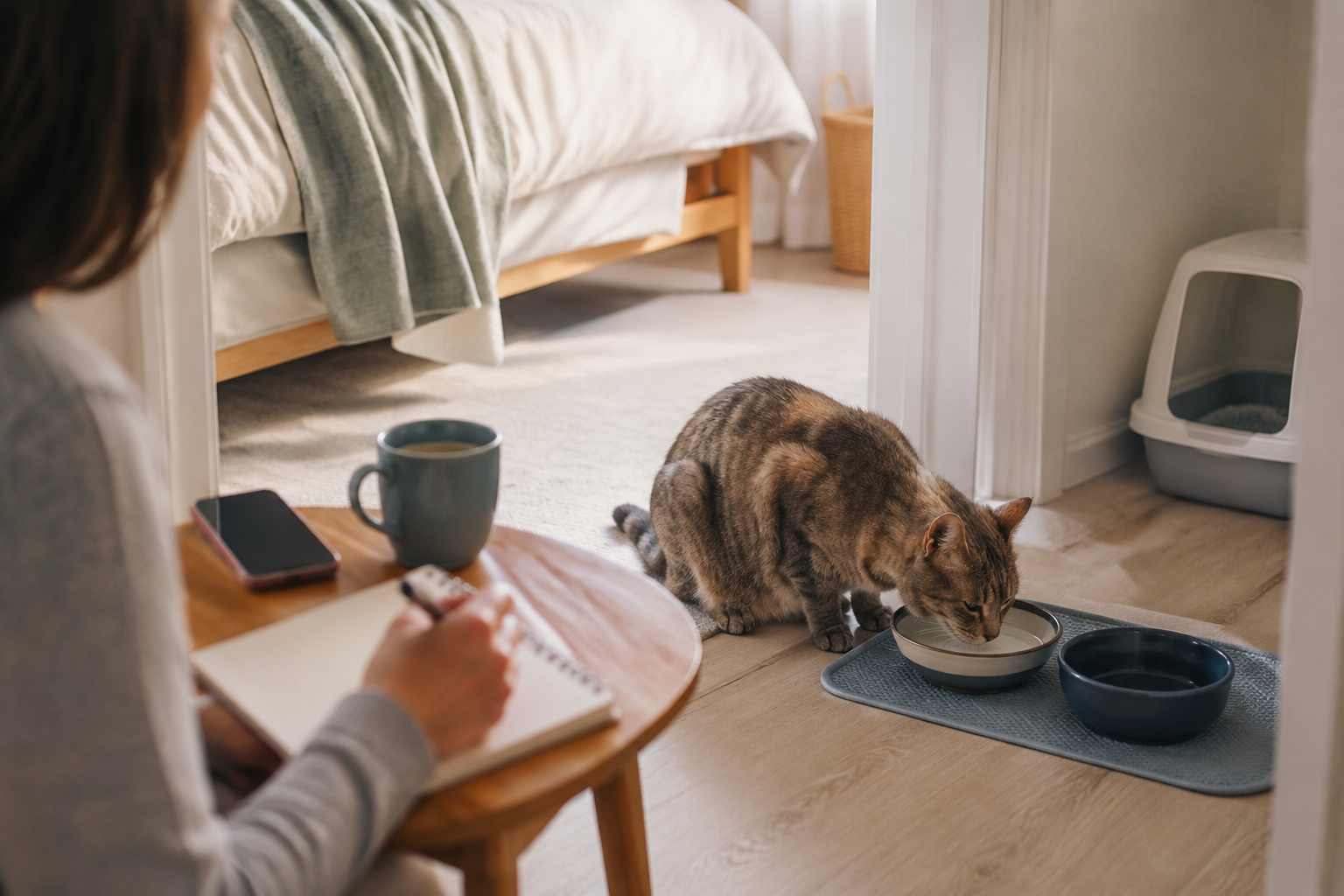
Use a simple nightly and morning note:
| Clue | What to write down |
|---|---|
| Water level | "About half the bedroom bowl gone" or "barely touched" |
| Bowl preference | Bedroom bowl, kitchen bowl, fountain, or shower/tap interest |
| Urination | Usual clumps, larger clumps, tiny clumps, accidents, or no urine |
| Mobility | Hesitated, slipped, used rug path, avoided stairs, or moved normally |
| Appetit | Ate usual food, picked at food, skipped meal, or asked for more |
| Other signs | Vomiting, hiding, crying, weight change, bad breath, or weakness |
Cornell's chronic kidney disease guidance says maintaining hydration is essential for cats with CKD and that multiple clean water sources and wet therapeutic diets may help support hydration under veterinary guidance 3. At the same time, suddenly drinking a lot can be a disease clue, not proof that your water setup is simply working better.
If your cat has a urinary history, pair water notes with SnuggleSouls' guide to encourage a cat to drink more after urinary problems and the guide to track cat urine clump size after urinary problems. Keep the notes practical. Your veterinarian needs a pattern, not perfect measurements.
When should drinking changes trigger a vet call?
Call your veterinarian if your senior cat suddenly drinks much more, drinks much less, urinates more, strains in the box, loses weight, vomits, stops eating, hides, seems painful, or becomes weak. Cornell specifically warns not to assume behavior or physical changes in older cats are just untreatable aging 1.
Drinking changes can be linked with many issues, including kidney disease, diabetes, hyperthyroidism, urinary problems, dental pain, nausea, medication effects, diet changes, stress, or reduced mobility. You do not need to identify the cause at home. You need to notice the pattern and contact the veterinary team early.
Seek urgent veterinary help now if your cat:
- Tries to urinate but produces little or no urine
- Cries in the litter box or repeatedly enters and exits it
- Collapses, has trouble breathing, or cannot stand normally
- Vomits repeatedly or seems rapidly weaker
- Refuses food for 24 hours, or sooner if your cat is frail or has known disease
- Shows severe dehydration clues such as extreme lethargy, tacky gums, sunken eyes, or rapid decline
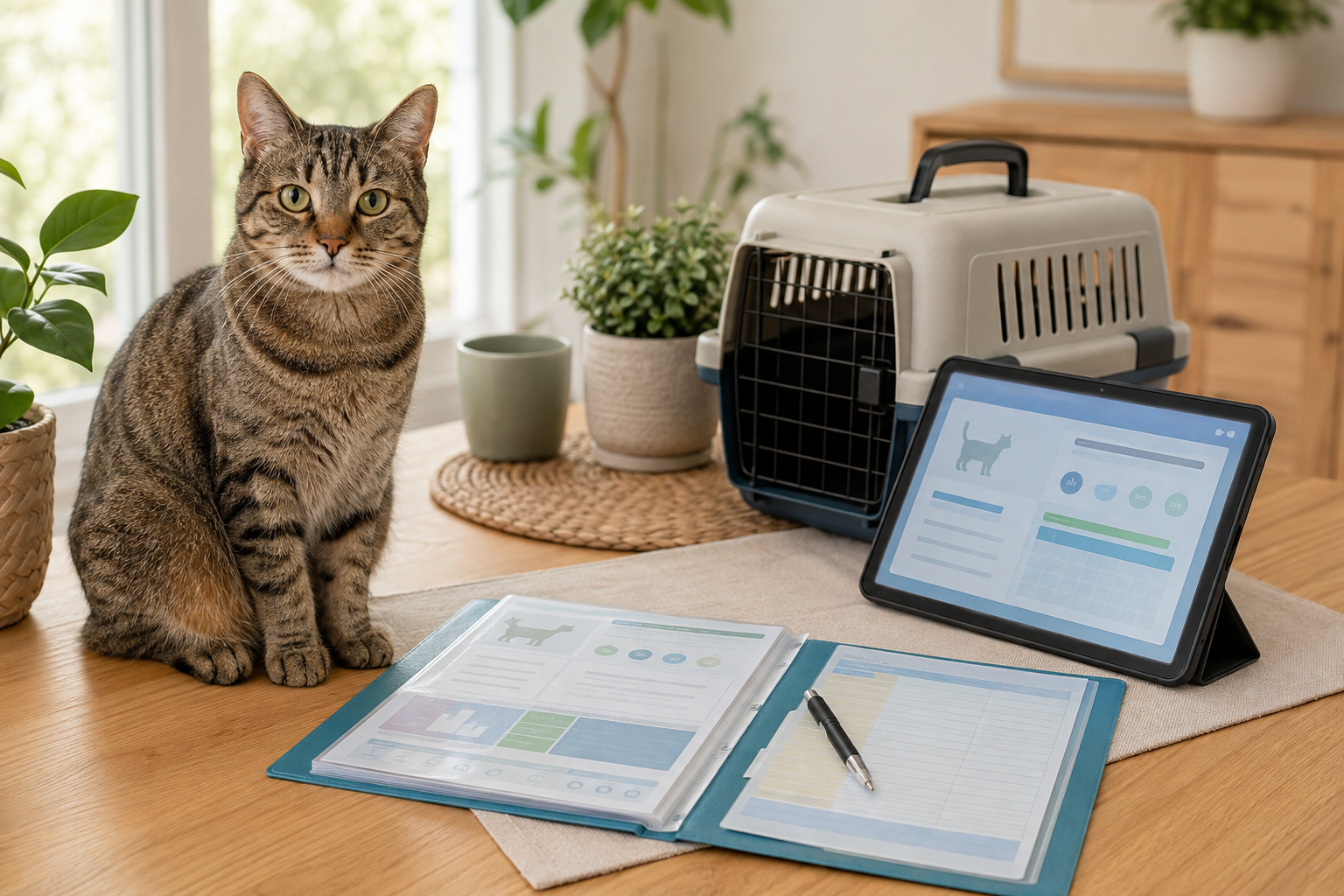
If the change is more subtle, make a short note before you call: when it started, which bowl changed, whether urine clumps changed, whether appetite changed, and whether mobility looks worse. If stiff movement is part of the pattern, compare your notes with common Anzeichen für Arthritis bei älteren Katzen.
What should you avoid around senior cat water stations?
Avoid setups that make water technically available but physically or emotionally harder to use. Senior cats may abandon a station because of slipping, noise, pain, resource crowding, or another pet blocking access.
Zu den häufigsten Fehlern gehören:
| Irrtum | Why it can backfire | Bessere Wahl |
|---|---|---|
| Tall raised bowl | Forces stretching or awkward posture | Floor bowl or very low stable riser |
| Bowl on slick tile or wood | Paws slide while drinking | Nonslip mat or rug under the station |
| Water beside litter | Many cats avoid drinking near toileting areas | Separate resources within the room |
| One bowl only downstairs | Stairs may be too hard at night | Add a quiet bedroom or hallway bowl |
| Motion light aimed at the bowl | Startles a sleepy or vision-impaired cat | Soft constant night light nearby |
| Strong scents or cleaners | May make water unappealing | Clean bowl with mild, well-rinsed soap |
| Bowl in a dead-end corner | Another pet can trap the cat | Choose an open route with an exit |
Do not force your cat to drink, lift them to the bowl repeatedly, syringe water without veterinary instruction, or add supplements, broths, salt, or flavorings unless your veterinarian approves them. Some additives are inappropriate for cats with kidney, heart, urinary, or digestive problems.
The best station is boring in the right way: clean water, steady footing, easy route, and no pressure.
Conclusion: Put water where your cat can reach it safely
Helping a senior cat reach bedroom water at night is mostly about removing small barriers. Put a shallow stable bowl on a nonslip surface, keep the route short and softly lit, test bowl height gently, and offer more than one clean water source if your cat's routine needs it.
Then watch the pattern. A senior cat who drinks more, drinks less, urinates differently, avoids the path, loses appetite, vomits, hides, or moves painfully needs veterinary guidance, not just a better bowl. For more senior and symptom-monitoring support, browse SnuggleSouls' Ratgeber zur Gesundheit von Katzen.
Häufig gestellte Fragen
Should a senior cat have water in the bedroom at night?
Yes, if the bedroom is where your cat sleeps or if stairs, pain, vision changes, or another pet makes the usual water bowl harder to reach. Keep the bedroom bowl clean, stable, and separated from the litter box as much as the room allows.
Is a raised water bowl better for older cats?
Sometimes a very low raised bowl helps a stiff cat avoid deep crouching, but a tall bowl can make posture worse. Offer a floor-level option too and choose the setup your cat uses with relaxed paws, neck, and shoulders.
Why is my senior cat drinking more water at night?
Your cat may simply find the bedroom bowl easier to use, but increased thirst can also be linked with kidney disease, diabetes, hyperthyroidism, medication changes, diet changes, or other health issues. Call your veterinarian if the increase is new, persistent, or paired with more urination, weight loss, vomiting, appetite change, or weakness.
What if my senior cat drinks less after I move the bowl?
Move the bowl back or offer both locations while you troubleshoot. The new station may be too high, too exposed, too close to litter, too close to a noisy appliance, on a slippery surface, or blocked by another pet.
How many water bowls should an older cat have?
Many senior cats benefit from more than one clean water source, especially if they avoid stairs or spend time in separate rooms. A bedroom bowl, a main living-area bowl, and a fountain can work well if each option is clean, accessible, and easy for your cat to approach.
Referenzen
[1] Cornell Feline Health Center. (2016). The Special Needs of the Senior Cat. Cornell University Hochschule für Veterinärmedizin
[2] Cornell Feline Health Center. (n.d.). Liebevolle Pflege für ältere Katzen. Cornell University Hochschule für Veterinärmedizin
[3] Cornell Feline Health Center. (2025). Chronische Nierenerkrankung. Cornell University Hochschule für Veterinärmedizin
[4] AAHA and AAFP. (2021). 2021 AAHA/AAFP-Leitlinien für die Lebensphase der Katze. AAHA
[5] AAFP and ISFM. (2013). Leitlinien zu den Umweltbedürfnissen von Katzen. Feline Veterinary Medical Association
 EN
EN DE
DE ES
ES PT
PT