
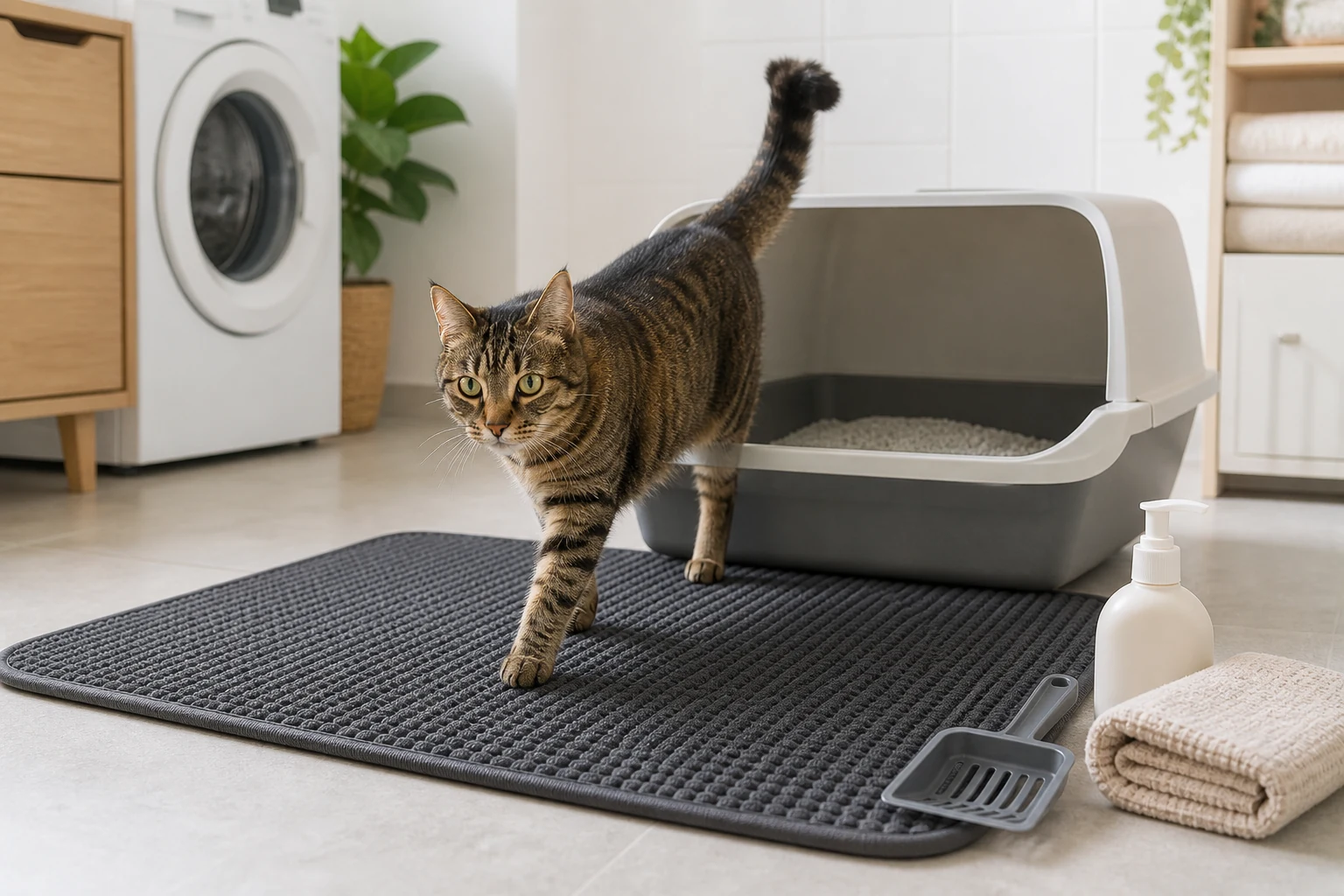
Clean a cat litter mat by emptying trapped granules, washing with mild unscented soap, rinsing well, and drying it fully before it returns to the box.
A litter mat is useful only if your cat still wants to cross it. The goal is not to perfume the litter area or scrub it with harsh cleaners. It is to remove loose litter, dust, urine splash, and odor without leaving a strong smell or slick residue that makes the box feel wrong.
Inhaltsübersicht
- How often should you clean a cat litter mat?
- What should you do before washing the mat?
- How do you wash different litter mat materials?
- How do you remove odor without making the mat smell wrong to your cat?
- How do you control dust around a litter mat?
- When should you replace the mat instead of cleaning it?
- What if your cat avoids the mat after cleaning?
- When is litter-area mess a vet warning sign?
- Conclusion: Keep the mat clean without making the litter area stressful
- Häufig gestellte Fragen
- Referenzen
How often should you clean a cat litter mat?
Shake, vacuum, or sweep the litter mat whenever tracked litter is visible, and wash it whenever odor, dust film, dampness, or sticky residue remains after dry cleaning. For many homes, that means a quick daily check and a deeper wash every one to two weeks.
Match the mat routine to the rest of the litter station. Merck Veterinary Manual advises daily scooping and regular full box cleaning because a dirty box can push cats away from the tray 1. Cornell also notes that some cats refuse a box containing any urine or feces 2. A mat that holds odor can create the same kind of problem even when the litter itself is fresh.
If you are still choosing a mat, start with the SnuggleSouls guide on how to choose a cat litter mat. If your bigger question is the whole cleaning rhythm, use the how often to clean a litter box schedule as the base and add the mat to that routine.
| Mat condition | Was ist zu tun? | Warum das wichtig ist |
|---|---|---|
| Loose clean granules on top | Shake outside, sweep, or vacuum gently | Keeps litter from spreading through the home |
| Litter trapped inside honeycomb pockets | Fold and pour into trash before washing | Prevents wet litter from clumping inside channels |
| Dusty surface or paw prints | Vacuum with a low-suction tool or wipe with a damp cloth | Reduces dust film without soaking the mat |
| Urine splash, diarrhea, or strong odor | Wash promptly, rinse well, and dry fully | Removes residue that can bother cats and people |
| Cracks, peeling layers, or odor that returns quickly | Replace the mat | Damaged materials can hold residue and irritate paws |
What should you do before washing the mat?
Remove dry litter first. Wetting a mat before emptying trapped granules can turn litter into paste, especially with clumping clay, and paste is much harder to rinse out of grooves, fabric backing, or honeycomb pockets.
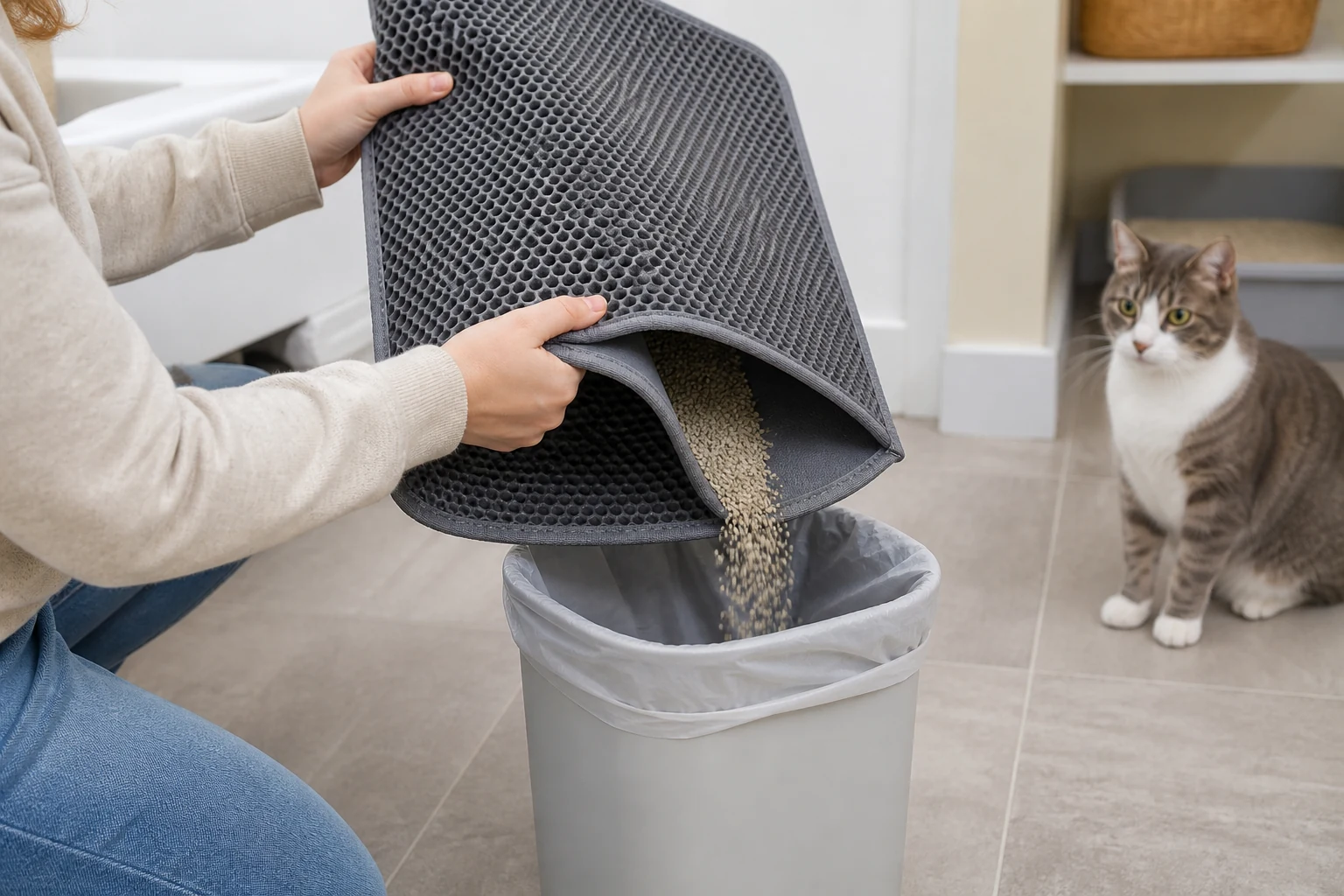
Shake or fold trapped litter out before washing so wet granules do not turn into paste inside the mat.
Use this order:
- Put on gloves if the mat may have urine splash, diarrhea, or damp residue.
- Carry the mat flat so trapped litter does not spill across the floor.
- Fold or roll the mat gently over a trash bag or outdoor bin.
- Tap the back of the mat to loosen granules from pockets and seams.
- Vacuum the surrounding floor after the loose litter is contained.
- Check the underside for moisture, plastic damage, or trapped debris.
Do not shake a dusty mat near your cat's face, food, water, or sleeping area. Cats are sensitive to litter texture and odor, and sudden unpleasant experiences near the box can become part of litter-area avoidance 2.
How do you wash different litter mat materials?
Wash the mat according to its material, then rinse until the water runs clear and the surface no longer feels slippery. If the care label gives a stricter instruction than a general guide, follow the label.
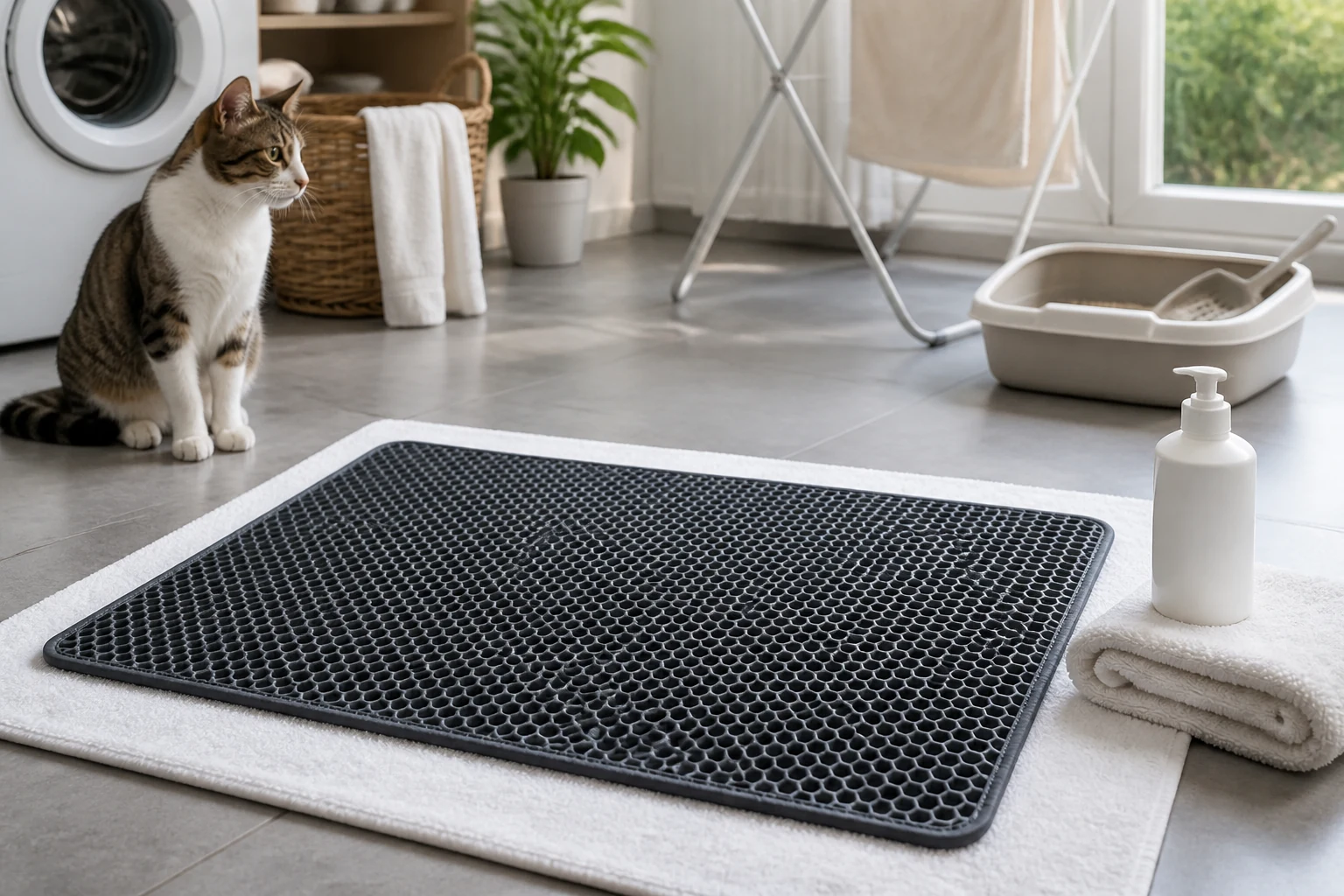
Let the mat dry completely before returning it to the litter station so paws stay comfortable and residue does not build up.
| Mat type | Best cleaning method | Avoid |
|---|---|---|
| Soft rubber or silicone | Rinse with warm water, wash with mild unscented soap, scrub grooves softly, rinse well | Strong fragrance, abrasive brushes that roughen the surface |
| Honeycomb double-layer mat | Empty pockets first, open layers, rinse from both sides, air-dry fully inside | Washing while filled with clumping litter |
| Washable fabric mat | Shake, vacuum, then launder only if the label allows it; dry fully before use | Fabric softener, fragrance beads, or leaving it damp |
| Foam-backed mat | Spot-clean gently and dry flat; replace if liquid reaches the backing | Soaking if the backing traps moisture |
| Coarse mesh mat | Rinse from the back side to push litter out, then dry where air can circulate | Rough scrubbing that leaves sharp or curled edges |
AAHA recommends mild soap and water for litter box hygiene and warns against strong-smelling disinfectants 3. That same logic works for mats: clean enough to remove residue, but not so scented that the whole station smells unfamiliar.
Before returning the mat, run your hand across the top and edges. It should feel dry, stable, and comfortable. If it feels tacky, gritty, oily, sharp, curled, or damp underneath, keep cleaning, keep drying, or replace it.
How do you remove odor without making the mat smell wrong to your cat?
Remove odor by removing the residue that causes it, not by covering it with fragrance. Cats often prefer unscented litter and can avoid toileting areas with unpleasant or strong smells 1. Perfume, deodorizer, or a cleaner smell that seems fresh to people may be too much for a cat standing inches above the mat.
A safer odor routine is:
- Empty loose litter every day or whenever you see buildup.
- Wash urine splash quickly instead of letting it dry into seams.
- Use mild unscented soap and warm water when the mat material allows.
- Rinse until no cleaner feel or smell remains.
- Dry the top, underside, and any inner pockets fully.
- Improve ventilation without moving the box into a noisy or exposed spot.
For accident cleanup outside the box, Cornell emphasizes neutralizing odor rather than simply deodorizing and advises avoiding ammonia or vinegar on cat-soiled household areas because they can smell urine-like or irritating to cats 2. For the mat itself, the practical takeaway is simple: skip ammonia-like cleaners, skip heavy fragrance, and do not return a wet or strongly scented mat to the box entrance.
ASPCA Animal Poison Control notes that many cleaning products can be used around cats when label directions are followed, but undiluted bleach can injure the mouth and esophagus, and cleaned items should be diluted, rinsed, and allowed to dry before pets return 5. If your cat walks through cleaner, licks a wet mat, drools, vomits, coughs, paws at the mouth, or seems unwell after exposure, call your veterinarian or poison control promptly.
How do you control dust around a litter mat?
Control dust by fixing the source first: litter type, litter depth, scooping habits, box size, and airflow. A mat catches granules after they leave the box, but it cannot solve a dusty litter that coats paws and floor every time your cat digs.
Start with the Die beste Einrichtung für ein Katzenklo: a roomy, accessible box in a calm location, with enough litter for digging and a mat your cat willingly crosses. If dust is constant, compare low-tracking cat litter options and review how much cat litter to use, because a layer that is too shallow or too deep can change how litter scatters.
For the mat and floor:
- Vacuum the mat with a low-suction upholstery tool if the surface can tolerate it.
- Sweep gently before dust spreads into nearby rooms.
- Wipe hard floors with a damp cloth after dry litter is removed.
- Keep the mat flat so litter does not collect under curled corners.
- Wash the mat before dust becomes a gray film on paws.
- Avoid blowing dusty litter with a fan, heater, or vacuum exhaust toward the box.
Do not make the litter area hard to approach in an effort to contain dust. FelineVMA house-soiling guidance emphasizes that box design and management are central to acceptable toileting habits, including clean boxes, suitable locations, and avoiding stressful blocked-off access 4.
When should you replace the mat instead of cleaning it?
Replace a litter mat when it keeps odor after washing, has cracks or peeling layers, traps dampness, curls into a trip edge, or has a texture your cat avoids. Cleaning should restore a mat to a neutral, comfortable surface. If it no longer does, replacement is usually kinder than more scrubbing.
Replace sooner if:
- Urine has soaked into foam, fabric backing, or separated layers.
- Honeycomb pockets have clumped litter that will not rinse out.
- The mat smells clean for only a few hours, then odor returns.
- Edges curl where your cat lands or turns.
- Loops, mesh, or cracks catch claws.
- A senior cat hesitates because the mat shifts underfoot.
- Your cat jumps over the mat every time and scatters litter farther away.
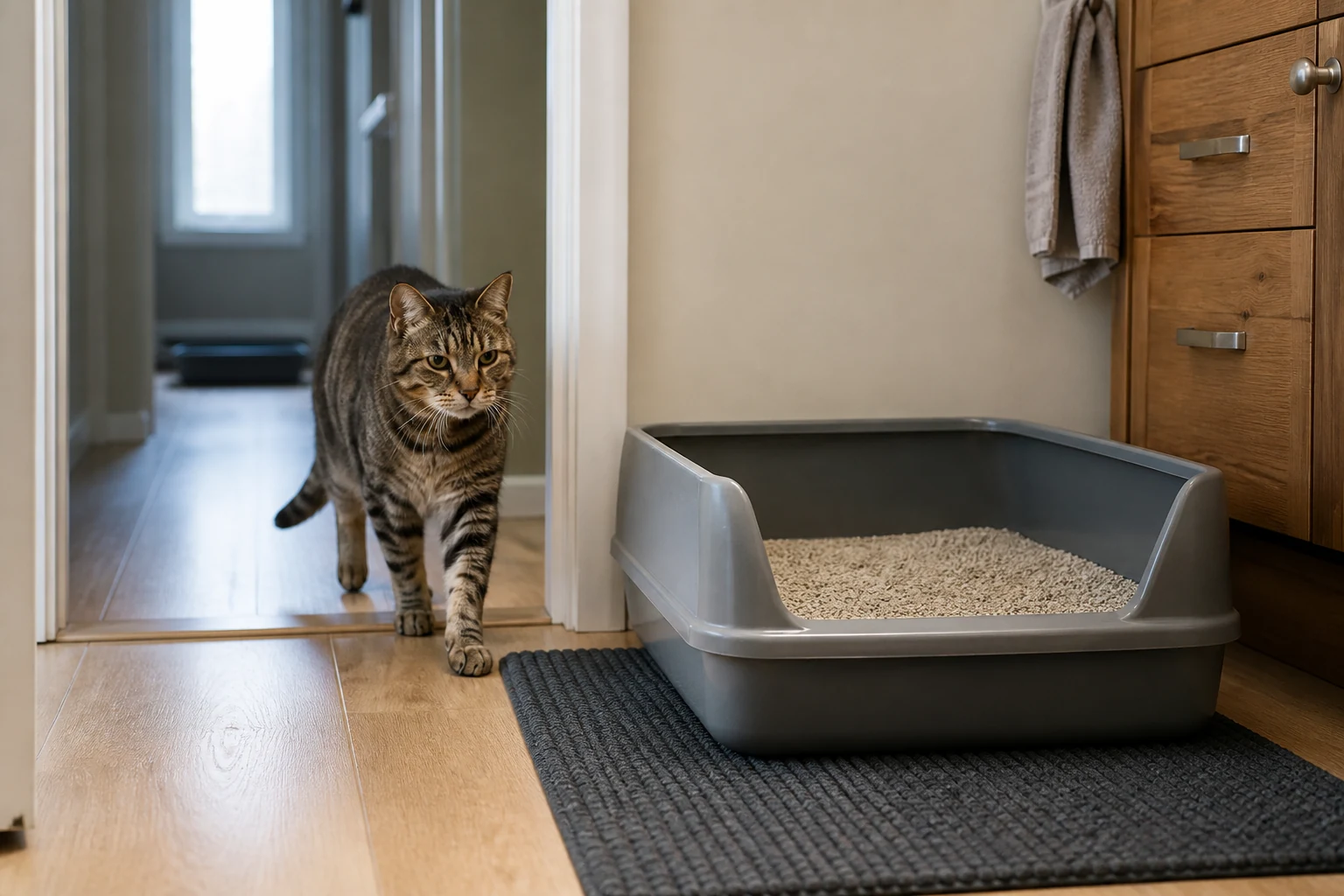
A very large box may need a larger mat, but the order matters. Adjust large cat litter box size first, then choose a mat that supports the real exit path. If the box is cramped, no mat will fully solve scatter.
What if your cat avoids the mat after cleaning?
If your cat avoids the mat after cleaning, remove the mat temporarily and treat that reaction as useful feedback. The surface may smell too strong, feel damp, slide underfoot, or have changed texture after washing.
Try this reset:
- Let the mat air out longer in a separate room.
- Rinse again if any soap smell or tacky feel remains.
- Put the mat slightly to the side so your cat can choose whether to step on it.
- Add a second, flatter mat near the exit if the first surface feels strange.
- Keep the box itself in the same location during the test.
- Watch whether your cat walks normally, jumps over the mat, or avoids the area.
Avoid forcing your cat onto the mat. A cat that feels trapped, startled, or uncomfortable near the litter box may start associating the whole area with stress. The FelineVMA client guidance notes that dirty boxes, startling noises, blocked access, and social pressure near the box can all contribute to house-soiling risk 4.
For senior cats, the issue may be footing rather than smell. A low-entry litter box for senior cats works best with a stable, low-profile mat that does not slide, catch nails, or create a raised edge.
When is litter-area mess a vet warning sign?
A dirty mat is usually a household maintenance issue, but a sudden change in the litter area can also be a health clue. Call your veterinarian if your cat suddenly misses the box, urinates or defecates outside the box, strains, cries, visits the box repeatedly, produces little or no urine, has blood in urine or stool, has diarrhea, seems constipated, vomits repeatedly, stops eating, hides, limps, collapses, or declines quickly.
Merck warns that soiling outside the box can indicate illness or behavior problems, and straining in the litter box can be a life-threatening emergency, especially in male cats 1. AAHA also lists medical problems, stress, box setup, and territorial behavior among common reasons cats stop using the litter box 3.
If accidents are happening on beds, rugs, laundry, or the floor near the tray, cleaning the mat may help the environment, but it should not delay health checks. Use the SnuggleSouls Probleme mit der Katzentoilette guide to organize clues, then involve your veterinarian when the change is new, repeated, painful, or paired with appetite, behavior, urine, stool, or mobility changes.
Conclusion: Keep the mat clean without making the litter area stressful
A clean litter mat should feel boring to your cat: dry, steady, low-odor, and easy to cross. Empty trapped granules before washing, use mild unscented soap when the material allows, rinse thoroughly, and wait until every layer is dry before returning it to the litter station.
Keep the mat in service of your cat's comfort, not just the floor. If cleaning leaves a strong smell, slippery texture, curled edge, or damp underside, fix that before your cat has to walk over it. A calm, clean, predictable litter area protects both household hygiene and your cat's trust in the box.
Häufig gestellte Fragen
Can you put a cat litter mat in the washing machine?
Only if the care label says the mat is machine washable. Many fabric mats can be washed on a gentle cycle, but rubber, foam-backed, layered, or honeycomb mats may warp, trap water, or shed material in the machine.
What cleaner is safest for a cat litter mat?
For most washable mats, warm water and mild unscented soap are the safest starting point. Rinse thoroughly and let the mat dry completely before your cat walks on it. Avoid heavy fragrance, ammonia-like cleaners, and harsh residues around the litter station.
How do you get urine smell out of a litter mat?
Remove loose litter first, wash the affected area promptly, rinse well, and dry fully. If urine soaked into fabric backing, foam, separated layers, or cracks and odor returns after washing, replace the mat instead of trying stronger cleaners.
Should the litter mat go under the whole litter box?
It can, but the most important area is your cat's real exit path. If placing the mat under the whole box makes the box wobble or creates a raised edge, keep the box stable and place the mat where your cat naturally steps out.
Can a dirty litter mat make a cat avoid the litter box?
Yes, it can contribute. Cats may avoid a toileting area that smells bad, feels uncomfortable, shifts underfoot, or seems blocked. If avoidance is sudden or paired with straining, accidents, blood, diarrhea, constipation, appetite change, hiding, or pain signs, call your veterinarian.
Referenzen
[1] Merck Veterinary Manual. (2025). Eine Katzentoilette für eine Katze bereitstellen. URL
[2] Cornell Feline Health Center. (2015). Verhaltensprobleme bei Katzen: Hausbeschmutzung. URL
[3] American Animal Hospital Association. (2026). Why Won't My Cat Use the Litter Box?. URL
[4] Feline Veterinary Medical Association. (2024). Feline House-Soiling: Useful Information for Cat Owners. URL
[5] ASPCA Animal Poison Control Center. (2026). Poisonous Household Products. URL
 EN
EN DE
DE ES
ES PT
PT