
Quick answer: Most female cats stay in heat (estrus) about 5–7 days, but it can last as short as 3 days or as long as 14 days.
If she doesn’t mate, heat can return every 2–3 weeks during breeding season.
If you’re not breeding your cat, castración is the only reliable way to stop heat cycles long-term.
If you’re wondering how long cat heat lasts, you’re probably dealing with the yowling, pacing, and nonstop affection right now.
This guide gives you the exact timeline (including how long each stage lasts), the 8 clearest signsy what actually helps at home—plus when spaying is the best option.
Cat Heat Cycle Timeline (Stages + How Long Each Lasts)
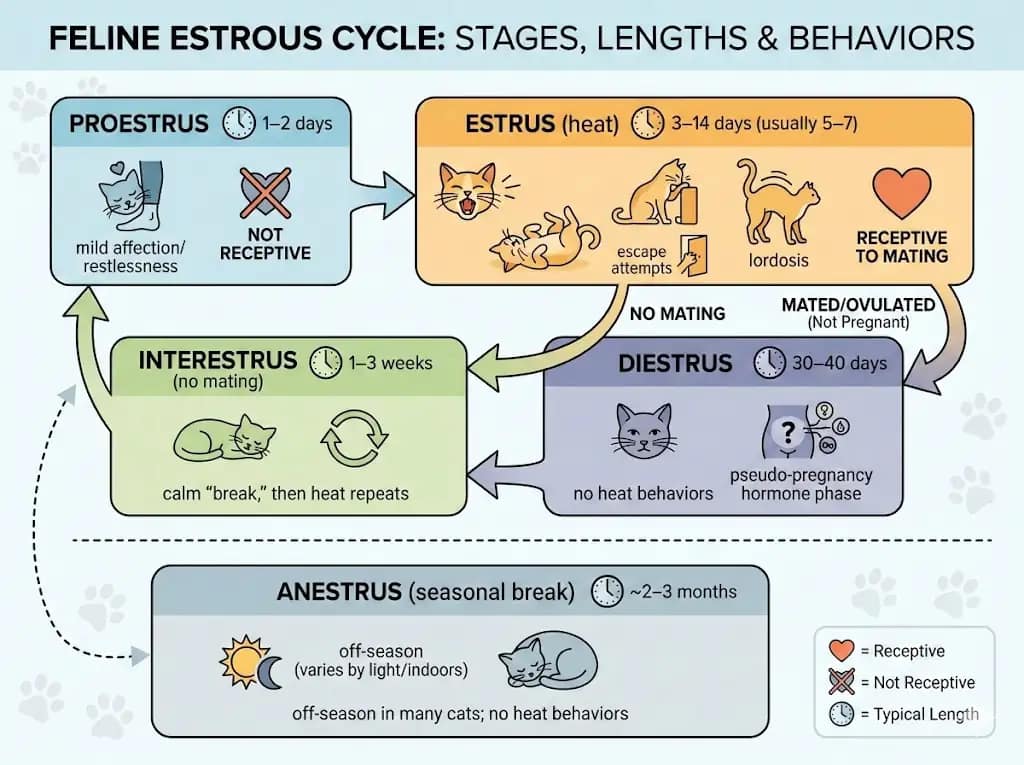
El ciclo estral felino consta de cuatro fases principales (proestro, estro, interestrus/diestrus y anestro). El proestro y el estro juntos constituyen el periodo de "celo" en el que tu gata es fértil, mientras que el interestrus (o diestrus) y el anestro son fases con poca o ninguna actividad de apareamiento.
El ciclo reproductivo de una gata se denomina ciclo estralcomúnmente conocido como ciclo de "celo". Los gatos son poliestro estacionallo que significa que pueden entrar en celo varias veces durante su época de cría activa.
En el hemisferio norte, esto suele significar un ciclo que va desde enero hasta finales de otoño, con un descanso en invierno. (Si vives en un clima tropical o mantienes a tu gato principalmente en el interior bajo una luz constante, puede que ciclo anual sin vacaciones de invierno).
Entonces, ¿cuánto dura cada calor y cómo es el calendario? He aquí un desglose de las fases típicas del ciclo que experimentará su gato:
| Stage | Typical length | What you’ll notice |
|---|---|---|
| Proestrus | 1–2 days | mild affection/restlessness; not receptive |
| Estrus (heat) | 3–14 days (usually 5–7) | yowling, rolling, rubbing, lordosis, escape attempts |
| Interestrus (no mating) | 1–3 weeks | calm “break,” then heat repeats |
| Diestrus (mated/ovulated, not pregnant) | 30-40 días | no heat behaviors; “pseudo-pregnancy” hormone phase |
| Anestrus (seasonal break) | ~2–3 months | off-season in many cats (varies by light/indoors) |
Key takeaway: Your cat is “in heat” only during estrus, which usually lasts about a week, but can stretch up to two weeks. If she doesn’t mate, it often repeats every 2–3 weeks in breeding season.
Proestrus (about 1–2 days)
Length: ~1–2 days
What’s happening: Estrogen starts rising and your cat’s body is gearing up for estrus.
What you’ll notice: Mild changes—slightly more affectionate, restless, or “off,” but many cats show very subtle signs.
Owner tip: Male cats may show interest, but she usually isn’t receptive yet—don’t assume the loud yowling stage has started.
Estrus (heat) (about 3–14 days)
Length: 3–14 days (most commonly 5–7 days)
What’s happening: This is the true “heat” phase when she’s fertile and actively seeking a mate.
What you’ll notice: Loud yowling (often day and night), intense rubbing/rolling, restlessness, escape attempts, and the mating stance (hindquarters raised, tail to the side).
Owner tip: She’s usually not in pain—it’s hormonal drive. Keep her strictly indoors; mating can happen very fast.
Why it varies: duration depends on the individual cat, season/light exposure, and whether she mates/ovulates.
Entre calores - Interestrus vs. Diestrus
If she does no mate: Interestrus (about 1–3 weeks)
Length: ~1–3 weeks
What’s happening: Heat behaviors stop temporarily, but the cycle resets and can start again soon.
What you’ll notice: She acts mostly normal again—quieter, calmer, less restless.
Owner tip: This “break” can be short. Many cats return to heat again within a couple of weeks during breeding season.
If she mates and ovulates (but isn’t pregnant): Diestrus (about 30–40 days)
Length: ~30–40 days
What’s happening: After ovulation, hormones shift into a “pseudo-pregnancy” phase even if she doesn’t conceive.
What you’ll notice: Heat behaviors usually disappear during this time.
Owner tip: No heat signs doesn’t automatically mean she isn’t pregnant—if mating happened, consider a vet check.
Anestrus (seasonal “off” period) (about 2–3 months)
Length: ~2–3 months (varies a lot)
What’s happening: Many cats pause cycling during shorter-daylight months; reproductive activity drops.
What you’ll notice: No heat behaviors—no yowling, no mating stance, no roaming urgency.
Owner tip: Indoor cats under constant lighting may have no clear off-season and can cycle year-round.
Key takeaway
Your cat is “in heat” only during estrus, which usually lasts ~5–7 days (range 3–14).
If she doesn’t mate, heat often returns every 2–3 weeks in breeding season.
The cycle repeats until she becomes pregnant—or you stop it through castración.
What Affects How Long a Cat Stays in Heat?
Cats don’t all follow the same schedule. Two cats can be in heat for very different lengths of time—even if both are healthy. Here are the biggest factors that influence how long heat lasts y how often it returns.
1. Age and “First Heat” Irregularity
First heat cycles (especially in younger cats) can be a bit unpredictable.
Some cats show milder signs at first, while others seem “in heat forever” because the behaviors blur together across early cycles.
Content note (SEO-friendly): This helps you rank for “how long is a cat in heat the first time?” and “why is my kitten in heat so long?”
2. Season and Daylight (Breeding Season vs Off-Season)
Cats are strongly influenced by day length. Longer days generally trigger more cycling.
During peak season, heat cycles can feel relentless because the “break” between heats may be short.
Add a 1-line clarifier:
If it’s spring/summer and your cat is unspayed, frequent heats are often normal.
3. Indoor Lighting (Year-Round Heats)
Indoor cats exposed to consistent artificial light may cycle more often and may not have a clear off-season.
That can make heat appear to last longer, when it’s actually short cycles repeating with short breaks.
Optional mini-tip (keep it mild):
Some owners find a darker, calmer room reduces stimulation, but it won’t stop the cycle entirely.
4. Whether Mating/Ovulation Occurs
Los gatos son induced ovulators, meaning ovulation typically happens after mating.
If your cat doesn’t ovulate, she may return to heat sooner.
If she does ovulate (even without pregnancy), she may enter a longer “quiet phase.”
Why this matters: This explains “why did she stop… then start again?” patterns.
5. Stress, Environment, and Household Triggers
Heat behaviors often look “worse” (and feel longer) when your cat is:
Hearing/smelling outdoor cats nearby
Living with an intact male (even separated)
Under stress (new home, new pets, routine disruptions)
Important framing:
These factors usually don’t change the biology of heat, but they can make the behaviors more intense or continuous.
6. Health Reasons That Can Mimic “Endless Heat” (When to Call a Vet)
Most prolonged heat is just variation—but it’s smart to watch for red flags.
Contact a vet if:
Heat-like behavior continues beyond ~14 days
You see sangre, foul-smelling discharge, or pus-like discharge
Your cat is lethargic, vomiting, ocultar, or refusing food for more than a day
The abdomen looks swollen, or she seems painful
Rule of thumb: Loud, needy behavior is common in heat. Signs of illness are not.
Quick summary
Heat length varies most because of edad, season/daylight, indoor lightingy whether ovulation occurs. If heat behavior seems to last longer than two weeks, or your cat seems unwell, it’s time to check in with a vet.
¿Con qué frecuencia entran en celo las gatas?
During breeding season, many unspayed female cats go into heat about every 2–3 weeks if they don’t get pregnant. That means once one heat ends, another can start again in as little as 1–2 weeks.
Durante el invierno (días cortos)
Esta es la fase de anestro que hemos mencionado, que dura un par de meses sin ciclos. Sin embargo, no todas las gatas leen el libro de texto: algunas gatas de interior bajo iluminación interior constante pueden saltarse las vacaciones de invierno y seguir pedaleando todo el año.
Además, algunas razas (como los siameses u otras razas orientales) son conocidas por tener ciclos de celo frecuentes o precoces, mientras que otras razas pueden tener ciclos más tardíos o menos intensos. La variación individual es enorme.
Para ponerlo en perspectiva, si no se esteriliza, una sola gata puede entrar en celo hasta una docena de veces o más en un año (sobre todo si no descansa en invierno). Son muchas montañas rusas hormonales tanto para el gato como para su dueño.
Esta es una de las razones por las que la gestión de un gato no esterilizado puede ser un reto: no es un suceso que ocurre de vez en cuando, sino un hecho frecuente de la vida.
Conclusión: Las gatas pueden entrar en celo repetidamente durante la mayor parte del año. Si tu gatita tiene su primer celo en primavera y no la esterilizas, prepárate para muchas rondas de coqueteos teatrales en los meses venideros. Sabiendo esto, es aún más importante reconocer la signos de calor y tener un plan para manejar cada ciclo (o mejor aún, prevenirlos, de lo que hablaremos pronto).
At a glance: Heat every 2–3 weeks (breeding season), with some indoor cats cycling year-round.
Reconocer las señales: Cómo saber si su gata está en celo
Si de repente oyes a tu gato gritar de forma extraña o frotarse con todo lo que tiene a la vista, es posible que te lo estés preguntando: ¿Está rara o está en celo?
La buena noticia (y a veces la difícil) es que cuando una gata entra en celo, su comportamiento suele dejarlo bastante claro.
Esto es lo que hay que tener en cuenta:
Vocalizar sin parar
Una de las señales más evidentes son los maullidos o aullidos fuertes y persistentes, a menudo por la noche. No son sus maullidos parlanchines habituales. Son profundos, prolongados e inconfundiblemente intensos. Es su forma de llamar a la pareja y puede parecer que sufre (no te preocupes, no es así).
Pegajoso y cariñoso, a veces hasta el extremo
De repente, su gato, normalmente independiente, puede estar pegado a su lado. Se frotará contra sus piernas, muebles, paredes -cualquier cosa- y puede revolcarse, reclamar atención y ronronear sin parar. Incluso los gatos tímidos pueden volverse atrevidos y necesitados durante el celo.
La postura de apareamiento (lordosis)
Cuando se la acaricia a lo largo del lomo, una gata en celo puede dejar caer la mitad delantera, levantar la trasera, mantener la cola a un lado y pisar con las patas traseras. Esta postura indica que está lista para el apareamiento. También puede ocurrir espontáneamente mientras camina o se estira.
Inquietud y comportamiento errante
Es de esperar que se pasee, se asome a las ventanas y merodee alrededor de las puertas. Su gata puede parecer inquieta y "en una misión": está intentando encontrar una forma de conocer a un macho.
Intentos de fuga
Las reinas en celo son artistas del escape. Puertas, ventanas, incluso armarios ligeramente entreabiertos, nada es seguro. Si se escapa, los gatos machos la encontrarán. Basta un momento para que se produzca un embarazo no deseado.
Pérdida de apetito
Algunas gatas comen menos durante el celo. Si la gata está activa y muestra otros comportamientos relacionados con el celo, es normal que pierda temporalmente el apetito. Asegúrate de que vuelve a comer normalmente cuando termine el ciclo.
Rociado o marcado con orina
Algunas hembras rocían las superficies verticales u orinan con más frecuencia. No es mala educación, sino biología. Su orina es rica en hormonas y feromonas, un mensaje para los tomcats locales de que es fértil.
Aumento del aseo de la zona genital
Puede que notes que se lame más esta zona. Una ligera hinchazón o una secreción clara pueden ser normales. No obstante, la sangre no es-si ves alguno, ponte en contacto con tu veterinario.
Hemos reunido un desglose completo del comportamiento para ayudarle a descifrar cada una de estas señales de celo y cómo responder.
Lea la guía completa: Señales de que tu gata está en celo: 8 comportamientos claros que debes conocer
Qué hacer cuando su gata está en celo (consejos de cuidados que realmente ayudan)
If your cat is in heat right now, treat the first hour like “damage control.” Your main goal is simple: prevent escape and calm the environment. Once that’s handled, you can focus on comfort for the next several days.
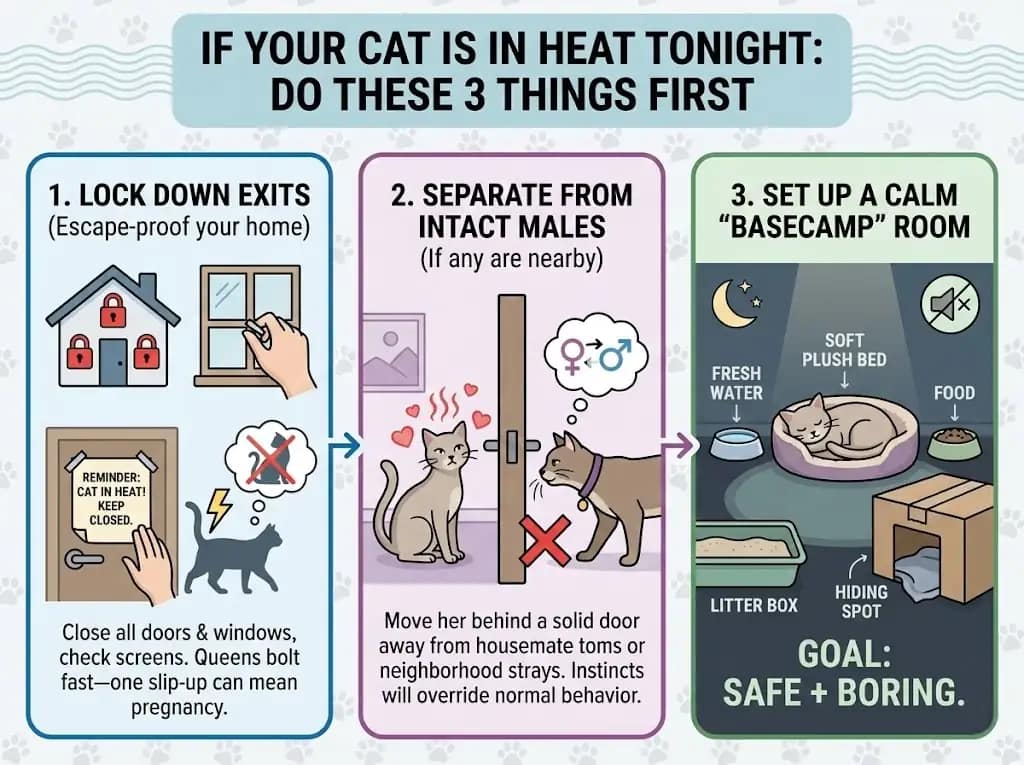
If your cat is in heat tonight: do these 3 things first
Lock down exits (escape-proof your home).
Close all doors and windows, check screens, and put a reminder note by entryways. Queens in heat can bolt fast—one slip-up can mean pregnancy.Separate her from intact males (if any are nearby).
If you live with an unneutered male cat—or if neighborhood toms hang around—move her to a room with a solid door. Even cats that normally get along will follow instincts.Set up a calm “basecamp” room.
Give her a quiet space with: fresh water, food, a clean litter box, soft bedding, and a hiding spot. Keep lights low and noise minimal—your goal is “safe + boring.”
Once you’ve done those three steps, use the tips below to make the rest of her heat cycle more manageable for both of you.
1. Keep the lockdown consistent (especially at doors).
You’ve already secured exits—now make it routine. Use a quick “door check” habit, and ask family members to pause before opening doors. If tomcats are outside, don’t leave windows open even with screens if they’re weak or loose.
2. Make her basecamp extra comforting.
Add a warm blanket or towel, and keep the room low-stimulation. Some cats relax with a covered bed or a box. The goal is “safe, quiet, predictable.”
3. Use short play bursts to burn off restless energy.
Even in heat, many cats will engage in short sessions. Try feather toys or a wand toy for 5–10 minutes, then let her rest. A little activity often reduces pacing later.
4. Offer affection—but let her control the dose.
If she seeks contact, give gentle strokes or brushing. If she gets overstimulated or walks away, don’t chase the interaction. Heat can make cats clingy one moment and sensitive the next.
5. Try calming aids (low-risk first).
A pheromone diffuser (like Feliway-style products) can take the edge off for some cats. If you’re considering supplements, choose cat-specific options and follow label directions. Skip essential oils—many aren’t cat-safe.
6. Keep the litter box spotless (and add a second box if needed).
Heat can increase urination or lead to spraying. Scoop more frequently, and if she’s confined to one room, an extra box can prevent accidents.
7. Clean marking with enzyme cleaner—fast.
If she sprays, clean it immediately with an enzyme-based cleaner so the scent doesn’t invite repeat marking. Avoid ammonia-based cleaners—they can smell like urine to cats.
8. Protect your sleep and your bond (no punishment).
Use white noise or move her basecamp away from bedrooms overnight if possible. Don’t scold heat behavior—she’s not misbehaving; she’s hormonally driven. Calm redirection works better than confrontation.
These strategies can make heat less intense, but they won’t stop the cycle from returning. For many cats, heat repeats every 2–3 weeks in breeding season—so if you’re not planning to breed, spaying is usually the kindest long-term fix.
Si quieres saber más sobre estos ocho puntos clave, explora nuestra guía completa de cuidados: Cómo ayudar a un gato en celo: Confort, seguridad y consejos para calmarlo
Todos estos consejos pueden aliviar la intensidad de un ciclo de celo, y muchos padres de gatos los encuentran realmente útiles. Pero esta es la verdad: no impiden que el ciclo se repita. Para la mayoría de los gatos, el celo vuelve cada 2-3 semanas durante la época de cría, y eso puede parecer implacable.
Por eso, si no piensas criar a tu gato, la esterilización es realmente la solución más amable a largo plazo. No sólo previene el embarazo, sino que también alivia la montaña rusa hormonal en la que ella (y tú) estáis inmersos. En breve hablaremos más sobre cuándo y por qué esterilizar.
Conclusión
Having an in-heat cat at home can be a lot — the yowling, pacing, and constant attention-seeking can wear anyone down. But it helps to remember this isn’t “bad behavior.” Your cat isn’t being difficult on purpose — she’s responding to powerful, natural hormones.
The good news is that once you understand the cronología of a heat cycle, the clear signs of estrus, and the qué hacer y qué no hacer that actually help, the situation becomes far more manageable. You’ll know what’s normal, what needs extra caution (especially escape attempts), and how to keep both your home and your cat calmer through each phase.
If you’re not planning to breed, spaying is the most effective long-term solution. It prevents unwanted pregnancy and stops the cycle from repeating every few weeks during breeding season — which often means a calmer, more comfortable life for your cat (and more sleep for you).
En SnuggleSouls, we focus on real-life pet parenting solutions that make life better for animals and strengthen the bond you share. Thanks for reading — and if you’re in the middle of a heat episode right now, take a breath. You’re not alone, and with the right steps, you’ll get through it.
FAQ About How Long Are Cats In Heat
¿Cuánto dura un celo de gato típico?
Por término medio, la fase de celo de una gata dura entre 5 y 7 días, pero puede oscilar entre 2 y 14 días en función de cada gata y de si se aparea o no durante este periodo.
¿Con qué frecuencia entran en celo las gatas?
Si no están esterilizadas y no están preñadas, las gatas pueden entrar en celo cada 2-3 semanas durante las épocas de cría (normalmente de febrero a octubre). Las gatas de interior con luz artificial pueden entrar en celo todo el año.
¿Las gatas sangran cuando están en celo?
No. A diferencia de los perros, las gatas suelen no sangrar durante el celo. Cualquier sangre visible debe ser tratada como anormal y revisada por un veterinario.
¿Puedo esterilizar a mi gata mientras está en celo?
Sí, aunque es algo más complejo debido al aumento del flujo sanguíneo a los órganos reproductores. Muchos veterinarios siguen realizando cirugías de esterilización con seguridad durante el celo; consulta a tu veterinario para que te aconseje sobre los plazos.
¿A qué edad debo esterilizar a mi gata?
La mayoría de los veterinarios recomiendan la esterilización en torno a los 5-6 meses de edad, idealmente antes del primer ciclo de celo, para reducir los riesgos para la salud y evitar comportamientos no deseados.
¿Por qué mi gato macho se vuelve loco cuando una hembra está en celo?
Los gatos macho no tienen ciclos de celo, pero responden con mucha intensidad a las hembras en celo. Pueden salpicar, aullar, intentar escapar o mostrarse agresivos.
¿Le duele el celo a mi gato?
No exactamente: los gatos en celo se dejan llevar por las hormonas y pueden parecer angustiados, pero no suele tratarse de dolor físico. Consolarlos ayuda a reducir el estrés.
¿Las gatas de interior pueden entrar en celo?
Sí, los ciclos de celo están determinados por las hormonas y la luz, no por la exposición a otros gatos. Las gatas de interior seguirán teniendo ciclos a menos que estén esterilizadas.
Referencias
ASPCA. (s.f.). Esterilizar a su mascota - Cuidados del gato. Sociedad Americana para la Prevención de la Crueldad contra los Animales. Obtenido de https://www.aspca.org/pet-care/general-pet-care/spayneuter-your-pet
Llera, R. M., y Yuill, C. (2022). Ciclos estrales en gatos. VCA Animal Hospitals. Obtenido de https://vcahospitals.com/know-your-pet/estrus-cycles-in-cats
Houpt, K. A. (2018). Comportamiento de los animales domésticos para veterinarios y zootecnistas (6ª ed.). Wiley-Blackwell.
Raíz Kustritz, M. V. (2006). Comportamiento reproductivo y fisiología de la reina. Teriogenología, 66(5), 701-706. https://www.sciencedirect.com/science/article/abs/pii/S0093691X06002378?via%3Dihub
Griffin, B. (2001). Estrategias proactivas para reducir la superpoblación felina: Programas de esterilización/castración de bajo coste. Revista de la Asociación Americana de Medicina Veterinaria, 219(12), 1667-1671.










 EN
EN DE
DE ES
ES PT
PT