
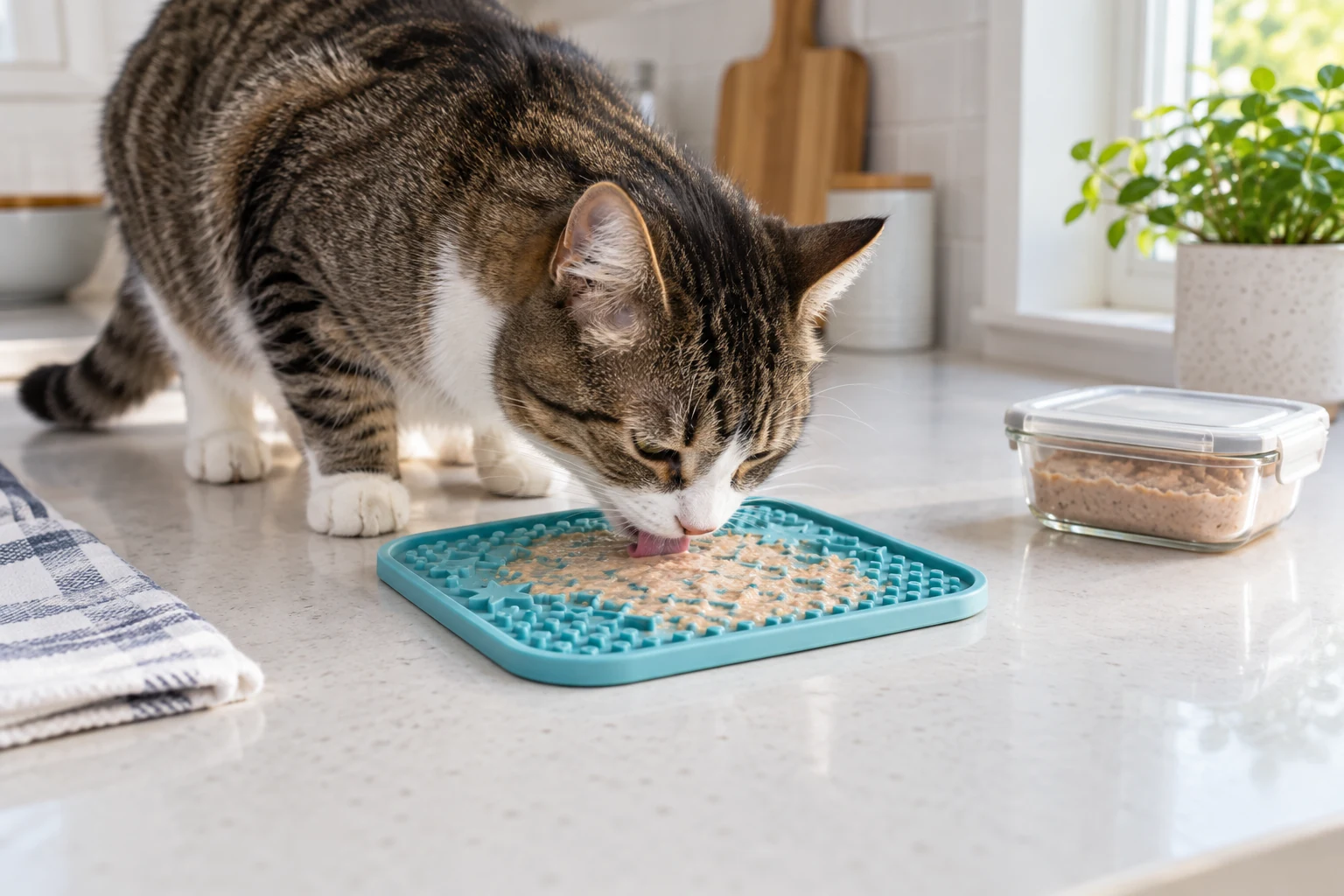
Frozen lick mats for cats can slow a measured wet-food meal, but keep them thin and supervised, and skip them when cold food hurts.
Many cat parents try freezing wet food because a regular lick mat disappears in two minutes. Freezing can make the same portion last longer, but it also changes texture, smell, temperature, and food-safety handling. The goal is not to make dinner difficult. The goal is to offer calm enrichment while protecting your cat's nutrition, comfort, and safety.
This guide explains when frozen lick mats make sense, how much wet food to use, which textures freeze best, and when to skip the freezer entirely.
Índice
- Are frozen lick mats safe for cats?
- What wet food texture works best after freezing?
- How much food should you freeze on a lick mat?
- Which cats should skip frozen lick mats?
- How do you freeze and serve a lick mat safely?
- How do you clean the mat and handle leftovers?
- What problems mean you should stop using a frozen lick mat?
- Conclusion: Are frozen lick mats worth trying?
- Preguntas frecuentes
- Referencias
Are frozen lick mats safe for cats?
Frozen lick mats can be safe for many healthy adult cats when they are supervised and made with the cat's normal wet food. They become less safe when the food is too hard, the portion is unmeasured, the mat is left out too long, or the cat chews the silicone instead of licking.
A lick mat is a feeding-enrichment tool, not a separate treat category. Feeding enrichment can support indoor cats by giving them a little more work and choice around food, and feline food-puzzle literature describes feeding activities as a way to support physical and emotional wellbeing 1. Freezing simply slows the licking process.
That extra challenge should stay gentle. If your cat licks calmly, pauses, returns, and finishes a small amount without distress, a frozen mat may fit into your rotation. If your cat paws at the mat, bites pieces, growls over it, walks away hungry, or vomits afterward, use a softer setup or stop.
If you are new to lick mats for cats, start with an unfrozen mat first. A cat who has never seen the texture should not have to solve cold, firm food on day one.
Use this quick safety screen:
| Situación | Frozen mat fit | Safer choice |
|---|---|---|
| Healthy adult cat, confident eater | Often reasonable with supervision | Thin frozen layer from a measured meal |
| Senior cat with possible mouth pain | Use caution | Soft room-temperature wet food |
| Kitten still learning meals | Usually skip or keep very soft | Normal kitten meal in a shallow dish |
| Cat on prescription diet | Ask your vet first | Vet-approved feeding plan |
| Cat chews silicone | Skip | Bowl, ceramic slow feeder, or supervised hand-off only |
| Multi-cat food stealing | Do not rely on one shared mat | Separate stations and closed doors |
What wet food texture works best after freezing?
Smooth pate, mousse, and finely mashed wet food usually work best because they freeze into a thin layer that can soften again at the surface. Chunky food, shredded meat, and thick gravy can freeze unevenly, trap hard pieces in grooves, and become frustrating to lick.
The easiest texture is spreadable before it goes into the freezer. If you need to press hard with the spoon, it may freeze too firm. Mix a small amount of warm water into the cat's normal wet food if the label and your veterinarian's guidance allow it. The finished layer should look thin and even, not like a mound.
Check the cat food feeding directions before using a new food on a mat. Some foods are calorie dense even in small spoonfuls, while others contain more moisture and look larger for the same calories.
Use this texture guide:
| Wet food texture | Freezer result | Best use |
|---|---|---|
| Smooth pate | Usually freezes evenly | Good first choice |
| Mousse or puree | Easy to spread thin | Good for shallow grooves |
| Pate mixed with a little water | Softer surface after thawing | Helpful for cautious cats |
| Minced or flaked food | May leave firm bits | Use only if mashed well |
| Shreds in gravy | Freezes unevenly | Better in a bowl |
| Large chunks | Can wedge into grooves | Avoid on lick mats |
Do not freeze unsafe human foods, seasoned leftovers, raw meat, or rich toppers just because they smear well. A frozen mat should mostly hold food your cat already eats safely.
How much food should you freeze on a lick mat?
Freeze only part of a measured meal, not an extra serving. For many cats, a thin smear from the normal wet-food portion is enough to create enrichment without quietly increasing daily calories.
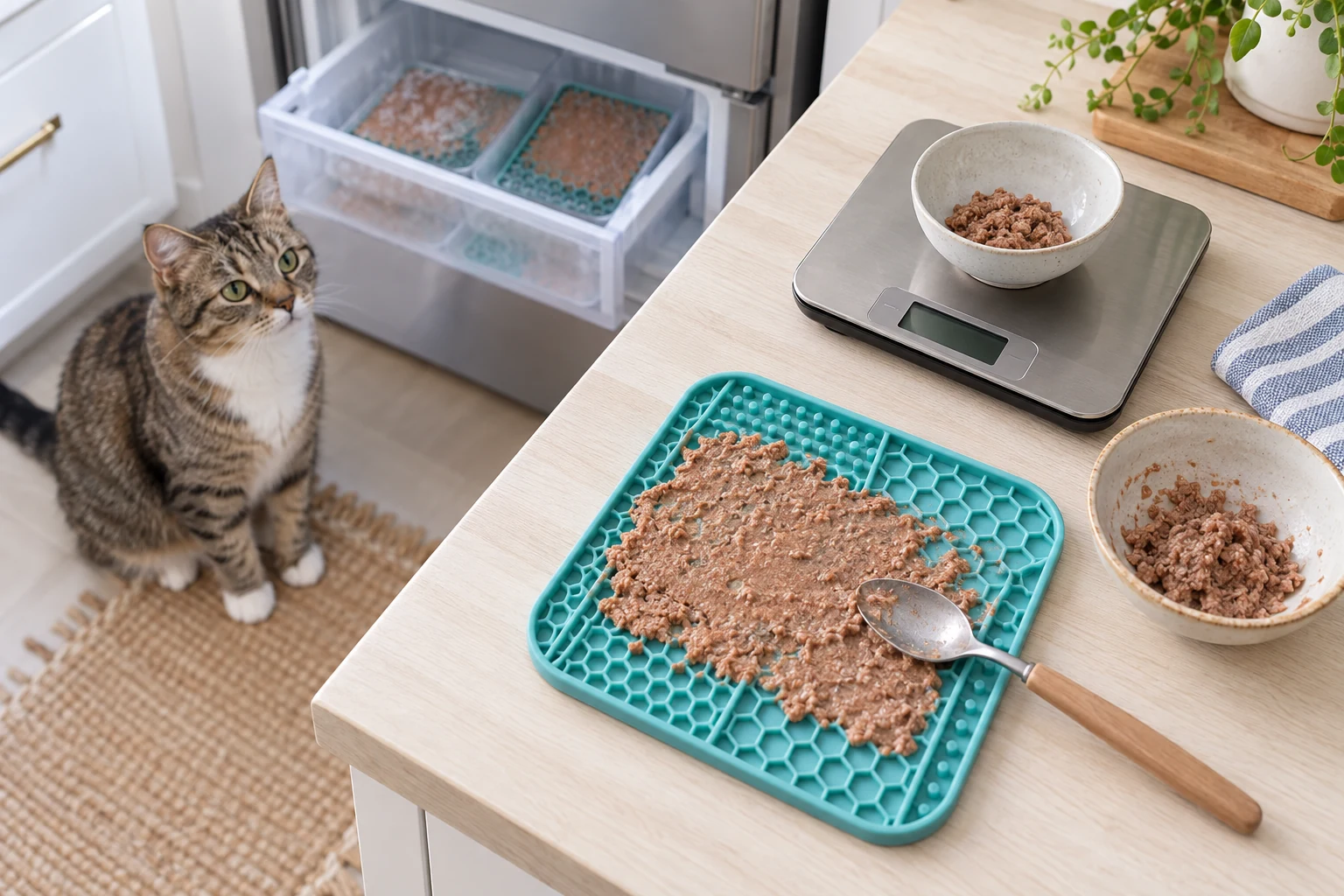
Measure the wet food before freezing it so the lick mat stays part of the meal plan rather than becoming an extra serving.
Portion control matters because cats can gain weight from small daily extras. Veterinary feeding guidance emphasizes maintaining an ideal body condition and adjusting food intake based on the individual animal, while Cornell's feline obesity guidance notes that excess body condition is a common health concern in cats 4, 5.
A practical routine looks like this:
- Decide the day's food amount first.
- Weigh or measure the wet food before spreading it.
- Put only a small part of one meal on the mat.
- Keep the layer thin enough that it softens at the surface.
- Subtract treats, toppers, and dry food from the same daily total.
If you are still figuring out ¿Qué cantidad de comida húmeda hay que darle a un gato?, solve that first. The calculadora de calorías para gatos can give you a starting estimate, and a kitchen scale for cat food portions helps you avoid guessing by spoonful. For wet food specifically, it can also help to weigh wet cat food portions by grams before freezing.
For a first trial, use less than you think you need. A teaspoon or two spread thinly is enough to test whether the cat enjoys the temperature and texture. Once you know the cat is comfortable, you can use a larger part of the meal if the total daily calories still make sense.
Which cats should skip frozen lick mats?
Skip frozen lick mats for cats who need reliable intake, have mouth pain, are under veterinary feeding instructions, or become stressed by food challenges. A frozen mat is optional enrichment, so it should never replace a comfortable, dependable meal.
Cats who should usually skip frozen mats include:
- Cats who are not eating normally.
- Cats who have dental pain, mouth ulcers, drooling, pawing at the mouth, or sudden chewing changes.
- Cats recovering from surgery or illness unless the veterinarian approves it.
- Cats with nausea, repeated vomiting, diarrhea, or weight loss.
- Cats on a prescription diet where intake must be measured closely.
- Diabetic cats or cats with kidney, urinary, gastrointestinal, or pancreatitis concerns unless the care team approves the setup.
- Kittens, frail seniors, or cats who get frustrated and quit.
- Cats who bite, tear, or swallow silicone.
Temperature can matter. Some cats dislike cold food because it smells less appealing, while others lick too aggressively at a hard frozen surface. If the mat seems to make eating uncomfortable, offer the same measured food at room temperature instead.
Also skip frozen mats if you are using them to delay a veterinary call. A cat who is vomiting, losing weight, avoiding food, straining to urinate, breathing abnormally, collapsing, or declining quickly needs individual veterinary advice, not a new feeder.
How do you freeze and serve a lick mat safely?
Freeze a thin layer, store it covered, and let the surface soften slightly before serving. The mat should feel cool and firm, not rock hard enough that your cat has to scrape, bite, or give up.
Use this process:
- Wash and dry the mat before filling it.
- Measure the wet food from the planned meal.
- Mash the food smooth and add a small amount of water only if appropriate for that food and cat.
- Spread a thin layer across shallow grooves.
- Cover the mat or place it in a clean food-safe container.
- Freeze it flat.
- Serve under supervision and pick it up when the session ends.
Do not leave uncovered wet food exposed in the freezer where it can pick up odors or contact other food. Do not refreeze a mat after your cat has licked it. Once saliva and room-temperature handling are involved, treat the remainder as used food.
For storage decisions around opened cans, pouches, and leftovers, follow the same care you would use for bowl feeding. The SnuggleSouls wet cat food storage guide can help you set a practical routine for covering, refrigerating, and discarding partial wet-food portions.
If your cat seems unsure, try a half-frozen or chilled mat instead of a fully frozen one. You can refrigerate the prepared mat briefly or freeze it for a shorter time so the food is cool and slow, but not hard. The best texture is the one your cat can lick calmly.
How do you clean the mat and handle leftovers?
Clean the lick mat after every wet-food session, even if the food was frozen. Freezing does not make wet food residue clean, and grooves can hold small bits that dry into the surface.
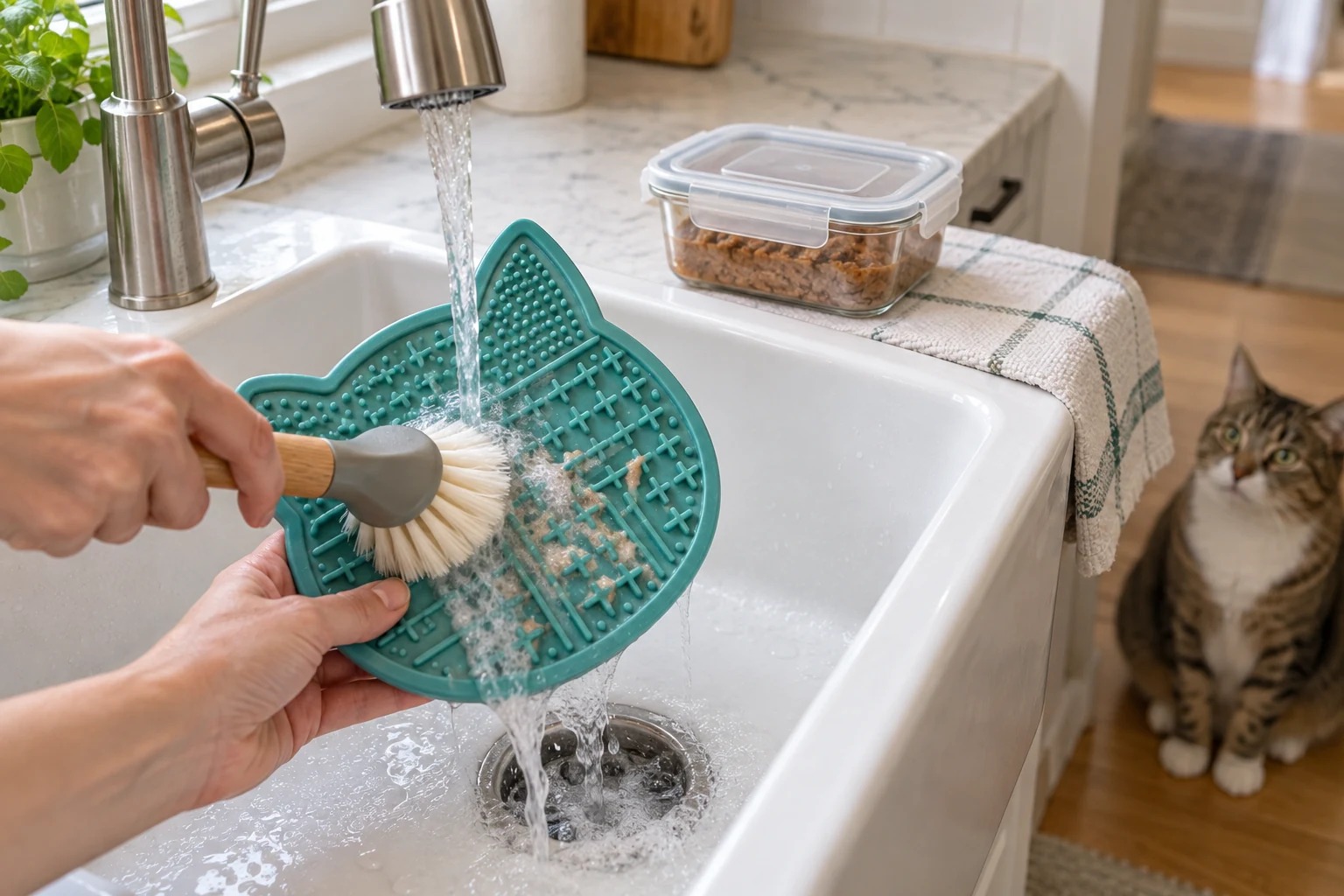
Frozen wet food still leaves residue in the grooves, so cleanup and leftover handling matter after every session.
The FDA advises washing pet food bowls and utensils with soap and hot water after use, and it also gives storage guidance for opened pet food and treats 2, 3. A lick mat needs at least the same level of care because it has more texture than a bowl.
After serving:
- Pick up the mat when your cat finishes or loses interest.
- Discard food left on the mat after the session.
- Rinse both sides under warm running water.
- Scrub the grooves with dish soap and a brush.
- Rinse well so no soap remains.
- Let the mat dry fully before storage.
- Inspect for cracks, rough edges, odor, or missing pieces.
Check the manufacturer's care instructions before putting a silicone mat in the dishwasher. Some mats tolerate the top rack, while others warp, trap odor, or break down faster.
If you prepare several mats ahead, keep them covered and rotate them by date. Use a simple household rule: if you would not be comfortable serving that opened wet food from a bowl, do not serve it from a frozen mat.
What problems mean you should stop using a frozen lick mat?
Stop using the frozen mat if it changes your cat's eating, comfort, or behavior in a concerning way. The tool is not worth keeping if it causes stress, pain, food guarding, or missed meals.
Watch for these warning signs:
| Firma | Qué puede significar | ¿Qué hacer ahora? |
|---|---|---|
| Biting or tearing the mat | Chewing risk or frustration | Remove the mat and use a bowl |
| Walking away hungry | Food is too hard, cold, or difficult | Serve the food soft and reassess |
| Drooling, pawing at mouth, or chewing on one side | Possible mouth pain | Call your veterinarian |
| Vomiting after frozen meals | Speed, nausea, cold texture, or another issue | Stop the mat and monitor closely |
| Guarding from other pets | Resource stress | Feed separately or skip shared enrichment |
| Weight gain | Uncounted calories | Recalculate the meal plan |
| Strong odor or residue in grooves | Cleaning or material breakdown issue | Replace the mat |
If your cat vomits after eating too fast, a frozen mat may help some cats slow down, but it is not the only option. Review meal size, texture, and pattern, and compare the signs in the SnuggleSouls guide to cat vomiting after eating too fast.
Call a veterinarian promptly if vomiting repeats, your cat cannot keep water down, refuses food for 24 hours, seems weak, has severe diarrhea, shows pain, strains in the litter box, or declines quickly. For kittens, seniors, cats with chronic disease, and cats on medication, get advice sooner.
Conclusion: Are frozen lick mats worth trying?
Frozen lick mats are worth trying for some healthy cats who already enjoy wet food and need a gentle way to make a measured meal last longer. Keep the setup simple: smooth wet food, thin layer, supervised session, counted calories, and careful cleaning.
Skip the freezer when the cat needs soft, reliable eating or shows any sign that cold food is uncomfortable. A regular lick mat, shallow dish, slow feeder, or veterinarian-directed feeding plan can be the better choice. The right answer is the feeding routine that keeps your cat nourished, relaxed, and safe.
Preguntas frecuentes
Can cats eat frozen wet food?
Some healthy cats can lick a thin layer of frozen wet food, but the surface should soften enough that the cat does not have to bite or scrape hard. If your cat hesitates, walks away, or seems uncomfortable, serve the same measured food chilled or at room temperature instead.
How long should I freeze a cat lick mat?
Freeze it only long enough to firm a thin layer. The exact time depends on the mat, freezer, and food texture, so test a small portion first. Let the surface soften slightly before offering it.
Can I leave a frozen lick mat out while I am gone?
No. Use frozen lick mats under supervision, especially until you know your cat will not chew the mat, guard it, or leave wet food sitting out. Pick it up when the session ends.
Should I freeze treats on a cat lick mat?
Use treats sparingly and count them within the day's calories. For routine use, your cat's normal complete-and-balanced wet food is usually the safest choice.
Is a frozen lick mat good for hot weather?
It can be a short cooling activity for some cats, but it is not a hydration or heat-safety plan. Keep fresh water available, keep cats in a cool indoor space, and contact a veterinarian urgently if a cat seems overheated, weak, or distressed.
Referencias
[1] Journal of Feline Medicine and Surgery. (2016). Rompecabezas alimenticios para gatos: una alimentación que favorece el bienestar físico y emocional. URL de origen
[2] FDA. (2024). Tips for Safe Handling of Pet Food and Treats. URL de origen
[3] FDA. (2024). Proper Storage of Pet Food and Treats. URL de origen
[4] Merck Veterinary Manual. (2024). Feeding Practices in Small Animals. URL de origen
[5] Cornell Feline Health Center. (2026). Obesidad. URL de origen
 EN
EN DE
DE ES
ES PT
PT