
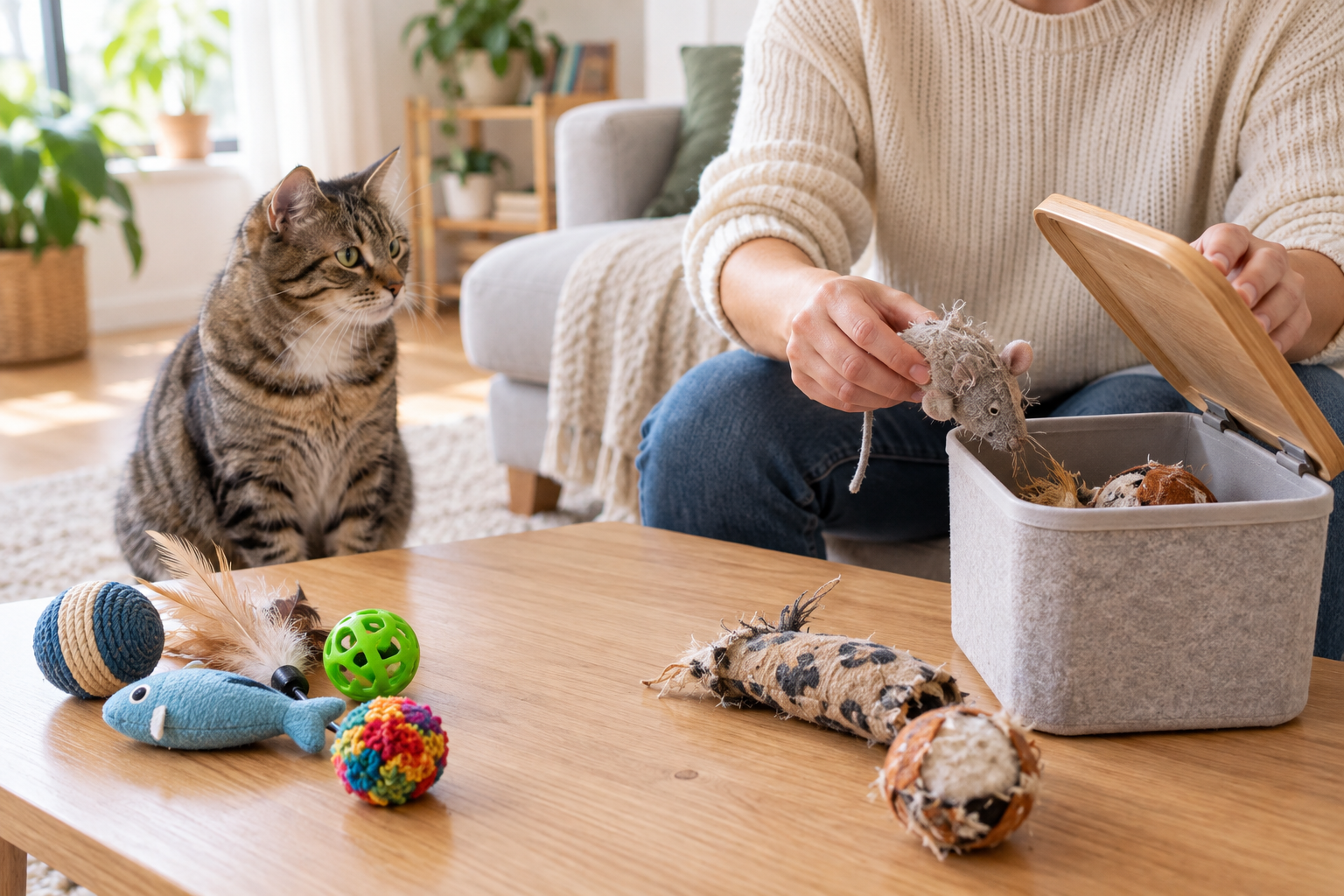
Retire damaged cat toys when they have loose pieces, chewed seams, exposed stuffing, frayed string, cracked plastic, trapped food, or missing parts.
That may sound strict, but it is kinder than hoping a worn toy lasts one more week. Cornell Feline Health Center warns cat parents to avoid toys with small pieces or strand-like parts that may separate and be ingested, especially when a cat chews during play 1. A simple retire-and-replace habit protects your cat while keeping play interesting.
The goal is not to throw away every toy with a scuff. It is to separate normal wear from damage that can be swallowed, cut paws or gums, trap germs, or encourage unsafe chewing.
Índice
- How do you know a cat toy should be retired?
- What damage is dangerous enough to throw away?
- What should you do if a toy has missing parts?
- Can you repair a damaged cat toy?
- How do you replace damaged toys without taking away enrichment?
- Which toys need cleaning before you decide?
- What if your cat chewed or swallowed part of a toy?
- Conclusion: Retire early, replace thoughtfully
- Preguntas frecuentes
- Referencias
How do you know a cat toy should be retired?
A cat toy should be retired when damage changes it from enrichment into a swallowing, choking, cutting, or hygiene risk. If you would not trust the toy during unsupervised chewing, it should not go back into the active toy basket.
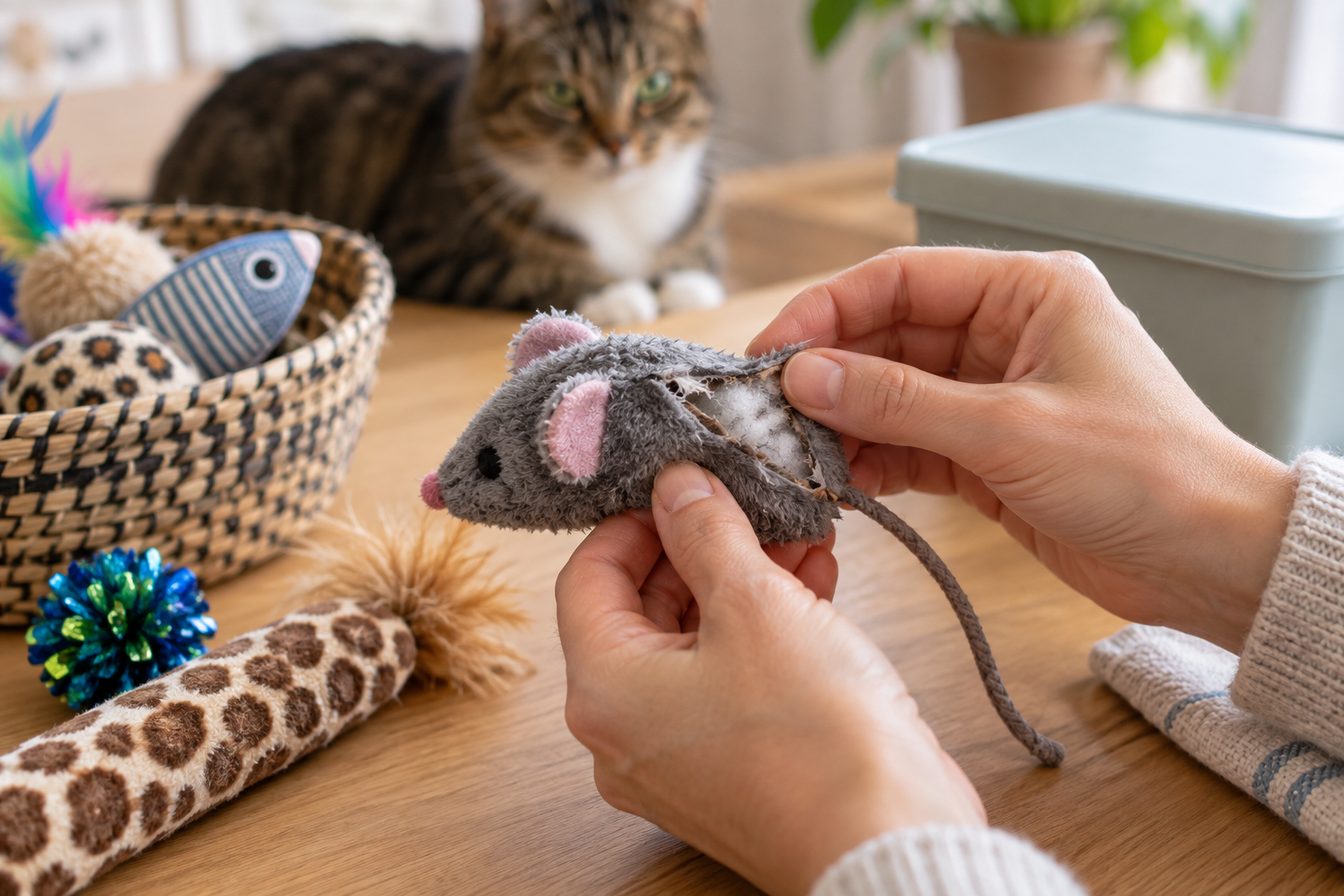
Use a two-minute inspection whenever you clean toys, rotate toys, or find one under furniture:
- Tug gently on seams, tails, ears, feathers, bells, eyes, pom-poms, and glued pieces.
- Squeeze plush toys to feel for exposed stuffing, crinkle film, or plastic inserts.
- Check wands and teaser toys for frayed cords, weak knots, cracked connectors, and loose swivels.
- Look over hard toys for sharp edges, cracked plastic, splintered pieces, or loose battery covers.
- Smell the toy; sour, musty, food-like, or litter-box odors mean it needs cleaning or retirement.
- Compare the toy with a photo or memory of how it looked before. If something is missing, treat that as a safety clue.
This check belongs inside a safe cat toy storage system. Keep a small active set out, store supervised toys behind a barrier, and create one obvious "retire" spot so damaged toys do not drift back into play.
What damage is dangerous enough to throw away?
Throw away a cat toy when the damaged part could come off in your cat's mouth, cut your cat, trap food, or hide missing pieces. Some toys can be cleaned or repaired, but many cheap plush, feather, rope, elastic, and plastic toys are safer to retire.
| Damage you see | Por qué es importante | Safer decision |
|---|---|---|
| Loose bells, eyes, buttons, beads, or plastic pieces | Small parts can separate and be swallowed | Retire the toy unless the part can be fully removed and the toy remains safe |
| Frayed string, yarn, ribbon, elastic, or tinsel | Strand-like materials can cause serious intestinal problems if swallowed | Retire or keep only as a supervised toy if fully intact |
| Torn seam or exposed stuffing | Cats may chew out filling or inner fabric | Retire unless it can be sewn securely and your cat is not a chewer |
| Cracked hard plastic or brittle rubber | Sharp edges can scrape the mouth, and fragments can break off | Throw away |
| Chewed foam, sponge, or soft rubber | Pieces can detach easily | Throw away |
| Loose battery cover, corrosion, or damaged electronic toy | Battery and wiring damage can be dangerous | Remove from use immediately |
| Persistent odor after cleaning | Dirt, saliva, food, or moisture may be trapped inside | Retire |
| Toy is smaller than your cat can safely mouth | It may be swallowed whole by some cats | Replace with a larger option |
Cat Friendly guidance also warns that string-type materials and toys with loose pieces should be put away after play because they can be swallowed 2. If you are shopping for replacements, choose sturdy, size-appropriate interactive cat toys for indoor cats and still inspect them regularly.
The risk also depends on your cat. A gentle senior who bats a ball once a day is different from a young cat who chews, shreds, and carries toys around the house. Kittens, heavy chewers, cats with pica-like habits, and cats who play alone at night need stricter toy rules.
What should you do if a toy has missing parts?
If a toy has missing parts, pause play and account for the missing piece before you return the toy or replace it. Missing feathers, bells, strings, foam chunks, plastic eyes, and fabric tails matter because they may be under furniture, inside the vacuum, or inside your cat.
Take these steps:
- Put your cat in a safe room away from the damaged toy.
- Photograph the toy if it helps you compare what is missing.
- Search the play area, under furniture, inside bedding, and around food or water bowls.
- Check your cat's mouth only if they allow gentle handling. Do not force their jaw open.
- If the missing piece could have been swallowed, call your veterinarian or an emergency clinic for advice.
Do not wait for vomiting before asking for help if the missing item is string, ribbon, yarn, elastic, a bell, a battery, a foam chunk, or sharp plastic. Merck Veterinary Manual describes gastrointestinal obstruction as an emergency condition and lists vomiting, not eating, diarrhea, lethargy, shock, and abdominal pain among possible signs depending on the obstruction 3.
If you find the piece and your cat seems normal, the toy still retires. A toy that already lost one part has told you what it will do next.
Can you repair a damaged cat toy?
You can repair a damaged cat toy only when the finished repair is smooth, secure, washable, and not tempting to chew. If the repair adds knots, glue blobs, dangling threads, staples, tape, pins, rubber bands, or hard lumps, it is not a cat-safe repair.
Reasonable repair candidates include:
- A sturdy fabric kicker with one small seam gap that can be sewn closed tightly.
- A washable toy cover where the weak thread can be removed and replaced.
- A cardboard puzzle where a torn edge can simply be trimmed away.
- A wand handle with a replaceable lure, if the old lure is discarded and the new one locks in securely.
Poor repair candidates include:
- Feather toys with loose shafts or sharp quills.
- Toys with glued-on eyes, bells, beads, sequins, or small plastic decorations.
- Rope toys that are unraveling.
- Anything your cat chews obsessively.
- Any toy that still smells bad after cleaning.
If you repair a toy, test it before your cat sees it. Tug the seam, rub the surface, check for loose thread, and make sure the toy does not have a new chew target. Then use it during supervised play first. SnuggleSouls' guide on Cómo jugar con tu gato can help you keep exciting toys under human control instead of leaving high-risk items out.
When in doubt, retire the toy. A replacement toy is cheaper than an emergency visit, and a homemade cardboard box or paper roll can be safer than a decorated toy that is falling apart.
How do you replace damaged toys without taking away enrichment?
Replace damaged toys by preserving the play function, not the exact object. If your cat lost a feather wand, they need a safe chase game. If a plush mouse split open, they may need a sturdy kicker or batting toy. If a treat ball cracked, they need another food puzzle that can be cleaned well.
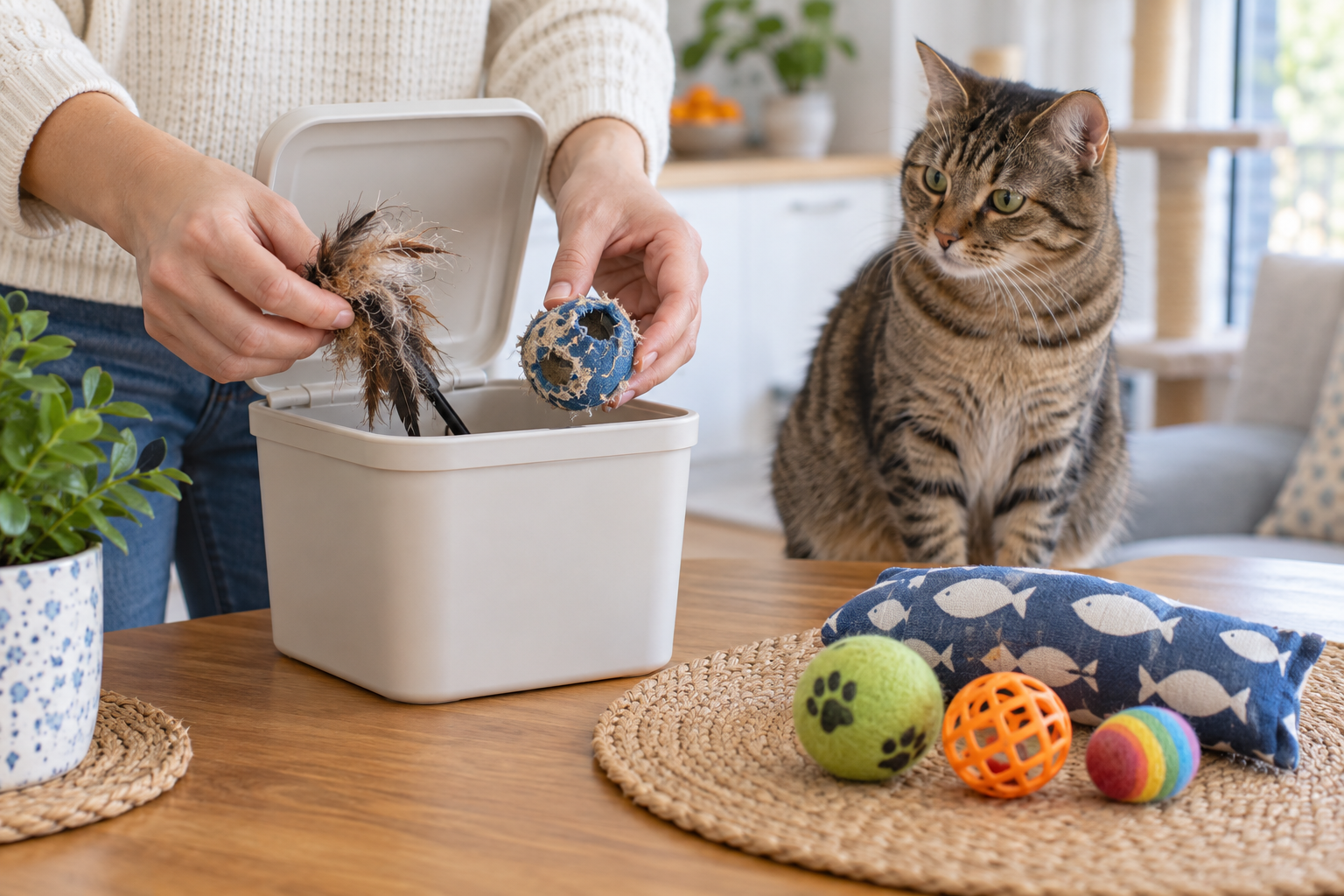
Use this matching approach:
| Retired toy | What your cat may have liked | Safer replacement idea |
|---|---|---|
| Feather teaser | Chasing and pouncing | Supervised wand toy with a secure lure |
| Plush mouse with torn seams | Carrying and bunny-kicking | Larger stitched kicker toy without loose decorations |
| Chewed foam ball | Batting and chasing | Hard plastic track ball or sturdy lattice ball sized for cats |
| Dirty food puzzle | Foraging and problem-solving | Dishwasher-safe puzzle or washable lick mat |
| Frayed ribbon toy | Fast movement | Fabric wand lure used only with a person |
This is where a cat toy rotation schedule helps. Keep a few safe toys active, rest the others, and inspect each toy before it returns. Rotation keeps novelty high without leaving every toy available to be chewed.
If your cat seems frustrated after a favorite toy disappears, increase interaction for a few days rather than replacing the toy with a riskier copy. A short chase game, a food puzzle, a cardboard box, or an extra window-watching perch can fill the enrichment gap. For energy planning, use SnuggleSouls' guide to how much playtime a cat needs.
Which toys need cleaning before you decide?
Clean toys before deciding if they are still usable when the main problem is dirt, food residue, saliva, or odor rather than structural damage. CDC guidance says pet items such as bowls and toys can carry germs, recommends regular cleaning, and gives monthly toy cleaning as an example schedule, with more frequent cleaning when items look dirty or smell bad 4.
Separate toys by material:
- Hard rubber or plastic toys: wash with warm soapy water, scrub grooves, rinse well, and air dry.
- Dishwasher-safe toys: use the dishwasher only if the maker says it is safe.
- Plush toys: machine wash if the tag allows it, then dry fully before storage.
- Rope toys: wash according to instructions and retire them if fibers fray or your cat chews strands loose.
- Catnip toys that cannot be washed: throw them away when dirty, damp, stale-smelling, or torn.
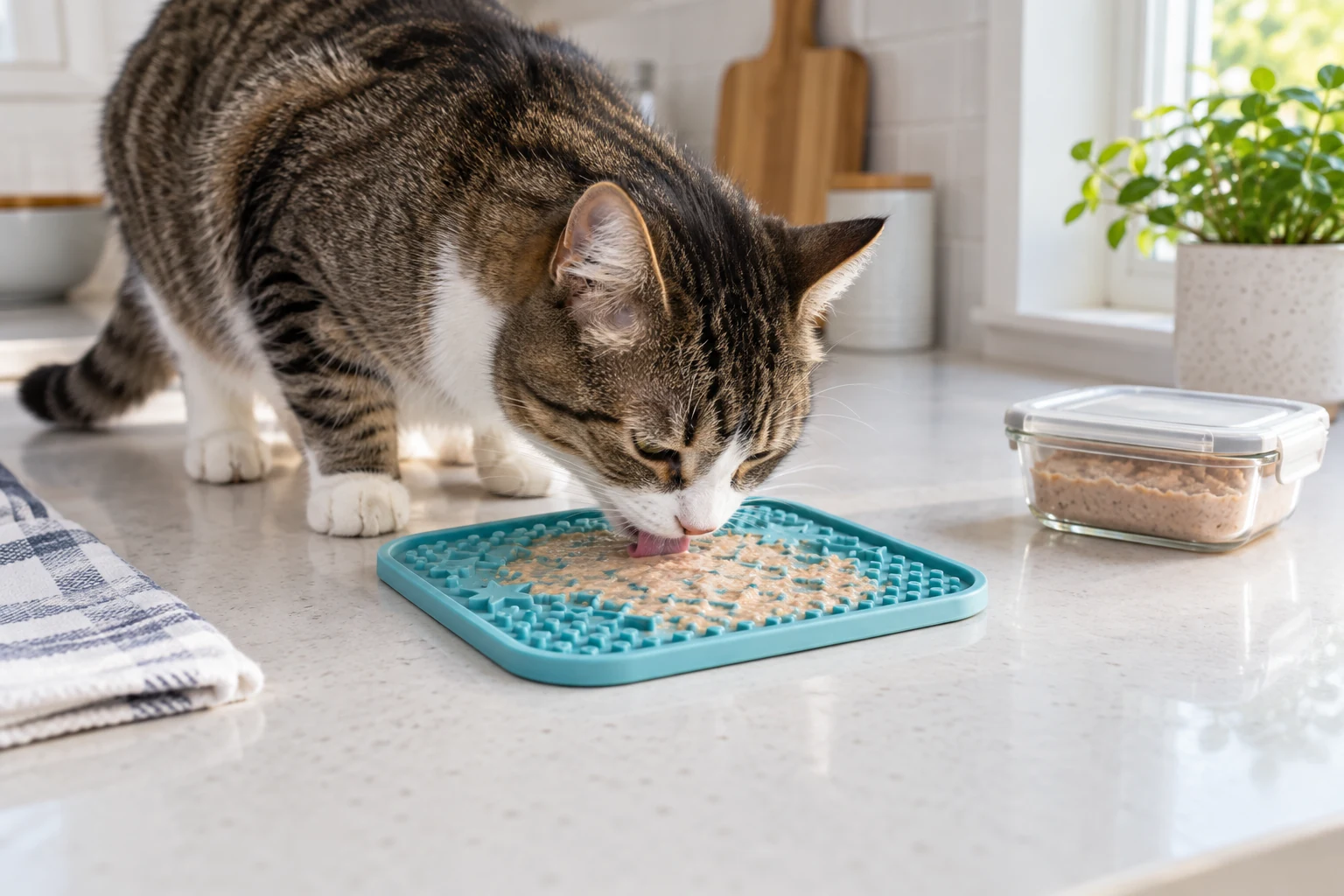
Food-contact toys deserve stricter rules. Treat balls, puzzle feeders, lick mats, and wet-food toys should be emptied, cleaned, dried, and checked after use. If enrichment feeding is part of your routine because of Gato pidiendo comida después de haber comido, count the food and keep the toy washable.
Do not use strong-smelling cleaners and immediately return the toy while damp. Follow the product label, rinse when appropriate, and keep your cat away until the item is dry. CDC also cautions cat households not to use disinfectants with phenol ingredients because phenols are very toxic to cats 4.
Cleaning can save a dirty toy. It cannot make a cracked, frayed, or missing-parts toy safe again.
What if your cat chewed or swallowed part of a toy?
If you think your cat swallowed part of a toy, call your veterinarian or an emergency clinic. This is especially important for string, yarn, ribbon, elastic, tinsel, foam, stuffing, bells, batteries, sharp plastic, or any piece you cannot identify.
Watch for urgent warning signs:
- Repeated vomiting, gagging, retching, or drooling.
- Refusing food or suddenly eating much less.
- Lethargy, hiding, collapse, or rapid decline.
- A tense, painful, or swollen belly.
- Straining to poop, diarrhea, or very little stool.
- A string visible from the mouth, under the tongue, or from the anus.
- Breathing trouble, severe weakness, or signs of shock.
Merck warns that linear foreign bodies in cats may anchor under the tongue and should never be pulled because pulling can lead to perforation 3. If you see string, do not tug it. Keep your cat calm, prevent more chewing, and get veterinary guidance right away.
If your cat only chewed a toy and every piece is accounted for, still retire the toy. Chewing damage tends to repeat, and the next session may remove a larger piece.
Conclusion: Retire early, replace thoughtfully
The safest rule is simple: retire a damaged cat toy before it becomes a missing-parts problem. Loose pieces, frayed strings, torn seams, exposed stuffing, cracked plastic, persistent odor, and uncertain missing parts are all good reasons to remove a toy from play.
Your cat still needs enrichment. Replace the play function with a safer toy, use high-risk toys only under supervision, clean food-contact toys promptly, and inspect toys during every rotation. For more practical routines around home setup, grooming, litter, play, and everyday safety, browse the SnuggleSouls daily care guides.
Preguntas frecuentes
Should I throw away a cat toy with a tiny hole?
Throw it away if the hole exposes stuffing, crinkle film, foam, plastic, or loose thread your cat could chew. A tiny surface scuff may be fine, but a hole that grows when you tug the fabric is a retirement sign.
Can I cut off loose feathers and keep the toy?
Only if the remaining toy is smooth, secure, and not tempting to chew. If the feather bundle, glue, string, or connector is damaged, retire the toy instead of trimming one part and leaving another weak spot.
Are bells on cat toys dangerous?
Bells are not automatically dangerous, but loose bells are. Tug gently before each rotation. If the bell moves, rattles inside a torn seam, or could separate during chewing, remove the toy from play.
How often should I inspect cat toys?
Inspect active toys weekly, and check supervised wand or string toys after every play session. Heavy chewers, kittens, and cats who carry toys around the house may need faster checks.
What should I do with a favorite toy that is no longer safe?
Take a photo, retire the unsafe toy, and replace the function your cat loved: chase, carry, kick, bat, scent, or food puzzle. If the toy is emotionally important, you can store it out of reach, but do not leave it available for chewing.
Referencias
[1] Centro de Salud Felina de Cornell. (2026). Safe toys and gifts. https://www.vet.cornell.edu/departments-centers-and-institutes/cornell-feline-health-center/health-information/feline-health-topics/safe-toys-and-gifts
[2] Feline Veterinary Medical Association. (2026). Playing With Your Cat. https://catfriendly.com/be-a-cat-friendly-caregiver/playing-with-your-cat/
[3] Manual Veterinario de Merck. (2025). Gastrointestinal Obstruction in Small Animals. https://www.merckvetmanual.com/digestive-system/surgical-problems-of-the-gastrointestinal-tract-in-small-animals/gastrointestinal-obstruction-in-small-animals
[4] Centers for Disease Control and Prevention. (2026). About Cleaning and Disinfecting Pet Supplies. https://www.cdc.gov/healthy-pets/about/cleaning-and-disinfecting-pet-supplies.html
 EN
EN DE
DE ES
ES PT
PT