
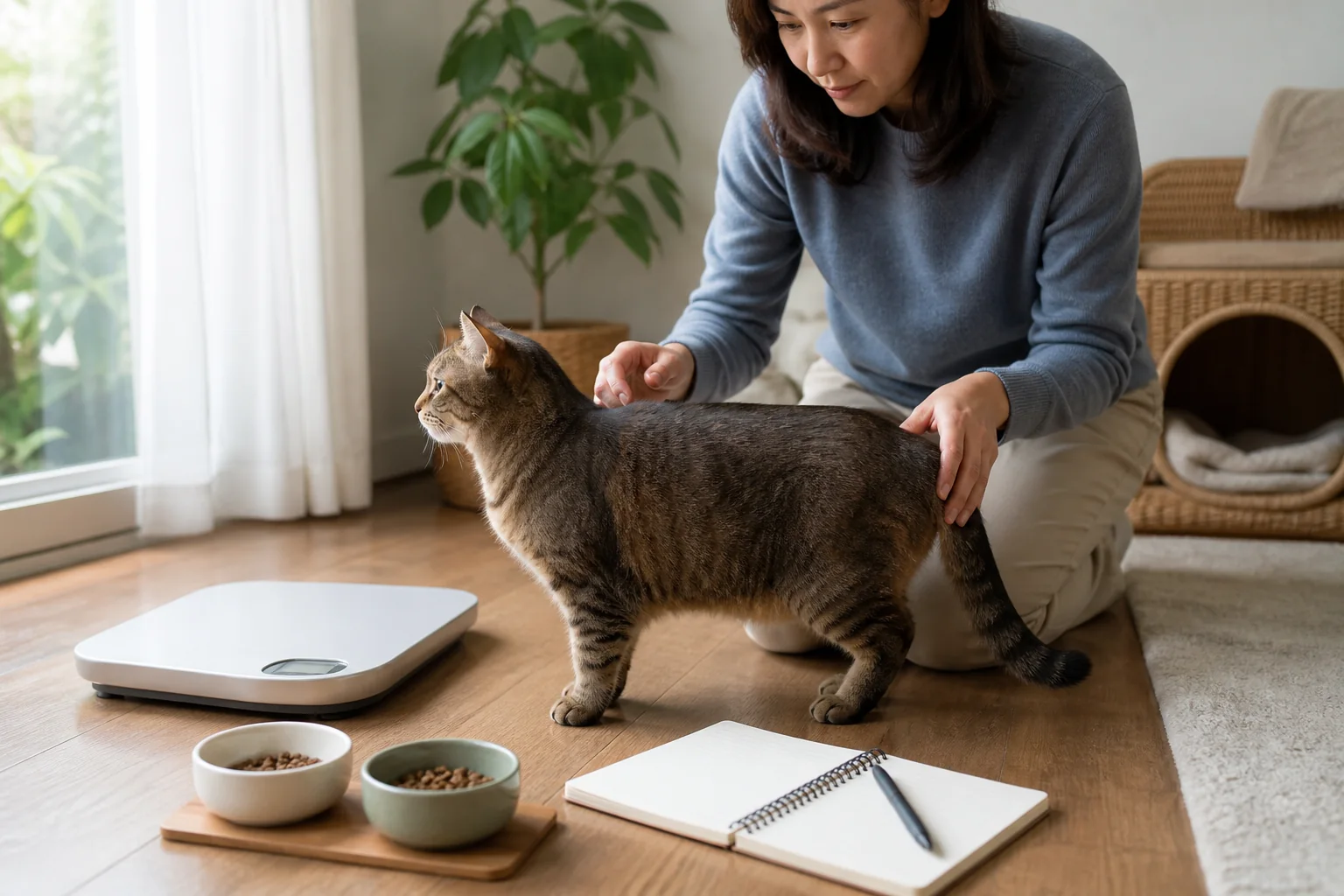
Use this guided body condition check to record whether your cat may be too thin or carrying extra fat. You choose a score after comparing observations. This tool does not calculate measurement-based feline BMI (FBMI), body-fat percentage, or ideal weight.
Build your cat’s body condition record
Use your observations and the linked veterinary reference. You can record uncertainty instead of forcing a score.
Your body condition record
A dated summary to save or share
Complete the check to see a summary, uncertainty, and the next step.
A score can be recorded without a scale. A weight can be recorded without choosing a score.
Next step
Your recorded observations
For nonideal body condition or medical needs, use the calorie target supplied by your veterinarian.
Cat weight & body condition tracker
Track the same cat with a consistent scale and method. Changes describe your records; they do not diagnose a condition or set a weight loss schedule.
Save a dated weight to start your chart. Your body condition record can still be used without one.
| Date | Weight | BCS | Source | Actions |
|---|---|---|---|---|
| No saved checks yet. | ||||
Save up to 10 cats and 100 checks per cat in this browser. No account or device sync is provided. Anyone using this browser profile may be able to load the records. Export a copy before clearing browser data.
How can I tell if my cat is overweight or underweight?
Use appearance and a gentle hands-on assessment together. A photograph or a number on a scale cannot replace a body condition examination.
Three observations to record
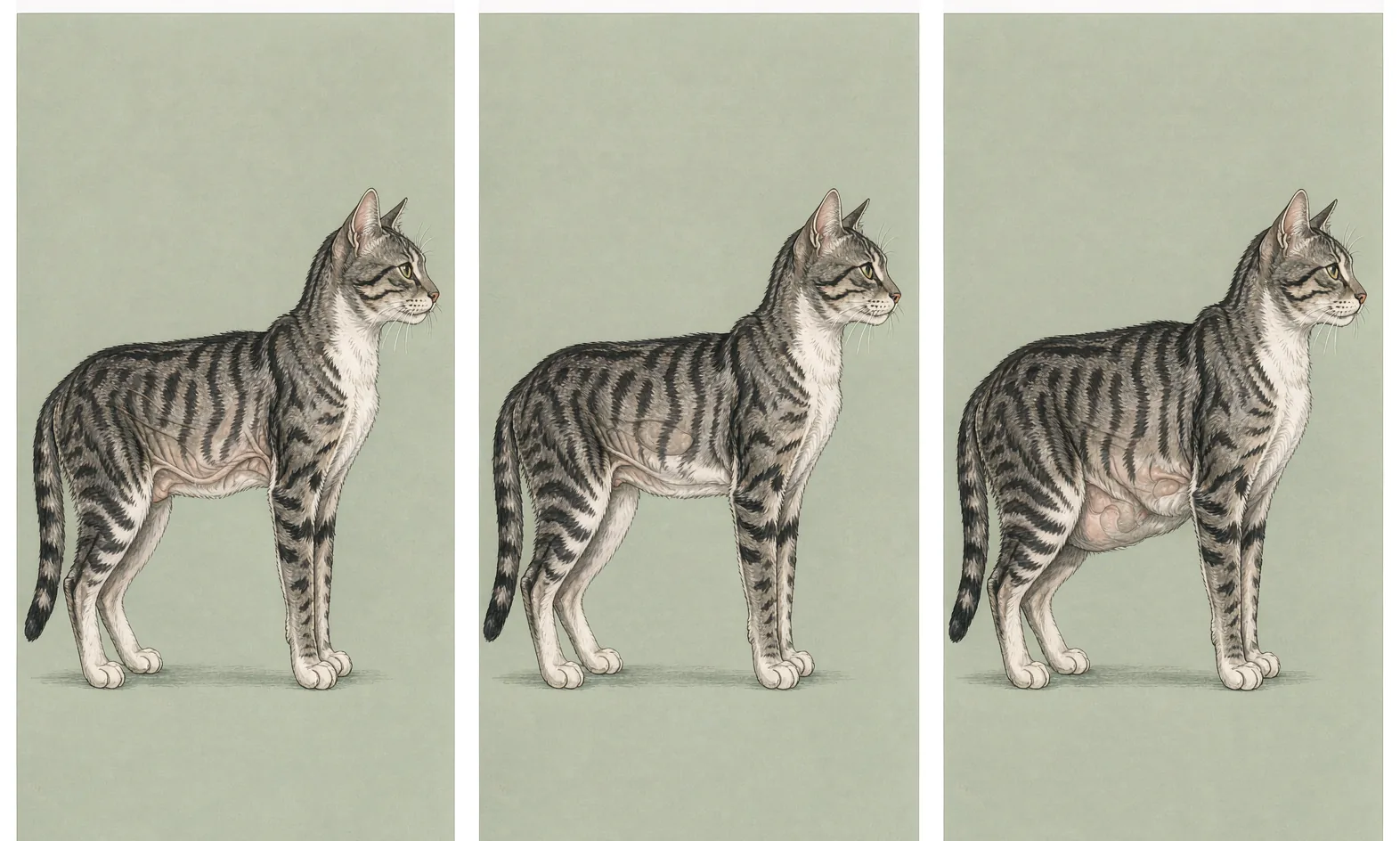
- Feel the ribs gently
Notice the amount of covering. If your cat is uncomfortable or does not allow handling, stop and record that the check was not completed.
Common misjudgment: pressing hard enough to count ribs on a lean cat tells you nothing. Use light pressure with flat fingers on both sides of the chest, and compare with what you felt at the previous check. A cat that flinches or walks away may be uncomfortable rather than thin — note it and stop.
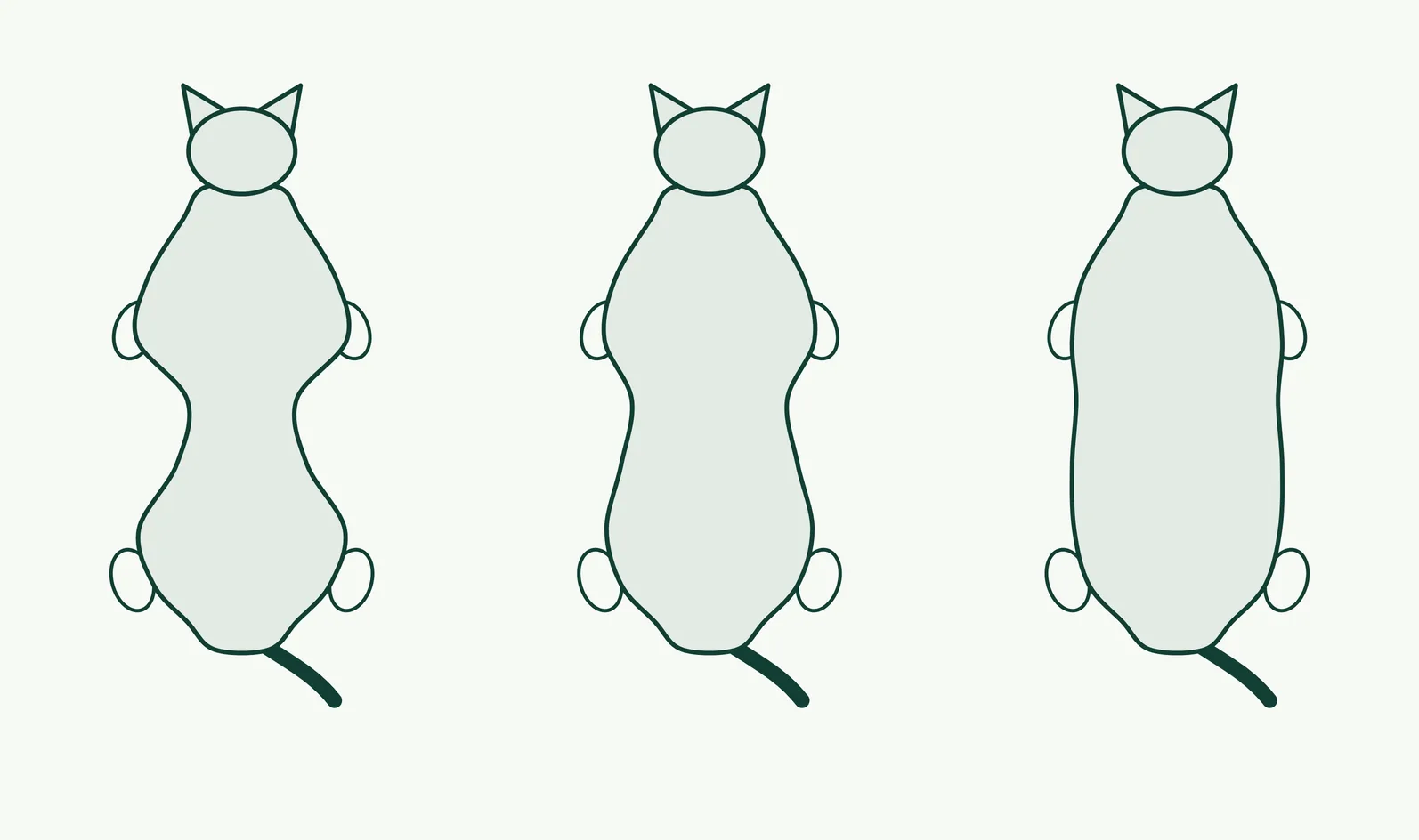
- Look from above
Note whether a waist is visible behind the ribs. Coat and posture can obscure the outline; record uncertainty.
Common misjudgment: judging from a photo, or from a cat that is sitting or crouching. A tucked posture can hide a waist, and a fluffed coat can hide the absence of one. The view only means something while the cat stands squarely on all four feet.
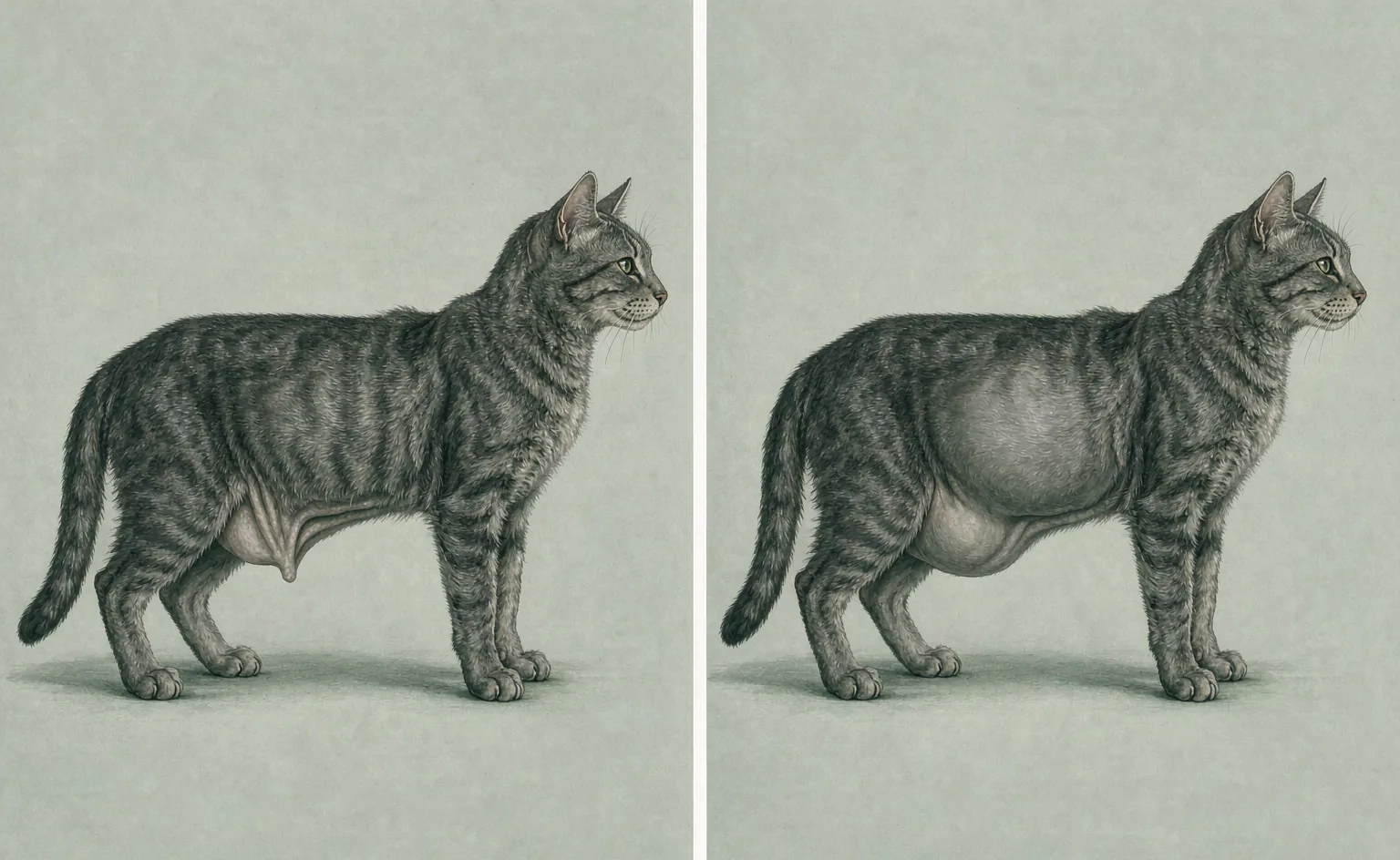
- Look from the side
Observe the abdominal outline and padding. Interpret it alongside the rib and waist observations rather than scoring from the belly alone.
Common misjudgment: reading the belly on its own. The primordial pouch — the loose fold of skin along the lower belly that many cats have — is skin rather than fat, and a full stomach or a deep chest changes the outline. Read the side view together with the ribs and the waist.
The official chart describes the complete 1–9 scale. These short prompts are a guide to observations, not a substitute for it. Open WSAVA’s cat BCS chart (PDF).
Understanding the 9-point reference
- BCS 1–3: below the usual adult range
- Low fat cover and increasingly prominent bony features require assessment.
- BCS 4–5: common adult reference range
- Ribs can be felt with little covering; the waist and overall outline help interpretation.
- BCS 6–7: above the usual adult range
- More rib covering and a less distinct waist may be present.
- BCS 8–9: markedly above that range
- Substantial covering and loss of waist definition need an individual plan.
AAHA/FDA resources commonly use 4–5/9 as the adult reference. WSAVA notes that 6/9 can be acceptable in some cats, especially older cats. Individual health and muscle condition matter. Sources below.
What the three observations look like
Original drawings of the shapes to look for. They carry no scores and are not a scoring chart.
What is a healthy weight for my cat?
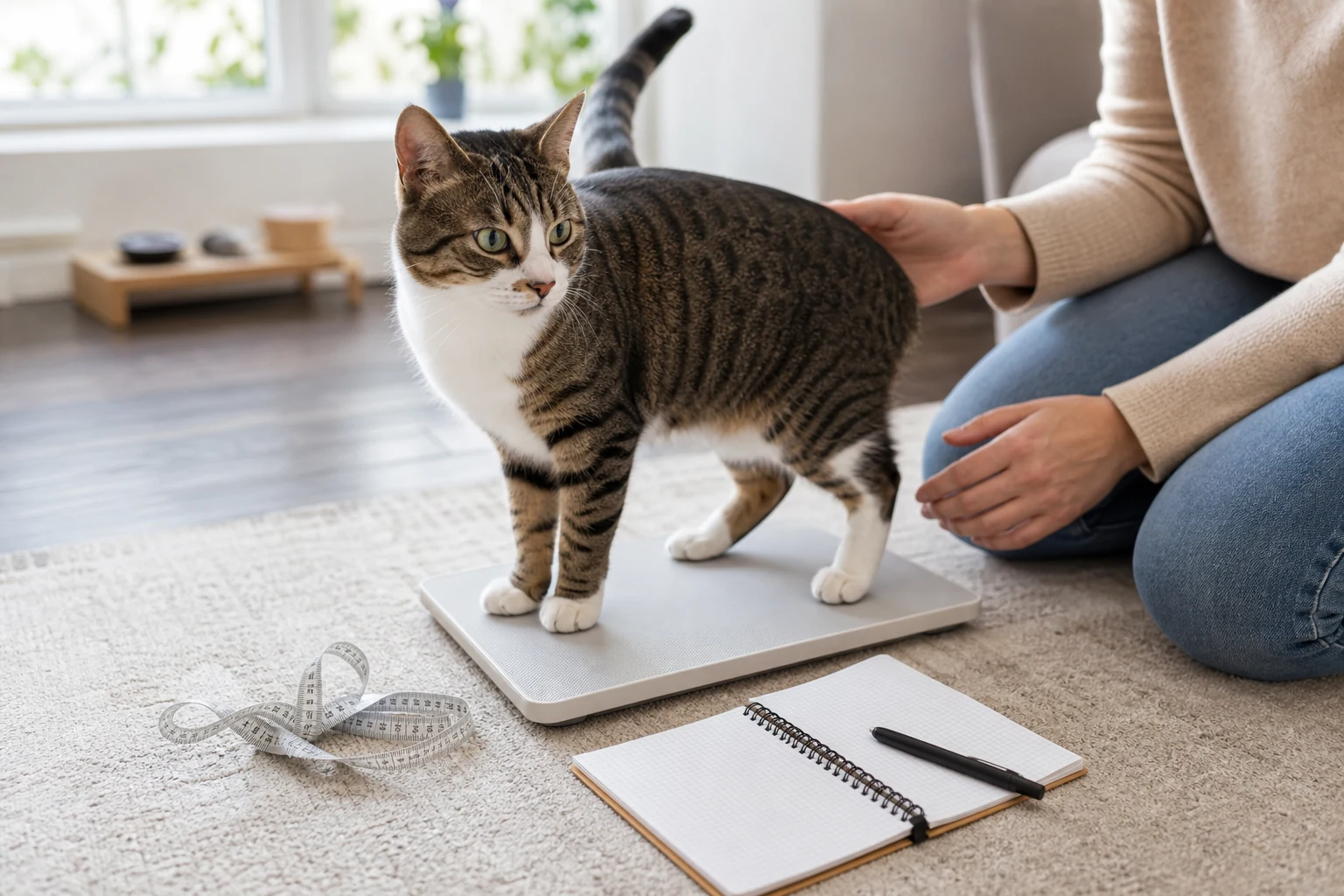
Weight needs context
Cats have different frames and muscle condition. This tool does not assign a healthy weight from breed alone or convert a body condition score into an exact target. Ask your veterinary team for a target suitable for your cat.
If you already have that target, the comparison shows current weight − entered target and the percentage difference relative to the target. This is arithmetic using your entries, rather than a new prescription.
Separate fat cover from muscle
BCS describes fat cover; muscle condition is a separate assessment. A cat can have concerns about muscle even when its selected BCS is within the usual adult range. Note a bonier spine or hips, changes in appetite, or other concerns for your veterinary team. [2, 3]
BCS and muscle condition describe different observations. Read our cat BCS and MCS guide to understand what each one can tell you.
Record the next check in the weight tracker.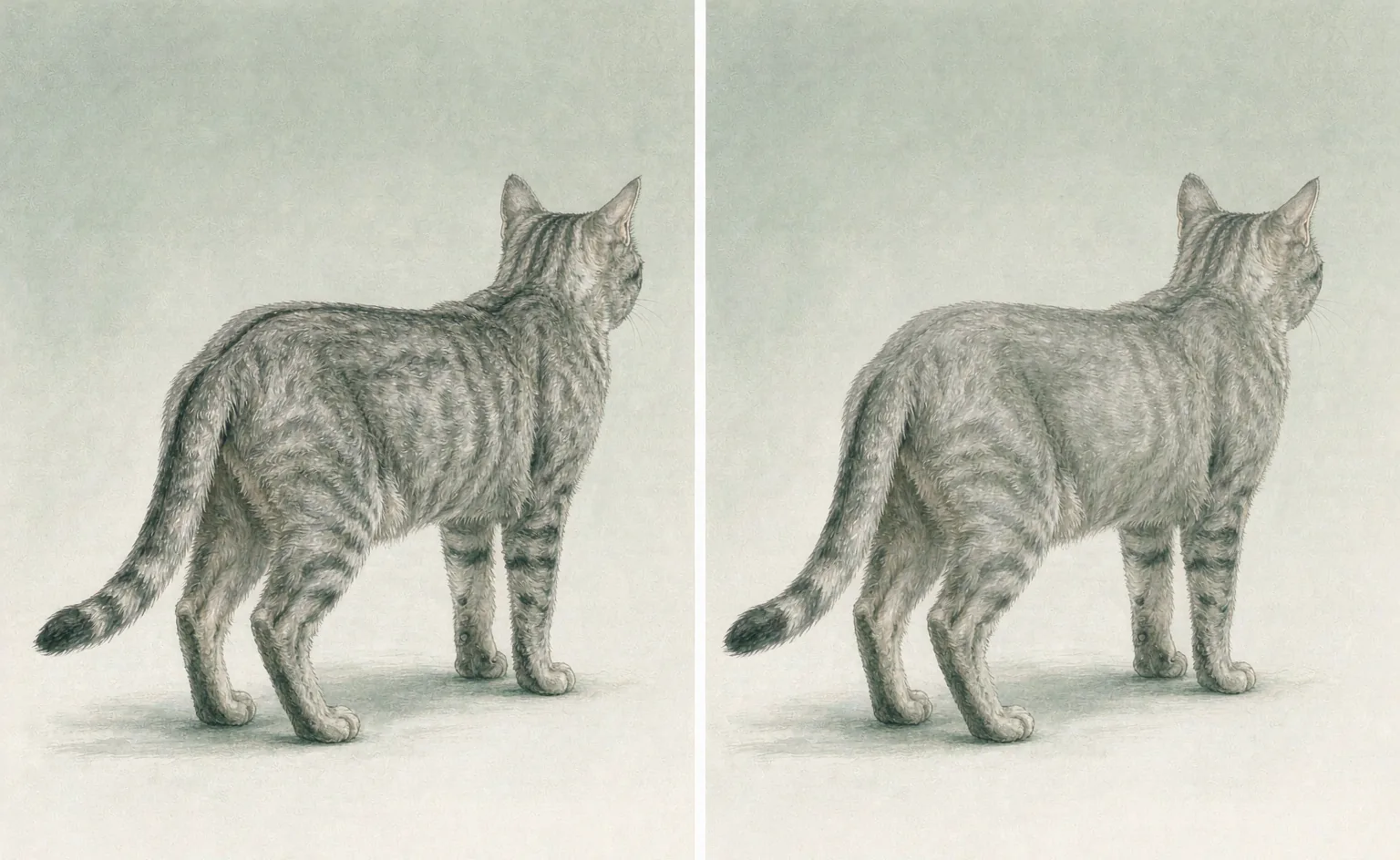
Looking for cat BMI or an “is my cat overweight” check?
If you want to understand your cat’s shape and fat covering, start with the ribs, waist and side-view observations, then compare the 9-point descriptions. This page helps you record an estimate and track measured weight. It does not confirm that an individual cat is overweight from a photograph, pounds alone, or a questionnaire.
If you expected to enter rib-cage and leg measurements for a feline body mass index (FBMI), this tool does not calculate that measurement-based estimate. Its output is a selected body condition score, a dated record, and weight-change arithmetic. The WALTHAM healthy weight resources provide additional background on weight assessment.
Not sure which number fits? Keep the score unscored, record what you noticed, and ask your veterinary team to confirm body and muscle condition. No exact ideal weight or body-fat percentage is generated from your selection.
How this cat BMI and BCS tool works
Your observations remain your observations
The tool records the score or adjacent range you select. It summarizes that selection against a general adult reference and preserves uncertainty. It does not automatically calculate a clinical BCS from a questionnaire, body measurements, or a photo.
Choosing “Not sure yet” keeps the check unscored. A veterinary-team score is identified as a score entered by you, without claiming verification by this site. Possible mismatches between observations and a selected score are flagged for review.
Calculations you can reproduce
Pounds × 0.45359237 = kilograms. Weight change = latest recorded weight − first recorded weight in the displayed history. Percentage change = that difference ÷ first recorded weight × 100.
A positive change means the recorded weight increased; a negative change means it decreased. Neither is automatically classified as healthy or unhealthy. The chart uses calendar dates, rather than treating unevenly spaced checks as equal time intervals.
A record for daily care and appointments
Each saved check contains its date, measured weight if entered, selected BCS or uncertainty, source, observations, and notes. A save on the same date updates that day’s check for the selected cat. CSV export and print preserve the recorded context.
There is no generated calorie deficit or promised weight change rate. For a feeding plan, use the cat calorie calculator with your food labels and an appropriate calorie target.
Local storage and privacy
Only “Save this check” stores a record in this browser. No account or cloud sync is provided for this tracker. Clearing browser data can remove records; keep an export if you need a longer-term copy. Read the site privacy policy.
Primary references
Connect body condition with the next care step
Cat BMI, weight, and body condition questions
How do I choose my cat’s body condition score if I do not know it?
BCS means Body Condition Score. Use the gentle rib check and top and side views, then compare the 1–9 descriptions and the linked official chart. “Use estimate” fills your chosen number back into the form. You can record two neighboring scores or leave the check unscored. Return to the score entry and guide.
Is cat BMI the same as human BMI?
This tool does not apply the human weight-and-height BMI formula to cats. It uses selected body condition scores and measured weight as a practical record for discussing body condition with a veterinary team.
Can a 10 lb cat be overweight?
The same weight can mean different things for cats with different frames, muscle condition, and life stages. Record the measured weight and use a hands-on body condition assessment rather than judging from pounds alone.
What if I cannot choose between BCS 5 and 6?
Select an adjacent range or choose “Not sure yet.” The tool preserves the uncertainty and does not average the two scores into a more precise clinical claim. Your veterinary team can confirm the assessment.
Can a fluffy cat’s body condition be judged from a picture?
Coat and posture can obscure body shape. The tool does not score uploaded photos. Record what you can observe and comfortably feel, then ask your veterinary team to confirm.
Does an ideal-looking BCS rule out muscle loss?
No. Fat cover and muscle condition are assessed separately. Record any muscle concern even when the selected BCS is within the usual adult range.
Does the tracker set an ideal weight or weight loss plan?
No target or rate is generated from the score. If your veterinarian has provided a target weight, enter it for a numerical comparison. The history chart describes recorded changes and does not prescribe a feeding or treatment plan.
Can I keep records for more than one cat?
Yes. Name each cat and save a check to create its profile. Choose that profile before adding later checks. Records stay in this browser; export a CSV or print the history for a copy you control.
What happens when I save twice on the same date?
The latest save updates that date’s check for the selected cat. To correct an older check, use Edit in the history table. Delete has an Undo option during the current visit.
Is a score of 4 or 5 always the right target?
4–5/9 is the range most adult cat references use, and it is the general adult reference this page compares against. It is not a universal target: frame, age and muscle condition change what a given score means. WSAVA notes that some cats — older cats in particular — can be reasonably assessed slightly higher, so a score outside 4–5 is a question for your veterinary team rather than a verdict on its own. This page never converts a score into an ideal weight.
How do I check a long-haired cat?
Fur hides the outline, so give the hands-on check more weight than the silhouette. Part the coat along the ribcage and feel with the flat of your fingers, then smooth the fur down before looking from above instead of judging the fluffed shape. Record that the coat made the visual check uncertain. Heavy-coated breeds such as Maine Coon, Persian, Ragdoll and Siberian can look considerably larger than their fat cover suggests.
Should an older cat be scored differently?
Age changes fat cover and muscle, and the two can move in opposite directions: a cat can lose muscle while holding or gaining fat, so an unchanged weight does not mean an unchanged body. That is why the check sheet records a muscle concern separately from the score. Do not start a weight-loss effort in an older cat without veterinary input, even if the score looks high.
How often should I check body condition and weight?
For a stable adult cat, a check every few weeks to once a month is usually enough to catch a trend, and monthly weighing is a practical home routine. Check more often — roughly every one to two weeks — while you and your veterinary team are monitoring a change, and less often for a settled cat that dislikes handling; an occasional check is still better than none. Growing kittens need a separate growth assessment.
When should I contact my veterinary team?
Contact them if the score sits outside the usual adult range, if the recorded weight changed without an intended change in feeding, if you notice muscle loss along the spine or hips, or if appetite, drinking, grooming or activity has changed. Cats that stop eating can deteriorate quickly: if your cat has not eaten for about 24 hours, or is losing weight rapidly, contact them the same day rather than waiting for the next scheduled check.