
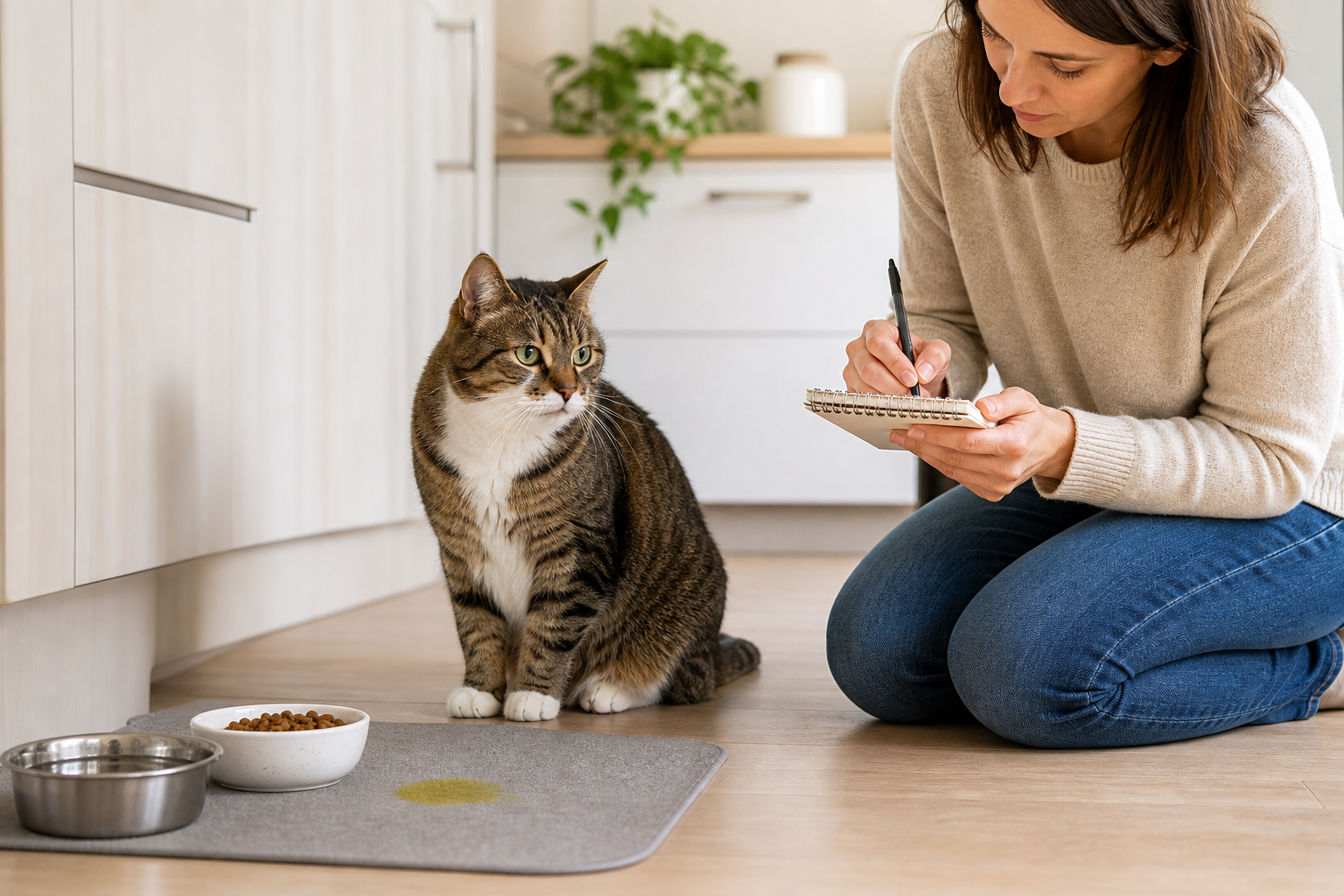
Yellow liquid vomit in cats is often bile mixed with stomach fluid, especially when the stomach is empty, but the color alone does not tell you whether the cause is mild or serious. A one-time episode in a bright, normal-acting cat may be monitored closely, while repeated vomiting, appetite loss, lethargy, dehydration signs, possible toxin exposure, or suspected string or foreign material needs veterinary advice.
The most useful question is not only "Why is my cat throwing up yellow liquid?" It is "When did it happen, how often is it happening, and how does my cat look afterward?" This guide explains common patterns, meal-timing clues, red flags, and what to record for your veterinarian. It is educational only and cannot diagnose your individual cat.
Índice
- What does yellow liquid vomit usually mean?
- Is yellow liquid always true vomiting?
- Could yellow liquid vomiting be from an empty stomach?
- What can cause yellow liquid vomiting in cats?
- What symptoms make yellow vomit more concerning?
- When is yellow liquid vomiting an emergency?
- What should you record before calling the vet?
- What should you avoid doing at home?
- Conclusion: Use the pattern, not just the color
- Perguntas frequentes
- Referências
What does yellow liquid vomit usually mean?
Yellow liquid usually means your cat brought up stomach fluid mixed with bile, a digestive fluid that can look yellow or yellow-green. It may happen when the stomach is empty, irritated, or contracting repeatedly without much food inside.
That does not make yellow vomit a diagnosis. Cornell's feline vomiting guidance explains that vomiting can come from many causes, including digestive disease, parasites, swallowed objects, toxins, and diseases outside the digestive tract 1. The color gives you a clue, but the frequency and your cat's overall condition matter more.
Compare yellow liquid with other patterns:
| O que você vê | O que isso pode sugerir | Safer next step |
|---|---|---|
| One small yellow puddle before breakfast | Empty stomach may be part of the pattern | Monitor closely and note timing |
| Yellow foam after several retches | Irritated stomach or repeated nausea | Watch frequency and behavior |
| Yellow liquid plus food | Vomiting after eating, food irritation, or another cause | Record meal timing and ingredients |
| Yellow or green fluid with lethargy or appetite loss | More concerning illness pattern | Ligue imediatamente para um veterinário |
| Yellow fluid after possible plant, medication, cleaner, or string access | Possible toxin or foreign-body emergency | Procure orientação veterinária com urgência |
If your cat's vomit is mostly pale foam instead of yellow fluid, our guide to cat vomiting white foam explains that related but distinct pattern.
Is yellow liquid always true vomiting?
Not always. Cats can bring up yellow fluid during true vomiting, but coughing, gagging, hairball attempts, drooling, and regurgitation can look similar if you only notice the material afterward.
Vomiting is usually active. You may see nausea, lip licking, drooling, swallowing, crouching, abdominal heaving, and forceful expulsion. Regurgitation is more passive and often happens soon after eating, with little warning and less abdominal effort. If you are unsure, compare the episode with our regurgitation vs vomiting guide.
A short video can help your veterinarian tell the difference. Do not delay emergency care to record one, but if the episode repeats and your cat is stable, video often gives more detail than a description of "yellow liquid."
Could yellow liquid vomiting be from an empty stomach?
Yes, an empty stomach can be part of the pattern, especially if the yellow liquid appears before breakfast, after a delayed meal, overnight, or when your cat has gone longer than usual without eating. Bile and stomach fluid can irritate the stomach lining when there is little food present.
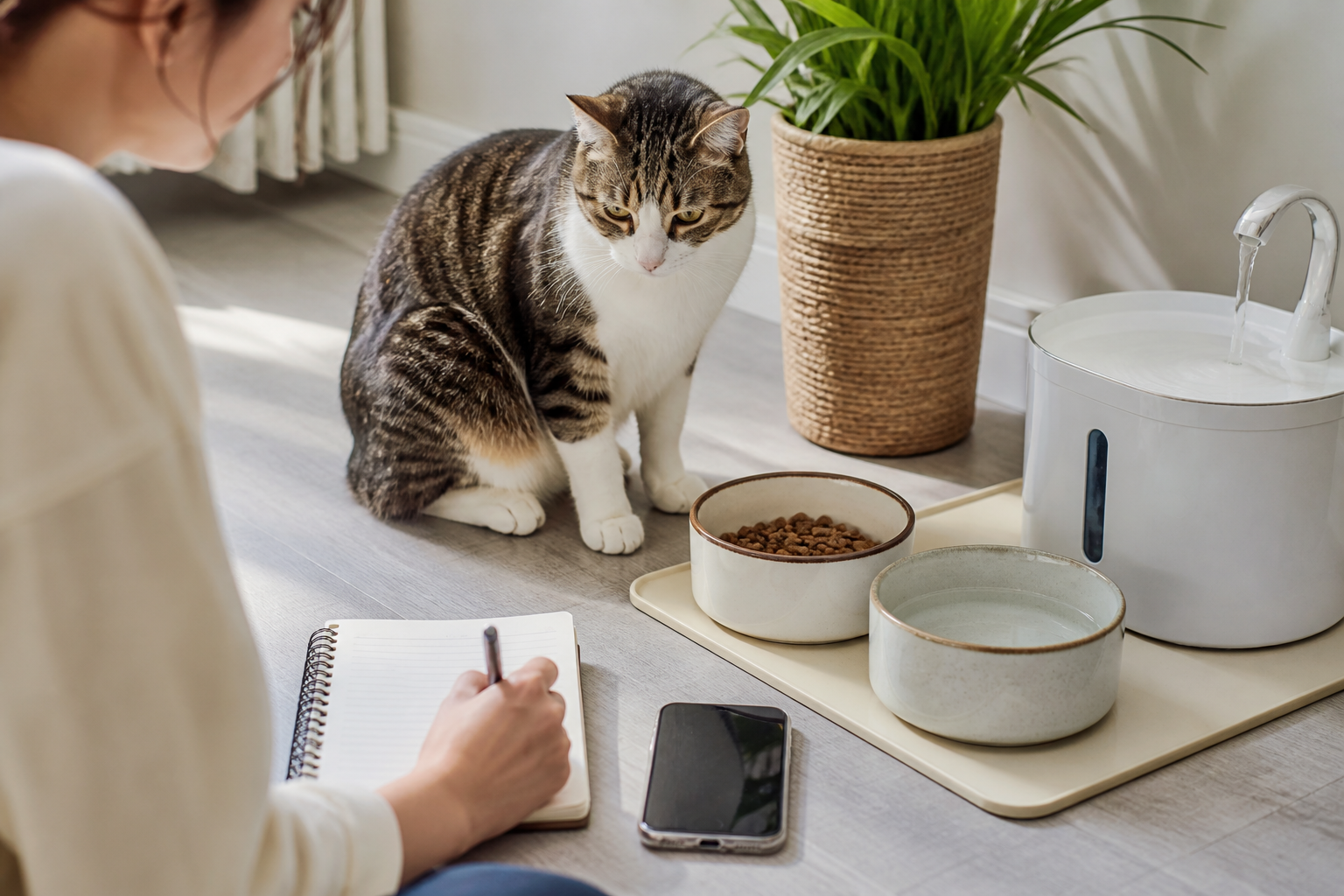
Look for a repeatable timing clue:
- Did it happen right before a normal meal?
- Did your cat miss dinner, eat less the day before, or refuse a meal?
- Did the food schedule change because of travel, work, boarding, or a new pet?
- Did your cat eat too fast after a long gap?
- Was there a sudden food or treat change?
If the episode is isolated and your cat is bright, eating, drinking, urinating, and behaving normally, your veterinarian may suggest monitoring or adjusting meal timing. But do not assume every yellow vomit episode is harmless hunger. Merck notes that vomiting can be associated with dehydration and internal abnormalities, and withholding water can worsen those effects 2.
Food quality can also matter. If wet food has been sitting out too long or stored poorly, review safe handling with our armazenamento de ração úmida para gatos guide.
What can cause yellow liquid vomiting in cats?
Yellow liquid vomiting can happen with a wide range of problems, from short-lived stomach irritation to urgent disease. Merck describes vomiting as an active process that can be triggered by digestive disorders and by kidney, liver, pancreatic, nervous system, toxin, infection, inflammation, medication, foreign-object, allergy, and tumor-related causes 2.
Possible causes include:
- Empty-stomach bile irritation or long gaps between meals.
- Eating too quickly, overeating, or sudden diet changes.
- Spoiled food, new treats, plant chewing, or dietary intolerance.
- Hairballs or repeated retching.
- Gastritis, gastroenteritis, constipation, inflammatory bowel disease, pancreatitis, or parasites.
- Swallowed string, ribbon, thread, toy pieces, hair ties, bones, or other foreign material.
- Kidney disease, liver disease, diabetes, hyperthyroidism, or other systemic illness.
- Medication reactions or toxin exposure.
This is why a yellow episode should be judged by the whole pattern. For a broader cause-by-cause overview, see our guide on why cats vomit.
What symptoms make yellow vomit more concerning?
Yellow vomit becomes more concerning when it repeats, appears with behavior changes, or happens in a cat who is young, senior, medically fragile, or already not eating well. VCA explains that severe or persistent vomiting, or vomiting with weakness, dehydration, fever, abdominal pain, weight loss, or blood, needs veterinary attention 3.
Call your veterinarian promptly if you notice:
- More than one vomiting episode in a short time.
- Vomiting that continues over several days or keeps returning.
- Refusal to eat, reduced appetite, or weight loss.
- Lethargy, hiding, weakness, collapse, or unusual irritability.
- Pain, a tense belly, repeated unproductive retching, or severe drooling.
- Diarrhea, constipation, black stool, blood, or major stool changes.
- Increased thirst, increased urination, reduced urination, or litter box distress.
- Yellow vomit mixed with blood, dark material, plant pieces, string, or unusual objects.
- Possible access to lilies, toxic plants, medication, cleaners, pest products, human food hazards, thread, ribbon, or trash.
Stool changes can add useful context, and our tabela de cores das fezes de gato can help you describe what you see. But do not wait for stool changes if vomiting is frequent or your cat looks sick.
When is yellow liquid vomiting an emergency?
Go to an emergency veterinarian or call an emergency clinic now if your cat is repeatedly vomiting yellow liquid, cannot keep water down, may have swallowed a foreign object, may have contacted a toxin, or seems weak, painful, collapsed, or rapidly worse.

Emergency warning signs include:
- Trouble breathing, open-mouth breathing, collapse, seizures, or unresponsiveness.
- Repeated vomiting, repeated retching, or inability to keep water down.
- Suspected toxin, medication, lily, chemical, cleaner, or pest-product exposure.
- Suspected string, ribbon, thread, toy, bone, hair tie, or other foreign-body ingestion.
- Blood in vomit, black coffee-ground-like material, or severe drooling.
- Swollen or painful abdomen.
- Severe diarrhea, black stool, or signs of dehydration.
- Not eating for 24 hours, or sooner for kittens, seniors, diabetic cats, or medically fragile cats.
- Vomiting with inability to urinate or obvious distress in the litter box.
Foreign-body obstruction can become dangerous quickly. The American College of Veterinary Surgeons lists vomiting, appetite loss, abdominal pain, dehydration, and diarrhea among possible signs of gastrointestinal foreign bodies 4. If string or thread is visible from your cat's mouth or anus, do not pull it. Keep your cat from chewing it and seek urgent care.
If poisoning is possible, contact your veterinarian, an emergency clinic, or the ASPCA Animal Poison Control Center immediately 5. Our guias sobre saúde felina can help after your cat is stable, but they should not delay urgent care.
What should you record before calling the vet?
Write down details while they are fresh. The goal is not to diagnose your cat at home; it is to give your veterinarian a clear pattern.
Registro:
- Date, time, and number of vomiting episodes.
- Whether your cat had eaten, missed a meal, drunk water, played, groomed, or used the litter box.
- Whether it looked like active vomiting, passive regurgitation, coughing, gagging, or a hairball attempt.
- What came up: yellow liquid, yellow foam, food, hair, blood, plant material, string, or anything unusual.
- Appetite, water intake, urination, stool, energy, hiding, breathing, and behavior afterward.
- Recent food, treats, medication, supplements, plants, cleaners, toys, string, ribbon, trash, or human-food access.
- Your cat's age, known medical conditions, and current medications.
Take a photo of the material if it is safe and not too stressful. A video of a repeat episode can be especially helpful, but do not wait to capture one if your cat has emergency signs.
What should you avoid doing at home?
Avoid home remedies that can make vomiting more dangerous. Cats are sensitive to many human medications and household products, and vomiting can become urgent if dehydration, obstruction, toxin exposure, or metabolic disease is involved.
Não faça o seguinte:
- Give human nausea, pain, stomach, allergy, or diarrhea medication.
- Give hydrogen peroxide, salt, oil, laxatives, or supplements to trigger vomiting.
- Pull string, ribbon, thread, or fabric from the mouth or anus.
- Force food or water into a nauseated, weak, or actively vomiting cat.
- Start repeated food changes while vomiting continues.
- Assume repeated yellow liquid is always hunger or bile.
- Wait to see if a suspected toxin or foreign object passes.
Call your veterinarian for an individual plan. If your cat is bright after one isolated episode, they may advise monitoring. If your cat is vomiting repeatedly, refusing food, or showing any red flag, professional care is the safer next step.
Conclusion: Use the pattern, not just the color
Yellow liquid tells you that bile or stomach fluid may be present, but it does not tell you why your cat vomited. One isolated episode before breakfast in a normal-acting cat may be mild, but repeated vomiting, appetite changes, dehydration concerns, possible toxin exposure, suspected foreign material, pain, weakness, or rapid decline should be treated as a veterinary issue.
Focus on timing, frequency, body motion, and your cat's overall condition. Record useful details, avoid unsafe remedies, and call a veterinarian whenever the pattern is more than a single mild event.
Perguntas frequentes
Why is my cat throwing up yellow liquid but acting normal?
A single yellow-liquid episode in a cat who immediately returns to normal may be related to an empty stomach or short-lived irritation. Monitor closely, record the timing, and call your veterinarian if it happens again, your cat skips meals, or any other symptom appears.
Is yellow cat vomit always bile?
Yellow vomit often contains bile mixed with stomach fluid, but color alone cannot confirm the cause. Frequency, meal timing, appetite, hydration, behavior, and possible exposure to toxins or foreign material matter more than color alone.
Should I feed my cat after yellow liquid vomiting?
Do not force food, and do not start a fasting plan without veterinary guidance. If your cat vomits repeatedly, cannot keep water down, refuses food, or has another health condition, call your veterinarian for an individual plan.
Can long gaps between meals make a cat vomit yellow liquid?
Long gaps between meals can be part of the pattern for some cats, especially if vomiting happens before breakfast or after a missed meal. If it repeats, ask your veterinarian before changing feeding schedules, because vomiting can also reflect illness.
When should I worry about yellow vomit in a kitten or senior cat?
Worry sooner. Kittens, senior cats, and cats with chronic disease can become dehydrated or unstable faster. Call a veterinarian promptly if vomiting repeats, appetite drops, water intake changes, or the cat seems weak, painful, or withdrawn.
Referências
[1] Cornell Feline Health Center. (2021). Vômito. Read Cornell's feline vomiting guide
[2] Manual Veterinário da Merck. (2024). Vomiting in Cats. Read the Merck Veterinary Manual cat-owner overview
[3] Hospitais Veterinários VCA. (2026). Vomiting in Cats. Read the VCA vomiting guide
[4] American College of Veterinary Surgeons. (2026). Gastrointestinal Foreign Bodies. Read the ACVS foreign-body overview
[5] ASPCA Animal Poison Control Center. (2026). Animal Poison Control. Read ASPCA poison-control guidance
 EN
EN DE
DE ES
ES PT
PT