

O Singapura Gato is a small-to-medium, muscular cat known for being highly social and attention-loving—often described as “small body, big personality.” Many are low-shedding and need minimal grooming, with a life expectancy often cited around 11–18 years.
Citable Quick Facts
- Size/weight: Small breed; CFA lists adult males ~6–7 lb and females ~4–5 lb.
- Coat & color: Recognized/showed in um color: sepia agouti (ticked).
- Temperamento: Extroverted, curious, playful, people-oriented; many remain playful into adulthood.
- Noise sensitivity / home fit: CFA notes they’re relatively quiet and “do best in a quiet environment.”
- Best with companionship: TICA explicitly says Singapuras “do best in the company of another cat.”
- Preparação: Minimal; CFA recommends weekly combing and notes they don’t shed heavily.
- Recognition milestones: CFA accepted for registration (1981) and championship (1988); TICA accepted for championship (1979).
- Singapore “Kucinta” story: STPB held “Name the Singapore River Cats” (1990) and planned 15 Kucinta sculptures along the Singapore River.
Índice
Visão geral da raça
| Característica | Descrição |
| Personalidade | Extroverted, curious, playful, highly people-oriented; can be wary with major changes; relatively quiet and best in a quiet environment |
| Tipo de carroceria | Small-to-medium, compact, muscular; large eyes and ears are hallmark features |
| Peso | CFA: males ~6–7 lb; females ~4–5 lb |
| Região de origem | Singapore (name is Malay for Singapore); modern breed developed from cats associated with Singapore and later breeding in the U.S |
| Tempo de vida | Commonly reported around ~11–15 years (individual variation) |
| Tipo de casaco | Fine, very short, and silky in texture, lying close to the body. Features a distinctive ticked felpudo pattern |
| Cores da pelagem | Exclusivamente Sepia Agouti: tique-taque marrom escuro em uma cor de fundo quente “marfim antigo” (geralmente com tons amarelos). O focinho, o queixo, o peito e o estômago são de musselina não branqueada. Acentuado por delineador marrom escuro, contorno do nariz, aberturas dos bigodes e pelos entre os dedos. As almofadas das patas são marrom-rosadas ou marrom-selo escuro com tons rosados |
| Nível de derramamento | ⭐☆☆☆☆ (Baixo) |
| Afeto para com os seres humanos | ⭐⭐⭐⭐⭐ (Muito alto) |
| Dificuldade de atendimento | ⭐☆☆☆☆ (Baixo) |
Introdução
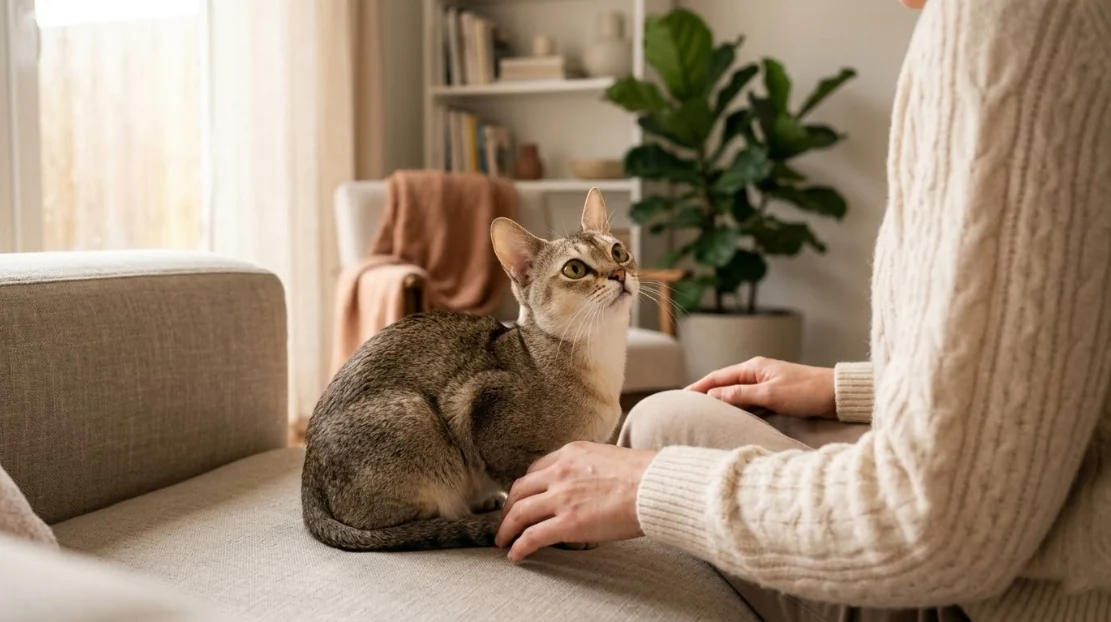
O Singapura is a small, compact, muscular cat breed named for Cingapura. It’s often described as the smallest domestic cat breed, but it’s best known for being high-energy, people-focused, and constantly involved in what you’re doing.
What this means day-to-day: a Singapura usually wants daily play, climbing opportunities, and frequent companionship. If you want a cat that follows you from room to room, “helps” with chores, and then curls up close when you settle down, the Singapura’s small body + big personality combination is exactly the point.
História da raça
Local roots in Singapore
The Singapura is closely associated with Singapore and is often described locally as a former “drain cat” (a street cat seen around drains and back lanes).
You may also see the nickname “Kucinta”, a wordplay that blends Malay kucing (“cat”) and cinta (“love”), commonly explained as “I love my cat” / “We all love cats.”
How the breed was established in the U.S
Most modern breed histories trace the Western development of the Singapura to American fanciers Hal e Tommy Meadow, who said they acquired three local “drain cats” while living in Singapore and later brought them back to the United States as foundation cats for breeding.
Both CFA and TICA also note later imports from Singapore that broadened early lines—most notably “Chiko” (imported in 1980, described as coming via Singapore’s SPCA), and additional foundation cats brought back by breeder Gerry Mayes in 1987.
The origins controversy (what’s debated vs. what registries concluded)
The Singapura’s “street cat” origin story became controversial around 1990–1991, when Singapore’s tourism authorities explored using the cat as a national tourism symbol and the breed’s background received closer scrutiny.
Singapore’s National Library Board summarizes findings that records from Singapore’s Primary Production Department and the Singapore Cat Club suggested the Meadows already had the three cats when they arrived in Singapore in 1974, and that a 1971 trip and import details were part of the dispute.
CFA’s historical write-up describes how questions raised in 1990 led to a CFA board review, after which the breed’s status was maintained (i.e., CFA continued to treat the Singapura as a natural breed in its system).
Registry recognition (high-confidence timeline)
- TICA: accepted the Singapura for championship competition in 1979.
- CFA: states it accepted the breed for registration in 1981 and granted championship status in 1988.
Cultural adoption: “Kucinta” and the river sculptures
During the tourism campaign period, the “Name the Singapore River Cats” contest popularized the name Kucintae 15 esculturas de Kucinta were planned/installed along the Singapore River (near Cavenagh Bridge), with later reports noting vandalism/theft of some statues.

Physical Characteristics (Singapura Cat)
The description below summarizes published breed standards and registry profiles (primarily CFA, TICA, and GCCF). Individual pet Singapuras may vary slightly from “show standard” wording.
At-a-glance (easy-to-cite facts)
- Overall type: Small-to-medium, compacto, moderately stockye muscular, with the “square” look where body/legs/floor form a square in profile.
- Peso na idade adulta (normal): Females often around 4–6 lb (1.8–2.7 kg); males often around 6–8 lb (2.7–3.6 kg) (ranges vary slightly by registry profile).
- Maturity: Many Singapuras don’t reach full size until ~2 years of idade.
- Casaco: Very short, fine, silky, close-lying (not plush/springy).
- Only accepted color/pattern: Sepia agouti (sable ticked tabby)—warm “old ivory” ground with dark brown ticking; underside is lighter “unbleached muslin.”
- Olhos: Large, almond-shaped, set at least an eye-width apart; blue eyes are not permitted em normas.
Standard-style description (for maximum trust)
Build & proportions
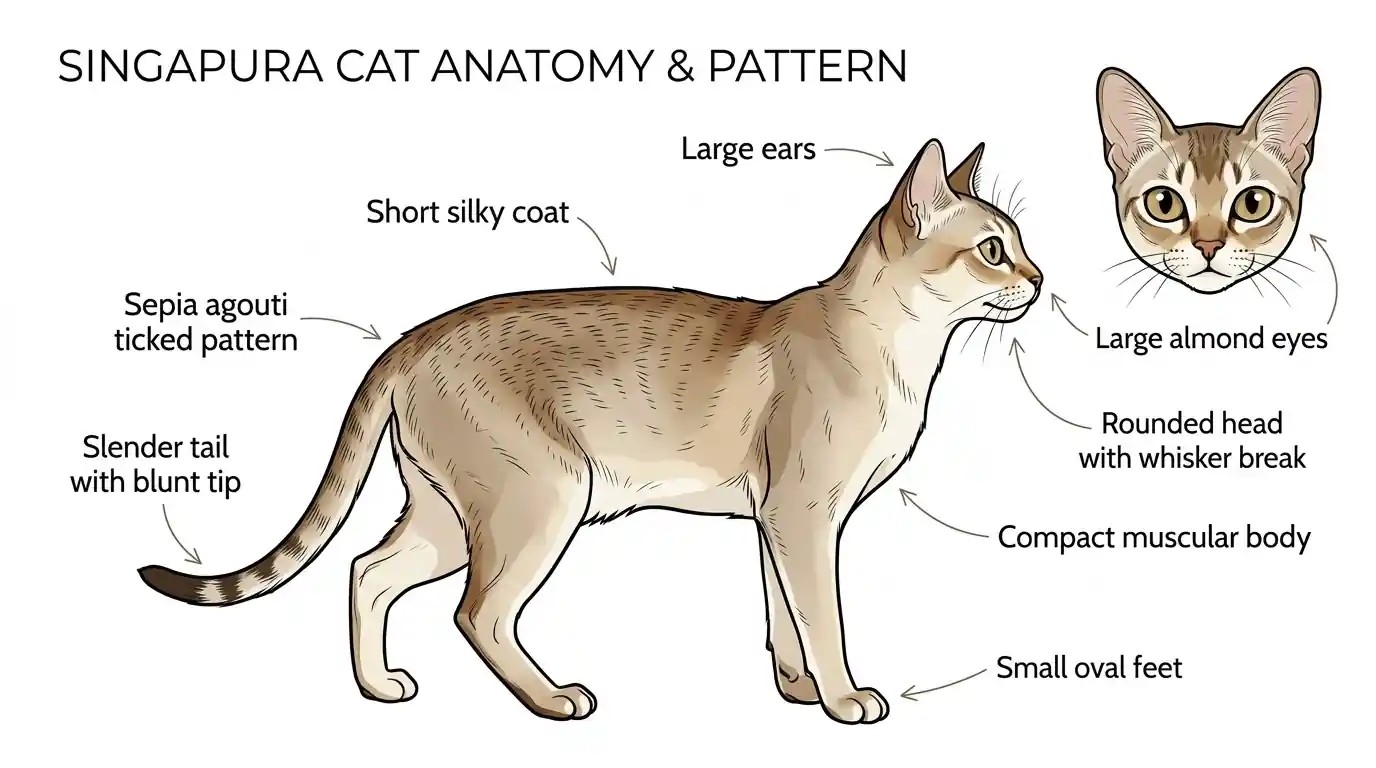
The Singapura cat is a small to medium gato com um compact, muscular body. Breed standards describe a distinctive “square” impression—body, legs, and the floor form a square when viewed from shoulder blades to the base of the tail, with a firm midsection (not tucked).
Head & muzzle
A cabeça é arredondado (front-to-back and side-to-side), narrowing at the outer eye to a definite whisker break. The muzzle is medium-short and broad com um nariz rombudoe o chin is well developed.
Orelhas
Ears are grande, bem aberto na basee deep-cupped, with slightly to moderately pointed tips. Standards explicitly note that small ears are a serious fault, because the “big ears” look is part of the breed’s hallmark expression.
Eyes (shape + allowed colors)
Eyes are grande, almond-shaped, e realizada bem aberto with a slight slant, set not less than an eye’s width apart.
Color note (important for accuracy): Allowed eye colors depend on the registry wording.
- CFA lists hazel, green, or yellow (and disqualifies olhos azuis).
- TICA describes a broader range that can include celadon green, hazel, green, gold, or copper, and also states blue is not permitted.
Coat, color, and ticking (the Singapura “signature”)
O casaco é fine, very short, silky, and lies very close to the body (a springy/plush coat is a fault in standards).
Singapuras cat are shown/recognized in um color/pattern only: sepia agouti / sable ticked. Each hair should show várias bandas (at least two darker ticking bands separated by lighter bands), with the lightest band near the skin e um ponta escura. The overall effect is ticking marrom escuro on a warm “old ivory” ground color, often with tons amarelos, with lighter “unbleached muslin” on the muzzle/chin/chest/underside.
Legs, feet, and tail
Legs are described as heavy and well-muscled at the body, tapering down to pés pequenos, curtos e ovais. A cauda é slender but not whippy, ends in a blunt tip, and is described as short of the shoulder when laid along the torso.
Comportamento e personalidade
O gato de Singapura
é um tiny cat with a big personality—highly active, highly affectionate, and happiest when it can be in the middle of whatever you’re doing.
Quick, citable temperament profile
- Energy & curiosity: Extroverted, curious, and very playful; many Singapuras stay enthusiastically active well into adulthood.
- “Always involved” companion: Often follows people from room to room and “helps” with daily tasks (typing, cooking, making the bed), then settles in close for cuddles.
- Affection level: Renowned for being highly affectionate and attention-seeking in a sweet, persistent way.
- Climbing / vertical habits: Not a “four-paws-on-the-floor” cat—many prefer shelves, cabinets, cat trees, and other high perches.
- Social compatibility: Typically friendly with people and can do well with other cats and cat-friendly dogs when introduced appropriately.
- Vocalization: Often described as relatively quiet, but they pode be surprisingly loud when they decide to speak up.
What this means for real life at home
Because Singapuras are smart, busy, and people-oriented, they do best with brincadeiras interativas diárias, puzzle/foraging toys, and access to espaço vertical (tall cat tree, shelves, window perches).
If they’re under-stimulated, expect “creative” behavior—extra insistence on attention, climbing into drawers/closets, or trying to insert themselves into your routines (this is especially common in highly interactive breeds).
Best-fit home environment
Many Singapuras are described as doing best in a quiet or calmer environment—not because they’re unfriendly, but because they’re so tuned in to their surroundings and routines.
They may also thrive with a feline companion, as TICA notes Singapuras “do best in the company of another cat,” which can help when you’re away during the day.
Observação: Individual cats vary. Early socialization, respectful handling, and gradual introductions to pets/children strongly influence how confident and adaptable a Singapura will be.

Guia de cuidados
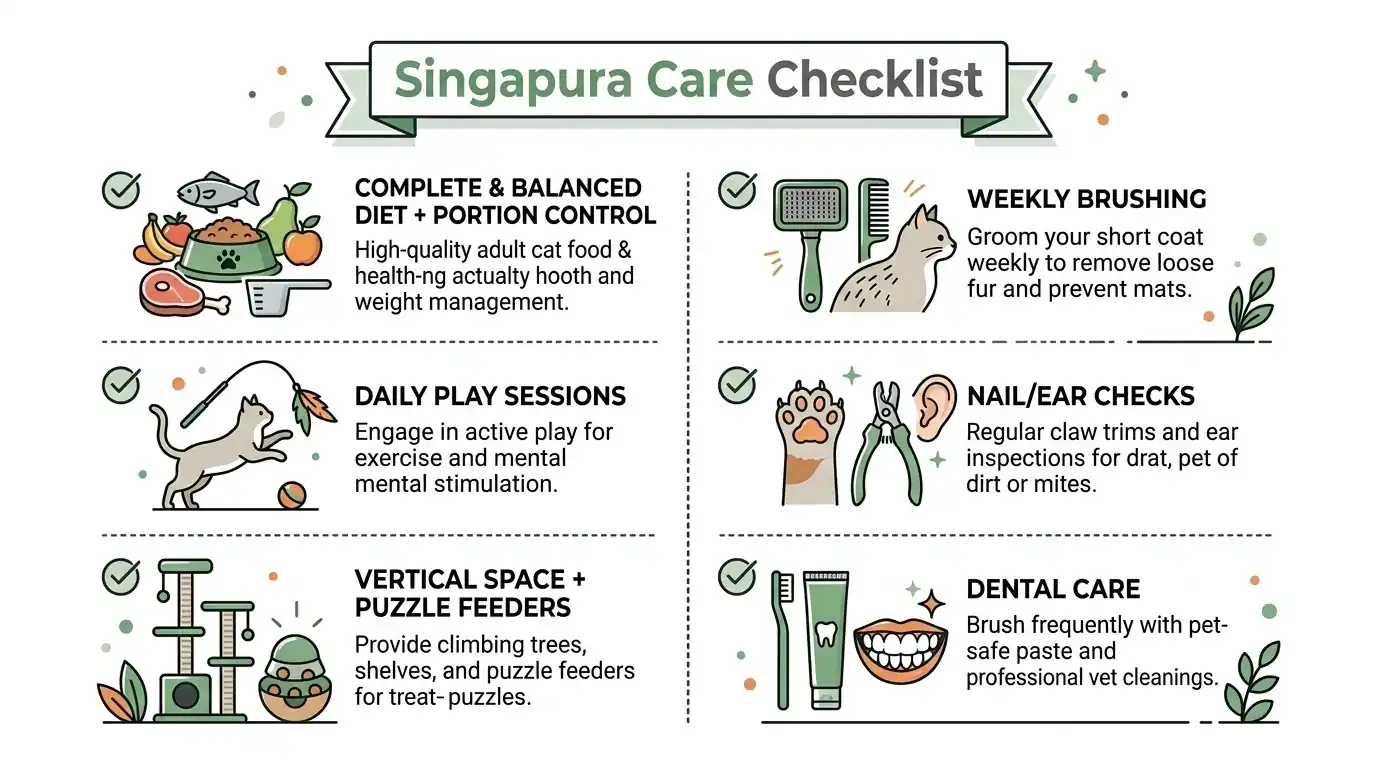
Quick Care Checklist (1-minute summary)
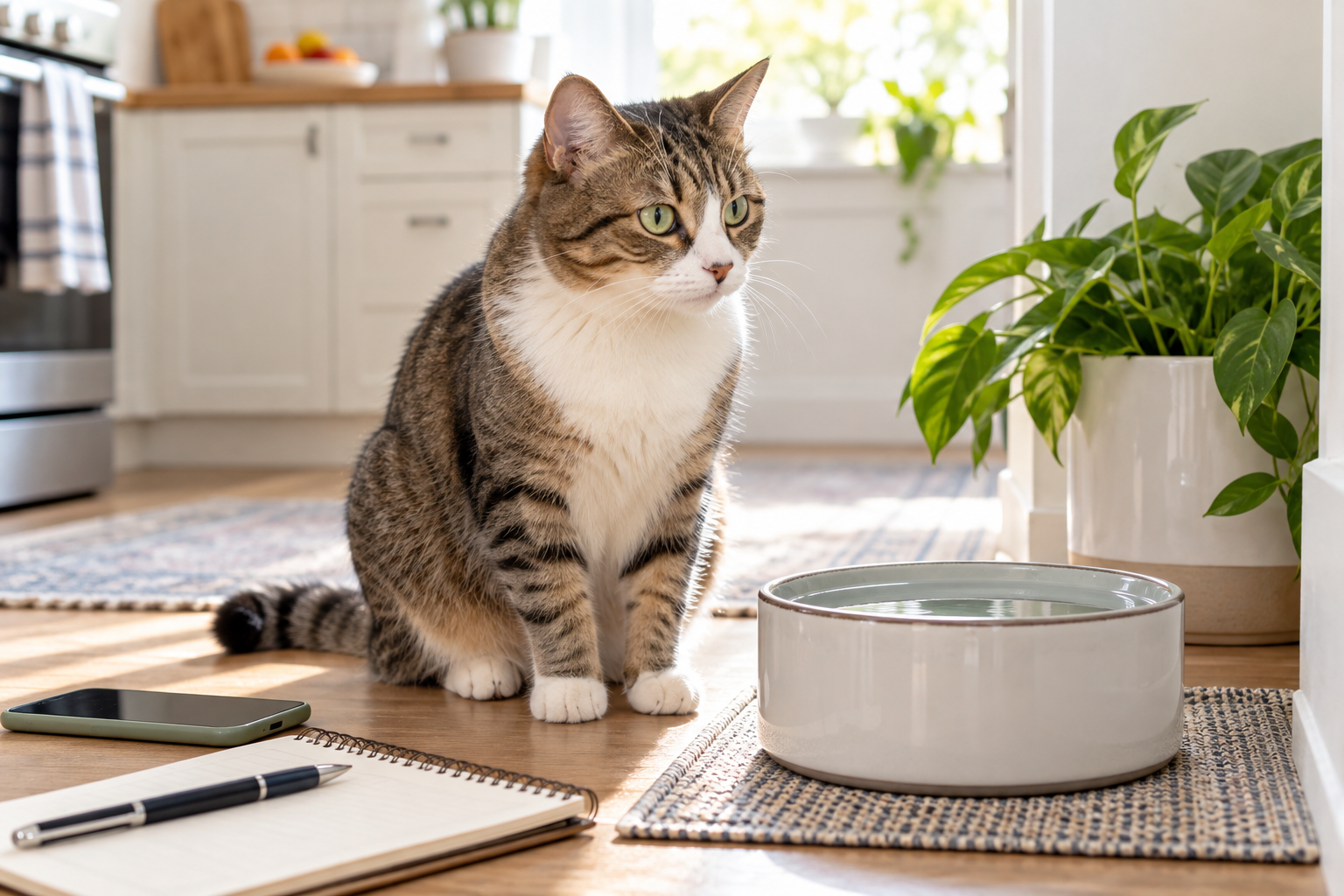
- Alimentar um completo e equilibrado diet for your cat’s life stage; measure portions and track body condition.
- Prevent weight gain—obesity and inactivity are major risk factors for feline diabetes.
- Provide daily play plus vertical space (cat tree/shelves) and predictable “resources” (alimentos, water, litter, scratching, resting).
- Grooming is simple: weekly comb/brush + routine nail/ear checks.
- Dental care matters: 50–90% of cats over age 4 show some form of dental disease—prevention helps.
Diet (Singapura Cat Feeding)
Singapura cats don’t need a special “breed diet.” The best baseline is a complete and balanced cat food matched to life stage (kitten/adult/senior), with portions adjusted to keep your cat lean and energetic.
What “good nutrition” means for cats
Os gatos são carnívoros obrigatórios and rely on nutrients found in animal tissues; in general, they do best with diets that provide high protein, moderate fat, and minimal carbohydrates.
Portion control (the “most important supplement”)
Rather than chasing specific nutrients, focus on calories and body condition:
- Obesity is one of the most common nutrition problems in cats.
- Obesity and physical inactivity are key risk factors for feline diabetes.
Practical tips:
- Measure food (don’t free-pour). Re-check portions every 2–4 weeks.
- Keep treats small and “count” them as calories, not extras.
Supplements: only when your vet recommends them
Healthy cats typically don’t need supplements if the diet is complete and balanced. Nutrition choices do not prevent genetic diseases (for example, progressive retinal atrophy is a hereditary issue discussed in some Singapura lines). If you’re buying a kitten, ask the breeder about health screening and family history.
Exercise (Daily Activity for a High-Energy Small Cat)
Singapuras are athletic and curious—plan for daily play to support a healthy weight, muscle tone, and confidence.
Simple routine that works for most homes:
- 2–3 short play sessions/day (5–10 minutes each)
- Use interactive toys that mimic prey (wand/feather, toy mouse dragged on the floor)
- Let your cat “catch” the toy sometimes to avoid frustration
Environment & Enrichment (Make the Home “Cat-Readable”)
A Singapura is social and smart—your setup matters as much as your schedule. The AAFP/ISFM guidelines emphasize that meeting a cat’s environmental needs is essential for wellbeing.
High-impact enrichment (most cats love these)
- Espaço vertical: cat tree, shelves, window perch
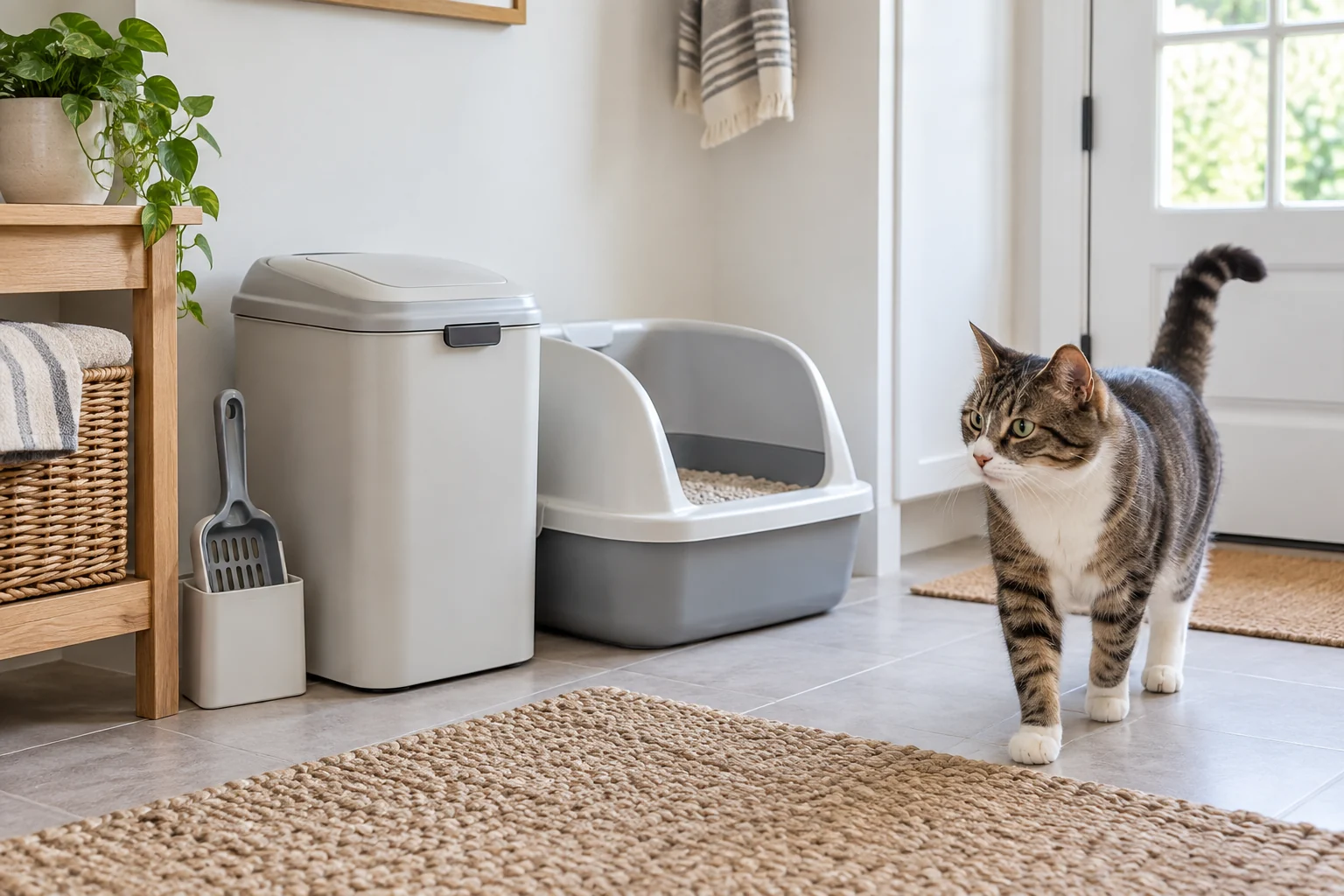
- Separated resources: multiple resting spots, scratching areas, feeding/water stations, and litter locations to reduce stress in multi-cat homes
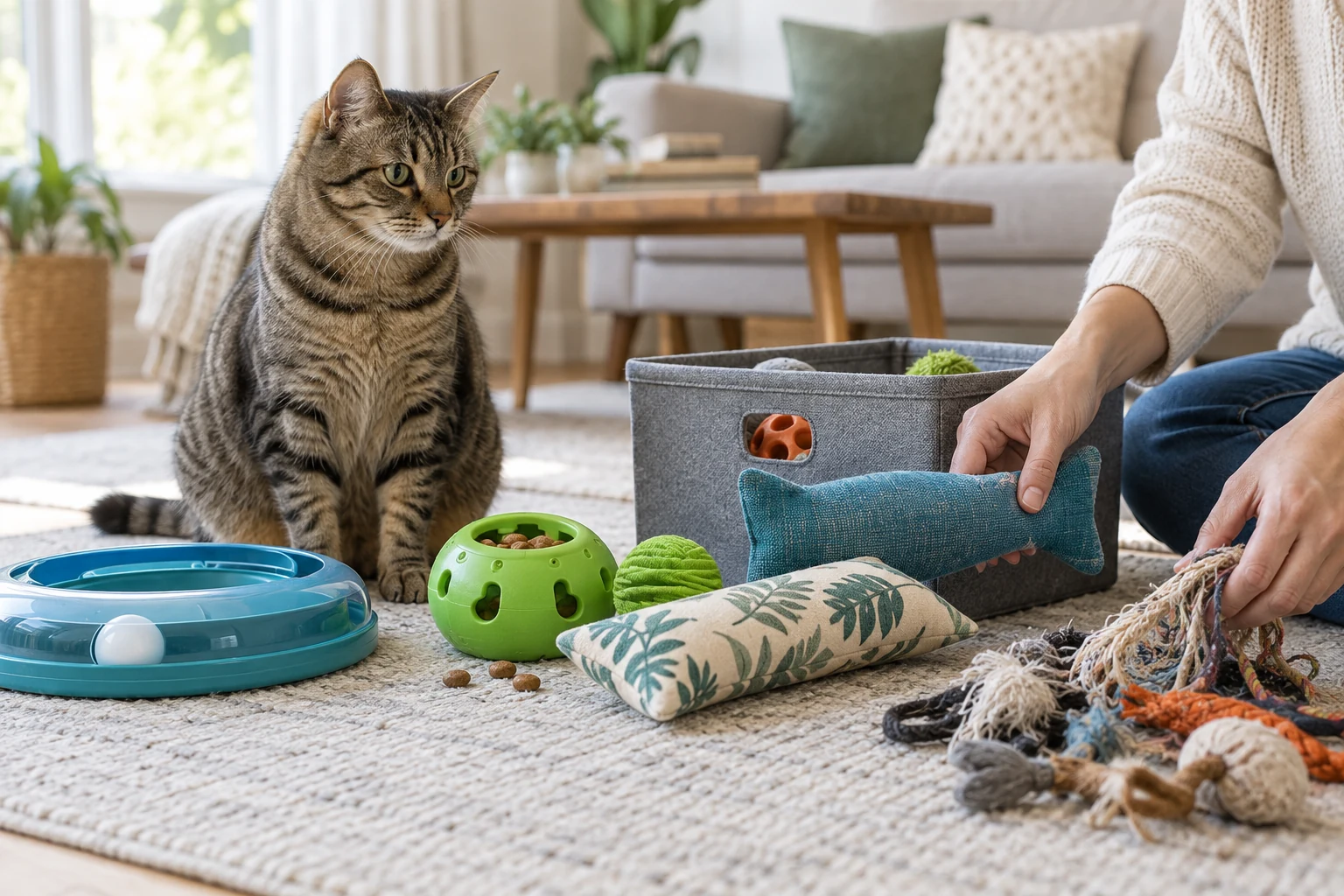
- Food puzzles/foraging: makes eating slower and more natural
If you’re away often, enrichment plus predictable routines help—but some cats also benefit from a compatible companion (especially in social breeds).
Grooming (Low-Maintenance, High Payoff)
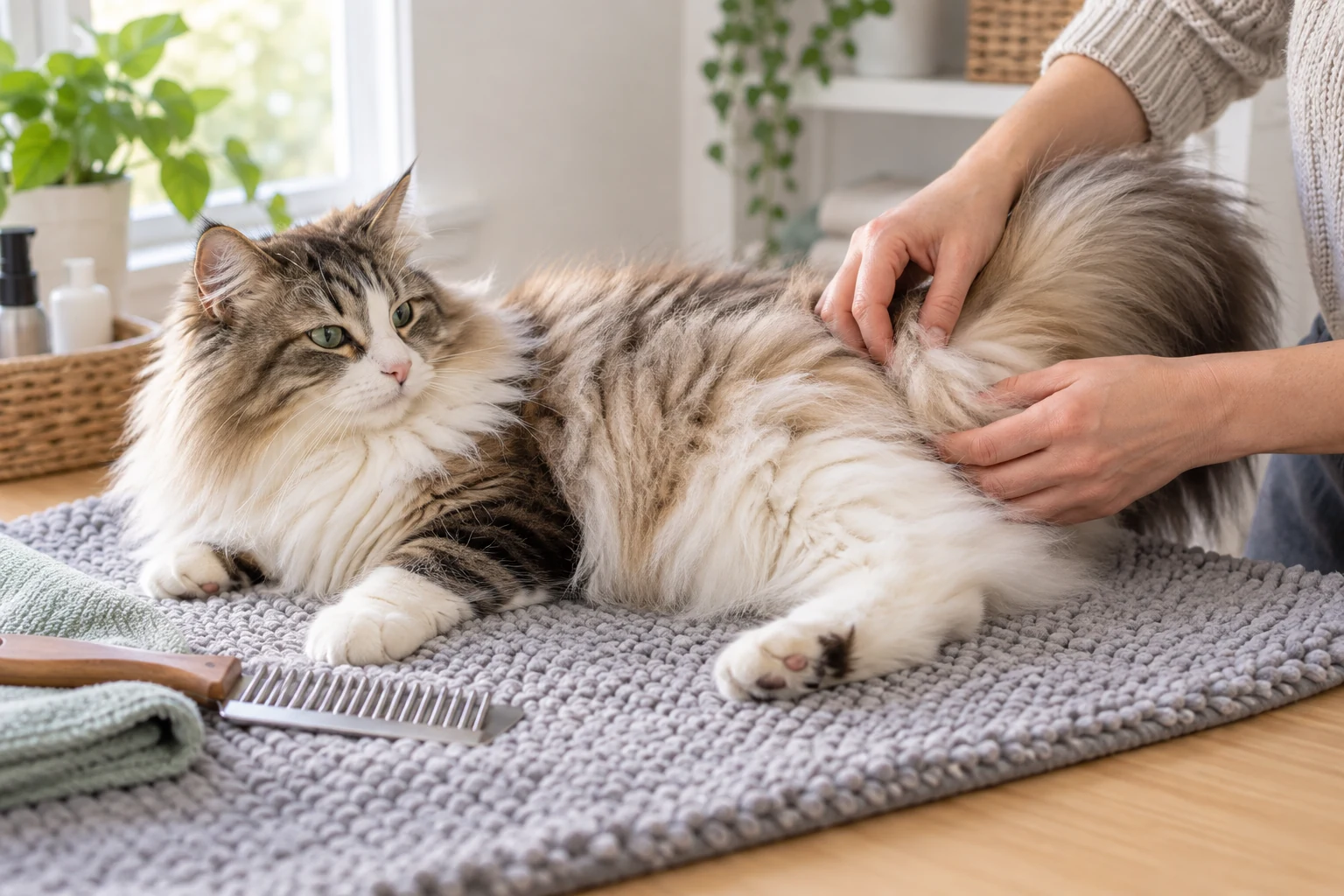
Singapuras have a short, close coat that doesn’t shed heavily. Plan on weekly combing/brushing—it removes dead hair and doubles as bonding time.
Also include:
- Nail trims as needed
- Quick ear checks
- Dental care (brush if possible; schedule vet dental checks). Dental disease is extremely common in cats over age 4.
Mental Stimulation (Prevent Boredom Behaviors)
Because Singapuras are curious and people-focused, mental stimulation isn’t optional—it’s behavior prevention.
Best options:
- Faça rodízio de brinquedos semanalmente (a novidade é importante)
- Puzzle feeders / treat balls (tiny portions)
- “Training” games (sit, target, recall) using kibble/treat crumbs
- Interactive play that follows a hunt sequence (stalk → chase → atacar → “catch”)
Health: what’s documented vs what’s “general cat care”
This section is informational and not a substitute for veterinary diagnosis.
A) Items commonly discussed for Singapura lines (source-backed):
| Topic | What to know | What owners can do |
|---|---|---|
| Genetic testing culture | CFA notes few health problems recorded and that breeders regularly do genetic testing; CFA also suggests asking breeders about any PRA history in lines. | Ask breeders what they test for; request documentation; ask specifically about PRA history. |
| PK deficiency (pKDef) | UC Davis VGL notes the PK deficiency mutation has been found in multiple breeds including Singapura, and offers testing used by breeders to avoid producing affected kittens. | If buying from a breeder: ask whether parents were tested; if adopting: ask your vet if screening is appropriate based on history. |
| Genetic diversity | TICA describes ongoing efforts (since 2017) to introduce new, unrelated foundation cats with documentation and testing—reflecting the breed’s small population and diversity goals. | Prefer breeders who can explain their diversity strategy and health testing practices. |
B) Common cat health issues (not Singapura-specific, but high-impact):
| Topic | Por que isso é importante | Prevention basics |
|---|---|---|
| Doença dentária | Cornell reports 50–90% of cats over age 4 have some form of dental disease. | Tooth brushing + regular veterinary dental checks. |
| Heartworm | AHS notes there is no approved drug therapy for heartworm infection in cats and emphasizes veterinary management; prevention is important. | Ask your vet about region-appropriate prevention (even indoor cats can be exposed via mosquitoes). |
| Allergic skin disease (atopy pattern) | Merck notes cats can present with several itchy-skin patterns (miliary dermatitis, alopecia, head/neck itch, etc.). | Vet evaluation to rule out parasites/food allergy; follow treatment plan. |
Is the Singapura right for you?
Best fit: a people-oriented, highly playful cat who wants to be involved in daily life.
Think twice if: your home is often loud or you can’t reliably provide daily interaction and enrichment.
Best match if you…
- Want a social “shadow cat.” Singapuras typically prefer being near their people and participating in household routines.
- Enjoy daily play + mental enrichment. They tend to stay active into adulthood and do best with interactive play, climbing space, and puzzle-style stimulation.
- Live in a generally calm home. If your household is quiet and predictable, a sound-sensitive cat is more likely to feel secure.
- Can provide companionship most days. This can be you (working from home, consistent evenings) or a compatible pet companion.
- Prefer low coat maintenance. The coat is short and usually straightforward to keep tidy with light, regular brushing.
- Are comfortable with responsible pet ownership basics. Routine vet care, preventive care, dental hygiene, and thoughtful nutrition.
Não é a melhor opção se você…
- Have limited time for daily interaction. If you want a low-engagement pet, this breed’s need for attention and stimulation can feel demanding.
- Live in a consistently noisy environment. Frequent loud sounds (young children who shriek, very barky dogs, constant commotion) may stress a noise-sensitive cat.
- Travel often or are away long hours with no support. Regular isolation can increase boredom, attention-seeking behavior, or stress.
- Expect “care-free.” Low grooming doesn’t mean low needs—social and enrichment needs still require commitment.
- Don’t want to research breeders or health screening. If purchasing, you’ll need to verify ethical breeding practices and ask about family health history/testing where appropriate.
- Need a “starter cat” with minimal activity needs. First-time owners can do well, but only if they’re ready for an energetic, interactive companion.
- Have aggressive or non-social pets. A sensitive, social cat can struggle in high-conflict multi-pet homes.

PERGUNTAS FREQUENTES
Os gatos Singapura se dão bem com outros animais de estimação?
Sim, os gatos de Singapura são conhecidos por sua personalidade amigável e social. Em geral, eles se dão bem com outros animais de estimação, inclusive cães, especialmente se forem apresentados no início de suas vidas. Essa característica faz com que o gato da raça Singapura seja uma escolha adequada para lares com vários animais de estimação. A resposta positiva consistente a essa pergunta indica que a compatibilidade social é uma alta prioridade para os possíveis proprietários, e a raça se destaca nessa área.
Os gatos de Singapura são amigáveis?
Com certeza! Os gatos Singapura são descritos como extremamente afetuosos e sociáveis. Sua natureza amorosa e leal contribui para que eles sejam excelentes companheiros.
Quanto tempo vivem os gatos de Singapura?
Em geral, os gatos Singapura têm uma vida útil que varia de 11 a 15 anos. Com os cuidados adequados, incluindo check-ups veterinários regulares e uma dieta balanceada, eles podem se tornar adultos saudáveis e desfrutar de uma vida longa.
Os gatos Singapura são fáceis de cuidar?
Sim, os gatos Singapura são considerados de baixa manutenção quando se trata de cuidados com a pelagem. Eles têm uma pelagem curta e sedosa que requer cuidados mínimos. A escovação semanal e verificações ocasionais das orelhas e unhas geralmente são suficientes para mantê-lo em boas condições.
Os gatos de Singapura gostam de tomar banho?
Em geral, os gatos Singapura não precisam de banhos frequentes devido à sua pelagem curta e de pouco pelo. No entanto, se o banho for necessário, eles tendem a tolerá-lo bem, tornando o processo de limpeza simples para seus donos.
Qual é o tamanho dos gatos de Singapura?
Os gatos Singapura tendem a ser pequenos, normalmente pesando entre 4-9 libras e variando de 7-8 polegadas de altura.
Os gatos de Singapura se desprendem?
Como gatos de pelagem curta, os Singapuras não perdem o pelo tanto quanto as raças de gatos de pelagem longa. Sua queda é mínima.
Fatos bônus
O fascínio do gato de Singapura vai além de sua personalidade encantadora e aparência única, abrangendo vários fatos fascinantes que destacam seu lugar especial no mundo felino e na herança cultural.
Cingapura Mascote
O gato Singapura, também conhecido como Kucinta, ocupa a estimada posição de ser considerado o mascote do Conselho de Turismo de Cingapura. Essa adoção cultural é particularmente digna de nota, dadas as controvérsias históricas em torno de suas origens, demonstrando como uma raça pode transcender sua história genética precisa para se tornar um poderoso símbolo nacional.
“Kucinta” name + river sculptures
Singapore’s STPB ran a “Name the Singapore River Cats” competition (results announced in 1990). The winning name “Kucinta” led to plans for 15 sculptures along the Singapore River.
Singapore cultural status
TICA notes that in 1991 the government of Singapore recognized the breed as a “living national treasure” and that it was once the Singapore Tourism Board’s mascot.
Size claim (safe version)
CFA calls the Singapura “one of the smallest of all pedigreed cats,” and TICA describes it as the smallest breed of cat.
“Kucinta” - O Gato do amor
O nome local “Kucinta” é um belo amálgama das palavras malaias “kucing” (gato) e “cinta” (amor). Esse nome foi escolhido por meio de um concurso “Name the Singapore River Cats”, consolidando ainda mais a conexão afetuosa da raça com a nação. O fato de esse nome e as esculturas associadas terem sido implementados mesmo depois que a controvérsia sobre a origem veio à tona ilustra uma decisão deliberada das autoridades de Cingapura de adotar a raça independentemente de sua história genética precisa, transformando-a em um símbolo de identidade e afeto nacional.
Rio Esculturas
Após a competição de nomes, 15 esculturas especiais da Kucinta foram colocadas ao longo do Rio Cingapura. Infelizmente, essas representações artísticas foram alvos de vandalismo, com algumas desfiguradas e uma até mesmo roubada.
Hardy apesar da aparência
Apesar de sua aparência delicada, o Singapura é um gato surpreendentemente resistente e musculoso para seu tamanho.
Selvagem Mamíferos Padrão de casaco
Seu padrão de pelagem excepcional e rico em ticked ou agouti é frequentemente encontrado em mamíferos selvagens, o que lhe confere uma estética distinta e natural.
Distintivo Facial Recursos
As orelhas grandes e os olhos incrivelmente bonitos do Singapura são frequentemente acentuados pelo que parece ser um “delineador” natural, com linhas de “chita” que se estendem até a almofada dos bigodes.
Referências
McHenry, Cathie. “Artigo sobre a raça”. Associação de criadores de gatos. Arquivado do original em 2 de junho de 2015. Recuperado em 21 de janeiro de 2014.
Ruetz, Nicki. “Artigo sobre a raça Singapura”. Associação de criadores de gatos. Arquivado do original em 14 de abril de 2015. Recuperado em 21 de janeiro de 2014.
Meadow, Tommy. “História da raça”. thesingapuracat.50megs.com. Recuperado em 21 de outubro de 2008.
Maggitti, Phil. “O Singapura”. Gatos e gatinhos. Pet Publishing Inc. Arquivado do original em 8 de dezembro de 2008. Recuperado em 21 de outubro de 2008.
Dass, Annalisa. “Gato de Singapura”. Infopédia de Cingapura. Conselho da Biblioteca Nacional. Arquivado do original em 10 de dezembro de 2008. Recuperado em 21 de outubro de 2008.
Stein, Rob (23 de março de 2008). “Usando o DNA para rastrear as origens dos gatos: Estudo confirma que eles foram domesticados no Crescente Fértil”. Washington Post. Recuperado em 21 de outubro de 2008.
Hartwell, Sarah. “Kucinta - O gato do amor de Cingapura”. messybeast.com. Recuperado em 21 de outubro de 2008.
“Gato ”Uniquely Singapura” no zoológico de Cingapura”. Zoológico de Cingapura. 22 de julho de 2004. Arquivado do original em 11 de julho de 2007.
“Gato de Singapura | Infopédia”. eresources.nlb.gov.sg. Recuperado em 2022-12-30.
“Padrão da raça: Singapura” (PDF). Associação de criadores de gatos. Arquivado do original (PDF) em 29 de junho de 2014. Recuperado em 21 de janeiro de 2014.
“Perfil da raça Singapura”. Cat Fanciers’ Association (Associação de criadores de gatos). Arquivado do original em 27 de maio de 2012. Recuperado em 21 de outubro de 2008.
Grahn, R. A.; Grahn, J. C.; Penedo, M. C.; Helps, C. R.; Lyons, L. A. (2012). “Mutação da deficiência de piruvato quinase eritrocitária identificada em várias raças de gatos domésticos”. Pesquisa Veterinária BMC. 8: 207. doi:10.1186/1746-6148-8-207. PMC 3534511. PMID 23110753.
“Informações, fotos, características e fatos sobre a raça de gato Singapura”. CatTime. Recuperado em 2020-02-16.
“Política de registro da Singapura Cats” (PDF). O Conselho de Administração da Cat Fancy. Arquivado do original (PDF) em 12 de dezembro de 2013. Recuperado em 10 de dezembro de 2013.
Lipinski, Monika J.; Froenicke, Lutz; Baysac, Kathleen C.; Billings, Nicholas C.; Leutenegger, Christian M.; Levy, Alon M.; Longeri, Maria; Niini, Tirri; Ozpinar, Haydar; Slater, Margaret R.; Pedersen, Niels C. (2008-01-01). "A ascensão das raças de gatos: Avaliações genéticas de raças e populações mundiais de raças aleatórias". Genômica. 91 (1): 12-21. doi:10.1016/j.ygeno.2007.10.009. ISSN 0888-7543. PMC 2267438. PMID 18060738.
 EN
EN DE
DE ES
ES PT
PT