
You’re Not Alone—And It’s Not Spite
Finding cat pee on your bed is upsetting, but it’s rarely “revenge.” In most cases, bed peeing happens for one of three reasons: (1) medical discomfort, (2) stress/anxiety, or (3) a litter box setup problem. The good news: once you identify the cause, most cats stop.
Quick Answer (Start Here Today)
If your cat peed on the bed, do these 5 steps in order:
Rule out medical pain first (UTI, inflammation, crystals, arthritis).
Add/optimize litter boxes (right number, right spots, easy access).
Remove urine odor completely with an enzyme cleaner (not ammonia).
Reduce stress triggers (routine + safe zones + resources per cat).
Rebuild positive bed habits (treats/play on the bed + temporary access control).
When to Call the Vet Today
Book a vet visit urgently if you notice straining, crying in the box, blood in urine, frequent tiny pees, not peeing at all, lethargy, or vomiting. These can signal painful urinary issues that shouldn’t wait.
What This Guide Covers
Below you’ll learn how to tell whether your cat’s bed peeing is medical, stress-related, or litter-box-related, plus exactly what to change to stop repeats—without punishment.
Spraying vs. Peeing: Which Is It?
Before you troubleshoot, confirm whether this is marking (spraying) or full urination (peeing):
Spraying (marking): usually standing, tail up, small amount, often on vertical surfaces (walls, furniture).
Peeing (full urination): usually squatting, larger puddle, often on soft horizontal surfaces (beds, laundry).
Why it matters: spraying is often territorial or stress-related, while full urination is more often linked to medical discomfort, box aversion, or location preference.
What to do next: If it’s spraying, jump to Stress/Anxiety + Litter Box & Resources sections. If it’s full urination, start with Medical Causes.

Medical Causes: Rule Out Health Problems First
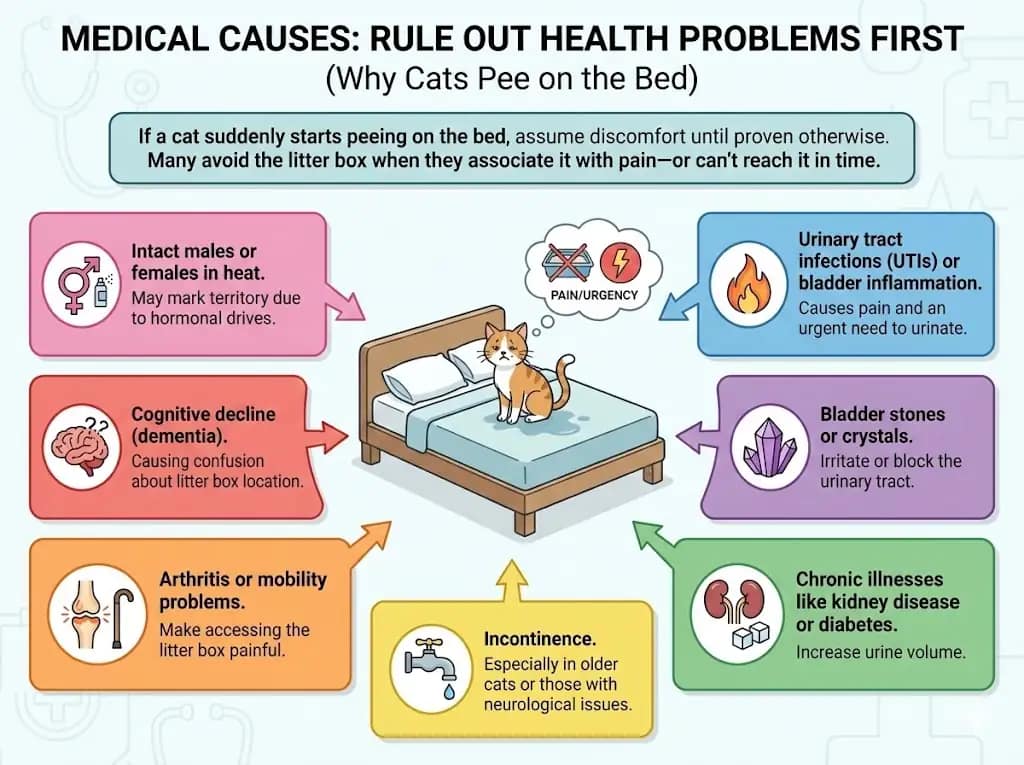
If a cat suddenly starts peeing on the bed, assume discomfort until proven otherwise. Many cats avoid the litter box when they associate it with pain—or they can’t reach it in time.
Common medical reasons (and clues you may notice)
- Urinary tract infections (UTIs) or bladder inflammation, which cause pain and an urgent need to urinate.
- Bladder stones or crystals that irritate or block the urinary tract.
- Chronic illnesses like kidney disease or diabetes, which increase urine volume.
- Incontinence, especially in older cats or those with neurological issues.
- Arthritis or mobility problems that make accessing the litter box painful.
- Cognitive decline (dementia), causing confusion about litter box location.
- Intact males or females in heat, who may mark territory due to hormonal drives.
What your vet may check
A typical workup can include a urinalysis, possibly culture, and sometimes imaging (x-ray/ultrasound) if stones/crystals are suspected.
Important: If your cat is straining and producing little/no urine, treat it as an emergency.
Next step: Schedule a vet visit, then continue with the sections below so you’re ready to fix any non-medical triggers too.
Related: Signs of a cat UTI vs stress peeing + what your vet may test Medical Reasons Your Cat Peeing on Bed (And What to Do)
Because when your cat’s body is healthy, their behavior can truly begin to heal too.
Why Did My Cat Start Peeing on the Bed Suddenly?
If your cat was using the litter box normally and then started peeing on the bed “out of nowhere,” the cause is usually one of three things: (1) medical discomfort, (2) a recent stressor, or (3) a litter box change—even a small one.
The 60-second “What Changed?” checklist
Check the last 2–4 weeks for:
A. Health / pain clues (vet first if yes):
Straining, frequent tiny pees, crying in the box
Blood in urine, genital licking, strong urine odor
Peeing in multiple places (not just the bed)
Sudden accidents in an older cat (arthritis/mobility)
B. Stressors that often trigger sudden bed peeing:
Moving, renovations, guests, new baby/pet
Schedule changes, travel, less attention/play
Outdoor cats seen/smelled near windows (territory stress)
Tension between cats (one cat “blocking” access to the box area)
C. Litter box changes that cats react to quickly:
New litter brand/scent, new box type (covered vs open)
Box moved to a noisier spot (laundry room, near appliances)
Cleaner used on the box that smells harsh
You’re scooping less often, even slightly
What to do today (fast, low-cost steps)
Add one extra litter box in a quiet location immediately (even temporarily).
Return to the old litter/box setup if you recently changed anything.
Stabilize routine (same feeding/play times for the next 7–10 days).
Use enzyme cleaner on the bed right away to prevent repeat marking.
If nothing changed—and especially if there are any pain/urgency signs—treat “sudden” bed peeing as a medical red flag and book a vet check.

Why Does My Cat Pee on the Bed at Night?
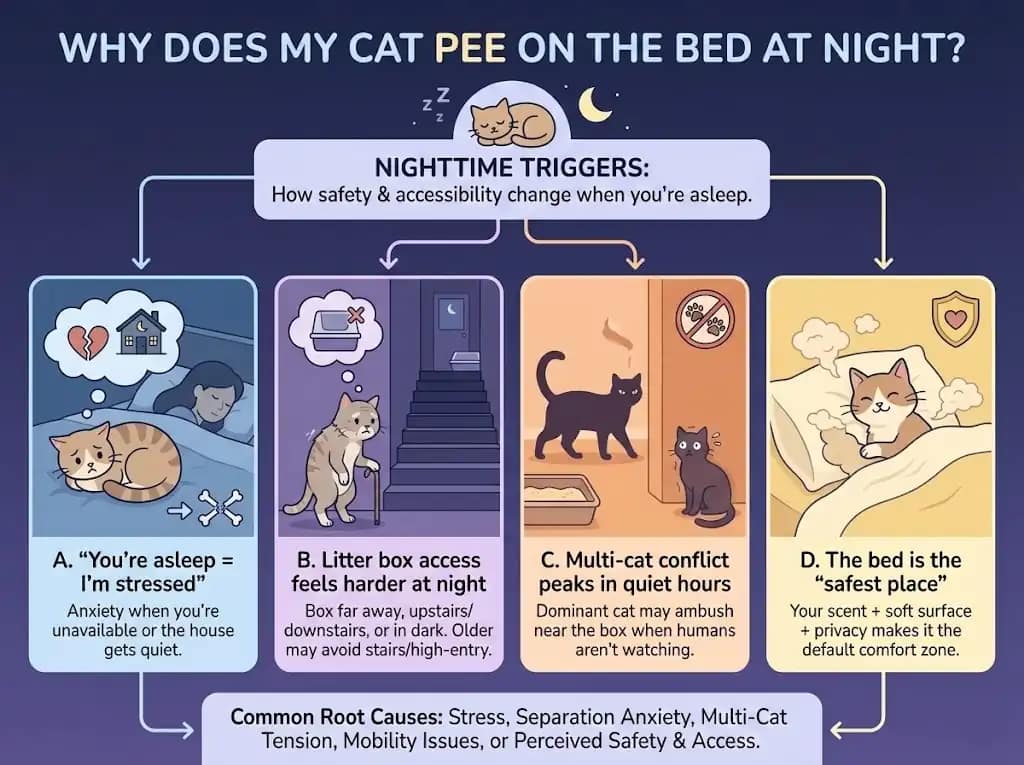
If bed peeing happens mostly at night, it often points to stress, separation anxiety, resource conflict (multi-cat tension), or mobility issues—because nighttime changes how safe and accessible the litter box feels.
The most common nighttime triggers
A. “You’re asleep = I’m stressed”
Some cats become anxious when you’re unavailable or the house gets quiet.
B. Litter box access feels harder at night
Box is far away, upstairs/downstairs, or in a dark hallway
Older cats may avoid stairs or high-entry boxes
C. Multi-cat conflict peaks in quiet hours
A dominant cat may patrol or ambush near the box area when humans aren’t watching.
D. The bed is the “safest place”
Your scent + soft surface + privacy makes it the default comfort zone.
What to try for the next 14 nights (simple protocol)
Put a litter box closer to the bedroom (even temporarily).
Add a night light near the box (helps seniors and anxious cats).
Do a short play session + small feed 30–60 minutes before bed (routine reduces anxiety).
If you have multiple cats: separate resources
add a box on each level
avoid “single hallway” box locations
Keep the bed fully enzyme-cleaned and dry, and consider a washable waterproof cover during retraining.
If night peeing continues
Re-check for pain (arthritis/UTI)
Consider whether another cat is guarding the box
Continue with the Stress and Litter Box sections below in this guide (they’ll become more relevant after you test the night protocol)
Stress and Anxiety: Emotional Triggers for Bed Peeing
If your vet has ruled out a medical cause, stress becomes one of the most common reasons cats pee on the bed. Cats don’t “get even”—they try to feel safe. And your bed is soft, quiet, smells like you, and often feels like the most secure place in the house.
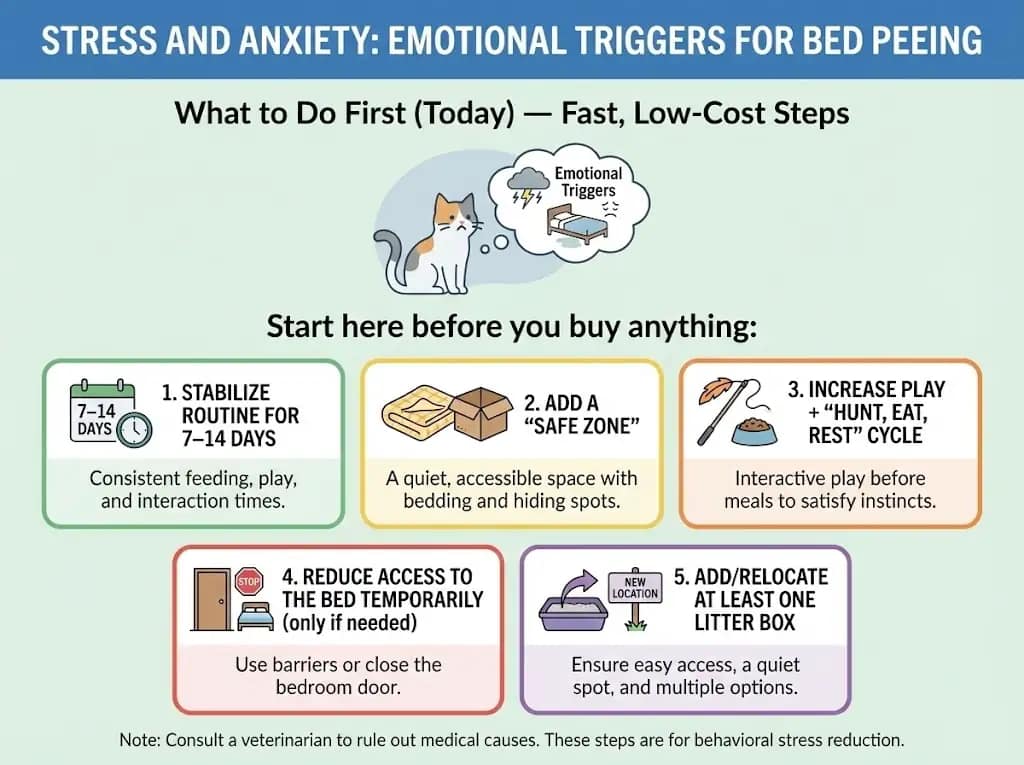
What to Do First (Today) — Fast, Low-Cost Steps
Start here before you buy anything:
Stabilize routine for 7–14 days
Feed, play, and clean litter boxes at consistent times. Predictability lowers anxiety fast.Add a “safe zone”
Create one quiet retreat (bed/box/cubby) in a low-traffic area. Add a blanket that smells like home.Increase play + “hunt, eat, rest” cycle
Two short play sessions daily (5–10 minutes) followed by food can reduce tension and nighttime anxiety.Reduce access to the bed temporarily (only if needed)
If accidents are recurring, prevent rehearsal of the behavior while you implement fixes (close the door / use a waterproof cover). This is not punishment—just management.Add/relocate at least one litter box
Stress and litter box avoidance overlap. A second box in a quiet area can be an immediate turning point—especially in multi-cat homes.
The Hidden Stressor: Resource Conflict (Multi-Cat “Politics”)
In multi-cat households, bed peeing often happens because one cat doesn’t feel safe using the litter box—even if you never see a fight. A confident cat may block hallways, stare, or ambush near the box, and the more timid cat chooses the bed instead.
Clues resource conflict may be involved:
peeing happens when the “boss” cat is nearby
one cat “escorts” the other out of rooms
chasing/staring that looks minor to humans but is intense to cats
litter box use is rushed, hesitant, or happens only at odd hours
the cat pees on the bed but is otherwise “well behaved”
Fixes that work quickly:
Spread resources out: food/water/litter/resting spots in different areas (not all in one room)
Multiple litter box locations: don’t line boxes up side-by-side (that’s effectively one “territory”)
Add vertical space: cat trees/shelves so timid cats can move without confrontation
Separate high-value areas: give each cat quiet resting zones they can “own”
If conflict is clear, consider short-term separation with structured reintroduction
Common Stress Triggers (Keep & Expand Your List)
Stress can build from changes that seem small to us but feel huge to a cat:
Changes in the home: moving, renovations, new furniture, new smells
New family members or pets: baby, partner, roommates, newly adopted pets
Guest traffic / noise: visitors, parties, loud appliances
Routine disruptions: travel, new work hours, less time at home
Inter-cat tension: chasing, stalking, litter box guarding, competition for attention
Outdoor “threats” through windows: neighborhood cats visible outside (very common)
Litter box changes: new litter type, covered box, moved box location, new cleaning products
Negative associations: being startled while using the litter box (noise, ambush, vacuum)
How to Tell If Stress Is the Main Cause
Stress-related peeing often comes with subtle signs:
hiding more than usual
overgrooming or hair loss patches
appetite changes
clinginess or avoidance
startle responses, tension, “watching” other pets
reduced play or restless pacing at night
If your cat pees on the bed mainly when you’re gone, it can be separation stress or “scent mixing” for comfort. Increase enrichment before departures (play + food puzzle), keep routine stable, and ensure litter boxes are easy and conflict-free.
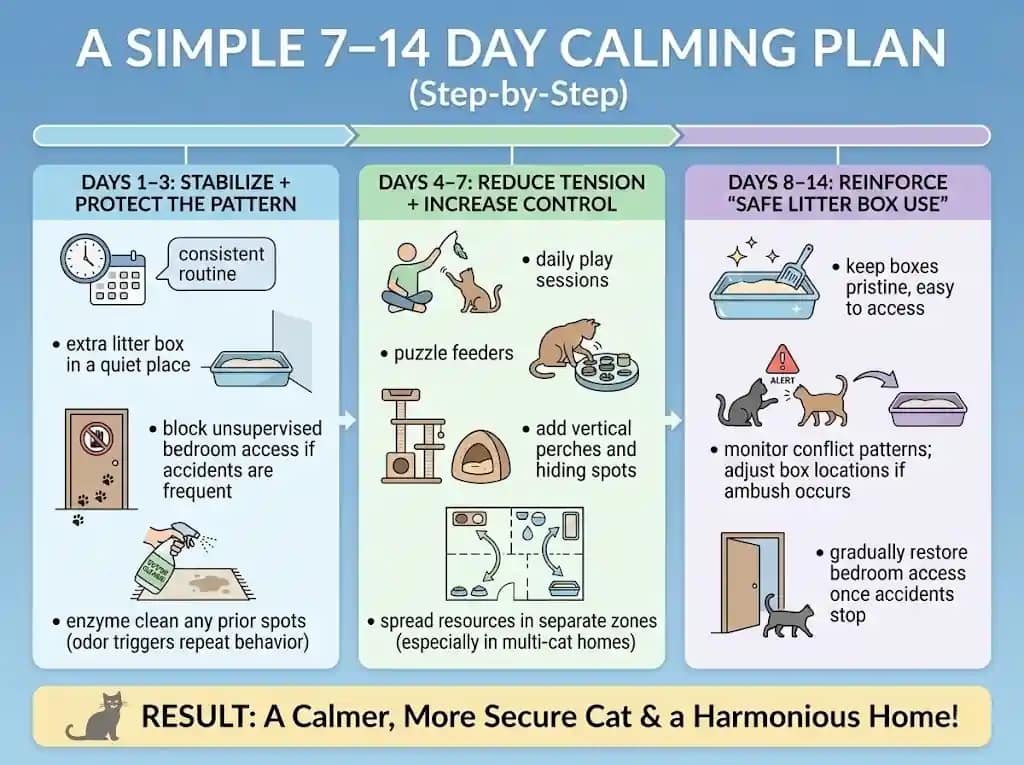
A Simple 7–14 Day Calming Plan (Step-by-Step)
Days 1–3: Stabilize + protect the pattern
consistent routine, extra litter box in a quiet place
block unsupervised bedroom access if accidents are frequent
enzyme clean any prior spots (odor triggers repeat behavior)
Days 4–7: Reduce tension + increase control
daily play sessions + puzzle feeders
add vertical perches and hiding spots
spread resources in separate zones (especially in multi-cat homes)
Days 8–14: Reinforce “safe litter box use”
keep boxes pristine, easy to access
monitor conflict patterns; adjust box locations if ambush occurs
gradually restore bedroom access once accidents stop
When to Escalate
If you’ve done the steps above for two weeks and accidents continue, the next best step is a vet follow-up (to re-check urinary issues) and/or a feline behavior professional. Some cats benefit from targeted anxiety treatment alongside environmental changes.
Related: Cat Stress and Peeing: How to Calm Anxiety and Save Your Bed Cat Stress and Peeing: How to Calm Anxiety and Save Your Bed
Litter Box & Environment: The Setup Checklist That Stops Bed Peeing
If your cat is peeing on the bed and medical causes have been ruled out, the litter box setup is often the fastest fix. Even a box that looks “clean” to us can still be wrong for your cat—wrong location, wrong litter texture, too few boxes, or a setup that feels unsafe (especially in multi-cat homes). Soft, scent-rich places like your bed can become the “safer” option.
Below is a step-by-step checklist. Start at the top and change one variable at a time so you can see what works.
Quick Setup Checklist (Do These in Order)
1. Number of boxes (most common mistake)
Use one box per cat + one extra (minimum).
Spread them out—don’t put all boxes in the same closet or corner.
2. Placement: privacy + easy access
Put boxes in quiet, low-traffic areas (not near loud appliances).
Avoid dead ends where a cat can feel trapped.
If accidents happen at night, add a box closer to the bedroom.
3. Box style: make it easy, not fancy
Start with a large, open box (many cats dislike covered boxes).
For seniors, use a low-entry box to reduce pain stepping in.
4. Litter type: unscented and soft is the safe default
Many cats prefer unscented, fine-grain litter.
If switching, transition gradually: mix old/new over 7–10 days.
5. Clean routine: keep it predictable
Scoop at least once daily (more if multi-cat).
Wash the box regularly with mild soap—avoid strong-smelling cleaners.
If you only change 3 things today: add an extra box, move one box to a quieter/easier spot, and switch to a large open box with unscented litter.
“But the Litter Box Is Clean…” Why Bed Peeing Still Happens
If your cat pees on the bed even when the box is clean, these are the most common reasons:
The box feels unsafe: another cat is guarding the area, or the box is in a busy hallway.
The box is hard to reach: too far away, upstairs, or painful to enter (arthritis/senior cats).
Your cat dislikes the litter: scent, dust, or texture can cause avoidance.
The box is too small: your cat can’t turn comfortably.
There aren’t enough boxes: one “clean” box can still mean competition or stress.
The bed became a habit spot: it’s soft, smells like you, and feels emotionally safe.
Multi-Cat Homes: Prevent Box Guarding and Stress Peeing
In multi-cat households, bed peeing often happens because a cat avoids the litter box to avoid a confrontation.
Do this:
Place boxes in separate locations so one cat can’t “control” them all.
Add vertical space (cat trees/shelves) to reduce tension in shared areas.
Ensure each cat has separate food, water, resting spots, and litter access.
Watch for subtle bullying: blocking doorways, staring, chasing, ambushing near boxes.
Quick test: temporarily add one extra box in a new quiet location for 2 weeks. If accidents decrease, you’ve likely found a resource/conflict issue.
Why the Bed Specifically? (Location & Surface Preference)
Cats often choose beds because they’re:
Soft and absorbent
Quiet and private
Scent-rich (smells like you)
Higher up (some cats feel safer off the floor)
To counter this, make the litter box environment more appealing than the bed:
keep boxes quiet and easy
use unscented litter
add a box near the bedroom temporarily
block bedroom access when unsupervised until habits reset
Avoid These Common Litter Box Mistakes
Using ammonia/strong cleaners near the box (can repel sensitive cats)
Moving all boxes at once (confuses routines)
Switching litter suddenly
Placing boxes next to food/water
Putting boxes where cats can be startled (washing machine, furnace room)
Want a tailored setup? Here’s a deeper guide with litter box placement examples, box types, and multi-cat layouts: Litter Box Problems: Litter Box Problems: Why Cats Pee on Beds & How to Fix lt
Because when your cat’s bathroom needs are fully met, your bed can finally go back to being a place for naps—not accidents.
Cleaning Cat Pee From Your Bed (Numbered Step-by-Step Protocol)
Quick answer: To stop repeat accidents, you must remove uric-acid odor (cats can smell it even when you can’t). The most reliable method is an enzyme cleaner, applied with enough contact time to break down the odor compounds.
Supplies (grab these first)
Paper towels or clean cloths
Enzyme-based pet urine cleaner (not bleach, not ammonia)
Laundry detergent + optional enzyme laundry additive
Baking soda (optional, for after-treatment odor absorption)
Waterproof mattress protector (for prevention after cleaning)
Plastic wrap or a trash bag (to keep enzyme solution from drying too fast)
Step-by-step cleaning protocol
Blot immediately (don’t rub).
Press firmly with paper towels to absorb as much urine as possible. Rubbing pushes urine deeper into the mattress fibers.Rinse lightly (optional but helpful for fresh urine).
If the spot is still wet, dab with a small amount of cool water, then blot again. This reduces concentration before the enzyme treatment.Soak the area with an enzyme cleaner (this is the key step).
Apply enough enzyme cleaner to reach the same depth the urine reached. For mattresses, that often means more than you think.Keep it wet for the required “dwell time.”
Enzymes need time to work. Cover the treated area with plastic wrap to prevent evaporation and leave it for the time stated on the label (often 10–30 minutes; sometimes longer).Blot again, then air-dry completely.
Remove the plastic, blot excess liquid, and let the area dry thoroughly. Use a fan if possible.
Avoid heat (especially dryer/space heater) until you’re confident the odor is gone.Repeat if any odor remains (especially for old stains).
If there’s any lingering smell, repeat steps 3–5. Old/dried urine often needs 2–3 rounds.
Mattress + bedding specifics (so you don’t miss the hidden urine)
If urine hit bedding only (no mattress):
Wash in cool/warm water with detergent
Add enzyme laundry additive if you have it
Air dry first (or low heat only after you confirm odor is gone)
If odor remains, rewash—don’t “bake it in” with heat
If urine reached the mattress:
Treat the mattress directly with enzyme cleaner (Step 3)
Make sure the cleaner penetrates the top layer where urine soaked in
Use plastic wrap for dwell time (Step 4)
Dry fully (Step 5)
Optional: once dry, sprinkle baking soda, let sit 6–12 hours, then vacuum
If urine hit a duvet/comforter:
Use the largest washer possible (tight loads don’t rinse well)
Consider a second rinse cycle
Air dry first to confirm odor is gone
What NOT to do (these cause repeat peeing)
Don’t use ammonia-based cleaners (can smell like urine to cats)
Don’t rely on air fresheners (masks for humans, not cats)
Don’t steam clean or heat-dry before odor is fully removed
Don’t mix chemicals (e.g., bleach + other cleaners)
Find hidden pee spots (this is a common “why it keeps happening” reason)
If your cat has peed on the bed, there may be other spots around the home:
Use a black light in a dark room to check carpets, laundry piles, corners, and bedding edges
Treat every spot found with the same enzyme protocol
Prevent repeats while you retrain the behavior
After cleaning:
Put a waterproof mattress protector on immediately
Block bedroom access temporarily if accidents are frequent
Keep litter boxes extra clean and accessible during the retraining phase
Related guide: How to clean cat urine from mattresses and bedding (with product tips and troubleshooting)
Because when your cat no longer smells the past, they can finally move forward with new habits—right where they belong: curled up beside you, not marking your sheets.

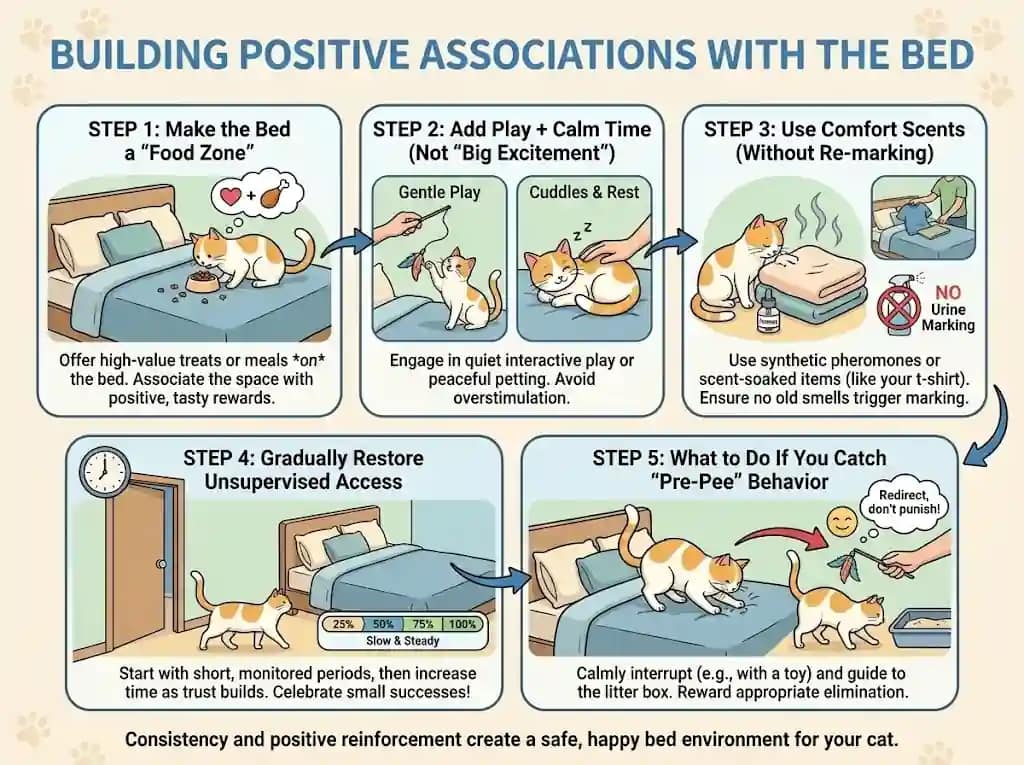
Building Positive Associations with the Bed
Once the cause is being addressed (medical, stress, or litter box) and your bed is truly odor-free, the final step is retraining the bed as a “safe resting place,” not a bathroom. The goal is simple: bed = food/play/rest, not toilet.
Quick Retraining Plan (Do This for 7–14 Days)
Pick 2–3 of the actions below and do them daily:
Treats or a small meal on the bed (even 5–10 kibbles counts)
2–5 minutes of play on the bed (wand toy, toss toy, or gentle bonding)
Comfort scent setup: place a clean blanket your cat already sleeps on at the foot of the bed
Temporary access control: close the bedroom door or cover the bed when you can’t supervise
Easy redirect: if you see pre-pee signs, calmly move your cat to the nearest litter box
Step 1: Make the Bed a “Food Zone”
Cats typically avoid eliminating where they eat. Once per day:
Give a small treat or snack on the bed (same spot each time).
If your cat is comfortable, you can feed one regular meal there for a short period.
Step 2: Add Play + Calm Time (Not “Big Excitement”)
You’re building a calm positive routine:
Play briefly on the bed, then end with a treat.
If your cat enjoys petting or brushing, do a short session on the bed when they’re relaxed.
Step 3: Use Comfort Scents (Without Re-marking)
After cleaning, the bed may smell “different.” Help it feel familiar:
Put a clean blanket your cat likes on the bed.
Add a worn (but clean) t-shirt that smells like you (optional).
Avoid strongly scented detergents during retraining if your cat is sensitive.
Step 4: Gradually Restore Unsupervised Access
Until the habit is broken, remove opportunities:
Allow bed access when you can watch (especially daytime).
If accidents happened overnight, keep the door closed at night for now.
Consider a waterproof cover temporarily—useful, but don’t rely on it as the only solution.
Step 5: What to Do If You Catch “Pre-Pee” Behavior
Pre-pee signs can include intense sniffing, circling, pawing, or backing into a spot.
Interrupt gently (call their name, light clap once—no yelling).
Pick up and place in a litter box calmly.
If they use the box, quiet praise or a small treat afterward.
If an Accident Happens Again
Treat it like a clue, not a failure:
Re-clean with enzyme cleaner (urine odor can restart the habit).
Add or relocate a litter box closer to the bedroom for 2–3 weeks.
Re-check recent stressors (schedule changes, guests, inter-cat tension).
If it’s recurring or sudden, re-check with your vet.
Signs You’re Making Progress
Your cat rests on the bed without intense sniffing
No repeat accidents for 7+ days
Increased litter box use + normal behavior (no hiding/overgrooming/straining)
Our goal is a household where the bed is for purring naps with you, and the litter box is for pee. By reinforcing the right associations, you help lock in the behavioral improvements you’ve worked so hard to achieve.
Patience and Understanding: We’re Here to Help You Solve the Real Problem
Solving bed peeing is a process, not a one-night fix—and that’s normal. You’ve already done the most important thing: you now understand the three core drivers behind this behavior—medical discomfort, stress/anxiety, and litter box/environment issues. What matters next is patience, consistency, and treating your cat’s behavior as information, not “misbehavior.”
Your cat isn’t trying to upset you. When a cat urinates on the bed, they’re usually communicating that something feels unsafe, uncomfortable, or painful. When you respond by identifying the root cause (instead of just cleaning the mess), you’re doing the most caring thing possible.
A quick, reliable checklist (use it when you feel stuck)
When progress feels slow, return to this simple sequence:
Health first: rule out pain or urinary issues with a vet check when symptoms suggest it.
Lower stress: restore routine, increase safe spaces, and reduce triggers at home.
Upgrade the litter setup: the right number of boxes, right locations, right litter, and easy access.
Remove every trace of odor: enzyme cleaning is non-negotiable to prevent repeat marking.
Rebuild habits: make the bed a “good place” again (treats/play/rest) and prevent slip-ups while retraining.
Stay kind and steady: calm consistency works better than any “discipline.”
If there’s a setback, don’t panic—use it as a clue
A repeat accident doesn’t mean you failed. It usually means something changed (stress, routine, box conditions) or the original cause isn’t fully resolved yet. Ask:
Did anything new happen in the home this week?
Are the boxes as clean and accessible as they were at the start?
Are there subtle medical signs that deserve a follow-up?
Behavior often improves after the environment becomes reliably comfortable. Some cats need days; others need a few weeks to fully “trust” the new setup.
One rule that matters most: never punish
Punishment doesn’t teach the litter box—it teaches fear. Yelling or rubbing their nose in it can increase stress and make accidents more frequent or more hidden. Instead, reward the behavior you want: quiet praise, a small treat, or gentle attention when your cat uses the litter box and relaxes calmly.
At SnuggleSouls, we focus on solving the real problem, not blaming the cat or the owner. You’re not a bad pet parent—and your cat isn’t a “bad cat.” With a science-based approach and steady routines, most families see real improvement and return to what you want most: a clean bed and a confident, comfortable cat.
Soon, this will be a chapter you barely remember—replaced by peaceful nights, fresh sheets, and the familiar sound of purring right where it belongs.

FAQ
Why is my cat suddenly peeing on my bed?
It’s usually medical discomfort, a recent stressor, or a litter box change.
Is my cat peeing on the bed out of spite or revenge?
No—cats don’t pee on beds to “get back at you”; it’s almost always stress, pain, or litter box aversion.
How do I clean cat urine from my bed so they don’t do it again?
Use an enzyme cleaner to fully remove the urine smell, or your cat may return to the same spot.
Can stress or anxiety cause a cat to pee on the bed?
Yes—stress can trigger bed peeing because the bed smells like you and feels safe.
How can I stop my cat from peeing on the bed permanently?
Permanent improvement comes from fixing the root cause (medical, stress, or litter box setup) and preventing repeats.
Should I punish my cat for peeing on my bed?
No—punishment increases stress and often makes the problem worse.
Will neutering or spaying stop my cat from peeing on the bed?
It can reduce spraying/marking, but it won’t fix bed peeing caused by pain, stress, or litter box issues.
How long does it take to fix this behavior?
It depends on the cause—medical issues can improve quickly with treatment, while stress/box habits usually take 2–6 weeks.
References
Barcelos, A. M., McPeake, K. J., Affenzeller, N., & Mills, D. S. (2018). Common risk factors for urinary house soiling (periuria) in cats and its differentiation: The sensitivity and specificity of common diagnostic signs. Frontiers in Veterinary Science, 5, 108. https://www.frontiersin.org/journals/veterinary-science/articles/10.3389/fvets.2018.00108/full
Carney, H. C., Sadek, T. P., Curtis, T. M., Halls, V., Heath, S., & Crowell-Davis, S. (2014). AAFP and ISFM guidelines for diagnosing and solving house-soiling behavior in cats. Journal of Feline Medicine and Surgery, 16(7), 579–598.
Cornell University Feline Health Center. (n.d.). Feline behavior problems: House soiling. Retrieved May 6, 2025, from https://www.vet.cornell.edu/departments-centers-and-institutes/cornell-feline-health-center/health-information/feline-health-topics/feline-behavior-problems-house-soiling
Buffington, C. A. T. (2011). External and internal influences on disease risk in cats. Journal of the American Veterinary Medical Association, 239(5), 526–530. https://doi.org/10.2460/javma.239.5.526
Mills, D. S., & Hall, S. S. (2014). Animal-assisted interventions: Making better use of the human-animal bond. Veterinary Record, 174(11), 269–273.
American College of Veterinary Behaviorists. (2018). Decoding Your Cat: The Ultimate Experts Explain Common Cat Behaviors and Reveal How to Prevent or Change Unwanted Ones. Houghton Mifflin Harcourt.
Ellis, S. L. H. (2009). Environmental enrichment: Practical strategies for improving feline welfare. Journal of Feline Medicine and Surgery, 11(11), 901–912.
Gunn-Moore, D. A., Moffat, K., Christie, L. A., & Head, E. (2007). Cognitive dysfunction and the neurobiology of ageing in cats. Journal of Small Animal Practice, 48(10), 546–553. https://doi.org/10.1111/j.1748-5827.2007.00384.x
Horwitz, D. F., & Neilson, J. C. (2007). Blackwell’s Five-Minute Veterinary Consult Clinical Companion: Canine and Feline Behavior. Wiley-Blackwell.
DePorter, T. L. (2016). Common feline problem behaviors: Destructive behavior and house soiling. Veterinary Clinics of North America: Small Animal Practice, 46(6), 1163–1178. https://www.sciencedirect.com/science/article/abs/pii/S0195561616300389













 EN
EN DE
DE ES
ES PT
PT