
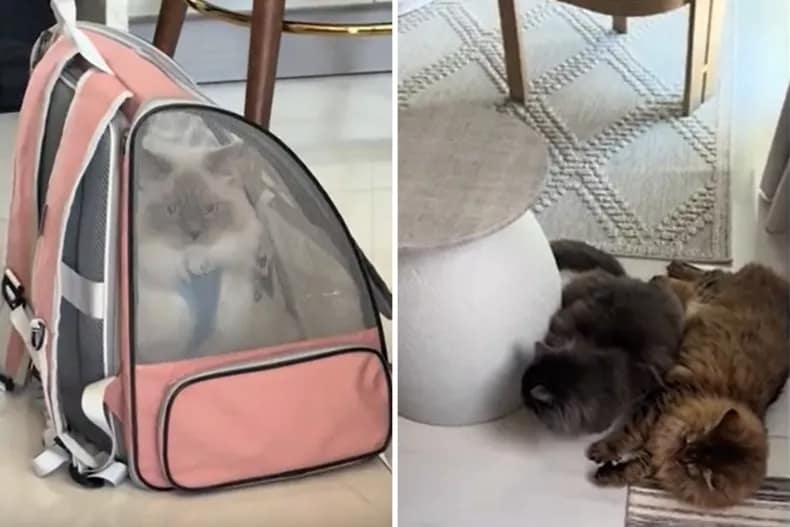
Pet-sitting usually comes with a few surprises—but TikTok user Mckenzie (@mckenziefrenziee) never expected her weekend with a friend’s cat to leave her own two felines hiding in terror.
A Fluffy Guest with Big Energy
On August 13, Mckenzie shared a now-viral clip (over 578,000 views) showing her two male cats nervously huddled behind a table. The cause? Chanel, a stunning white, fluffy cat who hadn’t even stepped out of her carrier yet.
The text over the video read: “Chanel is here for the weekend and the boys are terrified.”
When the camera shifted to Chanel, her piercing gaze said it all—she was in charge. Viewers couldn’t stop laughing at her intense expression. One user joked: “She was like: after I am done with these two, you’re next.” Another chimed in: “She looks so ready to start trouble.”
The Takeover: Chanel vs. Sullivan
A follow-up video revealed just how quickly Chanel established dominance. Sitting boldly on top of Sullivan, one of the male cats, she left no doubt about who ruled the household. Sullivan eventually slumped on the floor, defeated, while Chanel strutted away with diva-like calm.
“The poor guy is TIRED,” Mckenzie explained in the comments, and viewers agreed, calling Chanel the ultimate boss cat. Many even suggested it must be a Ragdoll thing, with one user adding: “When I take my girl Ragdoll over to my mum’s, she beats up her cat too. They’re such divas.”
@mckenziefrenziee Her face is sending me 💀💀💀
♬ original sound – Red Knight
Why Cats React This Way: Understanding Feline Aggression
Chanel didn’t waste any time claiming her place. This dramatic standoff is a classic example of feline aggression, a natural behavior triggered when cats feel their space—or authority—is threatened.
According to the ASPCA, cat aggression can show up in different ways:
- Fearful/Defensive Aggression
Happens when a cat feels trapped. Signs include crouching, flattened ears, tucked tail, dilated pupils, hissing, or swatting. Best response: give them space. - Territorial Aggression
Cats may defend their home—or even just a favorite spot—through stalking, chasing, or hissing. Triggers include new pets, household changes, or sexual maturity. - Play Aggression
Most common in kittens, this includes pouncing, biting, and scratching. It’s playful in intent but can still hurt. - Redirected Aggression
The most unpredictable type. If a cat is agitated by something they can’t reach (like a stray outside the window), they may lash out at whoever’s nearby.
What Pet Parents Can Learn
Bringing a new cat into the home—even temporarily—can shake up the entire feline dynamic. Careful introductions, safe spaces, and patience are key to reducing stress for all cats involved.
And as Chanel proved, sometimes all it takes is a single stare to make the whole house bow down.
FAQ
Q: Why were Mckenzie’s cats so scared of Chanel?
Chanel displayed strong territorial and dominance behavior, which is common when a new cat enters a home.
Q: Are some breeds more dominant than others?
Breed plays a role, but personality matters more. Chanel’s Ragdoll-like confidence is not universal—many Ragdolls are actually gentle companions.
Q: How can I safely introduce a new cat to my home?
Start with scent swapping, keep the newcomer in a separate room at first, and allow gradual, supervised introductions.












 EN
EN DE
DE ES
ES PT
PT