
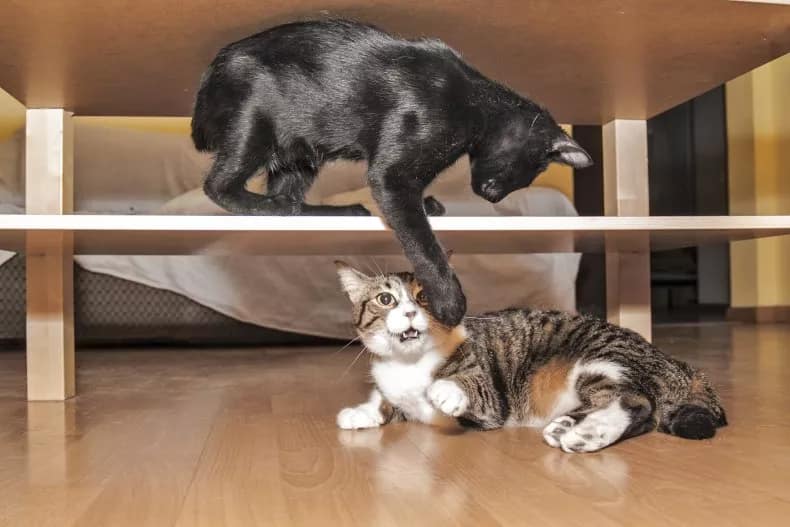
When one cat mom decided to get her calico a feline sibling, she hoped for instant friendship. Instead, what she got was a mix of hissing, paw-throws, and cautious curiosity—and TikTok can’t get enough.
Mila Meets Fifi
In a video posted in July by @miloskifanpage, the cat parent explains: “I adopted a male tuxedo for my female cat and I can’t understand if they are friends or not.”
The clip shows Mila, the calico, meeting her new brother Fifi.
- At first, Mila hisses at him for daring to get too close.
- Moments later, she softens and gently sniffs his nose.
- But when Fifi playfully bats a paw at her, Mila responds with another round of hissing.
The back-and-forth left viewers—and the owner—wondering: Do they actually like each other?
Why Cats Act This Way
Cat experts explain that such mixed signals are completely normal. Some cats thrive with companions, especially if raised with siblings, while others prefer solitude. Reasons cats may struggle with new friends include:
- Territorial instincts (defending their space)
- Past negative experiences with other cats
- Competition for resources like food, toys, or litter boxes
- Clashing personalities
- Lack of proper socialization
Still, all hope isn’t lost. With slow, scent-based introductions and supervised short visits, most cats can learn to coexist—and sometimes become inseparable.
Dr. Marta Vidal-Abarca, via Catster, emphasizes patience: “Start by introducing scent first. Keep interactions brief and closely monitored until you know they can handle more time together.”
Internet Reactions
The video has gone viral, racking up 447,000 views and 36,600 likes. Cat lovers chimed in with encouragement:
- “She’s a calico. Of course she is going to give him attitude.”
- “They’re not friends yet, but they’re learning each other’s boundaries. This is a good start!”
- “Not friends currently, but give them time—it looks promising.”
Takeaway for Pet Parents
Introducing a second cat can feel like an emotional rollercoaster. Hissing doesn’t necessarily mean failure—it often just means boundaries are being set. With time, patience, and the right approach, cats like Mila and Fifi may just surprise everyone and become the best of friends.
FAQ
Q: Is hissing always a bad sign when introducing cats?
Not necessarily. Hissing is a way for cats to communicate boundaries. It doesn’t always indicate aggression.
Q: How long does it take for cats to get along?
It varies—some may warm up in days, others take weeks or even months. Consistency and patience are key.
Q: What’s the best way to introduce a new cat?
Start with scent swapping, then allow short, supervised meetings. Always provide separate resources (litter boxes, bowls, beds) to reduce tension.









 EN
EN DE
DE ES
ES PT
PT