
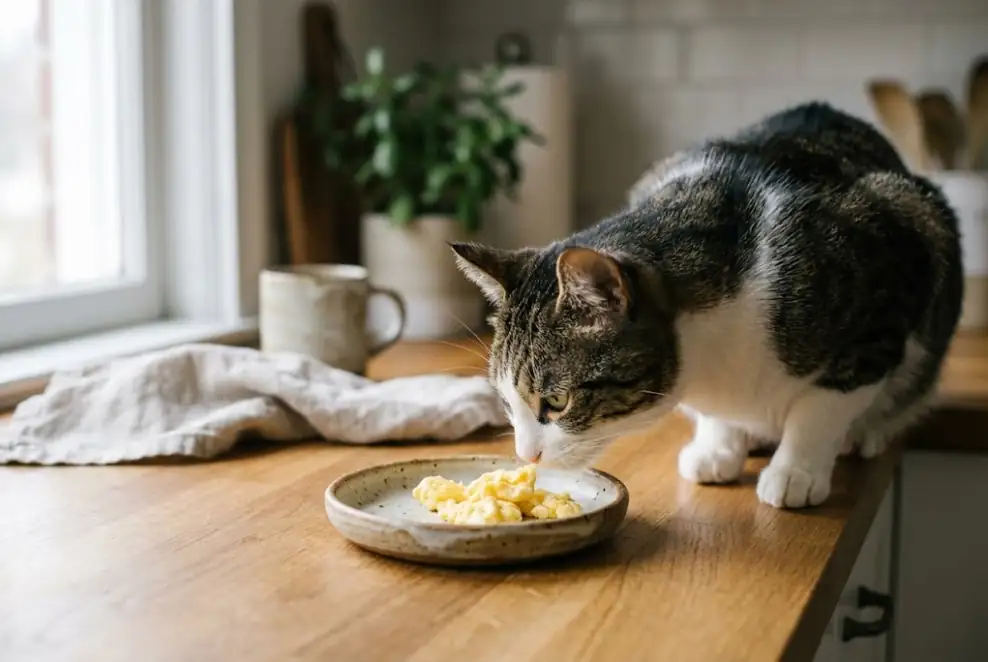
Resposta rápida: Os gatos podem comer ovos?
- Sim — os gatos podem comer ovos desde que estejam bem cozidos e sem nada (sem manteiga, leite, sal, cebola ou alho).
- Evite ovos crus ou com a gema mole (risco de bactérias transmitidas por alimentos). Cozinhe os ovos até que a gema e a clara estejam firmes; os pratos à base de ovo devem atingir 160 °F / 71 °C.
- Quanto custa? As guloseimas devem ser ≤10% de calorias diárias, por isso a maioria dos gatos só precisa de algumas garfadas (sobre 1 colher de sopa para um gato de aproximadamente 10 lb / 4,5 kg) 1 a 2 vezes por semana.
Quando consultar primeiro o veterinário: gatinhos ainda em fase de desmame, histórico de pancreatite, doença renal, obesidade, diabetes ou suspeita de alergias alimentares.
Neste guia, você vai descobrir se os ovos são saudáveis para gatos, qual é a maneira mais segura de servi-los, qual é a quantidade adequada em termos de peso e o que fazer no caso de gatinhos ou gatos com estômago sensível.
Os ovos são seguros para gatos? (Regras rápidas de segurança)
Sim — Os ovos geralmente são seguros para gatos quando totalmente cozidos e servidos sem tempero. Os maiores problemas ocorrem quando os ovos estão crus ou mal cozidos, ou quando são preparados como “comida de gente”, com óleos, manteiga, leite, sal ou temperos.
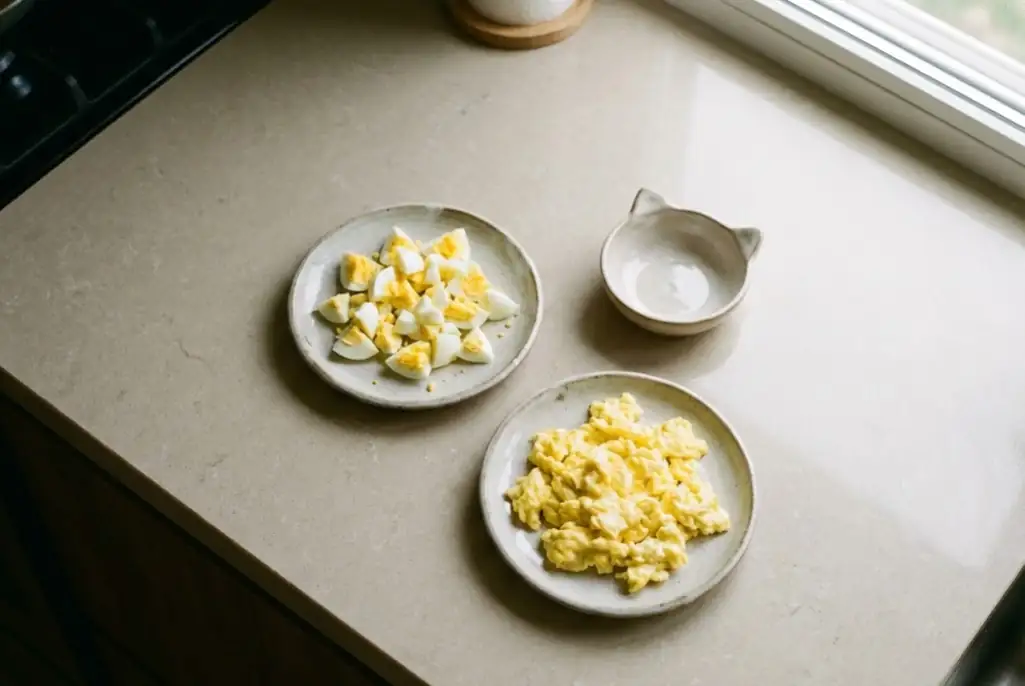
As formas mais seguras de servir ovos para gatos
Escolha uma destas opções simples:
- Ovo cozido: Totalmente cozido, fácil de dividir em porções. Pique ou amasse até ficar em pedacinhos bem pequenos.
- Ovos mexidos simples: Cozinhe até ficar bem firme em uma frigideira antiaderente sem manteiga/óleo (use um pouquinho de água, se necessário).
Sirva somente depois de esfriar e comece com um pedacinho para ver como seu gato reage.
O que evitar (erros comuns)
Evite pratos à base de ovo que contenham:
- Sal, pimenta, temperos, alho/cebola em pó
- Manteiga, óleo, gordura de bacon
- Leite ou creme (muitos gatos são intolerantes à lactose)
- Queijo ou molhos
Quando os ovos podem não ser uma boa ideia
Consulte seu veterinário antes de dar ovos para seu gato se ele tiver:
- Um estômago muito sensível ou vômitos/diarreia frequentes
- Histórico de pancreatite (alimentos gordurosos podem provocar crises)
- Obesidade ou está fazendo uma dieta para emagrecer
- Doença renal ou uma dieta prescrita
Os ovos são bons para os gatos?
Sim — Os ovos podem ser bons para os gatos como um petisco ocasional, pois fornecem proteína animal altamente digestível e vários nutrientes benéficos. Mas os ovos devem não servir como alimento diário ou substituir uma dieta completa para gatos.
Os gatos são carnívoros obrigatórios, por isso a proteína de origem animal é essencial. Os ovos se encaixam bem nesse perfil — muitos alimentos de alta qualidade para gatos incluem até mesmo o ovo como ingrediente para melhorar a qualidade da proteína.
Principais benefícios dos ovos para gatos (quando cozidos e servidos sem tempero)
- Proteína de alta qualidade: Ajuda a manter a massa muscular magra e fornece energia.
- Fácil de digerir (quando cozido): Muitos gatos toleram bem o ovo cozido, em comparação com “comidas de gente” mais complexas.”
- Nutrientes que contribuem para a saúde da pele e do pelo: Principalmente da gema (ácidos graxos + vitaminas lipossolúveis).
Clara de ovo x Gema de ovo x Casca de ovo — O que é melhor?
Clara de ovo cozida
- Magro, rico em proteínas, com baixíssimo teor de gordura
- Ótima opção para gatos que precisam de petiscos com menos calorias
Gema de ovo cozida
- Mais vitaminas e nutrientes, mas também maior teor de gordura e calorias
- O melhor em pequenas quantidades, especialmente se o seu gato engorda com facilidade
Casca de ovo (opcional)
- É principalmente cálcio, mas é fácil exagerar
- Use apenas pó de casca de ovo devidamente esterilizado e finamente moído, de preferência com orientação veterinária
A grande ressalva: os ovos não constituem uma alimentação completa
Os ovos são nutritivos, mas não são “completos e equilibrados”. Mais especificamente, os ovos são não é uma fonte significativa de taurina, e os gatos devem obter taurina por meio de uma alimentação completa (geralmente ração comercial para gatos formulada para atender aos perfis nutricionais).
Conclusão: Os ovos são um alimento útil guloseima extra, não substitui a ração para gatos.
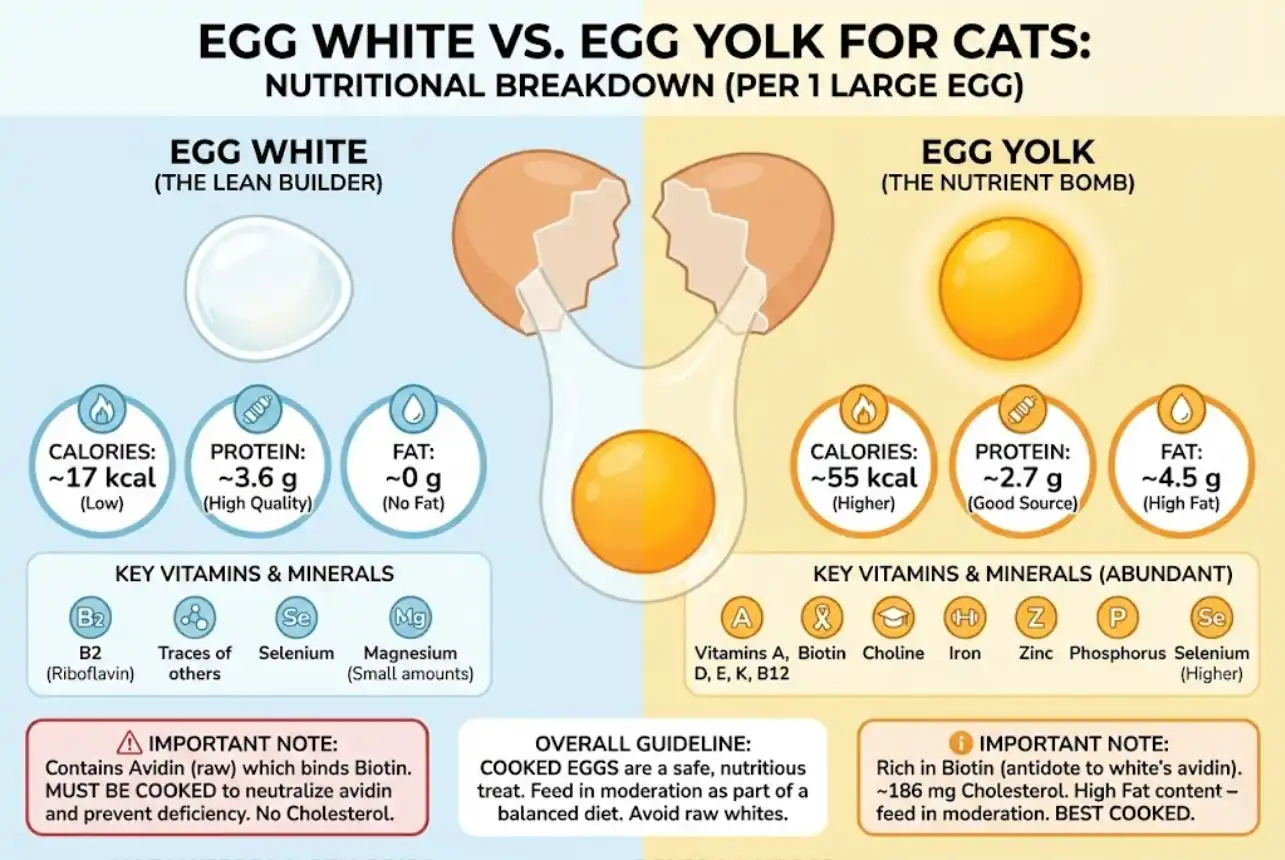
A seguir: Use a tabela abaixo para comparar rapidamente o valor nutricional da clara e da gema de ovo.
Clara x Gema de Ovo para Gatos: Calorias, Proteína, Gordura (por 1 ovo grande)
| Nutrientes | Clara de ovo (ovo grande) | Gema de ovo (ovo grande) |
|---|---|---|
| Calorias | ~17 kcal | ~55 kcal |
| Proteína | ~3.6 g | ~2.7 g |
| Gordura | ~0 g | ~4,5 g (principalmente na gema) |
| Vitaminas essenciais | B2 (riboflavina), traços de outros | Vitaminas A, D, E, K, B12, Biotina, Colina (abundante na gema) |
| Principais minerais | Selênio, magnésio (pequenas quantidades) | Ferro, Zinco, Fósforo, Selênio (mais rico em gema) |
| Outras notas | Sem colesterol; contém avidina (crua) que se liga à biotina | ~186 mg de colesterol em uma gema; alto teor de gordura |
Benefícios da alimentação de gatos com ovos
Com essa análise nutricional em mente, aqui estão alguns Benefícios para a saúde seu gato pode ganhar com um pouco de ovo em sua dieta:
Proteína de alta qualidade
Os ovos fornecem proteína animal completa que é altamente digerível para gatos. Os aminoácidos do ovo ajudam a manter a massa muscular magra e fornecem energia. Muitos criadores de gatos até adicionam ovos ocasionais às dietas para promover pelagem brilhante e garras saudáveis em gatos de exposição.
Se o seu gato for exigente com a comida, um pouco de ovo pode ser um reforço de proteína atraente.
Gorduras saudáveis para pele e pelagem
A gema de ovo contém ácidos graxos benéficos, incluindo o ácido linoleico e o ácido araquidônico, que contribuem para a saúde da pele e o brilho da pelagem. Elas também fornecem gorduras ômega-3 e ômega-6 que nutrem o sistema nervoso e podem ter efeitos anti-inflamatórios.
Você pode notar uma pelagem mais macia e brilhante em um gato que come ovos de vez em quando, graças a nutrientes como a vitamina E e a biotina presentes na gema.
Vitaminas e minerais
Conforme observado, os ovos são pequenos pacotes multivitamínicos. A vitamina A na gema auxilia a visão (especialmente a noturna) e a função imunológica.
Vitaminas B (B2 riboflavina, B12 cobalamina, B7 biotina, B1 tiamina) ajudam no metabolismo energético, na digestão e na função nervosa.
Vitamina D nos ovos trabalha com o cálcio para a saúde dos ossos. Minerais como ferro e selênio auxiliam na produção de glóbulos vermelhos e na defesa antioxidante.
Embora a ração normal do seu gato já deva fornecer esses nutrientes, um pouco de ovo pode dar um impulso extra.
Altamente palatável e digerível
A maioria dos gatos Adoro o sabor dos ovos - eles são ricos e saborosos. Felizmente, os ovos também são fáceis para os estômagos dos felinos quando cozidos.
Na verdade, os ovos são frequentemente utilizados em dietas para gatos com estômago sensível, pois são proteínas simples que raramente causam alergia nos gatos. Se o seu gato tiver tido algum pequeno distúrbio digestivo ou se tiver o estômago sensível, um ovo cozido sem tempero pode ser mais fácil de tolerar do que alimentos muito temperados.
Cada gato é diferente, mas, em geral, os ovos são os mais bem classificados em termos de digestibilidade e aceitação.
Qual a quantidade de ovo que posso dar ao meu gato?
Para a maioria dos gatos, algumas mordidas de ovo cozido já são o suficiente. Os ovos são nutritivos, mas também são ricos em calorias em relação ao corpo pequeno de um gato. A abordagem mais segura é tratar o ovo como um lanche de alto valor, e não uma refeição.
Guia rápido de porções (resposta mais pesquisada)
- Gato de 5 lb (2,3 kg): até 1–2 colheres de chá ovo cozido
- Gato de 10 lb (4,5 kg): sobre 1 colher de sopa ovo cozido
- Gato de 15 lb (6,8 kg): até 2 colheres de sopa ovo cozido
Prática recomendada: servir ovo sem tempero e totalmente cozido (mexidos ou cozidos). Evite adicionar manteiga, leite, sal, óleo, queijo ou temperos.
Calculadora de porções de ovos: Peso do seu gato (lb) × 0,1 = calorias máximas de petiscos por dia → mantenha o consumo de ovos dentro desse limite.
A Regra 10% para Guloseimas (Por que as porções são importantes)
Uma orientação prática utilizada por muitos veterinários e especialistas em nutrição animal é:
As guloseimas não devem representar mais do que ~10% das calorias diárias do seu gato.
Como os ovos contêm tanto proteína quanto gordura, eles “consomem” rapidamente as calorias dos petiscos — especialmente no caso de gatos menores. É por isso que as porções acima parecem pequenas.
Use esta tabela se quiser uma resposta rápida, sem precisar fazer cálculos. As porções pressupõem que ovo cozido simples (sem sal, manteiga, leite nem temperos).
Tabela de porções: limites de consumo de ovos por peso do gato
| Peso do gato | Calorias diárias típicas (estimativa) | Calorias máximas da guloseima (10%) | Quantidade de ovo cozido (por porção) | Com que frequência |
|---|---|---|---|---|
| 5 lb (2,3 kg) | ~180 kcal/dia | ~18 kcal | ≈ 1 colher de sopa ovo cozido (≈ 1/4 de ovo) | 1-2×/semana |
| 10 lb (4,5 kg) | ~240-250 kcal/dia | ~24-25 kcal | ≈ 1 colher de sopa ovo cozido (≈ 1/3 de ovo) | 1-2×/semana |
| 15 lb (6,8 kg) | ~300 kcal/dia | ~30 kcal | ≈ 2 colheres de sopa ovo cozido (≈ 1/2 ovo, no máximo) | 1×/semana |
Caloria Essas necessidades são estimativas para gatos adultos com peso ideal. Ajuste de acordo com o nível de atividade, idade, e seguindo as orientações do seu veterinário.
Com que frequência os gatos podem comer ovos?
Para a maioria dos gatos adultos saudáveis: 1 a 2 vezes por semana é um limite inteligente.
Os petiscos diários à base de ovo podem:
- aumentar demais a ingestão de calorias (é fácil ganhar peso)
- diminui o apetite por ração completa para gatos (o equilíbrio nutricional é prejudicado)
Casos especiais: quando reduzir ou evitar o consumo de ovos
Consulte seu veterinário antes de dar ovo regularmente ao seu gato, caso ele tenha:
- histórico de pancreatite (a gema tem mais gordura)
- plano para a obesidade ou para a perda de peso (as calorias das guloseimas se acumulam rapidamente)
- doença renal (alguns gatos precisam de um controle mais rigoroso dos níveis de fósforo e proteína)
- diabetes (a consistência do tratamento é importante)
Se o seu veterinário permitir o consumo de ovos, muitos donos costumam usar pequenas porções de clara de ovo cozida como a opção mais enxuta.
Sinais de que você está alimentando demais
Reduza a dose se perceber que:
- ganho de peso ou barriga crescente
- seu gato está pulando refeições regulares
- vômitos, fezes moles ou distúrbios digestivos após o consumo de ovos
Informações sobre gatos e ovos
Os gatos podem comer ovos mexidos?
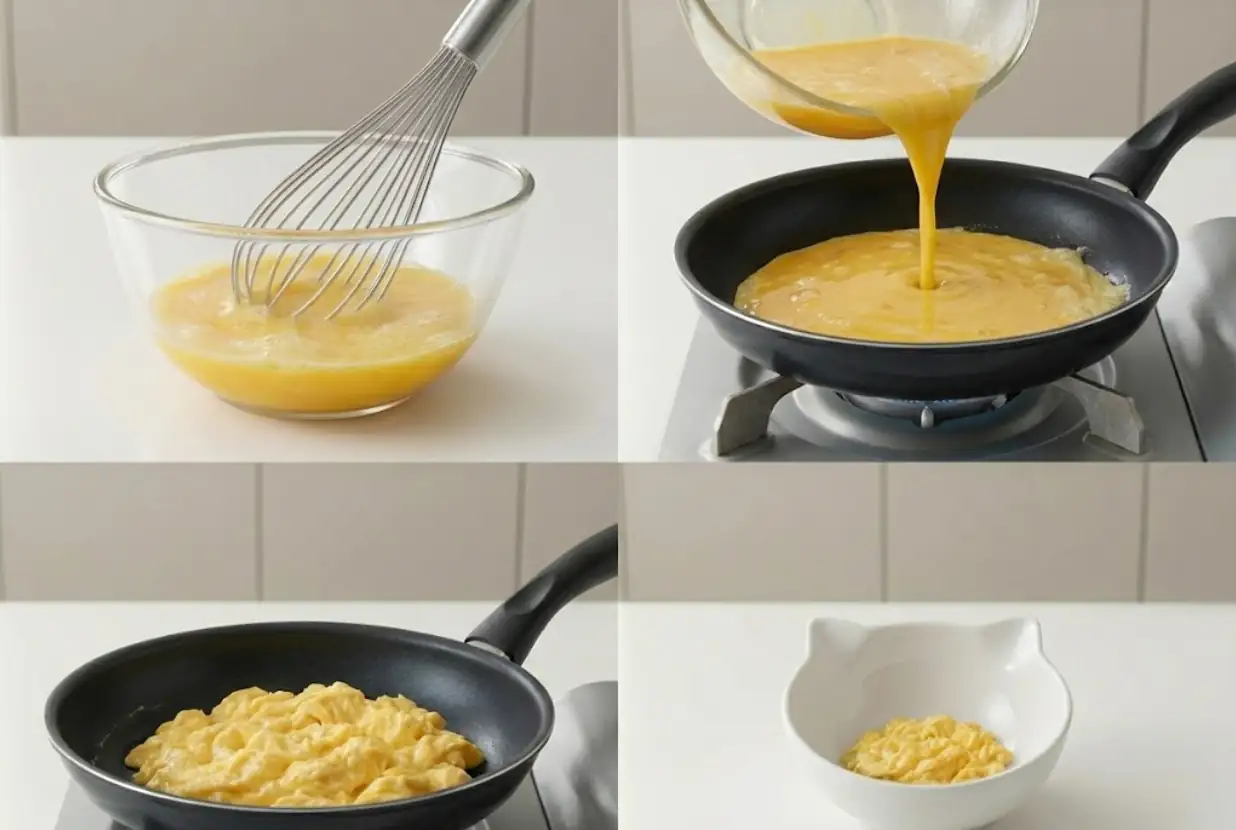
Sim — ovos mexidos simples são uma das formas mais seguras e fáceis de dar ovo para gatos.
Como preparar ovos mexidos para gatos (sem aditivos)
- Quebre 1 ovo em uma tigela e bata com um batedor.
- Aqueça uma frigideira antiaderente em fogo baixo (ou coloque um pouquinho de água).
- Cozinhe até ficar totalmente firme (sem partes líquidas).
- Deixe esfriar e, em seguida, sirva uma pequena porção.
NÃO adicione: manteiga, óleo, leite/creme de leite, sal, pimenta, alho/cebola em pó ou temperos.
Dica de apresentação: Misture uma colher de chá de ovo mexido na ração habitual do seu gato para que ele aceite melhor a comida, sem que ele coma demais.
Os gatos podem comer ovos cozidos (e outros tipos de preparo)?
Sim — Ovos cozidos são seguros quando estão bem cozidos e servidos sem acompanhamento. Além disso, são fáceis de dividir em porções.
- Cozido: Pique ou amasse; ótimo para controlar as porções.
- Escalfado/mal cozido: Não é o ideal se o centro estiver mole (mal cozido).
- Ovo frito: Normalmente preparado com óleo/manteiga → pular essa etapa.
- Omelete/petiscos de ovo: Somente se simples (sem queijo, leite, temperos, cebola ou carnes salgadas).
Os gatos podem comer gema de ovo?
Sim, gema de ovo cozida é seguro em pequenas quantidades, mas é mais rico em gordura e calorias do que a clara de ovo.
Bom para: gatos exigentes com a comida, gatos que precisam de calorias extras (com moderação).
Tenha cuidado se: Se o seu gato estiver acima do peso ou tiver histórico de pancreatite, a gema pode ser muito gordurosa.
Melhores práticas: Dê a gema como parte de uma porção pequena (não uma gema inteira sozinha).
Os gatos podem comer claras de ovo?
Sim — claras de ovo cozidas são um petisco magro, rico em proteínas e com pouquíssima gordura.
Importante: Evite alimentar clara de ovo crua regularmente. A clara de ovo crua contém avidina, que pode interferir na absorção da biotina ao longo do tempo.
Melhores práticas: Cozinhe bem a clara do ovo e sirva-a sem acompanhamentos.
Os gatos podem comer casca de ovo em pó?
Às vezes — mas somente se for preparado corretamente e usado com cuidado. O pó de casca de ovo é composto principalmente por cálcio.
Se você quiser usar casca de ovo em pó:
- Ferver ou assar primeiro as cascas de ovo (por segurança).
- Seque completamente.
- Moa até virar um pó fino (sem pedaços pontiagudos).
- Uso pequenas quantidades e, de preferência, apenas sob orientação veterinária (o excesso de cálcio pode causar desequilíbrio).
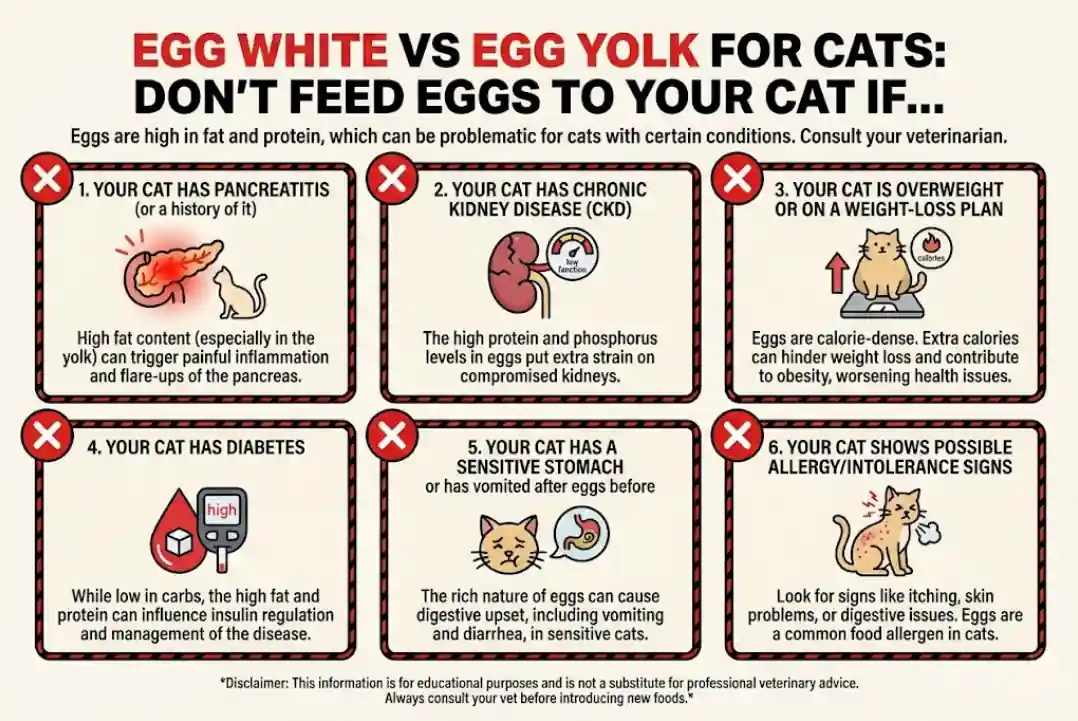
Não dê ovos para o seu gato se…
Os ovos geralmente são seguros quando bem cozidos e servidos sem acompanhamentos — mas há situações em que você deve evite dar ovos ou consulte primeiro o veterinário.
1. Seu gato tem pancreatite (ou tem histórico da doença)
A gema de ovo tem um teor relativamente alto de gordura, e guloseimas gordurosas podem ser uma má escolha para gatos propensos à pancreatite. Se o seu veterinário autorizar o consumo de ovo, pergunte se apenas pequenas quantidades de clara de ovo cozida são mais seguras.
2. Seu gato tem doença renal crônica (DRC)
Alguns gatos com DRC precisam de uma ingestão controlada de fósforo e proteína. O ovo pode não ser adequado para todos os planos renais. Se o seu gato estiver seguindo uma dieta renal prescrita, considere o ovo como somente com aprovação do veterinário.
3. Seu gato está acima do peso ou em um plano de emagrecimento
Os ovos são ricos em calorias para o tamanho corporal de um gato. Se você estiver controlando ativamente o peso do seu gato, use porções bem pequenas e diminua o consumo de outras guloseimas nesse dia.
4. Seu gato tem diabetes
Qualquer petisco pode atrapalhar uma rotina alimentar cuidadosamente planejada. Os ovos têm baixo teor de carboidratos, mas o tamanho da porção ainda é importante. Pergunte ao seu veterinário como os petiscos devem se encaixar na rotina e na meta calórica do seu gato.
5. Seu gato tem o estômago sensível ou já vomitou depois de comer ovos
Alguns gatos simplesmente não toleram bem o ovo. Se você tentar novamente, ofereça uma quantidade do tamanho de uma ervilha de ovo totalmente cozido e observe por 24 a 48 horas.
6. Seu gato apresenta possíveis sinais de alergia/intolerância
Pare de dar ovos ao animal e entre em contato com o veterinário se notar:
- vômito ou diarreia após comer ovo
- coceira na pele, higiene excessiva ou irritação nas orelhas
- novos distúrbios digestivos ou recusa em fazer as refeições habituais
Regra geral: Em caso de dúvida, considere os ovos apenas como um petisco ocasional — e priorize uma alimentação completa e equilibrada para o seu gato.
Os gatinhos podem comer ovos?
Sim — os gatinhos podem comer ovo, mas apenas como um minúsculo, como um petisco ocasional, assim que eles já estiverem se alimentando de forma consistente com uma ração completa e equilibrada para gatinhos. As guloseimas nunca devem substituir as refeições e devem ficar abaixo de 10% de calorias diárias.
A partir de quando os gatinhos podem experimentar ovo?
O desmame geralmente começa por volta das 3 a 5 semanas (com gatinhos em fase de transição para ração para gatinhos com composição nutricional equilibrada).
A maioria dos gatinhos é já estar totalmente alimentado com ração sólida para gatinhos por volta das 8 semanas.
Regra prática: Espere até que seu gatinho tenha desmamado e se alimentando regularmente de ração para gatinhos (geralmente por volta de 8 ou mais semanas) antes de oferecer um ovo como guloseima.
Como preparar ovos para gatinhos (método mais seguro)
Como os gatinhos são pequenos e ainda estão em fase de crescimento, seja extremamente rigoroso com a segurança alimentar:
Cozinhe os ovos até ficarem bem cozidos — a gema e a clara devem estar firmes; Ovos mexidos não devem ficar mal cozidos.
Se você estiver preparando um prato com ovos misturados, cozinhe até 160 °F / 71 °C.
Servir simples: sem sal, manteiga, óleo, temperos, cebola/alho ou leite (muitos gatos não toleram bem os laticínios).
As melhores rações para gatinhos: uma pitada de ovo cozido (purê) ou ovo mexido simples, totalmente cozido.
Qual é a quantidade adequada de ovo para um gatinho?
Os gatinhos têm necessidades energéticas muito elevadas para o crescimento; por isso, é importante evitar que os petiscos substituam a ração completa para gatinhos.
Comece com algo menor do que você imagina:
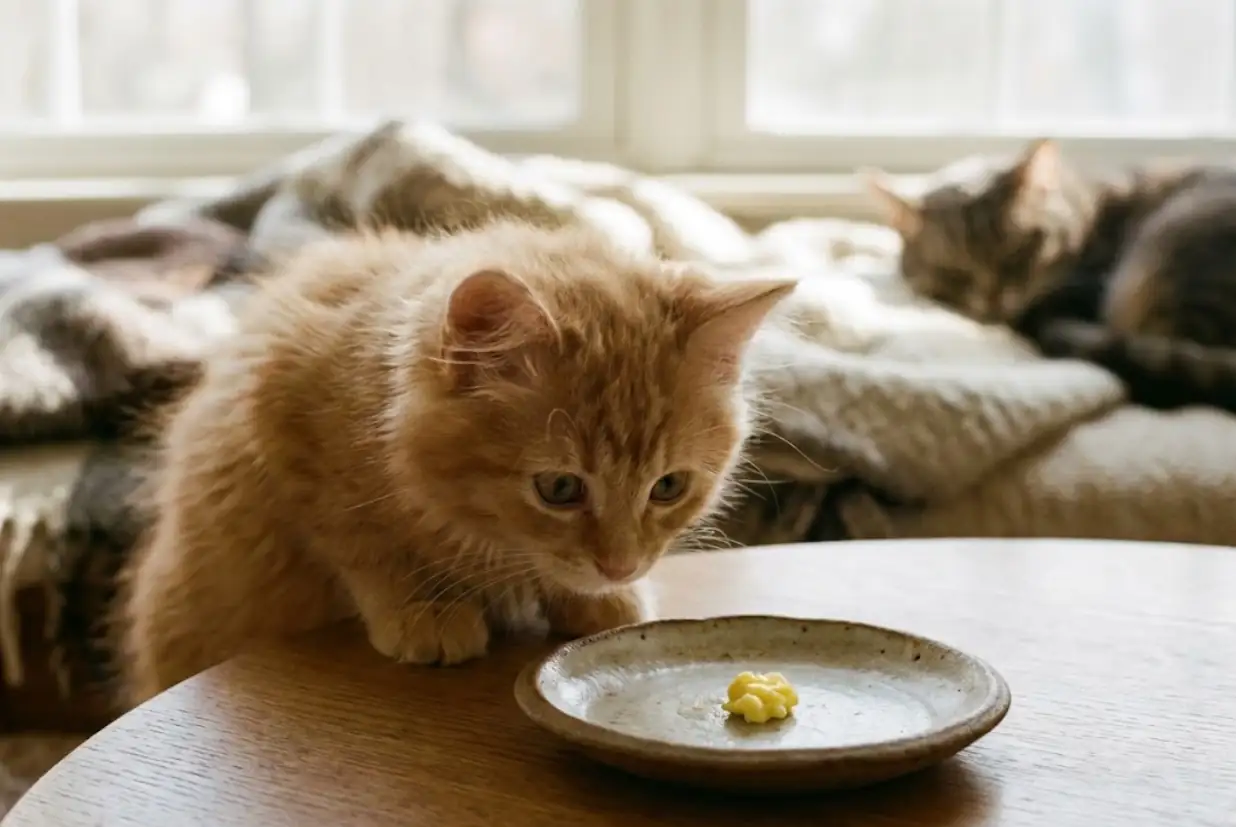
Primeira tentativa: uma amostra do tamanho de uma ervilha (ou algumas migalhas de ovo cozido).
Se for tolerável: até cerca de ½–1 colher de chá de vez em quando para muitos gatinhos (dependendo do tamanho), mantendo os petiscos <10% do total de calorias diárias.
Com que frequência: em geral 1 a 2 vezes por semana no máximo (o consumo frequente pode prejudicar uma alimentação equilibrada).
Ovo como guloseima de treinamento (funciona muito bem — use “micro-recompensas”)
Uma pequena porção de ovo cozido sem tempero pode ser uma recompensa muito valiosa para a socialização ou para o treinamento com a caixa de transporte ou a cama. Guarde-a micro (pense em “lamber”, não em “lanchar”) para não substituir acidentalmente parte de uma refeição.
Quando não dar ovos e entrar em contato com o veterinário
Evite dar guloseimas à base de ovo (ou consulte primeiro o seu veterinário) se o seu gatinho tiver:
diarreia/vômito contínuos, estômago sensível ou dieta veterinária prescrita
sintomas de intolerância/alergia após o consumo de ovo (coceira, vômito, diarreia, problemas nos ouvidos)
Os gatos podem comer ovos crus?
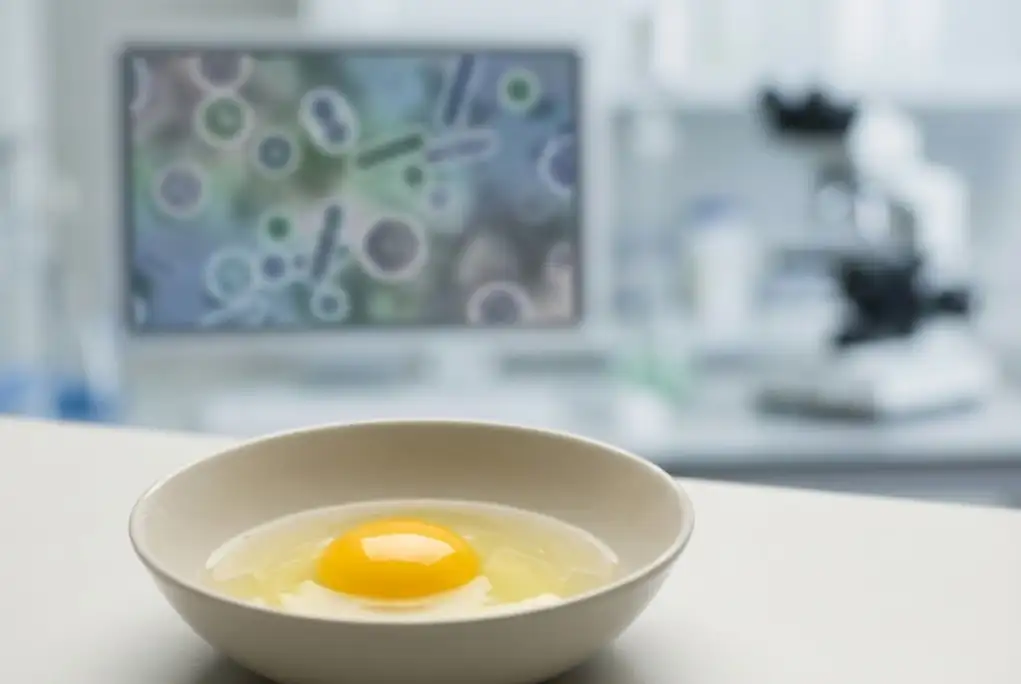
Resposta curta: Não — não dê ovos crus para gatos (claras cruas ou gemas cruas). A opção mais segura é ovo simples, totalmente cozido (sem manteiga, leite, sal ou temperos).
Veja por que não vale a pena correr o risco de consumir ovos crus:
1. Salmonela (e outros microrganismos): risco para o seu gato e sua família
Mesmo os ovos com casca que parecem limpos podem conter Salmonela, o que pode causar vômitos, diarreia, febre e fraqueza.
Uma avaliação de risco realizada pelo USDA estimou que prevalência geral de contaminação de ovos no país em torno de 1 em cada 20.000 óvulos (0.005%).
Além disso, os animais de estimação podem transmitir a bactéria em casa: a FDA observa que, mesmo sem sintomas evidentes, cães e gatos podem excretam Salmonella nas fezes e na saliva, contaminando o meio ambiente e aumentando o risco de exposição humana.
Preparação mais segura: cozinhe os ovos até que o a clara e a gema estão firmes, e preparar pratos com ovos para 160 °F / 71 °C.
2. As claras de ovo cruas podem interferir na absorção da biotina (em teoria, especialmente quando consumidas com frequência)
A clara de ovo crua contém avidina, uma proteína que se liga fortemente a biotina (vitamina B7). Essa ligação pode reduzir a absorção da biotina ao longo do tempo se claras de ovo cruas forem consumidas regularmente. O calor desnatura a avidina, e é por isso que O ovo cozido não apresenta esse problema.
(Observação: o ovo inteiro cru tem menos chances de causar problemas do que apenas as claras cruas, pois a gema contém biotina — mas isso ainda não elimina o risco de contaminação bacteriana.)
3. Não há nenhuma “vantagem” nutricional real em consumir ovos crus — a proteína do ovo cozido é melhor absorvida
Um estudo clássico sobre a digestão constatou que A proteína do ovo cozido era muito mais digestível do que a do ovo cru (digestibilidade ileal real ~90,91 TP3T cozido vs ~51,31 TP3T cru).
Portanto, você não está “perdendo benefícios” ao cozinhar — na verdade, seu gato pode uso mais dessa proteína.
Se o seu gato lamber acidentalmente um ovo cru
Não entre em pânico — basta bloquear o acesso, limpe as patas/boca, se necessário, e manter em observação por 24 a 48 horas em caso de vômito, diarreia, febre, letargia ou perda de apetite. Entre em contato com o veterinário imediatamente se os sintomas aparecerem (especialmente no caso de gatinhos, gatos idosos ou gatos imunocomprometidos).
Conclusão: Se você quiser dar ovos para o seu gato, não complique: totalmente cozido, sem tempero, porção pequena. Ovos crus representam um risco sem oferecer benefícios significativos.
Conclusão
Na SnuggleSouls, nosso objetivo é alimentar nossos gatos com amor e provas. Então...Os gatos podem comer ovos? Sim, desde que o ovo esteja totalmente cozido, sem tempero e servido como uma guloseima ocasional (não substitui uma refeição).
Lista rápida de verificação sobre ovos seguros para gatos
Cozinhe bem (claras e gemas bem cozidas; pratos à base de ovo chegam a 160 °F / 71 °C).
Evite ovos crus (ovos crus ou pouco cozidos podem transmitir Salmonela; é melhor evitar a presença de animais de estimação e pessoas na casa).
Mantenha as porções pequenas: os petiscos (incluindo ovo) devem permanecer menos de 10% de calorias diárias, e seu gato ainda precisa de um alimentação completa e equilibrada como alimento principal.
Sem complementos: sem manteiga, leite, sal, óleo, alho ou temperos.
Comece aos poucos e observe: se notar vômitos, diarreia, coceira ou inflamações nas orelhas, interrompa o tratamento e consulte seu veterinário.
Se o seu gato estiver acima do peso ou tiver condições como pancreatite, doença renal ou diabetes, consulte seu veterinário antes de adicionar ovo — especialmente a gema, que tem maior teor de gordura.
Quer mais ideias de lanches saudáveis (e saber o que deve evitar completamente)? O que os gatos podem comer? Alimentos humanos seguros e não seguros para gatos
 EN
EN DE
DE ES
ES PT
PT