
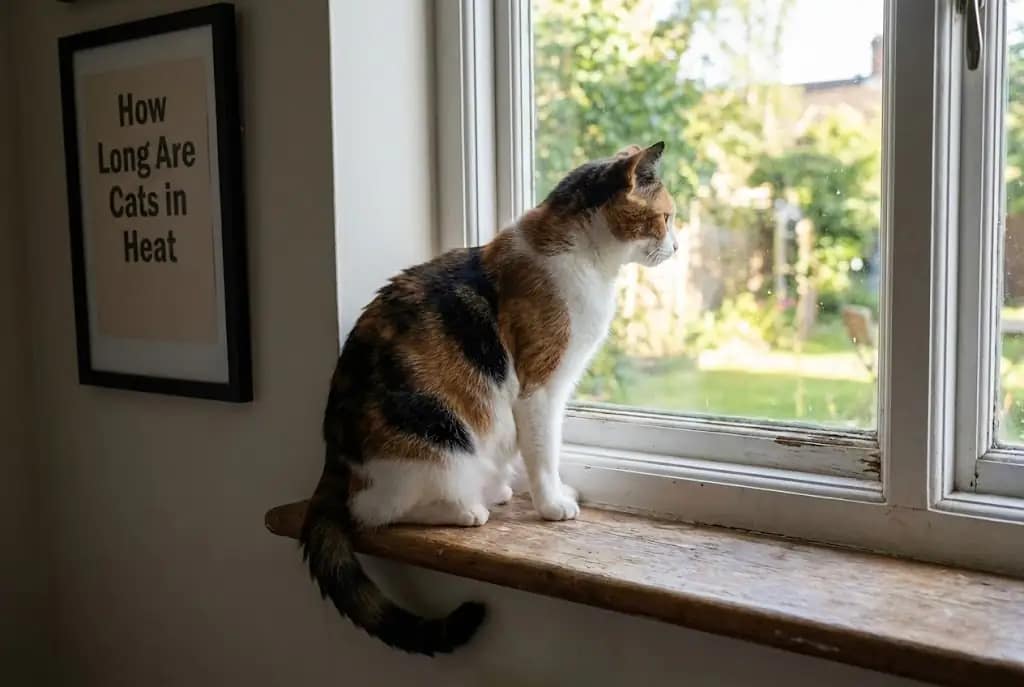
Quick answer: Most female cats stay in heat (estrus) about 5–7 days, but it can last as short as 3 days or as long as 14 days.
If she doesn’t mate, heat can return every 2–3 weeks during breeding season.
If you’re not breeding your cat, esterilização is the only reliable way to stop heat cycles long-term.
If you’re wondering how long cat heat lasts, you’re probably dealing with the yowling, pacing, and nonstop affection right now.
This guide gives you the exact timeline (including how long each stage lasts), the 8 clearest signse what actually helps at home—plus when spaying is the best option.
Cat Heat Cycle Timeline (Stages + How Long Each Lasts)
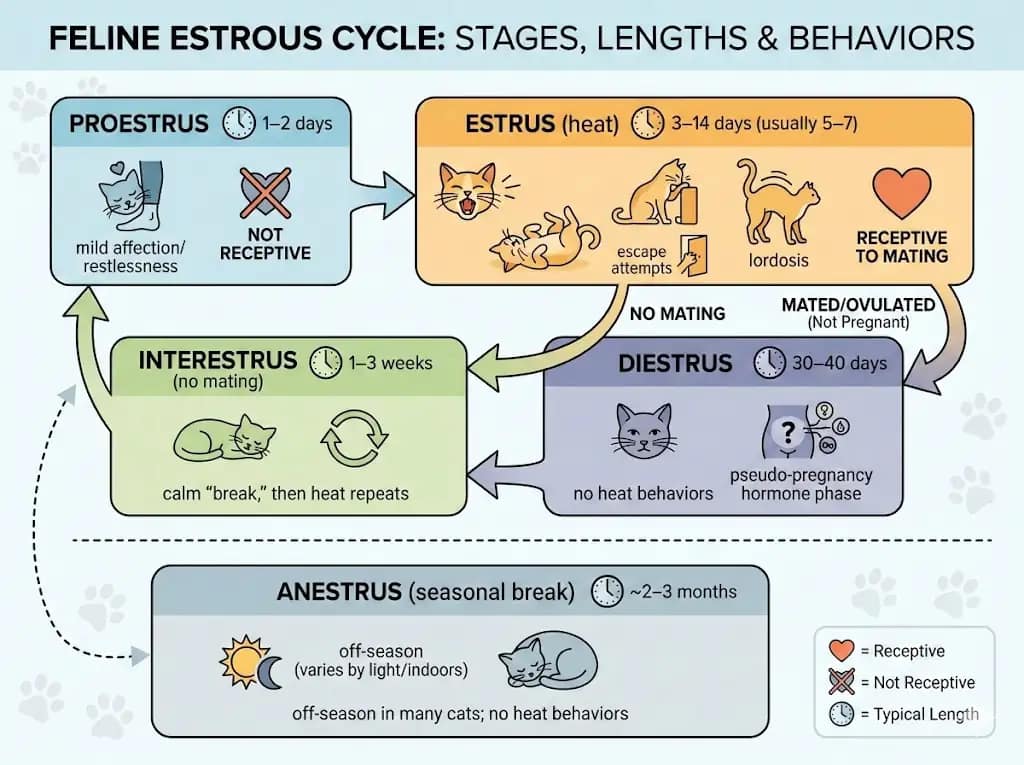
O ciclo estral felino consiste em quatro fases principais (proestro, estro, interestro/diestro e anestro). O proestro e o estro juntos constituem o período de "cio", quando sua gata é fértil, enquanto o interestro (ou diestro) e o anestro são fases com pouca ou nenhuma atividade de acasalamento.
O ciclo reprodutivo de uma gata é chamado de ciclo estralO ciclo de cio é o mais comum, comumente conhecido como ciclo de cio. Os gatos são poliestros sazonaisIsso significa que elas podem entrar no cio várias vezes durante sua estação de reprodução ativa.
No Hemisfério Norte, isso geralmente significa andar de bicicleta de janeiro até o final do outono e fazer uma pausa no inverno. (Se você vive em um clima tropical ou mantém seu gato principalmente dentro de casa sob luz constante, ele pode ciclo durante todo o ano sem férias de inverno).
Então, quanto tempo dura cada aquecimento e como é o cronograma? Aqui está um detalhamento das fases típicas do ciclo que seu gato experimentará:
| Stage | Typical length | What you’ll notice |
|---|---|---|
| Proestrus | 1–2 days | mild affection/restlessness; not receptive |
| Estrus (heat) | 3–14 days (usually 5–7) | yowling, rolling, rubbing, lordosis, escape attempts |
| Interestrus (no mating) | 1–3 weeks | calm “break,” then heat repeats |
| Diestrus (mated/ovulated, not pregnant) | 30-40 dias | no heat behaviors; “pseudo-pregnancy” hormone phase |
| Anestrus (seasonal break) | ~2–3 months | off-season in many cats (varies by light/indoors) |
Key takeaway: Your cat is “in heat” only during estrus, which usually lasts about a week, but can stretch up to two weeks. If she doesn’t mate, it often repeats every 2–3 weeks in breeding season.
Proestrus (about 1–2 days)
Length: ~1–2 days
What’s happening: Estrogen starts rising and your cat’s body is gearing up for estrus.
What you’ll notice: Mild changes—slightly more affectionate, restless, or “off,” but many cats show very subtle signs.
Owner tip: Male cats may show interest, but she usually isn’t receptive yet—don’t assume the loud yowling stage has started.
Estrus (heat) (about 3–14 days)
Length: 3–14 days (most commonly 5–7 days)
What’s happening: This is the true “heat” phase when she’s fertile and actively seeking a mate.
What you’ll notice: Loud yowling (often day and night), intense rubbing/rolling, restlessness, escape attempts, and the mating stance (hindquarters raised, tail to the side).
Owner tip: She’s usually not in pain—it’s hormonal drive. Keep her strictly indoors; mating can happen very fast.
Why it varies: duration depends on the individual cat, season/light exposure, and whether she mates/ovulates.
Entre os aquecimentos - Interestrus vs. Diestrus
If she does não mate: Interestrus (about 1–3 weeks)
Length: ~1–3 weeks
What’s happening: Heat behaviors stop temporarily, but the cycle resets and can start again soon.
What you’ll notice: She acts mostly normal again—quieter, calmer, less restless.
Owner tip: This “break” can be short. Many cats return to heat again within a couple of weeks during breeding season.
If she mates and ovulates (but isn’t pregnant): Diestrus (about 30–40 days)
Length: ~30–40 days
What’s happening: After ovulation, hormones shift into a “pseudo-pregnancy” phase even if she doesn’t conceive.
What you’ll notice: Heat behaviors usually disappear during this time.
Owner tip: No heat signs doesn’t automatically mean she isn’t pregnant—if mating happened, consider a vet check.
Anestrus (seasonal “off” period) (about 2–3 months)
Length: ~2–3 months (varies a lot)
What’s happening: Many cats pause cycling during shorter-daylight months; reproductive activity drops.
What you’ll notice: No heat behaviors—no yowling, no mating stance, no roaming urgency.
Owner tip: Indoor cats under constant lighting may have no clear off-season and can cycle year-round.
Key takeaway
Your cat is “in heat” only during estrus, which usually lasts ~5–7 days (range 3–14).
If she doesn’t mate, heat often returns every 2–3 weeks in breeding season.
The cycle repeats until she becomes pregnant—or you stop it through esterilização.
What Affects How Long a Cat Stays in Heat?
Cats don’t all follow the same schedule. Two cats can be in heat for very different lengths of time—even if both are healthy. Here are the biggest factors that influence how long heat lasts e how often it returns.
1. Age and “First Heat” Irregularity
First heat cycles (especially in younger cats) can be a bit unpredictable.
Some cats show milder signs at first, while others seem “in heat forever” because the behaviors blur together across early cycles.
Content note (SEO-friendly): This helps you rank for “how long is a cat in heat the first time?” and “why is my kitten in heat so long?”
2. Season and Daylight (Breeding Season vs Off-Season)
Cats are strongly influenced by day length. Longer days generally trigger more cycling.
During peak season, heat cycles can feel relentless because the “break” between heats may be short.
Add a 1-line clarifier:
If it’s spring/summer and your cat is unspayed, frequent heats are often normal.
3. Indoor Lighting (Year-Round Heats)
Indoor cats exposed to consistent artificial light may cycle more often and may not have a clear off-season.
That can make heat appear to last longer, when it’s actually short cycles repeating with short breaks.
Optional mini-tip (keep it mild):
Some owners find a darker, calmer room reduces stimulation, but it won’t stop the cycle entirely.
4. Whether Mating/Ovulation Occurs
Os gatos são induced ovulators, meaning ovulation typically happens after mating.
If your cat doesn’t ovulate, she may return to heat sooner.
If she does ovulate (even without pregnancy), she may enter a longer “quiet phase.”
Why this matters: This explains “why did she stop… then start again?” patterns.
5. Stress, Environment, and Household Triggers
Heat behaviors often look “worse” (and feel longer) when your cat is:
Hearing/smelling outdoor cats nearby
Living with an intact male (even separated)
Under stress (new home, new pets, routine disruptions)
Important framing:
These factors usually don’t change the biology of heat, but they can make the behaviors more intense or continuous.
6. Health Reasons That Can Mimic “Endless Heat” (When to Call a Vet)
Most prolonged heat is just variation—but it’s smart to watch for red flags.
Contact a vet if:
Heat-like behavior continues beyond ~14 days
You see sangue, corrimento com odor desagradável ou corrimento semelhante a pus
Your cat is lethargic, vomiting, escondido, or refusing food for more than a day
The abdomen looks swollen, or she seems painful
Regra geral: Loud, needy behavior is common in heat. Signs of illness are not.
Quick summary
Heat length varies most because of idade, season/daylight, indoor lightinge whether ovulation occurs. If heat behavior seems to last longer than two weeks, or your cat seems unwell, it’s time to check in with a vet.
Com que frequência os gatos entram no cio?
During breeding season, many unspayed female cats go into heat about every 2–3 weeks if they don’t get pregnant. That means once one heat ends, another can start again in as little as 1–2 weeks.
Durante o inverno (dias curtos)
Essa é a fase de anestro que mencionamos, com duração de alguns meses sem ciclagem. No entanto, nem todos os gatos leem o livro-texto - alguns gatos de interior sob iluminação interna constante podem pular as férias de inverno e continuar a pedalar durante todo o ano.
Além disso, algumas raças (como a siamesa ou outras raças orientais) são conhecidas por terem ciclos de cio frequentes ou precoces, enquanto outras raças podem ter ciclos um pouco mais tardios ou menos intensos. A variação individual é enorme.
Para colocar isso em perspectiva, se não for castrada, uma única gata pode entrar no cio até uma dúzia de vezes ou mais em um ano (especialmente se ela não tiver um descanso de inverno). São muitas montanhas-russas hormonais tanto para o gato quanto para o dono!
Essa é uma das razões pelas quais o manejo de uma gata não esterilizada pode ser desafiador - não é um evento que ocorre de vez em quando, mas um fato frequente da vida.
Conclusão: As gatas podem entrar no cio repetidamente durante a maior parte do ano. Se a sua gatinha tiver o primeiro cio na primavera e você não a esterilizar, prepare-se para muitas rodadas de teatros de flerte nos próximos meses. Sabendo disso, torna-se ainda mais importante reconhecer os sinais de calor e ter um plano para lidar com cada ciclo (ou melhor ainda, evitá-los, o que discutiremos em breve).
At a glance: Heat every 2–3 weeks (breeding season), with some indoor cats cycling year-round.
Reconhecendo os sinais: Como saber se sua gata está no cio
Se, de repente, você estiver ouvindo o seu gato gritar de forma estranha ou se esfregar em tudo o que vê, talvez esteja se perguntando: Ela está apenas sendo estranha ou está no cio?
A boa notícia (e às vezes a notícia desafiadora) é que, quando uma gata entra no cio, seu comportamento geralmente deixa isso bem claro.
Veja o que procurar:
Vocalização ininterrupta
Um dos sinais mais fortes é o miado ou uivo alto e persistente - geralmente à noite. Esses não são seus miados tagarelas habituais. São profundos, prolongados e inconfundivelmente intensos. Essa é a maneira de chamar por um companheiro e pode parecer que ela está sentindo dor (não se preocupe - ela não está).
Carinhoso e afetuoso - às vezes até o extremo
De repente, seu gato normalmente independente pode ficar colado ao seu lado. Ele se esfregará em suas pernas, móveis, paredes - qualquer coisa - e poderá rolar, exigir atenção e ronronar sem parar. Mesmo gatos tímidos podem se tornar ousados e carentes durante o cio.
A postura de acasalamento (lordose)
Quando acariciada no dorso, uma gata no cio pode abaixar a metade dianteira, levantar a traseira, manter a cauda de lado e pisar com as patas traseiras. Essa postura indica que ela está pronta para o acasalamento. Isso também pode acontecer espontaneamente quando ela caminha ou se alonga.
Comportamento de inquietação e mobilidade
Espere andar de um lado para o outro, olhar para fora das janelas e ficar rondando as portas. Sua gata pode parecer ansiosa e "em uma missão" - ela está tentando encontrar uma maneira de conhecer um macho.
Tentativas de fuga
As rainhas no cio são artistas da fuga. Portas, janelas, até mesmo armários ligeiramente entreabertos - nada é seguro. Se ela sair, os gatos machos a encontrarão. Basta um momento para que ocorra uma gravidez indesejada.
Perda de apetite
Algumas gatas comem menos durante o cio. Se ela estiver ativa e apresentar outros comportamentos de cio, uma queda temporária no apetite é normal. Apenas certifique-se de que ela volte a se alimentar normalmente após o término do ciclo.
Pulverização ou marcação de urina
Algumas fêmeas borrifam superfícies verticais ou urinam com mais frequência. Isso não é falta de educação - é biologia. A urina dela é rica em hormônios e feromônios, uma mensagem para os gatos locais de que ela é fértil.
Aumento da limpeza da área genital
Você pode notar que ela lambe mais essa área. Um leve inchaço ou secreção clara pode ser normal. No entanto, o sangue não é-Se vir algum, entre em contato com o veterinário.
Reunimos uma análise comportamental completa para ajudá-lo a decodificar cada um desses sinais de cio - e como reagir.
Leia o guia completo: Sinais de que sua gata está no cio: 8 comportamentos claros para conhecer
O que fazer quando sua gata está no cio (dicas de cuidados que realmente ajudam)
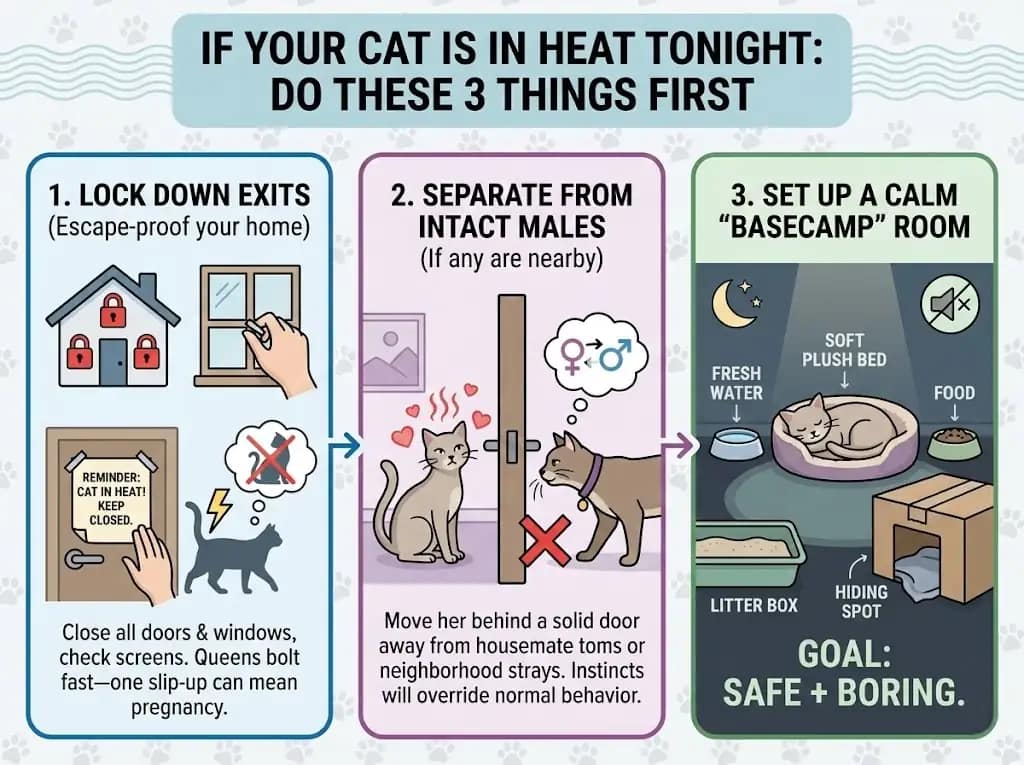
If your cat is in heat right now, treat the first hour like “damage control.” Your main goal is simple: prevent escape and calm the environment. Once that’s handled, you can focus on comfort for the next several days.
If your cat is in heat tonight: do these 3 things first
Lock down exits (escape-proof your home).
Close all doors and windows, check screens, and put a reminder note by entryways. Queens in heat can bolt fast—one slip-up can mean pregnancy.Separate her from intact males (if any are nearby).
If you live with an unneutered male cat—or if neighborhood toms hang around—move her to a room with a solid door. Even cats that normally get along will follow instincts.Set up a calm “basecamp” room.
Give her a quiet space with: fresh water, food, a clean litter box, soft bedding, and a hiding spot. Keep lights low and noise minimal—your goal is “safe + boring.”
Once you’ve done those three steps, use the tips below to make the rest of her heat cycle more manageable for both of you.
1. Keep the lockdown consistent (especially at doors).
You’ve already secured exits—now make it routine. Use a quick “door check” habit, and ask family members to pause before opening doors. If tomcats are outside, don’t leave windows open even with screens if they’re weak or loose.
2. Make her basecamp extra comforting.
Add a warm blanket or towel, and keep the room low-stimulation. Some cats relax with a covered bed or a box. The goal is “safe, quiet, predictable.”
3. Use short play bursts to burn off restless energy.
Even in heat, many cats will engage in short sessions. Try feather toys or a wand toy for 5–10 minutes, then let her rest. A little activity often reduces pacing later.
4. Offer affection—but let her control the dose.
If she seeks contact, give gentle strokes or brushing. If she gets overstimulated or walks away, don’t chase the interaction. Heat can make cats clingy one moment and sensitive the next.
5. Try calming aids (low-risk first).
A pheromone diffuser (like Feliway-style products) can take the edge off for some cats. If you’re considering supplements, choose cat-specific options and follow label directions. Skip essential oils—many aren’t cat-safe.
6. Keep the litter box spotless (and add a second box if needed).
Heat can increase urination or lead to spraying. Scoop more frequently, and if she’s confined to one room, an extra box can prevent accidents.
7. Clean marking with enzyme cleaner—fast.
If she sprays, clean it immediately with an enzyme-based cleaner so the scent doesn’t invite repeat marking. Avoid ammonia-based cleaners—they can smell like urine to cats.
8. Protect your sleep and your bond (no punishment).
Use white noise or move her basecamp away from bedrooms overnight if possible. Don’t scold heat behavior—she’s not misbehaving; she’s hormonally driven. Calm redirection works better than confrontation.
These strategies can make heat less intense, but they won’t stop the cycle from returning. For many cats, heat repeats every 2–3 weeks in breeding season—so if you’re not planning to breed, spaying is usually the kindest long-term fix.
Se você quiser saber mais sobre esses oito pontos principais, explore nosso guia completo de cuidados: Como ajudar um gato no cio: Dicas de conforto, segurança e calma
Todas essas dicas podem aliviar a intensidade de um ciclo de cio, e muitos pais de gatos as consideram genuinamente úteis. Mas aqui está a verdade honesta: eles não impedem o retorno do ciclo. Para a maioria dos gatos, o cio retorna a cada 2 ou 3 semanas durante a estação reprodutiva - e isso pode parecer implacável.
É por isso que, se você não planeja reproduzir seu gato, A esterilização é realmente a solução mais gentil a longo prazo. Isso não apenas evita a gravidez, mas também alivia a montanha-russa hormonal em que ela (e você) se encontra. Em breve, falaremos mais sobre quando e por que esterilizar.
Conclusão
Having an in-heat cat at home can be a lot — the yowling, pacing, and constant attention-seeking can wear anyone down. But it helps to remember this isn’t “bad behavior.” Your cat isn’t being difficult on purpose — she’s responding to powerful, natural hormones.
The good news is that once you understand the linha do tempo of a heat cycle, the clear signs of estrus, and the O que fazer e o que não fazer that actually help, the situation becomes far more manageable. You’ll know what’s normal, what needs extra caution (especially escape attempts), and how to keep both your home and your cat calmer through each phase.
If you’re not planning to breed, spaying is the most effective long-term solution. It prevents unwanted pregnancy and stops the cycle from repeating every few weeks during breeding season — which often means a calmer, more comfortable life for your cat (and more sleep for you).
No SnuggleSouls, we focus on real-life pet parenting solutions that make life better for animals and strengthen the bond you share. Thanks for reading — and if you’re in the middle of a heat episode right now, take a breath. You’re not alone, and with the right steps, you’ll get through it.
FAQ About How Long Are Cats In Heat
Quanto tempo dura um cio típico de gato?
Em média, a fase de cio de uma gata dura de 5 a 7 dias, mas pode variar de 2 a 14 dias, dependendo da gata e do fato de ela acasalar ou não durante esse período.
Com que frequência as gatas entram no cio?
Se não forem castradas e não estiverem prenhes, as gatas podem entrar no cio a cada 2 ou 3 semanas durante as estações de reprodução (geralmente de fevereiro a outubro). Gatas em ambientes internos com iluminação artificial podem entrar no cio o ano todo.
As gatas sangram quando estão no cio?
Não. Ao contrário dos cães, as gatas geralmente têm não sangrar durante o cio. Qualquer sangue visível deve ser tratado como anormal e examinado por um veterinário.
Posso esterilizar minha gata enquanto ela estiver no cio?
Sim, embora seja um pouco mais complexo devido ao aumento do fluxo sanguíneo para os órgãos reprodutivos. Muitos veterinários ainda realizam cirurgias de castração com segurança durante o cio - consulte seu veterinário para obter orientação sobre o momento certo.
Com que idade devo esterilizar meu gato?
A maioria dos veterinários recomenda a esterilização por volta dos 5-6 meses de idade, de preferência antes do primeiro ciclo de cio, para reduzir os riscos à saúde e evitar comportamentos indesejados.
Por que meu gato macho fica selvagem quando a fêmea está no cio?
Os gatos machos não têm ciclos de cio, mas reagem fortemente às fêmeas no cio. Eles podem borrifar, uivar, tentar fugir ou demonstrar agressividade.
Meu gato sente dor durante o cio?
Não exatamente - os gatos no cio são movidos por hormônios e podem parecer angustiados, mas geralmente não se trata de dor física. Confortá-los ajuda a reduzir o estresse.
As gatas que vivem dentro de casa ainda podem entrar no cio?
Sim. Os ciclos de cio são determinados por hormônios e pela luz, não pela exposição a outros gatos. As gatas que vivem em ambientes fechados continuarão a ter ciclos, a menos que sejam esterilizadas.
Referências
ASPCA. (n.d.). Spay/Neuter Your Pet - Cuidados com o gato. Sociedade Americana para a Prevenção da Crueldade contra os Animais. Obtido de https://www.aspca.org/pet-care/general-pet-care/spayneuter-your-pet
Llera, R. M., & Yuill, C. (2022). Ciclos estrais em gatas. Hospitais de animais VCA. Obtido de https://vcahospitals.com/know-your-pet/estrus-cycles-in-cats
Houpt, K. A. (2018). Comportamento de animais domésticos para veterinários e cientistas animais (6ª ed.). Wiley-Blackwell.
Root Kustritz, M. V. (2006). Reproductive behavior and physiology of the queen (Comportamento reprodutivo e fisiologia da rainha). Teriogenologia, 66(5), 701-706. https://www.sciencedirect.com/science/article/abs/pii/S0093691X06002378?via%3Dihub
Griffin, B. (2001). Estratégias proativas para reduzir a superpopulação felina: Programas de esterilização/neutralização de baixo custo. Journal of the American Veterinary Medical Association (Jornal da Associação Médica Veterinária Americana), 219(12), 1667-1671.










 EN
EN DE
DE ES
ES PT
PT