
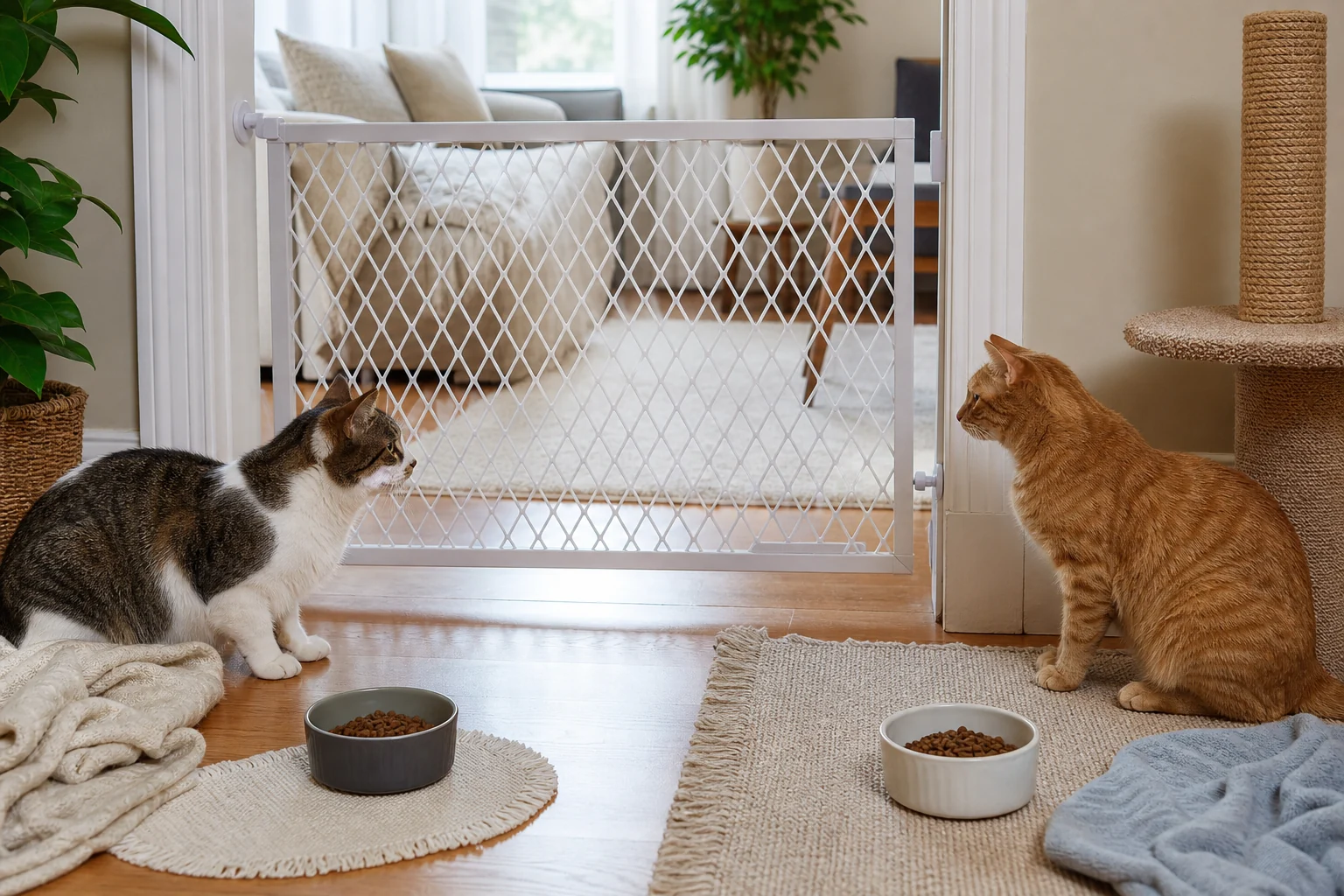
To introduce two cats without fighting, use separation, scent swapping, barrier meetings, and short supervised sessions before shared space.
Rushing the first meeting can create fear or territorial pressure, so the goal is not speed; it is letting each cat feel safe enough to choose calm behavior.
Some cats become friendly quickly. Others learn to share a home without becoming close companions. Both outcomes can be successful if the cats can eat, rest, use litter boxes, and move through the home without being chased, blocked, or threatened.
This guide explains a slow introduction plan, what to watch in each stage, and when to pause or get professional help. It is especially useful if you are bringing a new cat into a resident cat's territory, but the same principles also help after a failed first meeting.
Índice
- How long does it take to introduce two cats?
- What should you set up before the cats meet?
- How do you start with scent before sight?
- When are cats ready to see each other?
- How do you move from barrier meetings to supervised time?
- What body language means slow down?
- What if one cat hisses, growls, or attacks?
- What should you do when the cats can share space?
- Conclusión:
- Preguntas frecuentes
- Referencias
How long does it take to introduce two cats?
Most cat introductions take days to weeks, and some take longer. The right pace is the one where both cats can eat, sniff, look away, groom, play, or rest without panic or fixation.
UC Davis Veterinary Medicine emphasizes that cat introductions should be gradual and that first impressions can affect future relationships 1. International Cat Care also notes that some cats simply do not want close contact with other cats, so welfare matters more than forcing friendship 2.
A practical timeline looks like this:
| Escenario | What happens | Move forward when |
|---|---|---|
| Separate rooms | New cat settles in a safe room; resident cat keeps normal territory | Both cats eat, use the litter box, and behave normally |
| Scent swapping | Bedding, toys, and room scents are exchanged | Both cats sniff without prolonged hiding, swatting, or refusing food |
| Door feeding | Meals happen on opposite sides of a closed door | Both cats eat calmly and leave when finished |
| Barrier viewing | Cats see each other through a gate, cracked door, or mesh screen | They glance, sniff, and disengage without charging |
| Short supervised time | Barrier is removed for brief sessions | They can share space without chasing, cornering, or blocking resources |
If the new cat is also adjusting to the home, pair this plan with the broader Los primeros 30 días con tu nuevo gato routine so the introduction does not crowd out basic settling time.
What should you set up before the cats meet?
Set up a separate safe room before the new cat comes home. The new cat needs food, water, a litter box, bedding, hiding places, scratching options, toys, and a door that closes securely.
This safe room is not punishment. It lets the new cat decompress while protecting the resident cat's sense of territory. If the new cat hides at first, that can be normal; read more about Por qué se esconde tu gato before assuming the cat is being stubborn or unfriendly.
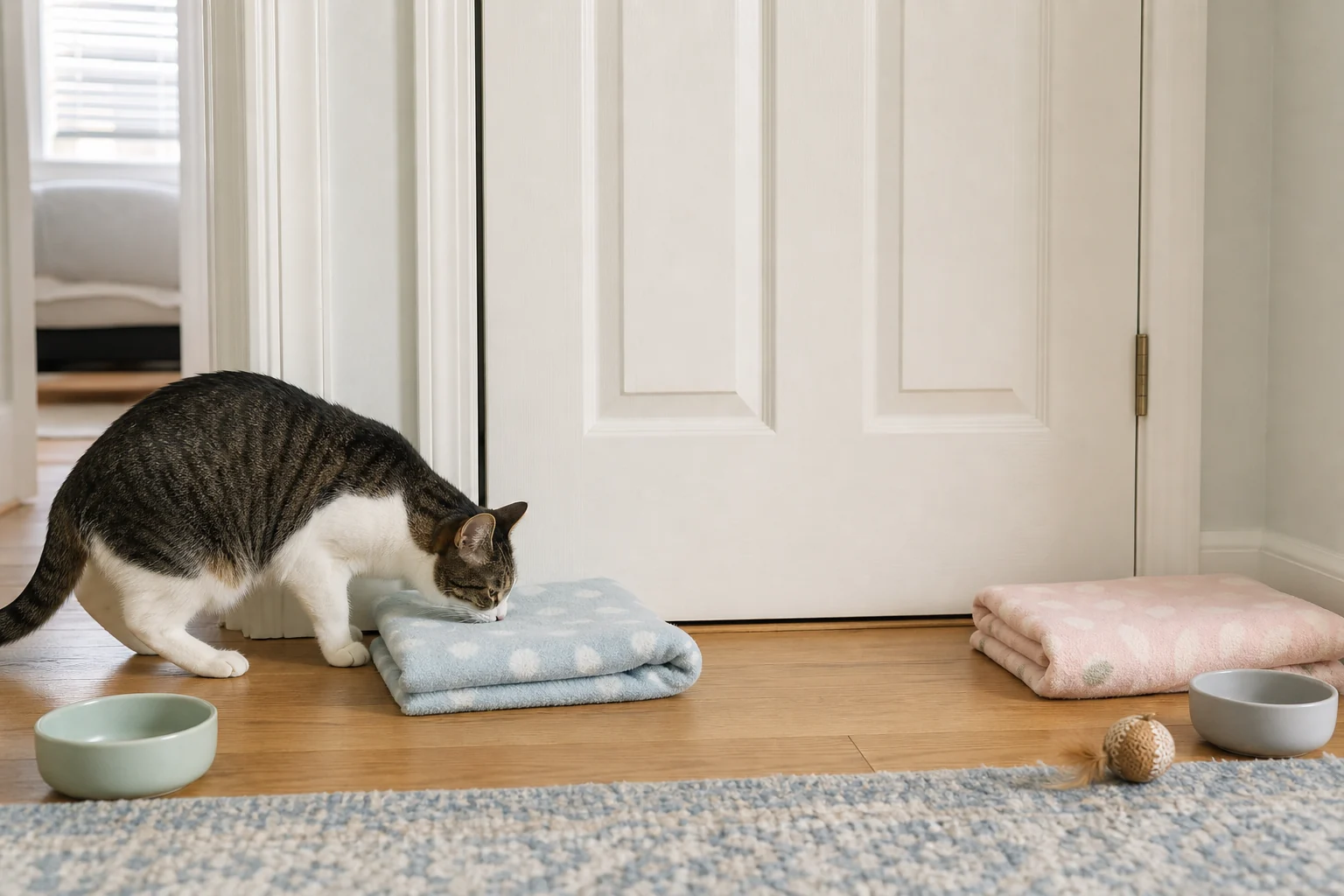
Scent swapping lets each cat learn the other's smell while a closed door keeps the situation low-pressure.
Before the cats share any space, prepare duplicate resources:
- At least one litter box per cat, plus one extra when possible.
- Separate feeding and water stations.
- Multiple resting spots, including elevated spaces.
- Scratching posts in more than one room.
- Hiding spots that do not trap a cat in a dead end.
- A baby gate, screen door, or mesh barrier for visual introductions.
- Treats, wand toys, or meals for positive associations.
The AAFP and ISFM environmental guidelines describe resource distribution, hiding, resting, scratching, play, and control over the environment as core feline needs 3. If you are still preparing the home, use the Lista de cosas que hay que comprar para un gato nuevo y una casa a prueba de gatos guide before the first meeting.
How do you start with scent before sight?
Start by letting each cat learn the other's scent without direct contact. Cats use scent heavily, and a new smell in familiar territory can feel less threatening when it arrives gradually.
Try this sequence:
- Keep the cats fully separated for the first settling period.
- Rub a clean cloth on one cat's cheeks or resting area, then place it near the other cat's room.
- Swap bedding or soft toys between rooms.
- Let each cat explore the other's empty room while the other cat is safely elsewhere.
- Feed high-value meals or treats near the closed door, far enough away that both cats still eat.
Do not push a scented item into a cat's face. Place it nearby and let the cat choose whether to investigate. If one cat avoids the item, growls, or stops eating, move it farther away and try again later.
The ASPCA cat-to-cat introduction guidance uses the same broad progression: separate room, scent exchange, visual contact at a distance, and short supervised interactions 4. That order matters because each stage gives the cats information without removing their escape options.
When are cats ready to see each other?
Cats are ready for visual contact when they can smell each other and eat near the closed door without intense stress. The first sighting should happen through a barrier, not by placing the cats together in the same room.
Use a baby gate, screen door, mesh gate, or cracked door that prevents rushing. Start with a few seconds or minutes, then end the session while both cats are still calm.
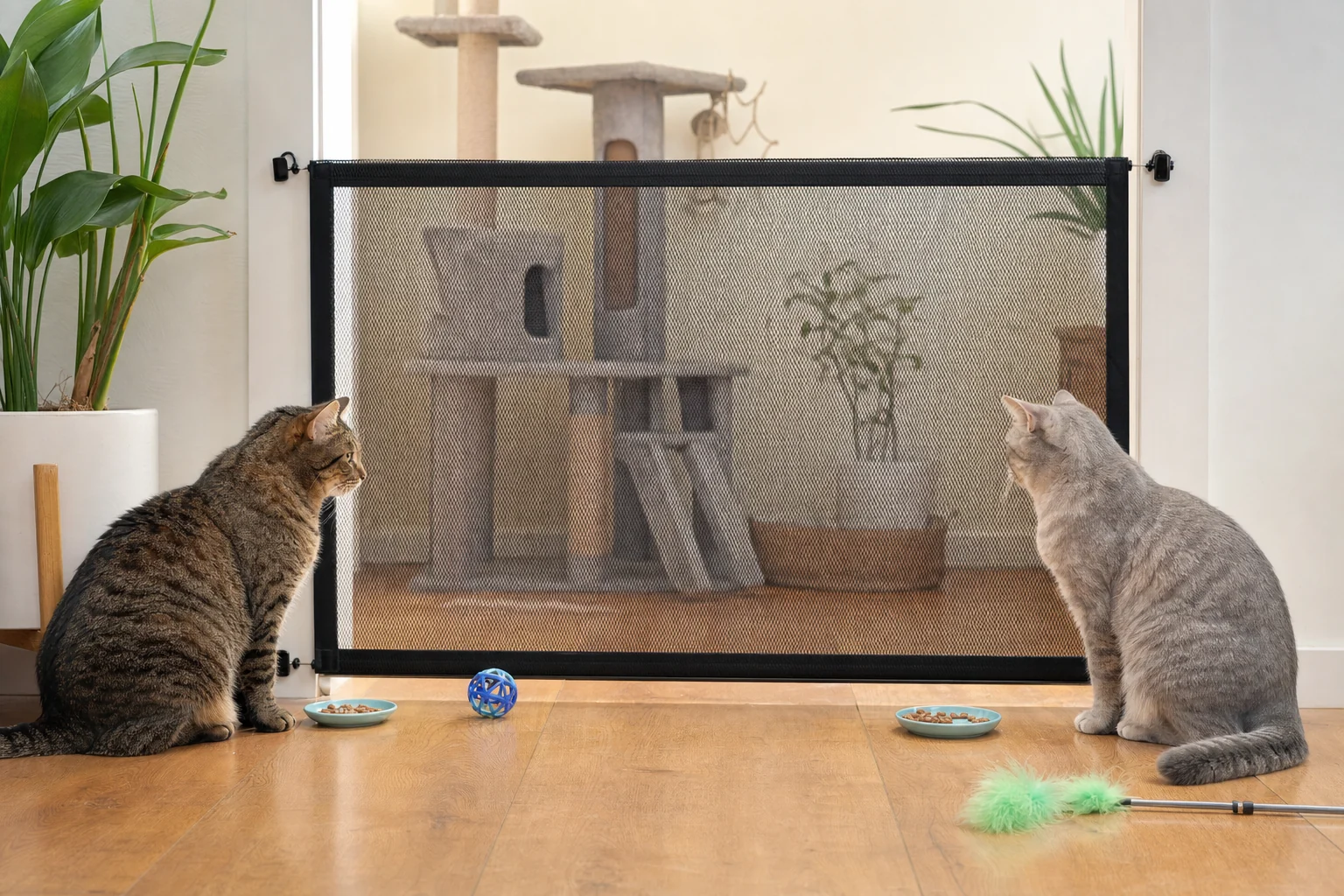
Short visual meetings through a barrier work best when both cats can choose distance and pair the other cat with good things.
During barrier meetings:
- Keep food or treats several feet from the barrier, not right at nose level.
- Reward looking, sniffing, and calmly looking away.
- Use a wand toy if play helps one cat relax.
- Keep sessions short.
- End before either cat escalates.
- Increase duration slowly over multiple calm sessions.
Avoid holding either cat, pushing them closer, or letting one cat stare at the other without interruption. Staring, stalking, and blocking are not "getting used to it." They are signs the distance or intensity may be too much.
How do you move from barrier meetings to supervised time?
Remove the barrier only after both cats have had repeated calm barrier sessions. The first open-room session should be brief, planned, and easy to end.
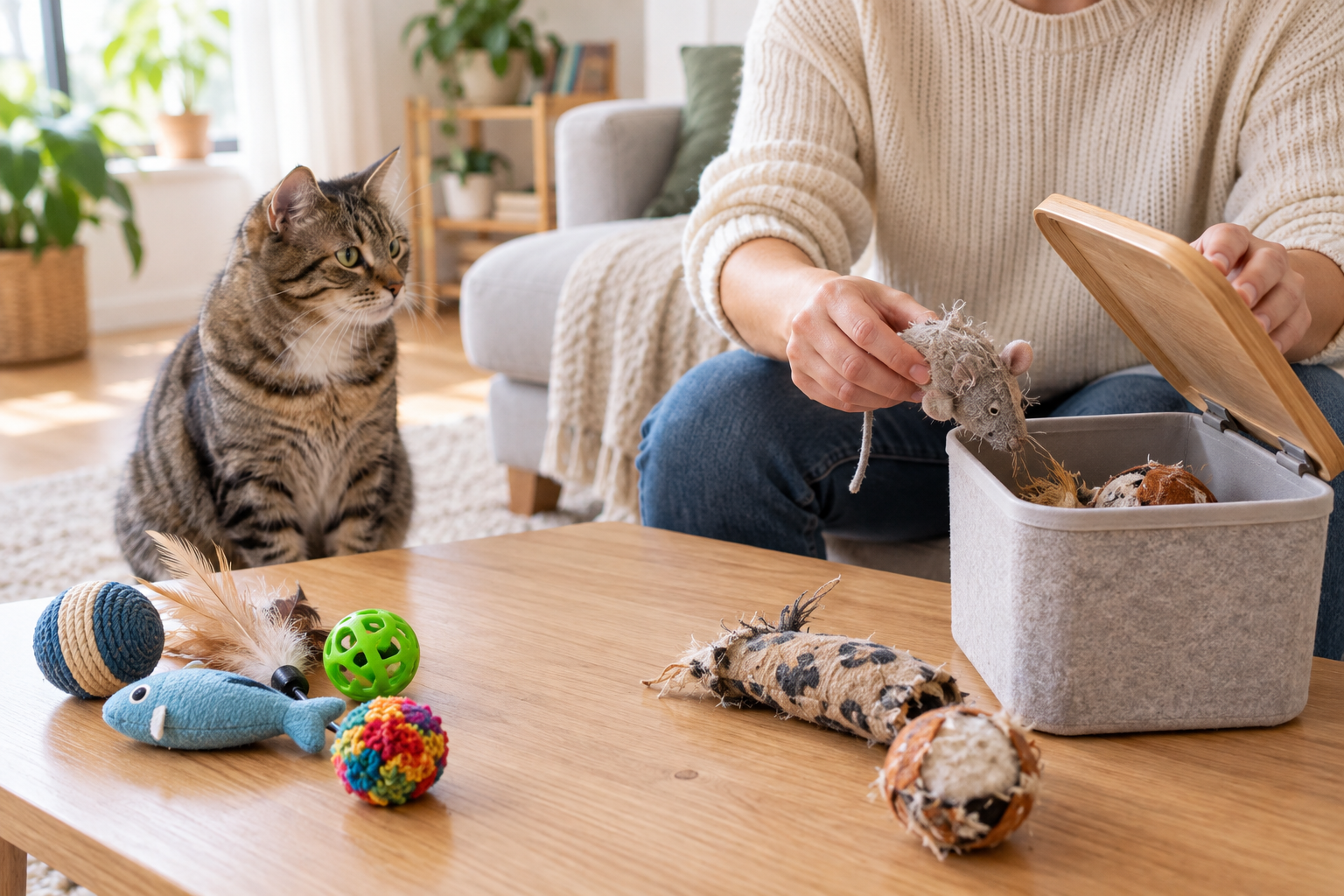
Choose a neutral-ish shared area if possible, with several exits and vertical options. Put away food bowls unless you are using controlled treats at a distance. Keep a towel, cardboard panel, or large cushion nearby so you can calmly block sight if tension rises; do not grab a fighting cat with bare hands.
A good first open session may last only one to five minutes. Let the cats notice each other, reward calm behavior, then separate them while the session is still going well. Several short wins are better than one long session that ends in a chase.
Move forward gradually:
| If you see this | What it means | Qué hacer |
|---|---|---|
| Brief sniff, then walking away | Healthy disengagement | Praise, reward, and end soon |
| One cat avoids but still eats later | Mild uncertainty | Give more space and repeat short sessions |
| Fixed staring, crouching, tail lashing, or blocking | Tension is building | Interrupt with distance, toy movement, or a visual block |
| Chasing, swatting, screaming, or wrestling that does not break | The session has failed | Separate safely and return to an earlier stage |
Keep unsupervised access off the table until the cats have had many calm supervised sessions in different rooms and at different times of day.
What body language means slow down?
Slow down when either cat shows repeated fear, defensive aggression, or resource guarding. A single hiss is information; a pattern of intense stress means the plan is moving too fast.
A tener en cuenta:
- Ears flattened sideways or back.
- Tail thrashing, puffing, or tucked tightly.
- Low crouching with tense muscles.
- Hard staring that the cat cannot break.
- Growling, yowling, or repeated hissing.
- Swatting at the barrier.
- Chasing, stalking, or blocking doorways.
- Refusing meals near the introduction area.
- Hiding for long periods after sessions.
- New litter box problems or stress behaviors.
Utiliza el lenguaje del rabo de gato guide as a quick body-language refresher. The safest interpretation is the whole body, not one signal in isolation.
Also watch the resident cat. People often focus on the newcomer, but the resident cat is the one whose territory changed overnight. If the resident cat is eating less, hiding, spraying, or guarding rooms, the plan needs more distance and more predictable resources.
What if one cat hisses, growls, or attacks?
If one cat hisses once and backs away, pause and create more space. If a cat charges, attacks, pins, chases, or will not disengage, end the session safely and return to separation.
Do not punish hissing or growling. Those sounds are warnings. Punishment can add fear to the other cat's presence and make future meetings worse.
If a fight starts:
- Stay calm and avoid putting your hands between the cats.
- Use a loud clap, a dropped soft object, or a visual block to interrupt.
- Separate the cats behind closed doors.
- Check both cats for injuries once they are calm.
- Call a veterinarian promptly for bites, limping, bleeding, eye injury, or a cat that seems painful, lethargic, or unwilling to eat.
- Restart several stages earlier after a cooling-off period.
Stress can also show up away from the meeting area. If either cat begins urine marking or avoiding the litter box, this cat stress peeing guide can help you describe the pattern, but new or painful urination signs should be discussed with a veterinarian.
Consider professional help if fights repeat, one cat is trapped or bullied, either cat is not eating, or the household feels unsafe. A veterinarian can check for pain or illness that may worsen irritability, and a qualified feline behavior professional can build a slower plan.
What should you do when the cats can share space?
Once the cats can share space calmly, keep the environment generous. Introductions do not end the day the barrier comes down; many conflicts begin later when cats compete over favorite routes, litter boxes, window perches, or people.
Keep these habits in place:
- Feed cats in separate areas, at least at first.
- Keep litter boxes in different locations, not lined up in one closet.
- Provide vertical routes and resting spots for both cats.
- Avoid closing both cats into a small room together.
- Play with each cat separately and together when appropriate.
- Watch for doorway blocking, resource guarding, or one cat always retreating.
- Give the cats predictable alone time if either one needs it.
If the cats become casual roommates rather than cuddly friends, that can still be a good result. A peaceful multi-cat home is measured by low stress, easy movement, normal eating and litter habits, and the ability for each cat to rest without being pressured.
For more behavior help, browse the SnuggleSouls Guías sobre el comportamiento de los gatos and focus on patterns: where tension happens, what resource is nearby, and which cat loses the choice to leave.
Conclusión:
The best way to introduce two cats without fighting is to make every stage boring, predictable, and easy to escape. Separate first, trade scents, feed on opposite sides of a door, use a barrier for visual contact, and keep open-room sessions short until calm behavior is routine.
Do not measure success by how quickly the cats touch noses. Measure it by whether both cats can eat, rest, use the litter box, play, and move through the home without fear. If the process stalls, step back instead of pushing through; a slower introduction is usually easier to repair than a frightening first fight.
Preguntas frecuentes
Should I let two cats fight it out?
No. Letting cats fight it out can make fear and territorial aggression worse. Separate them safely, return to an earlier introduction stage, and get veterinary or behavior help if fighting repeats.
Is hissing normal when introducing cats?
A brief hiss can be normal because it communicates discomfort or a need for space. Repeated hissing with charging, swatting, growling, hiding, or refusal to eat means the introduction is moving too fast.
Can I introduce two cats in one day?
Some easygoing cats may tolerate each other quickly, but a one-day introduction is risky for many households. A slower plan gives both cats time to form neutral or positive associations before they must share space.
What if my resident cat hates the new cat?
Go back to full separation, rebuild scent and door-feeding steps, and protect the resident cat's core resources. If the resident cat stays distressed, loses appetite, marks urine, or attacks, contact a veterinarian and consider a qualified feline behavior consultant.
Should kittens and adult cats be introduced the same way?
Use the same gradual structure, but supervise more carefully. Kittens may be socially bold and physically fragile, while adult cats may need more control over distance and escape routes.
When can I leave two newly introduced cats alone together?
Wait until they have had many calm supervised sessions with no chasing, cornering, blocking, or resource guarding. Start with short unsupervised periods only after the cats reliably disengage and use resources normally.
Referencias
[1] UC Davis School of Veterinary Medicine. (2019). Introducing Your New Cat to Your Other Household Cats. URL
[2] International Cat Care. (2024). Introducing Cats. URL
[3] American Association of Feline Practitioners and International Society of Feline Medicine. (2013). Directrices de la AAFP y la ISFM sobre las necesidades ambientales de los gatos. URL
[4] ASPCA Pet Health Insurance. (2022). Introducing a New Cat to Your Cat Family. URL



 EN
EN DE
DE ES
ES PT
PT