
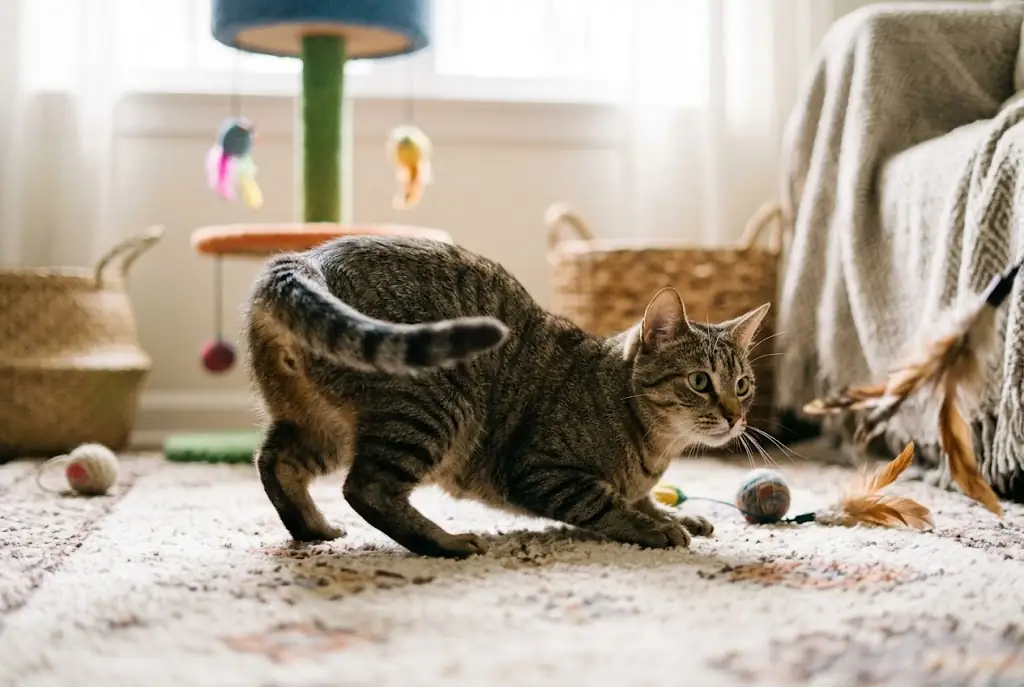
Cats usually wiggle before they pounce because they are entering the final setup of a hunting or play sequence. They focus on a target, lower the body, plant the front paws, compress the hind legs, shift the hips, and launch. The exact purpose of the wiggle has not been scientifically confirmed, but it likely belongs to positioning and readiness rather than random excitement.
In most cats, the wiggle is normal, playful predatory behavior. It becomes worth investigating when it is new, one-sided, happens without a target, or appears with pain, weakness, falling, skin rippling, frantic tail chasing, or sudden self-biting.
Índice
- Why do cats wiggle before they pounce?
- What happens during the pre-pounce wiggle?
- What might the wiggle help a cat do?
- Is the butt wiggle normal or concerning?
- Why does my cat wiggle before pouncing on me?
- How should I respond when my cat starts wiggling?
- ¿Cuándo debo llamar al veterinario?
- Preguntas frecuentes
- Referencias
Why do cats wiggle before they pounce?
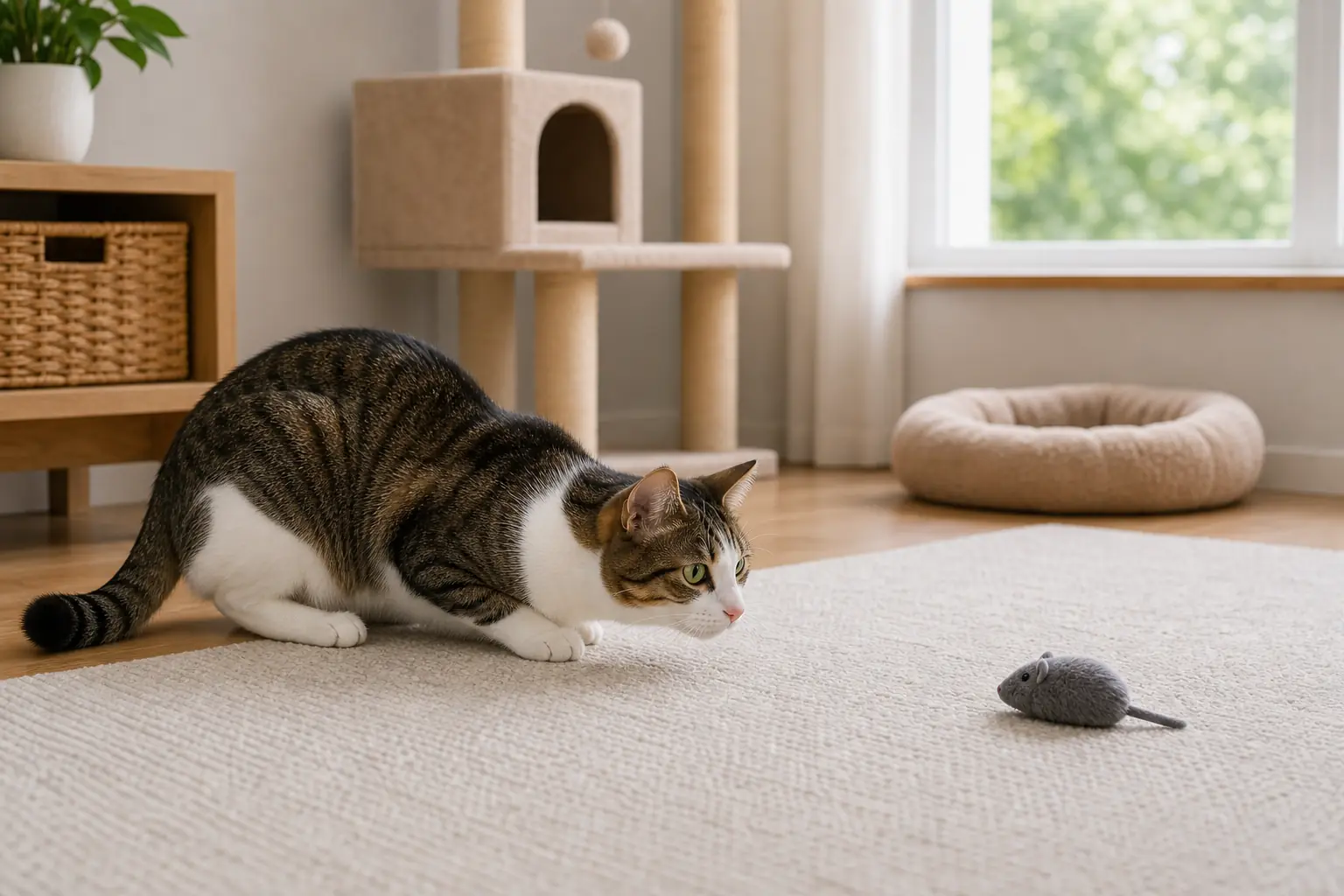
The wiggle is usually part of predatory play: the cat has selected a target and is preparing to spring. Merck describes stalking and pouncing as normal play behaviors that resemble predation 1. The wiggle appears in the brief transition between a low stalking crouch and the launch.
What owners call a “butt wiggle” can include:
- Small side-to-side hip shifts.
- Hind feet repositioning.
- Toes gripping or adjusting against the floor.
- A low crouch with peso moving backward.
- A steady or twitching tail.
- Intense visual focus on the target.
The behavior is especially common during play with toys, insects, moving shadows, another cat, or an owner’s feet under a blanket. It does not mean your cat is angry by itself.
What happens during the pre-pounce wiggle?
Before pouncing, a cat usually narrows attention onto a target, lowers the body, stabilizes the front half, folds the hind legs beneath the body, makes small position adjustments, and then pushes forward.
| Part of the sequence | What you may observe | Likely role |
|---|---|---|
| Target selection | Eyes and ears orient toward one moving object | Focuses attention |
| Stalking crouch | Body becomes low and movement slows | Reduces visibility and prepares approach |
| Front-paw planting | Front paws pause or make small adjustments | Stabilizes the front of the body |
| Hind-leg compression | Back legs fold under the cat | Prepares the main forward push |
| Hip or foot shifting | Small wiggles and repositioning | May help settle stance and readiness |
| Launch | Hind legs extend and the cat springs | Moves the cat toward the target |
| Catch and grab | Front paws contact; cat may bite or kick a toy | Completes the play-predation sequence |
The important distinction is between what can be observed and what has been proven. We can observe the crouch, weight shift, foot adjustments, and launch. It is reasonable to think the wiggle helps prepare the movement, but claims that it precisely measures distance, improves traction, or “calibrates” the jump remain explanations rather than established facts.
What might the wiggle help a cat do?
The wiggle may help a cat settle its feet, distribute weight, check balance, and prepare the hind legs before launch. It may also reflect excitement or motor preparation as the cat waits for the best moment to spring.
Possible functions include:
- Finding a stable stance. Small foot adjustments may improve comfort and balance on carpet, bedding, grass, or hard floors.
- Loading the hind legs. The cat shifts weight backward before extending the rear legs during the jump.
- Checking timing. A cat may pause and adjust while waiting for a toy or prey target to move into a better position.
- Expressing focused arousal. The movement can appear as excitement builds immediately before action.
These possibilities fit the visible sequence, but the exact reason for the wiggle has not been settled by direct research. Avoid treating a charming behavior explanation as proven biomechanics.
Is the butt wiggle normal or concerning?
A brief, target-focused wiggle before a smooth pounce is usually normal. Concern rises when the movement happens outside play, becomes repetitive or one-sided, or appears with pain, coordination problems, skin sensitivity, or behavior change.
| Lo que ves | Normalmente, es normal | Lo que resulta más preocupante |
|---|---|---|
| Context | Happens while stalking a toy, insect, or moving target | Happens repeatedly with no visible target or play context |
| Duración | A few seconds before a pounce | Long episodes, repeated spasms, or inability to settle |
| Movimiento | Balanced crouch followed by a controlled jump | Falling, stumbling, dragging a leg, or missing ordinary jumps |
| Lenguaje corporal | Focused eyes, forward interest, loose recovery after play | Distress, ocultar, flattened ears, pain response, or confusion |
| Skin and tail | Brief tail movement linked to play | Strong skin rippling, frantic tail chasing, sudden biting at back or tail |
| Afterward | Returns to normal play or rest | Limping, weakness, licking one area, appetite change, or lethargy |
An active hunting crouch is different from a relaxed resting posture. If you are comparing a compact resting cat with a low active crouch, see SnuggleSouls’ guide to a relaxed loaf versus active crouch.
Tail movement also changes meaning with context. A focused twitch during stalking is different from a rapidly lashing tail during overstimulation. The lenguaje del rabo de gato guide can help you read the whole body.
Why does my cat wiggle before pouncing on me?
Your cat may be treating your moving hands, ankles, hair, or feet under a blanket like a play target. This is common in kittens and young cats, but allowing the pattern can teach the cat that human skin is an appropriate object to stalk, grab, bite, and kick.
Do not punish or frighten the cat. Instead:
- Freeze rather than jerking your hand or foot away quickly.
- Calmly end access to the target.
- Redirect to a wand toy, rolling toy, or kicker toy.
- Keep play sessions predictable.
- Reward the cat for chasing toys rather than people.
- Avoid using hands as wrestling toys.
If the pounce includes hard biting, fear, growling, or reactions to touch, read the guide on play biting and overstimulation.
How should I respond when my cat starts wiggling?
If the target is a safe toy and the landing area is clear, let the cat complete the pounce. If the target is a person, another pet that wants space, a dangerous object, or an unsafe landing area, redirect before the launch.
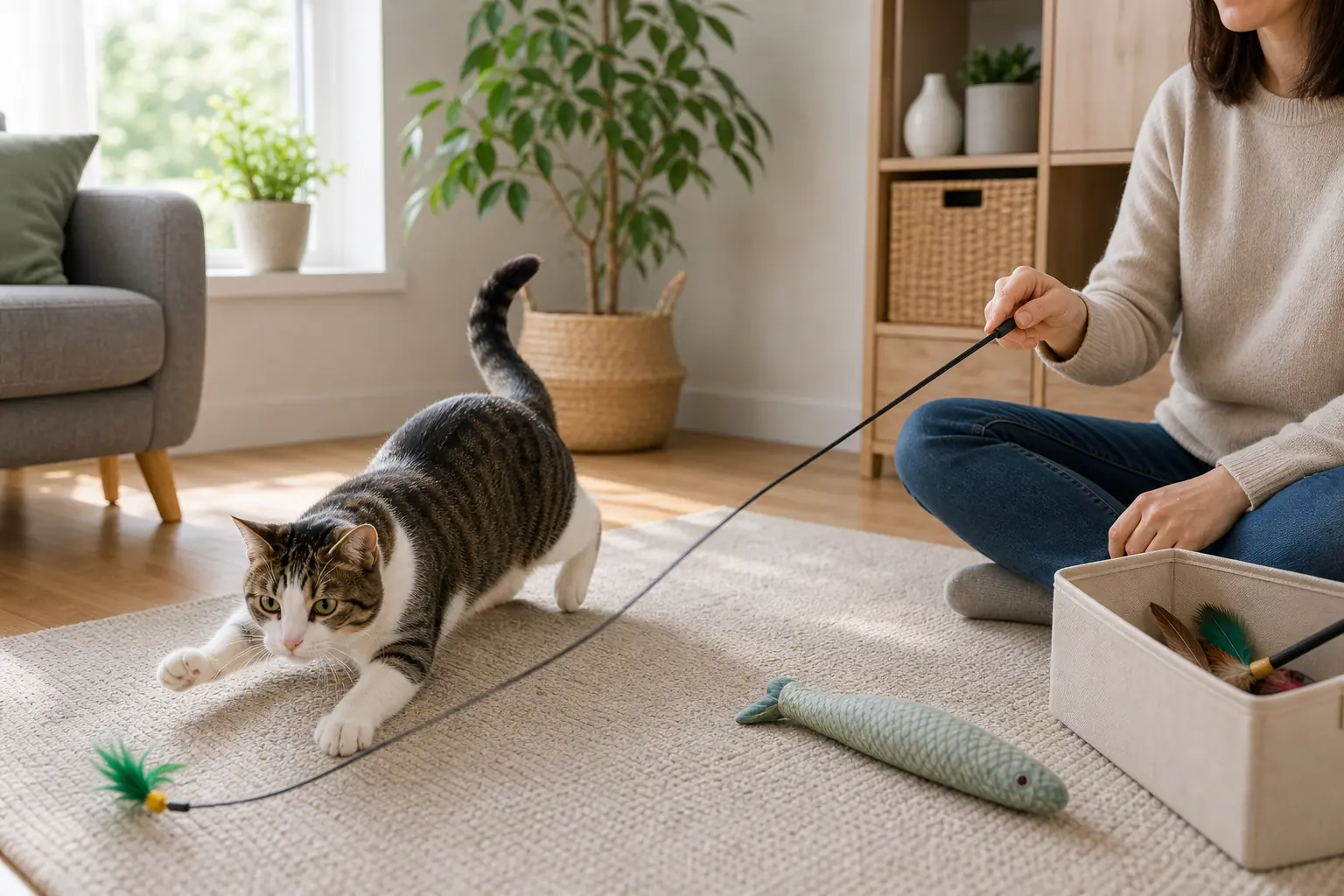
A safer play sequence:
- Clear slippery objects, cords, breakables, and unstable furniture from the play area.
- Move a wand-toy lure like prey, with pauses and direction changes.
- Keep the lure away from hands, feet, faces, and other pets.
- Give the cat space to crouch, wiggle, chase, and pounce.
- Let the cat catch the toy regularly.
- Finish with a calmer catch, then put string and wand toys away.
The AAFP/ISFM environmental needs guidelines recommend opportunities for predatory play and feeding behavior, along with positive and predictable human-cat interaction 2. Supervised interactive play can give the wiggle a safe target and reduce ambushes directed at people.
Never leave string, ribbon, feather wands, or easily swallowed toy parts out unattended.
¿Cuándo debo llamar al veterinario?
Call your veterinarian if the wiggle is new, frequent outside play, one-sided, or paired with pain, weakness, coordination changes, skin sensitivity, self-injury, or a meaningful behavior change.
Book a veterinary visit for:
- Limping, stiffness, or reluctance to jump.
- Falling, stumbling, weakness, or dragging a limb.
- Crying, flinching, biting, or hiding when the back or hips are touched.
- Repeated skin rippling along the back.
- Frantic tail chasing or biting at the back, flank, or tail.
- Episodes that seem uncontrollable or unrelated to a target.
- Appetite loss, lethargy, poor grooming, or litter box changes.
- A sudden change in an older cat.
Some unusual back sensitivity, skin rippling, tail chasing, and sudden self-biting can overlap with feline hyperesthesia signs, but many other medical and behavioral issues can look similar. Record a video if safe and let your veterinarian evaluate the pattern.
Seek urgent care for collapse, seizures, inability to walk, severe trauma, breathing trouble, sudden paralysis, extreme weakness, or rapid decline. VCA notes that meaningful changes in normal behavior can be an early clue that a cat is unwell 3.
Preguntas frecuentes
Do all cats wiggle before pouncing?
No. Some cats make an obvious hip wiggle, while others crouch and launch with little visible movement. Both can be normal.
Is the cat butt wiggle scientifically proven to improve a pounce?
No specific function has been conclusively proven. The wiggle occurs during a visible launch-preparation sequence and may help with stance, balance, weight shift, timing, or readiness, but these remain reasonable explanations rather than confirmed facts.
Why does my cat wiggle before jumping onto furniture?
Small body and foot adjustments before a jump may help the cat settle its stance and prepare the hind legs. Call your vet if the behavior is new and paired with hesitation, failed jumps, limping, stiffness, or pain.
Why does my cat wiggle before attacking my feet?
Moving feet can trigger play-predation behavior. Freeze, end access, and redirect to a long wand toy or kicker toy. Do not encourage attacks on hands or feet.
Does a tail twitch before pouncing mean aggression?
Not necessarily. A small tail twitch can reflect focus or excitement during stalking. Read the entire context, including ears, eyes, body tension, target, and what happens afterward.
Should I stop my cat from pouncing?
Do not stop safe play-pouncing. Redirect it away from people, unwilling pets, dangerous objects, and unsafe landing areas. Give the cat appropriate toys and supervised opportunities to complete the play sequence.
Why does my cat wiggle but not pounce?
The cat may decide the timing or target is wrong, become distracted, or simply enjoy stalking. It is usually normal if the cat moves comfortably and behaves normally afterward.
Can wiggling be a sign of pain?
Ordinary pre-pounce wiggling is usually not painful. Call your vet when movement is new, one-sided, unrelated to play, or paired with limping, weakness, falling, touch sensitivity, skin rippling, self-biting, or behavior change.
Referencias
[1] Merck Veterinary Manual. El comportamiento social de los gatos.
[2] Ellis, S. L. H., et al. Directrices de la AAFP y la ISFM sobre las necesidades ambientales de los gatos.
[3] Hospitales veterinarios VCA. Cómo reconocer los síntomas de enfermedad en los gatos.

 EN
EN DE
DE ES
ES PT
PT