
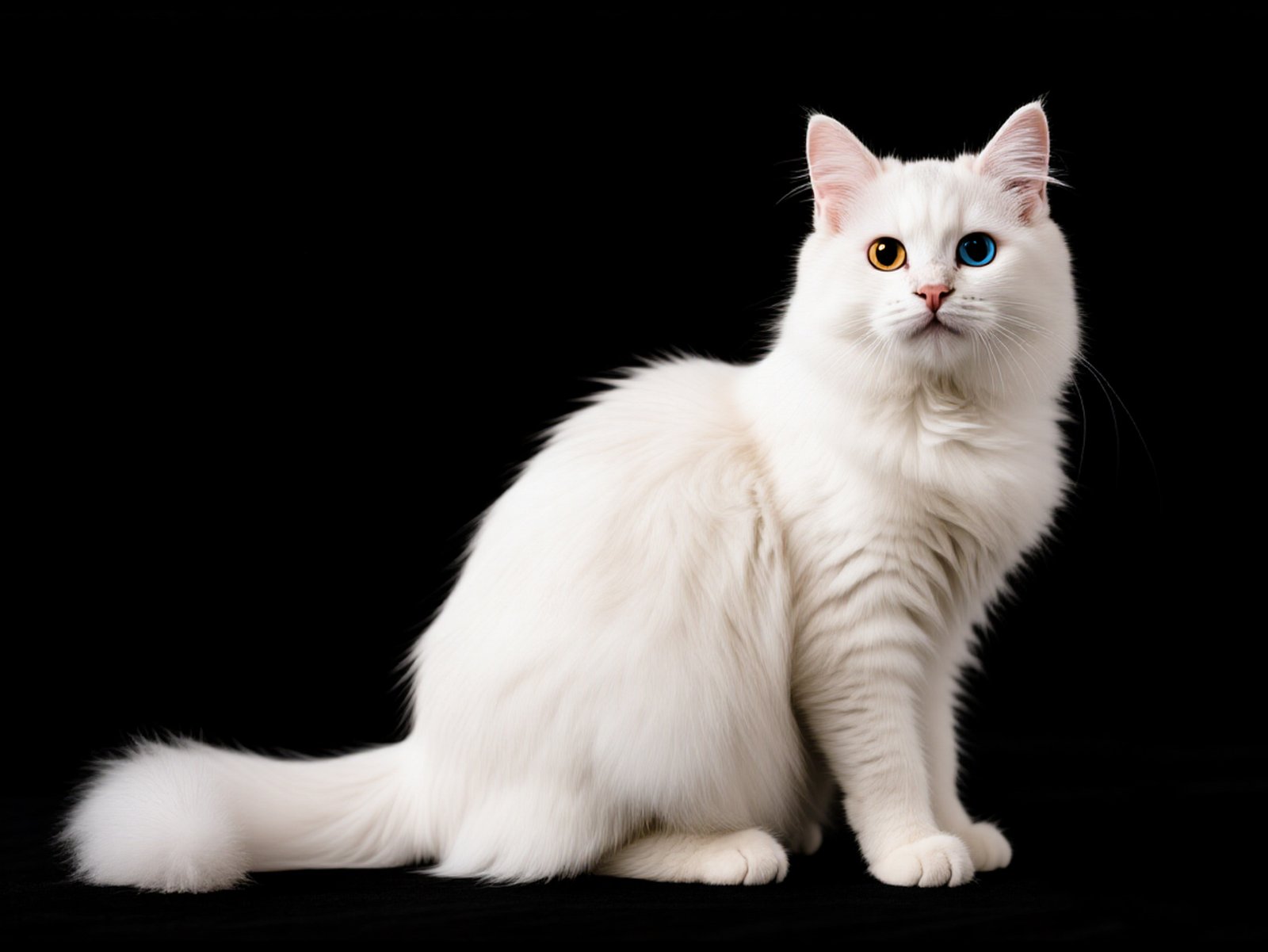
Resposta rápida: O Angorá turco is a medium-sized, athletic, people-oriented longhair known for alta inteligência, strong bondinge um silky single coat that’s usually easier to maintain than many long-haired breeds. They do best with owners who enjoy daily interaction, play, and enrichment—this is not a “leave-me-alone” cat.
Índice
Visão geral da raça
| Característica | Descrição |
| Personalidade | Sociable, clever, outgoing, affectionate, attentive, demanding of attention, forms strong bonds, enjoys entertaining, can be mischievous if ignored, displays dog-like loyalty |
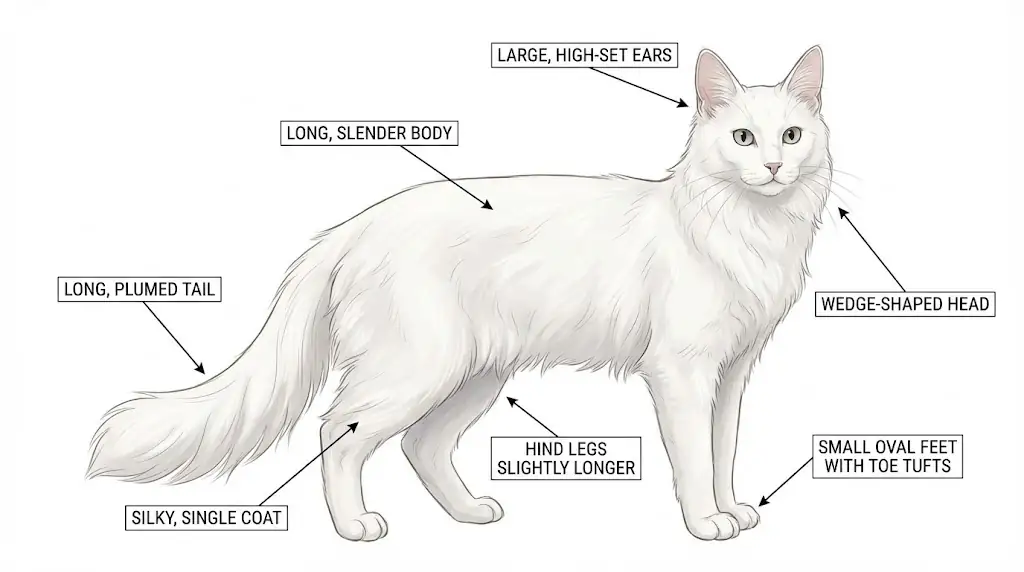
| Tipo de carroceria | Medium-sized, slender, finely-boned frame with a muscular build; long, lengthy body with hind legs slightly longer than front; small, oval feet often with toe tufts; wedge-shaped head (small to medium); large, high-set ears with slight points; long, tapering, richly plumed tail |
| Peso | Males: 7 to 10 pounds (3.2-4.5 kg); Females: 5 to 8 pounds (2.3-3.6 kg). Ranges up to 11 pounds (5 kg) are noted |
| Região de origem | Ankara, Turkey (formerly Angora); a naturally occurring breed with ancient roots |
| Tempo de vida | Generally 12 to 18 years, with some living up to 20 years |
| Tipo de casaco | Semi-long, long, silky, fine, single-layered (lacks a dense undercoat); gossamer-like texture that shimmers with movement; coat length varies seasonally, becoming thicker in winter and lighter in summer |
| Cores da pelagem | Traditionally white, but recognized in a wide array of colors and patterns including black, blue, cream, red, tortoiseshell, felpudo, shaded, smoke, calico, and bi-color. Eye color is independent of coat color. Exclusions for registration typically include chocolate, lilac, fawn, and pointed patterns |
| Nível de derramamento | ⭐⭐⭐☆☆ (Moderado) |
| Afeto para com os seres humanos | ⭐⭐⭐⭐⭐ (Muito alto) |
| Dificuldade de atendimento | ⭐⭐☆☆☆ (Low to Moderate) |
Introdução
The Turkish Angora cat is a medium-sized, athletic longhair known for its silky coat, sharp intelligence, and highly social “people-cat” personality.
If you want a companion that follows you, plays daily, and learns routines, this breed often fits—but they can be attention-seeking if under-stimulated.
In this guide you’ll get quick facts on temperament, shedding and grooming, size and lifespan, health risks to watch for, and the best home setup for an Angora.
História da raça
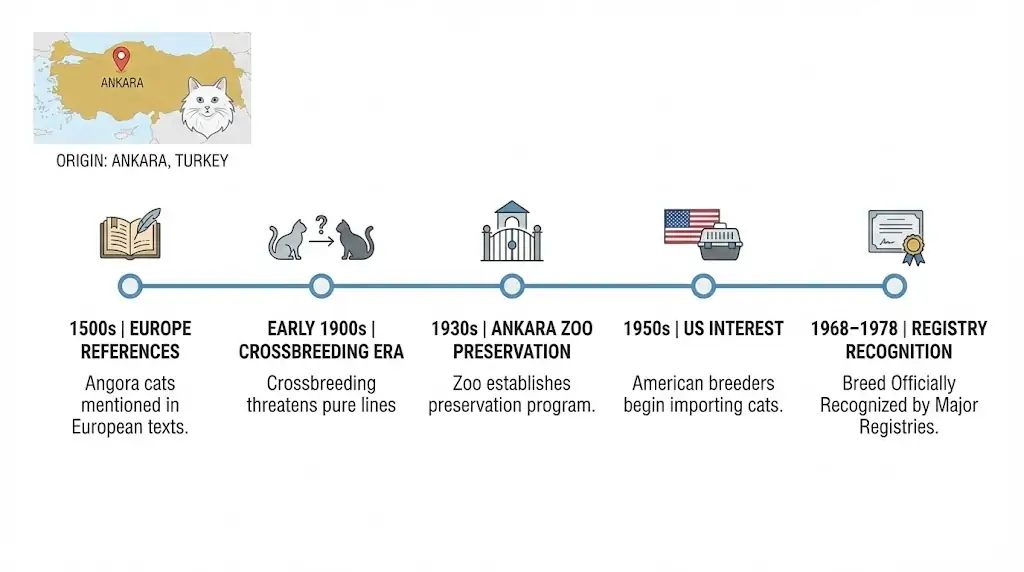
Turkish Angora origin: The Turkish Angora is a naturally occurring longhaired cat from Ankara, Turkey (historically called “Angora”). The earliest widely cited written references appear in 16th-century France, and the breed later became popular with European cat fanciers.
Key takeaway for modern owners: In the early 1900s, Turkish Angoras were widely used in Persian breeding programs, which contributed to the Turkish Angora nearly disappearing as a distinct breed in the West. Turkey then treated the cats as a cultural treasure and supported preservation breeding at the Ankara Zoo, which became a major foundation source for modern Turkish Angoras exported abroad.
Turkish Angora history timeline (high-confidence milestones)
- 1500s (16th century): Written references to Angora cats appear in France; the breed becomes known in Europe.
- Late 1800s–early 1900s: Angoras are well represented in the early European “cat fancy,” then heavily used in Persian breeding programs and fade as a separate breed identity.
- Mid-1900s (preservation era): Turkey establishes and maintains a preservation-focused breeding program at the Ankara Zoo, historically emphasizing white cats (including blue-eyed, gold-eyed, and odd-eyed).
- 1950s: American servicemen visiting Turkey help spark renewed interest in Turkish Angoras in North America.
- 1962: Ankara Zoo allows Colonel and Mrs. Walter Grant to export two foundational cats—Yildiz (odd-eyed white male) and Yildizcek/Yildizcik (amber-eyed white female)—which anchor a major U.S. breeding program.
- 1968–1978 (registry recognition): CFA begins registering white Turkish Angoras (1968), grants championship status (1972), and later recognizes colored Turkish Angoras (1978).
What this history means today
Because many modern lines outside Turkey trace back to preserved zoo-bred and imported cats, reputable breeders often emphasize documented pedigrees, careful outcross avoidance, and health screening—especially when breeding for historically prized traits like coat texture and eye color.
Características físicas
Turkish Angora appearance (breed-standard summary): The Turkish Angora is a balanced, medium-sized gato com um fine, silky coat that “flows” in motion—often escondido a firm, long, muscular body underneath.
Quick identifiers (what you’ll notice first)
- Compilação: long, slender, fine-boned—refinement matters more than size in show standards
- Legs & paws: long legs with hind legs longer than front; small paws with toe tufts
- Cabeça e orelhas: small-to-medium smooth wedge head; large, high-set, erect ears (often described as giving a “bunny rabbit” look)
- Final: long and tapering with a full “brush”/plume
How big do Turkish Angoras get?
Most are tamanho médio, commonly cited around 5–10 lb (2.3–4.5 kg), with males often heavier on average.
Because the body is long and slim, many Angoras look larger than the scale suggests.
Cabeça, orelhas e olhos
A cabeça é um smooth, medium-long wedge with an open expression and large ears set high and upright.
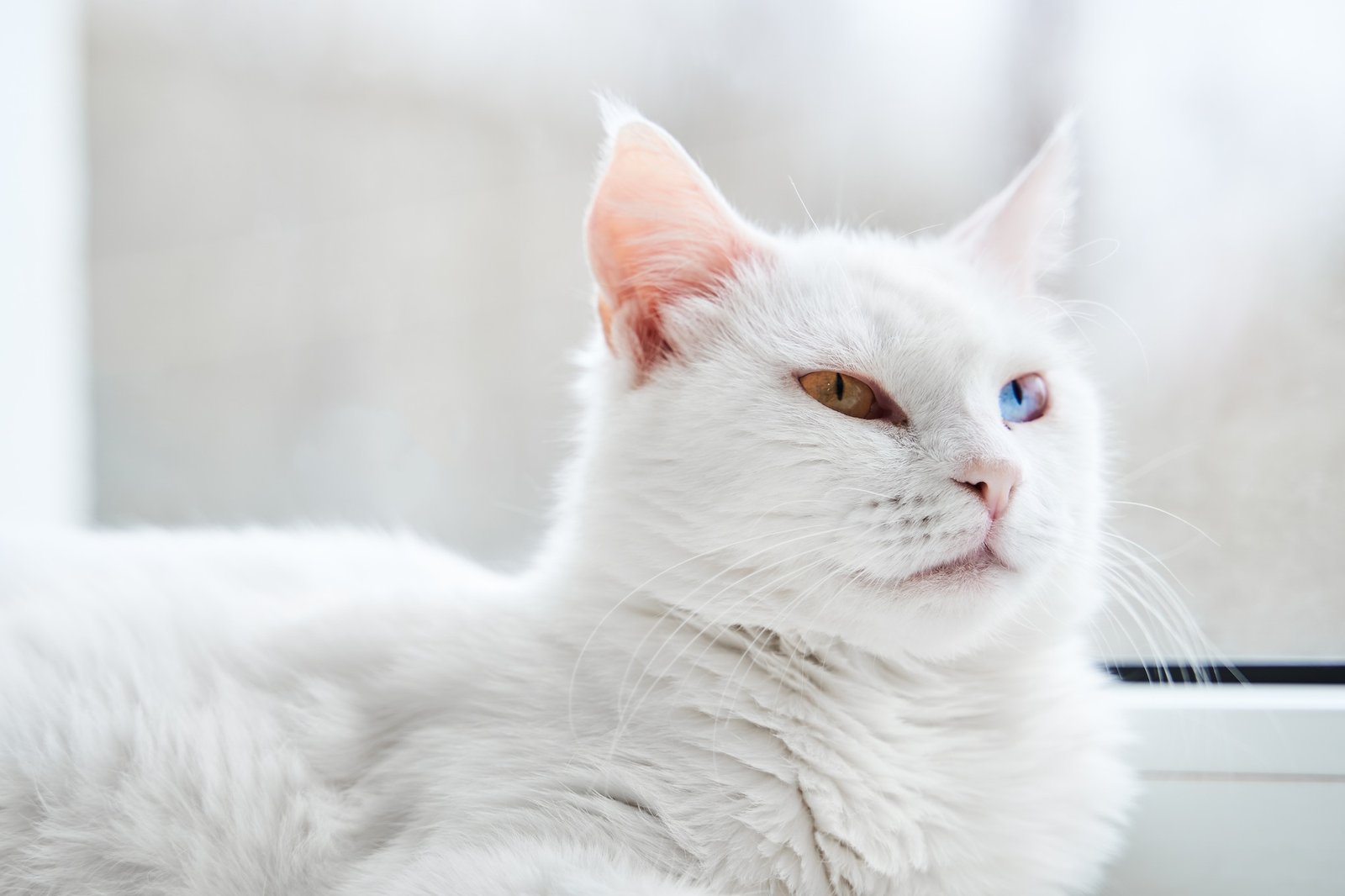
Eye color can include blue, green, ambere odd-eyed (one blue and one non-blue); importantly, breed standards note there is no required relationship between coat color and eye color.
Coat texture and seasonal coat changes
The Turkish Angora coat is typically described as single-coated (or very minimal undercoat), which is why it rarely mats compared with many other long-haired breeds.
Coat length varies by season: in winter, adults often show a fuller ruff and noticeable “calças” on the hind legs; in summer, the coat is usually shorter and lighter while the tail remains plumed.
Colors and patterns (what’s accepted can depend on registry)
Modern Turkish Angoras appear in many colors and patterns, not just white.
No entanto, registry rules differ. For example, CFA notes Turkish Angoras are found in virtually every color exceto chocolate, lilac, and pointed patterns (not eligible for registration).
Some other registry standards also exclude additional colors such as cinnamon and fawn (and still exclude pointed patterns).
Comportamento e personalidade
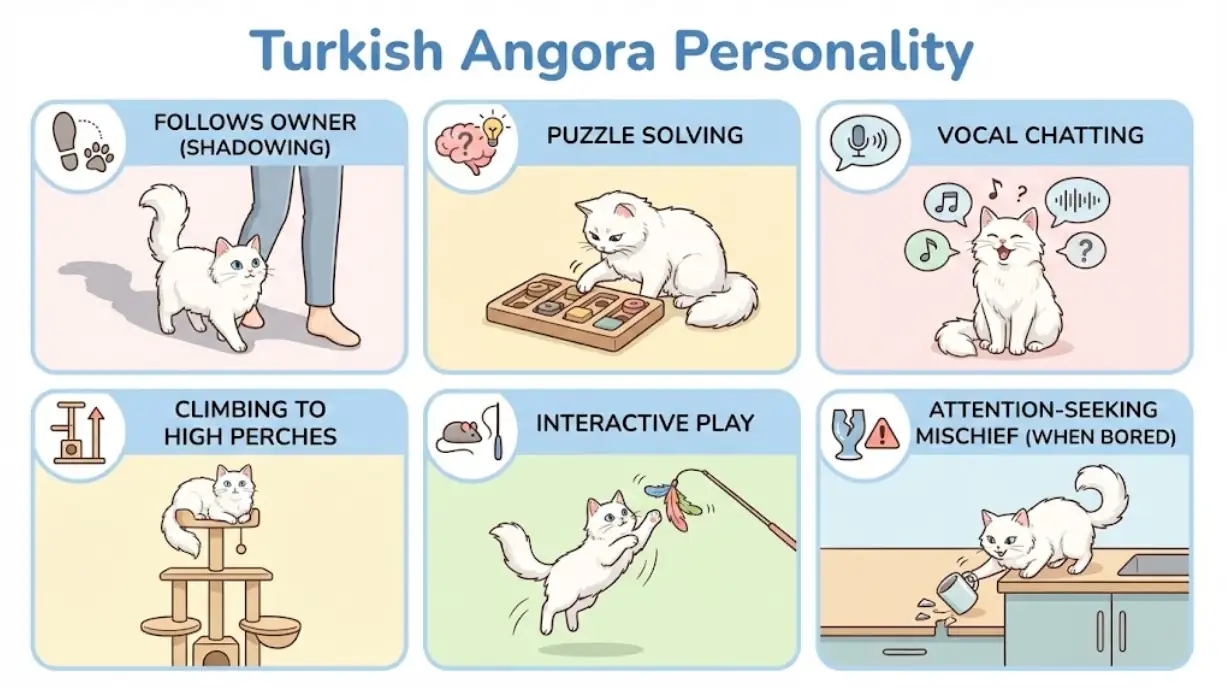
Turkish Angora personality (temperament): Turkish Angoras are among the most interactive and people-focused cat breeds. Expect a cat that follows you, seeks involvement in daily routines, and uses intelligence to get what it wants—attention, play, and access to “interesting places.” They’re affectionate, but many prefer near-you interaction (play, conversation, supervising) over being held for long periods.
What owners notice most:
- “Dog-like” loyalty (shadowing you room to room)
- Curiosity + problem-solving (doors, cabinets, high shelves)
- Vocal communication (chirps/trills, conversational meows)
- Mischief when bored or ignored (attention-seeking behaviors)
Suas inteligência é um hallmark trait, with many owners noting their remarkable ability to learn tricks and commandse até mesmo solve puzzles.
Isso mental acuity means they can be quite curious and clever, often figuring out how to open cabinets or doorsou scaling to the highest vantage points in a room, such as the top of a refrigerator or a door.
Turkish Angoras form deep and devoted bonds with their chosen humans, often becoming a “faithful shadow” que follows them from room to room, eager to be involved in every activity.
Embora sejam afetuoso e crave human contact, they are not always typical "gatos de colo" and may resist being picked up and carried for extended periods.
Instead, they prefer to interact through play, conversation, and simply being in close proximity. They are known for being quite vocal, expressing themselves through a variety of chilreios, trinadose animated conversations.
Apesar de suas gentle and tolerant nature, Turkish Angoras possess a strong will and can be quite assertive, often establishing themselves as the “alpha” in multi-pet households.
Eles geralmente get along well with other pets, including dogs, provided that these companions understand the Angora’s dominant personality.
Guia de cuidados
Turkish Angora care (key takeaway): Turkish Angoras do best when you consistently meet three needs: (1) complete, life-stage nutrition, (2) daily interactive playe (3) an enriched indoor setup with vertical space and predictable routines. Their coat is typically easier to maintain than many long-haired breeds, but mental stimulation is essential for good behavior and wellbeing.
Simple routine
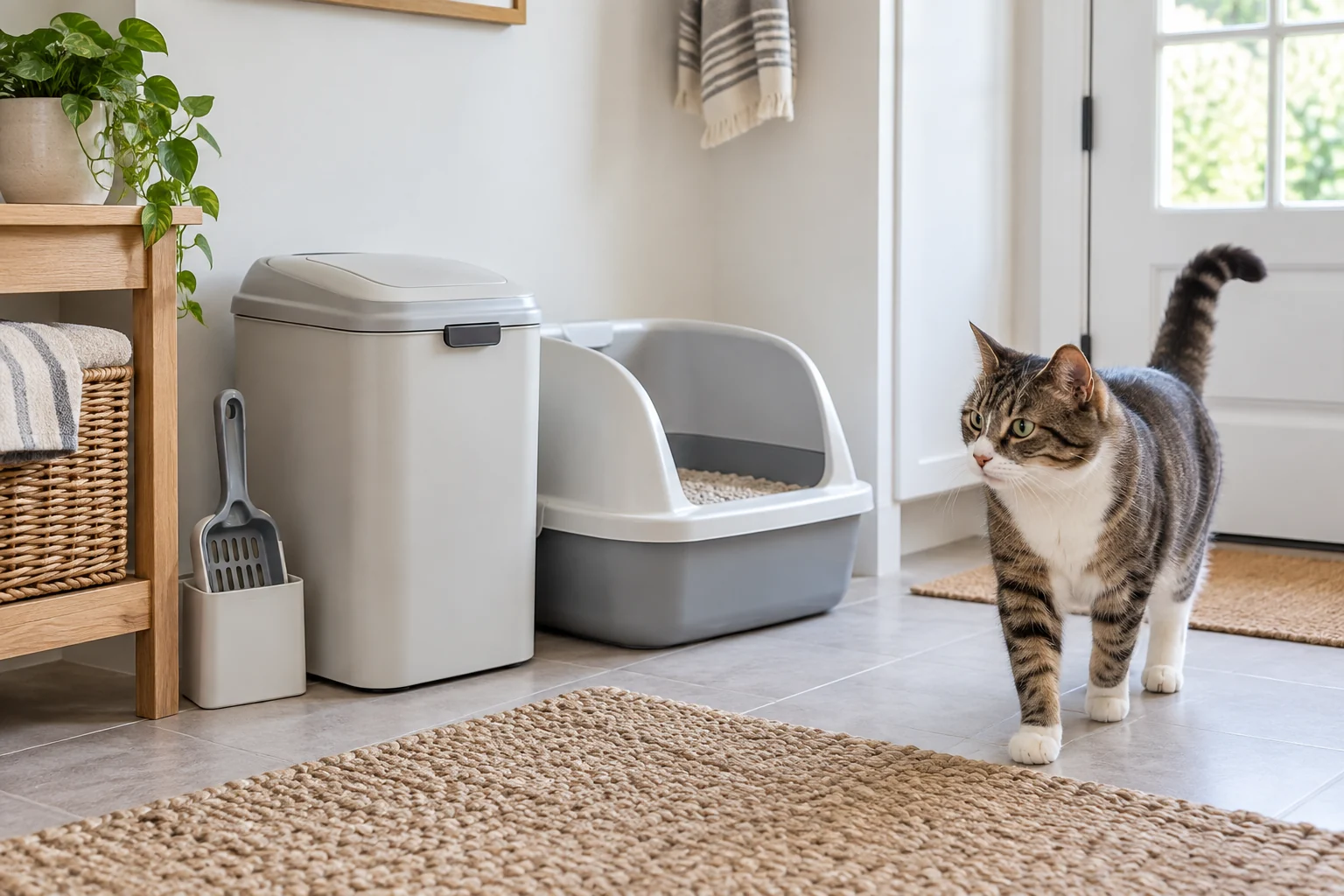
- Daily (10–20 minutes total): 2 short play sessions + quick “environment check” (fresh water, tidy litter, rotate one toy).
- Semanal: coat combing + nail check + refresh enrichment (new box, new perch spot, swap puzzle toy).
- Mensalmente: weigh-in at home (or body-condition check) and adjust portions with your veterinarian if needed.
Scope note: This guide is educational and not a substitute for veterinary advice—ask your vet for caloria targets, weight plans, and diet selection if your cat is growing, pregnant, senior, overweight, or has medical conditions.
Dieta
What to feed a Turkish Angora (key takeaway): Escolha um completo e equilibrado gato alimentos matched to life stage (kitten, adult, senior) and feed consistent portions to prevent gradual weight gain. Global veterinary nutrition guidance emphasizes selecting diets that are appropriate, safe, and nutritionally adequate for the individual cat.
Life-stage basics
- Kittens (first year): feed a kitten-growth formula to support development.
- Adults: a quality adult maintenance diet is usually appropriate; adjust portions based on body condition and activity.
Label checklist (fast, practical)
- Look for a statement indicating the diet is complete and balanced for the intended life stage (growth/maintenance/senior, depending on your region’s standards).
- Prefer brands that provide clear nutrition information and quality-control transparency (the WSAVA toolkit is designed to help owners evaluate foods beyond marketing claims).
Hydration-friendly feeding (especially useful for active cats)
- Oferta fresh water in multiple locations and keep bowls clean; many cats drink more when they have choices.
- Considere um fonte de água if your cat prefers moving water (common in many cats).
- If your cat tends to drink little, discuss wet food strategies with your veterinarian; reputable feline resources include wet food and water-access tactics as practical ways to support hydration.
When to call a vet about eating/drinking
Sudden appetite loss, vomiting/diarrhea lasting >24 hours, or a noticeable jump in thirst/urination warrants a vet check. (Excessive drinking can signal underlying disease.)
Exercício
Exercise needs (key takeaway): Turkish Angoras are athletic and benefit from daily play that includes chasing, jumping, and climbing, not just passive toys. A practical baseline is two short interactive sessions per day (5–15 minutes each) plus access to climbing/perching options indoors.
High-payoff play ideas (rotate to prevent boredom)
- Wand toy “hunt” (stalk → chase → atacar → treat)
- Toss-and-chase (soft ball/mouse)
- Short clicker sessions (sit, touch, come) for brain + body work
Signs your Angora may be under-stimulated
- Night-time zoomies that don’t improve with routine play
- Attention-seeking mischief (cabinet-opening, counter-surfing)
- Escalating rough play or persistent vocal demands
If you see these, add one more short play session and increase vertical/outlet options.
Meio ambiente e enriquecimento
Best home setup (key takeaway): Turkish Angoras can thrive in apartments or houses se you provide vertical space, predictable routines, and “cat-appropriate” resources (resting spots, hiding areas, scratching outlets). Feline environmental guidelines emphasize that meeting these needs reduces stress and helps prevent behavior problems.
Minimum enrichment kit (works in small spaces)
- Espaço vertical: cat tree + a window perch or shelf path (cats often feel more secure when they can observe from above).
- Safe retreat: a covered bed/box in a quiet area (a “no one bothers me” zone).
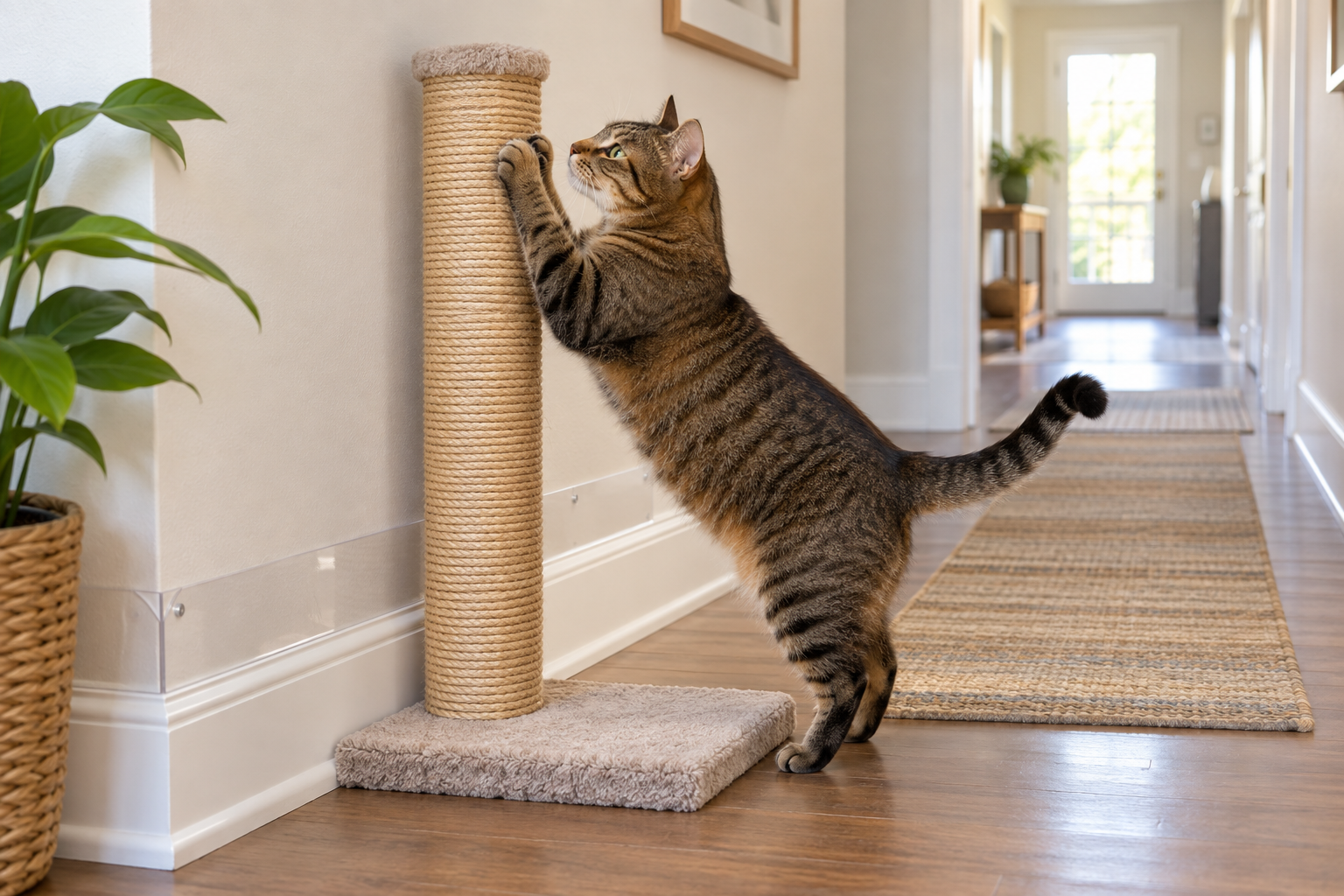
- Scratch options: at least one vertical and one horizontal scratcher.
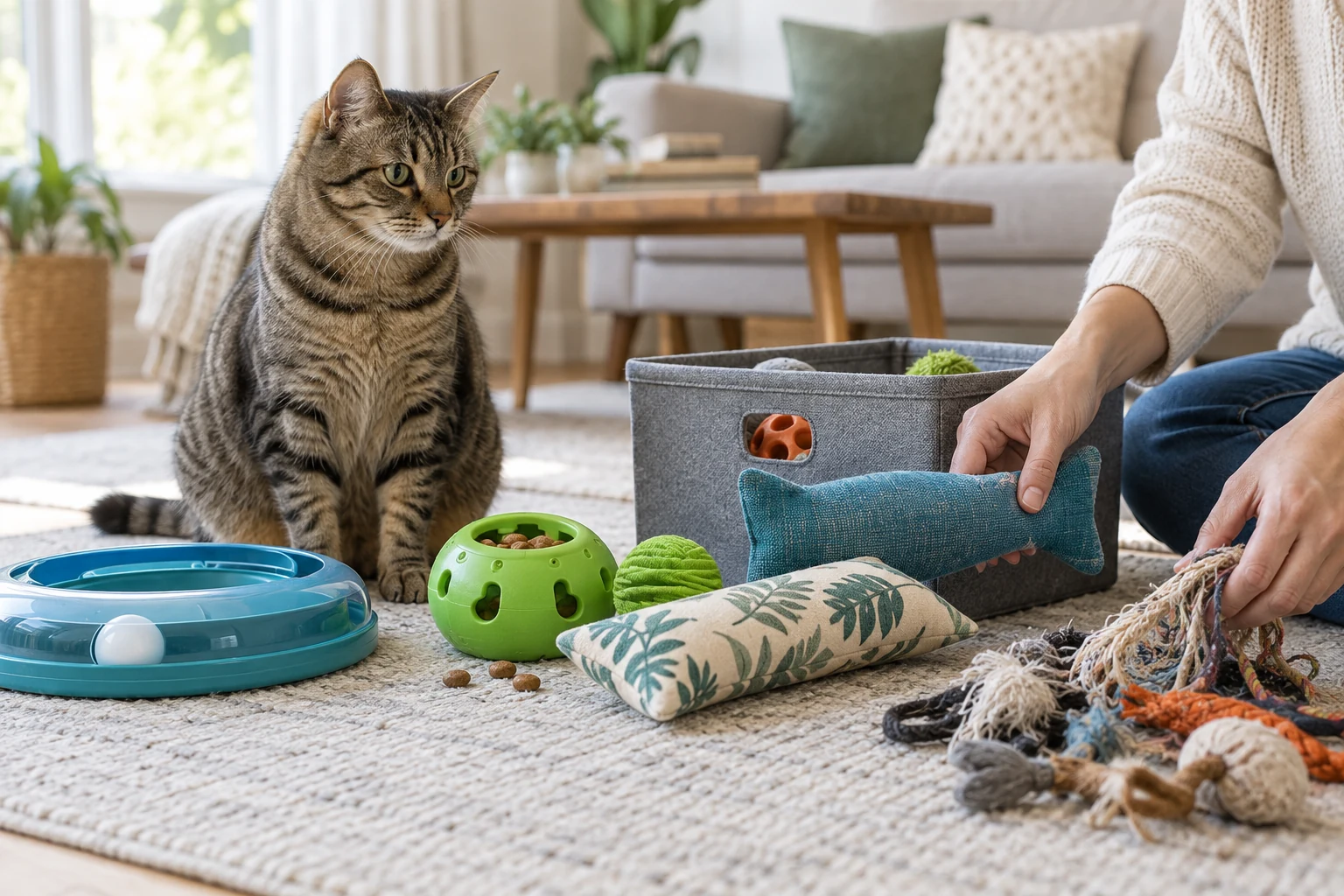
- Busca por alimento: puzzle feeder or treat scatter 1–2x/week to encourage natural hunting behavior.
Indoor safety (especially important for agile cats)
- Keep windows/balconies secured; provide a stable climbing setup so the cat doesn’t invent unsafe routes.
- If you offer outdoor time, a secured catio is a safer option than free roaming for many households.
Companionship note
Turkish Angoras are often people-focused; long alone time can lead to stress behaviors. If your schedule is busy, plan enrichment you can “set and forget” (window perch + puzzle feeder + scheduled play).
Limpeza
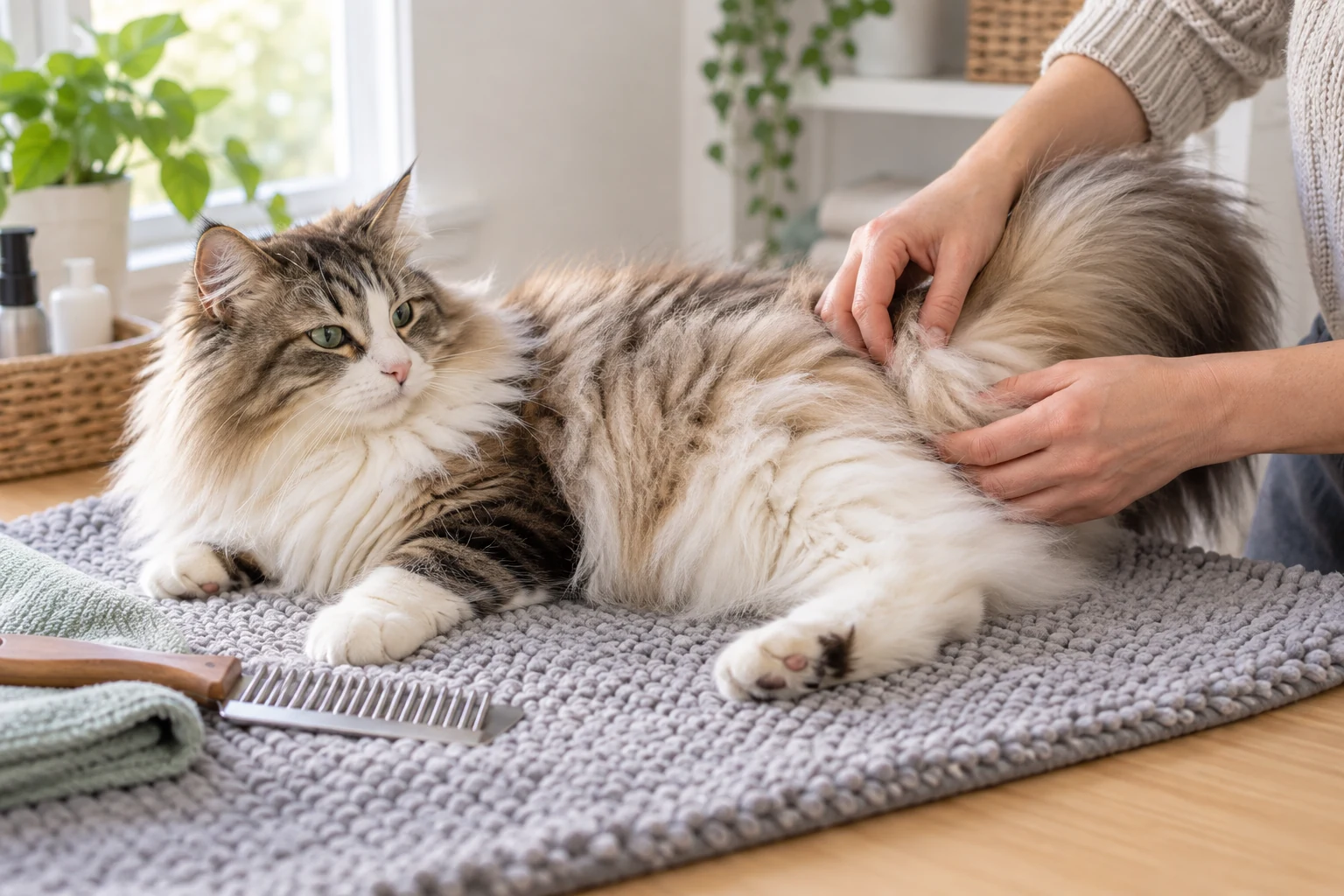
Shedding and grooming (key takeaway): Turkish Angoras are generally moderate shedders and often have a coat that’s menos propenso a emaranhar than many long-haired cats. Many owners can maintain the coat with periodic combing, increasing frequency during seasonal shedding or in older cats.
Easy grooming schedule
- Baseline: comb semanal (quick pass over back, sides, belly, tail).
- If shedding increases: comb 2–3x/week until it settles.
- If you’re aiming minimal maintenance: CFA notes that combing two or three times a month may be sufficient for many (often more for older cats).
Technique (fast + gentle)
- Start with the tail and ruff (where tangles hide)
- Comb in sections (don’t yank; hold fur near the skin)
- End with a reward so grooming stays positive
Bathing (optional)
Baths aren’t required for most Angoras, but some tolerate bathing well and may show interest in water; keep it low-stress and infrequent unless medically indicated.
Estimulação mental
Mental stimulation (key takeaway): Turkish Angoras are problem-solvers. Without structured stimulation, they often create attention-getting behaviors (cabinet-opening, climbing forbidden areas). Veterinary feline enrichment guidance supports using positive interaction, play outlets, and environmental enrichment to support wellbeing and reduce unwanted behavior.
High-impact enrichment (10 minutes/day)
- Micro-training: 2–5 minutes of rewards-based training (touch, sit, leash acclimation if appropriate)
- Puzzle feeding: use a puzzle toy for part of a meal 2–3x/week
- Rotação de brinquedos: keep only 4–6 toys out; swap weekly to restore novelty
- “Hunt games”: hide small treats/kibble in 3–5 locations and let them search
Socialização
Early, positive exposure to handling, grooming tools, carriers, and new people helps build a calmer, more adaptable adult cat.

Preocupações com a saúde
Boas notícias: Turkish Angoras are not known for having many breed-specific health problems overall, mas white cats—especially blue-eyed—can be more prone to congenital deafness.
As with any cat, Turkish Angoras can still develop common feline conditions (dental disease, weight gain) and heart disease such as hypertrophic cardiomyopathy (HCM).
Not medical advice: This guide supports owners in recognizing risk factors and asking better questions. Always consult a veterinarian for diagnosis and treatment.
Health issues to know (with practical owner actions)
| Condition / Risk | What’s known (plain English) | Signs you might notice | What to do (most useful actions) |
|---|---|---|---|
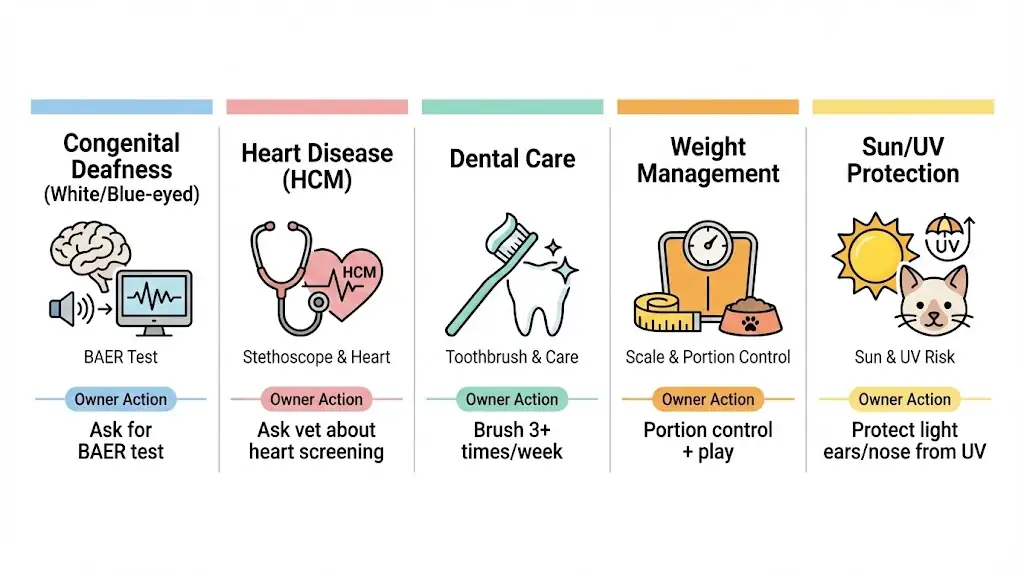
| Congenital deafness (white / blue-eyed cats) | Breed authorities note that white cats can be prone to deafnessespecialmente blue-eyed cats. In some regions, BAER hearing tests for white kittens are required/recommended. Genetics research and veterinary charities describe the link with the dominant W (white) gene—but not all white cats are deaf. | Not responding to sounds, sleeping very deeply, startling when approached, “selective hearing” that’s actually hearing loss. | If adopting/buying a white kitten, ask for a BAER test result. BAER measures electrical responses in the hearing pathway. Deaf cats usually do well em ambientes fechados with visual cues and consistent routines. |
| Cardiomiopatia hipertrófica (CMH) | HCM is a common feline heart disease. It has no cure, but treatment plans can manage signs and complications (heart failure and clot risk). TICA recommends breeders screen for HCM. | Many cats show no early signs. When signs appear, they can include rapid/labored breathing (heart failure), lethargy, reduced appetite; clots can cause sudden pain/weakness. | When choosing a breeder: ask what cardiac screening they do (e.g., echocardiogram history in lines). If your cat has breathing difficulty, collapse, or sudden hind-limb weakness: atendimento veterinário de urgência. |
| Dental disease / periodontal problems | Dental disease is very common in cats; prevention is lifelong. Tooth brushing is the most effective home habit; 3×/week is a minimum recommendation, daily is best. | Bad breath, red gums, drooling, pawing at mouth, reluctance to chew, appetite changes. | Start gradually (treat-based training). Use cat-safe toothpaste and aim for brushing 3+ times/week. Schedule vet dental checks/cleanings as advised. |
| Ganho de peso / risco de obesidade | Not “breed-specific,” but common across pet cats—weight management improves long-term health and reduces comorbidity risk. AAHA provides structured weight-management guidance for cats. | Less activity, difficulty grooming, ribcage harder to feel, weight creeping up over months. | Use portion control, measure calories, prioritize play, and ask your vet to track body condition score regularly. |
| Sunburn / UV damage (white or light cats) | Cats with light skin/fur are at higher UV risk, especially ears/nose. International Cat Care recommends pet-safe sunscreen for vulnerable areas when needed. | Redness, crusting, scabs on ear tips/nose, irritation. | Keep indoor during peak sun, use UV-blocking film, and only use cat-safe sunscreen products if advised. Vet check for persistent skin changes. |
| Wobbly gait / “ataxia” (symptom, not a diagnosis) | “Ataxia” describes uncoordinated movement and has multiple causes (congenital, infectious, toxic, injury). It’s more trustworthy to treat it as a red-flag symptom requiring veterinary evaluation rather than a Turkish Angora “known hereditary disease.” | Tremors, stumbling, head tilt, difficulty jumping, unsteady walking. | If a kitten/young cat is uncoordinated: schedule a vet visit promptly; keep the environment safe (no high falls) while investigating. |
“Ask a breeder / rescue” checklist (adds credibility + usability)
- If the cat is white: ask whether a BAER hearing test was performed and request documentation.
- Ask what heart screening practices exist in their lines (TICA explicitly encourages HCM screening).
- Ask for recent vet records, vaccine/deworming history, and whether the cat has had any breathing episodes, collapse, or sudden weakness.
Essa raça é ideal para você?
| Adequado para | Não adequado para |
|---|---|
| Owners who are frequently home and enjoy daily interaction, play, and involving their cat in routines | People with busy schedules, frequent absences, or limited time for companionship |
| Families with children (especially older, respectful ones) who understand gentle handling | Homes with young children who may not respect the cat’s boundaries or insist on prolonged holding |
| Households with other pets (cats or dogs), especially if introductions are slow and socialization is guided | Multi-pet homes where dominant dynamics may cause conflict or where pets are not receptive to an “alpha” feline personality |
| Apartment dwellers who can provide vertical space like cat trees, wall shelves, and window perches | Small or bare apartments with no enrichment, climbing access, or space to explore |
| Owners willing to dedicate time daily for play, mental stimulation, and bonding | Those seeking a low-maintenance or independent cat that doesn’t require much attention |
| Pet parents looking for a low-maintenance long-haired breed (requires only weekly brushing) | People expecting a no-shedding or hypoallergenic breed, or those unwilling to do basic grooming/dental care |
PERGUNTAS FREQUENTES
These are the most common Turkish Angora questions people search before adopting or buying—size, shedding, personality, kid/pet compatibility, water behavior, and health. Each answer starts with a direct takeaway, followed by brief context so you can make a decision quickly.
How big do Turkish Angoras get?
Turkish Angoras are typically medium-sized cats. Males generally weigh between 7 to 10 pounds (3.2-4.5 kg), while females are slightly smaller, weighing 5 to 8 pounds (2.3-3.6 kg). Some sources indicate a range of 5 to 10 pounds or up to 11 pounds (5 kg). They are known for their long, slender bodies, which can reach up to or past 18 inches in length.
Do Turkish Angoras shed a lot?
Turkish Angoras are considered a moderate-shedding breed. Their single-layer coat is silky and fine, without a dense undercoat, which means it is less prone to matting compared to other long-haired breeds. While they do shed, particularly during seasonal transitions from winter to summer, weekly combing is usually sufficient to manage loose hair and keep their coat in good condition.
Are Turkish Angoras good with children and other pets?
Yes, Turkish Angoras are generally known to be good with children and other pets. They are sociable and affectionate, enjoying interaction with all family members. However, they tend to have a dominant personality and prefer to be the “alpha” in multi-pet households.
It is important to teach children gentle interaction, as Angoras may not always appreciate being held for long periods. Early socialization can help them adjust well to new companions.
Do Turkish Angoras like water?
Unusually for a cat breed, many Turkish Angoras actually enjoy playing in water. Some have been observed splashing in sinks, hopping into showers, or even willingly entering bodies of water to paddle around. This unique trait can make bathing them a surprisingly easy or even entertaining experience for owners.
What are the common health issues for Turkish Angoras?
Turkish Angoras are generally not known for many breed-specific health problems, mas white cats (especially blue-eyed) have a higher risk of congenital deafness, and some regions recommend/require BAER hearing tests for white kittens.
Like all cats, they can also develop common conditions such as doença dentária, ganho de peso, and heart disease such as HCM (which has no cure but can be managed under veterinary care).
Fatos bônus
National Treasure
The Turkish Angora is considered a national treasure in its native Turkey, with a dedicated breeding program at the Ankara Zoo established to preserve its lineage, especially the white variety.
Ancient Lineage
Believed to be one of the oldest naturally occurring long-haired cat breeds, the Turkish Angora’s written history dates back to the 1600s in Europe. It is thought to be the true origin of the longhair mutation in domestic cats.
“Einsteins” of the Gato World
Due to their high intelligence, some Turkish Angoras are affectionately called “Einsteins” by their owners. They are known for their problem-solving skills and ability to learn complex tricks.
Dog-like Companions
Their loyalty, eagerness to interact, and tendency to follow their owners around the house often lead to them being described as “dog-like”. They may even greet guests at the door.
A Sense of Humor
Anecdotal evidence suggests that Turkish Angoras possess a genuine sense of humor, often engaging in mischievous antics designed to entertain or gain attention.
Referências
Loeschke, S. (November 1997). “Turkish Angoras in Ankara Zoo … or on the road investigating the Turkish Angora”. Erkr.de. Archived from the original on 18 July 2011. Retrieved 17 September 2011.
“The white beauty of Ankara: Ankara Cat”. Hürriyet Daily News. Archived from the original on 20 December 2016. Retrieved 8 December 2016.
Azan, Barbara; Rodgers, Sandralee. “The Turkish Angora: About This Breed”. CFA.org. Associação de criadores de gatos. Retrieved 5 December 2023.
Catton, Charles (1788). “The Persian Cat”. Animals Drawn from Nature and Engraved in Aqua-tinta. I. and J. Taylor. Plate 8.
Simpson, Frances (1 February 1902). “The Book Of The Cat”. Cassell. Retrieved 26 January 2013 – via Chest of Books.
“Ankara’nın evcil hazineleri: Ankara kedisi”. Kedici.com.tr (in Turkish). 24 February 2011. Archived from the original on 10 May 2013. Retrieved 26 January 2013.
"Histórico". TurkishAngorabreedCouncil.Weebly.com. CFA Turkish Angora Breed Council. Retrieved 11 September 2023.
“Breed Profile: Turkish Angora”. CFA.org. Associação de criadores de gatos. Archived from the original on 29 October 2012. Retrieved 8 October 2014.
“Turkish Angora Standard” (PDF). Associação de criadores de gatos. Archived from the original (PDF) on 3 July 2014. Retrieved 1 March 2024.
Shojai, Amy (1997). For the Love of Cats. Lincolnwood, Illinois: Publications International. pp. 108–109. ISBN 0-7853-1411-3 - via Internet Archive.
“Turkish Angora”. Cuidados internacionais com gatos. Retrieved 1 March 2024.
Hartwell, Sarah. “The Domestication of the Cat”. MessyBeast.com. Recuperado em 21 de dezembro de 2017.
Hartwell, Sarah. “The Tangled Tale of the Turkish Angora”. MessyBeast.com. Retrieved 11 September 2023.
Lipinski, Monika J.; Froenicke, Lutz; Baysac, Kathleen C.; Billings, Nicholas C.; Leutenegger, Christian M.; Levy, Alon M.; Longeri, Maria; Niini, Tirri; Ozpinar, Haydar (2008). "A ascensão das raças de gatos: Avaliações genéticas de raças e populações mundiais de raças aleatórias". Genômica. 91 (1): 12-21. doi:10.1016/j.ygeno.2007.10.009. PMC 2267438. PMID 18060738.
Kurushima, J. D.; Lipinski, M. J.; Gandolfi, B.; Froenicke, L.; Grahn, J. C.; Grahn, R. A.; Lyons, L. A. (2012). “Variation of cats under domestication: Genetic assignment of domestic cats to breeds and worldwide random-bred populations”. Genética animal. 44 (3): 311–324. doi:10.1111/age.12008. PMC 3594446. PMID 23171373.
 EN
EN DE
DE ES
ES PT
PT