

Ragdolls, Maine Coons, Siamés, Burmese, Birmans, Sphynx, Abyssinians, and Exotics are often described as social cat breeds. But “friendly” can mean peluche, playful, talkative, confident with visitors, or simply happy to stay nearby. Breed offers tendencies, not guarantees; an adult cat with a known personality is the most predictable choice.
Use this guide to match a cat’s social style, activity, grooming, and need for company to your real household rather than choosing from a popularity list alone.
Índice
- Which cat breeds are often the friendliest?
- What does a friendly cat actually look like?
- How do friendly cat breeds compare?
- Which friendly breeds are relaxed companions?
- Which friendly breeds are active and people-focused?
- Are friendly cat breeds good with children and other pets?
- Is an adult rescue cat more predictable than a breed?
- How should I choose a friendly cat?
- Conclusión
- Preguntas frecuentes
- Referencias
Which cat breeds are often the friendliest?
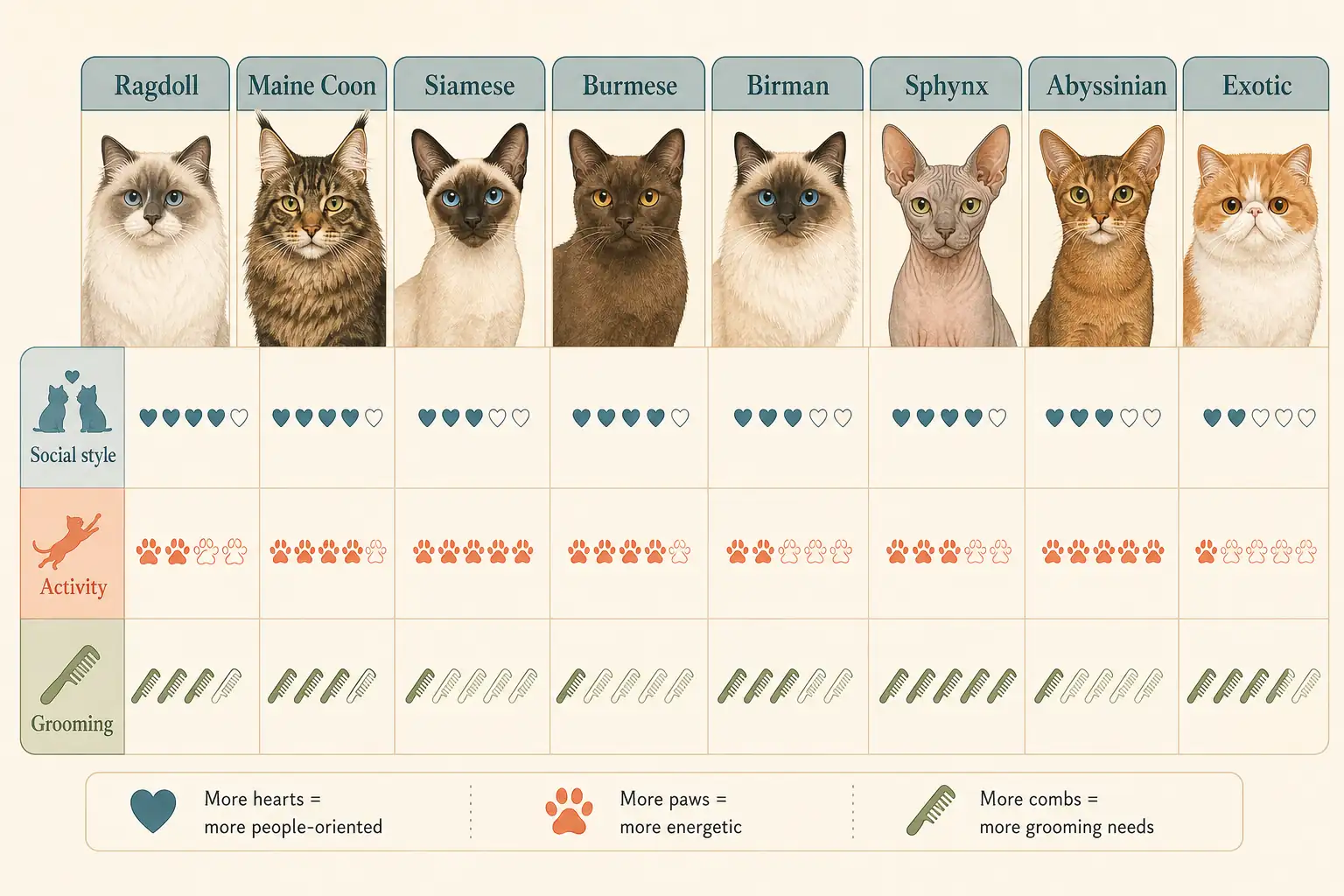
Several pedigree breeds are known for being people-oriented, but they express friendliness differently. Ragdolls and Birmans are often gentle companions; Siamese and Burmese tend to be highly involved; Maine Coons and Abyssinians often enjoy interactive household life; Sphynx cats frequently seek warmth and company; Exotics are commonly quieter and affectionate.
| Raza | Common social style | Activity tendency | Main care tradeoff |
|---|---|---|---|
| Ragdoll | Relaxed, affectionate, often follows people | Moderado | Regular coat care and companionship |
| Mapache de Maine | Sociable, playful, often involved without constant lap time | Moderado a alto | Large-cat space, play, and coat care |
| Siamés | Vocal, interactive, strongly people-focused | Alta | Needs frequent engagement |
| Birmano | Affectionate, playful, and socially involved | Alta | May struggle with long periods alone |
| Birmano | Gentle, social, and family-oriented | Moderado | Coat care and companionship |
| Sphynx | Warmth-seeking, outgoing, and attention-oriented | Alta | Skin, ear, and temperature care |
| Abisinio | Curious, athletic, and socially engaged | Alta | Significant play and climbing needs |
| Exotic | Quietly affectionate with playful moments | Lower to moderate | Face, eye, coat, and health care |
None of these descriptions promises how an individual cat will behave. Early experience, edad, health, environment, and the way people interact with the cat all matter.
What does a friendly cat actually look like?
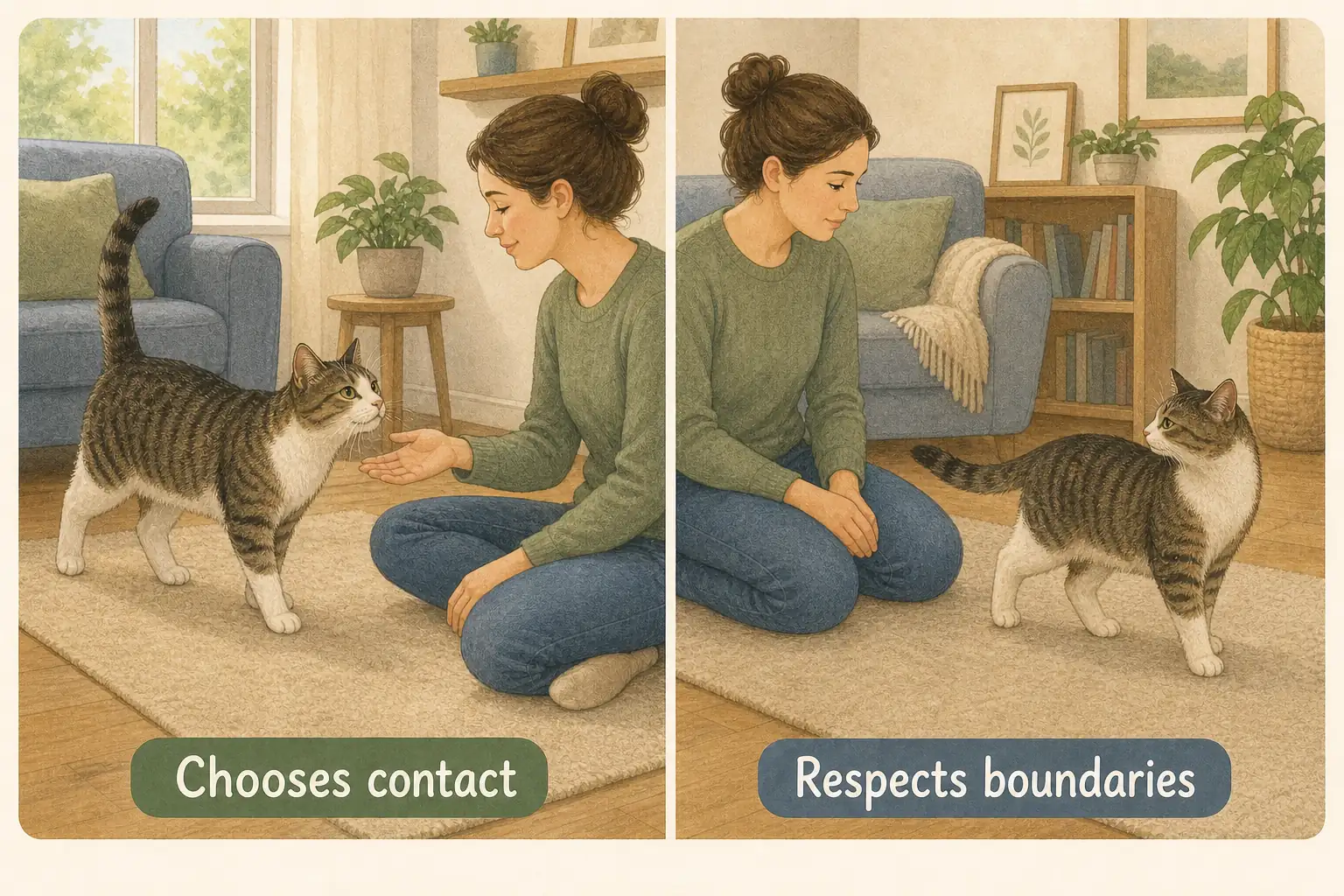
A friendly cat chooses social contact while remaining comfortable enough to leave. Friendliness is not the same as tolerating hugs, being carried, accepting rough play, or greeting every stranger.
Busca:
- approaching with a loose body and neutral or forward ears
- rubbing, slow blinking, greeting, or settling nearby
- recovering after a new sound or visitor rather than remaining distressed
- choosing play or social contact and then leaving calmly
- accepting gentle interaction without freezing, fleeing, or becoming tense
The AAFP/ISFM environmental needs guidelines emphasize positive, predictable human-cat interaction that respects each cat’s preferences.9 Los SnuggleSouls Guía del lenguaje de la cola del gato can help you read social signals in context.
How do friendly cat breeds compare?
The best breed fit depends on the type of social relationship you want and the care workload you can maintain. A highly interactive cat may be a poor match for a quiet household that is empty most of the day, while a gentle nearby companion may disappoint someone seeking constant play.
| Your priority | Strong candidates to research | Important question |
|---|---|---|
| Relaxed companion that stays nearby | Ragdoll, Birman, Exotic | Does the individual enjoy laps, nearby company, or more space? |
| Talkative and highly interactive cat | Siamese, Burmese | Can the household provide frequent play and attention? |
| Playful cat involved in family activity | Maine Coon, Abyssinian | Is there enough climbing space and daily enrichment? |
| Outgoing cat that seeks warmth and contact | Sphynx | Can you manage skin care and temperature needs? |
| Known visitor, child, and pet response | Adult foster or shelter cat | What has the caregiver observed in a home-like environment? |
Use the SnuggleSouls Las razas de gatos más cariñosas guide if lap seeking and physical closeness matter more than general sociability. For quieter candidates, compare the calm cat breeds guide.
Which friendly breeds are relaxed companions?
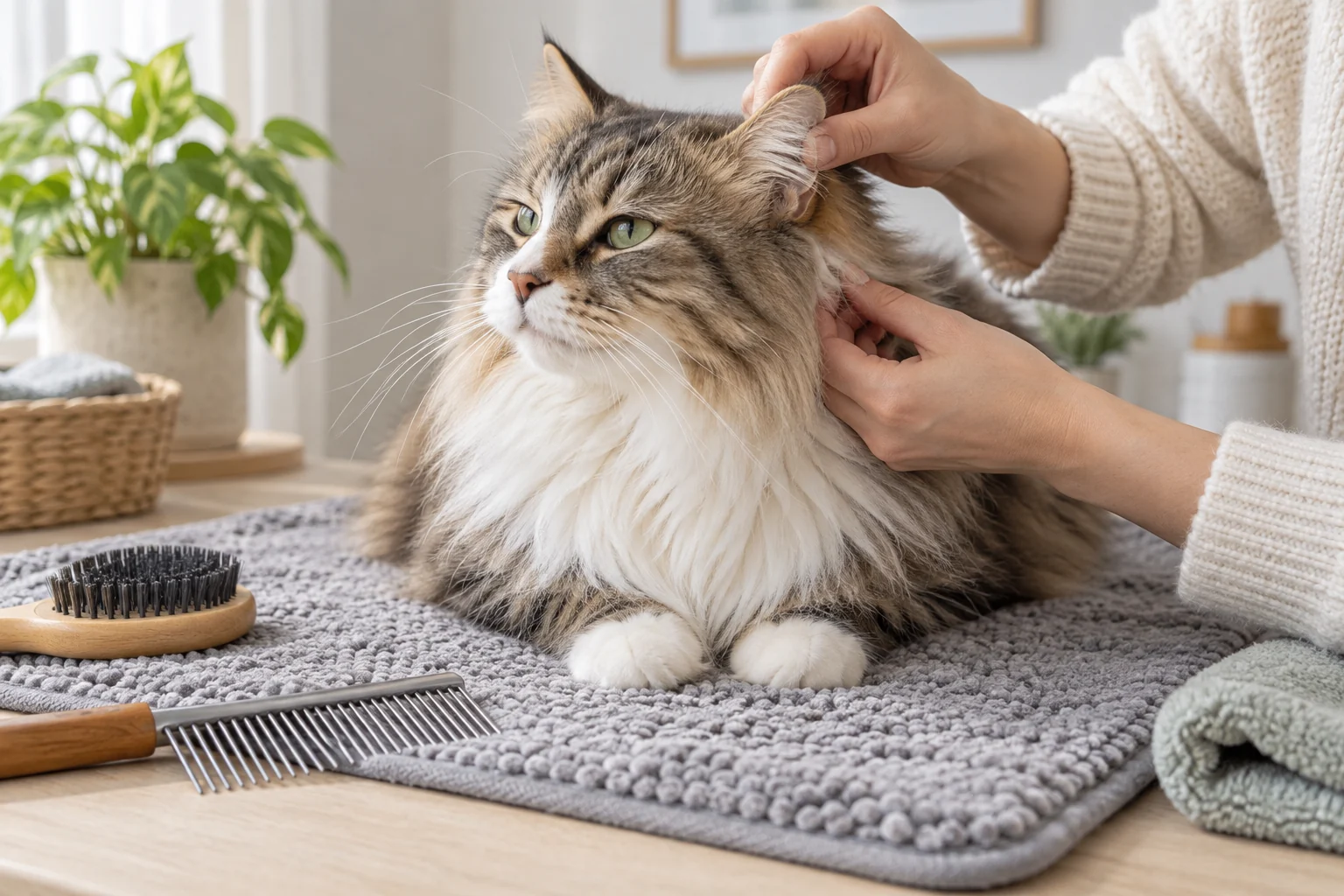
Ragdolls, Birmans, and Exotics often appeal to people seeking gentle social contact without the constant activity of the most energetic breeds. They still need play, companionship, and individual assessment.
Ragdoll
CFA describes Ragdolls as loving, laid-back cats that enjoy being with their people while remaining playful.1 They may fit a household seeking a relaxed companion, but no Ragdoll is guaranteed to enjoy being held. Read the SnuggleSouls Ragdoll guide before deciding.
Birmano
Birmans are commonly described as gentle, affectionate, and social.5 They often suit people who want a companion involved in household life without the intensity of a highly vocal breed. The SnuggleSouls Birman guide covers the breed’s care needs.
Exotic
Exotics often combine a quiet manner with affectionate, playful moments.8 Their shorter coat is easier than a Persian coat, but facial structure, eye care, grooming, and health screening still matter. See the SnuggleSouls Exotic Shorthair guide.
Which friendly breeds are active and people-focused?
Siamese, Burmese, Maine Coons, Sphynx, and Abyssinians often express friendliness through conversation, play, curiosity, and participation. These breeds may be social, but they are not low-effort companions.
Siameses y birmanos
Siamese cats are known for being vocal, intelligent, and strongly people-oriented, while Burmese cats are commonly affectionate, playful, and socially involved.34 Both may be poor fits for households wanting a very independent cat. Compare the SnuggleSouls Siamese cat guide y Burmese cat guide.
Mapache de Maine
Maine Coons are often social, playful cats that enjoy household activity without necessarily demanding constant holding.2 Their size, coat, and enrichment needs deserve serious planning. Use the SnuggleSouls Maine Coon guide for deeper research.
Sphynx and Abyssinian
Sphynx cats often seek warmth, activity, and human company, while Abyssinians are commonly curious, athletic, and involved.67 These are better candidates for people who enjoy active interaction than for someone seeking a quiet lap cat. See the SnuggleSouls Sphynx guide y Abyssinian guide.
Are friendly cat breeds good with children and other pets?
Breed friendliness does not guarantee safety or compatibility with children, dogs, or other cats. The individual cat’s history, introductions, resources, handling preferences, and the other household members’ behavior matter more than a list.
For children:
- teach calm voices and gentle touch
- let the cat approach rather than carrying the cat over
- provide child-free ocultar and resting spaces
- supervise interaction
- stop when the cat turns away, tenses, or leaves
For other pets:
- use gradual introductions
- provide separate alimentos, water, litter, rest, and hiding options
- prevent chasing and blocked escape routes
- watch both animals’ body language
- accept that some friendly cats prefer to be the only pet
Do not describe any breed as automatically child-proof, dog-proof, or suitable for every family.
Is an adult rescue cat more predictable than a breed?
An adult cat in a shelter or foster home often provides the clearest evidence of real social style. Caregivers may already know whether the cat approaches visitors, enjoys play, seeks laps, tolerates other pets, or needs a quieter home.
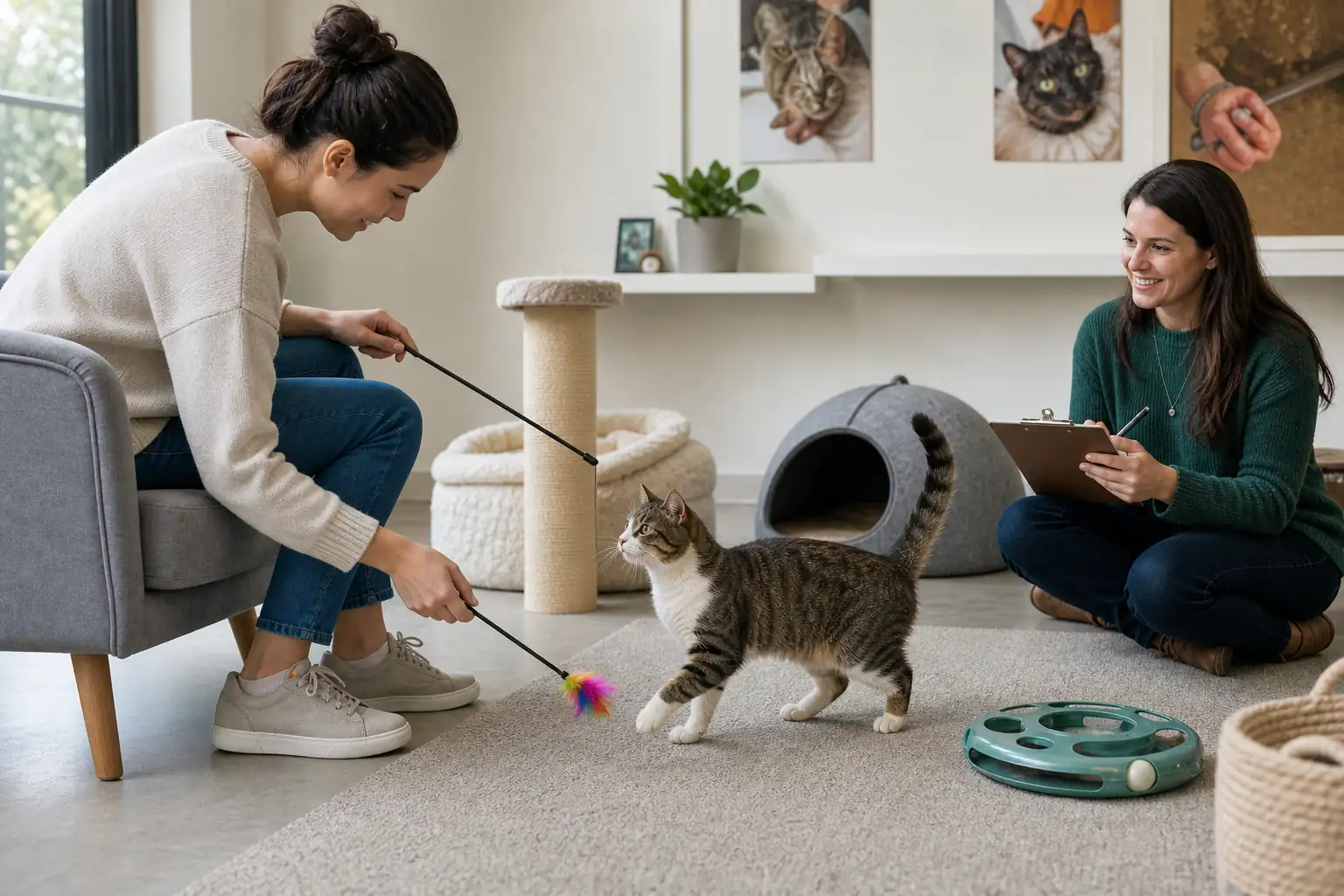
Ask:
- Does the cat initiate contact or prefer nearby company?
- How does the cat respond to unfamiliar people?
- Does the cat enjoy interactive play?
- How quickly does the cat recover after a surprise?
- Has the cat lived with children, cats, or dogs?
- How does the cat behave when left alone?
- Are there grooming, medical, or environmental needs?
Use the SnuggleSouls cat adoption guide y Los primeros 30 días con un gato nuevo guide to prepare for a successful match.
How should I choose a friendly cat?
Choose for the relationship and care routine you can actually provide. Define what friendliness means to you, then evaluate the individual cat rather than relying on breed reputation alone.
Use this checklist:
- Decide whether you want a lap cat, playful companion, talkative follower, or relaxed nearby cat.
- Be honest about time for play, company, grooming, and training.
- Meet adult cats when personality predictability matters.
- Ask breeders or rescues for observed behavior and health records.
- Let the cat initiate and end interaction during meetings.
- Consider activity, grooming, size, health, and cost alongside sociability.
- Avoid choosing a breed solely for an extreme physical feature or popularity.
- Plan a gradual introduction to the household.
A good match is not the cat that tolerates the most handling. It is the cat whose preferences and needs fit the household’s behavior and routine.
Conclusión
Ragdolls, Maine Coons, Siamese, Burmese, Birmans, Sphynx, Abyssinians, and Exotics can all be social companions, but their friendliness looks different. Some are relaxed and affectionate; others express connection through play, conversation, and constant involvement.
Breed tendencies can narrow your search, but the individual cat decides the relationship. Meet adult cats when possible, respect boundaries, and choose a social style, activity level, grooming workload, and care plan that your household can sustain.
Preguntas frecuentes
What is the friendliest cat breed?
There is no universal winner. Ragdolls, Burmese, Siamese, Birmans, Maine Coons, Sphynx, Abyssinians, and Exotics are often social, but individual personality and household fit matter more than ranking.
Which cat breeds are most affectionate?
Ragdolls, Burmese, Birmans, Sphynx, and Exotics are often described as affectionate. Affection can mean lap time, following people, play, greeting, or resting nearby.
What friendly cat breed is good for a busy household?
Choose carefully. Highly social cats may need more interaction, not less. An adult cat whose response to activity, visitors, and time alone is already known may be the safest match.
Are friendly cat breeds good with children?
Some individuals are, but breed does not guarantee compatibility. Children need supervision, gentle-handling rules, and respect for the cat’s resting and hiding spaces.
Are male or female cats friendlier?
Sex alone does not reliably determine friendliness. Personality, socialization, age, health, neuter status, environment, and past experience all influence social behavior.
Is a kitten or adult cat more likely to be friendly?
Kittens are still developing, so adult social style is harder to predict. An adult foster or shelter cat may offer clearer information about affection, play, visitors, and other pets.
Referencias
[1] Cat Fanciers’ Association. Ragdoll.
[2] Cat Fanciers’ Association. Gato Maine Coon.
[3] Cat Fanciers’ Association. Siamés.
[4] Cat Fanciers’ Association. Birmano.
[5] Cat Fanciers’ Association. Birmano.
[6] Cat Fanciers’ Association. Sphynx.
[7] Cat Fanciers’ Association. Abisinio.
[8] Cat Fanciers’ Association. Exotic.
[9] Ellis, S. L. H., et al. Directrices de la AAFP y la ISFM sobre las necesidades ambientales de los gatos.
 EN
EN DE
DE ES
ES PT
PT