
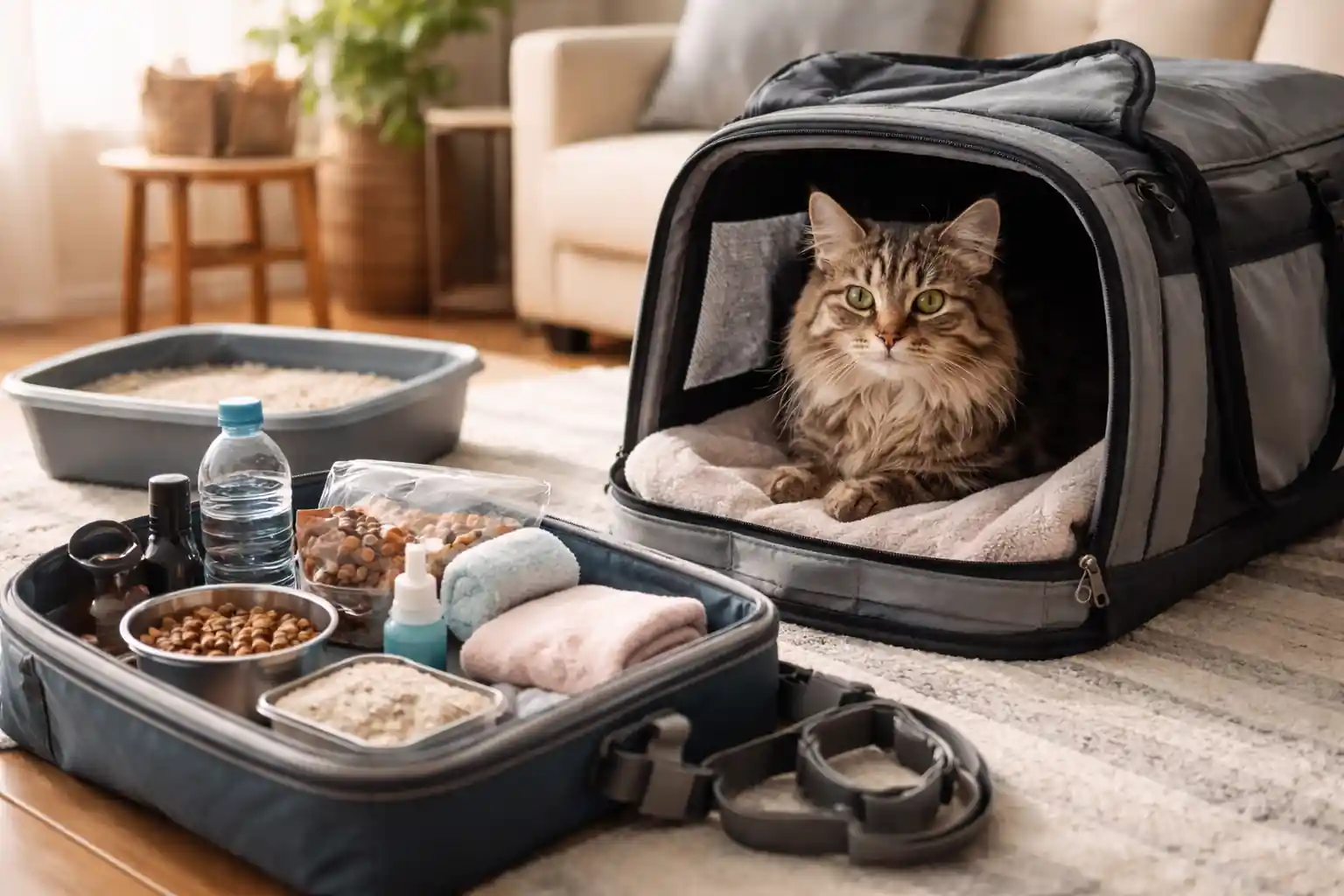
Traveling with a cat works best when the carrier becomes a “safe room” weeks ahead, the travel day stays predictable, and arrivals start with a simple basecamp routine.
Table of Contents
Quick answer
Most cats travel best when the carrier becomes their “safe room” long before the trip, and the travel day stays predictable: secure carrier, calm environment, and a simple arrival routine. Plan paperwork early (especially for flights/international travel), pack a small “cat kit,” and watch for stress or illness signals that mean it’s time to pause or call your vet.
Do this first (60-second checklist)
- Start carrier training now: carrier stays out daily; treats + short door-close practice
- Choose a stable carrier: ventilated, easy-open, won’t wobble or collapse
- Car trips: carrier stays secured in the back seat; never open in parking lots
- Flights/international: verify airline + destination rules early; schedule vet paperwork
- Arrivals: set up a one-room basecamp (litter + water + hide spot) before exploring
Why this matters (and who it’s for)
Cats are home-base animals. New sounds, smells, movement, and unfamiliar rooms can feel intense—especially when stressors stack (carrier → car → lobby → strange room). The goal isn’t to make your cat “love” travel overnight; it’s to make travel safe, less scary, and recoverable.
This guide is general, evidence-informed cat care—not a substitute for veterinary advice. If your cat has medical conditions, persistent symptoms, sudden behavior changes, or urgent warning signs, contact a veterinarian.
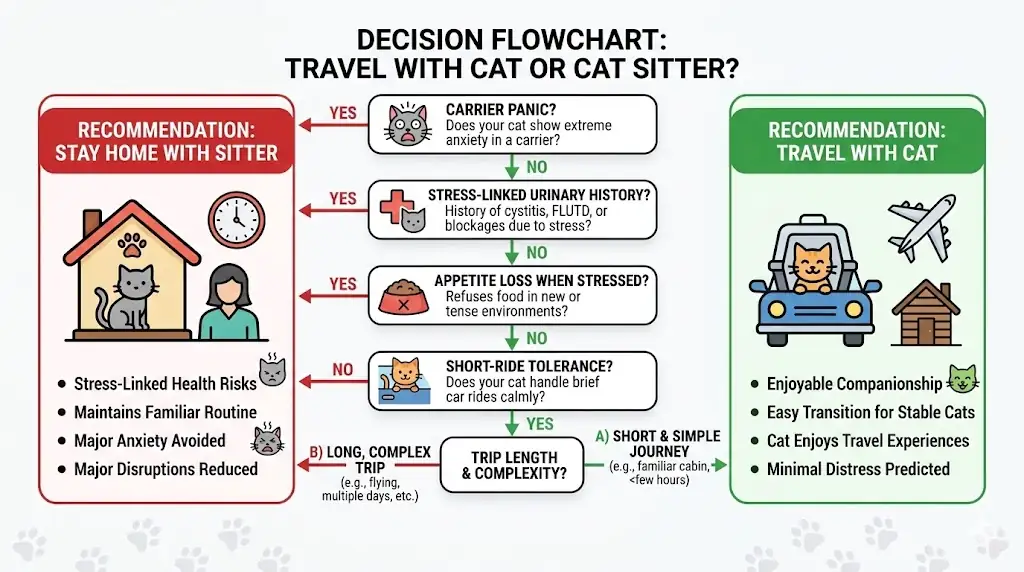
Tip 1) Should I travel with my cat—or leave them at home?
Best default for short trips: If your cat is strongly stress-reactive, staying home in familiar territory is usually kinder—with a trusted sitter and a stable routine. Cats are “home-base” animals; repeated, intense stress can trigger appetite loss, vomiting, and flare-ups of stress-sensitive conditions (especially urinary issues).
Choose stay home (sitter + routine) if your cat:
- Panics in the carrier despite gradual training (thrashing, open-mouth breathing, prolonged yowling)
- Stops eating or hides for hours after routine disruptions
- Has a history of stress-linked urinary problems (straining, blood in urine, frequent litter trips)
- Is elderly, medically fragile, or recovering from illness/surgery
- Gets repeated vomiting/drooling during even short drives
Travel can make sense if:
- You’re moving, traveling for weeks, or there’s no safe home-care option
- Your cat already tolerates short rides with mild, recoverable stress
- You can keep the trip predictable (stable carrier setup, quiet handling, simple arrival routine)
What this looks like in a real home: If your cat hides for hours after a 10-minute drive to the vet, a two-hour road trip is probably a “not yet” until you’ve done more carrier + car practice.
Tip 2) Carrier training: make the carrier furniture, not a trap
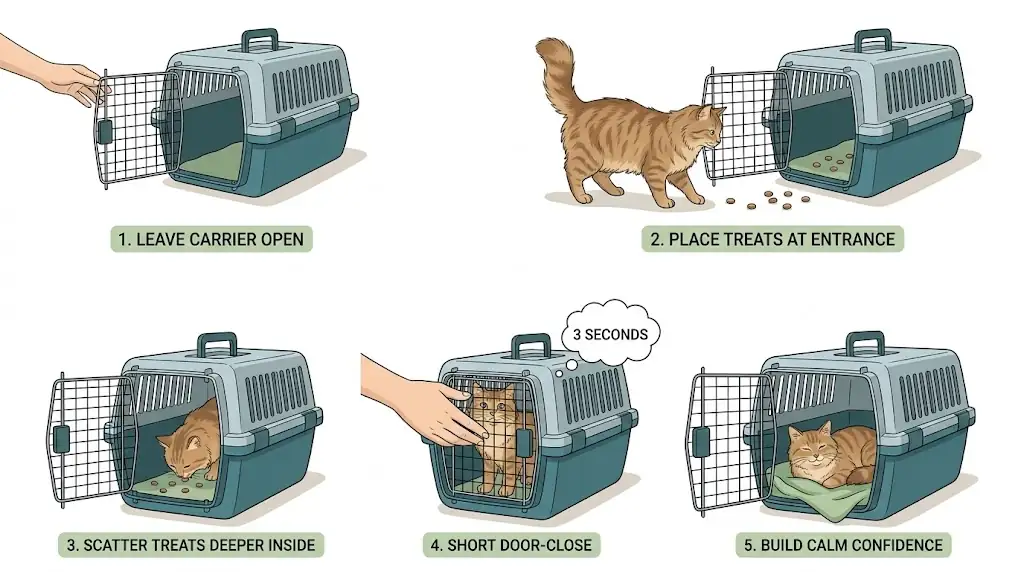
Most carrier stress comes from a predictable pattern: carrier appears → scary event happens. The fix is simple behavior science: desensitization + positive reinforcement so the carrier reliably predicts calm, familiar rewards—not restraint.
Start 2–4 weeks before travel (longer for anxious cats) and aim for many tiny wins:
- Leave the carrier out every day in a quiet spot with the door open—treat it like furniture, not equipment.
- Make it smell like home: add familiar bedding (a towel/blanket your cat already sleeps on).
- Create a “treat trail”: place treats just inside the doorway, then gradually deeper over days—let your cat choose the pace.
- Practice micro-closures: close the door for 1–3 seconds → treat → open. Repeat a few times, then stop before your cat gets tense.
- Add gentle handling practice: pick up the carrier briefly, keep it level, set it down, treat—so motion doesn’t equal panic.
If your carrier has a removable top, train with it. Cat-friendly handling guidance notes that many cats do better staying in the carrier base while the top is removed, and covering with a towel can help reduce anxiety during handling/exams.
Good progress looks like: your cat enters voluntarily, eats treats inside, and can tolerate brief door closures without freezing, panting, or frantic escape attempts.
Common mistakes to avoid: only bringing the carrier out on “vet day,” rushing to longer door-closed sessions, or forcing entry (which re-teaches the “trap” association). Carrier training: make the carrier furniture, not a trap
Tip 3) Pick the right carrier—and make it feel steady
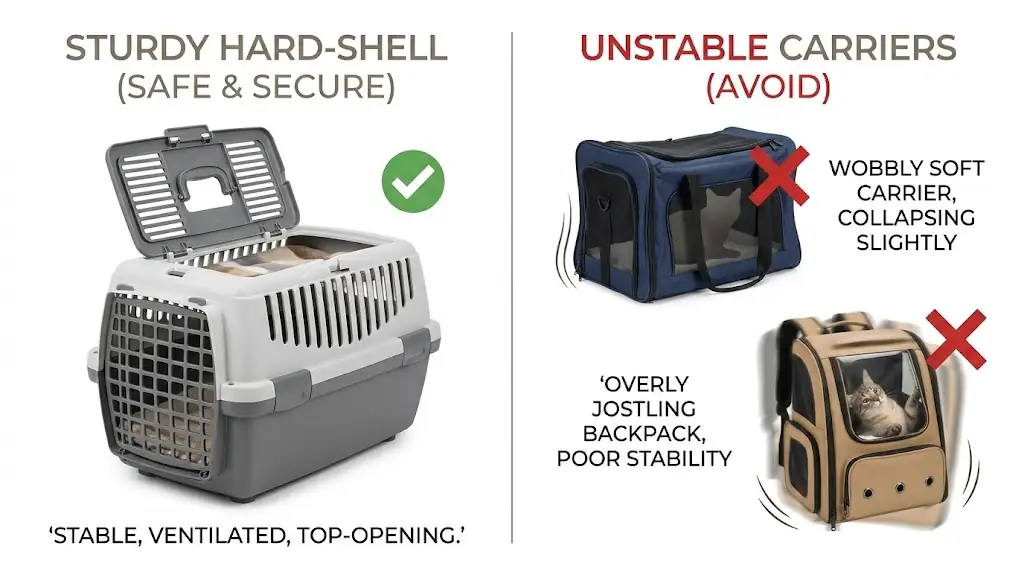
A carrier should function like a portable safe room: sturdy, predictable, and easy to handle—so your cat isn’t “riding an earthquake.”
What to look for (minimum standards)
- Sturdy, secure, stable (won’t flex, wobble, or collapse; latch won’t pop open).
- Ventilation on at least two sides for consistent airflow.
- Right size: big enough for your cat to lie down and reposition, but snug enough that they don’t slide around.
- Easy access: a top opening or removable top makes loading and vet checks calmer (less wrestling, fewer forced exits).
- Easy to clean: hard, wipeable materials are practical if your cat drools or toilets from stress.
Make it feel steady (small handling changes, big stress reduction)
- Carry level and supported from underneath (two hands under the base; keep it close to your body to reduce swinging/jostling). Minimizing jostling matters—movement can frighten cats.
- Set it down gently on flat surfaces (avoid bumps/doorframe knocks—those “thuds” add up).
- In the car: keep it upright and secure it with a seatbelt so it can’t slide—an unsecured carrier can move and scare your cat.
- Optional calm boost: drape a towel over part of the carrier to reduce visual overstimulation.
Avoid these common “looks comfy but stresses cats” choices
- Flimsy/cheap carriers that wobble, flex, or feel unstable in your hands.
- Backpack-style carriers for longer travel if they don’t allow enough room to move/reposition or create lots of motion.
Multi-cat note: Even bonded cats should usually travel in separate carriers—stress can make even friends snap.
Tip 4) Cat travel checklist: ID, paperwork, and a small “cat kit”
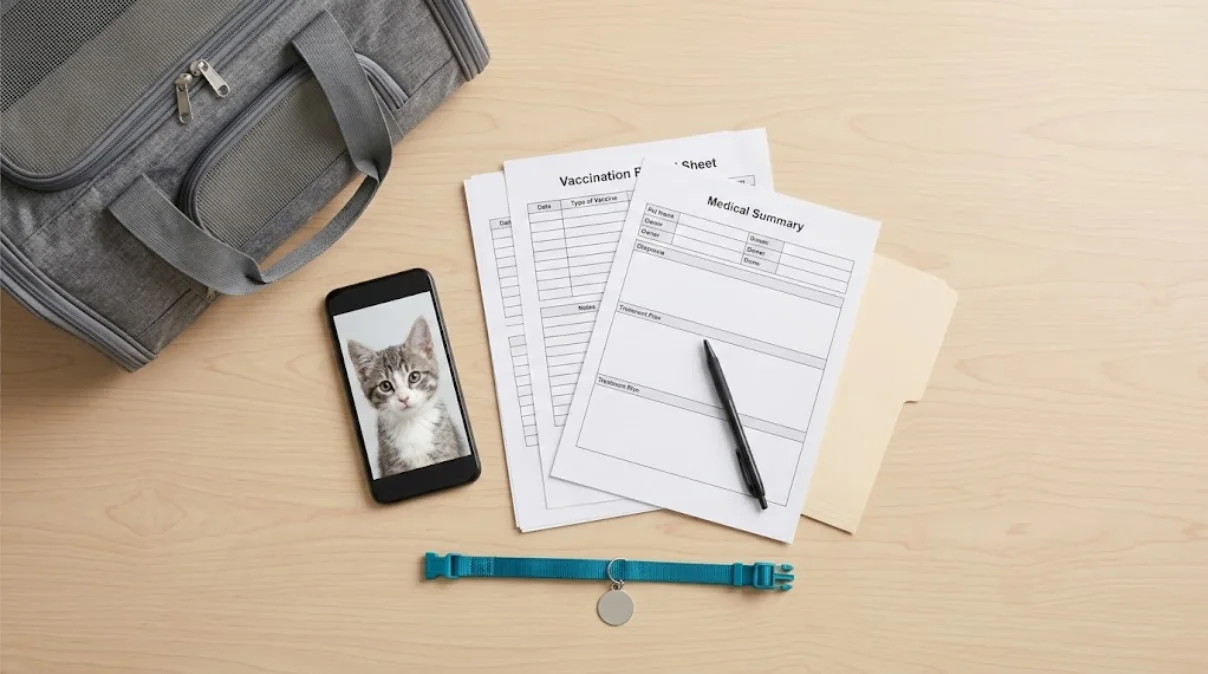
Travel is when indoor cats most often get lost—a single open door in a new place is all it takes. Treat ID + paperwork as your first “safety system,” then pack a small kit so you’re not improvising under stress.
1) Minimum ID basics (do these even for short trips)
- Microchip + current contact info (verify your phone/email are correct before you leave).
- Breakaway collar + ID tag only if your cat safely tolerates collars.
- 2–3 recent photos: full body + close-up of face; note unique markings.
2) Paperwork basics (what to gather before you travel)
- Your cat’s medical summary (vaccines, meds, conditions) and your vet’s contact info—paper or screenshots.
- Prescription labels for any meds you’re carrying.
3) Flying or international travel (start early—rules vary and change)
Requirements can differ by destination, airline, and timing windows, so plan ahead and verify official rules each trip. USDA APHIS recommends contacting a USDA-accredited veterinarian as soon as you decide to travel and creating a schedule to meet destination requirements (vaccines/tests/treatments often must be done in a specific timeframe).
4) A small “cat kit” (the essentials, not a suitcase)
- A day’s food + extra, bottled water, small bowls
- Disposable litter tray + regular litter (enough for delays)
- Paper towels + enzyme cleaner + poop bags
- Familiar towel/blanket (scent = calm)
For flying and international travel: requirements vary by destination and can change, so start early and verify official rules every trip. USDA APHIS specifically recommends contacting a USDA-accredited veterinarian early and creating a schedule to meet destination requirements.
For travel into the U.S., CDC notes cats aren’t required federally to have a rabies certificate, but many states/countries may require it and CDC recommends rabies vaccination.
Tip 5) Pack a “cat travel kit” (small, but complete)
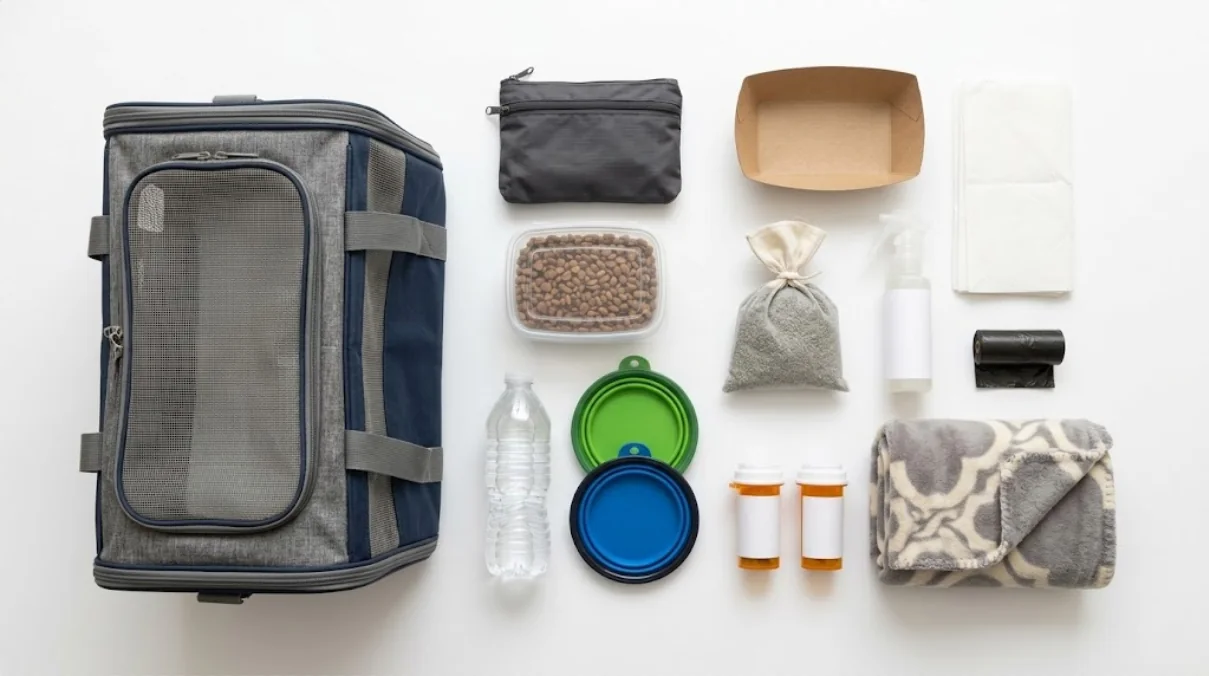
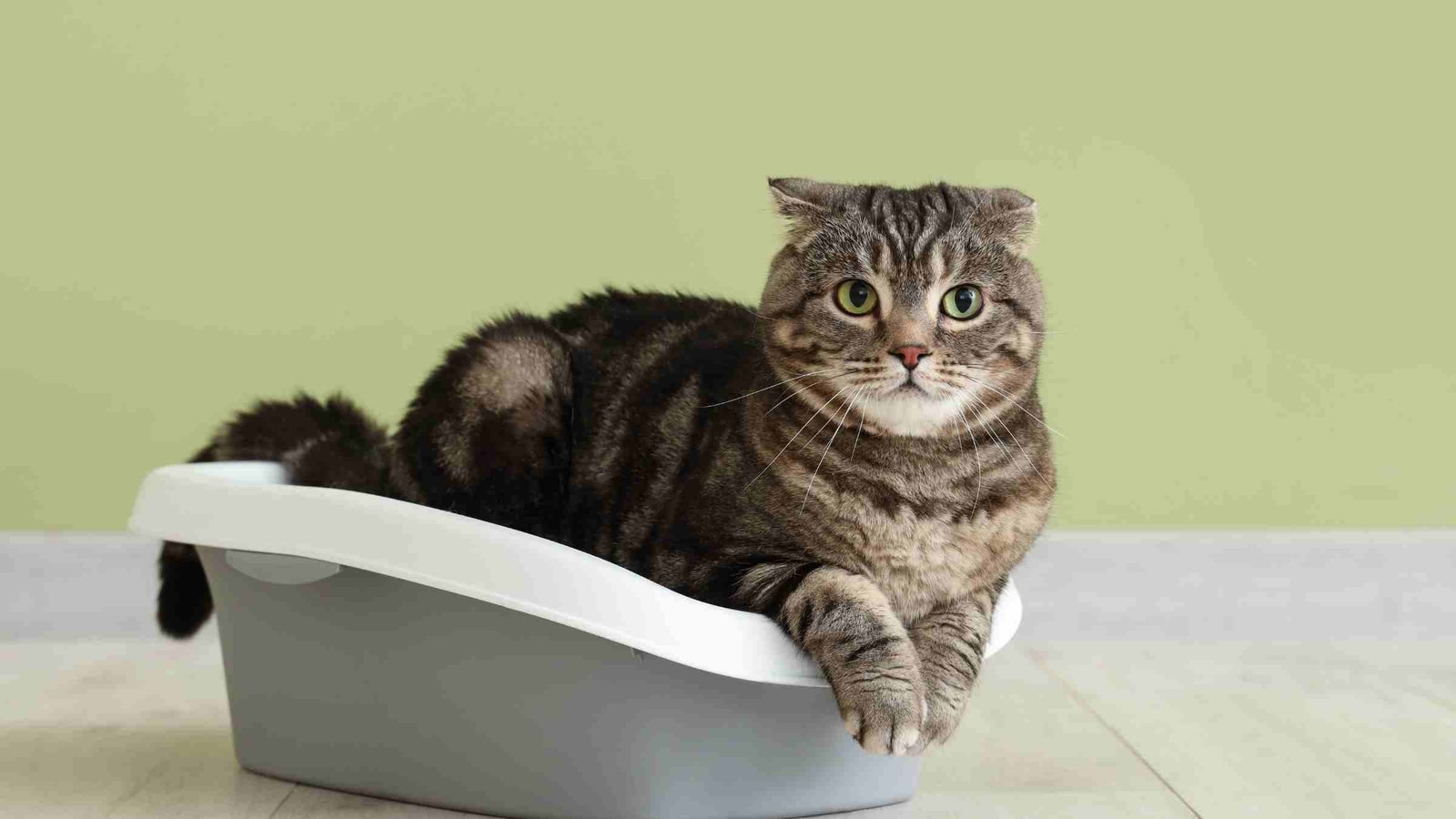
The “12-hour delay test”: If you got stuck for 12 hours, could your cat eat, drink, and use a litter tray safely—without changing routines?
Pack this (minimum kit)
Food + water
- Your cat’s usual food + 1–2 extra meals (avoid sudden diet changes during travel).
- Bottled/known water (some cats refuse unfamiliar water).
- Non-spill bowl or a spill-resistant travel dish (prefer something you can offer without fully opening the carrier if needed).
Litter + cleanup
- Your usual litter + a small disposable tray or lightweight pan.
- Poop bags, paper towels, and enzyme cleaner for accidents (enzyme cleaners remove odor better than standard sprays).
Health + documents (don’t skip)
- All prescribed meds in original containers + extra doses.
- Photo/PDF of medical records (conditions + medications) and your vet’s contact info. AVMA specifically recommends traveling with current copies of your pet’s medical records and medication information.
- If you’re traveling during an emergency season (storms, wildfires), the CDC’s pet preparedness kit checklist also emphasizes food, water, meds, and copied veterinary records.
Comfort + control
- Familiar blanket (home scent) + spare towel (backup bedding / cleanup).
- Harness/leash only if already trained (don’t introduce a new harness on travel day).
How to pack it (so it’s actually usable)
- Put everything in one grab-and-go bag (zip pouch inside for docs/meds).
- Keep meds + records in the same place every time (fast access matters).
- If flying, keep the kit essentials (meds, a small portion of food, wipes, documents) in your carry-on, not checked baggage.
What this looks like in a real home: In a small apartment, a disposable aluminum roasting pan can work as a temporary litter tray in a bathroom—lined with a thin layer of your regular litter so it smells “right.”
Tip 6) Keep the stomach calm: meals, water, and litter timing
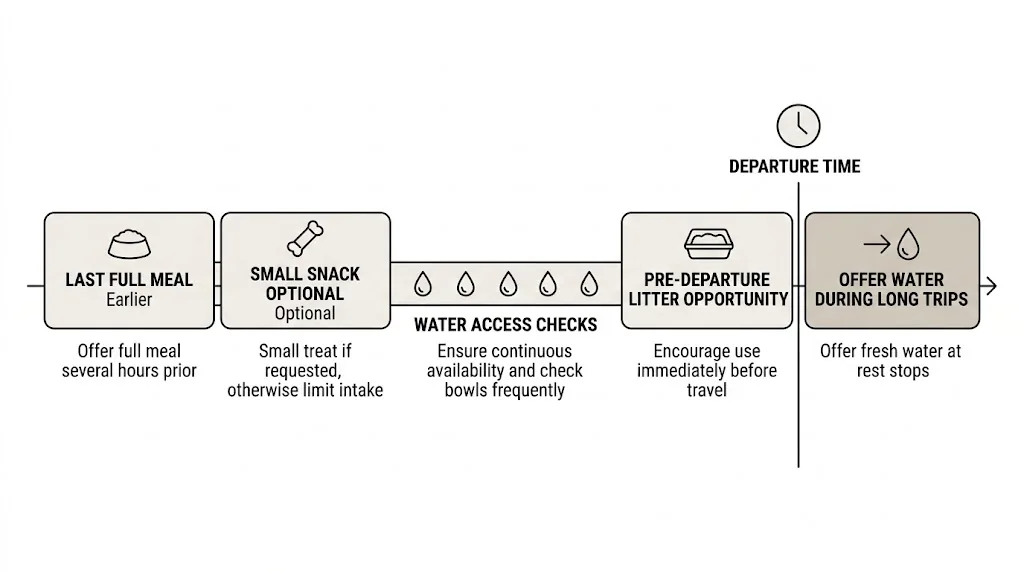
Snippet-ready takeaway: Most travel nausea and “accidents” improve when you keep your cat’s routine predictable: no big meal right before departure, steady access to water on long trips, and a familiar litter setup.
What to do (action-first)
- Keep the usual diet and meal rhythm. Sudden food changes + travel stress can stack.
- If your cat gets carsick, skip the “big pre-trip meal.” Pets commonly get motion sickness in cars; avoiding a large meal before travel can reduce an upset stomach.
- Hydration: prioritize “easy sips.” For longer journeys, plan regular checks/stops so your cat can access water as often as needed.
- Litter: keep it familiar. Use your cat’s regular litter type and offer a bathroom opportunity before you leave. For long trips, plan realistic elimination intervals and consider absorbent carrier liners if needed.
What to watch for (don’t push through it)
Motion sickness can show up as nausea, drooling/excess salivation, vomiting, diarrhea, yawning, whining, or uneasiness. If symptoms reliably happen even on short rides, scale back training and talk with your vet.
Medication note
Don’t self-prescribe human/dog anti-nausea meds—some common motion-sickness meds used in dogs/people aren’t effective in cats, and your veterinarian can prescribe an appropriate option if needed.
If your cat has repeated vomiting, drooling, or extreme distress during short practice drives, talk with your veterinarian before the real trip.
Tip 7) Traveling with a cat in the car: safest setup + temperature rules
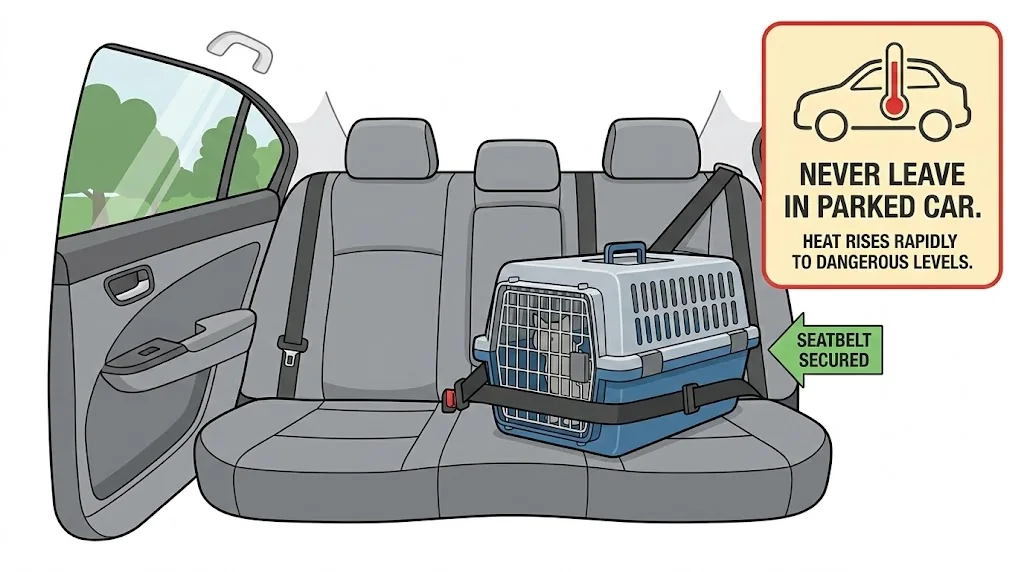
Two non-negotiables: (1) secure containment and (2) no heat/cold exposure.
Safest car setup (do this every ride)
- Carrier stays closed and secured the whole drive. A loose cat can panic, distract you, and wedge under pedals.
- Back seat is the safest location. Place the carrier on the back seat and seat-belt it in so it can’t slide or tip. The FDA (citing AVMA) highlights the back seat, properly restrained in a crate/carrier/safety harness, to reduce distraction and injury risk.
- Stability = comfort. Keep the carrier level and supported from underneath (less “swinging earthquake” feeling).
Temperature rules (zero exceptions)
- Never leave your cat unattended in a parked car—ever. Even “mild” days and “cracked windows” are unsafe; AVMA warns cars can quickly reach dangerous temperatures even in shade, and cracking windows doesn’t help.
- If the car isn’t comfortable for you without A/C or heat running, it’s not safe for a cat.
Stops and “rest breaks” (what to do instead)
- For most cats, a “break” is quiet time with the carrier still closed (music off, windows up, calm voice).
- Don’t open car doors with the carrier open. Parking lots are high-escape-risk zones.
What this looks like in a real home: If you’re traveling solo, put your cat’s carrier in the back seat, seat-belted in, before you load the rest of the car—so you’re not juggling bags while your cat is waiting.
Tip 8) Calming supports (without knocking your cat out)
Best first-line calmer: predictable practice + carrier training. Calming add-ons work best after your cat already feels somewhat safe in the carrier.
What to do (low-risk supports)
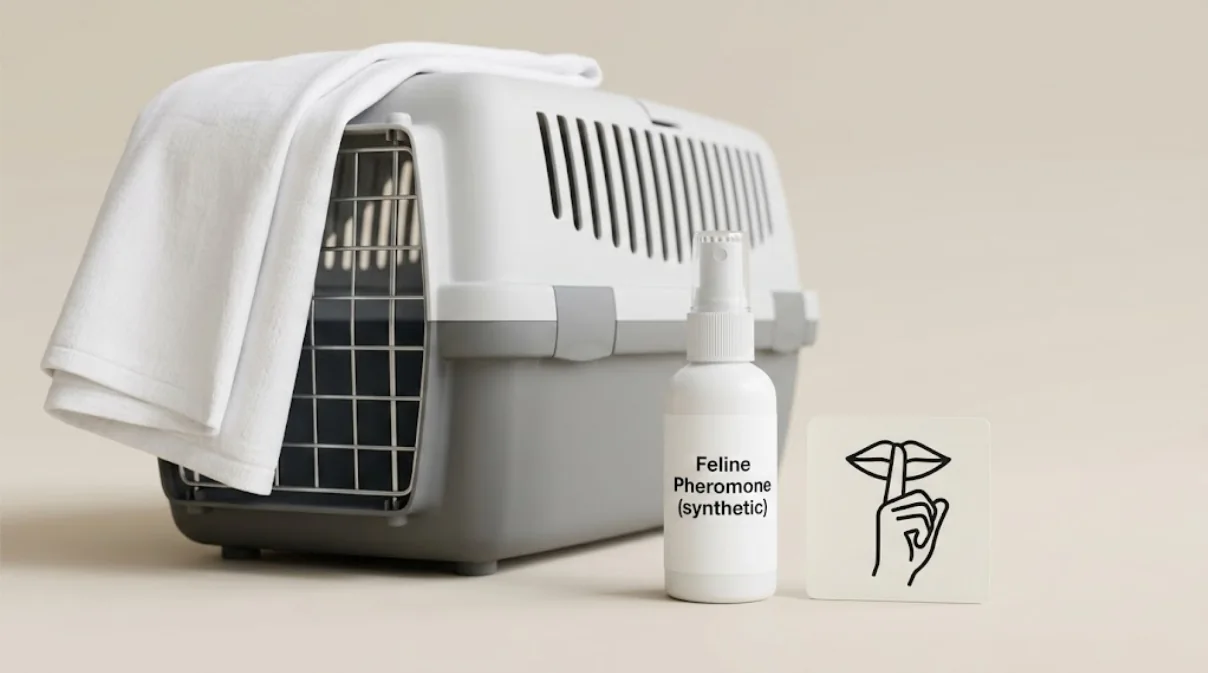
- Create a “cave.” Cover the carrier with a towel/blanket that smells like home to reduce scary sights/sounds and help your cat feel hidden and secure.
- Consider synthetic feline pheromones (optional). Spray a blanket (or the carrier bedding) 15 minutes to 4 hours before travel and let it dry; keep your cat away while spraying.
- Keep the environment boring. Stable carrier + calm handling + minimal noise tends to outperform “more gadgets” for many cats.
About medication (vet-guided, not DIY)
- Some cats benefit from veterinarian-prescribed pre-travel medication when training alone isn’t enough; AAFP guidance notes this can reduce stress for difficult trips.
- Do a home “test run” first (same timing, same setup) so you don’t discover side effects on travel day.
About sedatives (especially for flights)
- Some airlines won’t accept sedated/tranquilized cats and warn of higher respiratory/cardiovascular risk at altitude—so always check policies and follow your veterinarian’s direction.
- Routine tranquilization for air transport is not recommended; if used at all, it should be under veterinary instruction with awareness of air-travel conditions.
If your cat has severe travel anxiety, ask your vet for an individualized plan and do a test run at home—never try a new medication for the first time on travel day.
Tip 9) Hotels & arrivals: create a 10-minute “basecamp”
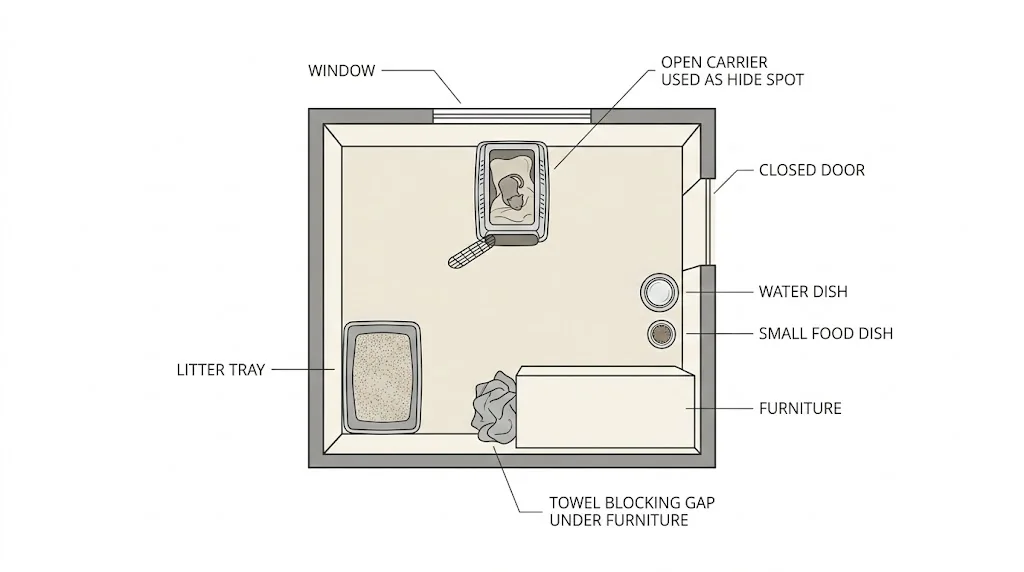
In a new place, start your cat in one closed, quiet “basecamp” room with litter, water, food, a hiding option, and the carrier left open—then let them emerge on their own timeline before expanding access.
Cats are territory-first animals. A whole hotel room (or rental) is a flood of new smells, sounds, and hiding gaps. A basecamp lowers “stress stacking” and prevents the two biggest travel risks: bolting and hiding where you can’t reach them.
The 10-minute basecamp checklist (do this before opening the carrier)
- Pick one quiet room: bathroom or bedroom is ideal (fewer exits, easier to control).
- Make it escape-proof: close the door; check windows/balcony; block unsafe gaps (under beds, behind headboards) with towels/luggage.
- Set up the essentials (in a simple layout):
- Litter tray (furthest from food/water)
- Water + small food portion (don’t push a big meal immediately)
- Hidey option (carrier counts; add a towel-draped corner or box)
- Carrier placed as a “safe cave,” door open
- Reduce surprises: hang “Do Not Disturb” (or request no housekeeping), keep TV volume low, limit new people entering.
- Release without forcing: open the carrier and wait. No pulling, no chasing, no “look, it’s fine!” tours.
What this looks like in a real home: In a hotel, hang the “Do Not Disturb” sign and place the carrier in the closet or bathroom corner with the door open—many cats decompress faster when they can choose privacy. Hotels & arrivals: create a 10-minute “basecamp”
Tip 10) Flying with a cat: airline rules, TSA screening, and crate training
A smooth flight with a cat usually comes down to three things: (1) an airline-compliant carrier your cat is already comfortable in, (2) knowing the TSA screening steps ahead of time, and (3) keeping the day predictable—no last-minute surprises.
1) Before you book: confirm the airline rules (they vary)
- Airlines set their own pet policies (in-cabin availability, fees, carrier size, per-flight limits, seasonal temperature rules). Confirm on the airline site and call to reconfirm.
- Reserve the in-cabin pet spot early—many airlines limit how many pets can be in the cabin on one flight.
- If your route includes connections, re-check rules for every leg (one “yes” doesn’t guarantee the whole itinerary works).
2) Carrier/crate requirements: size + comfort + stability
- Under-seat space is tight; only small cats + small carriers will fit.
- Use a carrier that lets your cat sit/stand, turn around, and lie naturally; IATA emphasizes these minimum comfort/sizing standards for air travel containers.
- Train weeks ahead: introduce the carrier well before travel so confinement stress is lower on flight day.
- Practical add-on: skip “new carrier on travel day.” It’s one of the easiest preventable stress triggers.
3) TSA screening (U.S.): what will happen and how to stay safe
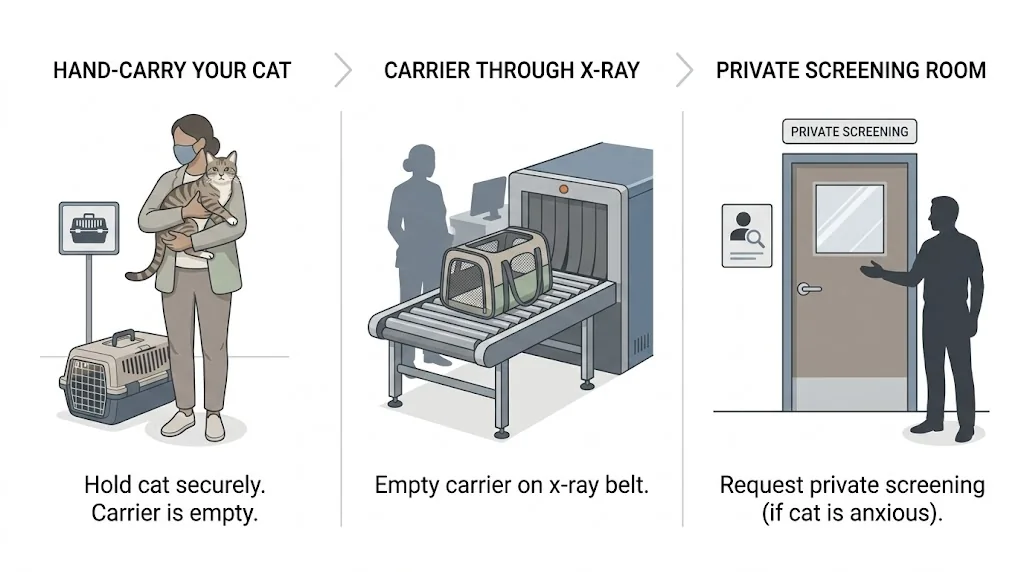
TSA’s standard process for small pets is:
- Remove your cat from the carrier at screening.
- Send the empty carrier through the X-ray.
- Keep control of your cat while you pass through screening.
Cat-specific safety move (highly recommended):
- If your cat may bolt or panic when removed, request a private screening room—TSA explicitly recommends this for skittish pets.
- After screening, re-secure your cat in the carrier at the re-composure area (away from the busy checkpoint).
- Use a harness/leash only if your cat is already trained—don’t introduce new gear at the airport.
Note: TSA procedures apply to U.S. airports. Other countries’ security processes can differ—check the departure airport’s guidance.
4) During the flight: keep it simple and consistent
- Keep the carrier closed and under the seat as required by the airline; IATA guidance also notes pets should not be removed and the container should not be opened during flight.
5) Medication note (trust + safety)
- Sedation/tranquilization is generally advised against for in-cabin air travel except under a veterinarian’s direction; IATA notes risks and that airlines may refuse sedated animals.
- Some airlines also state they won’t accept sedated cats/dogs and cite higher altitude-related respiratory/cardiovascular risk.
Cat-specific TSA safety move: ask for a private screening room if available, keep a secure harness on your cat if they’re trained to it, and re-secure your cat back into the carrier before you collect your other bags.
Quick decision table: “What kind of trip is this?”
Use this like a checklist: pick your trip type → follow the “non-negotiables” → add the one “highest-leverage” comfort move.
| Trip type | Safest setup (non-negotiables) | Biggest stress / safety risk | Best “make-it-easier” move (highest leverage) |
|---|---|---|---|
| Short car ride (<1 hour) | Cat rides in a secure carrier, seat-belted in the back seat; car stays cool; no free-roaming in cabin (AVMA/FDA guidance) | Carrier fear + sudden noises/turns | Carrier = furniture daily (door open, treats inside) + 1–3 minute practice drives |
| Long road trip (multi-hour) | Secure carrier in back seat; stable temperature; plan “quiet breaks” with doors closed; never leave cat in a parked car (AVMA heat safety) | Heat risk + escape risk during stops | Do not open the carrier in parking lots; pre-plan a litter strategy (regular litter + simple tray in a closed room) |
| Hotel / new place (overnight) | Start with a single “basecamp room” (bathroom/bedroom): litter, water, food, hiding spot, carrier open | Bolting/hiding in unfamiliar space | Set up litter + water before opening the carrier; keep door closed while moving luggage |
| Flying (in-cabin) | Airline-approved under-seat carrier; arrive early; expect security screening where pet is removed and carrier is X-rayed (TSA) | Airport noise + handling at security | Request private screening when available; keep routine minimal; use only pre-trained harness if needed |
| Flying (hold/cargo, where applicable) | IATA-style rigid crate sized for stand/turn/lie naturally; airline coordination; temperature/season restrictions apply (IATA) | Handling + temperature variables | If possible, choose alternatives (in-cabin, ground travel) or get vet guidance for anxiety/motion sickness well ahead of time |
Notes for trust & safe use
- Policies vary by airline, destination, and season. Confirm requirements each trip using official sources (below).
- If your cat has severe anxiety, repeated vomiting, breathing trouble, collapse, or urinary straining, pause travel plans and contact a veterinarian.
Simple timeline checklist
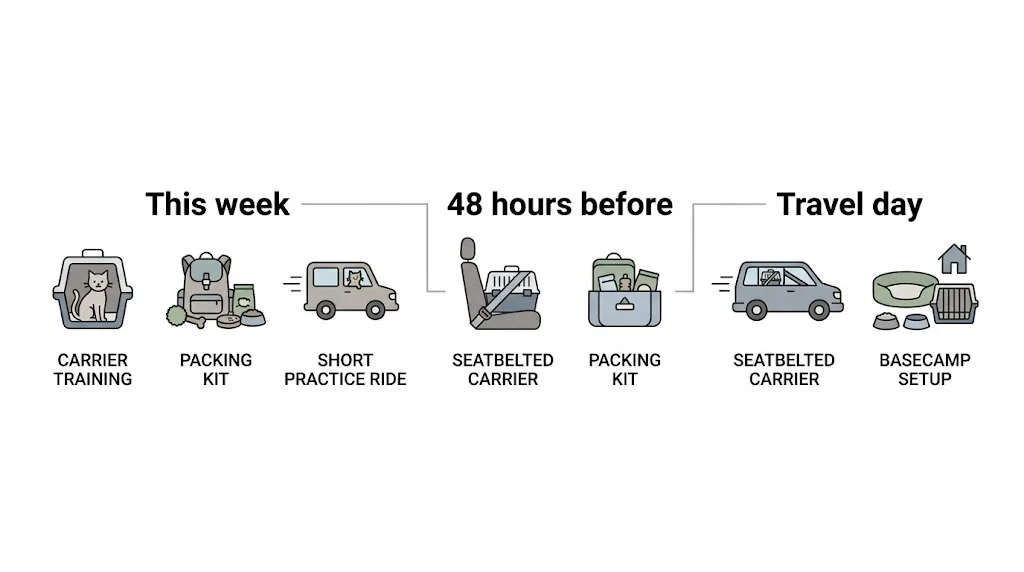
This week (or as soon as you decide to travel—earlier for flights/international)
- Carrier stays out daily (door open) + 1–3 minutes of treats/meals in/around it.
- Confirm lodging is pet-friendly (fees, weight limits, “do not disturb” rules) and choose a quiet “basecamp” room for arrival.
- Save an emergency vet near your destination (address + phone) in your phone.
- If flying/international: verify airline + destination requirements and start your paperwork timeline with a vet early.
48 hours before
- Pack your cat kit + paperwork (food, water, bowls, litter plan, meds, cleaning supplies, records).
- Confirm ID basics: tag (if tolerated), microchip contact info updated, and a clear phone photo.
- Do one short practice ride (5–10 minutes) if your cat is new to travel—end on a calm note.
- If your cat gets car nausea: skip a large pre-trip meal.
Travel day
- Secure the carrier in the back seat (seat-belted/anchored so it won’t slide) and keep the car cool + quiet.
- Never leave your cat unattended in a parked car—temps can rise fast (≈20°F in ~10 minutes).
- Keep stops simple: doors closed, carrier stays closed (parking lots = escape risk).
- If flying: arrive early and plan TSA screening—pet comes out, carrier is X-rayed; never X-ray the pet (ask for private screening if needed).
- Safety check: if your cat has repeated vomiting, trouble breathing, collapse, or extreme distress, pause and contact a veterinarian.
Conclusion
Traveling with a cat is safest—and least stressful—when you train the routine in advance instead of trying to “power through” on travel day. Start weeks ahead by making the carrier a familiar safe room, then keep the trip predictable: secure carrier restraint, stable temperature, and a simple arrival setup that lets your cat decompress and regain a sense of control.
Quick recap (citable takeaways):
- Train, don’t rush: carrier out daily + short, reward-based practice sessions.
- Safety first: cat rides contained and secured (never loose in the car).
- Plan the basics: ID/microchip info, records/paperwork, food/water, litter plan, cleanup kit.
- Arrive calmly: start with a one-room “basecamp” (litter, water, hide spot, open carrier) before expanding space.
- Rules change: for flights/international trips, verify airline + destination requirements every trip.
If your cat shows repeated vomiting, heavy drooling/panting, collapse, trouble breathing, or straining to urinate, pause travel and contact a veterinarian promptly.
Want more step-by-step routines like this? Explore SnuggleSouls’ Daily Care and Behavior guides for carrier confidence and low-stress habit building at home.
FAQ
Should I bring my cat, or is it kinder to leave them at home?
If your cat panics in the carrier or gets sick from stress, staying home with a reliable sitter is often kinder than forcing a short trip. Travel makes most sense for relocations or longer stays where routine can be rebuilt.
How early should I start carrier training?
Start well before the trip—days to weeks for confident cats, longer for anxious cats—so the carrier becomes a normal safe space.
What’s the safest way to transport a cat in a car?
The safest setup is a secured carrier in the back seat (or otherwise restrained so it won’t shift), which reduces distraction and injury risk.
Can I let my cat roam free in the car to “calm down”?
No—free-roaming pets can distract the driver and are at higher risk of injury; use a properly secured carrier instead.
Should I open the carrier during rest stops?
Usually no—opening the carrier during travel increases escape risk and can make stress worse.
What are “stop now and see a vet” warning signs during travel?
Seek urgent veterinary care if your cat has difficulty breathing (especially open-mouth breathing), collapses/weakness, persistent vomiting, or can’t pass urine/strains repeatedly.
How do I help a cat who cries nonstop in the car?
Start smaller: carrier comfort first, then sit in a parked car for 1–2 minutes, then tiny drives. If crying escalates to panting/drooling/vomiting, pause and ask your vet for help.
Should I use a harness for travel?
Only if your cat is already harness-trained. A brand-new harness on travel day can cause panic and escape attempts.
Do I need a litter box on a short trip?
Usually not for short rides, but it’s smart for multi-hour trips or hotel stays. Use your regular litter and a simple tray.
References
American Association of Feline Practitioners (AAFP) & International Society of Feline Medicine (ISFM). Getting Your Cat to the Veterinarian: Reducing the Stress of Veterinary Visits for You and Your Cat (Client Brochure).
American Association of Feline Practitioners (AAFP) & International Society of Feline Medicine (ISFM). Getting Your Cat to the Veterinarian — Practical Tips (handout/PDF mirror).
U.S. Food & Drug Administration (FDA). Travel Training for You and Your Pets.
American Veterinary Medical Association (AVMA). Pet safety in vehicles (Pets in Vehicles).
Centers for Disease Control and Prevention (CDC). Pet Travel Safety (Healthy Pets, Healthy People): Keeping pets safe in the car.
Transportation Security Administration (TSA). TSA tips on traveling with pets through a security checkpoint (press release).
International Air Transport Association (IATA). Traveling with Pets.
American Airlines Cargo. Policies & Restrictions — Sedation Policy.
American Veterinary Medical Association (AVMA). Traveling with your pet FAQ.
American Veterinary Medical Association (AVMA). Microchipping Your Pet (Client Brochure).
Merck Veterinary Manual (Cat Owners). Motion Sickness in Cats.
Cornell University College of Veterinary Medicine — Cornell Feline Health Center. Feline Lower Urinary Tract Disease (FLUTD).







 EN
EN DE
DE ES
ES PT
PT