
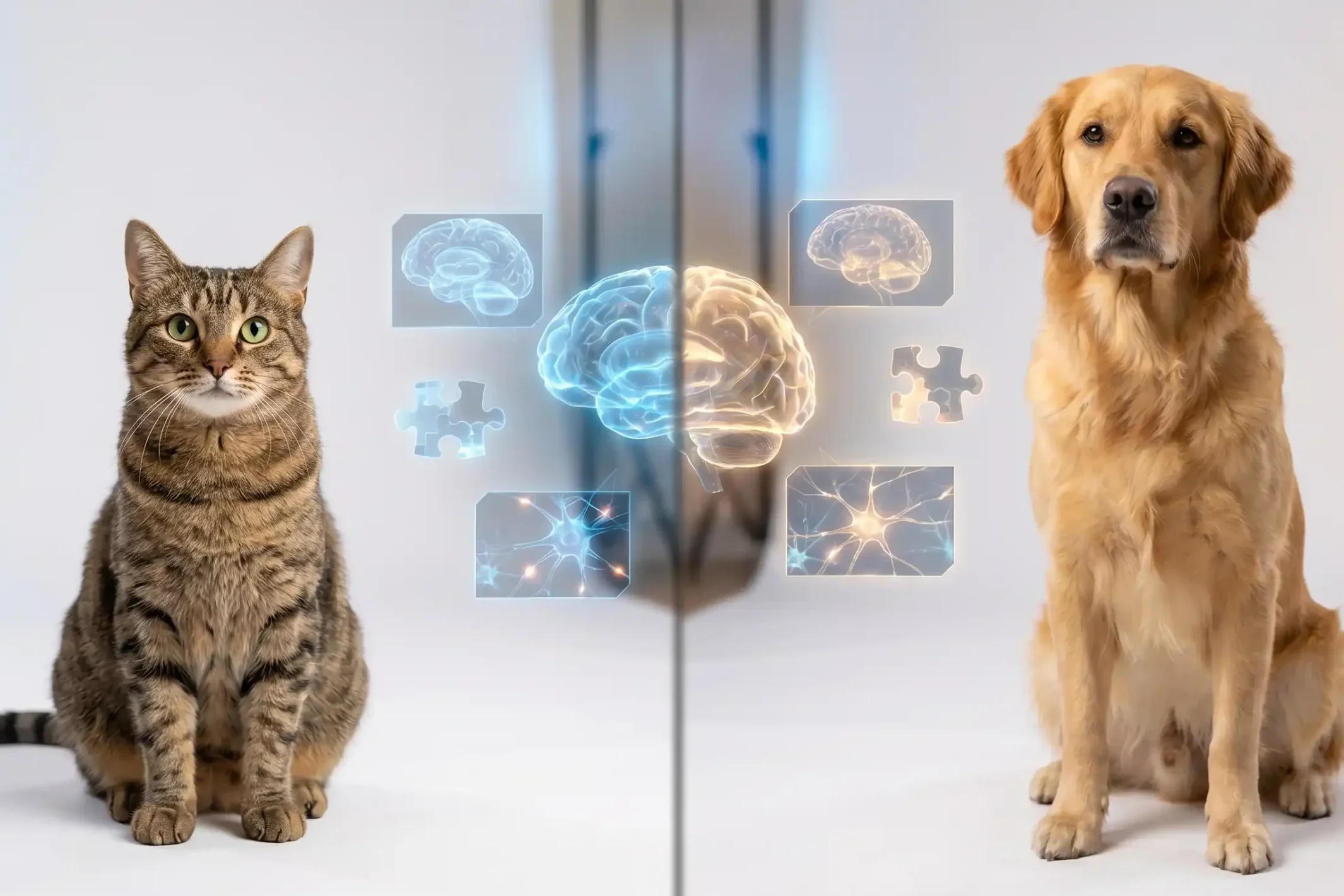
Science cannot fairly declare cats or dogs smarter overall. Dogs often perform well in tasks involving human gestures, cooperation, and trained responses. Cats can learn routines, recognize familiar words and voices, remember useful information, and solve problems when motivated. The result depends on which ability is tested, how the test is designed, and whether the animal wants to participate.
Table of Contents
- Why is it difficult to compare cat and dog intelligence?
- What cognitive abilities do cats show?
- What cognitive abilities do dogs show?
- Do dogs have more neurons than cats?
- Does trainability mean a dog is smarter?
- How can I observe my cat’s intelligence fairly?
- When can a behavior change signal a health problem?
- Conclusion
- Frequently Asked Questions
- References
Why is it difficult to compare cat and dog intelligence?
Intelligence is not one ability. Learning, memory, self-control, navigation, social communication, problem-solving, and adapting to change can produce different winners, even within the same species.
| Comparison problem | Why it changes the result |
|---|---|
| The task favors human cooperation | Dogs may be more willing or practiced at following a person’s cue |
| The reward is not motivating | A capable cat or dog may simply stop participating |
| The setting is unfamiliar or stressful | Caution can look like failure |
| Training history differs | Practice improves performance without proving greater general intelligence |
| Breed, age, health, and personality differ | Individual variation can exceed the species-level difference |
| One test is treated as a full IQ score | Success in one domain does not measure every cognitive ability |
A comparative review argued that dog cognition should be understood within the abilities of other social carnivores and domesticated animals, rather than treating dogs as universally exceptional.3 The same caution applies to cats: a species should not be judged unintelligent because it behaves differently from a dog in a dog-friendly test.
What cognitive abilities do cats show?
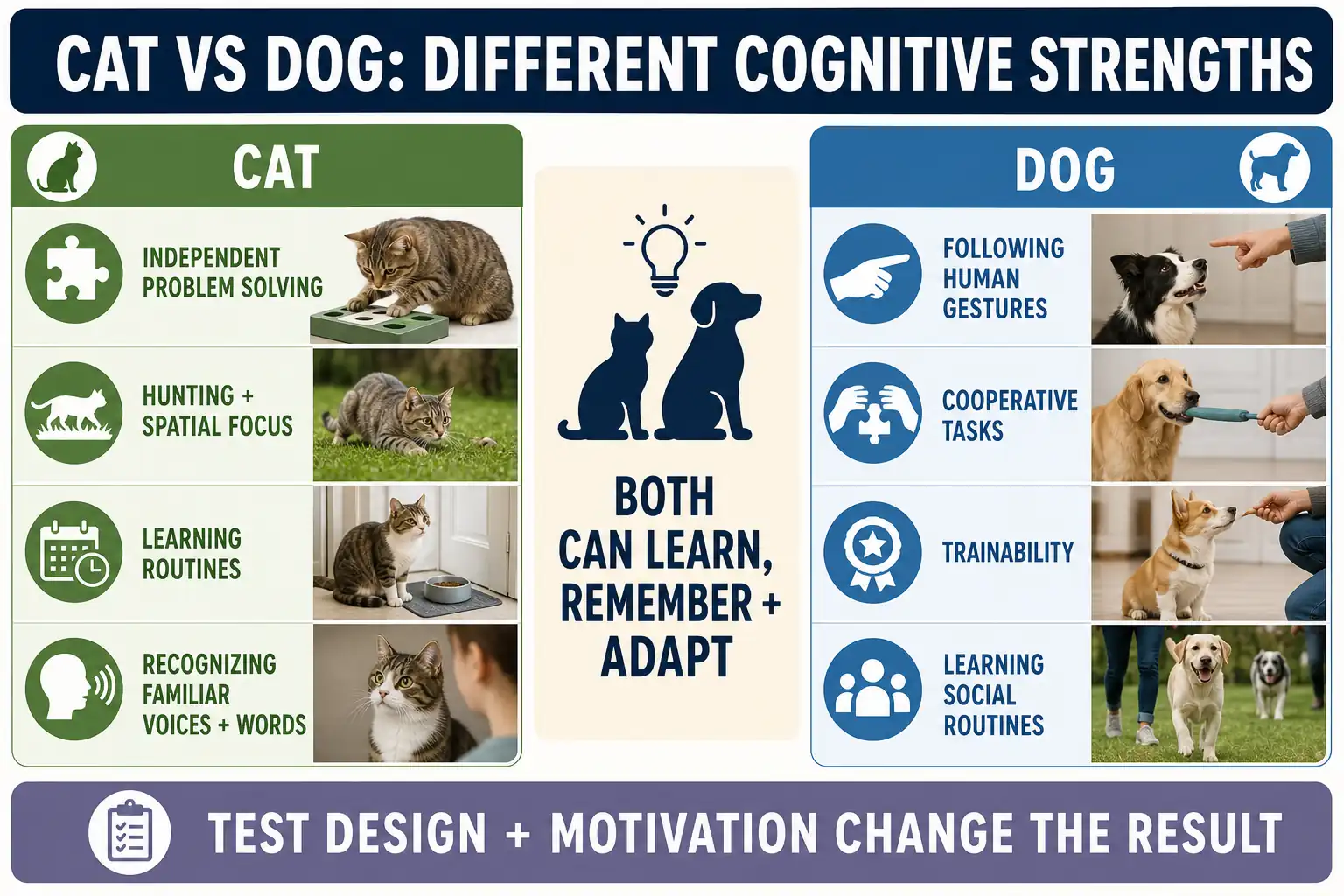
Cats demonstrate learning, memory, attention, and sensitivity to meaningful human signals. Their abilities can be easy to underestimate because cats may be less willing than dogs to repeat unfamiliar tasks on command.
Cats can learn meaningful words and voices
In a controlled study, domestic cats distinguished their own names from other words, even when an unfamiliar person spoke them.1 That does not mean cats understand names exactly as humans do, but it shows they can learn that a particular sound has special relevance.
Another study found evidence that cats mentally tracked their owner’s unseen location after hearing the owner’s voice from different places.2 This suggests cats use familiar auditory information to build expectations about where an important person is.
Cats learn routines and consequences
Many cats learn meal times, the sound of a treat container, where toys are stored, which doors open, and what behavior gains attention. A cat that does not perform a requested trick may still have learned the cue and decided that the reward or situation is not worthwhile.
Cats solve species-relevant problems
Cats are adapted to notice small movements, navigate vertical spaces, wait, stalk, and make rapid hunting decisions. Those skills may not appear in a test built around pointing, retrieving, or sustained cooperation with a person.
Behavior also communicates what a cat has noticed. The guides to cat tail language and why cats wiggle before pouncing can help you observe attention and arousal without turning every movement into a claim about intelligence.
What cognitive abilities do dogs show?
Dogs often excel at reading human actions, cooperating, and performing learned behaviors in structured settings. Their long history of selection for work alongside humans helps make many dogs attentive and responsive partners.
Common dog strengths include:
- following pointing and gaze cues
- learning verbal and visual signals
- cooperating with people on repeated tasks
- performing trained sequences
- seeking human help when a problem cannot be solved
- adapting behavior to household and working routines
These strengths are real, but they do not prove dogs are better at every cognitive task. Dogs vary enormously by individual, breed history, training, age, and motivation. A highly trained dog and an untrained cat are not a fair species comparison.
The most accurate answer is that dogs often make their learning more visible to humans. They may look smarter in tasks where success means watching a person, responding quickly, and repeating the behavior.
Do dogs have more neurons than cats?
One study estimated that dogs have more neurons than cats in the cerebral cortex, the brain region sampled in the comparison.4 This finding is interesting, but neuron count is not a direct IQ test and cannot by itself establish how intelligent an individual animal is.
Brain comparisons require caution:
- estimates depend on the sampled animals and measurement methods
- more neurons do not identify which cognitive skills are strongest
- brain organization and connectivity also matter
- behavior is influenced by motivation, sensory abilities, development, and experience
- a species-level average cannot rank individual pets
It is reasonable to say that the study found a difference in estimated cortical neuron counts. It is not reasonable to turn that difference into a universal statement that every dog is smarter than every cat.
Does trainability mean a dog is smarter?
Trainability measures how readily an animal learns and performs behaviors under particular conditions. It is useful, but it is not identical to general intelligence.
| What you observe | What it may reflect |
|---|---|
| Responds quickly to a cue | Learning history, motivation, attention, and clarity of training |
| Stops participating | Stress, low-value reward, fatigue, distraction, or task mismatch |
| Solves a puzzle without looking at a person | Persistence and independent exploration |
| Looks to a person for help | Social communication and learned cooperation |
| Learns a household routine | Memory, prediction, and reinforcement history |
| Avoids a previously unpleasant situation | Memory and adaptive decision-making |
A cat may learn a behavior but perform it only when the reward is valuable. A dog may enthusiastically repeat a trained response but struggle with a different independent task. Neither example produces a complete intelligence ranking.
Avoid punishment when training either animal. Reward-based, short, voluntary sessions reveal more about learning than forcing an anxious or disengaged pet to continue.
How can I observe my cat’s intelligence fairly?
Give your cat safe choices, appropriate motivation, and time to investigate. The goal is enrichment and observation, not proving that your pet can beat another species.
Try this low-pressure approach:
- Choose a simple cat-appropriate puzzle with an easy starting level.
- Use a small portion of a familiar food or favorite toy as the reward.
- Introduce the puzzle in a quiet, familiar room.
- Demonstrate only if the cat remains interested; do not repeatedly point or move the cat’s paws.
- Stop before frustration or stress develops.
- Repeat on another day before drawing conclusions.
- Increase difficulty gradually after the cat succeeds.

Useful observations include how the cat approaches a new object, remembers where rewards are hidden, changes strategy, asks for help, or returns later. A cat that leaves may be communicating that the task, reward, or setting is not worth the effort.
If your cat becomes frustrated or defensive, stop. The guide to why cats bite can help distinguish play, fear, and overstimulation. A cat that prefers social contact over puzzles may show its learning through household routines and affection; see why some cats are especially cuddly.
When can a behavior change signal a health problem?
A sudden decline in learned behavior, navigation, interaction, or response to familiar cues may reflect pain, sensory loss, stress, or illness rather than lower intelligence. Focus on change from your pet’s normal baseline.
Contact a veterinarian if you notice:
- sudden confusion or getting stuck in familiar spaces
- new difficulty finding food, water, or the litter box
- a major change in sleep, appetite, activity, or social behavior
- no response to familiar sounds, especially with other changes
- new weakness, imbalance, circling, or apparent vision problems
- persistent hiding or withdrawal
- sudden irritability or pain during normal handling
Do not use home intelligence games to assess a pet that seems unwell. Record what changed, when it began, and any related physical signs, then speak with a veterinarian. The guide to why cats hide can help you describe context, but it cannot diagnose the cause.
Conclusion
Cats are not simply less-intelligent versions of dogs, and dogs are not just more-trainable cats. Each species brings different sensory priorities, social histories, motivations, and problem-solving styles to a test. Dogs often shine when the task involves human cooperation; cats may reveal more when they can explore independently and the reward matters to them.
The better question is not which species wins. Ask what your individual pet notices, learns, remembers, and enjoys doing. Use that knowledge to provide suitable enrichment, communicate more clearly, and recognize when a sudden behavior change deserves veterinary attention.
Frequently Asked Questions
Are cats smarter than dogs?
Science does not support a single overall winner. Cats and dogs show different strengths, and results depend on the cognitive ability, test design, training history, and motivation.
Are dogs smarter because they are easier to train?
No. Trainability is one useful ability, especially for human-directed tasks, but it does not measure every form of learning, memory, or problem-solving.
Do cats understand their names?
Research shows that cats can distinguish their own names from other words. This demonstrates learned recognition, although it does not prove they understand names in the human sense.
Do dogs have more brain cells than cats?
One study estimated more cerebral-cortex neurons in dogs than cats. Neuron count is scientifically interesting, but it is not a direct IQ score or a complete measure of intelligence.
Why does my cat ignore commands it knows?
The cat may be distracted, stressed, tired, insufficiently motivated, or uninterested in repeating the task. Knowing a cue and choosing to respond are different things.
How can I make my cat smarter?
Provide safe enrichment, short reward-based learning sessions, predictable routines, climbing and hiding options, play, and appropriate food puzzles. The goal is healthy engagement, not an IQ ranking.
References
[1] Saito et al. Domestic cats discriminate their names from other words.
[2] Takagi et al. Socio-spatial cognition in cats: Mentally mapping owner’s location from voice.
[3] Lea and Osthaus. In what sense are dogs special? Canine cognition in comparative context.
[4] Jardim-Messeder et al. Dogs have the most neurons, though not the largest brain: Trade-off between body mass and number of neurons in the cerebral cortex of large carnivoran species.






 Why Does My Cat Flinch When Touched While Sleeping? Startle, Trust, and Pain Clues">
 Cat Scratching Baseboards: Trim Guards and Route Fixes">
 EN
EN DE
DE ES
ES PT
PT