

A complete room-by-room guide to cat-proofing your home before bringing your new cat home. Covers toxic plants, electrical cords, windows, safe rooms, and more.

The moment you decide to adopt a cat, something shifts. You start looking at your home differently — noticing the trailing cable behind the TV, the lily on the windowsill, the cabinet under the sink that's never had a lock. This is exactly the right instinct. Cat-proofing your home before your new companion arrives is one of the most meaningful things you can do as a first-time owner, and it's far less daunting than it sounds.
Cats are naturally curious, agile, and surprisingly determined. They will investigate every corner, climb every shelf, and chew on things that have no business being chewed. Most household hazards are easy to address once you know what to look for — and this guide will walk you through every room, every risk, and every practical fix, so that when your cat walks through the door, they walk into a home that's ready for them.
What You'll Find in This Guide
Why Cat-Proofing Your Home Is the First Step to a Happy Life Together
The ASPCA Animal Poison Control Center receives over 400,000 calls per year about potential pet poisonings, with household plants, human medications, and cleaning products among the most common causes.[1] Many of these incidents happen in the first weeks after adoption, when a new cat is still exploring an unfamiliar environment with maximum curiosity and minimum caution.
The good news is that the vast majority of these hazards are simple to address. You don't need to transform your home — you need to take a thoughtful walk through it. This guide is structured to help you do exactly that: starting with the most important step (the safe room), moving through each room in your home, and ending with how to make your space not just safe, but genuinely enriching for your new cat.
If you're still in the planning stages of adoption, our Complete Cat Adoption Guide covers the full journey from choosing a shelter to bringing your cat home. And if you're weighing the differences between adopting a kitten versus an adult cat, our guide on Kitten vs. Adult Cat can help you decide — the two require slightly different approaches to home preparation.
Start Here: Setting Up a Safe Room for Your New Cat
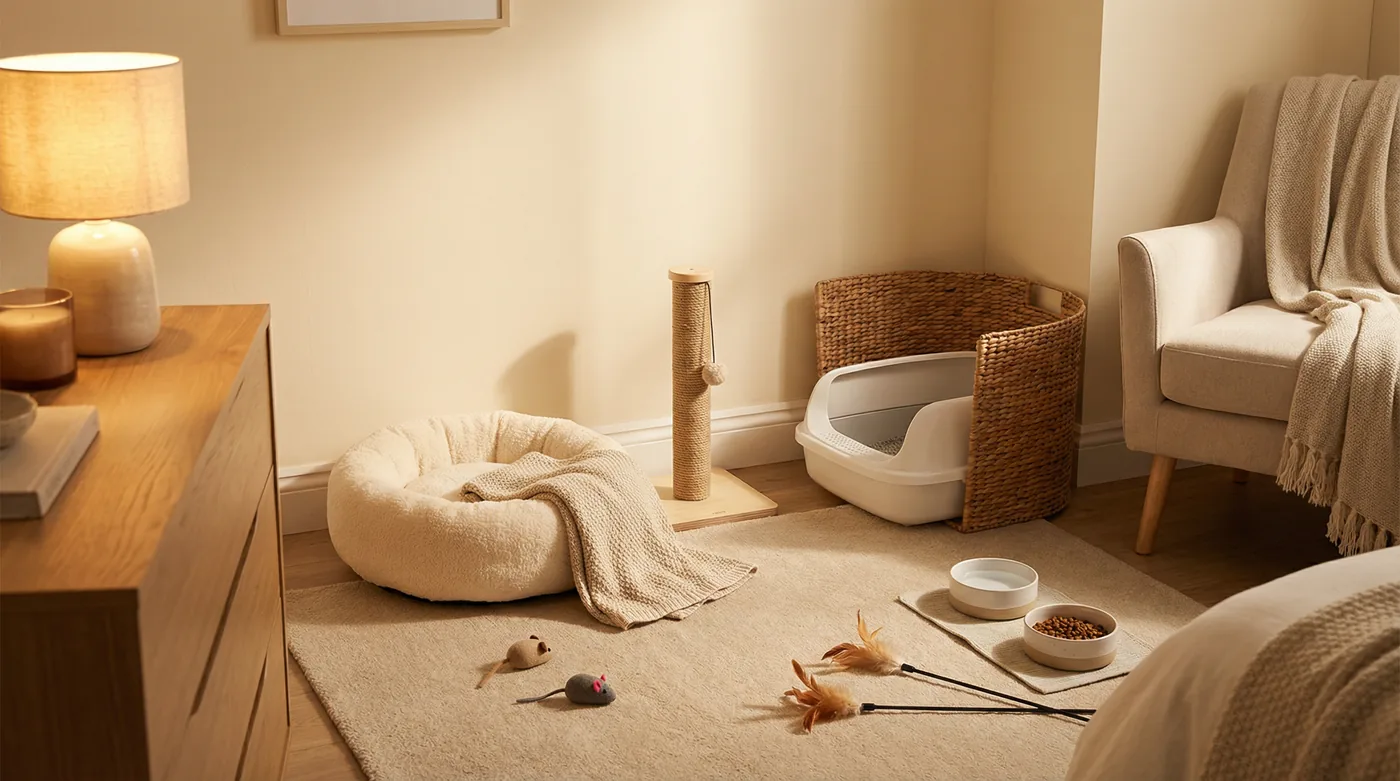
Before you cat-proof your entire home, focus your energy on one room. Animal behaviorists and shelter professionals consistently recommend giving a new cat a single, contained "safe room" for their first few days — or longer, for shy or anxious cats. This approach reduces overwhelm, helps your cat decompress, and gives you a fully controlled environment to get right before expanding access to the rest of the house.
A spare bedroom, a bathroom, or even a large walk-in closet can work well. The key is that the space is quiet, free of hazards, and set up with everything your cat needs. If you're wondering why your new cat might hide even in a well-prepared safe room, our article on Why Is My Cat Hiding explains the adjustment process in detail.
Safe Room Essentials Checklist
Room by Room: Your Complete Cat-Proofing Checklist

Once your safe room is ready, it's time to walk through the rest of your home with fresh eyes — specifically, with the eyes of a curious, agile, and occasionally reckless cat. The following room-by-room breakdown covers the most common hazards in each space and what to do about them.
Kitchen
- Install cabinet locks under the sink (cleaning products)
- Use a lidded trash can or cabinet-mounted bin
- Add stove knob covers — cats jump on counters
- Keep plastic bags in a closed drawer
- Secure toxic foods: onions, garlic, grapes, xylitol
- Never leave sharp utensils on counters
Bathroom
- Keep toilet lid down (drowning risk for kittens)
- Lock all medications in a closed cabinet
- Remove hair ties, rubber bands, dental floss
- Store razors and sharp objects out of reach
- Avoid essential oil diffusers (many are toxic)
- Keep cleaning products in locked cabinet
Living Room
- Install cord covers on all electrical cables
- Secure tall, top-heavy furniture to the wall
- Move breakables off low shelves
- Never leave candles unattended
- Use a fireplace screen
- Pick up small objects: buttons, coins, rubber bands
Bedroom
- Keep medications off the nightstand
- Store jewelry and small accessories in a box
- Remove elastic hair ties (top cause of intestinal obstruction)
- Keep closet doors closed
- Check under the bed before closing doors
- Secure any loose cords from lamps or chargers
Laundry Room
- Always check washer and dryer before starting
- Store detergent pods securely — highly toxic if chewed
- Keep dryer sheets out of reach (toxic to cats)
- Block access behind appliances
- Keep the room door closed when not in use
Home Office
- Manage all computer and monitor cables
- Keep rubber bands and paper clips in a drawer
- Store pens and markers away (ink can be toxic)
- Secure thin charging cables — most tempting for kittens
- Keep printer paper in a closed tray
For guidance on what foods are and aren't safe for your cat, our articles on What Can Cats Eat and Can Cats Eat Tuna provide detailed, vet-informed breakdowns. And if you're curious about dairy, Can Cats Drink Milk addresses one of the most common misconceptions about feline nutrition.
The Plant Problem: Common Houseplants That Are Toxic to Cats
This is the section that surprises most first-time cat owners. Many of the most popular houseplants — the ones you'll find in every interior design blog and home décor store — are genuinely toxic to cats. The ASPCA maintains a list of over 400 plants toxic to cats,[2] and the table below covers the ones most likely to be found in a typical home.
| Plant Name | Toxicity Level | Symptoms if Ingested |
|---|---|---|
| Lilies (all species, incl. Easter, Tiger, Asiatic) | SEVERE | Vomiting, lethargy, kidney failure — can be fatal in small amounts |
| Sago Palm | SEVERE | Vomiting, seizures, liver failure — all parts are toxic |
| Azalea / Rhododendron | SEVERE | Vomiting, drooling, heart arrhythmia, weakness |
| Autumn Crocus | SEVERE | Vomiting, GI bleeding, multi-organ failure |
| Tulips & Hyacinths | MODERATE | Vomiting, drooling, diarrhea (highest concentration in bulb) |
| Daffodil / Narcissus | MODERATE | Vomiting, diarrhea, tremors, cardiac arrhythmia |
| Dieffenbachia | MODERATE | Oral irritation, drooling, difficulty swallowing |
| Pothos / Devil's Ivy | MILD–MOD | Oral irritation, vomiting, drooling |
| Monstera | MILD–MOD | Oral irritation, vomiting, drooling |
| Aloe Vera | MILD–MOD | Vomiting, diarrhea, lethargy |
| English Ivy | MILD–MOD | Vomiting, diarrhea, drooling, abdominal pain |
If you're not ready to give up your houseplants entirely, consider replacing toxic varieties with cat-safe alternatives. The following plants are confirmed non-toxic to cats by the ASPCA:
ASPCA Animal Poison Control Center
If you suspect your cat has ingested a toxic plant or substance, call immediately: (888) 426-4435. Available 24 hours a day, 7 days a week. A consultation fee may apply. You can also use the ASPCA's online resources to check specific plants and substances.
Electrical Cords: A Hidden Danger You Can Fix in an Afternoon
Electrical cord chewing is one of the most common — and most preventable — hazards for cats, especially kittens. The behavior can be driven by boredom, the texture of the cord, or simply the irresistible appeal of something that dangles. The consequences range from minor burns to electrocution. The good news is that this is one of the easiest hazards to address systematically.
Do a cord audit
Walk through every room and identify all exposed cords — TV, computer, lamps, phone chargers, kitchen appliances. Note which ones are at floor level or within jumping distance.
Install cord covers or concealers
Flexible split loom tubing, cord covers, or cable management boxes encase cords in a hard plastic shell that is difficult to chew through. These are inexpensive and available at any hardware store.
Apply bitter apple spray
Bitter apple spray is a safe, non-toxic deterrent that makes cords taste unpleasant. Apply it to any cords that can't be fully covered. Reapply every few days initially.
Unplug appliances not in regular use
An unplugged cord is a safe cord. For appliances you use infrequently — a spare lamp, a seldom-used kitchen gadget — simply unplug them and store the cord out of reach.
Provide enrichment to reduce boredom
Cord chewing is often a sign of under-stimulation. Providing appropriate chew toys, puzzle feeders, and regular play sessions significantly reduces the urge to chew on inappropriate items. See our guide to Best Near-Free Cat Toys for ideas.
Windows, Balconies, and Doors: Preventing Falls and Escapes
Cats have a well-deserved reputation for balance and agility, but this can create a false sense of security about heights. Veterinarians use the term "high-rise syndrome" to describe injuries sustained by cats falling from windows and balconies — and it is a genuine, documented phenomenon in urban cat populations.[4] Falls from as low as two stories can cause serious injuries.
For apartments with balconies, cat-proof netting is the gold standard solution. Specially designed cat netting can be attached to balcony railings and creates a secure enclosure without obstructing the view. Many cat owners also create a "catio" — a partially or fully enclosed outdoor space — which gives their cat safe access to fresh air and outdoor stimulation.
Door safety is equally important. Cats are fast, and a cat who darts out the front door into an unfamiliar neighborhood can become lost very quickly. Establish a "cat check" habit — always glance down before opening exterior doors. Keep your new cat indoors for at least the first four to six weeks after adoption, giving them time to fully bond with your home before any outdoor access is considered.
Beyond Safety: Creating a Home Your Cat Will Love

Cat-proofing is not only about removing hazards — it's about creating an environment where your cat can thrive. Cats are complex, active animals with strong instincts to climb, scratch, hunt, and observe. A home that accommodates these needs will have a happier, calmer, and better-behaved cat.
Vertical Space
Cat trees, wall-mounted shelves, and window perches give cats the elevated vantage points they instinctively seek. Vertical space also reduces territorial conflict in multi-cat homes.
Scratching Surfaces
Provide at least one scratching post per room where your cat spends time. Cats scratch to maintain their claws, stretch their muscles, and mark territory — it's non-negotiable.
Hiding Spots
Every cat needs a place to retreat when they feel overwhelmed. A cardboard box, a covered cat bed, or a space under a bed all serve this purpose. Don't block these off.
Window Views
A perch near a window is one of the greatest gifts you can give a cat. Bird feeders placed outside the window create a natural "cat TV" that provides hours of stimulation.
Enrichment & Play
Daily interactive play sessions — even just 10–15 minutes — are essential for mental health and bonding. Rotate toys to keep things interesting. See our toy guide for ideas.
Litter Box Placement
Place litter boxes in quiet, accessible locations away from food. The general rule is one box per cat, plus one extra. Avoid high-traffic areas and loud appliances nearby.
If you're navigating the additional complexity of introducing a cat to a home with young children, our article on Balancing Cat Care with a New Baby offers practical guidance for making the transition smooth for everyone.
Ready to Take the Next Step?
Your home is almost ready. Now it's time to find the perfect cat to fill it — and understand what the first weeks will really look like.
Frequently Asked Questions
Your Home Is Ready. Your Cat Is Waiting.
Cat-proofing is an act of love — a way of saying "I've prepared this space just for you." Now go find the one who belongs in it.
References
The following sources were used in the preparation of this article and are provided to support further reading and verify factual claims.
- 1ASPCA Animal Poison Control Center — Overview & Statistics https://www.aspca.org/pet-care/animal-poison-controlAuthority
- 2ASPCA — Toxic and Non-Toxic Plant List for Cats https://www.aspca.org/pet-care/animal-poison-control/cats-plant-listAuthority
- 3American Veterinary Medical Association (AVMA) — Cat Care Resources https://www.avma.org/resources-tools/pet-owners/petcare/catsAuthority
- 4PetMD — How to Cat-Proof Your Home (Vet-Reviewed) https://www.petmd.com/cat/general-health/how-to-cat-proof-your-homeVet-Reviewed
- 5The Humane Society of the United States — Bringing Your New Cat Home https://www.humanesociety.org/resources/bringing-your-new-cat-homeAuthority
- 6Cornell Feline Health Center — Household Hazards for Cats https://www.vet.cornell.edu/departments-centers-and-institutes/cornell-feline-health-center/Academic
- 7Zoetis Petcare — How to Cat-Proof Your Home https://www.zoetispetcare.com/blog/article/cat-proof-homeExpert
- 8Best Friends Animal Society — New Cat Checklist https://bestfriends.org/pet-care-resources/new-cat-checklist-welcome-your-new-feline-friend-homeAuthority












 EN
EN DE
DE ES
ES PT
PT