
A complete, step-by-step guide to adopting a cat — from deciding if you're ready to bringing your new companion home. Covers where to find cats, the adoption process, costs, cat-proofing, diet transition, and the first 30 days.
There's a moment that happens in almost every shelter visit. You walk down a row of kennels, and one cat holds your gaze a beat longer than the others. Maybe they press their nose to the glass. Maybe they simply sit very still and watch you with an expression that seems to say, I've been waiting. That moment is the beginning of something that can last 15 or 20 years — one of the most quietly profound relationships in a person's life.
But that relationship starts long before your cat walks through your front door. It starts with knowing what to expect, asking the right questions, and giving yourself the best possible foundation. Adopting a cat is one of the most rewarding decisions you'll ever make — and one of the most misunderstood. There's a persistent myth that cats are independent, low-maintenance pets who take care of themselves. The truth is more nuanced, and more beautiful: cats form deep, lasting bonds with their people. They notice when you're sad. They learn your schedule. They choose you, every single day.
Whether you're a first-time cat owner or returning to cat parenthood after years away, this guide covers every step of the adoption journey — from deciding if you're ready to navigating the first 30 days at home. We've also created in-depth guides for every major decision along the way. You'll find links throughout this page to resources on adoption costs, kitten vs. adult cat, cat-proofing your home, and much more.
Are You Ready to Adopt a Cat?
Before you fall in love with a face on Petfinder, it's worth taking an honest look at your readiness — not to discourage you, but to set you and your future cat up for success. Cats live 12 to 18 years on average, and some well-cared-for cats reach their mid-20s. This is a long-term relationship, and the best ones start with clear eyes.
The practical considerations matter: Do you have landlord permission if you rent? Can you comfortably absorb $500–$1,500 per year in ongoing costs? Is everyone in your household genuinely on board? These aren't gatekeeping questions — they're the same questions a good shelter counselor will ask, because they care about the cat finding a permanent home.
The emotional considerations matter just as much. Cats need daily interaction, mental stimulation, and consistent care. A cat left alone for 10+ hours a day without enrichment or a companion will develop stress behaviors. If your schedule is demanding, that's not a dealbreaker — it just means you might consider adopting a bonded pair, or an older cat with a calmer temperament.
Quick Readiness Check
Answer 5 questions to see how prepared you are. No right or wrong — just honest reflection.
Pre-Adoption Readiness Checklist
- Written landlord permission (if renting) — verbal agreements don't hold up
- Budget confirmed: $600–$1,500/year for food, litter, vet care, and supplies
- Emergency vet fund of $500–$1,000 set aside or pet insurance researched
- All household members — including children and other pets — are on board
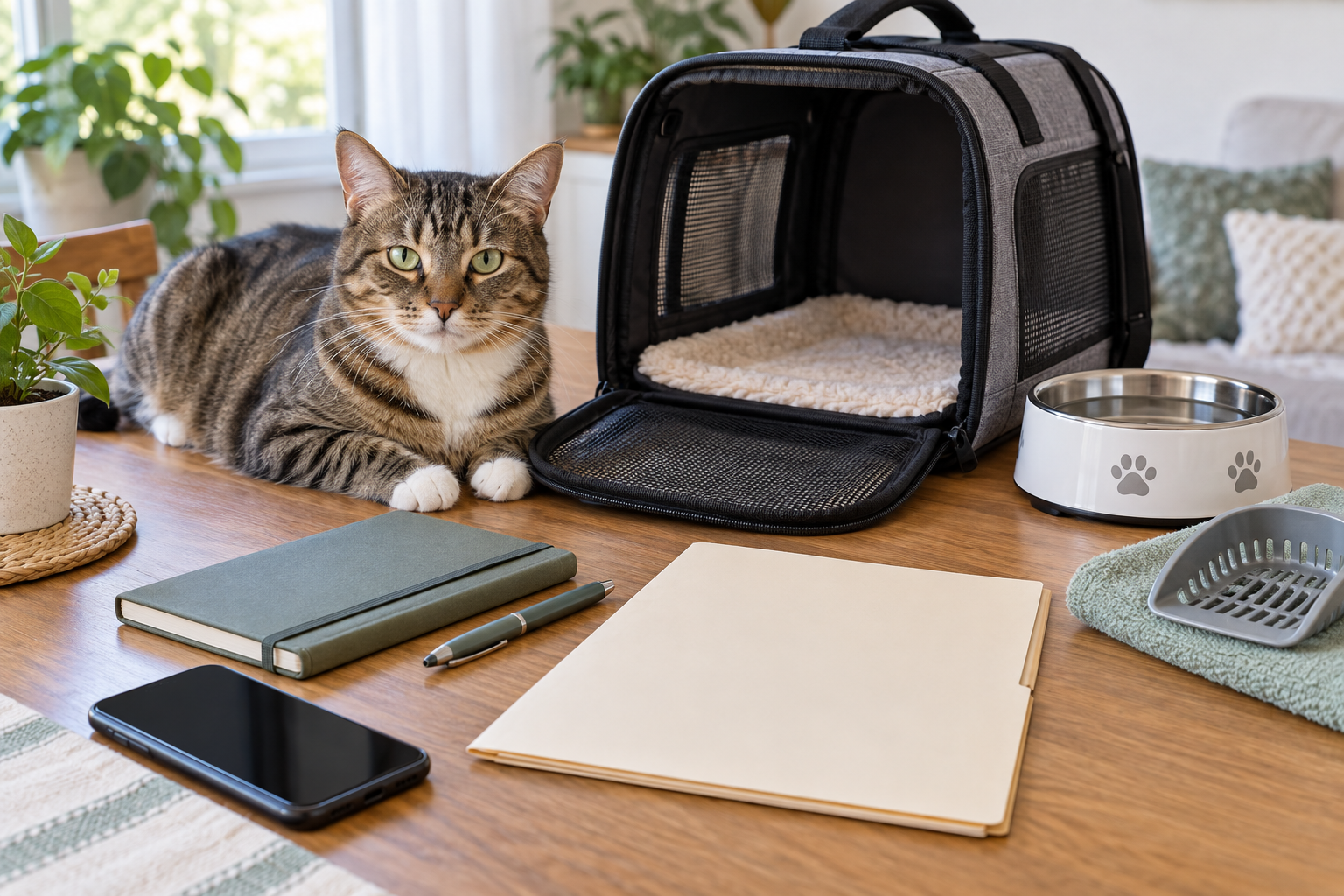
- Plan for cat care during travel (pet sitter, trusted neighbor, or boarding)
- Ready for a 12–18 year commitment, including end-of-life decisions
- Allergies checked — spend time with cats before adopting if uncertain
Still weighing the financial side? Our detailed breakdown covers everything from adoption fees to first-year costs to ongoing monthly expenses: How Much Does It Cost to Adopt a Cat?
Where to Find a Cat to Adopt
There are four main paths to adopting a cat: municipal shelters, private rescue organizations, foster-based networks, and breed-specific rescues. Each has its own process, timeline, and fee structure. All four are excellent options — the best choice depends on your timeline, the type of cat you're looking for, and how much behavioral information you want upfront.
| Source | Adoption Fee | Wait Time | Age Range | Vetting Level |
|---|---|---|---|---|
| Municipal Shelter | $25–$150 | Same day | All ages | Basic (vaccines, spay/neuter) |
| Private Rescue | $75–$250 | 1–3 weeks | Varies by rescue | Thorough (health + behavior) |
| Foster Network | $50–$200 | 1–2 weeks | All ages | Very thorough (home environment data) |
| Breed Rescue | $150–$400 | 2–6 weeks | Adult / senior | Thorough (breed-specific knowledge) |
The best places to start your search online are Petfinder.com and Adopt-a-Pet.com, both of which aggregate listings from thousands of shelters and rescues nationwide. You can filter by age, breed, color, and distance, and set up email alerts so you're notified the moment a matching cat becomes available.
One important note: we strongly recommend adopting from a shelter or rescue rather than purchasing from a pet store or online breeder. Pet store kittens are frequently sourced from kitten mills — large-scale breeding operations with poor welfare standards. Adoption is always the more ethical and often more affordable choice.
Not sure how to navigate the paperwork once you find your cat? Our guide to decoding the adoption application walks you through every question — and how to answer it well.
Choosing the Right Cat for Your Lifestyle
The most important decision in the adoption process isn't which shelter to visit — it's understanding what kind of cat will genuinely thrive in your home. Age, personality, energy level, and coat type all play a role. And here's the thing: the cat who's right for you might not be the one you expected to fall for.
Shelter cats often mask their true personalities in the kennel environment. Stress, noise, and unfamiliar smells can make an outgoing cat seem withdrawn, or a calm cat seem skittish. This is why spending time with a cat in a quiet meet-and-greet room — and asking staff about their behavior in foster care — is so valuable.
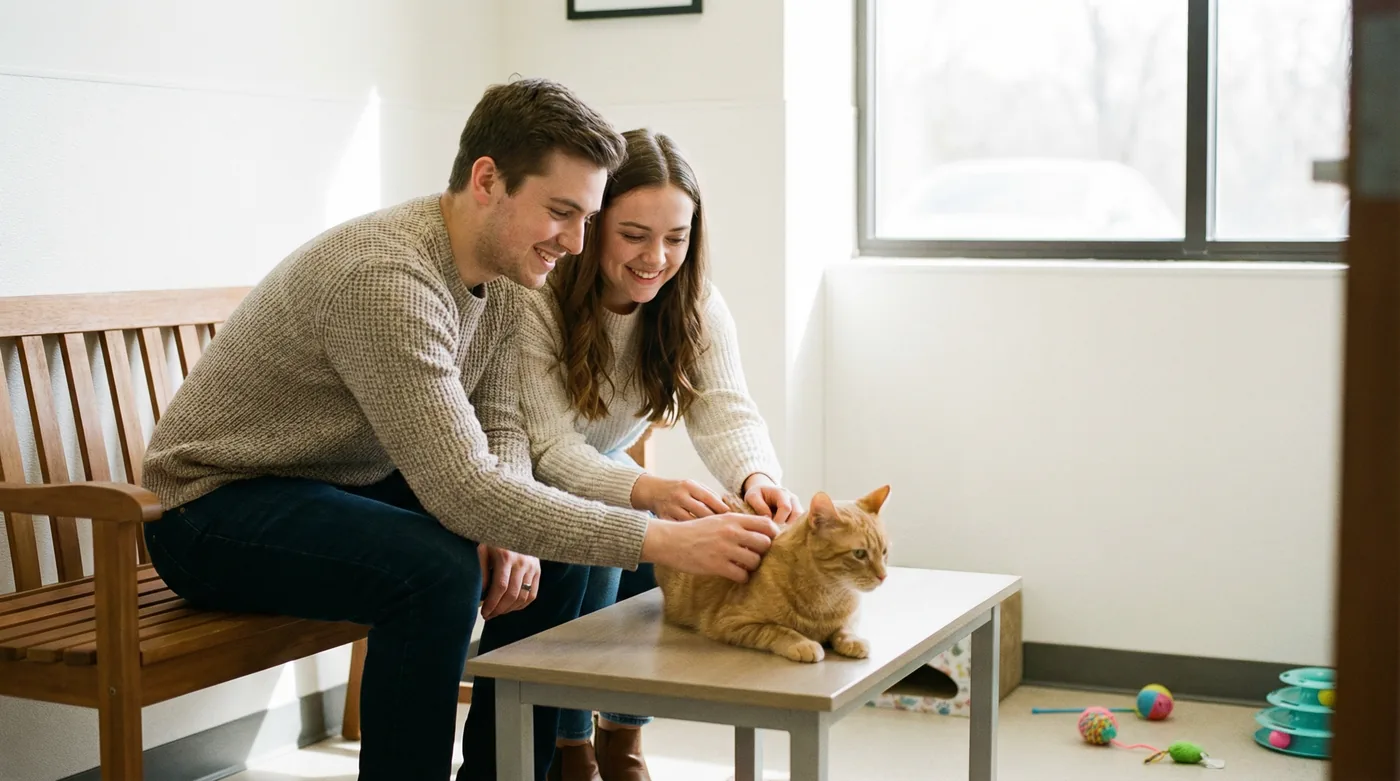
A quiet meet-and-greet room gives you a much more accurate read on a cat's true personality than the kennel environment.
Kitten, Adult, or Senior?
Age is one of the biggest factors in the adoption decision. Here's a quick overview — and links to our in-depth guides for each stage:
Kitten (0–1 year)
High energy, requires training and socialization, bonds deeply. Needs more time and supervision. Best for households with flexible schedules.
Littermates can differ in size and growth. Meet Fleece and Flannel, two orphaned siblings, in this rescue story; one case cannot predict an individual kitten’s health or needs.
Adult Cat (1–7 years)
Established personality — what you see is what you get. Lower maintenance than kittens, easier to assess compatibility. Great for most households.
Senior Cat (7+ years)
Calm, affectionate, and deeply grateful. Often overlooked in shelters, but among the most rewarding adoptions. May need more vet care.
For a full side-by-side comparison, read: Kitten vs. Adult Cat: Which Is Right for You?
Considering an older cat? Don't miss: The Heart of Gold: A Guide to Adopting a Senior Cat
Understanding Cat Personality Types
Beyond age, personality is the single most important compatibility factor. Research by Dr. Lauren Finka at Nottingham Trent University identified five core cat personality types — from the highly social "Human Cat" to the independent "Cantankerous Cat." Understanding which type fits your lifestyle dramatically increases the chances of a lasting, happy match.
Read our full personality guide: Finding Your Perfect Match: A Guide to Cat Personalities
Indoor vs. Outdoor: Making the Decision
One of the most debated questions in cat ownership is whether cats should live indoors, outdoors, or both. The data is clear on one point: indoor cats live significantly longer. But the right answer also depends on your environment, your cat's history, and their individual temperament.
🏠 Indoor Cat
- Average lifespan: 12–18 years
- Protected from cars, predators, and disease
- No exposure to toxins, parasites, or fights
- Requires enrichment: climbing, play, windows
- Recommended by AVMA and most vets
- Catio or leash walks offer safe outdoor access
🌿 Outdoor / Free-Roaming Cat
- Average lifespan: 2–5 years (outdoor only)
- Risk of traffic, predators, and theft
- Higher exposure to FIV, FeLV, and parasites
- Significant impact on local wildlife populations
- Not recommended for kittens or declawed cats
- Supervised outdoor time is a safer middle ground
If your cat was previously an outdoor cat, a sudden indoor-only transition can cause stress. Work with your vet to create a gradual adjustment plan, and invest in window perches, bird feeders outside windows, and interactive toys to satisfy their outdoor instincts safely.
The Adoption Process, Step by Step
The adoption process varies between organizations, but most follow a similar arc: find a cat, submit an application, get approved, and bring them home. Understanding what to expect at each stage reduces anxiety — for you and, ultimately, for your cat.
Research and Prepare
Before visiting any shelter, decide on your preferences: age range, energy level, coat type, and whether you want a single cat or a bonded pair. Read about the adoption process at your local organizations so you know what documentation to bring (ID, proof of address, landlord permission letter if renting).
Visit and Meet Cats
Schedule a visit during a quieter time of day if possible. Ask to spend time with cats in a meet-and-greet room rather than the kennel. Ask staff specific questions: "How does this cat behave with strangers?" "Has she been in a foster home?" "Does she have any known health conditions?" The more information you gather, the better your match.
Submit Your Application
Most organizations require a written application covering your living situation, experience with pets, household members, and your plan for the cat's care. Be honest and thorough — shelters aren't looking for perfection, they're looking for commitment and transparency. Our guide to the adoption application covers every question in detail.
Application Review and Interview
Private rescues typically conduct a phone or in-person interview after reviewing your application. This is a conversation, not an interrogation. Come prepared with questions of your own — it shows genuine interest and helps you make a fully informed decision. Some rescues also conduct home visits, particularly for special-needs cats.
Approval and Adoption Agreement
Once approved, you'll sign an adoption agreement that outlines your responsibilities as the new owner. Read it carefully. Most agreements include clauses about veterinary care, indoor/outdoor status, and what to do if you can no longer keep the cat. Pay your adoption fee and receive your cat's medical records.
Bring Your Cat Home
Bring a secure carrier and a familiar-smelling item (a blanket or piece of clothing). Keep the car ride calm and quiet. Have your safe room set up before you leave — food, water, litter box, hiding spots, and a cozy bed. The first 24 hours set the tone for the entire adjustment period.
The full timeline from first visit to homecoming is typically 1–3 weeks for rescues, and can be same-day for municipal shelters. If you're adopting from a rescue, use the waiting period to prepare your home thoroughly.
Before your cat arrives, it’s important to think ahead about which supplies you’ll need and have them ready in advance. If you’re ordering litter, bowls, toys, a cat tree, or other starter essentials online, reliable protective packaging solutions can help keep everything organized, reduce the risk of damage during transit, and make the whole setup process smoother.
Preparing Your Home Before Your Cat Arrives
The single most important thing you can do before bringing your cat home is set up a dedicated safe room. This is a small, quiet space — a spare bedroom or bathroom — where your cat will spend the first few days decompressing. It should contain everything they need: food, water, litter box, a hiding spot, and a comfortable resting place. This isn't a punishment; it's a gift. A smaller, manageable space helps a new cat feel secure before they're ready to explore the wider home.

Having everything ready before your cat arrives makes the first day calm and welcoming for both of you.
What to Buy: A Three-Phase Checklist
Not everything needs to be purchased at once. Here's what to prioritize by phase:
Before Day 1 — Essentials
- Carrier (hard-sided or soft) $30–$80
- Stainless steel food + water bowls $15–$30
- Litter box (1 per cat + 1 extra) $20–$60 each
- Unscented clumping litter $15–$25/bag
- Age-appropriate cat food (same as shelter's) $20–$50
- Cat bed or cozy blanket $20–$50
- Hiding box or covered bed $20–$40
- Scratching post (vertical + horizontal) $25–$60
Week 1 — Enrichment
- Interactive wand toy (feather, ribbon) $10–$20
- Puzzle feeder or slow bowl $15–$30
- Window perch or cat tree $40–$150
- Collar with ID tag + breakaway clasp $10–$20
- Microchip registration (if not done) $20–$45
- Nail clippers $8–$15
- Brush or grooming mitt $10–$25
- Pheromone diffuser (Feliway) $25–$45
Month 1 — Long-Term Setup
- Vet visit (new pet exam) $50–$150
- Pet insurance (monthly) $20–$50/mo
- Additional litter boxes for multi-floor homes $20–$60 each
- Cat grass or catnip $5–$15
- Automatic water fountain $30–$60
- Stain + odor remover (enzyme-based) $10–$20
- Baby gates (if needed for pet separation) $25–$60
- Lint roller (you'll need many) $5–$10
Litter Box Setup: The Rules That Actually Matter
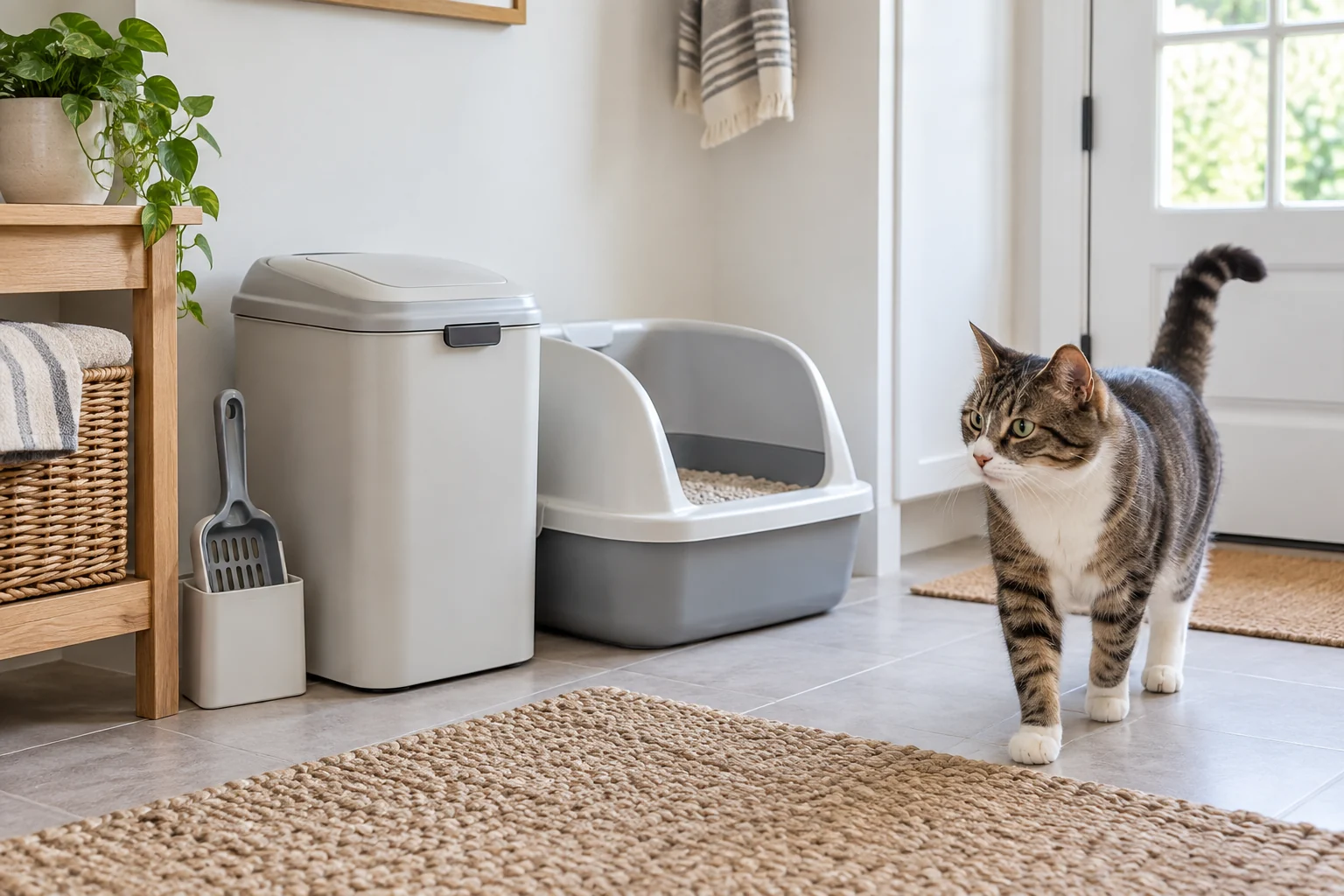
Litter box problems are the number one reason cats are returned to shelters — and almost all of them are preventable with proper setup. The golden rule is one litter box per cat, plus one extra. A household with two cats needs three boxes, placed in different locations.
Box Type
Most cats prefer open, uncovered boxes — covered boxes trap odors and can feel like a trap. If you prefer covered for aesthetics, choose one with a large opening and clean it twice as often.
Litter Type
Start with unscented, fine-grained clumping litter — it's the closest to the natural substrate cats prefer. Avoid scented litters; the fragrance that appeals to humans is often aversive to cats.
Location
Place boxes in quiet, low-traffic areas with easy escape routes. Never place a litter box next to food or water. Avoid laundry rooms — the sudden noise of a washer can startle a cat and create a negative association.
Cleaning Frequency
Scoop at least once daily, ideally twice. Full litter changes every 2–4 weeks. Cats are fastidiously clean animals — a dirty box is one of the most common causes of inappropriate elimination outside the box.
For a complete room-by-room safety guide, see: A First-Time Owner's Guide to Cat-Proofing Your Home
The First Days Home: The 3-3-3 Rule
The 3-3-3 rule is the most useful framework for understanding what your new cat is experiencing — and what to expect from them. It describes the typical adjustment timeline in three phases: 3 days to decompress, 3 weeks to learn your routine, and 3 months to truly feel at home. The timeline is a guideline, not a guarantee — some cats settle in faster, others take longer. What matters is that you follow their lead.
| Phase | What Your Cat Is Experiencing | What You Should Do |
|---|---|---|
Days 1–3 Decompression | Overwhelmed, hiding, possibly not eating or using the litter box. This is normal stress, not rejection. | Keep them in the safe room. Don't force interaction. Sit quietly nearby. Speak softly. Let them come to you. |
Weeks 1–3 Learning | Starting to explore, learning your schedule, testing boundaries. May show some stress behaviors (over-grooming, hiding). | Establish consistent routines for feeding and play. Begin gentle handling. Introduce new rooms gradually. |
Weeks 3–12 Settling | Personality emerging, seeking interaction, becoming comfortable with household sounds and people. | Introduce enrichment activities. Schedule first vet visit. Begin any training (litter, scratching post). |
Month 3+ At Home | Fully relaxed, showing true personality, bonding deeply. This is the cat you adopted. | Maintain routines. Deepen the bond through play, grooming, and quality time. Enjoy the relationship you've built. |
Transitioning Your Cat's Diet
One of the most overlooked aspects of bringing a new cat home is diet transition. Changing food abruptly — even to a higher-quality option — can cause vomiting, diarrhea, and food refusal. Always use the same food the shelter was feeding for at least the first week, then transition gradually over 7 days.
| Day | Old Food | New Food | Visual Guide |
|---|---|---|---|
| Days 1–2 | 75% | 25% | |
| Days 3–4 | 50% | 50% | |
| Days 5–6 | 25% | 75% | |
| Day 7+ | 0% | 100% |
For a week-by-week guide to the entire first month, see: The First 30 Days: A Week-by-Week Guide for Your New Cat
Ready to Find Your Cat?
Use Petfinder to search thousands of cats available for adoption near you — filter by age, breed, and distance.
Search Petfinder → Adoption Application GuideOngoing Care: The Four Pillars of Cat Health
Once your cat has settled in, the focus shifts from adjustment to long-term wellbeing. Cats are remarkably self-sufficient in many ways, but they depend on you for the four essentials that determine their quality of life: nutrition, veterinary care, mental enrichment, and preventive health.
A thriving cat is an engaged cat — even if that engagement looks like watching you from across the room.
Nutrition
Feed a high-quality, age-appropriate diet with named protein as the first ingredient. Wet food supports hydration (cats have a low thirst drive). Avoid free-feeding dry food only — it's linked to obesity and urinary issues. Measure portions and adjust for your cat's weight and activity level.
Veterinary Care
Schedule a new-pet exam within the first week. Annual wellness visits are essential for adult cats; twice-yearly for seniors. Keep vaccinations current (FVRCP, rabies), maintain parasite prevention (flea, tick, heartworm), and discuss dental cleanings — dental disease affects 70% of cats over age 3.
Mental Enrichment
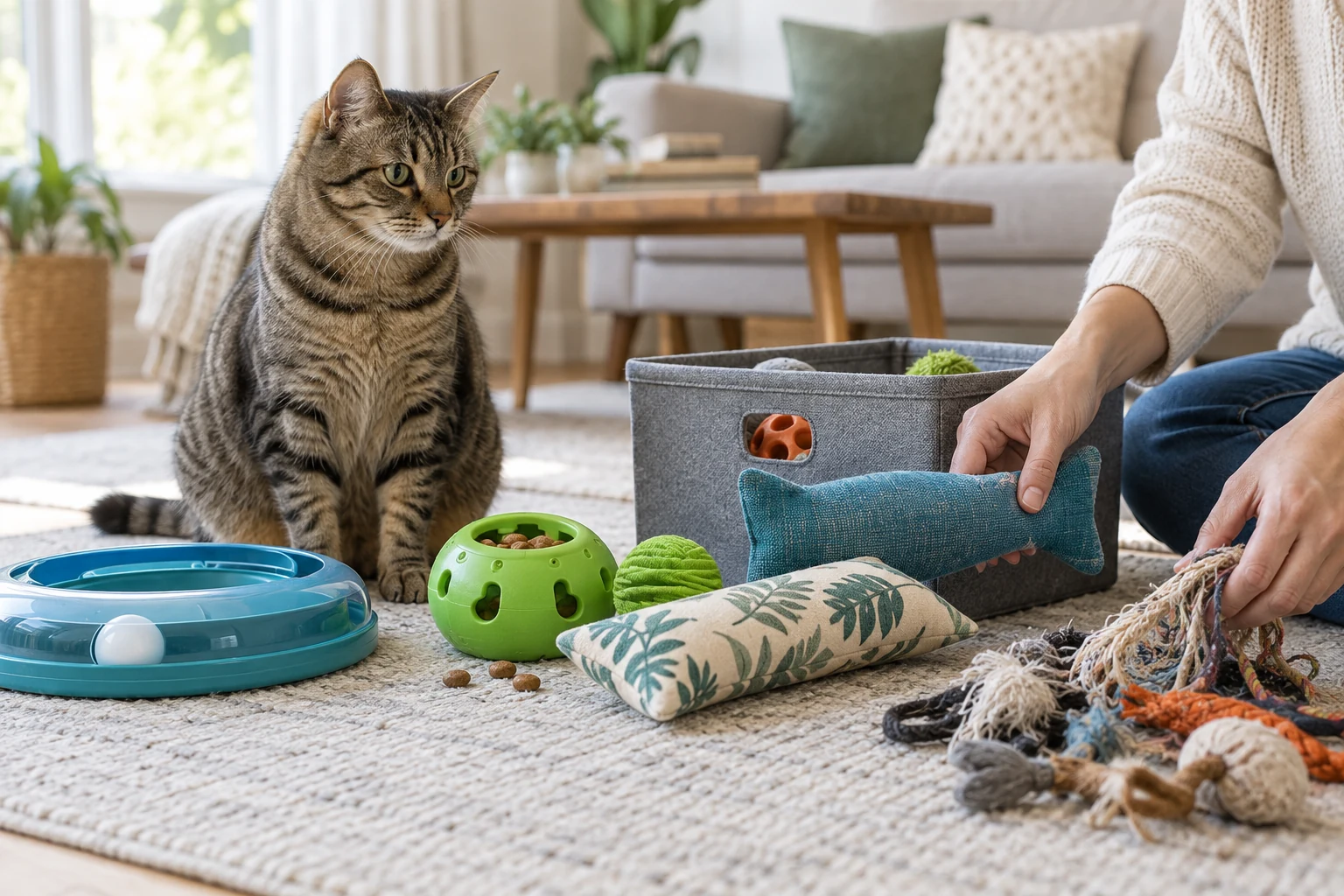
Cats need daily mental and physical stimulation. Dedicate 15–20 minutes per day to interactive play with a wand toy. Provide climbing structures, window perches, puzzle feeders, and rotating toys. An under-stimulated cat will find their own entertainment — usually at your expense.
Preventive Health
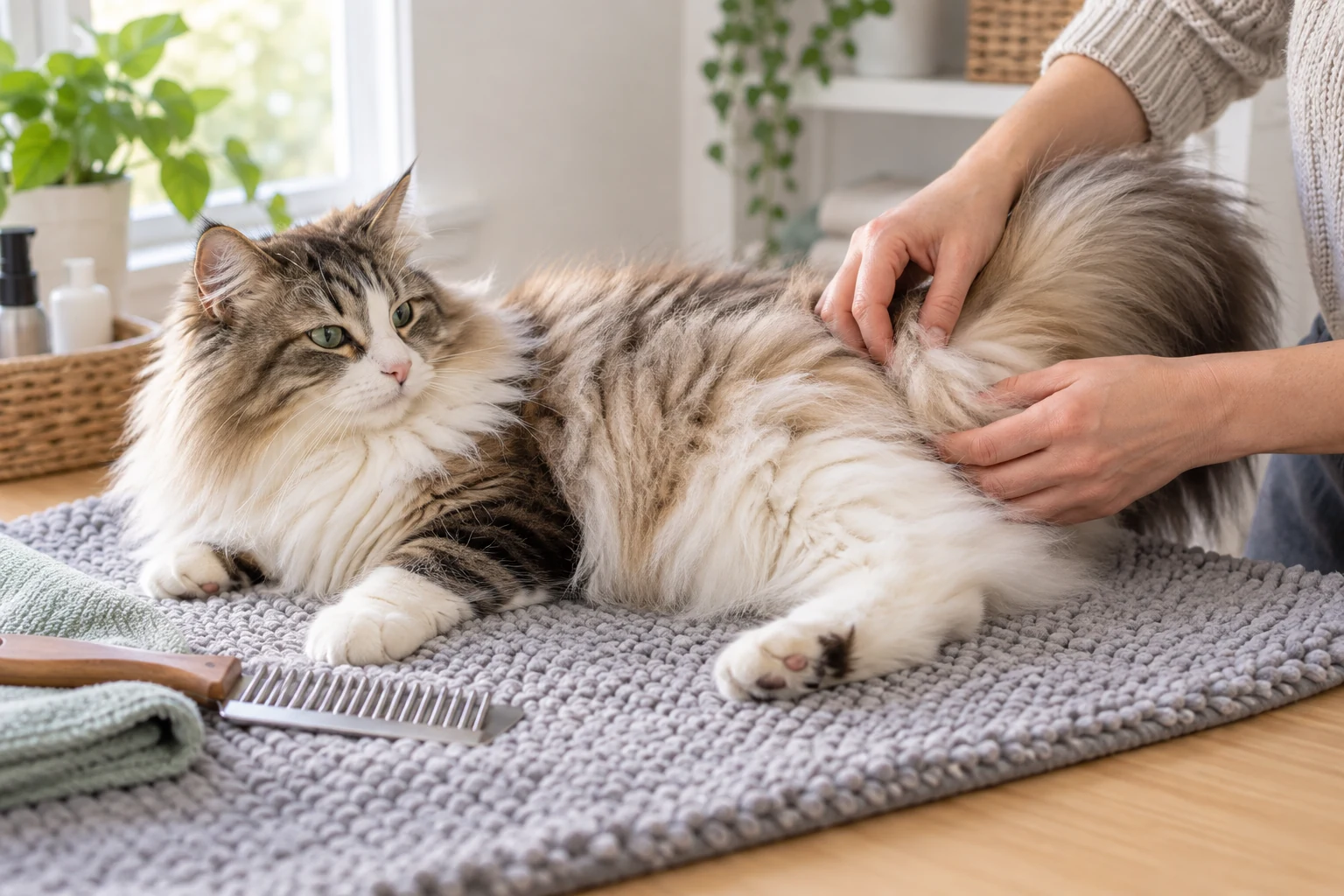
Monthly flea and tick prevention, even for indoor cats. Annual fecal tests for intestinal parasites. Dental care (tooth brushing or dental treats). Nail trims every 2–4 weeks. Regular grooming — especially for long-haired cats — to prevent matting and hairballs. Spay/neuter if not already done.
Signs Your Cat Is Thriving
A happy, healthy cat shows it in dozens of small ways. Here are the key indicators that your newly adopted cat has truly settled in and is flourishing:
Eating Well
Consistent appetite, finishing meals, maintaining healthy weight
Using the Litter Box
Consistent, appropriate elimination — no accidents outside the box
Grooming Themselves
Regular self-grooming; coat is clean, shiny, and free of mats
Playing and Exploring
Showing curiosity, engaging with toys, exploring their environment
Relaxed Body Language
Slow blinking, belly exposure, kneading, purring near you
Seeking Your Company
Choosing to be near you, initiating contact on their own terms
Deep-Dive Guides for Every Step of the Journey
This guide covers the full arc of cat adoption, but every major decision deserves its own in-depth treatment. We've created dedicated resources for each stage — use them as you need them, in whatever order makes sense for where you are in the process.
How Much Does It Cost to Adopt a Cat?
Adoption fees, first-year costs, ongoing expenses, and how to budget for unexpected vet bills.
Read the guide →Kitten vs. Adult Cat: Which Is Right for You?
A side-by-side comparison of every major factor — energy, training, cost, and compatibility.
Read the guide →Finding Your Perfect Match: A Guide to Cat Personalities
The five core cat personality types and how to find the one that fits your lifestyle.
Read the guide →Decoding the Adoption Application: How to Get Approved
Every question on the adoption application — and exactly how to answer it well.
Read the guide →A First-Time Owner's Guide to Cat-Proofing Your Home
Room-by-room safety checklist, toxic plants, electrical hazards, and safe alternatives.
Read the guide →The First 30 Days: A Week-by-Week Guide for Your New Cat
What to expect — and what to do — in each week of your cat's adjustment period.
Read the guide →The Heart of Gold: A Guide to Adopting a Senior Cat
Why senior cats make extraordinary companions, and how to give them the care they deserve.
Read the guide →You're Here: The Complete Adoption Guide
Bookmark this page as your central resource — and share it with anyone considering adoption.
Share this guide →Your Perfect Cat Is Waiting
Every day, thousands of cats in shelters and rescues across the country are hoping for exactly what you're looking for — a home, a routine, and someone to choose them. Start your search today.
Frequently Asked Questions
The process typically takes 1–3 weeks from your first shelter visit to bringing your cat home. Municipal shelters may process same-day adoptions, while private rescues often conduct a more thorough screening process that includes an application review, reference checks, and sometimes a home visit. Use any waiting period to prepare your home and purchase supplies.
Adoption fees typically range from $25 to $250 depending on the organization. However, first-year costs including supplies, vet visits, food, and litter typically total $1,000–$1,500. Ongoing annual costs after the first year average $600–$1,000. See our full breakdown: How Much Does It Cost to Adopt a Cat?
Some shelters run free or reduced-fee adoption events, especially for senior cats, bonded pairs, or cats who have been in the shelter for an extended period. Check your local shelter's website or social media for upcoming promotions. Even "free" adoptions typically include spay/neuter, vaccinations, and microchipping — a significant value. Follow shelters on social media to be notified of events.
The best age depends on your lifestyle. Kittens (under 1 year) are high-energy and require more time and training. Adult cats (1–7 years) have established personalities and are easier to assess for compatibility. Senior cats (7+ years) are calm and affectionate, often the most overlooked and most rewarding adoptions. Read our full comparison: Kitten vs. Adult Cat: Which Is Right for You?
Yes, but you'll need written permission from your landlord first. Many shelters require proof of pet permission before approving an application. Some landlords charge a pet deposit (typically $200–$500), which is usually refundable if no damage occurs. Get the permission in writing — verbal agreements are not accepted by most rescues.
If you're away from home for 8 or more hours a day, adopting two cats — especially a bonded pair — is strongly recommended. Cats are more social than commonly believed, and a companion significantly reduces stress, boredom, and destructive behavior. Bonded pairs from the same shelter often have lower combined adoption fees and adjust more quickly to a new home.
The 3-3-3 rule describes the typical adjustment timeline for a newly adopted cat: 3 days to decompress from the shelter environment (hiding, not eating — this is normal), 3 weeks to learn your household routine and start showing their personality, and 3 months to truly feel at home and form a deep bond. The timeline is a guideline — some cats settle faster, others take longer. Follow your cat's lead.
Set up a safe room before your cat arrives — a small, quiet space with food, water, litter box, hiding spot, and a cozy bed. Place their carrier in the room, open the door, and let them come out on their own terms. Don't force interaction. Sit quietly in the room and let them approach you. Keep the environment calm and quiet for the first 24–48 hours. Resist the urge to show them the whole house immediately.
Always use a slow, scent-based introduction process. Keep the new cat in a separate room for the first 1–2 weeks, then gradually introduce scent swapping (exchange bedding), visual contact through a cracked door or baby gate, and finally supervised face-to-face meetings. Never force interaction. The entire process can take 2–8 weeks. Rushing introductions is the most common cause of long-term inter-pet conflict.
Always transition gradually over 7 days to avoid digestive upset. Start with 25% new food mixed with 75% old food for days 1–2, then 50/50 for days 3–4, then 75% new food for days 5–6, and 100% new food from day 7 onward. If your cat shows vomiting or diarrhea, slow down the transition. Use the same food the shelter was feeding for at least the first week before starting any transition.
Indoor cats live significantly longer on average (12–18 years vs. 2–5 years for outdoor cats) due to reduced exposure to cars, predators, disease, and toxins. Most veterinary organizations recommend keeping cats indoors. If your cat craves outdoor stimulation, a supervised catio, leash walks, or window perches are safe alternatives that provide enrichment without the risks.
Signs of a thriving cat include: eating and drinking normally, using the litter box consistently, grooming themselves regularly, showing curiosity and playfulness, purring or slow-blinking at you, and seeking your company on their own terms. A happy cat is an engaged cat — even if that engagement looks like watching you from across the room with half-closed eyes.
Both are excellent options. Shelters typically have lower fees and faster processes; rescues often have more thoroughly vetted cats and more detailed behavioral information because cats live in foster homes rather than kennels. The best choice depends on your timeline, budget, and the specific cat you fall in love with. Don't let process differences deter you from either path.
Shelters primarily want to confirm that you can provide a safe, stable, and loving home. They look at your living situation (owned vs. rented), experience with pets, household members (including children and other animals), your plan for the cat's care during travel, and your financial readiness for vet care. Being honest and thorough is more important than having a perfect profile. See our full guide: Decoding the Adoption Application.
Ask the shelter or rescue for the cat's full medical history, including vaccinations, parasite treatment, spay/neuter status, and any known health conditions. Look for clear eyes, clean ears, a clean coat, and normal breathing. Schedule a vet visit within the first week of adoption for an independent health assessment — this is standard practice and most shelters expect it. Many adoption agreements include a health guarantee period.
References
The following sources were used in the preparation of this article and are provided to support further reading and verify factual claims.
- 1American Society for the Prevention of Cruelty to Animals (ASPCA). Pet Statistics. https://www.aspca.org/helping-people-pets/shelter-intake-and-surrender/pet-statistics
- 2American Veterinary Medical Association (AVMA). Cat Care: Preventive Care and Wellness. https://www.avma.org/resources-tools/pet-owners/petcare/cat-care
- 3Cornell Feline Health Center. Feeding Your Cat. Cornell University College of Veterinary Medicine. https://www.vet.cornell.edu/
- 4Finka, L. R., et al. (2019). Owner personality and the wellbeing of their cats share parallels with the parent-child relationship. PLOS ONE, 14(2). https://doi.org/10.1371/journal.pone.0211862
- 5The Humane Society of the United States. Adopting a Cat. https://www.humanesociety.org/resources/adopting-cat
- 6Best Friends Animal Society. How to Adopt a Cat: A Complete Guide. https://bestfriends.org/resources/how-to-adopt-a-cat
- 7American Association of Feline Practitioners (AAFP). AAFP Cat Friendly Practices: Feline Life Stage Guidelines. https://catvets.com/
- 8VCA Animal Hospitals. Bringing Your New Cat Home. https://vcahospitals.com/
- 9Patronek, G. J., et al. (1996). Risk factors for relinquishment of cats to an animal shelter. Journal of the American Veterinary Medical Association, 209(3), 582–588.
- 10Zoran, D. L. (2002). The carnivore connection to nutrition in cats. Journal of the American Veterinary Medical Association, 221(11), 1559–1567.

 Why Does My Cat Flinch When Touched While Sleeping? Startle, Trust, and Pain Clues">
 Cat Scratching Baseboards: Trim Guards and Route Fixes">
 EN
EN DE
DE ES
ES PT
PT