
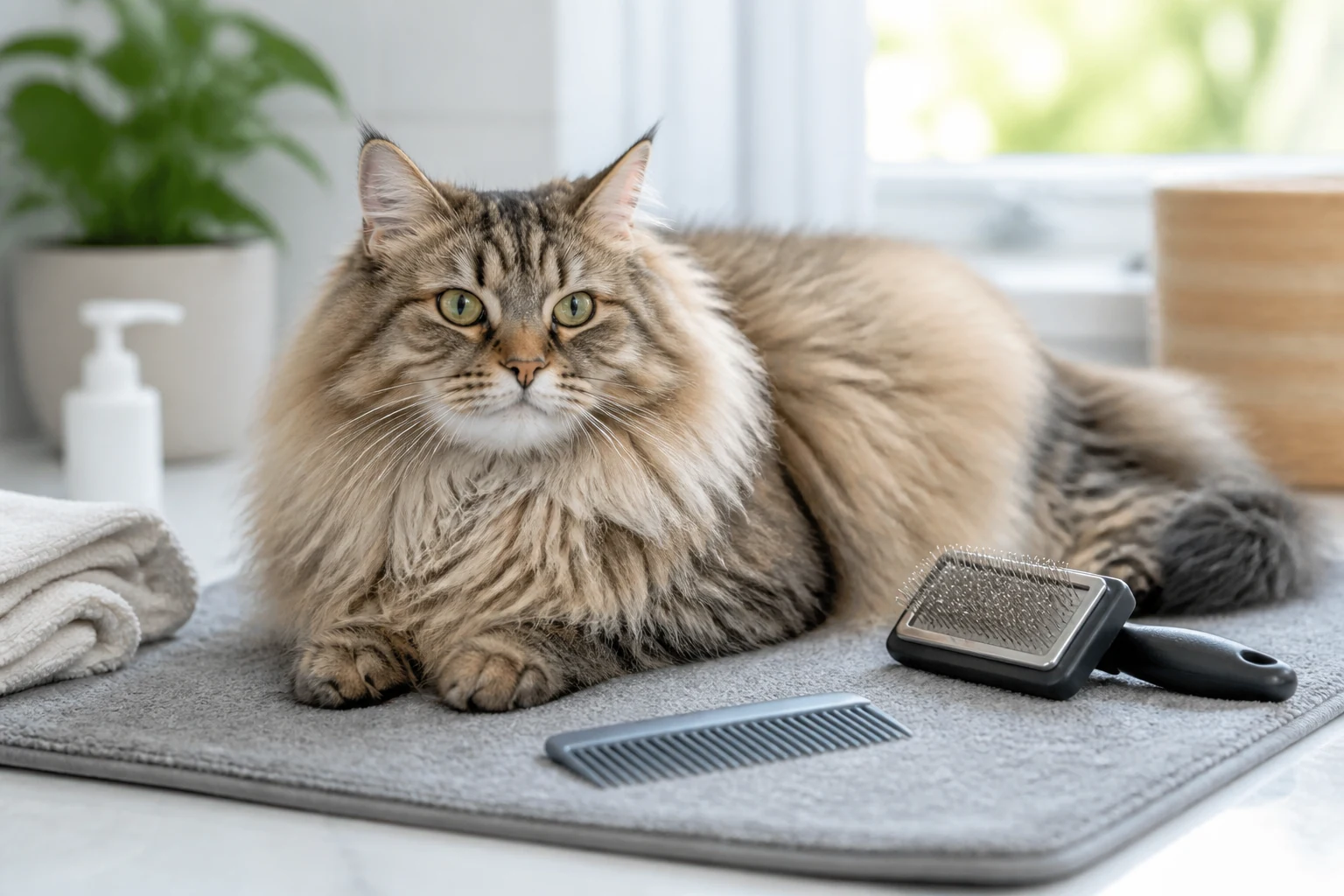
You can sometimes remove a small cat mat at home if it is loose, dry, away from delicate skin, and your cat stays relaxed. Stop immediately if the mat feels tight against the skin, your cat flinches or growls, the skin looks red or sore, or you feel tempted to use scissors.
Mats are not just a cosmetic problem. Regular brushing helps keep the coat clean and gives you a chance to notice skin changes early 1, while tight mats can irritate the skin and, in neglected cases, contribute to painful lesions or infection 3. The safest goal is not to "win" the grooming session. It is to protect your cat's skin, comfort, and trust.
Table of Contents
- How can you tell if a small mat is safe to work on at home?
- What tools should you use for small cat mats?
- How do you loosen a small cat mat step by step?
- When should you stop and call a groomer or veterinarian?
- How do you keep the grooming session calm?
- What should you do after the mat is gone?
- What can cause repeated mats?
- Conclusion:
- Frequently Asked Questions
- References
How can you tell if a small mat is safe to work on at home?
A mat is a possible home-grooming job only when it is small, loose, and not stuck flat to the skin. You should be able to lift or wiggle the tangle gently without pulling your cat's skin upward.
Think of the first check as a safety screen, not the beginning of brushing. Use your fingertips to feel around the mat. If you can slide your fingers under some of the tangle, separate a few outer hairs, and your cat remains comfortable, you may be able to work slowly.
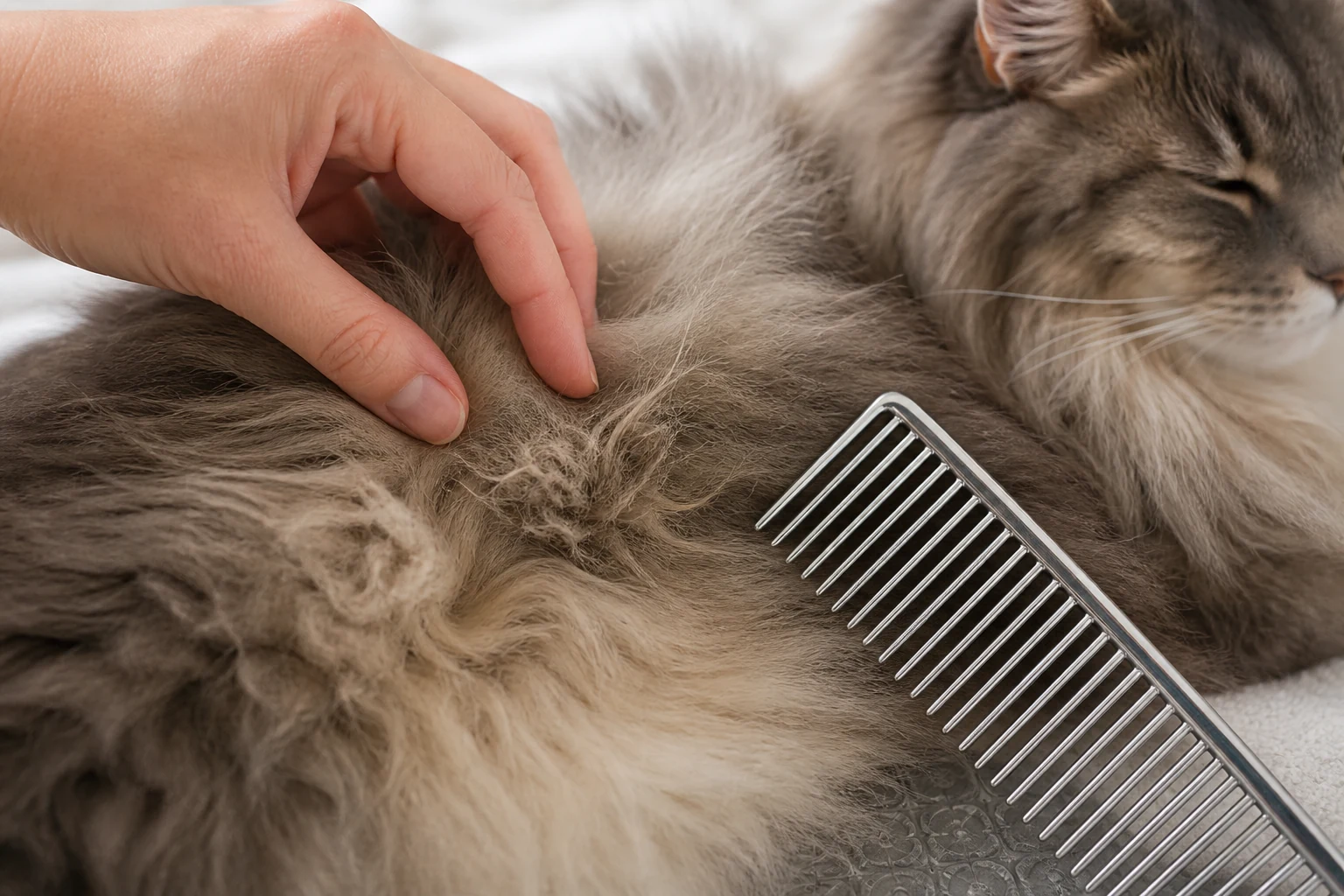
Work only on small, loose mats that can be separated with your fingers before a comb ever touches the tangle.
Use this quick check before deciding:
| Mat or cat signal | What it may mean | Safer next step |
|---|---|---|
| The mat is pea-sized, loose, and at the surface of the coat | It may be a small tangle caught in shedding undercoat | Try finger loosening and short comb strokes |
| The mat is flat, hard, or close to the skin | Skin may be pulled into the mat | Stop and book a professional groomer or veterinarian |
| The mat is under the armpit, belly, groin, tail base, or behind the ears | The skin is thin, mobile, or easy to nick | Do not cut; ask a professional |
| Your cat growls, swats, bites, pants, freezes, or repeatedly tries to leave | The session is stressful or painful | Stop for the day |
| Skin under or beside the mat is red, moist, scabby, smelly, or bleeding | There may be irritation, infection, or injury | Call your veterinarian |
Longhaired cats often need more frequent brushing because their coats tangle more easily, especially around the ears, armpits, and back legs 2. For prevention routines by trouble spot, see SnuggleSouls' guide to how to prevent mats in longhaired cats.
What tools should you use for small cat mats?
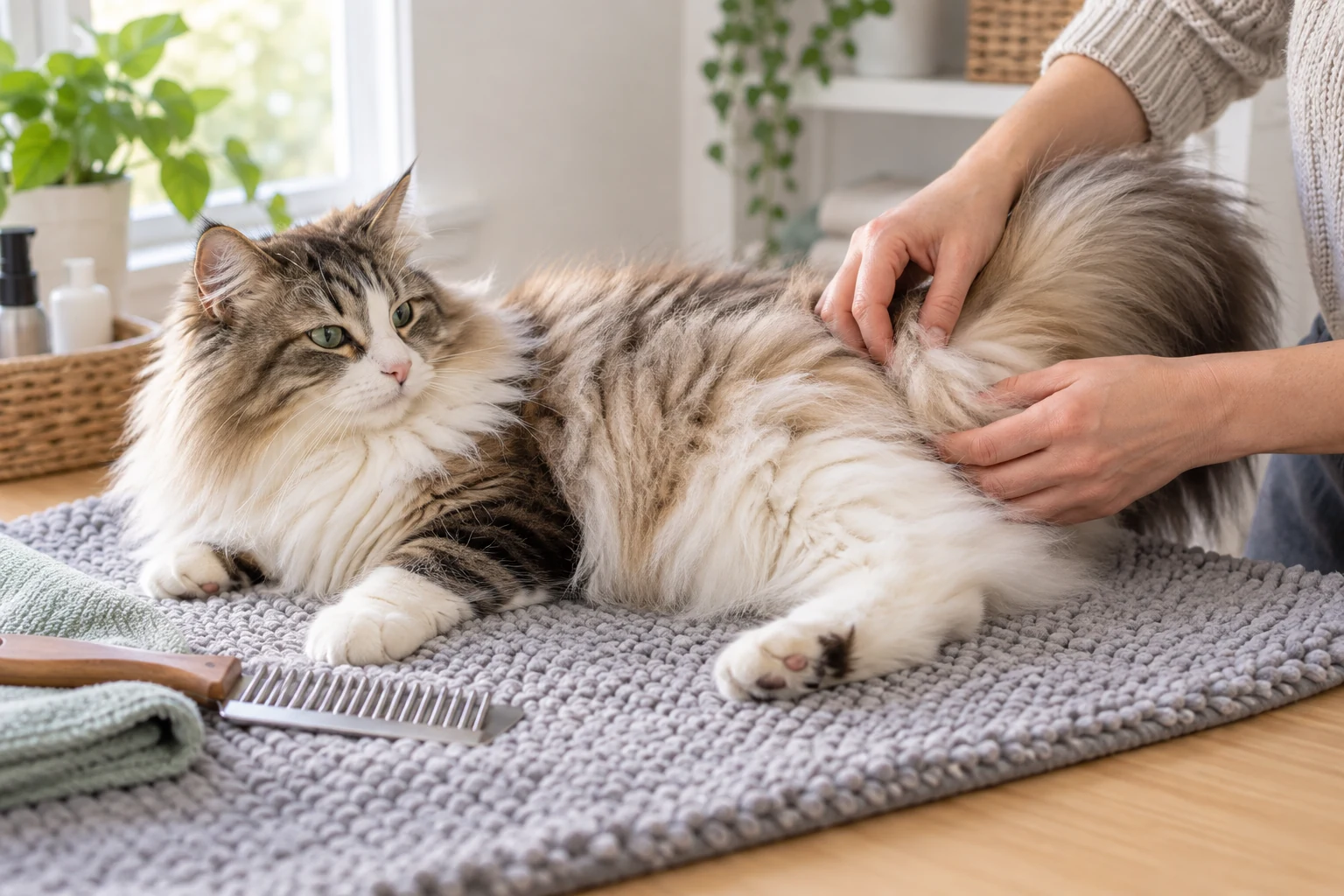
Use fingers first, then a wide-tooth comb, and only then a soft slicker or finishing comb if the tangle is already loosened. The tool should separate hair without scraping skin or forcing the mat tighter.
Helpful tools include:
- A wide-tooth metal comb with smooth tips
- A soft slicker brush used lightly, not pressed into the skin
- A grooming mat or towel so your cat has stable footing
- High-value treats or a lick-safe reward
- A second towel to create a calm resting surface
Avoid household scissors. Cat skin is thin and mobile, and mats can pull skin upward into the tangle where it is hard to see. If a mat seems to require cutting, it is no longer a casual at-home brushing task. A trained groomer or veterinary team can clip close mats with the right equipment and handling.
If you are still building a basic kit, start with SnuggleSouls' cat grooming guide and the no-pulling routine in how to brush a longhaired cat. The right daily tool matters more than an aggressive dematting tool used only after tangles become painful.
How do you loosen a small cat mat step by step?
Work in tiny increments and stop before your cat gets frustrated. A successful session might remove one small mat, or it might simply make the mat looser for tomorrow.
- Choose a calm moment.
Pick a time when your cat is resting, not hungry, overstimulated, or already irritated. Keep the session in a familiar place with good light.
- Check the skin and location.
Part the fur around the mat with your fingers. If you see redness, swelling, scabs, moisture, fleas, feces, or a wound, stop and call your veterinarian.
- Stabilize the fur near the skin.
Hold the fur at the base of the mat with your fingers so any pressure stays in your hand instead of tugging your cat's skin.
- Tease the outer edge apart.
Use your fingertips to loosen the outermost hairs. Do not yank the center of the mat. Work from the outside inward.
- Comb only the loosened ends.
Use a wide-tooth comb on the outer edge, moving in very short strokes. If the comb catches, back up and use your fingers again.
- Reward and pause often.
Give a treat after a few calm seconds. A cat-friendly session can be 30 seconds long. Several peaceful micro-sessions are safer than one forced grooming battle.
- Finish with normal brushing only if the mat is gone.
Once the tangle separates, brush the surrounding coat lightly so loose undercoat does not rebuild the mat.
Never wet a mat to "soften" it unless your veterinarian or groomer specifically tells you to. Water can make some tangles tighten as they dry, and bathing a cat who is already matted can make the grooming problem harder.
When should you stop and call a groomer or veterinarian?
Stop when the mat is tight, painful, close to delicate skin, or emotionally too much for your cat. Professional help is not a failure; it is often the most humane choice.
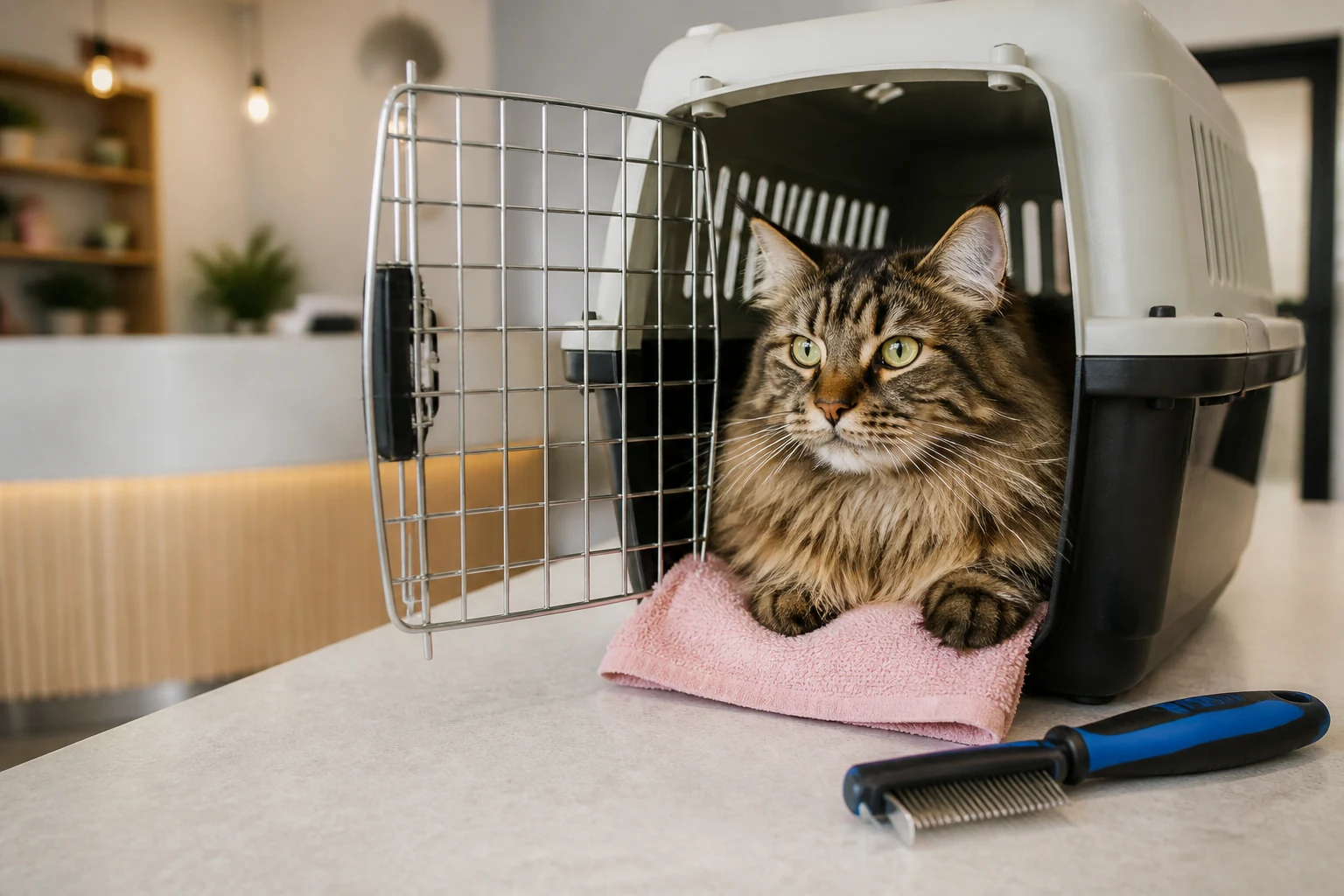
Professional help is the kinder choice when a mat is tight, painful, near delicate skin, or stressful for your cat.
Call a groomer or veterinarian if:
- The mat is larger than a coin or there are several mats grouped together
- The mat is tight against the skin or feels like a hard shell
- The mat is on the belly, armpit, groin, tail base, sanitary area, or behind the ears
- Your cat reacts as if the area hurts
- You notice redness, sores, odor, discharge, fleas, ticks, feces, or urine trapped in the coat
- Your cat is senior, arthritic, obese, ill, or difficult to handle safely
- You cannot see where the mat ends and skin begins
Matted coats can hide irritation and parasites, and severe matting can contribute to infected lesions 3. If your cat seems painful beyond the mat itself, review common cat pain signs and contact your veterinarian for individual guidance.
A groomer may be appropriate for a calm, healthy cat with coat-only matting. A veterinarian is the better first call when the skin looks abnormal, your cat may need pain relief or sedation, the mats are severe, or an underlying health problem may be involved.
How do you keep the grooming session calm?
Keep grooming short, predictable, and consent-based. Cat-friendly handling guidelines emphasize reducing fear and other negative emotions during handling, because stress can escalate quickly 4.
Set up the session before you invite your cat over. Put tools within reach, offer a towel or mat for grip, and use treats before the comb appears. If your cat walks away, let the session end. Chasing a cat to finish a mat usually makes the next grooming attempt harder.
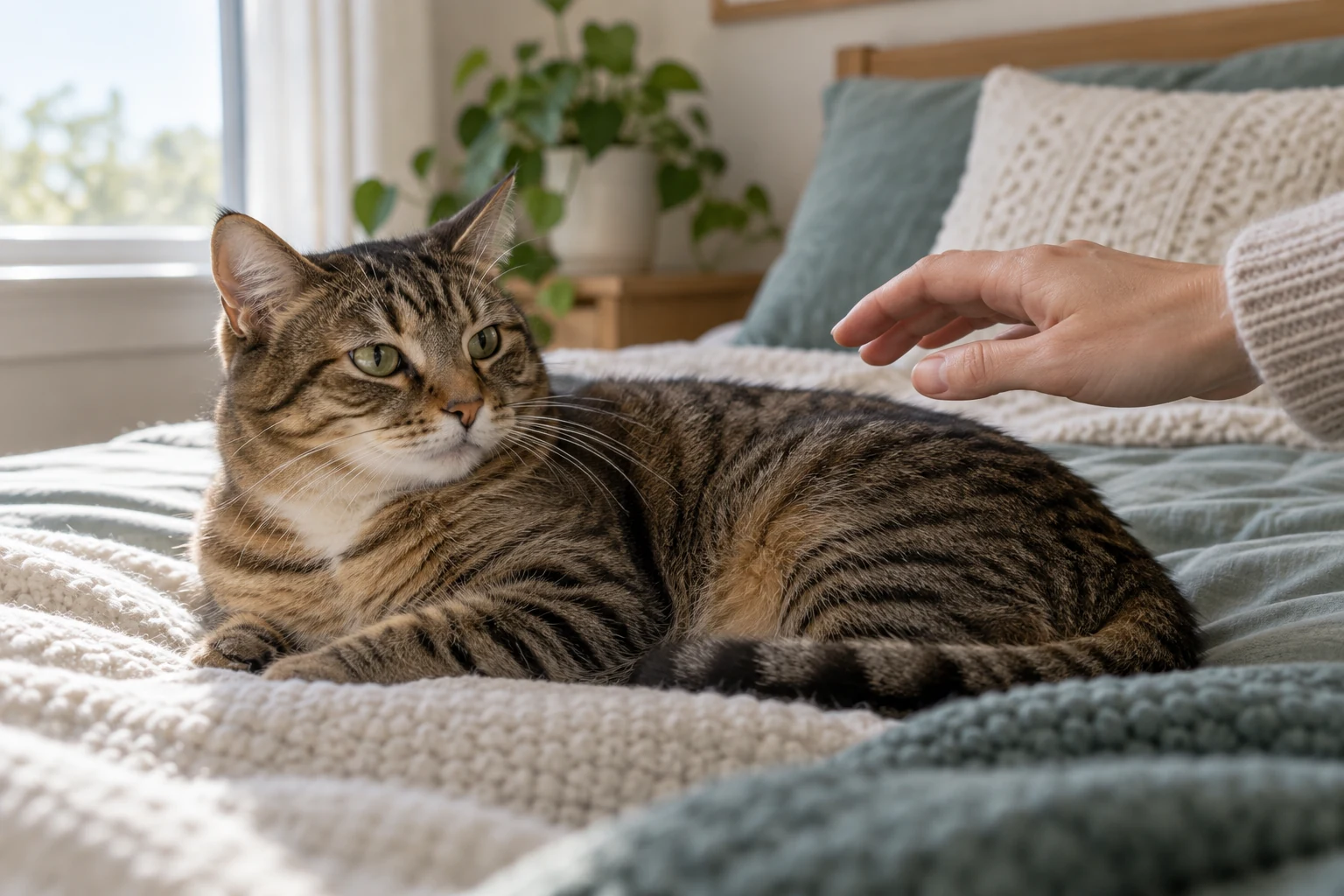
Good signs include leaning into touch, relaxed ears, normal breathing, soft blinking, and accepting treats. Warning signs include skin twitching, tail lashing, pinned ears, head turning toward your hand, freezing, growling, swatting, or sudden grooming of the area you touched.
If your cat scratches when handled, trim only when both of you can stay calm. SnuggleSouls' guide to trim cat nails safely uses the same principle: shorter, easier sessions protect trust better than pushing through resistance.
What should you do after the mat is gone?
Check the skin, reward your cat, and adjust the routine so the same spot does not mat again. The area may be sensitive after the tangle is removed, even if the skin looks normal.
Aftercare checklist:
- Part the fur and look for redness, dandruff, scabs, swelling, or broken skin
- Leave irritated skin alone and call your veterinarian if it looks sore or moist
- Brush the surrounding coat lightly to remove loose undercoat
- Note the trouble spot: armpits, chest, belly, rear legs, tail base, or behind ears
- Add a short check of that spot to your weekly routine
- Keep sessions positive with treats, praise, and an easy stopping point
For longhaired cats, daily grooming may be needed to keep tangles from forming 2. If daily brushing is too much for your cat, aim for a rotating schedule: one trouble zone per day, very short sessions, and a professional maintenance groom before seasonal shedding gets ahead of you.
What can cause repeated mats?
Repeated mats often mean the coat needs a different maintenance plan, but they can also be a clue that your cat is not grooming normally. Age, arthritis, dental pain, obesity, stress, illness, coat type, and heavy seasonal shedding can all make self-grooming harder.
VCA notes that long, silky, or curly coats need frequent brushing, and that pain or medical conditions may affect a cat's ability to groom certain areas 2. If mats keep appearing on the lower back, hips, or rear legs, consider whether stiffness or weight is limiting your cat's reach. SnuggleSouls' guide to helping an arthritic cat at home may help you spot comfort and mobility issues to discuss with your vet.
Also look at behavior. Overgrooming can thin the coat, while undergrooming can let dead hair build into tangles. If you are seeing bald spots, greasy fur, dandruff, sudden coat changes, or a cat who no longer grooms as usual, read more about cat grooming problems and schedule a veterinary check.
Conclusion:
Small cat mats are safest to handle at home only when they are loose, superficial, and your cat remains comfortable. Start with fingers, use a wide-tooth comb only on loosened edges, and stop long before the session turns into a struggle.
The most important rule is simple: do not use scissors on a close mat. If the mat is tight, painful, near delicate skin, hiding irritated skin, or too stressful for your cat, a professional groomer or veterinarian is the kinder and safer route.
Frequently Asked Questions
Can I cut a small mat out of my cat's fur with scissors?
It is safer not to use scissors on cat mats, especially if the mat is close to the skin. Cat skin can be pulled into the mat, making it easy to cut skin instead of hair. If the mat cannot be loosened with fingers and a comb, stop and ask a professional.
Is matted fur painful for cats?
It can be. Tight mats pull on the skin, limit comfortable movement, and may trap moisture, dirt, parasites, urine, or feces. If your cat reacts painfully or the skin looks irritated, call your veterinarian.
Should I bathe my cat before removing mats?
Usually no. Bathing can make mats tighter and harder to remove as they dry. Remove loose tangles before bathing, and ask a groomer or veterinarian before bathing a cat with significant mats.
What if my cat bites or scratches during mat removal?
Stop immediately. Biting, swatting, growling, freezing, or repeated escape attempts mean the session is too stressful or painful. Try a shorter session another day only if the mat is loose; otherwise book professional help.
How often should I check for mats?
Longhaired cats often need daily or near-daily coat checks, especially behind the ears, under the armpits, along the belly, behind the legs, and at the tail base. Shorthaired cats may need less, but senior, overweight, painful, or ill cats should be checked more often.
References
[1] Cornell Feline Health Center. (2024). Choosing and Caring for Your New Cat. Cornell Feline Health Center
[2] VCA Animal Hospitals. (2026). Grooming and Coat Care for Your Cat. VCA Animal Hospitals
[3] ASPCA. (2015). A Haircut Could Save a Life: Preventing Your Pet's Coat from Matting. ASPCA
[4] AAFP and ISFM. (2022). 2022 AAFP/ISFM Cat Friendly Veterinary Interaction Guidelines. CatVets
[5] ASPCA. (2024). Cat Grooming Tips. ASPCA
 EN
EN DE
DE ES
ES PT
PT