
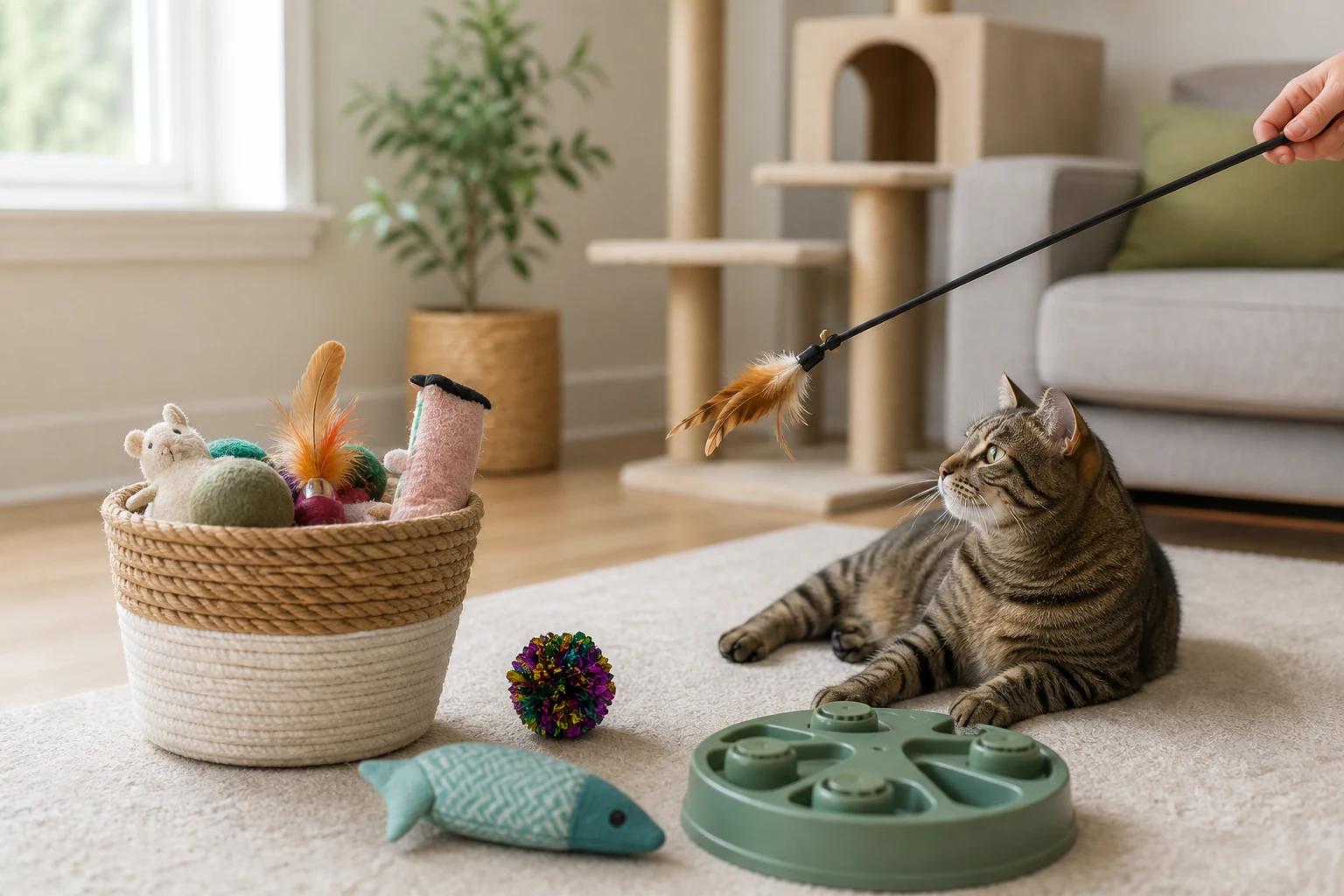
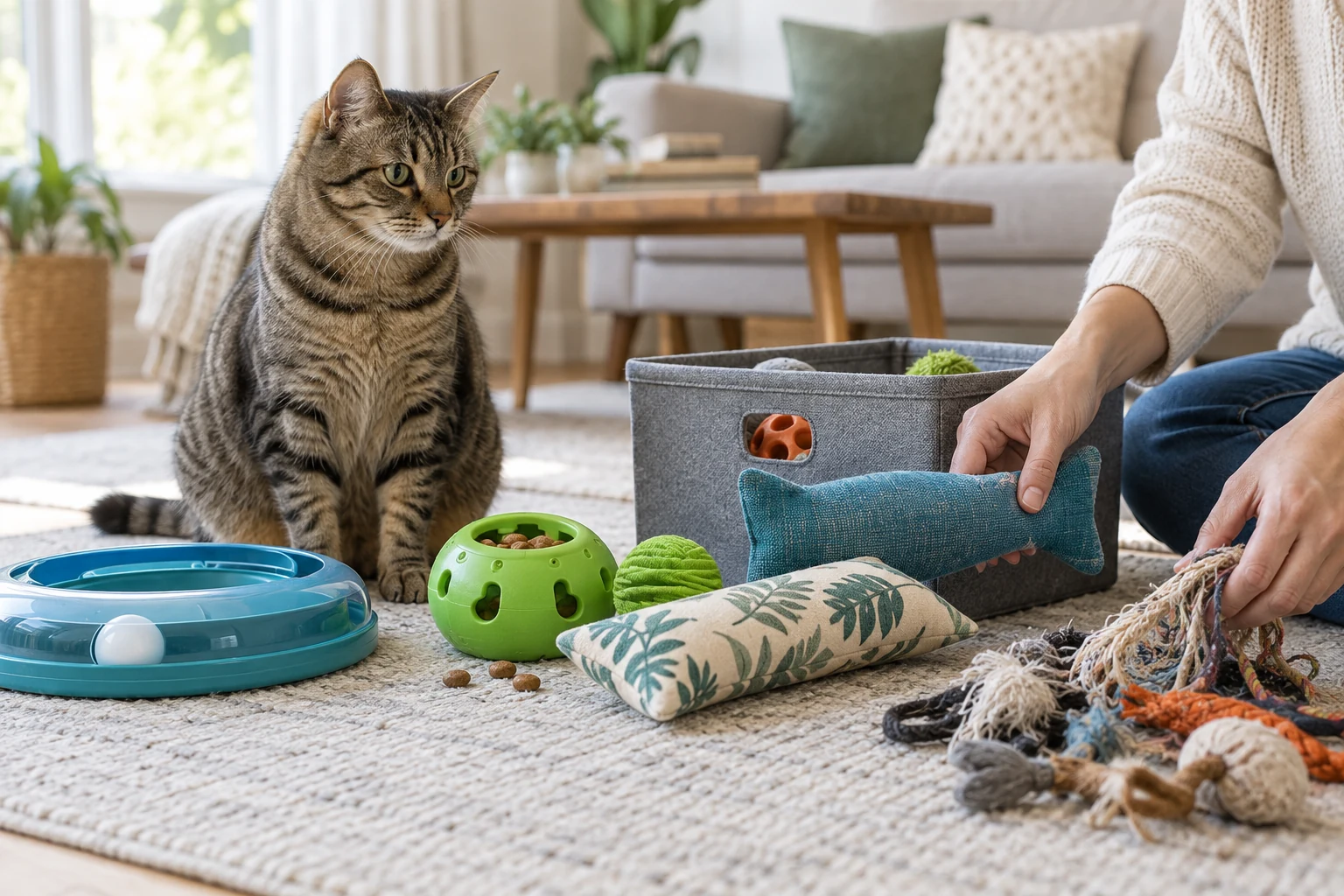
Most cats do best with a small active toy set that changes once a week, plus a few favorite staples that stay available every day.
Toy rotation is not about hiding everything your cat loves. It is about keeping novelty alive, making play easier for you to repeat, and checking toys before they become unsafe. Cornell Feline Health Center specifically notes that rotating toys can help prevent boredom, while also warning cat parents to watch for small parts, loose strings, and risky play spaces 1.
The easiest plan is simple: keep three to five toys out, store the rest, inspect toys before they come back, and adjust the schedule based on your cat's age, energy, and play style.
Table of Contents
- What is the best cat toy rotation schedule?
- Why do cats get bored with toys?
- Which toys should stay out, rest, or be supervised?
- How should you reintroduce a toy so it feels new?
- What safety checks should you do before rotating toys back in?
- How does toy rotation fit into daily play?
- Can toy rotation reduce clutter without reducing enrichment?
- Can food puzzles be part of the rotation?
- Conclusion: Keep rotation simple and safe
- Frequently Asked Questions
- References
What is the best cat toy rotation schedule?
A good starting schedule is to rotate cat toys once a week, keeping only a small mix available at a time. Put out one chase toy for supervised play, one or two solo-safe toys, one kicking or wrestling toy, and one puzzle or scent-based option if your cat enjoys it.
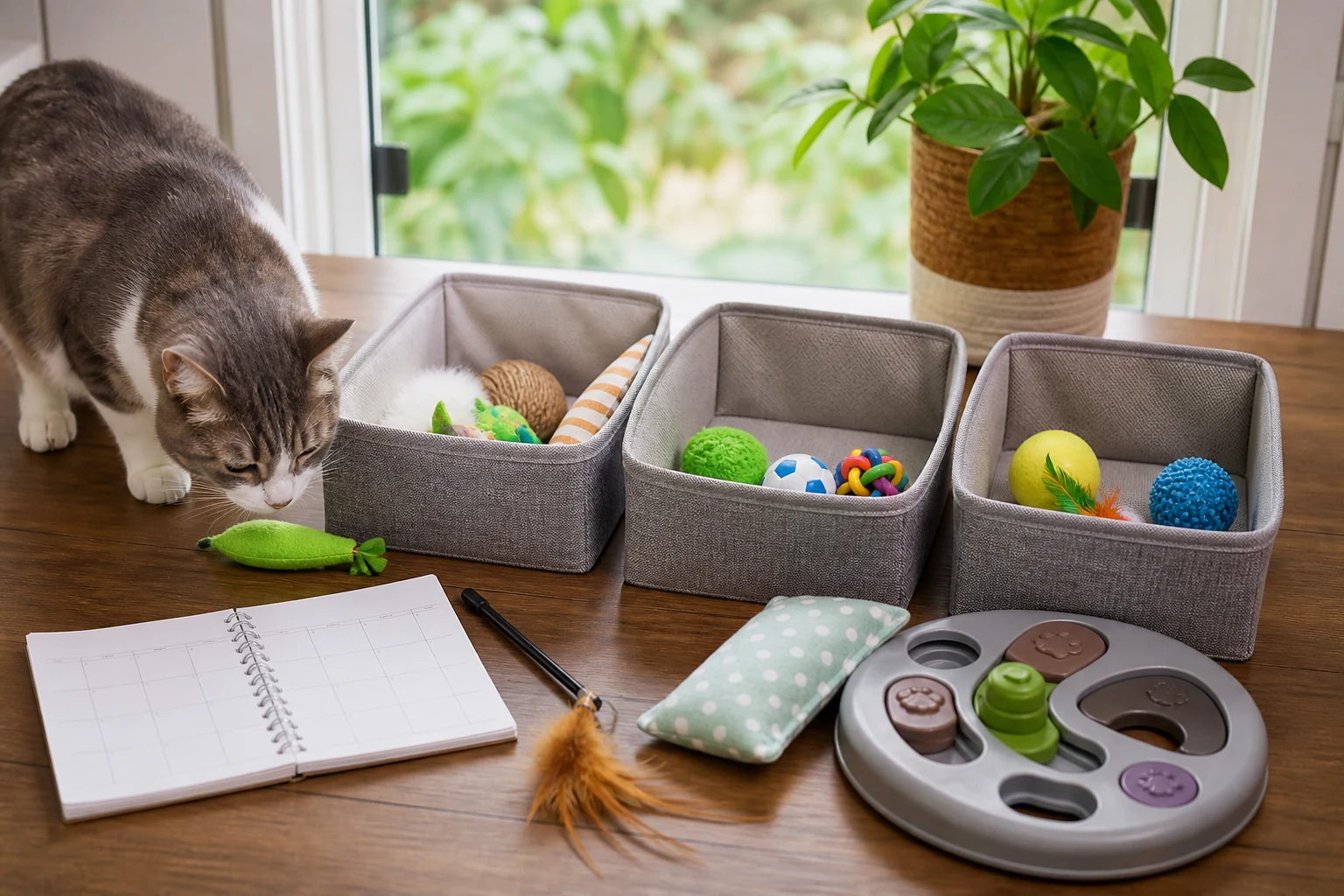
For many homes, this rhythm is enough:
| Toy group | How many to keep active | When to swap |
|---|---|---|
| Wand or teaser toys | 1, supervised only | Every few sessions, or when interest drops |
| Balls, soft mice, crinkle toys | 2 to 3 | Weekly |
| Kicker toys | 1 | Weekly or every two weeks |
| Puzzle feeders | 1 | Change the puzzle or food location weekly |
| Special scent toys | 1 | Store airtight between short sessions |
This schedule keeps the room manageable and gives your cat something to rediscover. If your cat has one beloved toy that works like a comfort object, leave it available. Rotate the supporting toys around it instead.
Why do cats get bored with toys?
Cats often lose interest when a toy sits in the same place, smells the same, and moves the same way every day. Indoor cats still need outlets for stalking, chasing, pouncing, catching, and problem-solving. The AAFP/ISFM environmental needs guidelines describe play and predatory behavior as a core part of a healthy feline environment 2.
In the wild, prey does not lie in the middle of the living room for three weeks. It appears, disappears, hides, moves, and changes. Rotation helps household toys feel a little more like that: scarce, surprising, and worth investigating.
Toy boredom is also not a character flaw. Some cats are cautious. Some want the toy to move away from them like prey. Some prefer scent, sound, texture, or food puzzles over dramatic jumping games. If your cat sniffs a toy and walks away, try changing the movement, location, or timing before assuming the toy has failed.
Which toys should stay out, rest, or be supervised?
Leave out toys that are sturdy, quiet, and unlikely to be swallowed. Store or supervise anything with string, feathers, elastic, bells, small detachable pieces, batteries, or chewable parts. Cornell warns cat parents to avoid toys with small pieces or linear strand-like parts that may separate and be ingested 1.
Here is a practical sorting system:
| Category | Examples | Best use |
|---|---|---|
| Always available | Durable balls, sturdy soft mice, cardboard boxes, safe scratchers | Solo batting, pouncing, and exploration |
| Rotate weekly | Kicker toys, crinkle toys, puzzle feeders, scent toys | Novelty and enrichment |
| Supervised only | Wand toys, ribbon teasers, feather toys, laser pointer games | Interactive play with a person |
| Retire or repair | Split seams, loose bells, unraveling cords, exposed stuffing, cracked plastic | Remove until fixed or replaced |
If you are choosing new toys, start with variety rather than volume. One good wand toy, one sturdy kicker, one rolling toy, one food puzzle, and one cardboard or paper option can be more useful than a large pile of similar toys. For ideas by play style, see SnuggleSouls' guide to the best interactive cat toys for indoor cats.
How should you reintroduce a toy so it feels new?
Bring the toy back in a new way: a different room, a different time of day, a different movement pattern, or a short scent refresh. A toy that was boring on the carpet may become interesting when it peeks around a doorway, rustles behind a paper bag, or darts behind a chair leg.
International Cat Care explains that play can involve search, stalk, chase, pounce, catch, and manipulate behaviors 3. Use that sequence when you reintroduce a toy:
- Start with the toy half-hidden instead of waving it in your cat's face.
- Move it away from your cat, not toward them.
- Pause so your cat can stalk.
- Let your cat catch the toy often enough to prevent frustration.
- End with a calm finish, such as a small meal, treat puzzle, or quiet rest.
If your cat grabs, bites, and kicks the toy, that can be successful play. If they flatten their ears, hide, hiss, pant, or leave the room, lower the intensity. SnuggleSouls' guide on how to play with your cat can help you match the game to your cat's confidence level.
What safety checks should you do before rotating toys back in?
Before a toy returns to the active basket, check it for loose parts, chew damage, exposed stuffing, sharp edges, weak seams, and trapped dirt. A one-minute inspection is one of the biggest benefits of a rotation routine.
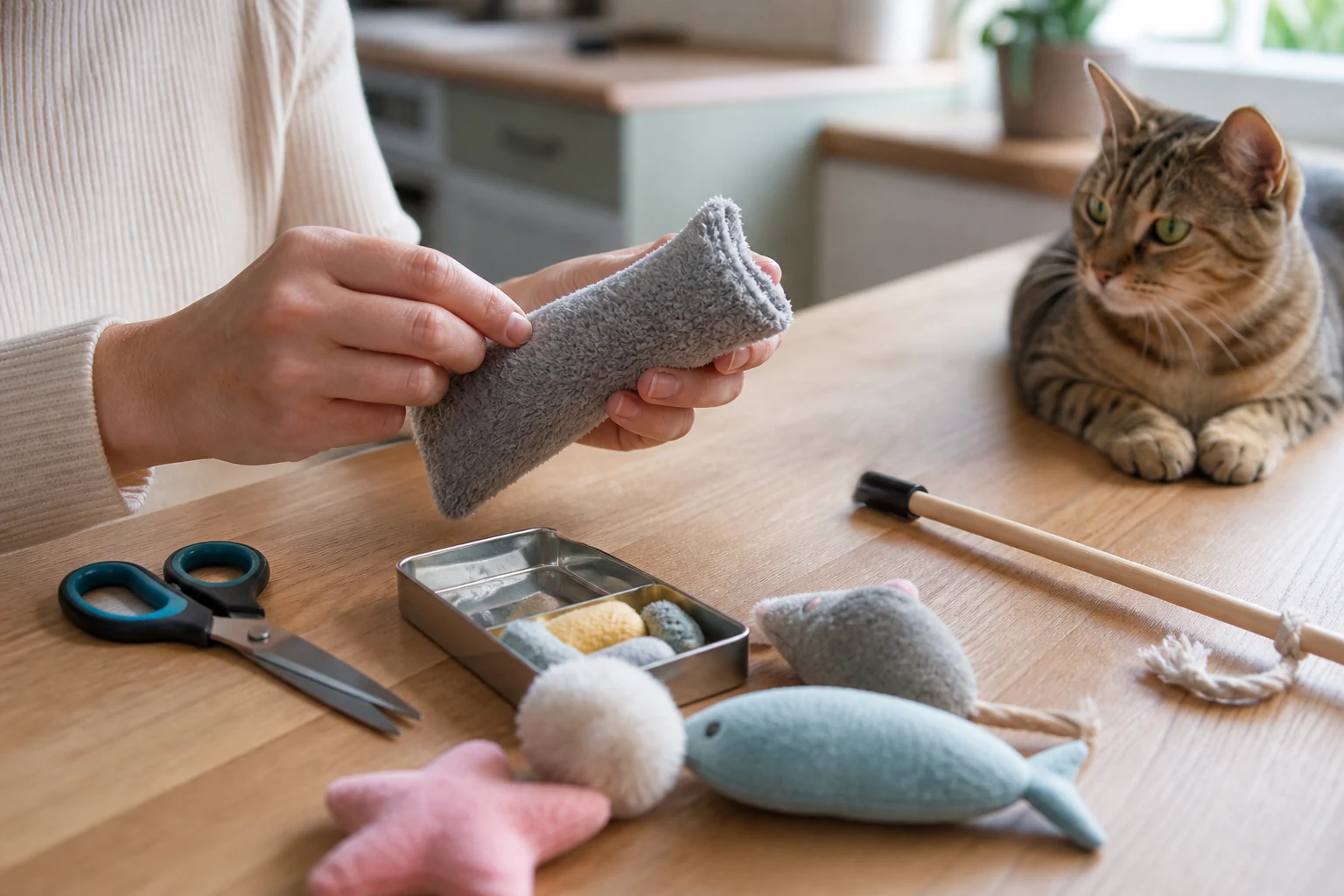
Use this checklist:
- Tug gently on feathers, tails, bells, eyes, ribbons, and glued-on pieces.
- Squeeze plush toys to check for holes or exposed stuffing.
- Look for cracked plastic, sharp edges, or loose battery covers.
- Wash washable toys if they are dirty or covered in saliva.
- Throw away toys that cannot be repaired safely.
- Store wand toys and string toys after each session.
Call your veterinarian promptly if your cat may have swallowed string, ribbon, elastic, a bell, toy stuffing, or a broken plastic piece. Do not pull a string that is visible from the mouth or rectum; that can cause serious injury. Seek urgent care for repeated vomiting, refusal to eat, painful belly, lethargy, collapse, breathing trouble, or sudden major behavior change.
How does toy rotation fit into daily play?
Toy rotation works best when it supports a daily routine, not when it replaces play with you. Many cats benefit from short, focused play sessions every day, especially before meals or before the household settles for the evening.
If you already follow a routine from SnuggleSouls' guide on how much playtime a cat needs, rotation gives that routine fresh material. You can use the same daily schedule but change which toy appears in each session.
Try this pattern:
| Time | Goal | Toy idea |
|---|---|---|
| Morning | Quick energy outlet | Ball chase, soft mouse toss, short wand game |
| Afternoon | Independent enrichment | Puzzle feeder, cardboard box, safe solo toy |
| Evening | Strong hunting-style play | Wand toy, kicker toy, catch-and-cool-down routine |
Keep sessions short if your cat is a kitten, senior, overweight, recovering, or easily overstimulated. For cats with arthritis, breathing disease, heart disease, recent surgery, or unexplained tiredness, ask your veterinarian what level of play is appropriate.
Can toy rotation reduce clutter without reducing enrichment?
Yes. In many homes, fewer visible toys make play more interesting and the environment easier to clean. The point is not minimalism for humans; it is better access, better novelty, and safer inspection.
Set up three zones:
| Zone | What goes there | Why it helps |
|---|---|---|
| Active basket | This week's safe toys | Easy for your cat to find |
| Resting bin | Clean toys out of sight | Restores novelty |
| Repair or retire spot | Damaged toys | Keeps unsafe toys from drifting back |
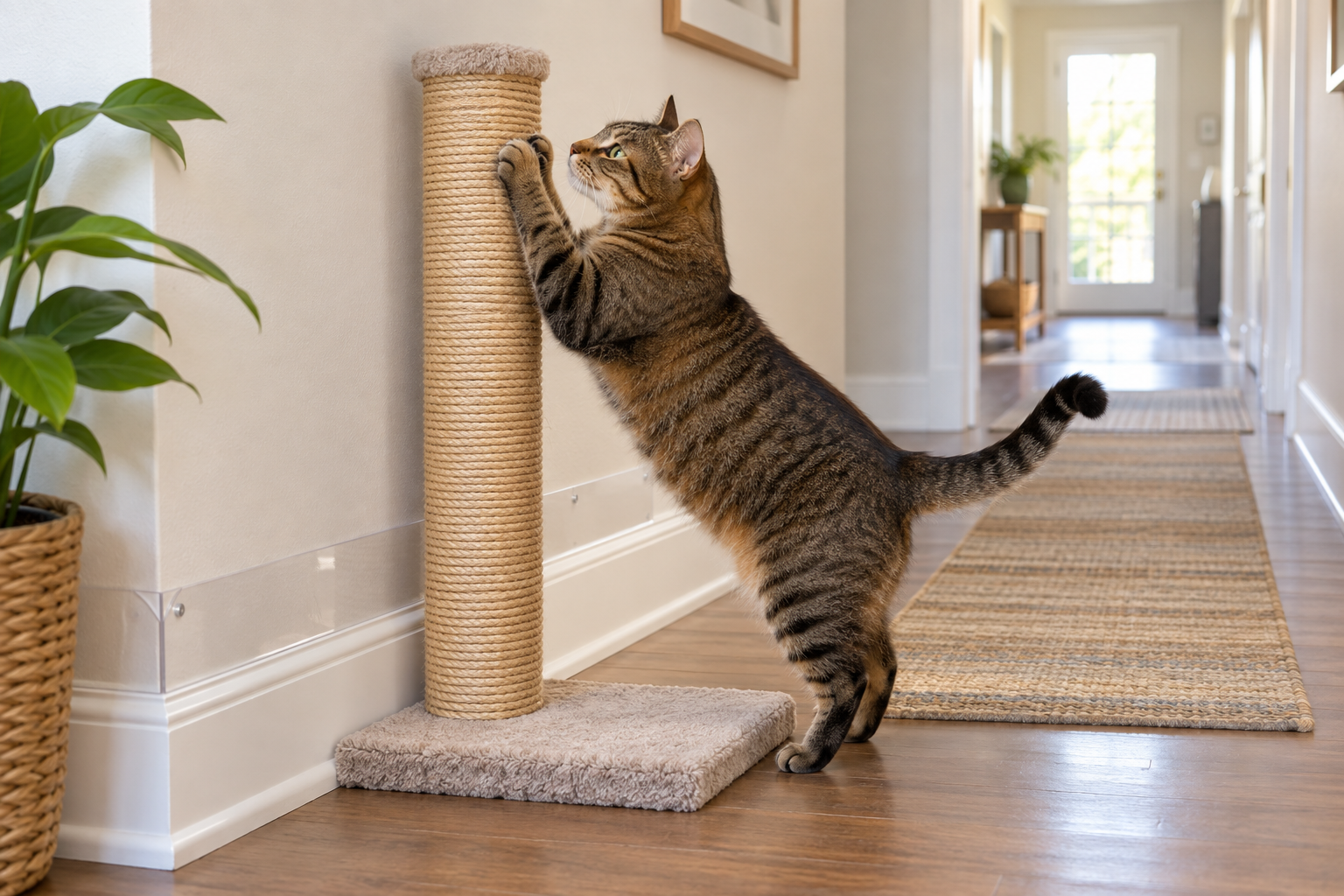
Toy rotation should sit beside other enrichment, not replace it. Cats also need scratching, climbing, resting, hiding, litter access, water access, and predictable social choice. A good scratching post setup can reduce furniture frustration more reliably than adding another toy pile.
For multi-cat homes, spread active toys across more than one area. Some cats guard toys or block access without an obvious fight. Multiple play spots give shy cats a fair chance to engage.
Can food puzzles be part of the rotation?
Food puzzles can be part of toy rotation, especially for cats who enjoy problem-solving more than chasing. Environmental enrichment literature often includes feeding devices and foraging opportunities as ways to support natural behavior in indoor cats 4.
Use food puzzles thoughtfully:
- Start easy so your cat succeeds.
- Count treats or kibble as part of daily calories.
- Clean puzzle feeders often.
- Avoid hard puzzles for cats who become frustrated or food-guarding.
- Use wet-food-safe lick mats only if they can be washed thoroughly.
If your cat seems hungry all the time, a puzzle may help slow eating, but it should not hide a feeding or health problem. SnuggleSouls' article on cat begging for food after eating explains common causes, and the cat calorie calculator can help you discuss portions more clearly with your veterinarian.
Conclusion: Keep rotation simple and safe
A cat toy rotation schedule does not need to be complicated. Keep a few safe toys active, store the rest, change the set about once a week, and inspect every toy before it returns.
The best rotation is the one your cat actually uses. If your cat loves one toy, keep it. If they get bored fast, rotate more often. If they are cautious, reintroduce toys quietly and let them choose. For more practical home routines, browse the SnuggleSouls daily care guides.
Frequently Asked Questions
How often should I rotate my cat's toys?
Once a week is a good starting point for most cats. Rotate sooner if your cat loses interest quickly, and rotate more slowly if your cat is cautious or strongly attached to familiar objects.
Should I leave cat toys out at night?
Leave out only toys that are safe for unsupervised play, such as sturdy balls or durable soft toys without loose pieces. Put away wand toys, string toys, ribbon toys, feather teasers, and anything your cat chews apart.
How many toys should a cat have out at once?
Three to five active toys is usually enough. Choose a mix of textures and play styles instead of leaving out a large pile of similar toys.
Why does my cat ignore new toys?
The toy may be moving too directly toward your cat, placed in a boring location, or introduced at the wrong time of day. Try hiding it partly behind furniture, moving it like prey, or offering it during your cat's naturally active period.
Are laser pointers good for toy rotation?
Laser pointers should be used carefully because the cat cannot physically catch the light. If you use one, keep sessions brief, avoid shining it in eyes, and end by letting your cat catch a real toy or food puzzle.
References
[1] Cornell Feline Health Center. (2026). Safe toys and gifts. https://www.vet.cornell.edu/departments-centers-and-institutes/cornell-feline-health-center/health-information/feline-health-topics/safe-toys-and-gifts
[2] Feline Veterinary Medical Association. (2013). 2013 AAFP/ISFM Environmental Needs Guidelines. https://catvets.com/resource/aafp-isfm-environmental-needs-guidelines/
[3] International Cat Care. (2024). Playing with your cat. https://icatcare.org/articles/playing-with-your-cat
[4] Journal of Feline Medicine and Surgery. (2014). Environmental Enrichment for Indoor Cats. https://pmc.ncbi.nlm.nih.gov/articles/PMC3922041/
 EN
EN DE
DE ES
ES PT
PT