
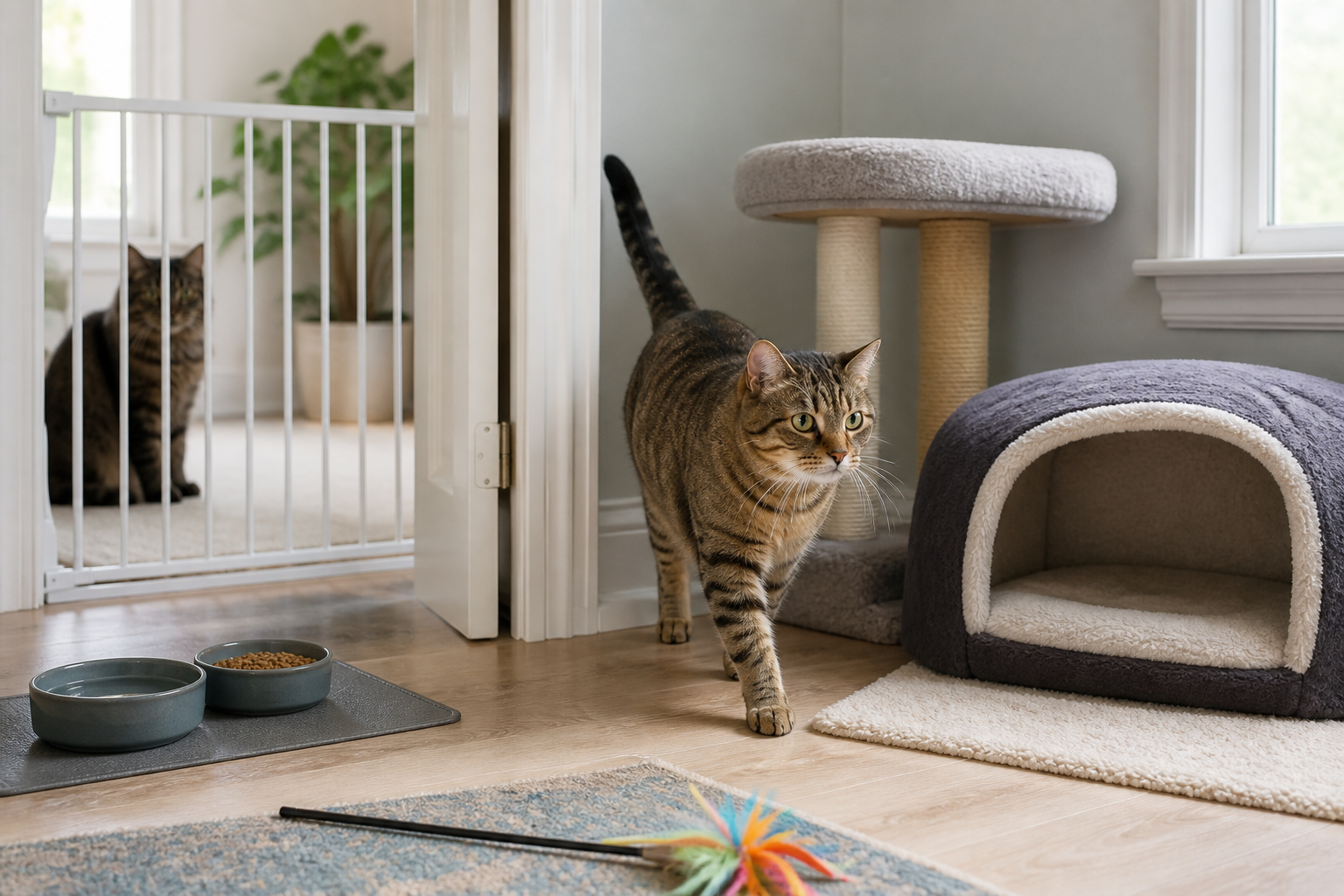
To rebuild confidence in a bullied cat, start after the chasing, blocking, and resource guarding have stopped. Use short play sessions, predictable rewards, and carefully managed shared-space practice so the target cat can choose to move, pause, retreat, and succeed.
Confidence work is not about making the bullied cat "stand up" to the other cat. It is about changing the home experience from trapped and watched to safe and controllable. A cat who has been guarded away from food, rushed in doorways, or stared down near the litter box may need days or weeks of small wins before shared space feels normal again.
Table of Contents
- What has to be stable before confidence work starts?
- What does confidence look like in a bullied cat?
- How should you use play to rebuild confidence?
- How do rewards help without forcing the cats together?
- When is a shared-space session ready?
- What signs mean the bullied cat is still overwhelmed?
- How do you measure progress without rushing?
- When should you call a veterinarian or behavior professional?
- Conclusion: rebuild choice before closeness
- Frequently Asked Questions
- References
What has to be stable before confidence work starts?
The bullied cat needs reliable safety first: separated resources, open escape routes, and no active chasing or cornering. If the other cat can still block doors, guard bowls, or rush the target cat, confidence sessions will feel like another test instead of recovery.
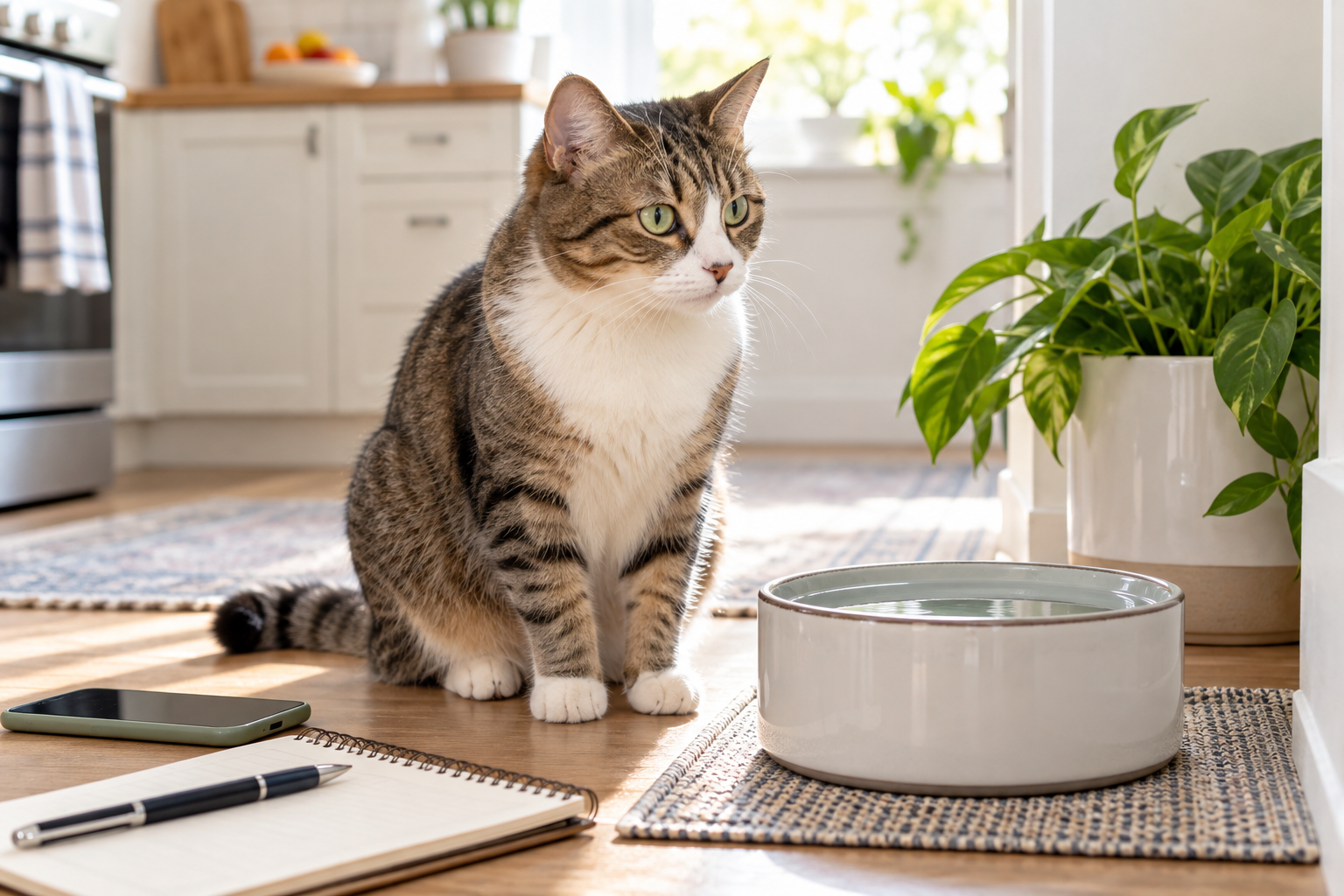
Start with the foundation in place. The target cat should have a protected room or zone, food and water the other cat cannot control, a litter box with an open route, resting spots, and predictable quiet time. If you have not done that step yet, begin with SnuggleSouls' guide to safe zones for a bullied cat.
The 2024 AAFP intercat tension guidelines emphasize recognizing subtle tension and managing the environment before conflict escalates 1. That matters because many bullied cats do not show dramatic fights. They may simply stop entering certain rooms, wait for the other cat to leave, crouch in doorways, or hide when household traffic increases.
Use this readiness check before starting confidence work:
| Readiness question | Good sign | Wait and adjust if |
|---|---|---|
| Can the target cat eat without being watched or displaced? | Eats normally in a protected spot | Leaves food, eats only at night, or startles away |
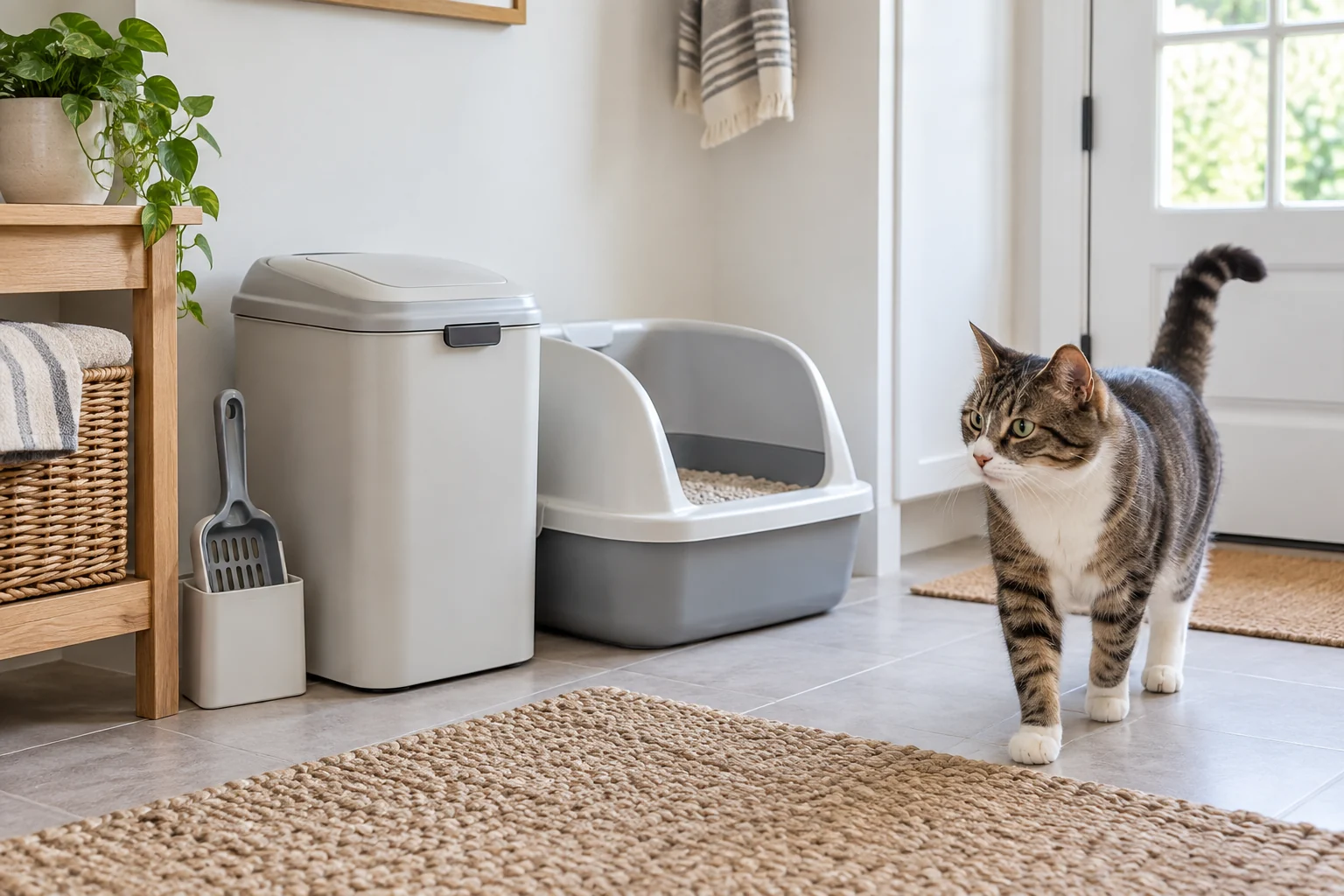
| Can the target cat reach litter without passing the other cat? | Uses the box on a normal schedule | Holds urine/stool, has accidents, or runs from the box |
| Can the target cat leave a room without being trapped? | Moves through at least one open route | Freezes, crouches, or turns back at bottlenecks |
| Has chasing stopped? | No rushing, ambushing, or blocking for several days | Any repeated chase, swat, or doorway guarding continues |
| Can people interrupt tension calmly? | Cats can be redirected with distance and routine | Conflict escalates quickly or humans feel unsafe |
If the bullying is still active, pause confidence exercises and return to separation. SnuggleSouls' guide on how to stop one cat from bullying another covers the immediate safety and interruption steps.
What does confidence look like in a bullied cat?
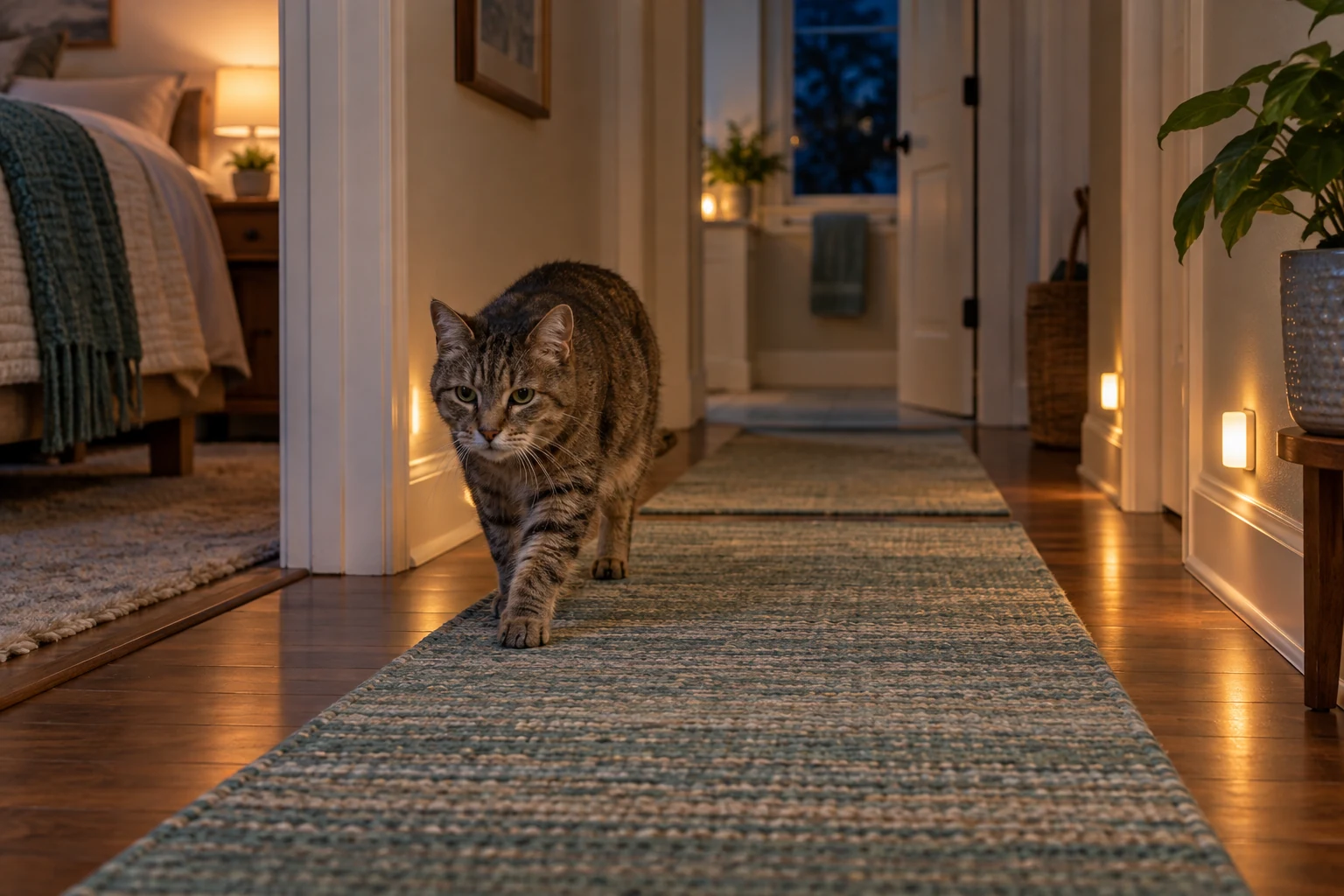
Confidence looks like voluntary movement, relaxed recovery, and normal choices. The cat does not have to become bold or social; a cautious cat can still be confident if they can eat, play, rest, explore, and leave without panic.
Look for body language in context. A cat may be improving if they walk instead of sprint, pause in the doorway without freezing, take treats with a loose body, use vertical space, groom after a session, or return to a favored resting place rather than disappearing for hours. Cornell's aggression guidance notes that fear and aggression signs can include flattened ears, dilated pupils, crouching, tucked posture, and tense body signals 4. Improvement often means those signals appear less often, last for less time, or resolve faster.
Do not confuse stillness with calm. A bullied cat may freeze because moving has felt risky. Calm confidence usually includes choice: the cat can look away, sniff, eat, stretch, move to a perch, or leave the room.
Track these small wins:
- The cat enters a room without needing to be carried.
- The cat plays for 30-60 seconds near a safe route.
- The cat takes a treat and then stays visible.
- The cat passes a doorway with loose shoulders and tail.
- The cat recovers after seeing the other cat instead of hiding all day.
- The cat chooses a perch, bed, or food station while the other cat is elsewhere.
These are better goals than "make the cats friends." Some cats become companions again; others do best with peaceful distance and good management.
How should you use play to rebuild confidence?
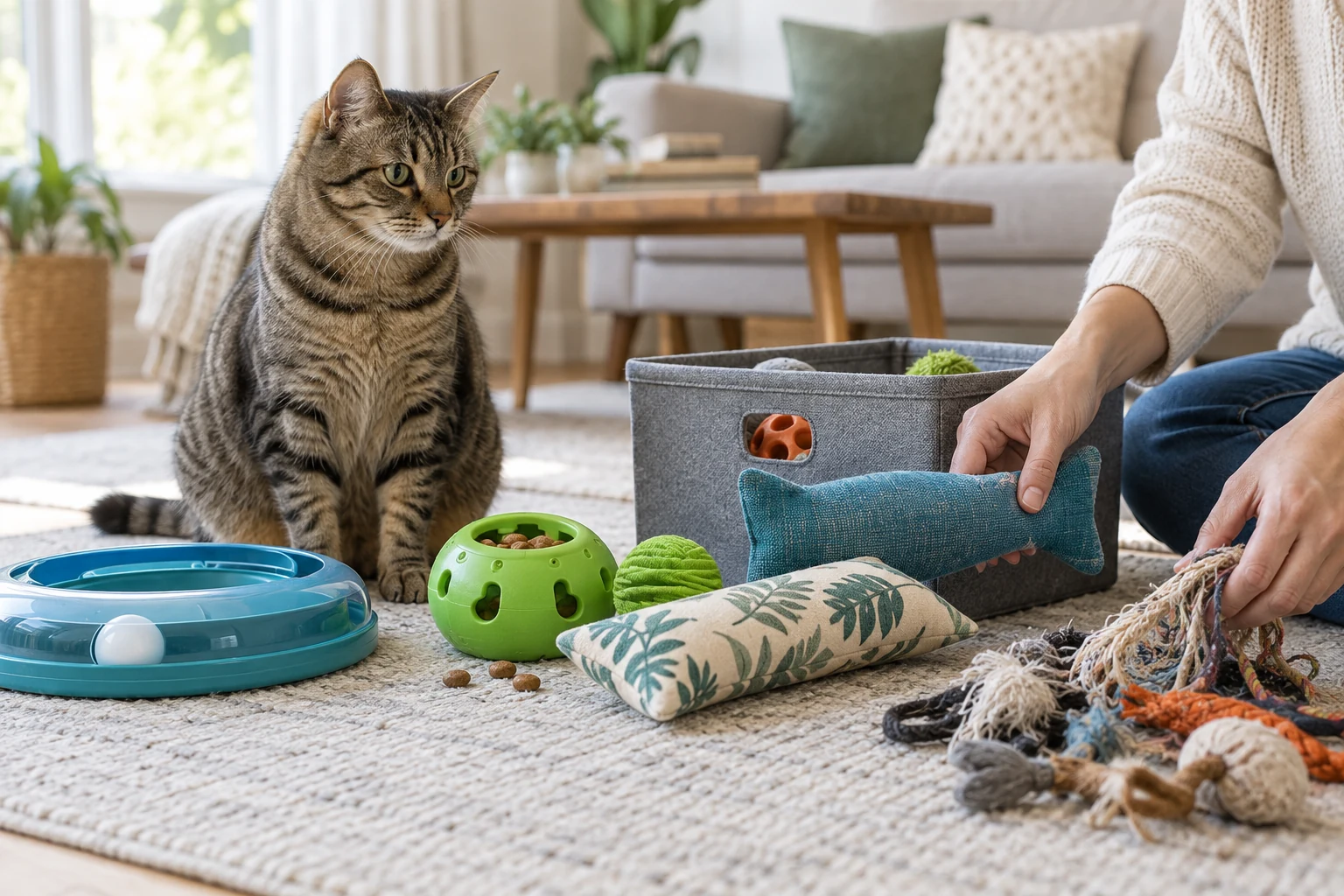
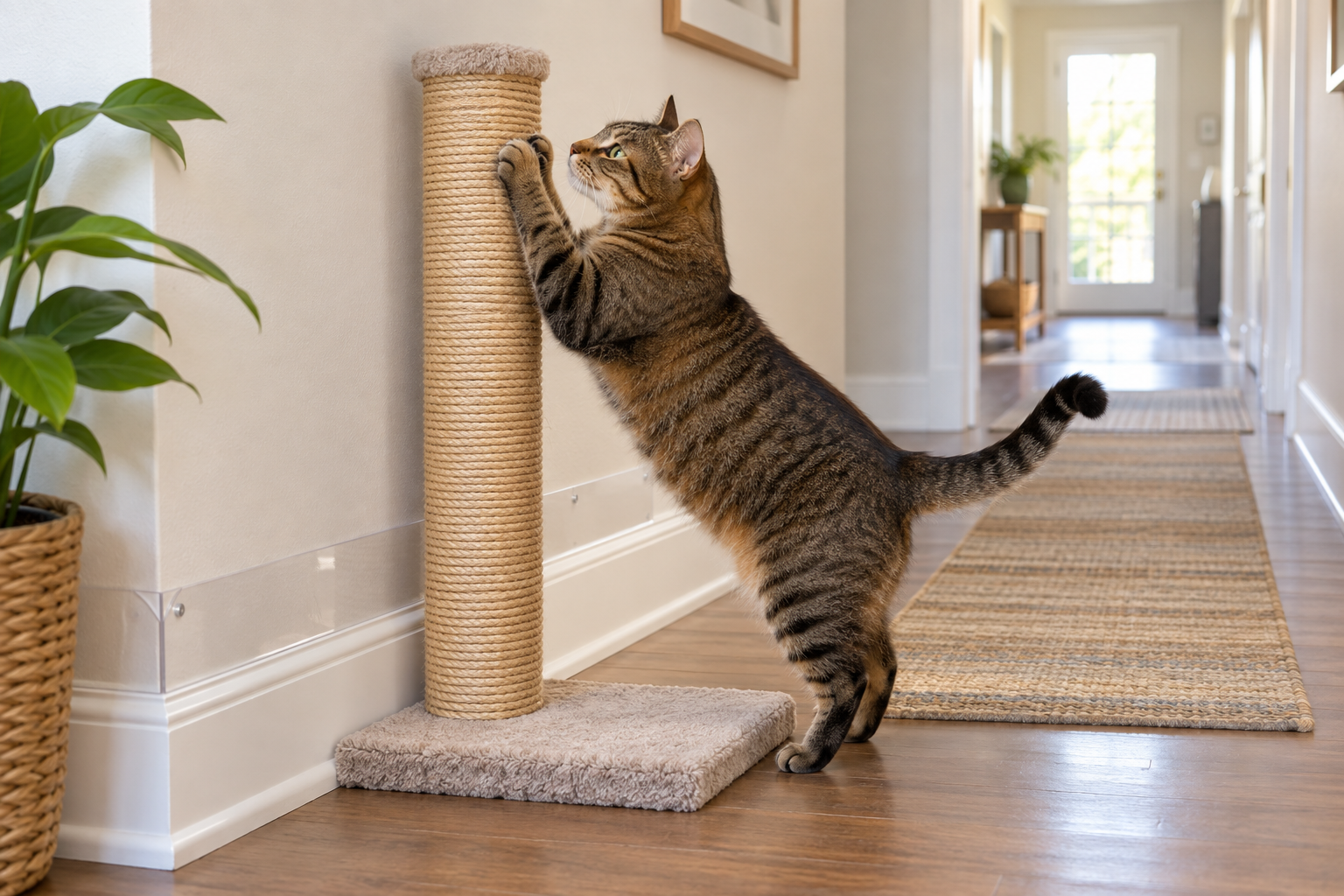
Use play as a private confidence exercise first. The goal is not exhaustion or wild chasing; the goal is controlled movement, successful pouncing, and the feeling that the room is safe enough to explore.
The Merck Veterinary Manual describes environmental management, behavior modification, and reinforcement-based training as core parts of addressing behavior problems in cats 5. For a bullied cat, play can become a gentle behavior-modification tool because it rewards brave movement without forcing contact with the other cat.
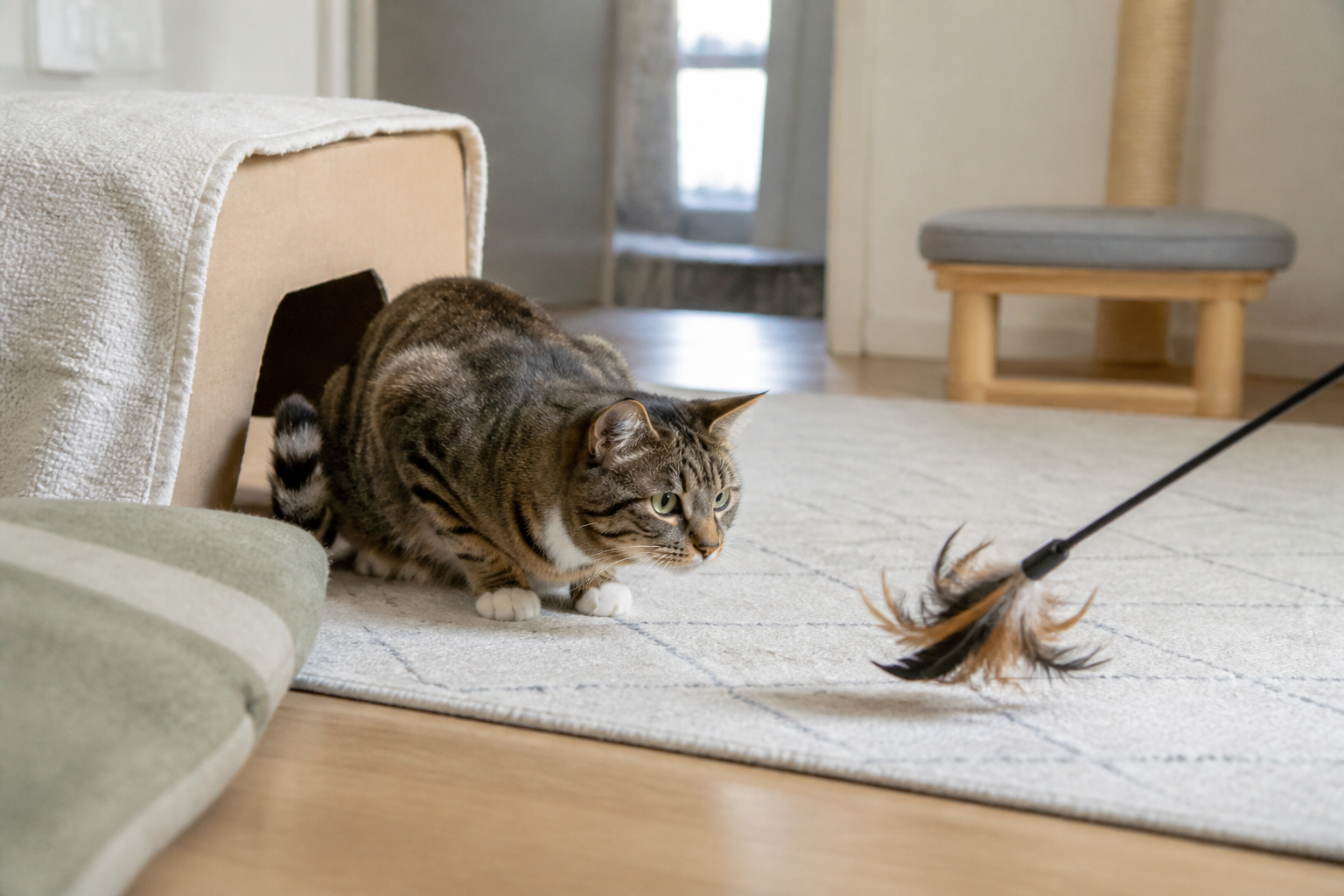
Set up the first sessions like this:
- Choose the target cat's safe room or a quiet nearby room.
- Keep the other cat fully separated.
- Place the cat's hideaway, perch, and exit route in view.
- Use a wand toy, ribbon toy, or soft toss toy that keeps hands away from teeth and claws.
- Move the toy away from the cat, not straight at the cat.
- End after a tiny success, such as one paw tap, chase step, or relaxed sniff.
- Follow with a small treat or meal if the cat enjoys food rewards.
Keep sessions short: two to five minutes is enough for many cautious cats. Stop before the cat becomes tense, pants, hides, or refuses to re-engage. A successful session can look boring to a person: one gentle chase, one treat, and a relaxed exit.
Avoid play that increases competition. Do not use one wand toy between both cats at first, do not make the target cat chase past the other cat, and do not toss treats where the confident cat can steal them. Shared play comes later, and some cats never need it.
How do rewards help without forcing the cats together?
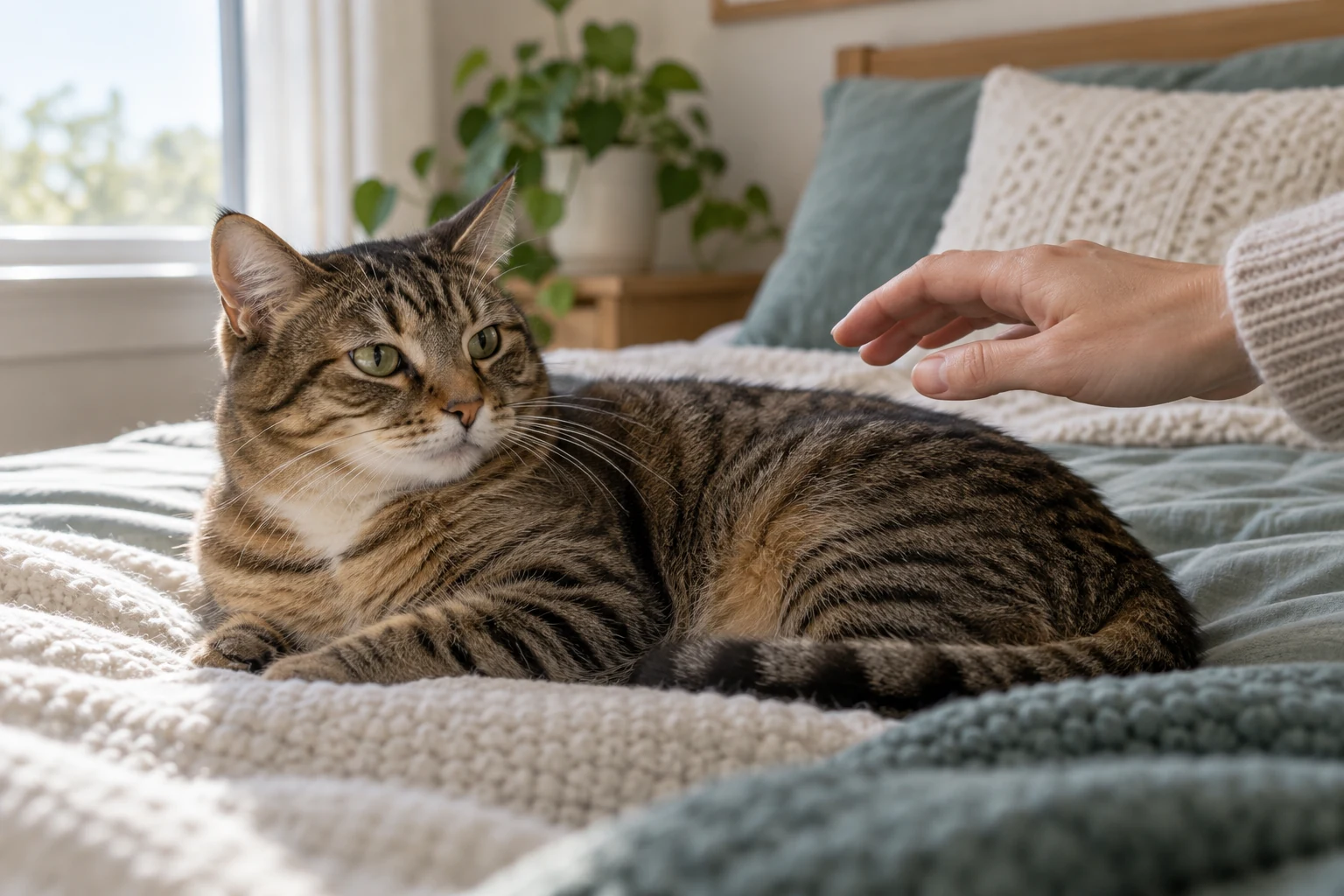
Rewards help when they are tied to calm choices, not proximity. Treats, meals, praise, brushing, or play can teach the bullied cat that appearing, moving, and resting in visible places are safe again.
Think in layers. First, reward the target cat for calm behavior when alone. Then reward calm behavior when the other cat is behind a closed door. Later, reward calm behavior at a greater visual distance, such as across a baby gate or across a large room. If either cat stares, stalks, rushes, or stops eating, the setup is too hard.
Use a simple reward ladder:
| Step | Setup | Reward the target cat for |
|---|---|---|
| 1 | Alone in safe room | Looking out, playing, eating, stretching, using a perch |
| 2 | Other cat behind closed door | Staying relaxed during normal household sounds and scent |
| 3 | Other cat visible through barrier at a distance | Looking and then disengaging, eating, blinking, or turning away |
| 4 | Same room, far apart, supervised | Staying on a mat, taking treats, exploring, or leaving calmly |
| 5 | Short ordinary overlap | Passing through without crouching, sprinting, or being followed |
Reward the other cat too, but separately. The more confident cat should be reinforced for looking away, staying on their own mat, responding to a cue, or choosing a perch instead of approaching. This prevents the whole session from becoming target-cat pressure.
Never withhold food to force a session. Hungry cats can become more frustrated, and food competition can make intercat tension worse. Use tiny high-value rewards or part of a normal meal, with each cat's portion controlled separately.
When is a shared-space session ready?
A shared-space session is ready when both cats can be calm with distance and the target cat has a clear exit. The first session should feel too easy: short, supervised, and set up so neither cat has to pass close to the other.
International Cat Care recommends multiple key resources in multi-cat homes, including food, water, litter trays, beds, and high resting places 3. Keep that principle during shared-space practice. Each cat should have their own mat, dish, perch or resting option, and route out of the room.
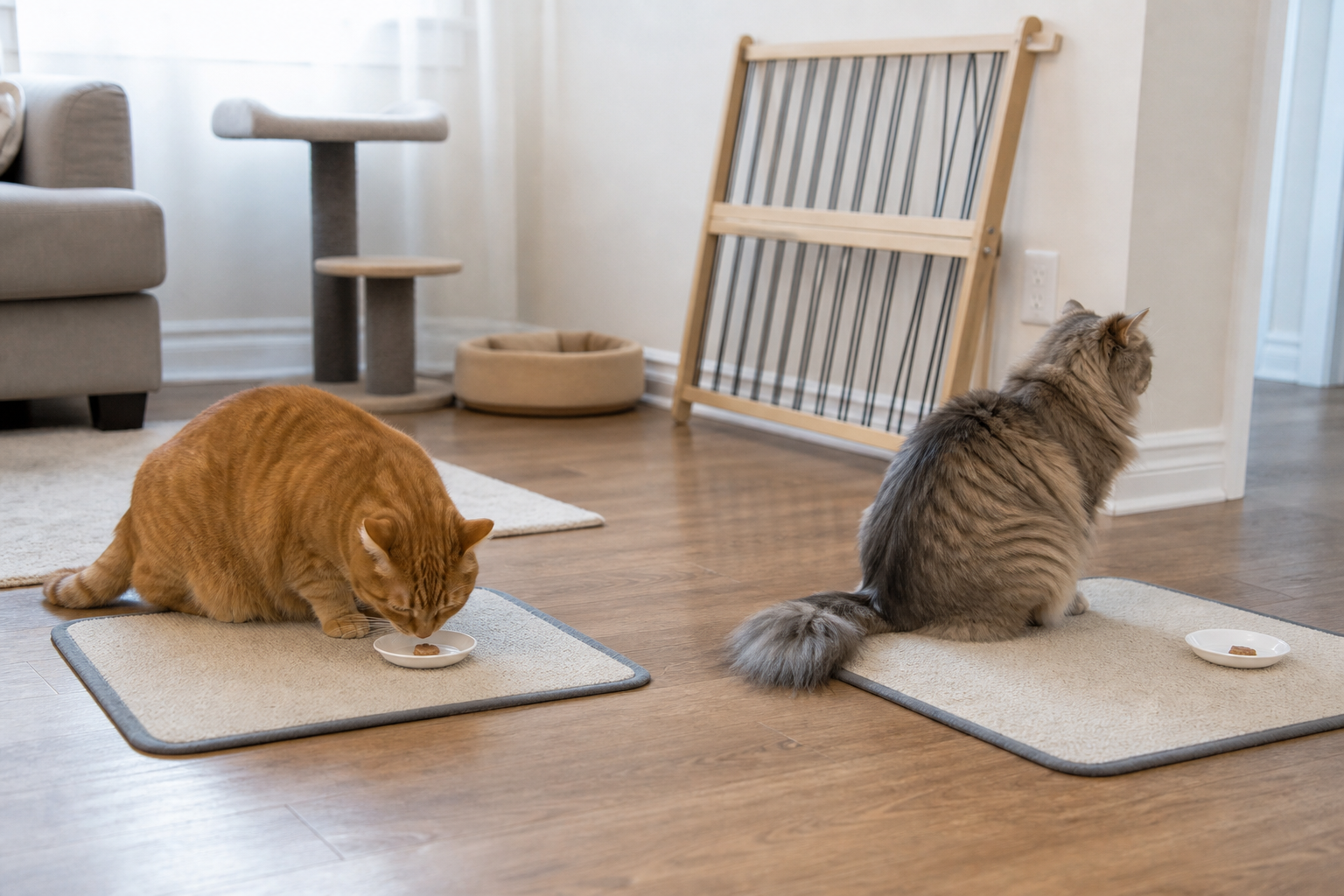
For the first session:
- Use a room with two exits or a clear barrier you can close calmly.
- Place mats at opposite sides of the room.
- Put the target cat closer to the safest exit or perch.
- Keep food rewards separate.
- Let the target cat enter under their own power.
- Keep the session under one to three minutes.
- End while both cats are still calm.
Do not wait for trouble before ending. If the cats glance, eat, look away, and stay loose, that is a complete session. The next repetition can be the same length; longer is not automatically better.
If this is really a reintroduction after fighting, follow a gradual reintroduction plan instead of jumping straight to shared space. SnuggleSouls' guide on how to introduce two cats without fighting walks through scent, barrier, and distance steps.
What signs mean the bullied cat is still overwhelmed?
The bullied cat is still overwhelmed if they stop eating, hide for long stretches after sessions, freeze at thresholds, avoid the litter box, crouch low, flatten ears, lash the tail, or bolt when the other cat appears. These signs mean the plan needs more distance, shorter sessions, or a return to full separation.
Do not push through fear. Cornell advises separating cats that act aggressively toward each other and reintroducing them slowly with positive reinforcement 4. That principle applies to the target cat too: if the cat is showing fear, reduce the challenge instead of asking for more bravery.
Watch for subtle stress after the session:
- The cat eats during the session but vomits, hides, or refuses food later.
- The cat plays alone but will not cross the doorway afterward.
- The cat sleeps in a new hidden spot and stops using usual resting places.
- The cat uses the litter box less often or chooses a risky location.
- The cat becomes clingier, more reactive, or unusually withdrawn.
For more context on avoidance behavior, SnuggleSouls' guide to why your cat is hiding can help you separate normal decompression from a stress pattern that needs action.
How do you measure progress without rushing?
Measure progress by recovery speed and daily choices, not by how close the cats can sit. A bullied cat is improving when ordinary life expands: more rooms, more visible resting, easier routes, better play, and faster return to normal after seeing the other cat.
Use a simple weekly log:
| What to record | Why it matters |
|---|---|
| Eating location and appetite | Resource confidence often returns before social confidence |
| Litter box use | Avoidance can signal fear, pain, or blocked routes |
| Favorite resting places | Visible rest suggests the home feels safer |
| Play length | Voluntary play shows emotional bandwidth |
| Doorway behavior | Doorways are common pressure points in multi-cat tension |
| Recovery time after seeing the other cat | Faster recovery is real progress even without closeness |
The AAFP/ISFM environmental needs guidelines frame a healthy feline environment around safe places, separated resources, opportunities for play and predatory behavior, positive predictable human interaction, and respect for scent 2. Those pillars make useful measurement points: is the target cat using resources, playing, interacting, resting, and moving with more choice?
Keep expectations realistic. If a cat needed three days to recover after a conflict and now recovers in 20 minutes, that is meaningful. If the target cat can eat across a gate but not in the same room, stay at the gate. For more related behavior reading, use SnuggleSouls' broader cat behavior guides.
When should you call a veterinarian or behavior professional?
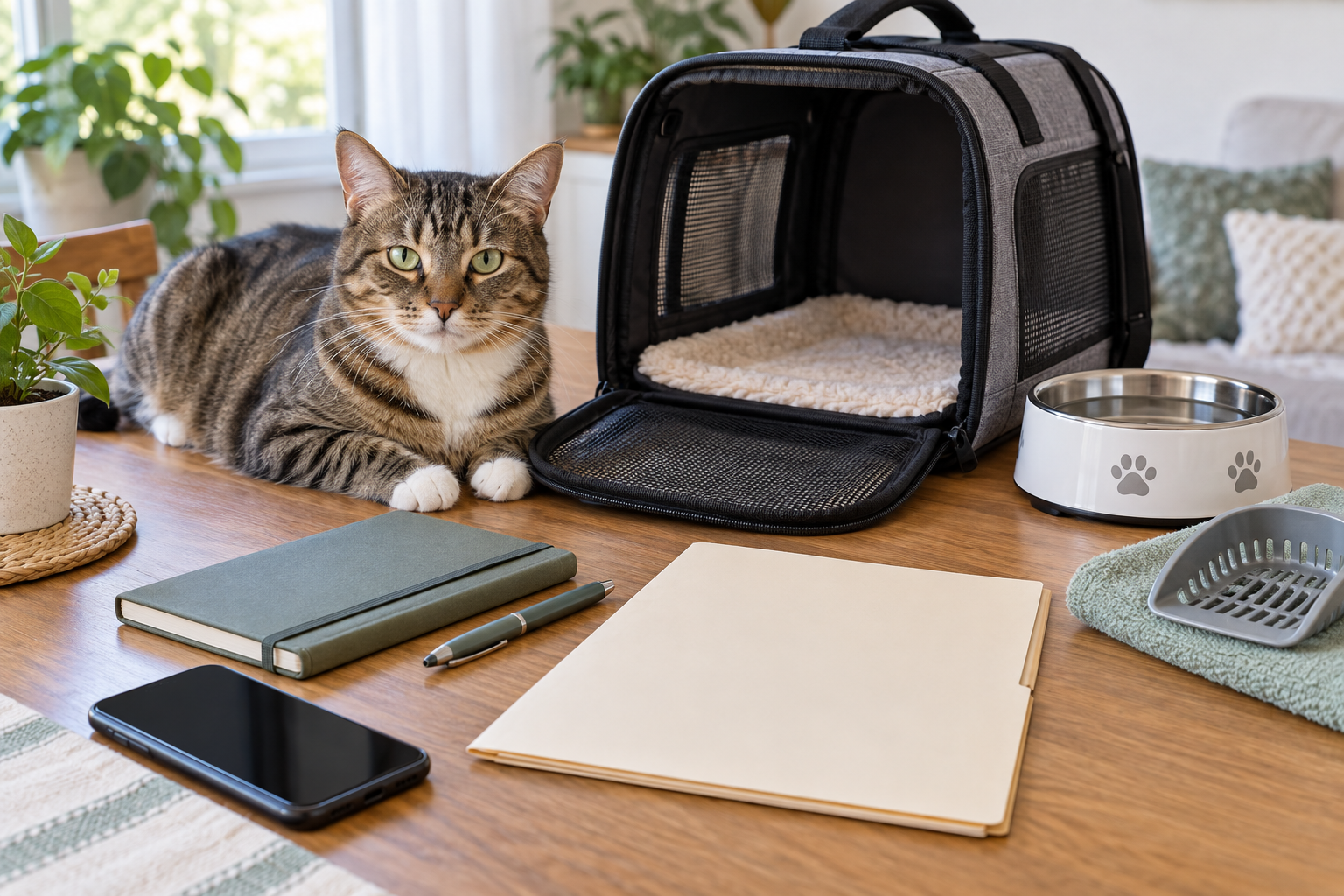
Call a veterinarian promptly if the bullied cat is injured, stops eating, has litter box changes, vomits repeatedly, hides with sudden decline, limps, cries, loses weight, or seems painful. Stress can worsen behavior, but pain and illness can also make cats more defensive or withdrawn.
Cornell notes that medical issues such as osteoarthritis, dental disease, hyperthyroidism, and central nervous system problems can contribute to aggression, so veterinary input matters before assuming the problem is only social 4. Merck also notes that behavior problems may require environmental management, behavior modification, and sometimes veterinary behavior support 5.
Seek a qualified behavior professional sooner if:
- The cats have caused puncture wounds or repeated injuries.
- One cat stalks, traps, or attacks despite separation attempts.
- The target cat cannot use food, water, or litter normally.
- Sessions worsen fear instead of improving it.
- You feel unsafe interrupting conflict.
- The household cannot maintain separation without help.
Do not use punishment, yelling, spray bottles, forced holding, or "let them fight it out" methods. Punishment can increase fear and make the bullied cat feel even less safe around people and the other cat.
Conclusion: rebuild choice before closeness
A bullied cat regains confidence when the home becomes predictable again. Start with stable safe zones, then add short private play, separate rewards, and carefully managed shared-space sessions that end before either cat becomes tense.
The strongest signal is not instant friendship. It is the target cat choosing to eat, rest, play, move, look away, and recover normally. Build from those choices, protect the cat's exits, and slow the plan down whenever fear returns.
Frequently Asked Questions
How long does it take to rebuild confidence in a bullied cat?
Some cats improve within a few weeks, while others need months of environmental management and careful sessions. The timeline depends on the severity of the bullying, the cats' temperaments, health issues, and how consistently the home prevents new negative encounters.
Should I make the bullied cat and the other cat eat together?
Not at first. Eating near the other cat can help later, but only when both cats already feel calm at a comfortable distance. Begin with separated meals, then use barrier or distance feeding only if neither cat guards, stares, rushes, or stops eating.
What if the bullied cat only plays when the other cat is locked away?
That is still progress. Private play helps the target cat rebuild movement and confidence without pressure. Keep the other cat separated during play until the target cat is consistently relaxed and recovers quickly after sessions.
Is hissing always a setback?
One brief hiss can be information rather than failure, especially if both cats disengage and recover. Repeated hissing, chasing, blocking, swatting, or hiding after the session means the setup is too hard and should be made easier.
Can two cats live peacefully without becoming friends?
Yes. A good outcome may be calm distance, predictable routines, separate resources, and no guarding or chasing. The goal is a safe home where both cats can make normal choices, not a forced friendship.
References
[1] American Association of Feline Practitioners. (2024). 2024 AAFP Intercat Tension Guidelines: Recognition, Prevention and Management. Source URL
[2] American Association of Feline Practitioners and International Society of Feline Medicine. (2013). AAFP and ISFM Feline Environmental Needs Guidelines. Source URL
[3] International Cat Care. (2025). Multi-cat Households. Source URL
[4] Cornell Feline Health Center. (2016). Feline Behavior Problems: Aggression. Source URL
[5] Merck Veterinary Manual. (2025). Behavior Problems of Cats. Source URL
 EN
EN DE
DE ES
ES PT
PT