
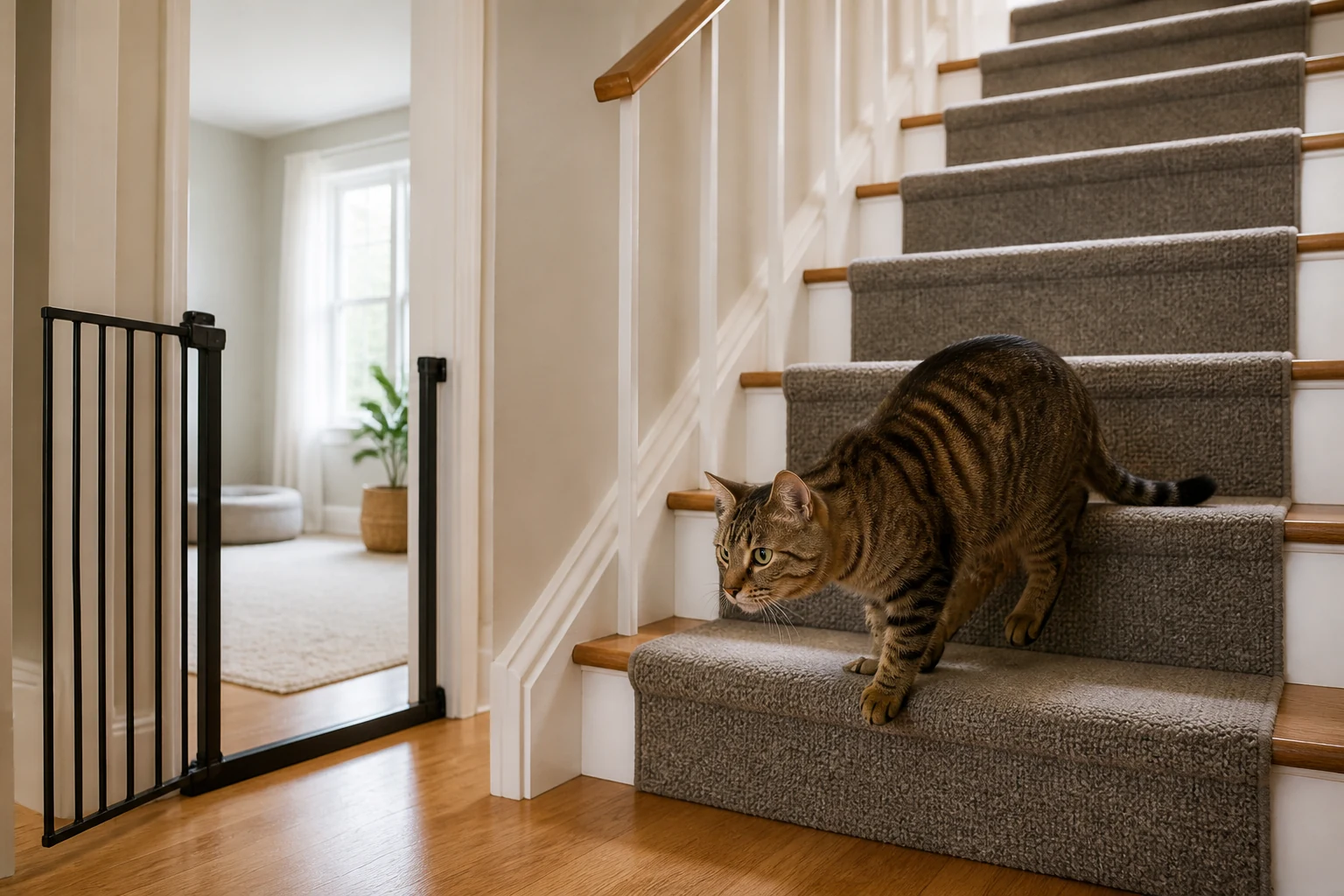
Help a new cat explore stairs only after the starter room and nearby rooms are stable. Prepare grip, block unsafe routes, keep a clear retreat path, and treat one or two calm steps as success rather than trying to get your cat up and down the whole staircase.
This guide is the stair-specific next step after you let a new cat explore the house room by room. Stairs add height, echo, slick edges, landing traffic, gaps between railings, and the risk of another pet or child blocking the route. A slow plan helps your cat map the staircase without feeling chased, trapped, or forced.
Cats cope better when they have safe places, predictable resources, and control over whether to approach or retreat. The AAFP and ISFM feline environmental guidelines describe safe places and separated key resources as central to a healthy cat environment, especially when a cat needs to feel secure in a changing space.1
Table of Contents
- What should be true before stairs are part of the plan?
- What should you check before your new cat tries stairs?
- Should you use gates on stairs with a new cat?
- How do you run the first stair session?
- What confidence cues mean your cat is ready for more stairs?
- How should you handle slick stairs, carpeted stairs, and landings?
- When should stair trouble make you pause or call a vet?
- Conclusion: Make stairs optional until they feel familiar
- Frequently Asked Questions
- References
What should be true before stairs are part of the plan?
Stairs should wait until your cat is already using a small home base normally. That does not mean your cat has to be outgoing. It means eating, drinking, litter box use, sleep, and curiosity are steady enough that a stair session will not disrupt basic welfare.
Before opening stair access, look for these signs:
| Readiness check | Ready enough to try stairs | Wait if you see this |
|---|---|---|
| Food and water | Eats normal meals and drinks or takes wet food consistently | Skips meals, hides from food, or intake drops |
| Litter box | Urine and stool are appearing as expected | Straining, no urine, diarrhea, or repeated accidents |
| Safe room | Uses the starter room as a calm retreat | Freezes, panics, or cannot settle there |
| Doorway confidence | Sniffs, watches, and returns calmly | Bolts through doors or hides hard afterward |
| Nearby rooms | Can explore a hall or room and recover | Becomes more fearful after each small expansion |
Cornell Feline Health Center recommends preparing a new cat's basic provisions before arrival, including food, water, litter, scratching, and a safe home setup.2 Keep those resources in place while stair access begins. Do not move the litter box upstairs or downstairs on the same day you introduce the stairs.
If your cat is still in the first adjustment phase, use SnuggleSouls' guide to how to settle a cat into a new home first. A staircase is a route expansion, not the first test of courage.
What should you check before your new cat tries stairs?
Check the staircase like a cat might use it: low to the ground, close to the edges, behind the railing, and from the landing. The goal is not to make the stairs exciting. The goal is to remove surprises.
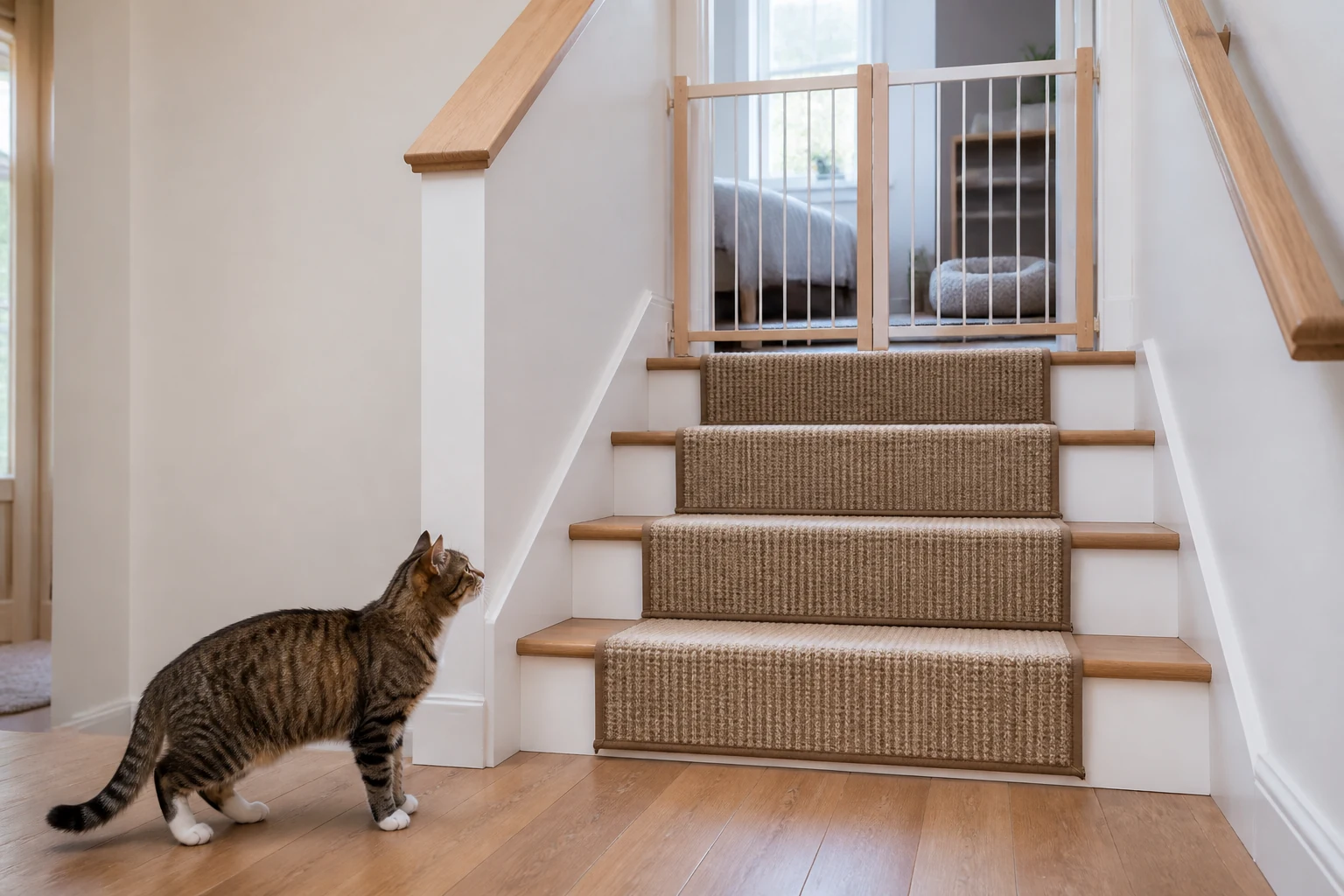
Prepare the stairs before the first session so your cat can stop, turn around, or return to the starter room safely.
Before the first session:
- Remove shoes, bags, toys, laundry, cords, and loose rugs from the steps.
- Secure windows, balcony doors, basement doors, and exterior doors near the stairs.
- Block access to unfinished basements, utility spaces, and storage areas.
- Check railing gaps, open risers, and landing ledges, especially for small cats.
- Add grip on slick wood, tile, or laminate steps.
- Keep the starter-room route open and visible.
- Put dogs, toddlers, and visitors behind a closed door.
- Make sure no one is vacuuming, cooking loudly, moving furniture, or carrying boxes.
Use SnuggleSouls' cat-proofing your home checklist for a broader hazard pass. If your staircase is carpeted and your cat is already tempted to rake the lower steps, the guide to how to protect carpeted stairs from cat scratching can help you choose safer covers and nearby scratchers without creating a trip hazard.
International Cat Care advises keeping exploration to one room at a time if a cat shows stress during a move or new-home transition.3 Apply the same idea to stairs: one landing, one short section, one easy return.
Should you use gates on stairs with a new cat?
Use gates as traffic control, not as your main cat-safety plan. A gate can slow a dog, toddler, or busy household member, but many cats can climb, squeeze, or jump over gates. A frightened cat may also panic if a gate blocks the route back.
Good gate use looks like this:
- Keep dogs and young children away from the stair session.
- Block an unsafe upper floor until it is prepared.
- Leave the cat's retreat route open during supervised practice.
- Avoid pressure from people watching through the gate.
- Check whether the gate has footholds a cat can climb.
Poor gate use looks like this:
- closing the cat on the stairs to "make them learn"
- letting a dog stare through the gate at the new cat
- using a gate with large gaps for a small cat
- relying on a gate beside an open exterior door
- placing a gate where a nervous cat could fall while climbing it
If your home has dogs, children, or resident cats, stair sessions should happen with active supervision and separation. Do not let another animal stand at the top or bottom of the stairs and control the route. For a new cat, being blocked on a staircase can feel much more intense than being watched across a room.
How do you run the first stair session?
Run the first stair session as a choice-based practice, not a training drill. Pick a quiet time, open only the prepared stair area, and let your cat decide how much of the route to inspect.
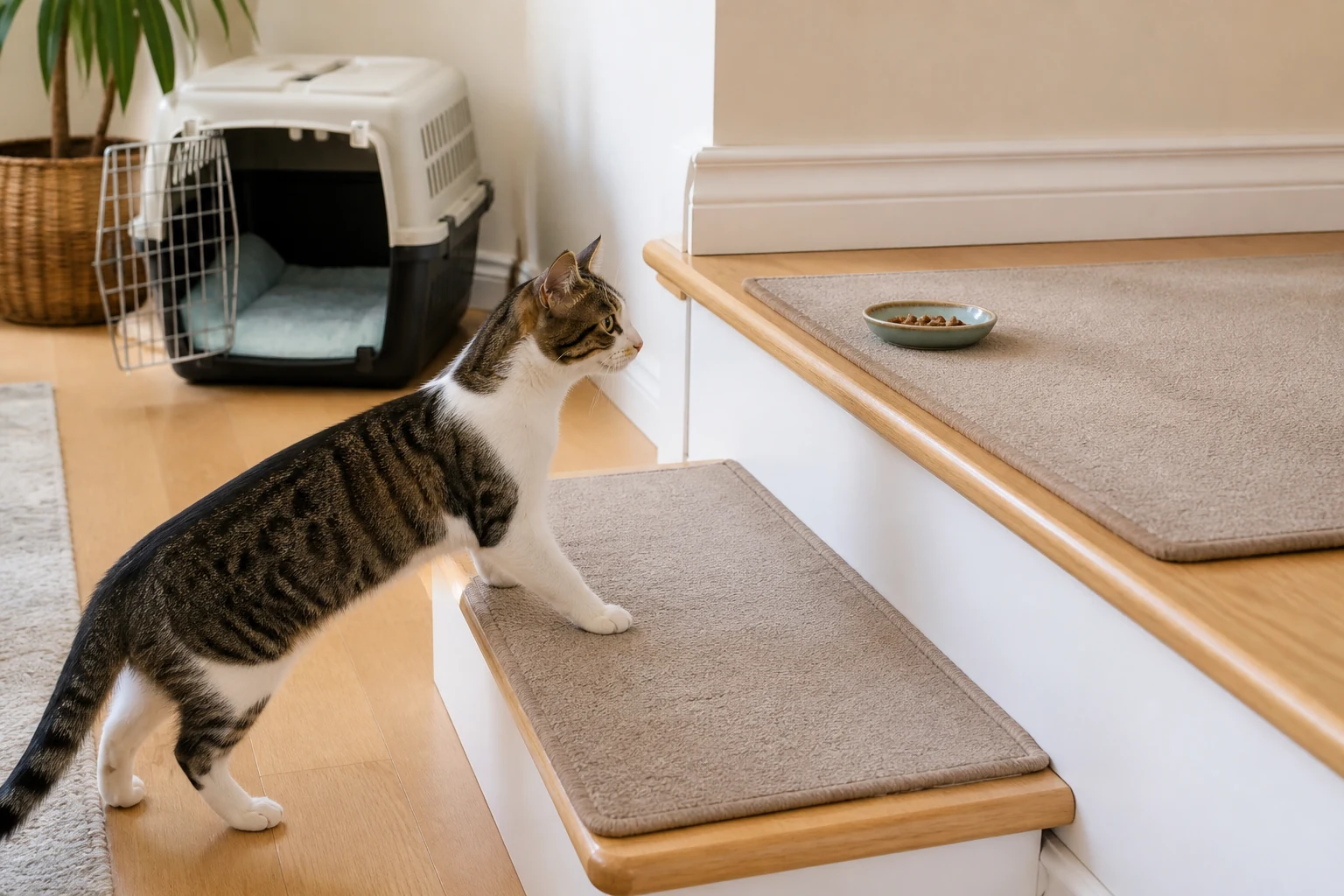
Short, low-pressure practice helps a cautious cat learn that stairs are optional, predictable, and easy to leave.
Try this first session:
- Start from the room or hallway your cat already knows.
- Open the stair route while keeping the retreat path clear.
- Stand to the side instead of facing your cat head-on.
- Let your cat sniff the first step, railing, wall, and landing.
- Reward calm looking, sniffing, or one step with a treat if your cat likes treats.
- Stop after a few minutes, especially if your cat returns to the starter room.
- Close access gently and let your cat decompress.
Do not carry your cat onto the middle of the staircase. Do not lure your cat so far with food that they turn around and realize they are higher than expected. Do not cheer, crowd, film close to the face, or block the stairs for a photo.
A better first goal is boring: sniff the bottom step, place two paws up, step down, and walk away calmly. That teaches the staircase is predictable and reversible.
What confidence cues mean your cat is ready for more stairs?
Your cat is ready for more stairs when they can approach, pause, turn around, and recover. Confidence is not the same as rushing upward. A cat who races upstairs and hides under a bed may have moved too fast.
Look for these green-light cues:
- loose body posture near the first steps
- ears forward or neutral rather than pinned
- tail neutral or softly raised
- sniffing and cheek-rubbing on stair edges
- stepping up and down without scrambling
- taking food or play near the landing
- returning to normal eating, litter use, and rest afterward
Slow down if you see these yellow or red signals:
| Signal | What it may mean | What to do next |
|---|---|---|
| Crouching flat on the step | The staircase feels exposed | End the session and add a nearby hide |
| Sprinting up or down | The cat may be escaping pressure | Reduce access to one landing next time |
| Tail tucked, ears flat, growling | Fear or defensive stress | Stop and remove people or pets from the area |
| Scrambling or slipping | Poor grip or a mobility concern | Add traction and keep practice to lower steps |
| Hiding all day afterward | Too much space or stress | Return to the previous successful room plan |
International Cat Care emphasizes staying calm and letting a cat settle gradually after a home change.3 The same patience matters here. If one step is all your cat can do today, that is useful information.
How should you handle slick stairs, carpeted stairs, and landings?
Slick stairs need traction before confidence work. Carpeted stairs need tidy, secure surfaces. Landings need clear turn-around space and no ambush points.
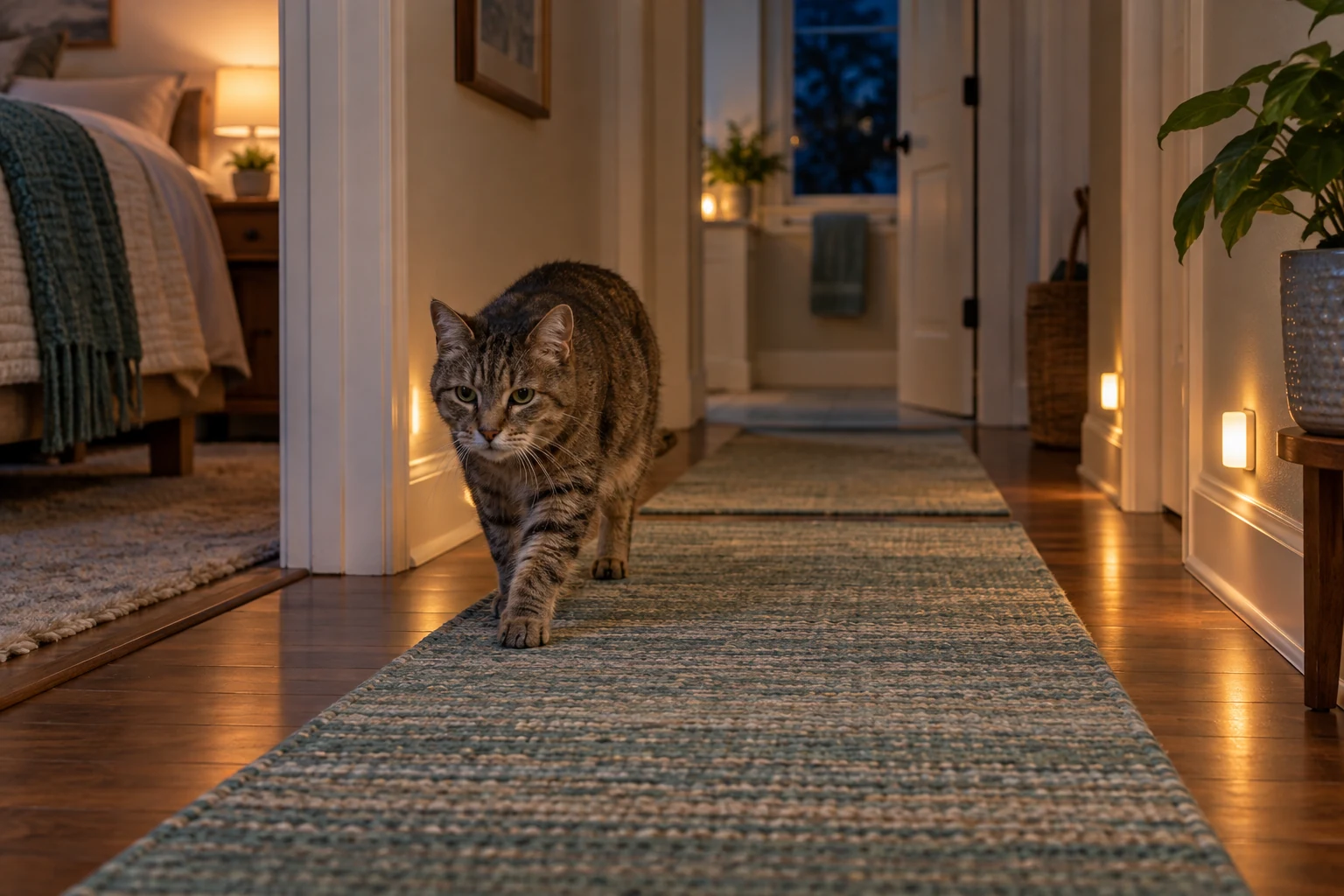
For slick wood, tile, or laminate stairs:
- Add fitted non-slip treads or a secured runner.
- Avoid loose mats that can slide under paws.
- Keep claws trimmed so they do not snag while turning.
- Practice on the lowest one or two steps first.
- Use lighting so the cat can see edges clearly.
For carpeted stairs:
- Trim loose threads your cat could catch.
- Secure any lifted carpet edges.
- Keep stair covers flat and firmly attached.
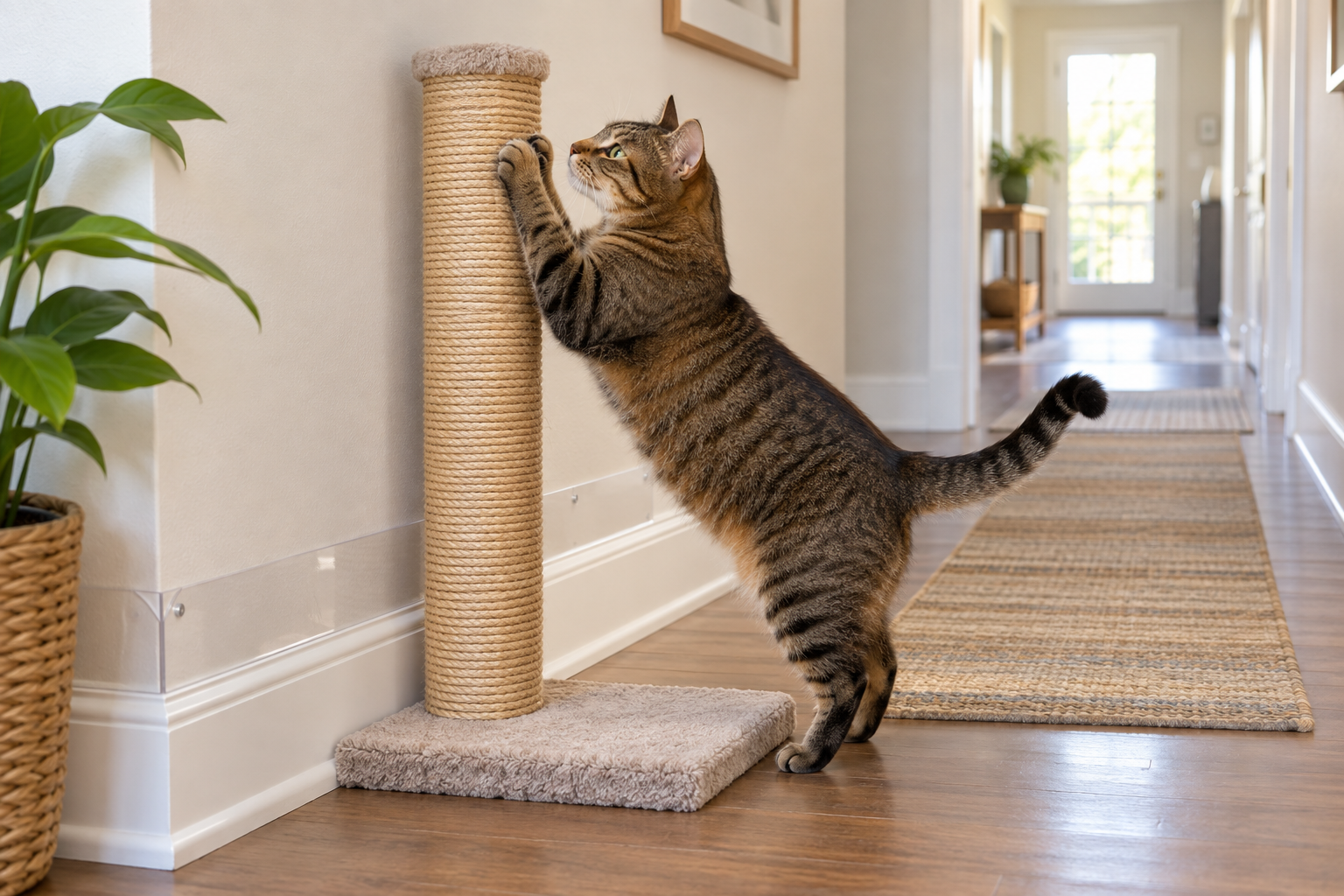
- Place a legal scratcher on the landing if your cat starts marking the steps.
- Avoid sticky deterrents where paws or human feet land.
For landings:
- Leave enough space for your cat to turn around.
- Add a temporary hide if the landing is open.
- Keep laundry baskets, shoes, and boxes away from step edges.
- Do not let another pet wait at the top or bottom.
The environmental goal is simple: each stair area should offer grip, orientation, and escape. AAFP and ISFM guidelines note that cats benefit from safe places and accessible routes, including lower or ramped access for cats with limited mobility.1 Even if your new cat is young and agile, traction and choice make early exploration less stressful.
When should stair trouble make you pause or call a vet?
Pause stair access if your cat seems more stressed, less coordinated, or less willing to use normal resources after a session. Go back to the last easy space, shorten practice, and make the stair environment quieter and grippier.
Call your veterinarian if you see limping, stiffness, weakness, swollen joints, reluctance to jump, difficulty climbing stairs, overgrooming one area, slow walking, or low energy. PDSA lists difficulty climbing stairs among signs that can appear with limping and stiffness in cats.4 Merck Veterinary Manual also describes lameness as a sign that may indicate a musculoskeletal disorder, with possible weakness, limb swelling, or joint dysfunction.5
Seek urgent veterinary care if your cat falls, cannot bear weight, cries in pain, has sudden weakness, collapses, breathes with effort, has repeated vomiting, has severe diarrhea, cannot urinate, has suspected poisoning exposure, or declines quickly.
New-home fear can make a cat hesitate, but pain and injury can look like hesitation too. If your cat is older, heavy, recently injured, declawed, or already avoids jumping, read SnuggleSouls' guide to how to help an arthritic cat at home and schedule your new cat's first vet visit for individualized guidance.
Conclusion: Make stairs optional until they feel familiar
The safest stair plan for a new cat is slow, prepared, and reversible. Keep the starter room available, improve grip, block unsafe areas, use gates to control other household members, and let your cat decide how far to go.
One calm step counts. A sniff, a retreat, and a normal meal afterward count too. When stairs become just another predictable route instead of a big test, your new cat can build confidence without losing the sense of safety that makes exploration possible. For more help reading stress, confidence, play, and home routines, visit SnuggleSouls' cat behavior guides.
Frequently Asked Questions
How soon can a new cat use stairs?
Many cats can try stairs after they are eating, drinking, using the litter box, and calmly exploring the room or hallway near the staircase. Some confident cats are ready within a few days, while cautious cats may need longer.
Should I carry my new cat up the stairs to show them?
No. Carrying a cat onto the stairs can make the space feel unsafe because the cat did not choose the route and may not know how to return. Let your cat approach from the bottom or a familiar landing.
What if my new cat runs upstairs and hides?
Keep the area quiet, block pets and children, and let your cat return when ready if the hiding spot is safe. For the next session, reduce access to a smaller stair area and keep the starter-room route clearer.
Are baby gates safe for cats on stairs?
Baby gates can help manage children or dogs, but they are not cat-proof. Many cats can climb or jump gates, and a frightened cat may fall while trying. Use gates only as part of a supervised setup.
Do cats need carpet on stairs?
Not always, but they do need secure footing. Slick stairs may need fitted non-slip treads or a secured runner, especially for kittens, seniors, heavy cats, or cats who already hesitate when jumping.
Why does my cat go up the stairs but not down?
Going down can feel harder because the cat must control speed and see the step edges. Add traction, improve lighting, practice on the lowest steps, and pause if your cat slips, scrambles, or seems painful.
Should I put treats on each stair?
Use treats sparingly and close to the starting point. Treats should reward calm exploration, not lure your cat higher than they are ready to go. Place treats on a landing or first step, then let the cat choose.
When is stair fear a medical concern?
Stair fear is more concerning if it appears with limping, stiffness, weakness, reluctance to jump, falling, appetite change, hiding that worsens, litter box changes, or signs of pain. Contact your veterinarian for guidance.
References
[1] Ellis, S. L. H., Rodan, I., Carney, H. C., et al. (2013). AAFP and ISFM Feline Environmental Needs Guidelines. URL
[2] Cornell Feline Health Center. (n.d.). Choosing and Caring for Your New Cat. URL
[3] International Cat Care. (2025). Moving House With Your Cat. URL
[4] PDSA. (n.d.). Limping and Stiffness in Cats. URL
[5] Merck Veterinary Manual. (n.d.). Lameness in Cats. URL



 EN
EN DE
DE ES
ES PT
PT