
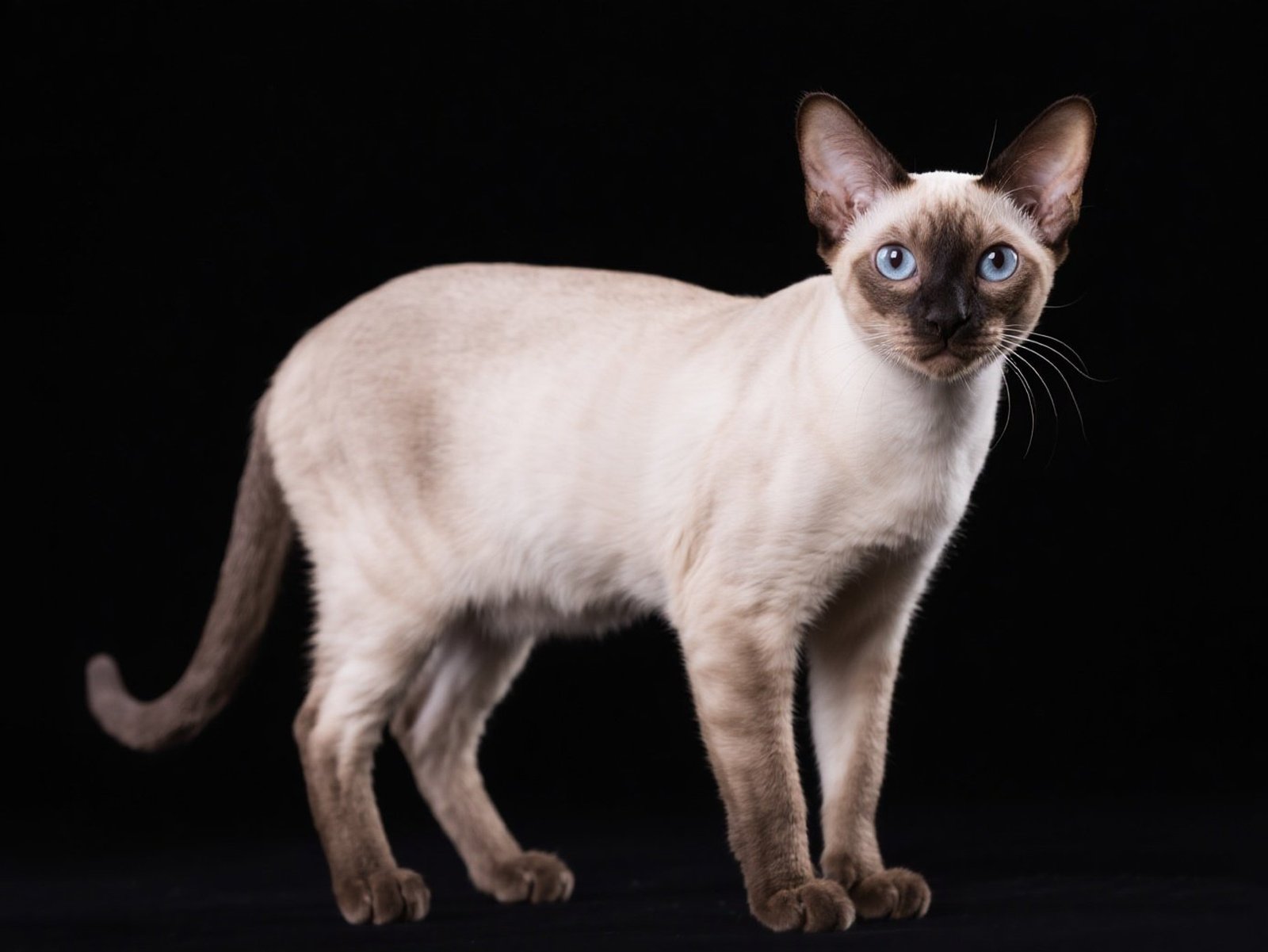
Tonkinese cats are medium-sized, people-focused companions known for a playful, “dog-like” attachment to their family. This guide covers personality, shedding, coat/eye traits, common health risks to discuss with your vet, and a daily care checklist so you can decide if a Tonkinese fits your home.
Table of Contents
Breed Overview
| Characteristic | Description |
| Personality | Highly intelligent, active, playful, and extremely affectionate. Often described as “dog-like” in its devotion and ability to learn tricks. Vocal, social, and enjoys being involved in family activities |
| Body Type | Medium length rectangle, semi-foreign, neither compact nor elongated. Solid, well-developed musculature with clean lines |
| Weight | Males typically weigh 8-12 pounds (3.6-5.4 kg); females range from 6-8 pounds (2.7-3.6 kg). Average weight is 6-12 pounds (2.7-5.4 kg) |
| Origin Region | Primarily developed in North America (Canada/United States) from Siamese and Burmese lines, though similar cats appeared in ancient Thai texts |
| Lifespan | Generally 10-16 years, with many living into their late teens with proper care |
| Coat Type | Medium short, luxuriant, close-lying, fine, soft, and silky with a lustrous sheen, often described as “mink-like” |
| Coat Colors | Natural (Seal), Champagne (Chocolate), Blue, Platinum (Lilac), Cinnamon (Honey), Red, Fawn, Cream, Apricot. Also available in tortoiseshell variations of these colors |
| Shedding Level | ⭐⭐☆☆☆ (Low to Medium) |
| Affection Toward Humans | ⭐⭐⭐⭐⭐ (High) |
| Care Difficulty | ⭐⭐⭐☆☆ (Moderate) |
Introduction
The Tonkinese cat is a medium-sized companion breed best known for being highly social, intelligent, and playful, with a strong preference for staying close to its people. Developed from Siamese and Burmese lines, the Tonkinese is often described as a balanced blend of both: interactive and curious, yet typically more “easygoing” than many extreme-type Siamese.
If you want a cat that will follow you from room to room, learn routines quickly, and actively seek attention, the Tonkinese can be a great match. They tend to do best in homes that can provide daily interactive play, enrichment (climbing spaces, puzzle toys), and companionship, since boredom and long periods alone can lead to mischief or stress-related behaviors.
This guide focuses on real-world temperament, care needs, and common health considerations using reputable breed authorities and veterinary guidance where applicable—so the information is easy to verify, cite, and trust.
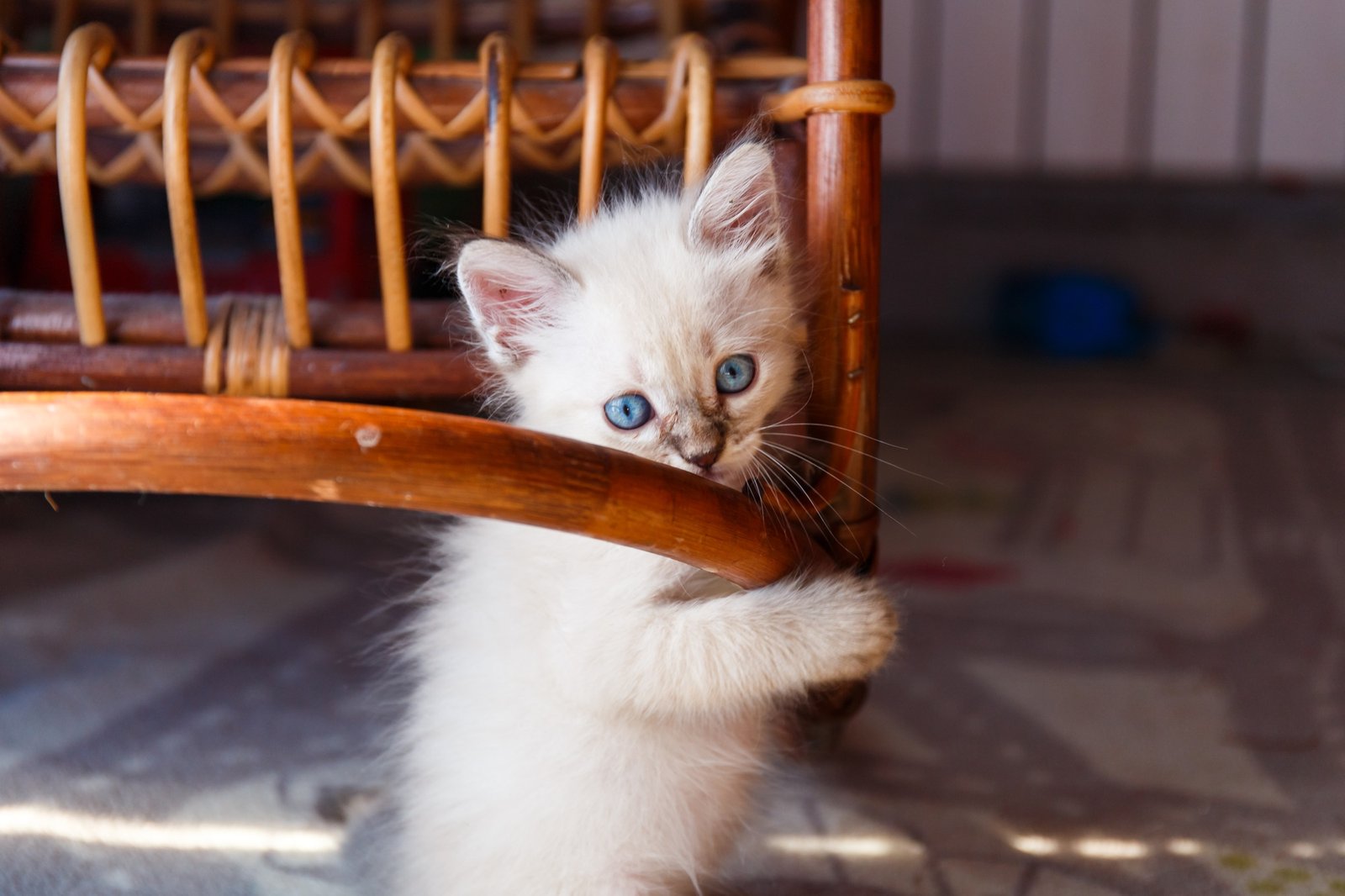
Breed History
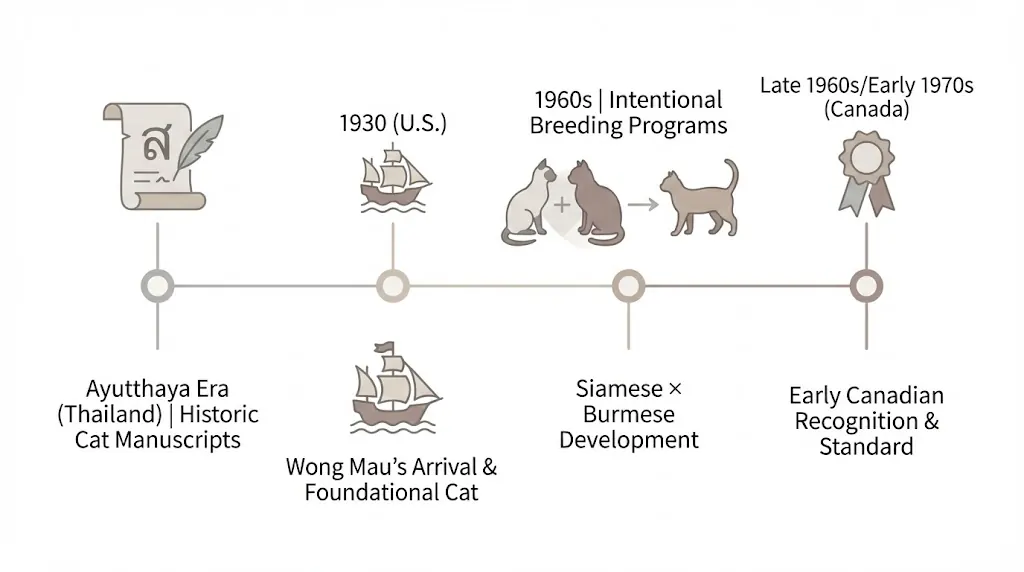
The Tonkinese is best understood as a modern, deliberately developed breed that also resembles cat types described in much older Southeast Asian cat manuscripts.
Ancient references (context, not a modern “pedigree record”)
Some cat registries note that cats resembling today’s Tonkinese appear in Thai cat manuscripts often called the “Cat-Book Poems” (Tamra Maew), associated with the Ayutthaya period (1358–1767).
These manuscripts describe and illustrate cat “types” known in historical Siam (Thailand), but they are not equivalent to modern breed registries—think cultural/historical documentation rather than formal breed standards.
Modern breed development (what can be verified)
- 1930 (foundation cat in the Siamese/Burmese “middle”): Wong Mau was imported to the U.S. by Dr. Joseph C. Thompson and bred with a Siamese, a pivotal event in the development of Burmese lines and often discussed in Tonkinese origin narratives.
- 1960s (intentional Tonkinese breeding programs): Breeders including Jane Barletta (U.S.) and Margaret Conroy (Canada) intentionally crossed Siamese × Burmese to create a moderate “in-between” cat—balancing the parent breeds’ look and temperament.
- Name standardization: Early breeders used both spellings “Tonkanese” and “Tonkinese”; over time, “Tonkinese” became the agreed spelling.
- Recognition in Canada: The Canadian Cat Association (CCA) is widely cited as the earliest registry to recognize the breed, with sources noting registration in 1967 and championship status in 1971, alongside the official spelling change.
Editorial note for trust: Because different organizations summarize early timelines differently, this section prioritizes primary breed bodies (TICA/CFA/CCA) and clearly separates historical “cat-type” references from modern breed formation and registry recognition.
Physical Characteristics (Tonkinese)
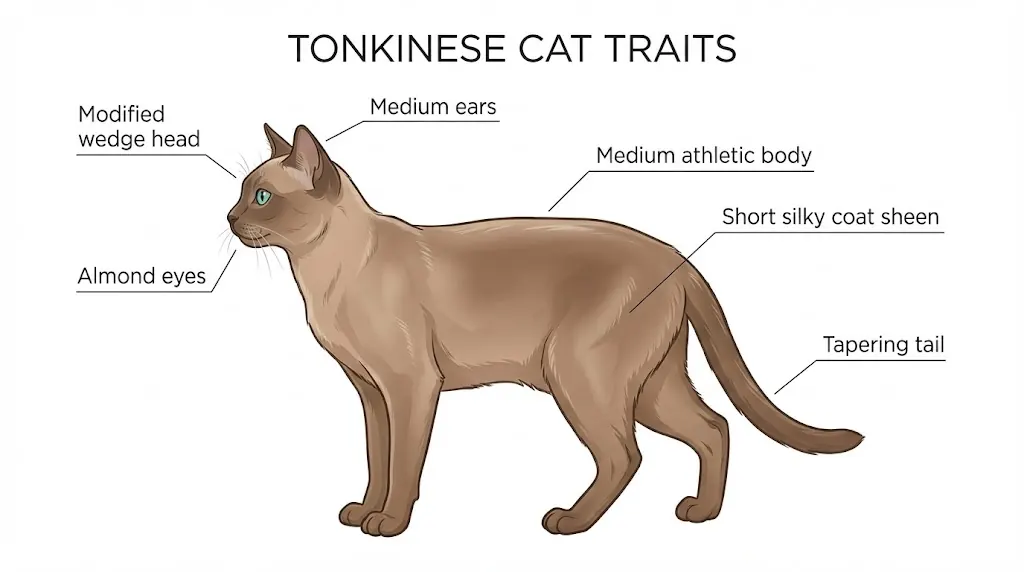
The Tonkinese is a medium-sized, “moderate” cat—neither cobby nor ultra-svelte—known for a firm, muscular feel and a surprisingly heavy weight for its size.
At-a-glance identification
- Build: medium, athletic, well-muscled; feels heavier than it looks
- Head: modified wedge, slightly longer than wide; rounded muzzle/soft contours
- Ears: broad at the base with oval tips; set as much to the sides as the top
- Eyes: open almond shape; eye color is linked to coat pattern
- Coat: short to medium-short, close-lying, silky with a soft sheen (often described as “mink-like”)
Body type and proportions
Tonkinese have a balanced, semi-foreign silhouette: a medium-length body with clean lines, a firm abdomen, and good muscle development. Legs are slim and proportional (hind legs slightly longer than front), with oval feet and a tail that tapers from a wider base toward the tip. Overall, balance and proportion matter more than extreme size.
Head, face, and ears
The head is a modified wedge with gently curved contours—typically slightly longer than it is wide—and cheekbones that create a pleasant, sculpted look. Ears are medium-sized, broad-based with oval tips, and angled forward slightly, contributing to the breed’s alert expression.
Eyes and eye color (pattern-linked)
A defining Tonkinese feature is that eye color corresponds to coat pattern (this is repeatedly emphasized in breed descriptions/standards):
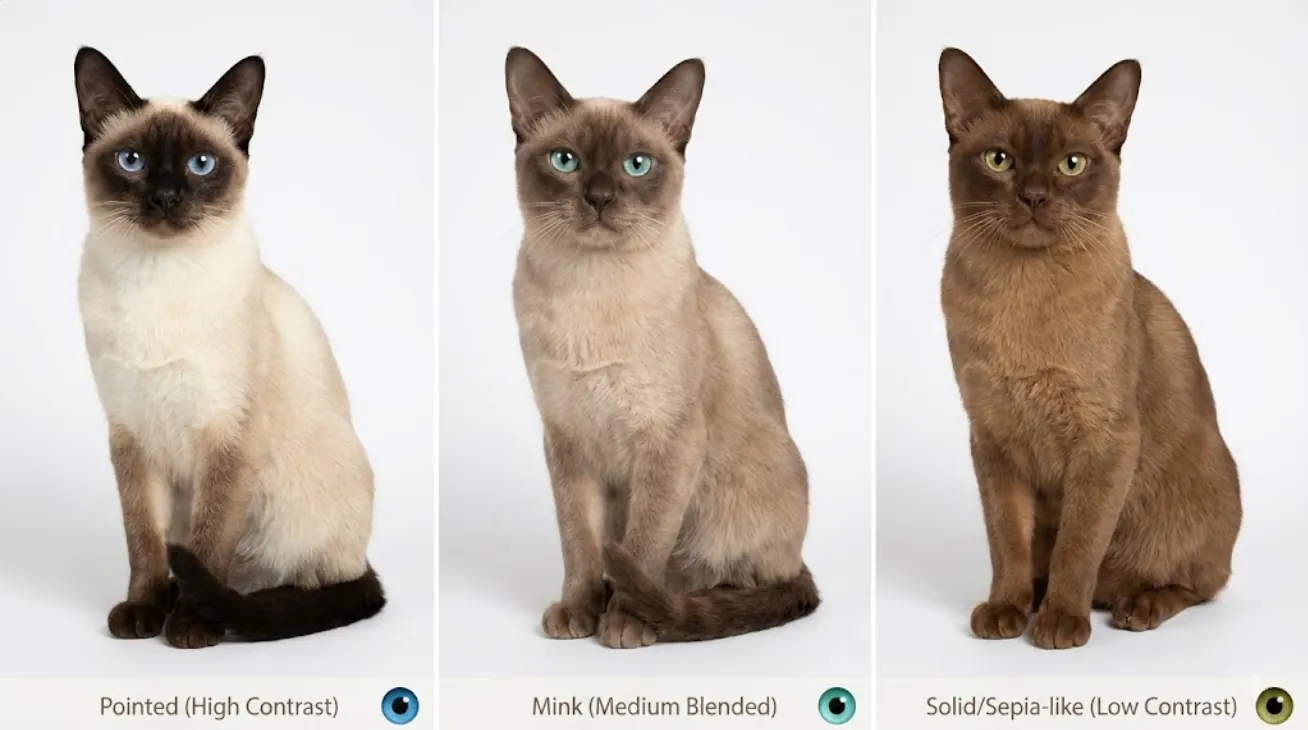
- Mink (TCR / Tonkinese Colour Restriction): aqua / aquamarine eyes
- Pointed (CPP / Colourpointed Pattern): blue eyes
- Solid (BCR / Burmese Colour Restriction): green to green-gold / yellow-green eyes
Note: Pet Tonkinese can vary, and different registries describe the ranges slightly differently—use the registry standard most relevant to your region/show association when citing.
Coat texture and the 3 primary coat patterns
The Tonkinese coat is dense, close-lying, and silky, with a soft sheen. Tonkinese commonly appear in three coat “restrictions” (patterns):
- BCR (Solid / Burmese Colour Restriction): more even body color; green/gold-toned eyes
- TCR (Mink / Tonkinese Colour Restriction): signature Tonkinese look; body color blends gently into darker points; aqua/aquamarine eyes
- CPP (Pointed / Colourpointed Pattern): stronger point contrast; blue eyes
Tonkinese Coat Patterns and Colors (Pointed, Mink, Solid)
In Tonkinese cats, “coat pattern” refers to the degree of contrast between the darker “points” (face, ears, legs, tail) and the lighter body color. The three standard contrast patterns are pointed, mink, and solid.
How naming works
Most breeders and references use this simple convention:
Base color name + pattern name = full variety name
Examples: Blue Mink, Champagne Point, Natural Solid.
Note on wording: “Mink” can mean (1) the mink pattern (medium contrast) and (2) a mink-like coat feel (soft, close-lying, glossy). The breed is often described as having a “mink coat” texture, which is separate from the “mink pattern” label.
Pattern definitions
- Pointed (high contrast): Siamese-style look—dark points with a noticeably lighter body.
- Mink (medium contrast): The Tonkinese “in-between” look—points blend more gradually into the body (often described as the breed’s hallmark in many registries).
- Solid (low contrast): A sepia-like look with the least contrast; the cat still has “points,” just much less visible (some references note Tonkinese aren’t truly solid in the same way as some other breeds).
Quick reference table
| Pattern | Contrast level | What you’ll see | Common naming example |
|---|---|---|---|
| Pointed | High | Dark points + lighter body | Champagne Point |
| Mink | Medium | Softer blending between points and body | Blue Mink |
| Solid | Low | Most even overall color; points are subtle | Natural Solid |
Tonkinese vs Siamese: What’s the Difference?
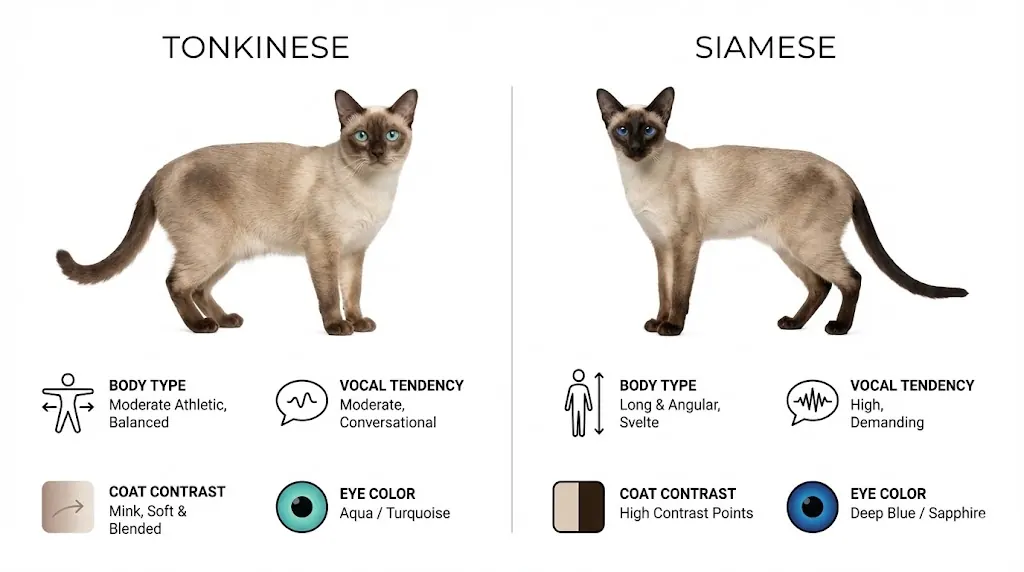
If you’re choosing between a Tonkinese and a Siamese, the simplest way to think about it is: Tonkinese are typically a “moderate middle” (between Siamese and Burmese), while Siamese are a more “extreme” long-and-angular type and are famously demanding/talkative.
At-a-glance comparison
| Category | Tonkinese | Siamese |
|---|---|---|
| Origins | Developed from Siamese × Burmese | Ancient “Eastern/Siam (Thailand)” roots described in historical manuscripts |
| Body type | Medium, muscular, moderate (neither cobby nor svelte) | Long, elegant, angular “defined by extremes” |
| Coat pattern | Pointed, Mink, Solid (mink is most associated) | Classic pointed contrast (dark points, lighter body) |
| Eye color | Often aqua in mink; can be blue (pointed) or chartreuse (solid) | Deep rich blue |
| Vocal style | Chatty, but not as vocal as a Siamese | Demanding/talkative, needs lots of interaction |
| Grooming | Short coat; weekly rubber-brush commonly recommended | Short coat; weekly combing/hand grooming commonly recommended |
1) Origins & “type”
The Tonkinese was developed from a cross between the Siamese and Burmese, with breeders aiming for a cat “in between the two extremes.”
The Siamese is described by TICA as having Eastern origins tied to Siam (Thailand), with references to historical manuscripts and a long-established presence in cat fancy history.
2) Appearance: moderate vs extreme lines
Tonkinese are described as medium-sized, muscular, and moderate—“neither cobby nor svelte.”
Siamese are described as long, slender, and angular, “defined by extremes” with long tubular body and long triangular head.
3) Coat patterns & eye colors (a key visual giveaway)
Tonkinese come in three main patterns—Pointed, Mink, Solid—and eye color is closely linked to pattern: mink typically aqua, pointed blue, solid chartreuse.
Siamese are known for their striking pointed contrast and deep blue almond-shaped eyes.
4) Personality & vocalization
Tonkinese are affectionate “lap-cat” companions and will hold chatty conversations, but are explicitly described as not as vocal as a Siamese.
Siamese are described as demanding, talkative, and highly social, needing people around to thrive.
5) Grooming & care expectations
Tonkinese grooming is typically described as easy: weekly rubber-brush upkeep is commonly suggested by TICA, and CFA notes many are more seasonal than year-round shedders.
Siamese also have a short coat that’s easy to groom, and CFA notes they do shed and benefit from regular grooming (even just with hands).
6) Health notes (keep this as “discussion prompts,” not diagnosis)
CFA and TICA both flag gingivitis/dental care as a notable Tonkinese concern to manage proactively.
CFA highlights two issues breeders work on in Siamese lines—progressive retinal atrophy (genetic testing) and amyloidosis (ongoing research)—so it’s reasonable to ask breeders what screening/history they have.
Which one should you choose?
- Choose a Tonkinese if you want a social, playful cat that’s typically a bit less intense vocally than a Siamese, with that signature mink/aqua look.
- Choose a Siamese if you love a very talkative, highly interactive cat with a long, angular look and classic blue-eyed pointed appearance.
Behavior and Personality
At a glance: Tonkinese are typically highly social, people-oriented, smart, and playful—a “busy but cuddly” companion that wants to be involved in whatever you’re doing.
What most Tonkinese are like
- Affectionate and interactive: Many will follow you room-to-room, settle into laps, and seek close contact rather than spending the day alone.
- Active, athletic play style: Expect climbing, jumping, and frequent bursts of play—Tonkinese are often described as smart and active cats.
- Quick learners: They tend to enjoy problem-solving and can do very well with puzzle toys and simple training games (fetch-style play is commonly reported).
- Chatty communicators: Many Tonkinese vocalize regularly and may “talk back,” especially when engaged with people.
The “dog-like” reputation (what that really means)
Owners and breed organizations often describe Tonkinese as part puppy—they may greet visitors, shadow their people, and prefer interactive games over solitary play.
Translation for readers: this breed usually thrives with daily engagement, not just food-and-water care.
Great fit vs. not ideal
Often a great fit if you want a cat who:
- enjoys company and interaction most of the day
- plays actively and benefits from training/puzzle time
May be frustrating if you want a cat who:
- is independent and content with minimal attention
- will be left alone for long hours without enrichment
Preventing boredom (important for this breed’s happiness)
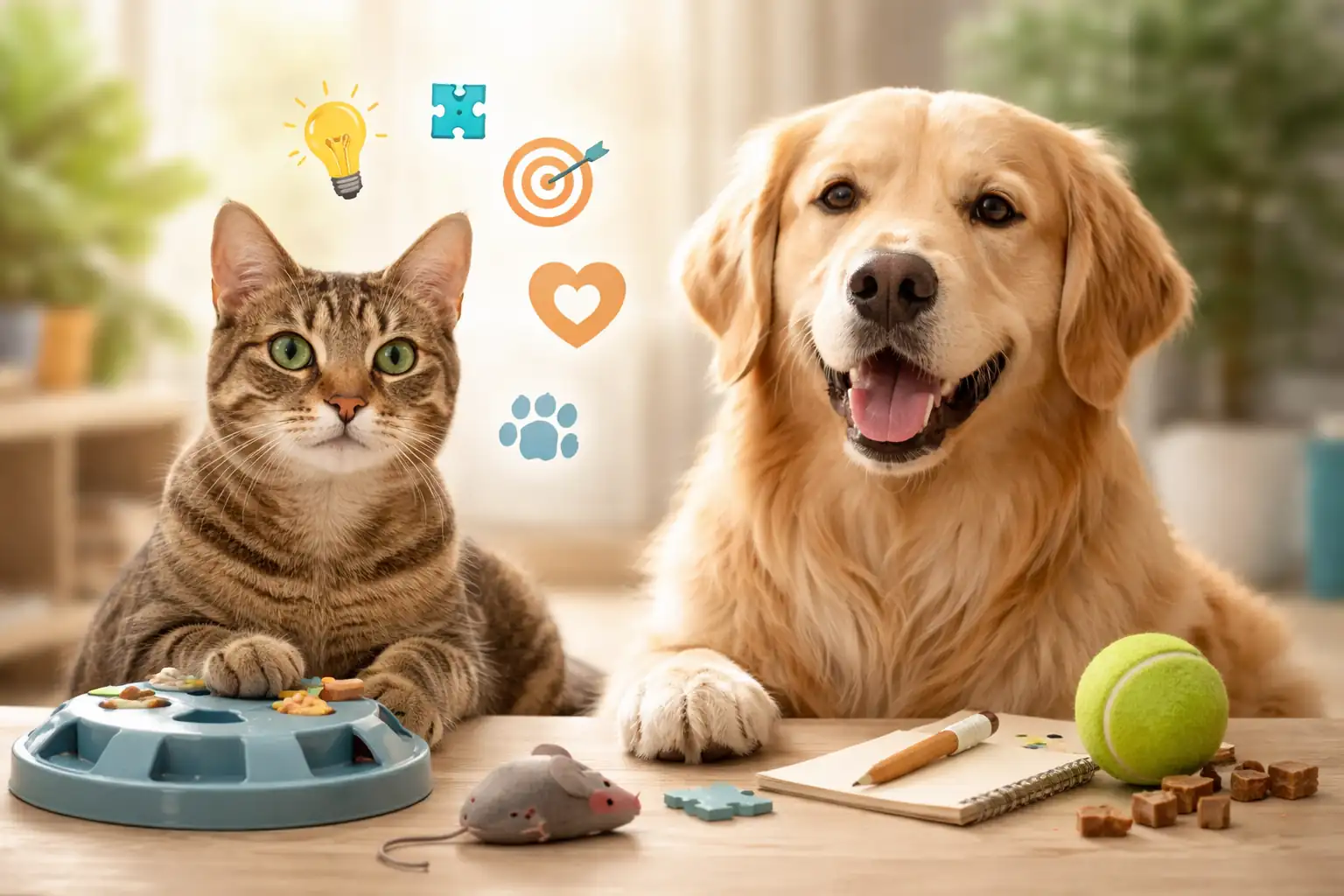
Because Tonkinese are commonly described as smart and active, plan enrichment like puzzle/foraging toys, rotating toys, and short interactive play sessions. Enrichment helps reduce boredom and can prevent behavior problems by letting cats use natural hunting/foraging behaviors in healthy ways.
Note: temperament varies by individual cat, early socialization, and home environment—use these as common tendencies, not guarantees.
Care Guide
Goal: keep a Tonkinese’s weight, teeth, urinary health, and stress levels in a great place—because this breed is often described as highly social and interactive, and breed registries note higher concern around dental disease and FLUTD compared with many cats.
Diet (and hydration)
What to feed
- Choose a commercial diet labeled “complete and balanced” for your cat’s life stage (kitten/adult/senior). This helps ensure the food meets recognized nutrient standards.
- Cats are obligate carnivores and require nutrients found in animal tissue (including taurine). Prioritize diets where animal-based ingredients are prominent and the formula is nutritionally complete for cats.
How to feed (portion control that’s easy to follow)
- Prefer measured meals over leaving food down all day (“free-feeding”). Meal feeding makes it easier to prevent gradual weight gain.
- If your cat needs to lose weight, do it with a veterinarian’s plan—crash dieting can be dangerous (risk of hepatic lipidosis).
Hydration (supports urinary health)
- Tonkinese are reported to be more prone to FLUTD; good hydration is part of prevention and long-term support.
- Practical ways to boost water intake:
- Offer wet food (higher moisture) and/or add water to food (if your cat accepts it).
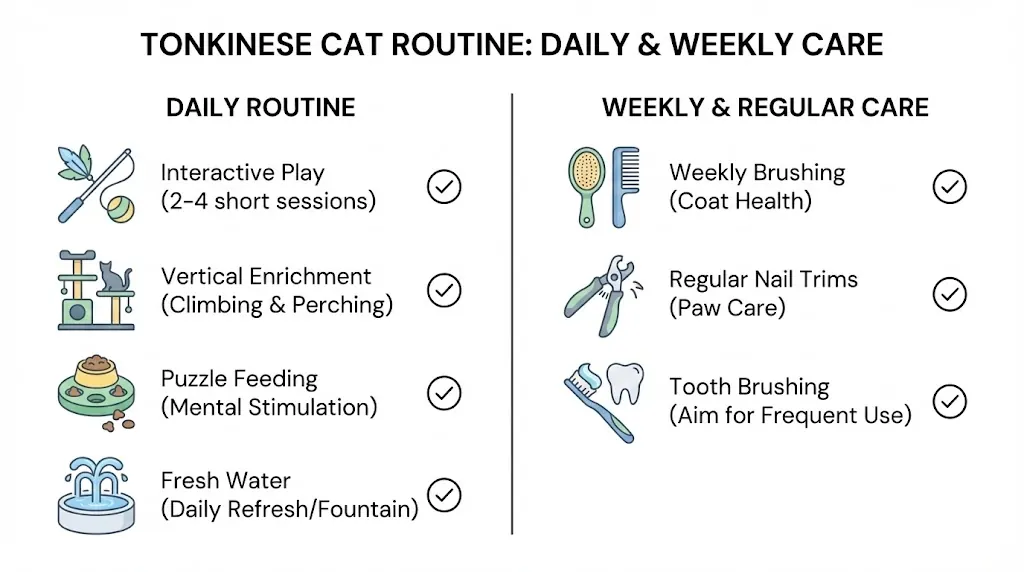
- Provide multiple water stations; some cats drink more with a fountain.
When to call a vet (don’t wait)
- Straining to urinate, crying in the litter box, frequent tiny pees, blood in urine, or urinating outside the box can be FLUTD signs and need veterinary guidance.
Exercise (daily play that matches Tonkinese energy)
Tonkinese tend to do best with daily interactive play—they’re often not the “leave me alone all day” type.
A simple, realistic routine
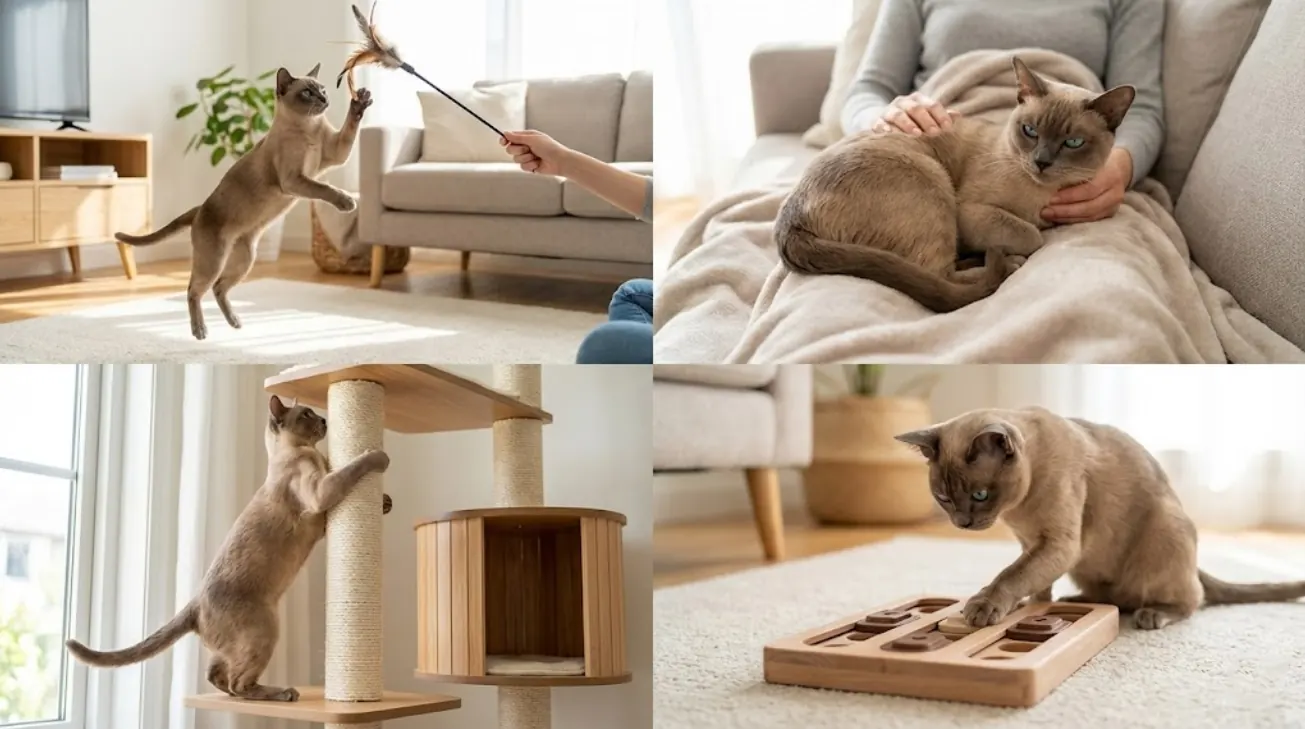
- Aim for 2–4 short sessions/day (5–10 minutes each) of interactive play. Adjust up or down based on age and fitness.
- Best play styles mimic hunting:
- wand toys (stalk → chase → pounce)
- fetch-style games (many Tonkinese enjoy this)
- puzzle feeders / treat balls for “work for food”
Tip that improves behavior
- End play with a small meal or treat to complete the “hunt cycle.” This can reduce post-play frustration and help settle your cat.
Environment & enrichment (high-impact, evidence-based setup)
The AAFP/ISFM Feline Environmental Needs Guidelines summarize what most indoor cats need to thrive: a safe haven, separated resources, play/predatory outlets, positive human contact, and a predictable environment.
Minimum environment checklist
- Vertical space: cat tree(s), shelves, window perch (climb, watch, feel safe).
- Separate resources (especially in multi-cat homes):
- more than one food/water station
- multiple litter boxes in quiet locations
- multiple resting spots + scratching options
- Safe hideouts: covered bed/box where no one bothers them.
- Predictable routine: consistent feeding/play times reduce stress.
If your Tonkinese is alone a lot
- Highly social cats may show stress when lonely (clinginess, over-vocalizing, appetite changes, inappropriate urination). Increase enrichment first (play, foraging toys, perches, “safe room”).
- A second pet may help—but only if your cat generally enjoys other animals and you can do a slow, structured introduction.
Grooming (coat + nails + the Tonkinese “big one”: teeth)
Coat
- Tonkinese coats are typically short and relatively easy-care; a weekly brush is usually enough to reduce loose hair and keep the coat glossy.
Dental care (priority)
- Breed registries specifically flag gingivitis/dental disease as a key concern in Tonkinese—so build a dental routine early.
- Best practice:
- Daily brushing is ideal, but 3×/week is a practical minimum that still helps reduce plaque buildup.
- Use cat-safe toothpaste + a finger brush or soft pet toothbrush.
- Watch for: bad breath, red gums, drooling, pawing at mouth, chewing on one side, or dropping kibble—these warrant a vet/dental check.
Mental stimulation (prevent boredom-driven mischief)
Tonkinese are typically smart and engagement-seeking, so mental work matters as much as physical exercise.
High-ROI enrichment ideas
- Rotate toys weekly (novelty keeps them engaging).
- Puzzle feeders (turn meals into a 5–15 minute “job”).
- Clicker training (sit, high-five, leash basics) using tiny treats.
- “Bird TV”: window perch facing safe outdoor activity.
Behavior signal
- If a Tonkinese starts getting destructive, overly vocal, or pushy, treat it like a needs-check: more play + more predictable routine + better foraging enrichment (and rule out medical issues if sudden).
Tonkinese Health: What to Watch For
| Condition | Description & Symptoms | Management & Prevention |
|---|---|---|
| Dental Disease (Gingivitis, Periodontal) | Gum inflammation, tartar buildup, bad breath, pain, difficulty eating; may cause tooth loss and systemic issues. | Brush teeth 3x/week, regular dental cleanings, dental-friendly diet. |
| Feline Lower Urinary Tract Disease (FLUTD) | Straining to urinate, frequent/inappropriate urination, blood in urine. | Ensure adequate water intake (e.g., fountains), stress reduction, urinary-supportive diet. |
| Inflammatory Bowel Disease (IBD) | Chronic vomiting, diarrhea, appetite and weight loss. | Prescription diets (e.g., novel/hydrolyzed proteins), anti-inflammatory meds. |
| Amyloidosis | Abnormal protein deposits in organs (liver/kidneys); can cause organ failure. | Genetic screening where applicable; early detection and supportive care. |
| Feline Asthma (Allergic Bronchitis) | Coughing, wheezing, labored breathing due to allergen-triggered airway inflammation. | Avoid triggers (dust, smoke); manage with bronchodilators or corticosteroids. |
| Hyperthyroidism | Weight loss despite increased appetite, hyperactivity, vomiting, diarrhea—common in older cats. | Medication, radioactive iodine, surgery, or special diets; regular screening. |
| Hypokalemic Myopathy | Muscle weakness, neck bending (chin-to-chest posture); can be intermittent. | Genetic testing for breeders; potassium supplements to control symptoms. |
| Hypertrophic Cardiomyopathy (HCM) | Thickened heart muscle; may cause heart failure or sudden death. | Regular heart screening (e.g., echocardiogram); medication to manage heart function. |
| Crossed Eyes (Strabismus) | Misaligned eyes, primarily cosmetic. | No treatment usually needed; not preventable. |
| Polycystic Kidney Disease (PKD) | Cyst growth in kidneys leading to early kidney failure. | Genetic testing for breeders; supportive renal care and monitoring. |
Is This Breed Right for You?
Best one-line summary: A Tonkinese cat is typically social, active, and people-oriented, and tends to do best in homes that can provide daily interaction and play.
Quick self-check (easy to quote)
A Tonkinese is a strong fit if you can say “yes” to most of these:
- Daily companionship: Someone is home often, or the cat won’t be alone for long stretches.
- Daily play & enrichment: You can commit to interactive play, climbing space, and puzzle-style stimulation.
- Social household: You’re comfortable with a cat that is engaged with people and may follow you around.
- Basic grooming routine: You can do light coat care (a quick rubber-brush session weekly is commonly recommended).
- Dental routine: You’re willing to build a tooth-brushing habit early, since Tonkinese are noted as prone to gingivitis.
Suitable For / Not Suitable For
Suitable for you if…
- You want an interactive, affectionate companion that prefers being involved with the household.
- You’re home frequently or can provide consistent daily attention (or a compatible pet companion).
- You enjoy training and enrichment (puzzle toys, structured play, climbing/vertical space).
- You have kids/other pets (when introduced properly): Tonkinese are commonly described as a good choice for families with children and cat-friendly dogs/cats.
- You want easy coat maintenance: registries describe the coat as easy to maintain, often recommending a rubber brush weekly (or a few times per month depending on shedding).
Not suitable for you if…
- You’re away most of the day, most days, and the cat would regularly be alone for long hours (social breeds can struggle without enough interaction).
- You prefer a very independent, low-engagement cat that doesn’t need daily play and mental stimulation.
- You can’t provide vertical space / active play outlets (cat trees, shelves, climbing, interactive toys).
- You’re not willing to do routine dental care (Tonkinese are noted as prone to gingivitis; dental disease is also common in adult cats generally).
- Your household has rough handling or stressful pet dynamics that would overwhelm a highly social cat (choose a calmer, more independent temperament profile).

FAQ
Are Tonkinese cats affectionate?
Yes—Tonkinese are widely described as people-focused and affectionate, often seeking lap time, shoulder rides, and “supervising” whatever you’re doing. They tend to bond strongly and prefer being involved in daily routines rather than staying independent.
Are Tonkinese cats vocal?
They can be quite chatty. Many descriptions note they’ll “talk” to you, expect a response, and use a range of sounds beyond simple meows—though they’re often framed as less intense than some Siamese lines.
Can Tonkinese cats be left alone all day?
Usually, they don’t love it. Breed references often emphasize that Tonkinese prefer company and may do better with a second cat or a household that can provide consistent interaction and play.
Are Tonkinese good with kids, dogs, and other pets?
In many descriptions, yes—Tonkinese are commonly characterized as sociable and comfortable in active homes, including those with respectful children and cat-friendly dogs. As with any breed, early socialization and gentle introductions matter.
Do Tonkinese cats shed a lot?
They’re often described as more seasonal shedders than constant, heavy shedders. Regular light grooming is typically enough to keep loose hair manageable in most homes.
How often should you groom a Tonkinese?
Most guidance is “low-maintenance coat”: a quick brush periodically (weekly is commonly suggested) helps remove loose hair and keep the coat sleek. Baths are generally not frequent unless needed for shows or specific messes.
What coat patterns and eye colors do Tonkinese have?
Tonkinese are commonly described in three contrast patterns—pointed, mink, and solid—with pattern intensity sitting between Siamese and Burmese extremes. Eye color is frequently linked to pattern (for example, mink-patterned cats are often noted for aqua eyes).
How long do Tonkinese cats live?
A commonly cited range is about 15–20 years, assuming good preventive care and appropriate veterinary attention. Individual lifespan varies with genetics, environment, and health history.
What health issues are Tonkinese commonly associated with?
Some breed references say Tonkinese are generally healthy, but note higher attention areas—especially dental disease, and some also mention FLUTD, IBD, and amyloidosis as conditions to watch for. The most helpful way to present this is: “these are possible risks; ask your vet and breeder what screening is appropriate.”
How can I reduce dental disease risk in a Tonkinese?
Start dental handling early and aim for consistent at-home care. Veterinary guidance often recommends daily brushing when possible, with 3×/week as a practical minimum for plaque control, plus regular dental checks with your veterinarian.
What are FLUTD warning signs—and when is it an emergency?
Common warning signs include painful/difficult urination, frequent attempts, crying while urinating, blood in urine, urinating outside the box, or excessive genital licking. If a cat is passing little or no urine and seems increasingly distressed, that can indicate urethral obstruction, which is an immediate emergency—seek urgent veterinary care right away.
Are Tonkinese cats hypoallergenic?
No cat breed is truly hypoallergenic. Allergy organizations note that all cats produce allergens, and studies have not shown that cats can be “hypoallergenic” in the sense of not causing allergy—some individuals may still tolerate certain cats better, but it’s not guaranteed.
Tonkinese vs Siamese vs Burmese: what’s the difference?
Tonkinese were developed from Siamese and Burmese lines with the goal of being a “middle ground” in look and temperament—often described as moderate in build and a blend of traits from both. If your readers are comparison-shopping, the cleanest framing is: Tonkinese = the intentional midpoint between Siamese and Burmese types.
Can Tonkinese cats be trained?
Often, yes—many descriptions emphasize intelligence, puzzle-toy skills, and a willingness to learn tricks and interactive games (like fetch). Keep sessions short, reward-based, and consistent to match their attention span and high engagement needs.
Bonus Facts
A Tonkinese cat named Shun Gon makes an appearance in the classic Disney film “The Aristocats”.
Despite their name, the Tonkinese cat has no direct geographical link to the Bay of Tonkin in Vietnam. The breed was originally named “Tonkanese,” inspired by an island in the musical “South Pacific” where “half-breeds” were safe and accepted.
Known for their cleverness, Tonkinese can be quite crafty. They have been known to figure out how to open doors or cabinets in their quest for exploration or delicious snacks.
The beautiful mink-like coat of a Tonkinese cat undergoes a fascinating transformation. It can take up to two years for their full body color to develop, and their coloring will continue to darken as they age.
References
“Tonkinese”. Governing Council of the Cat Fancy. Retrieved 31 January 2024.
“Cat Fancier’s Association: Breed Profile: Tonkinese”. Retrieved 5 November 2024.
Houle, Tori (15 December 2014). “The Tonkinese”. Pet Health Network. Retrieved 1 January 2020.
“Tonkinese Standard” (PDF). Governing Council of the Cat Fancy. Retrieved 31 January 2024.
“WCF – World Cat Federation”. wcf.info. Retrieved 23 July 2023.
The International Cat Association (1 May 2004). “TICA: Tonkinese Breed Standard” (PDF). www.tica.org. Retrieved 5 November 2024.
Helgren, J. Anne (1997). “6: The Recognized Breeds”. Encyclopedia of Cat Breeds. Barron’s Educational Series, Inc. p. 220. ISBN 0-7641-5067-7.
Albasan, H.; Osborne, C. A.; Lulich, J. P.; Lekcharoensuk, C. (2012). “Risk factors for urate uroliths in cats”. Journal of the American Veterinary Medical Association. 240 (7): 842–847. doi:10.2460/javma.240.7.842. PMID 22443437.
“Tonkinese Genetics: Color, Coat Pattern, Eye Color”. www.tonkinesebreedassociation.org. Retrieved 2 January 2020.

 EN
EN DE
DE ES
ES PT
PT