
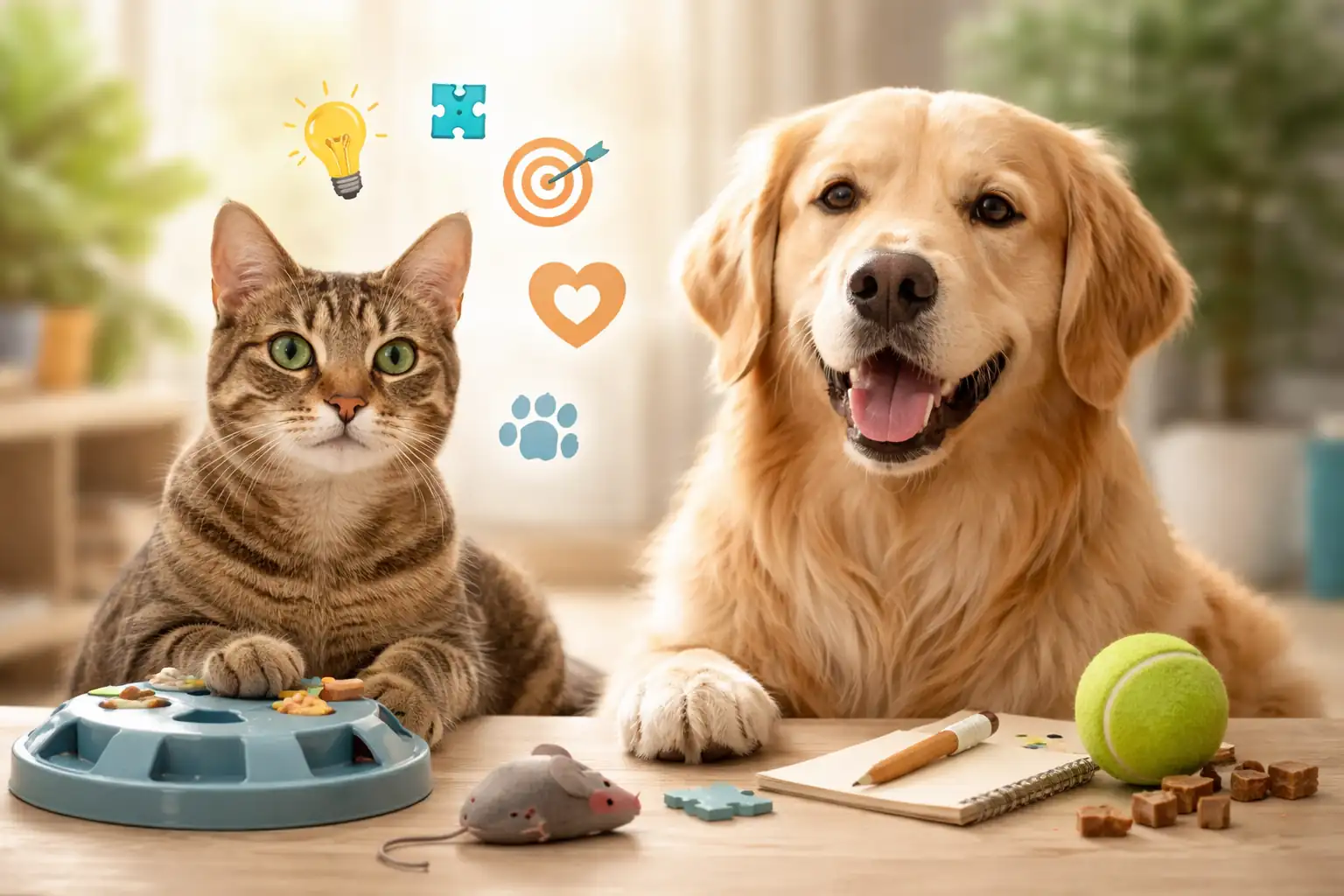
It depends on what you mean by “smart”—and whether the test rewards teamwork (dogs) or independence (cats).
Table of Contents
Quick answer: Are cats smarter than dogs
Cats aren’t “less intelligent” than dogs—they’re optimized for different kinds of cognition. Dogs often outperform cats on human-directed social tasks (following gestures, cooperating with people), while cats often excel at independent, self-directed problem-solving tied to solitary hunting. “Who’s smarter” depends on the test—and many tests reward cooperation, which can bias results.
Key takeaways
- There isn’t one “IQ” for animals—intelligence is a toolkit (social cognition, memory, problem-solving, inhibition).
- Dogs tend to shine in human-interactive tests because domestication and selection favored cooperation.
- Cats may underperform in lab-style tasks due to stress, low motivation, or dislike of the setup—not lack of ability.
- Neuron counts are informative, not decisive: brains specialize and behavior depends on learning context.
- If your cat seems “less sharp” suddenly, rule out health issues (pain, thyroid/kidney disease, hypertension), especially in seniors.
Why the cat vs. dog debate is tricky
When we ask “Are cats smarter than dogs?”, we’re usually mixing together several different questions: Who learns faster? Who obeys better? Who remembers more? Who understands us more? Intelligence isn’t one single trait—it’s a toolbox of abilities shaped by evolution, domestication, and daily life.
We’ll keep this practical: what research suggests cats and dogs are good at, why the comparisons are tricky, and how we can support our cats’ mental wellbeing with simple routines (because a bored cat is rarely a “well-behaved” cat).
We share general, evidence-informed cat care guidance, but if you’re worried about your cat’s health or safety—or symptoms are severe or persistent—please contact a veterinarian.
What scientists mean by “smart” — and why cats vs. dogs comparisons are tricky
Intelligence isn’t one score
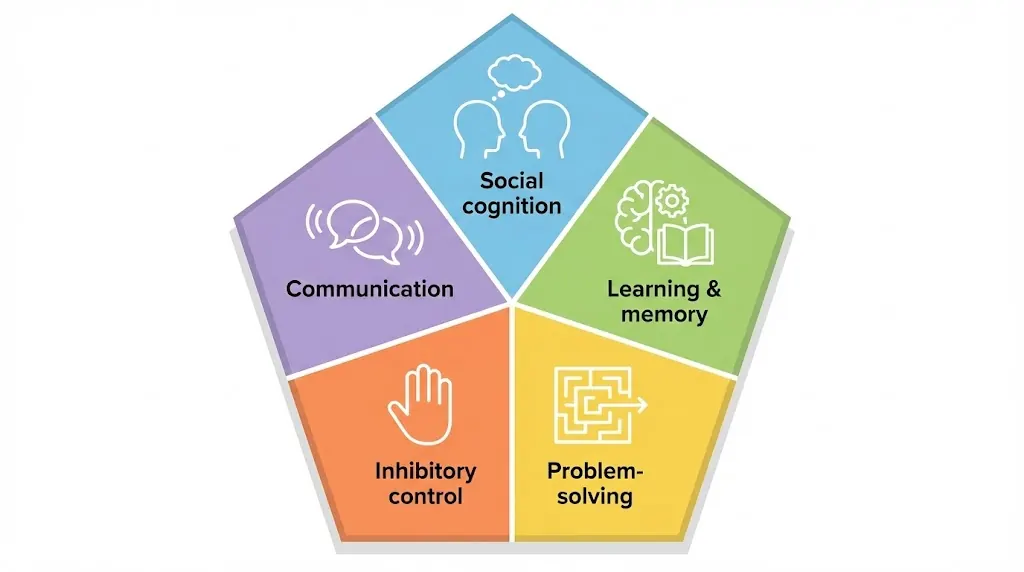
In animal cognition research, “intelligence” is multi-dimensional. A pet can perform strongly in one area and average in another. Common domains include:
- Social cognition: using social cues (gaze, gestures, attention, emotion) to predict what others will do.
- Learning & memory: forming associations, remembering rules, routines, and locations over time.
- Problem-solving: navigating obstacles, detours, and puzzles to reach a goal.
- Inhibitory control: resisting impulses (e.g., waiting, stopping, choosing a better option).
- Communication: understanding signals and using signals effectively (vocal, visual, scent/body cues).
Key point: “Smarter” depends on which cognitive skill you’re measuring and how you measure it.
Domestication history shapes what comes easily
Dogs were domesticated and selectively bred for roles that often reward cooperation with humans (e.g., herding, guarding, retrieving). That history likely strengthened traits such as attention to people, responsiveness to human cues, and persistence in human-guided tasks.
Cats’ domestication is often described as more commensal/self-directed (cats living near humans because it was advantageous, especially for hunting rodents), with generally less intensive selection for human-directed work. As a result, cats may be more selective about when to engage, and their strengths can be easier to see in tasks that resemble independent foraging or hunting rather than teamwork.
Practical implication: dog-friendly tests often reward cooperation; cat-friendly tests often reward autonomy and low-stress exploration.
Why some tests can make cats look “worse” than they are
Many classic cognition tests assume the animal will:
- approach unfamiliar people or settings quickly,
- repeat trials many times for food,
- tolerate handling or close human proximity, and
- stay engaged even when the task is repetitive.
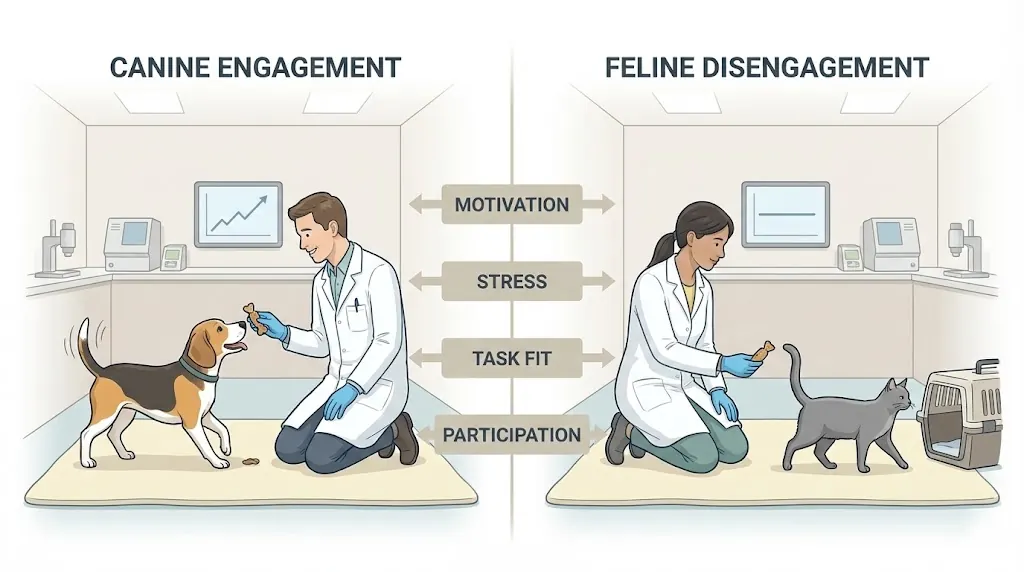
Those assumptions often fit many dogs. Many cats, however, may opt out if they feel stressed, bored, under-motivated, or uncomfortable with the setting. In research terms, low participation can reflect motivation, stress/arousal, or task fit—not necessarily low cognitive ability.
How to interpret results fairly:
If a cat doesn’t perform a task, it’s important to ask whether the study measured ability, or whether it unintentionally measured willingness to participate under those conditions.
In comparative cognition, “intelligence” isn’t a single trait; it includes social cognition, learning/memory, problem-solving, inhibitory control, and communication. Cats and dogs differ in domestication history and typical motivation/engagement patterns, so tests that require high cooperation or repeated trials can underestimate cats by conflating performance with participation.
Brain size vs. brain power: neurons are a clue, not a verdict
One popular data point: dogs appear to have more neurons in the cerebral cortex than cats in at least one cross-species analysis using the isotropic fractionator method. In that work, cats were estimated around 250 million cortical neurons, while dogs were around the ~500 million range (with variation by individual/breed).
That’s interesting—but it’s not a final answer. Neuron counts don’t automatically translate to “who’s smarter” in real life because:
- brains specialize (smell vs vision vs social processing),
- learning depends on motivation and experience,
- and intelligence is multi-dimensional.
Think of neuron counts as one piece of the puzzle, not the scoreboard.
Where dogs often outperform cats (and why)
Bottom line: Dogs often look “smarter” on tests that reward human-directed social skills and cooperation—because dogs were shaped by domestication and selective breeding to work with people.
1) Using human cues and cooperating with us
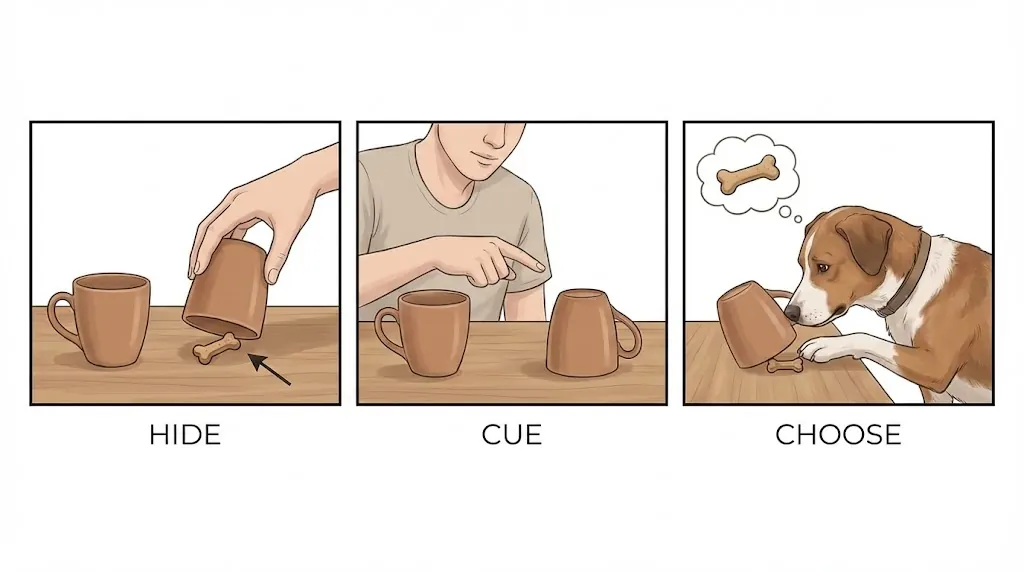
One-sentence answer: In many lab tasks, dogs more reliably use human gestures and attention cues (like pointing and eye contact) to solve problems.
What the research supports
- Dogs commonly succeed in “object-choice” style tasks where a human indicates a hidden reward (e.g., via pointing/gaze), outperforming species that aren’t domesticated for interspecies cooperation.
- Comparative work argues these human-oriented skills are plausibly a domestication by-product (selection for reduced fear/aggression and increased sociability can indirectly boost responsiveness to human cues).
- Dogs treat eye contact and other ostensive cues as meaningful social signals more than many other species, which can make them better “partners” in human-led tasks.
Why this can make dogs “win” cat–dog comparisons
Many “intelligence” tests quietly assume the animal will stay engaged with a human stranger in a new setting and repeat trials. Dogs often do; many cats disengage when the setup feels unsafe, unrewarding, or pointless—so cats can appear worse even when ability isn’t the issue. (That’s a measurement bias, not proof of “less intelligence.”)
2) Trainability for human-defined tasks
One-sentence answer: Dogs are often easier to train for our goals because many dogs find training itself rewarding—through social reinforcement (attention, play) plus food.
Dogs often appear “smarter” because they’re easier to train for the things humans value: cues, routines, jobs, and household rules. That doesn’t mean cats can’t be trained—it means dogs are typically more reinforced by the training process itself (praise, play, shared attention).
Also, training style matters. Veterinary behavior guidance strongly favors reward-based methods because they’re effective and reduce risk of harm to welfare and the human–animal bond.
Where cats often shine (and why)
Bottom line: Cats often look “less smart” in obedience-style tests because their cognition is more self-directed and context-sensitive—motivation, stress, and task design strongly shape what they’ll show.
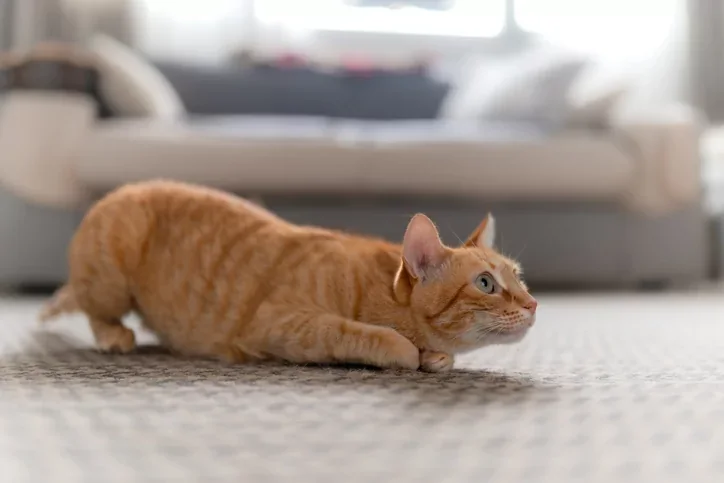
Cats commonly solve problems through exploration → pause/observe → targeted attempt, especially when the task resembles foraging or hunting.
1) Independent learning & problem-solving (on their terms)
Cats commonly solve problems through exploration → pause/observe → targeted attempt, especially when the task resembles foraging or hunting (pursuit, capture, manipulation). What looks like “stubbornness” is often selective engagement: many cats conserve effort unless the reward is worth it.
What research supports: In puzzle-box style problem-solving tasks, some cats do learn to access food rewards, but performance varies widely and can be influenced by factors like a cat’s socialization toward humans and willingness to approach a novel apparatus—meaning “won’t do it” can reflect comfort/motivation, not ability.
How to interpret it fairly: If a cat walks away, treat it as a data point about incentive and setting, not “intelligence.” Short trials, familiar environments, and rewards the cat actually values tend to show more of what the cat can do.
2) Memory & “hidden object” reasoning (object permanence)
Cats are predators, so skills like tracking movement and predicting where a target went are ecologically relevant. In cognition research, this is often studied through object permanence—the idea that an object still exists even when out of sight.
What recent studies show (and why it’s tricky): A home-based study tested cats on object permanence using visible hiding and a “violation-of-expectancy” setup (where outcomes are either consistent or surprising). The authors note that cats’ engagement and behavior can shift with testing method and person familiarity, and their results did not map cleanly onto the “expected” surprise pattern seen in some other species—highlighting how method and motivation can change what we observe.
In plain language: Cats may not “perform on cue,” but many can be excellent at remembering places, routines, and where rewards tend to appear—especially when the task feels natural and low-stress.
Social smarts: cats aren’t aloof—just different
Cats can learn human words that matter to them
Cats can recognize and discriminate words—especially ones that predict outcomes. A Scientific Reports study found many cats could discriminate their own names from other words using a habituation–dishabituation approach.
That fits what we see at home: the cat who ignores you… until you say the magic word (“treat,” “dinner,” or their name right before something good).
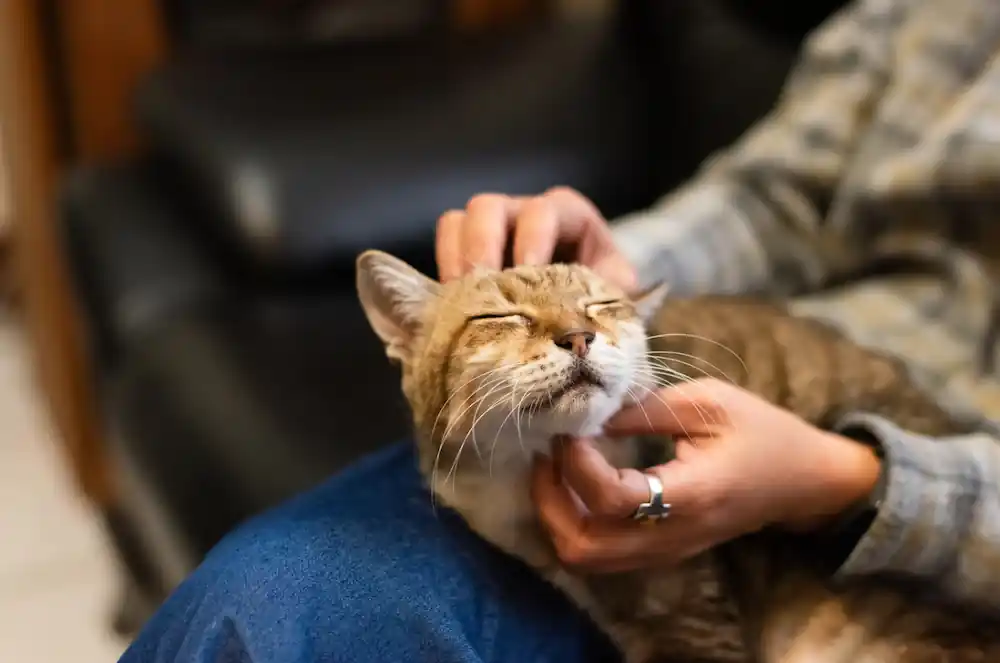
Cats form real bonds and attachment patterns. Research suggests cats can form attachment relationships with caregivers, with individual differences in attachment style—more like “some cats are secure, some are not,” rather than “cats don’t bond.”
Cats form real bonds and attachment patterns
Research suggests cats can form attachment relationships with caregivers, with individual differences in attachment style—more like “some cats are secure, some are not,” rather than “cats don’t bond.”
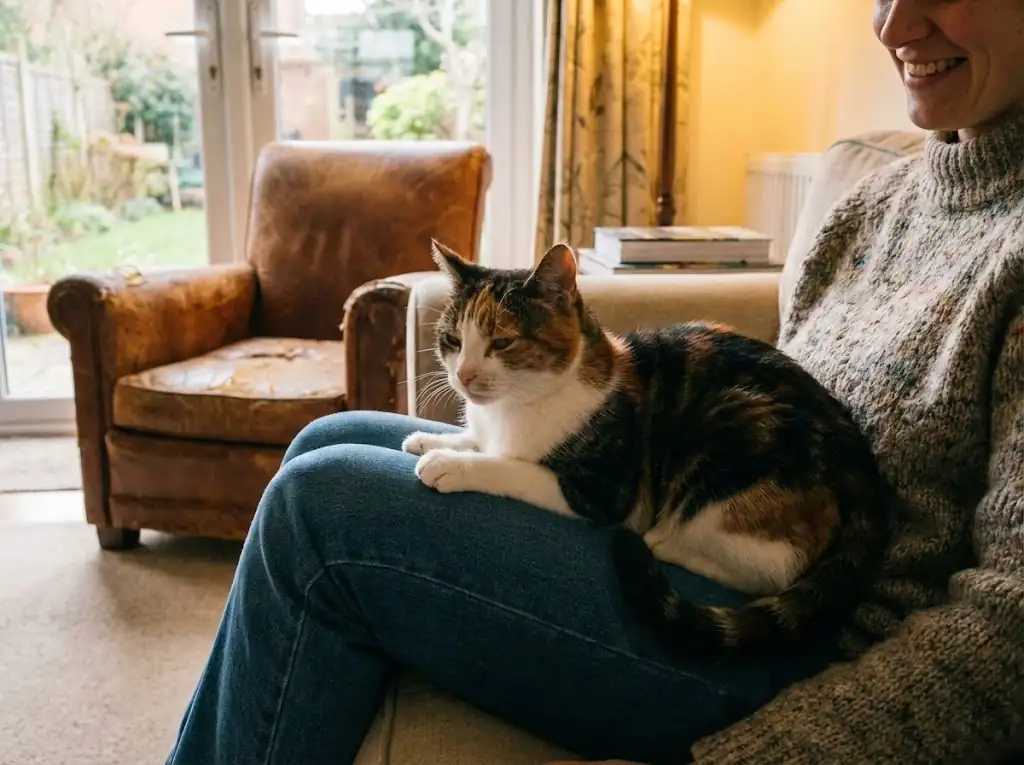
So if your cat follows you from room to room, sleeps near you, or checks in visually, that’s not “just food”—that’s social behavior.
A fair comparison: different kinds of “smart”
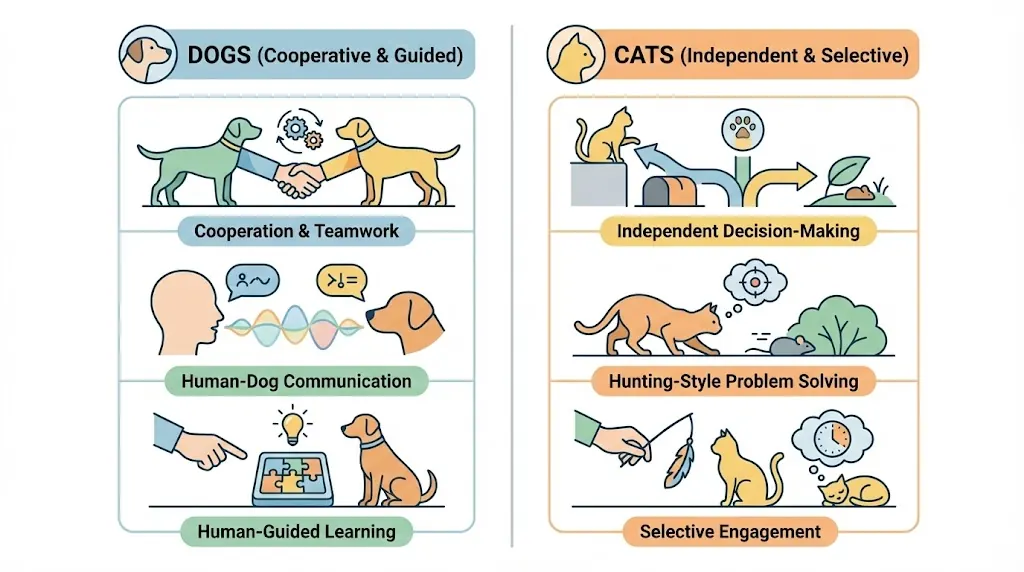
Cats and dogs aren’t “more” or “less” intelligent overall—they tend to be intelligent in different ways, shaped by domestication and ecology. Dogs often excel at human-directed social learning (cooperation, gestures, tasks we assign). Cats often excel at self-directed problem-solving (independent decisions, hunting-style challenges, selective engagement).
A practical framing (non-biased)
- Dogs (on average): optimized for cooperation + communication + learning human-defined tasks
- Cats (on average): optimized for solitary hunting skills + independent decision-making + selective engagement
Neither is “better.” They’re different toolkits—and individuals vary a lot (age, experience, temperament, and training matter).
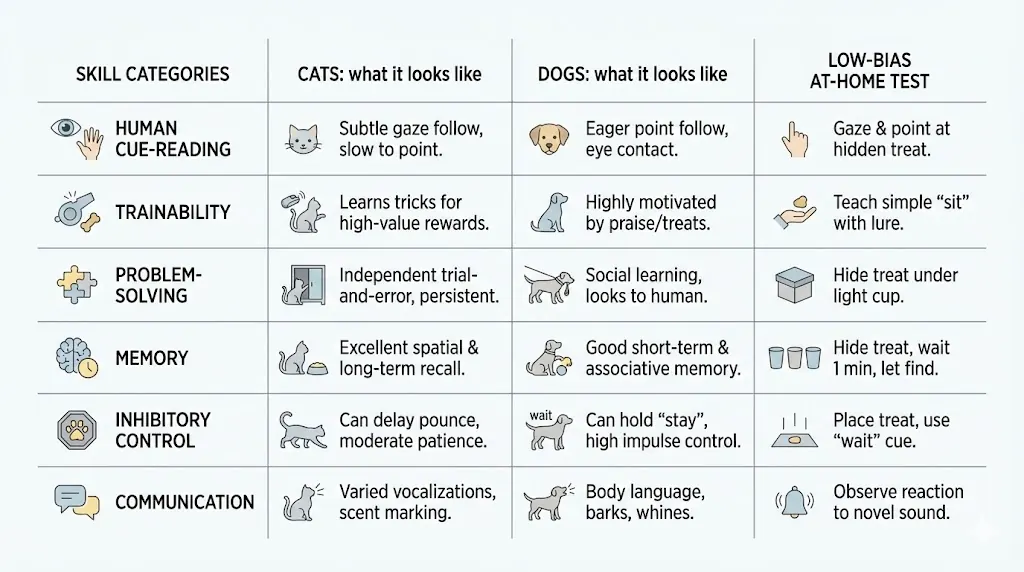
“Smarts” by category: what it can look like and how to test fairly at home
How to use this table (so results are meaningful):
- Keep sessions short (1–3 minutes) and low-stress; stop if either animal disengages or shows anxiety.
- Use high-value rewards (treats/play) and repeat on 2–3 different days.
- Score behavior as “attempted / solved / solved quickly” rather than “obeyed / didn’t obey.”
| Skill category | Cats often show it as… | Dogs often show it as… | A fair at-home test (low-bias) |
|---|---|---|---|
| Human cue-reading | Checks your face; may follow cues selectively | Follows pointing/gestures more reliably | Two-cup treat test: hide a treat under 1 of 2 cups. For cats, use minimal talking/pointing; for dogs, use clear pointing. Run 6–10 trials. |
| Trainability (human-defined tasks) | Short bursts; may walk away when “done” | Repetition-friendly; handler-focused | Micro sessions: 1–3 minutes, 3–5 reps max. End on a win. Compare “learning over days,” not “obedience in one session.” |
| Problem-solving (physical puzzles) | Watches first; tries efficient solutions | Tries quickly; may persist socially (looks to you) | Puzzle feeder / treat ball: choose species-appropriate difficulty. Time to first success + number of strategies tried. |
| Memory & routines | Strong time/place associations (food spots, nap spots) | Strong cue/routine memory; route memory | Find-it rotation: hide rewards in 2–3 locations; rotate daily. Track whether they go to the “new” spot after 1–2 exposures. |
| Inhibitory control | Pauses/disengages; may “opt out” | Can build strong impulse control with training | Wait/leave-it variant: dogs practice “wait” before food. Cats practice slow treat delivery + “look at me/target” before reward. |
| Communication | Subtle signals (body position, tail, scent/rubbing), context-specific vocalizing | Big body language + learned cues; more overt signaling | Signal shaping: reward calm attention and clear signals (e.g., sitting, gentle touch). Do not punish communication—it can increase stress and worsen behavior. |
Practical enrichment routine: build your cat’s “brain skills” (without turning life into homework)
Goal: not to “outsmart dogs,” but to reduce boredom, prevent stress-linked behavior problems, and strengthen your bond—using short, repeatable habits that fit normal life.
Why this works (in plain English): Most feline welfare guidance emphasizes meeting cats’ core environmental needs—safe space, key resources, play/hunting outlets, and predictability—because these directly affect behavior and wellbeing.
Daily (10–20 minutes total)
1) Two hunting-style play sessions (5–8 minutes each)
How: wand toy (or chase toy) in a simple sequence: stalk → chase → pounce → “catch.”
Finish with: a small snack (or part of a meal) to complete the “hunt” cycle.
Why: interactive play that mimics hunting is a common enrichment recommendation for indoor cats.
Make it safer/better
- Let your cat “win” regularly (catch the toy).
- Keep sessions short; stop while they’re still interested.
- If using treats, count them into the day’s food (or use kibble) to avoid overfeeding.
2) One tiny training burst (1–3 minutes)
Pick one behavior per session:
- Target touch
- Sit
- Step onto a mat (“station”)
- Come (short distance)
Rules that make cats succeed
- 5–10 reps max, then stop.
- Reward with a high-value treat or play.
- End on a win (even a small one).
Evidence note: Cats can learn multiple cued behaviors with brief clicker-training sessions in shelter-like settings, supporting the idea that short, reward-based training is feasible.
3) One “novelty rotation” (30–60 seconds)
Swap one small thing:
- A new box
- A paper bag with handles removed
- A new toy texture
- A cat-safe scent item (avoid essential oils)
Why: novelty and choice help keep indoor environments mentally engaging (key theme in feline environmental needs guidance).
Weekly (choose 2–3 items)
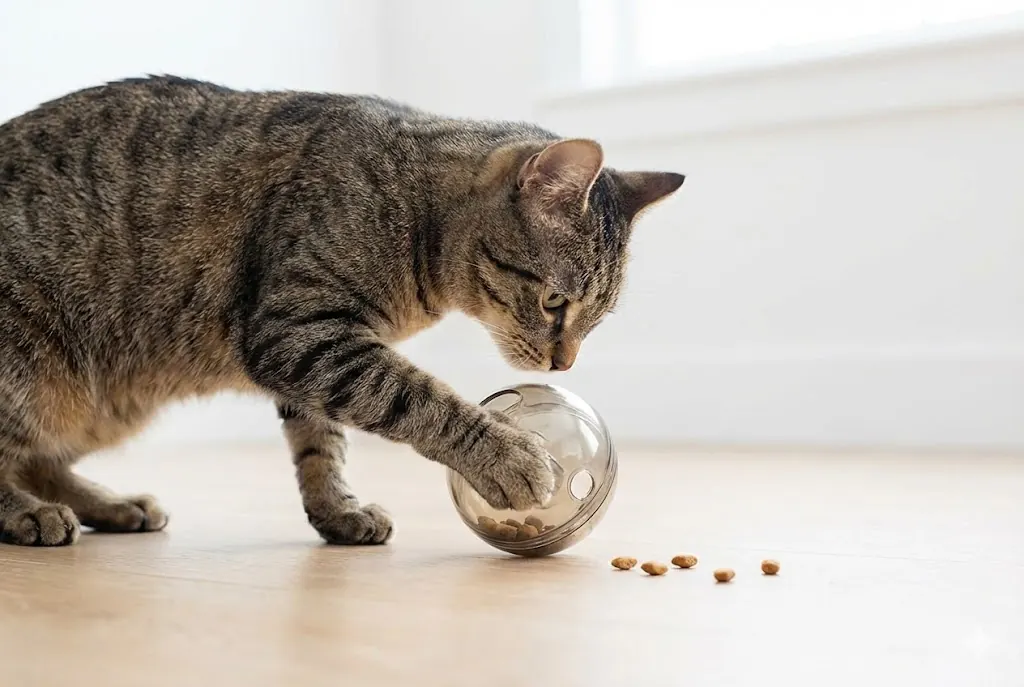
1) Puzzle feeding (3–5×/week)
Use a puzzle feeder or DIY treat hunt (small portions in 2–4 spots).
Why: food-foraging is enrichment and can reduce boredom.
2) Environment refresh (5 minutes)
- Rotate toys
- Move a scratcher
- Add a perch/window view (even temporarily)
Why: vertical space and scratching opportunities are common indoor-cat enrichment basics.
3) Micro “confidence reps” (1–2 minutes)
Reward calm, cooperative moments:
- Step into carrier
- Step onto a scale
- Brief gentle handling (touch ears/paws, then treat)
Why: predictable, positive experiences can make necessary care less stressful (and are consistent with welfare-first guidance).
Monthly (10 minutes)
1) Skill upgrade
Make one thing slightly harder:
- Puzzle a bit more challenging
- Teach a new cue
- Add a second mat “station” in another room
2) Health + behavior check-in
Quick notes: appetite, litter box, sleep, play interest, social behavior. If you see a sudden change, treat it as a potential health signal and contact a vet.
Proof cats can learn: clicker training works (and why it transfers to home)
Studies in shelter contexts show cats can learn cued behaviors with structured clicker sessions, and other research has reported clicker training can increase exploratory behavior and reduce inactivity in cats in controlled settings.
When a “smarts” change might actually be a health issue
Sometimes “my cat is acting dumb” really means “my cat doesn’t feel well.”
Contact a veterinarian promptly if you notice:
- sudden disorientation, wobbliness, or head tilt
- abrupt personality change (very withdrawn or unusually clingy)
- accidents outside the litter box with no obvious environmental cause
- staring spells, collapse, or suspected seizures
- sudden aggression or yowling that’s out of character
- rapid appetite/weight change
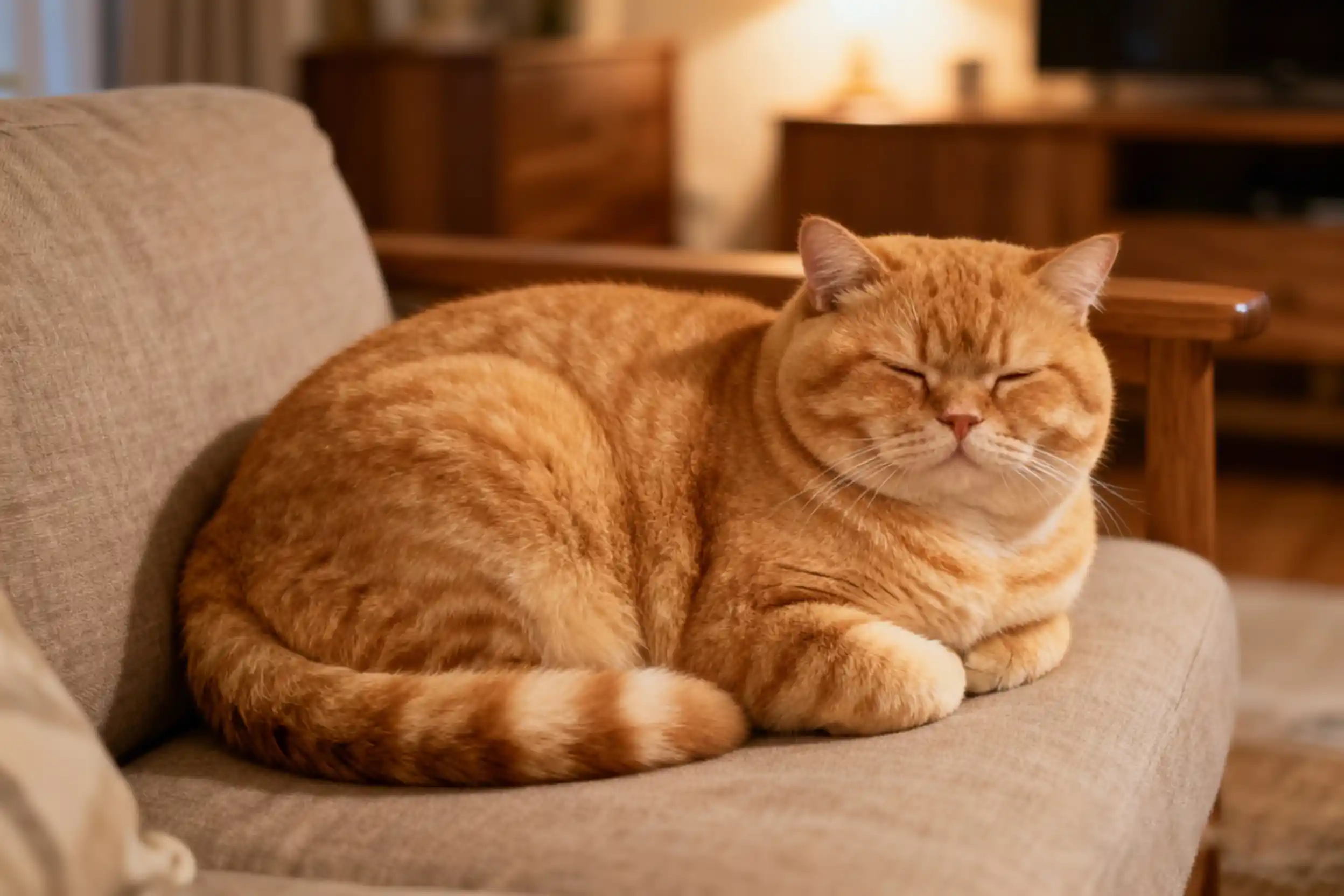
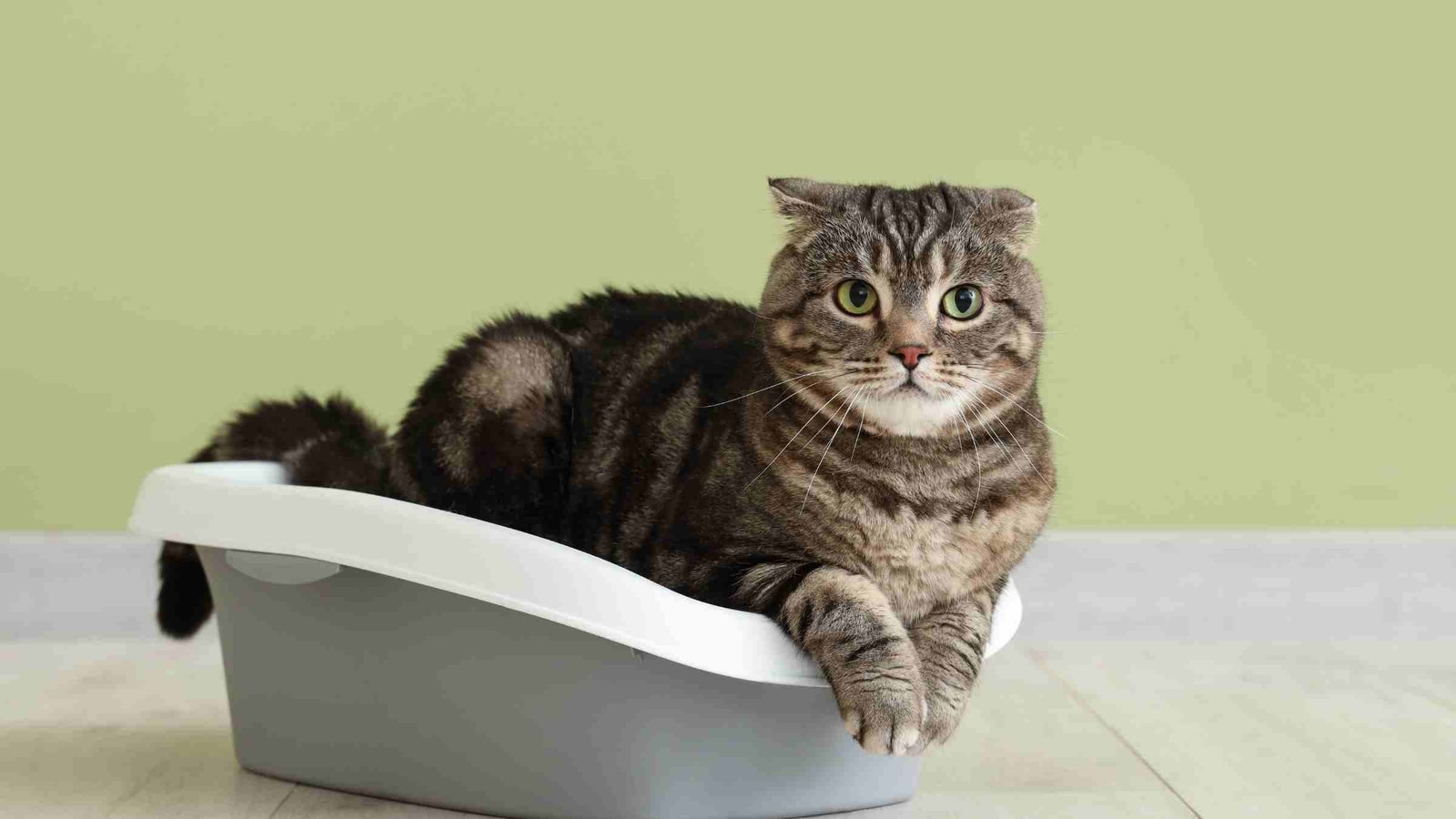
- if your cat suddenly adopts a hunched cat loaf position with other symptoms.
Especially in seniors, cognitive changes can overlap with pain, thyroid disease, kidney disease, hypertension, or sensory decline—things we don’t want to miss.
Conclusion
Bottom line: Cats and dogs aren’t “smarter” in a single, universal way—they tend to excel at different types of cognition, and the “winner” depends on what the test measures.
Dogs often look smarter in everyday life because many common tests reward human-directed social skills and cooperation. Cats may look “stubborn” in those same setups because they’re often more self-directed and selective about engagement—which can hide ability if the task, setting, or motivation isn’t right.
Practical takeaway for cat homes: Instead of trying to “prove” intelligence, aim to build it: short reward-based training (1–3 minutes), hunting-style play, and simple enrichment rotations. A mentally engaged cat is more likely to be calm, adaptable, and easier to live with.
FAQ
Are cats smarter than dogs?
There isn’t one “IQ score” that fairly ranks cats and dogs. Dogs often look smarter on tests that reward cooperation with humans, while cats often excel at independent problem-solving and hunting-relevant skills. A fair answer depends on which ability you’re measuring and how the test is designed.
What kind of intelligence are dogs usually best at?
Dogs often shine in human-focused social cognition: paying attention to people, learning cues we teach, and cooperating in repeated training tasks. This doesn’t mean dogs are smarter overall—it means many dogs are optimized for teamwork and communication with humans.
What kind of intelligence are cats usually best at?
Cats often shine at self-directed learning: exploring, testing solutions, and disengaging when the payoff isn’t worth it. Their strengths often align with solitary hunting, efficient decision-making, and selective engagement rather than repeated “do it again” obedience-style tasks.
Do cats know their name?
Many cats can discriminate their own names from other words in controlled experiments, especially when the word predicts something meaningful (food, play, attention). In daily life, a cat may “know” the name but choose not to respond if the context isn’t motivating.
Can cats be trained like dogs?
Yes—many cats learn cues and routines well, but training usually works best in very short sessions (1–3 minutes) with high-value rewards. Cats tend to respond better to calm setups, clear rewards, and stopping before they lose interest, rather than long, repetitive drills.
Does neuron count prove dogs are smarter than cats?
Neuron counts are an interesting clue, but they don’t automatically translate into a single “smarter” verdict. Brains specialize, motivation and experience matter, and intelligence is multi-dimensional. Treat neuron counts as one data point—not a scoreboard for real-world intelligence.
Do cats have object permanence?
Research suggests cats can show object permanence (understanding that something still exists when hidden), but results can vary depending on test design and stress levels. Cats may also disengage in lab-style setups, which can make abilities harder to measure consistently across studies.
How can I make my indoor cat “smarter” (more mentally engaged)?
Focus on enrichment: short hunting-style play, puzzle feeding, novelty rotation (boxes, scents, toy swaps), and tiny reward-based training bursts. The goal isn’t to “beat dogs”—it’s to prevent boredom, reduce stress behaviors, and build a more confident, curious cat.
When is a “smarts” change a health issue?
If your cat suddenly seems disoriented, wobbly, unusually withdrawn, or has abrupt behavior changes, treat it as a health concern—especially in seniors. Sudden changes can overlap with medical problems, so it’s best to contact a veterinarian promptly for guidance.
Reference
Frontiers in Neuroanatomy (2017) – Dogs Have the Most Neurons, Though Not the Largest Brain
Scientific Reports (2019) – Domestic cats discriminate their names from other words (PDF)
PLOS ONE (2024) – Object permanence in domestic cats using violation-of-expectancy
Animals / MDPI (2017) – Assessment of Clicker Training for Shelter Cats
AAFP/FelineVMA + ISFM (2013; page accessed 2026) – Environmental Needs Guidelines overview + download link
AAHA (2025) – Indoor Enrichment for Cats
AVSAB (2021; PDF) – Position Statement on Humane Dog Training
Oregon State University (2019; news release) – Cats develop attachment styles to caregivers





 EN
EN DE
DE ES
ES PT
PT