
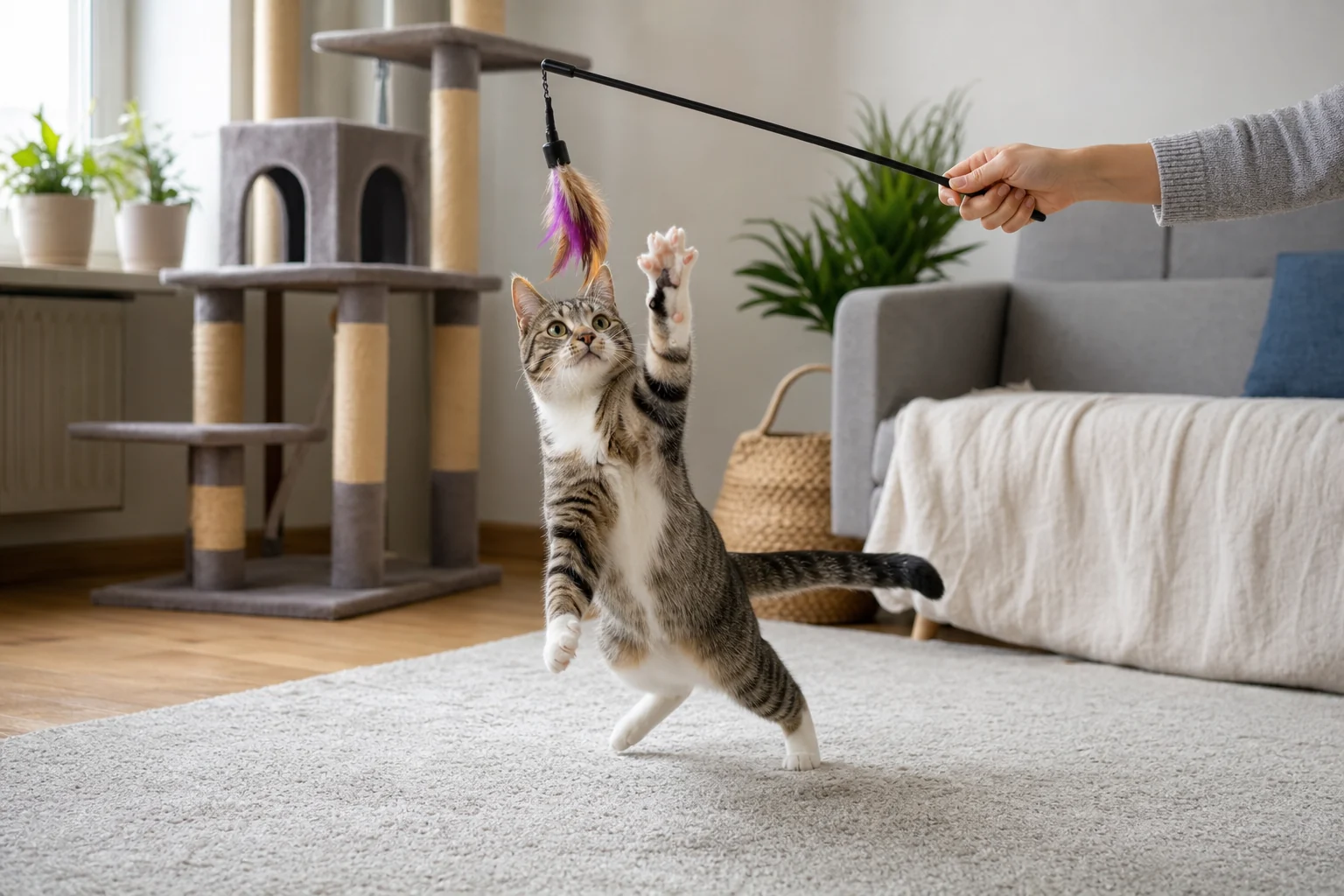
The best way to play with your cat is to copy a short hunting routine: let your cat watch, stalk, chase, pounce, catch, and then settle with food or rest. Most cats do better with one or two predictable play sessions every day than with random toy waving when they are already overstimulated.
Play is not just exercise. Feline environmental-needs guidelines include opportunities for predatory-style play and food-seeking behavior because these outlets support a cat's physical activity, mental engagement, and relationship with people.1 A daily routine also gives you useful clues about your cat's mood, mobility, confidence, and stress level.
Table of Contents
- Why does daily play matter for indoor cats?
- What is the best way to play with your cat?
- How long should you play with your cat each day?
- How do you use the hunt-catch-eat sequence?
- How do you choose the right toy for your cat?
- What play mistakes should you avoid?
- What if your cat does not want to play?
- How do you end play without frustrating your cat?
- Conclusion: Make daily play simple and satisfying
- Frequently Asked Questions
- References
Why does daily play matter for indoor cats?
Daily play matters because it gives indoor cats a safe outlet for normal hunting behavior. Cats commonly follow a sequence that includes searching, locating, stalking, chasing, pouncing, catching, and eating prey.2 Even a well-fed indoor cat may still need a way to express parts of that pattern.
Without a play outlet, some cats redirect energy into ankle attacks, late-night zooming, rough play with hands, pestering other pets, or boredom-driven mischief. That does not mean your cat is "bad." It often means the environment is missing a predictable chance to chase, grab, bite a toy, and win.
Play also builds trust. A shy cat can watch from a hiding spot before joining. A confident cat can burn energy before bed. A senior cat can do gentle paw taps, short chases, and food puzzles without being pushed beyond comfort.
What is the best way to play with your cat?
The best method is supervised interactive play with a toy that acts like prey moving away from the cat. Instead of dangling a lure in your cat's face, move it across the floor, behind furniture legs, around a tunnel, or under a sheet so your cat can plan the chase.3
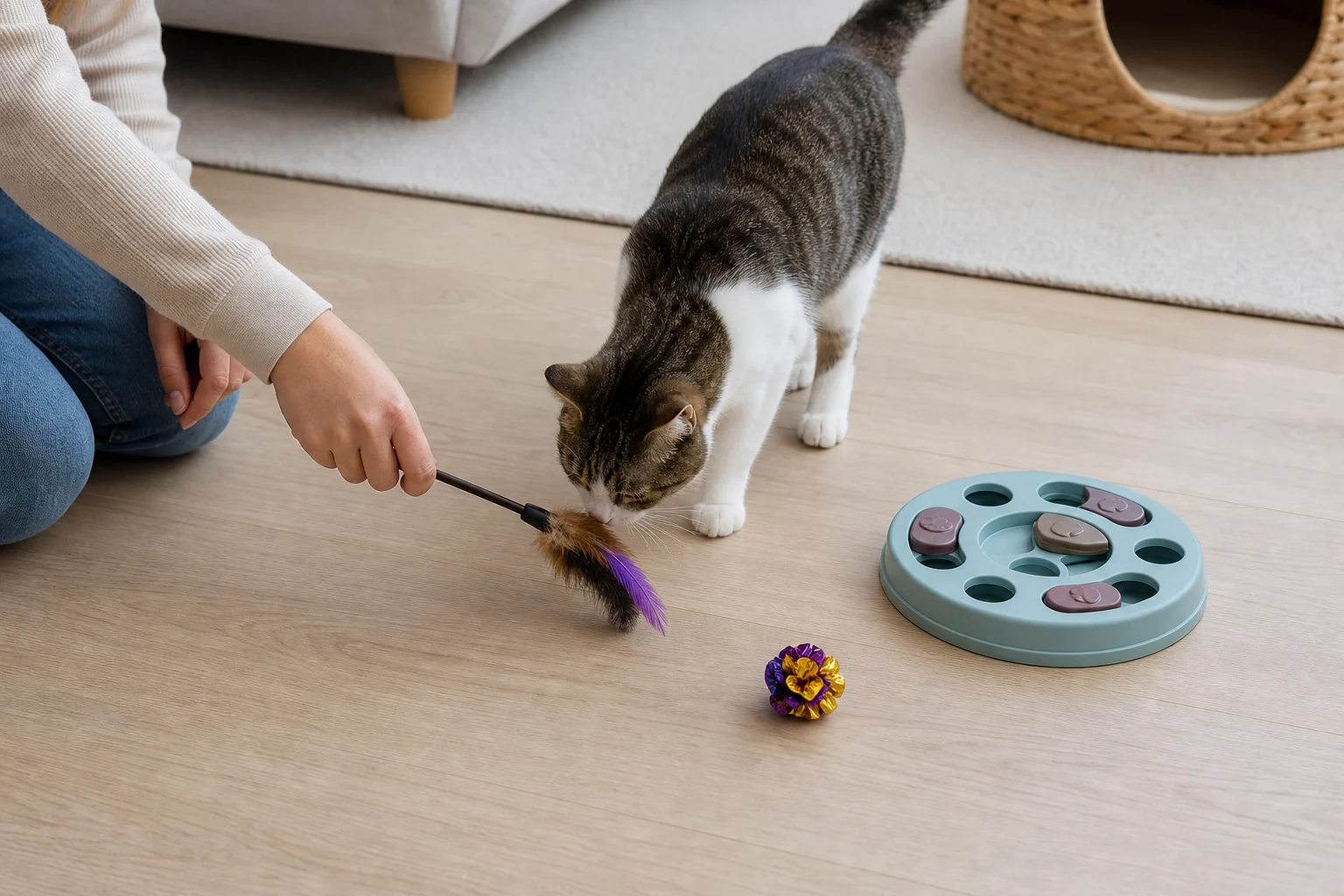
Start simple:
- Pick a clear floor area with traction.
- Put away fragile objects and unsafe strings.
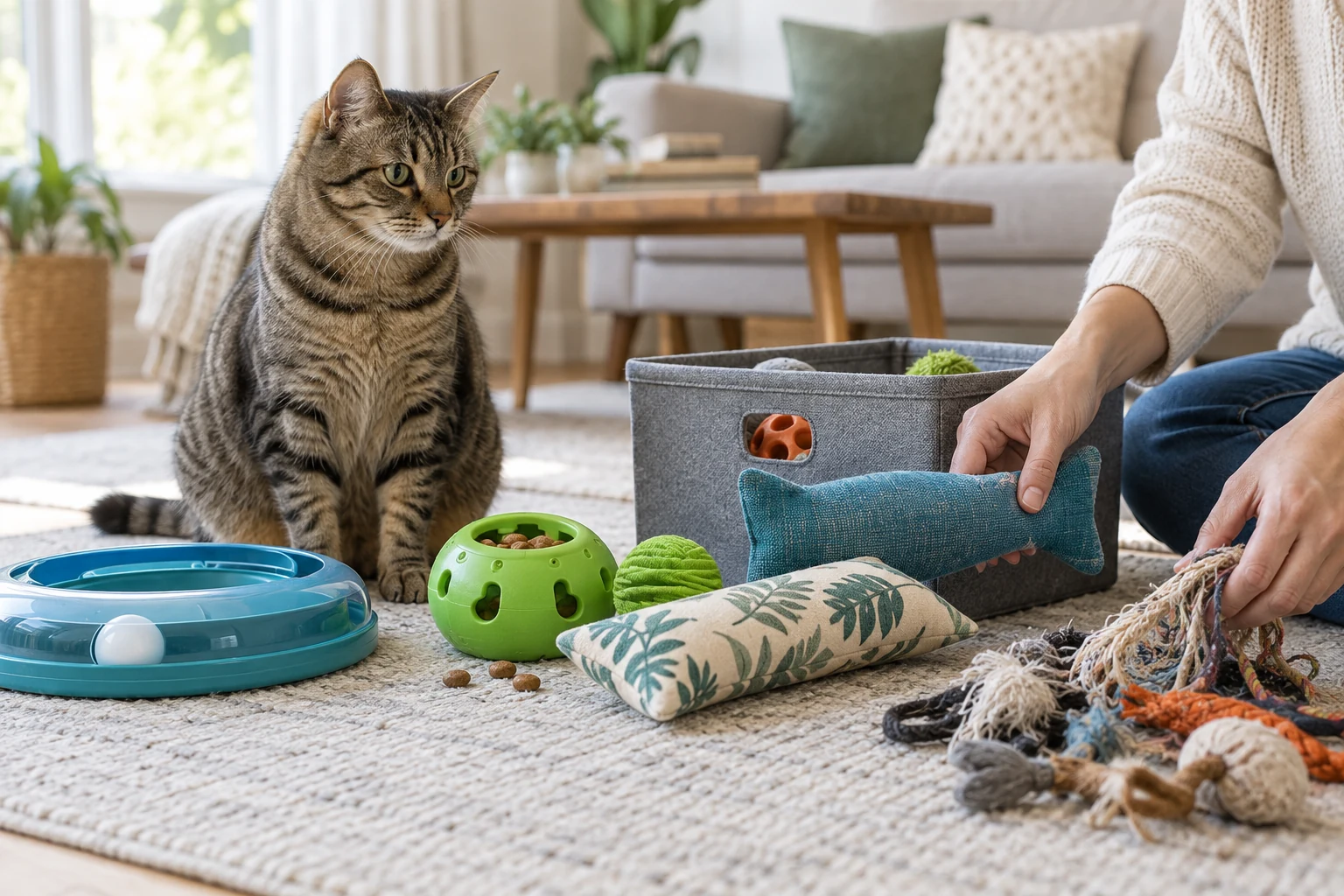
- Use a wand toy, kicker, small ball, or puzzle feeder.
- Move the toy away from your cat like a mouse, bird, or bug.
- Let your cat catch the toy often enough to stay interested.
- Stop before your cat becomes frantic or frustrated.
If you need help matching toy types to play styles, the SnuggleSouls guide to the best interactive cat toys for indoor cats can help you build a small starter set instead of buying a pile of look-alike toys.
How long should you play with your cat each day?
For many adult cats, aim for 10 to 15 minutes once or twice a day, then adjust to your cat. Some young, energetic cats want several short sessions. Some older, overweight, painful, or nervous cats may only want two or three gentle minutes at first.
International Cat Care has promoted even five minutes of daily play as a useful welfare habit for cat owners.5 The exact number matters less than consistency and quality. A focused five-minute session that lets your cat stalk, catch, and finish calmly is better than 20 minutes of frantic waving while your cat looks confused.
Use this quick guide:
| Cat's response | Session length to try | What to change next |
|---|---|---|
| Watches but does not chase | 3-5 minutes | Slow the toy down and let it hide |
| Chases hard, then walks away | 8-12 minutes | End with a catch before interest fades |
| Gets rough or grabs hands | 5-10 minutes | Use a longer wand and calmer movements |
| Senior cat taps from a bed | 2-5 minutes | Keep play low, soft, and close |
| Kitten keeps restarting | 10 minutes, repeated | Add several short sessions across the day |
How do you use the hunt-catch-eat sequence?
Use the hunt-catch-eat sequence by building a beginning, middle, and ending instead of keeping the toy at maximum speed the whole time. Cats often need time to stare and stalk before they pounce. That still counts as engagement.
Try this routine:
- Hunt: Let the toy peek out, pause, and move away.
- Chase: Drag, flutter, or skitter the toy in short bursts.
- Catch: Let your cat grab and bite the toy.
- Reset: Make the toy "escape" after a pause.
- Final catch: Slow the toy down and let your cat win.
- Eat or settle: Offer a small meal, treat puzzle, or quiet rest.
The little crouch and rear-end wiggle before a leap can be a sign your cat is preparing to spring. If you enjoy reading those signals, see why cats wiggle before pouncing and use that moment to let the toy move just far enough away to invite a chase.
How do you choose the right toy for your cat?
Choose toys by prey style, not by what looks cute to humans. Some cats like bird-like toys that flutter above the floor. Others prefer mouse-like toys that dart along baseboards, bug-like toys that pause and twitch, or food puzzles that reward sniffing and paw work.
VCA's summary of feline environmental needs notes that play-based interaction and feeding devices can help encourage natural instincts, while string-like toys should be put away after play because parts can be ingested.4 That distinction matters: some toys are safe only when you are actively supervising.
| Toy style | Good match for | Safety note |
|---|---|---|
| Wand toy | Stalking, chasing, jumping | Store after use, especially if it has string |
| Kicker toy | Grabbing, bunny-kicking, biting | Choose sturdy seams and appropriate size |
| Crinkle ball | Solo batting and chasing | Avoid pieces that can break off |
| Puzzle feeder | Food-seeking and slower meals | Count treats or kibble in daily calories |
| Tunnel or box | Ambush play and shy cats | Keep exits open and stable |
Rotate two or three toys at a time. Too many toys on the floor can become background clutter. A small rotation keeps each session fresher and lets you notice what your cat actually chooses.
What play mistakes should you avoid?
Avoid using your hands or feet as toys. It may seem harmless with a kitten, but it teaches your cat that skin is an acceptable target. If your cat is already grabbing or biting during play, switch to longer toys and read the SnuggleSouls guide to why cats bite during play.
Also avoid:
- Waving the toy directly into your cat's face.
- Making every chase impossible to win.
- Forcing a nervous cat out of hiding.
- Playing on slippery floors where your cat skids.
- Leaving string, ribbon, yarn, or wand attachments out unsupervised.
- Using a laser pointer as the only game, especially without a final catchable toy.
- Letting one cat monopolize play in a multi-cat home.
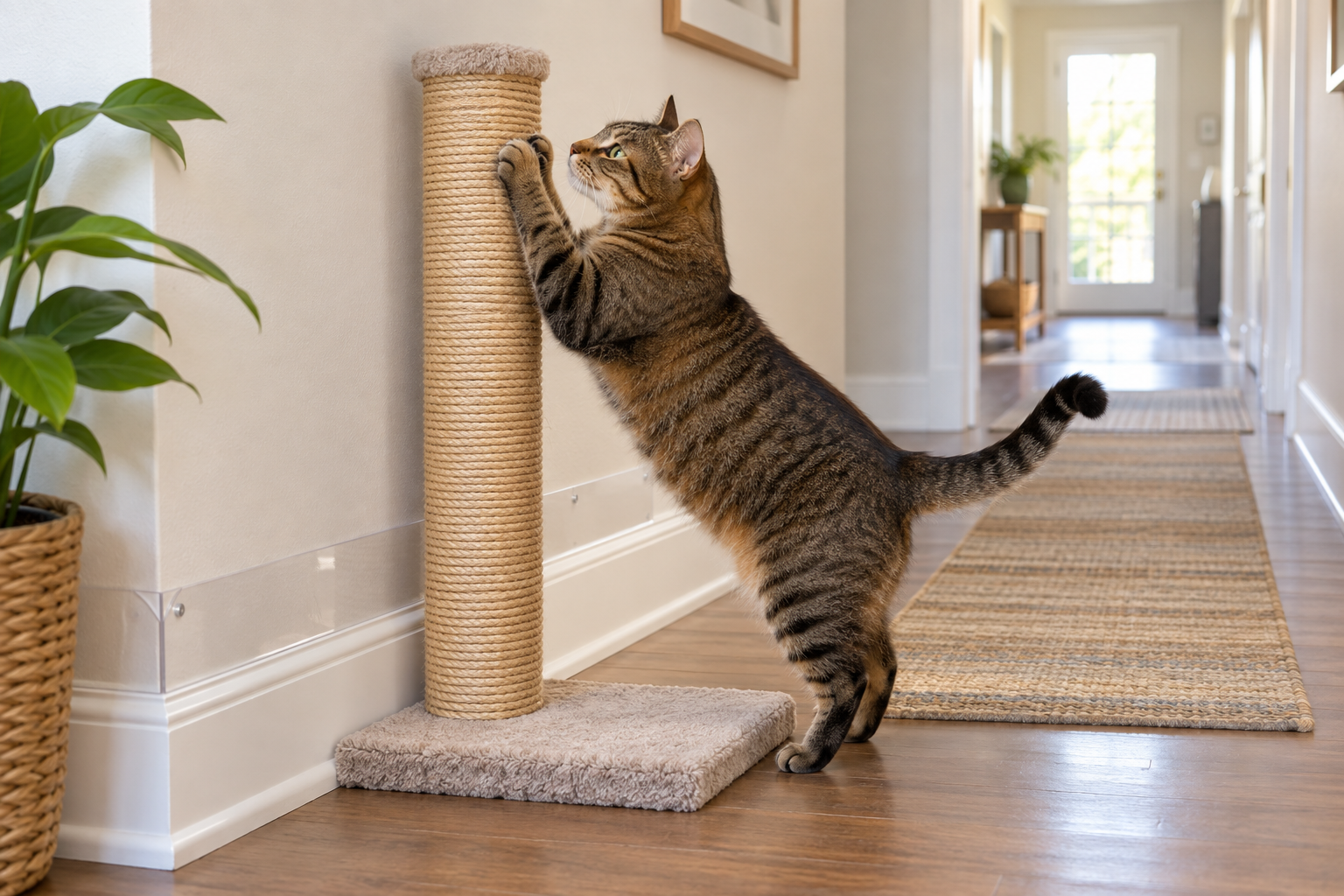
Before energetic games, cat-proof your home around the play area. Move breakables, secure blind cords, check rugs for slipping, and make sure your cat has acceptable climbing and scratching outlets. Good scratching posts for cats can absorb some of the stretching and marking that naturally follows excitement.
What if your cat does not want to play?
If your cat does not want to play, start smaller and slower. A cat who ignores a toy may still be interested if their ears turn, pupils widen, whiskers move forward, or head follows the lure. Watching is often the first step.
Try these adjustments:
- Play at dawn or evening when many cats are naturally more active.
- Drag the toy away from the cat instead of toward the cat.
- Let the toy hide behind a box, tunnel, chair leg, or blanket edge.
- Use softer movements for shy cats and shorter sessions for seniors.
- Warm up with a food puzzle if your cat is more food-motivated.
- Give each cat a private turn if another pet is intimidating them.
If your cat suddenly stops playing, hides more, limps, pants, coughs, seems painful, or has a sharp appetite or energy change, treat that as a health clue and call your veterinarian. A play routine should respect the cat in front of you; it should never pressure a cat who may be uncomfortable.
For more body-language help, browse the SnuggleSouls cat behavior guides and compare patterns over time instead of judging one session in isolation.
How do you end play without frustrating your cat?
End play by gradually slowing the toy, allowing a final catch, and then offering a small meal, treat, or puzzle feeder. This gives the session a satisfying finish instead of stopping abruptly while your cat is still fully wound up.
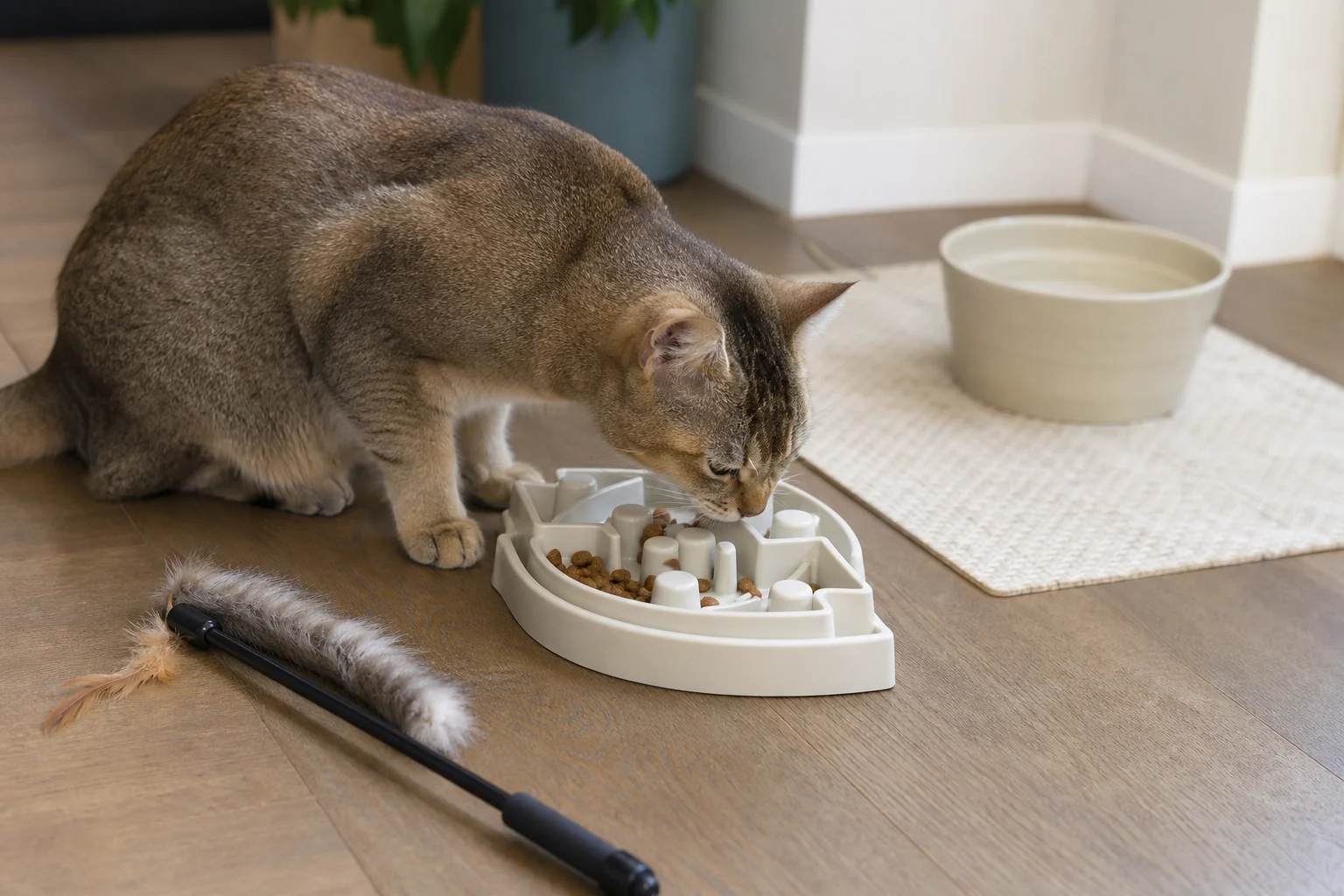
A simple evening routine might look like this:
| Time | What to do | Why it helps |
|---|---|---|
| Minute 1-2 | Slow lure movements and stalking | Lets your cat focus |
| Minute 3-8 | Chases, pounces, and catches | Gives physical and mental work |
| Minute 9-10 | Slower "tired prey" movement | Prevents an abrupt stop |
| Final moment | Big catch and brief bite/kick | Lets your cat win |
| Afterward | Small meal or puzzle feeder | Supports a calm transition |
For cats who wake you at night, schedule the strongest play session before the last meal of the evening. It will not solve every nighttime behavior, but it often gives restless energy a better place to go.
Conclusion: Make daily play simple and satisfying
Playing with your cat works best when it feels like a small daily routine, not a random burst of toy waving. Give your cat a safe place to stalk, chase, pounce, catch, and settle; then adjust the toy, speed, and session length to the individual cat.
Keep it simple: one wand toy, one chase toy, one puzzle or food-finding option, and a predictable time of day. From there, you can build richer daily cat-care routines around what your cat genuinely enjoys.
Frequently Asked Questions
How many times a day should I play with my cat?
Most cats benefit from at least one focused play session every day, and many do well with two short sessions. Kittens, high-energy cats, and indoor-only cats may need more frequent play, while senior or painful cats may need shorter, gentler sessions.
Is it okay if my cat only watches the toy?
Yes. Watching can be part of the hunting sequence, especially for cautious, older, or less confident cats. Slow the toy down, let it hide, and reward small signs of interest instead of forcing a chase.
Should I use a laser pointer to play with my cat?
A laser pointer can create chasing behavior, but it does not give your cat something physical to catch. If you use one, keep sessions short and finish with a real toy your cat can grab, then offer a small food reward or puzzle.
Why does my cat bite me after play?
Your cat may be overstimulated, still in hunting mode, or used to treating hands as toys. Pause the session, redirect to a longer toy, and avoid rough hand play so your cat has a clearer target.
What is the best toy for a lazy cat?
Start with a slow wand toy that hides behind a blanket edge or box, because many cats prefer stalking before chasing. Food puzzles can also help food-motivated cats engage without needing big jumps or fast running.
References
[1] American Association of Feline Practitioners and International Society of Feline Medicine. (2013). AAFP and ISFM Feline Environmental Needs Guidelines. URL
[2] International Cat Care. (2024). Understanding the hunting behaviour of cats. URL
[3] Maddie's Fund. (2026). Playing With Your Cat. URL
[4] VCA Animal Hospitals. (2026). Feline Environmental Needs Guidelines. URL
[5] International Cat Care. (2023). International Cat Day 2023: Make it a Purrfect Play Day. URL
 Why Does My Cat Flinch When Touched While Sleeping? Startle, Trust, and Pain Clues">
 Cat Scratching Baseboards: Trim Guards and Route Fixes">
 EN
EN DE
DE ES
ES PT
PT