
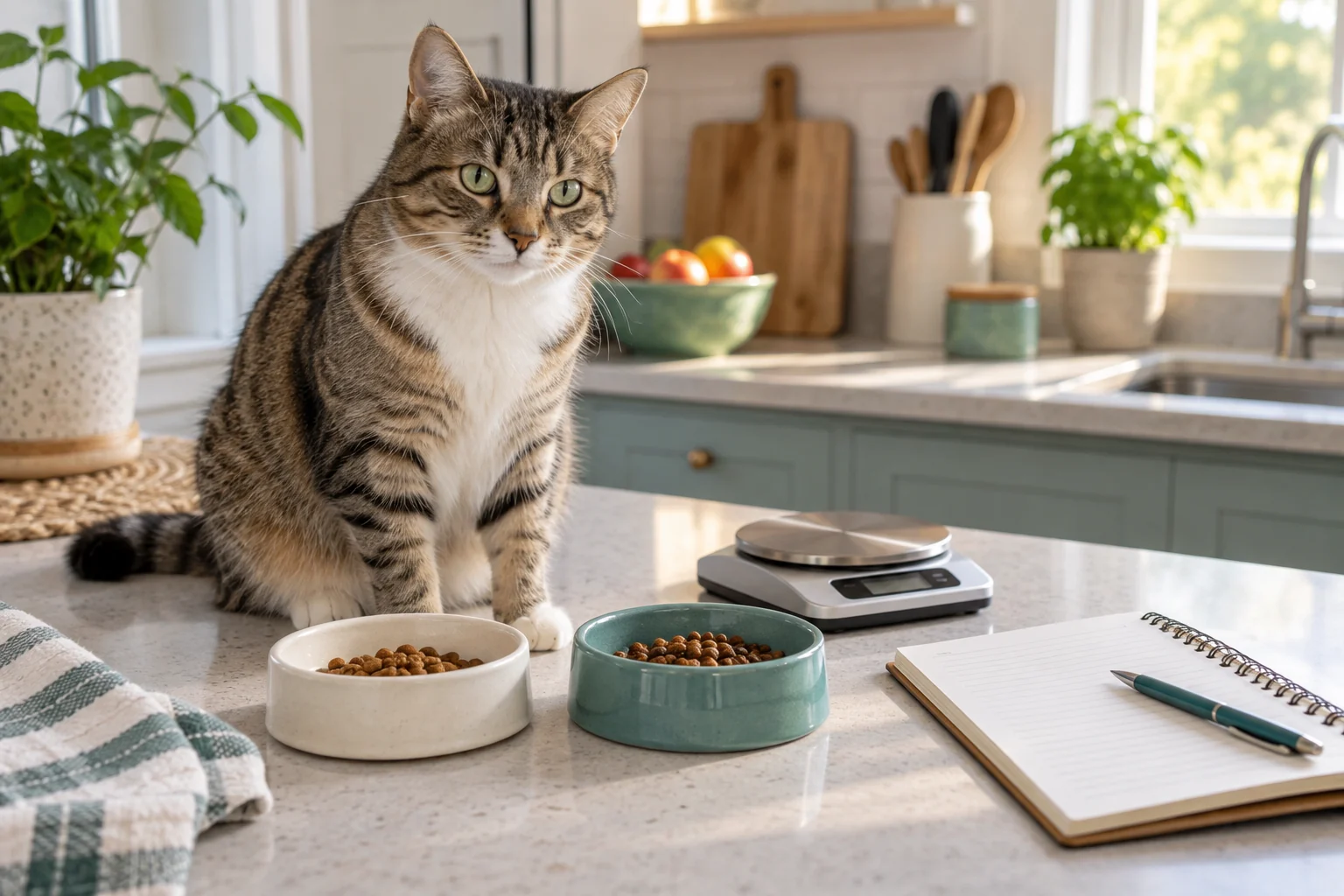
A cat food switch log tracks what your cat ate, stool, vomiting, treats, weight, and appetite so you can spot food-switch problems early.
That may sound fussy, but it prevents the most common food-switch problem: guessing from memory. If your cat eats less on day three, has soft stool on day five, or starts begging after the new dry food, a log helps you see whether the timing fits the diet change, the portion, the treats, or something that needs your veterinarian.
Use this guide for an otherwise stable cat during a planned food change. If your cat has repeated vomiting, diarrhea, sudden appetite loss, weight loss, urinary signs, diabetes, kidney disease, food allergies, a prescription diet, or any other medical condition, ask your veterinarian how to switch foods and what to track.
Índice
- How does a food switch log help?
- What should you write in a cat food switch log each day?
- How do you log wet food, dry food, and mixed meals?
- Which appetite and stomach clues deserve attention?
- How often should you weigh your cat during a food switch?
- How do you use the log to adjust the portion?
- When should you stop the switch and call the vet?
- Conclusion: Keep the Log Simple Enough to Use
- Preguntas frecuentes
- Referencias
How does a food switch log help?
A food switch log helps you separate normal transition bumps from patterns that need a slower plan or veterinary advice. Instead of remembering "she seemed off this week," you can say, "she ate 75 percent of breakfast for two days after the new food reached half the meal, then had soft stool."
That detail is useful because nutrition is individualized. AAHA describes nutritional assessment as an ongoing process that includes history, environment, activity level, body weight, body condition score, and muscle condition score 2. A home log does not replace that assessment, but it gives your veterinarian better facts if the switch does not go smoothly.
It also keeps portion changes honest. If you already used the SnuggleSouls guide to adjust cat food portions when switching brands, the log is where you test the plan in real life. The math sets the starting point. Appetite, stool, weight, and behavior show whether that starting point is working for your cat.
What should you write in a cat food switch log each day?
Write the same small set of details every day: date, food ratio, amount offered, amount eaten, stool quality, vomiting or hairballs, treats, appetite, energy, and any unusual behavior. The goal is not a perfect medical chart. It is a consistent snapshot.
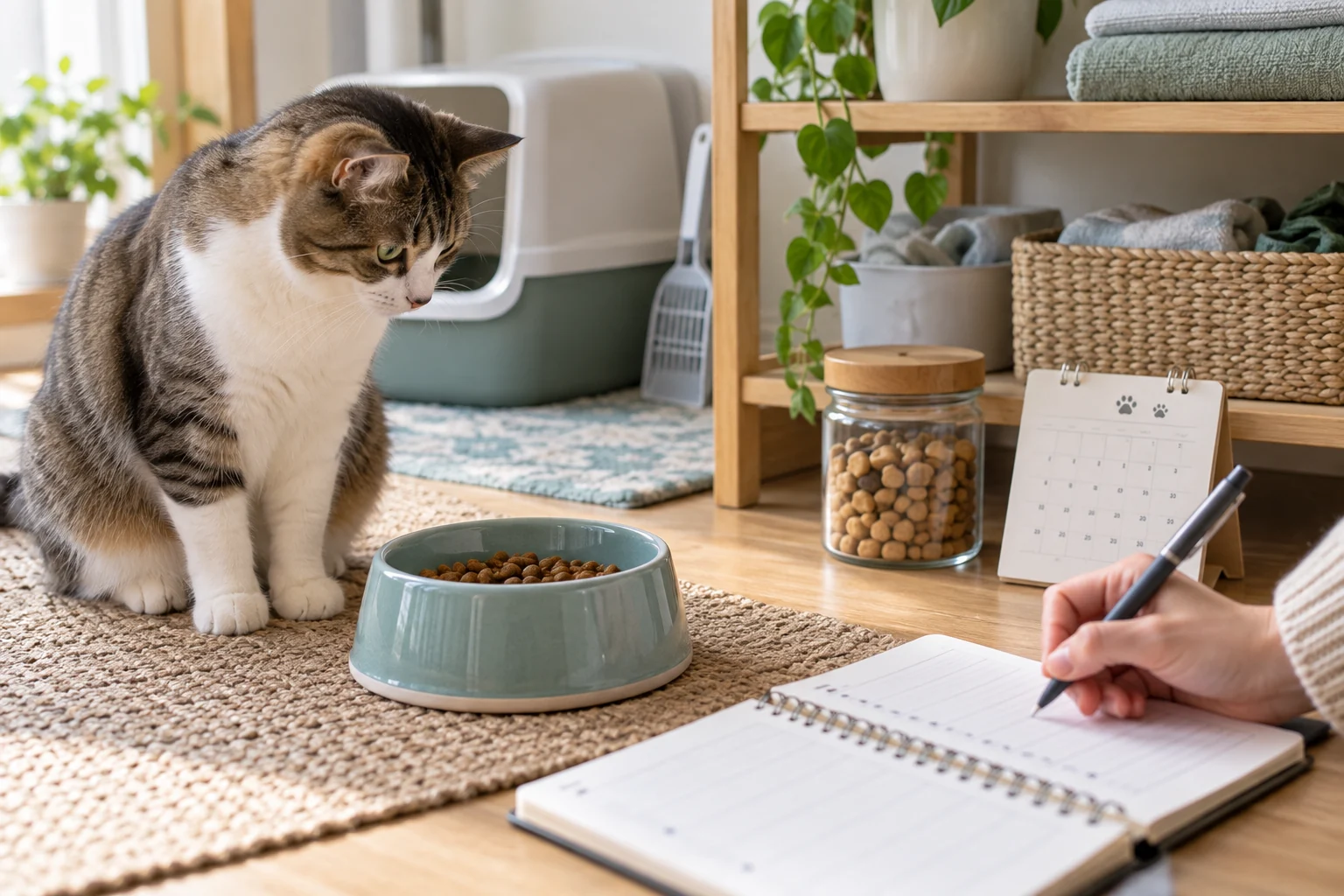
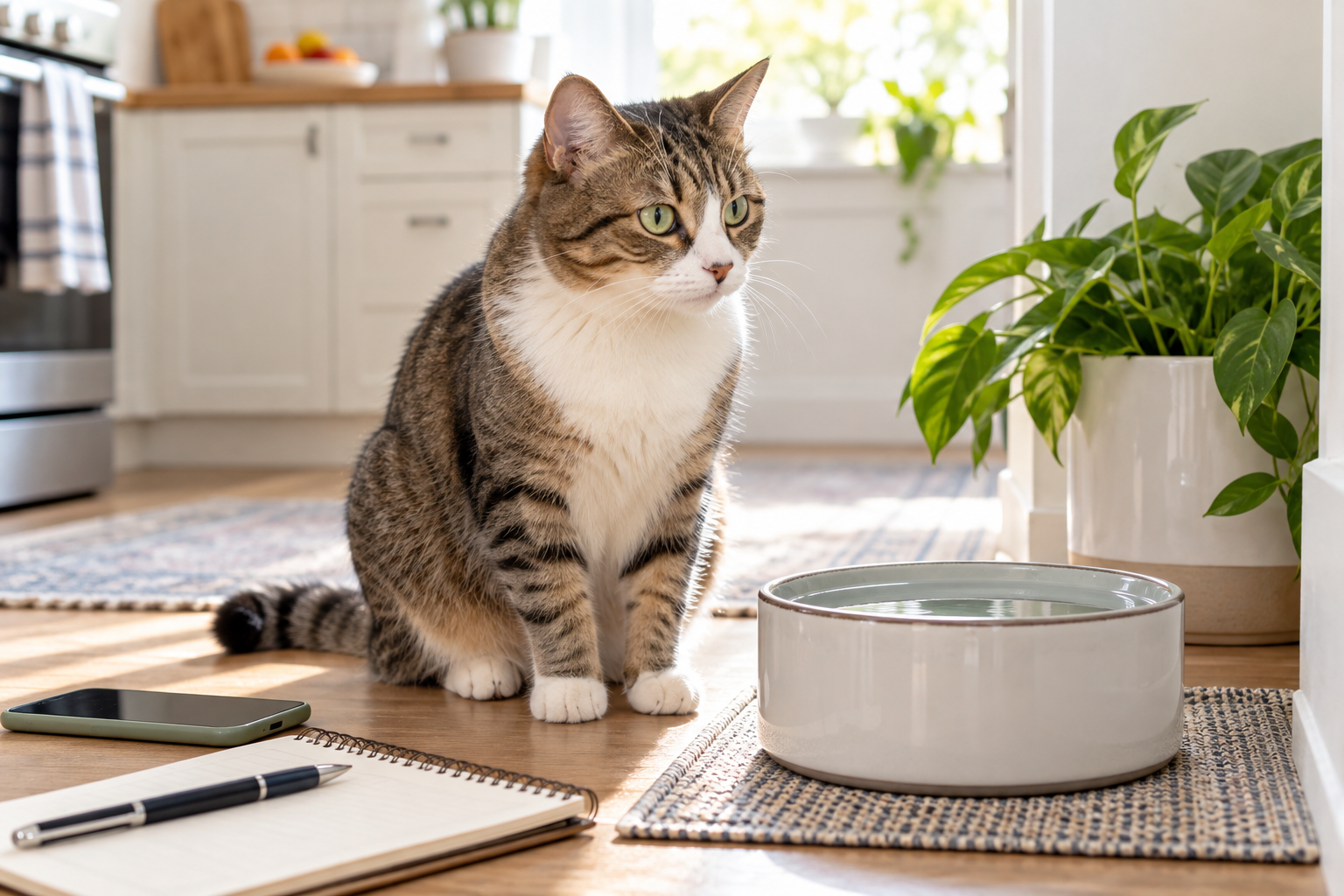
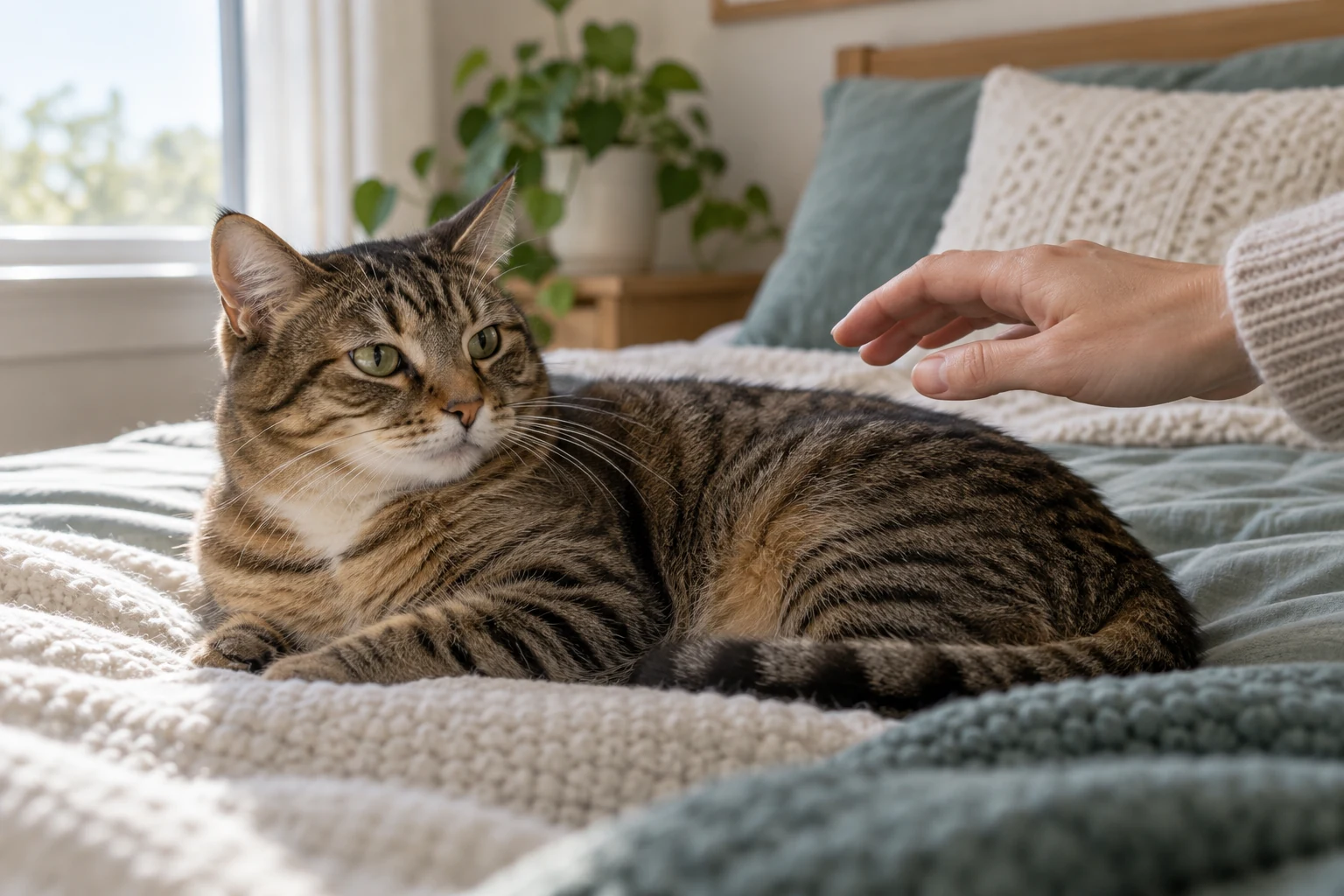
Daily notes are most useful when they track the same few clues: appetite, stool quality, vomiting, treats, and behavior around meals.
Use a notebook, spreadsheet, phone note, or printed table. Keep it near the food area so the person who feeds the cat can fill it out immediately.
| What to log | Simple entry | Por qué es importante |
|---|---|---|
| Food ratio | 75% old, 25% new | Shows exactly where your cat is in the transition |
| Amount offered | 35 g dry, 1/4 can wet | Prevents scoop drift and accidental overfeeding |
| Amount eaten | all, half, refused, leftovers | Appetite changes are often easier to see in writing |
| Taburete | normal, soft, watery, no stool | Helps connect diet timing with digestive changes |
| Vómitos | none, hairball, food, liquid | Repeated vomiting is not a normal food-switch goal |
| Treats or extras | 4 treats, pill pocket, table food | Treats can confuse appetite, calories, and stool patterns |
| Comportamiento | hungry, hiding, normal, restless | Meal behavior can show stress, competition, or nausea |
| Peso | weekly entry | Tracks whether the new portion is too high or too low |
If you are unsure how the package amount relates to the real daily portion, review the cat food feeding directions and measure the amount in grams when you can. A kitchen scale is especially helpful for dry food because cups can vary by how tightly the kibble settles. SnuggleSouls also has a practical guide on how to use a kitchen scale for cat food portions.
How do you log wet food, dry food, and mixed meals?
Log wet food by container amount or grams, dry food by grams or level measuring cup, and mixed meals by separating the wet and dry parts. The more mixed the routine is, the more useful the log becomes.
For wet food, write something like "1/2 of 3 oz can" or "42 g wet food." For dry food, write "28 g dry food" or "1/4 cup dry food." If your cat eats both, write both lines rather than only the total meal. That makes it easier to notice whether your cat is refusing the new wet texture, picking out dry food, or eating the gravy but leaving chunks.
Cornell Feline Health Center notes that cats can have strong preferences and that factors such as noisy locations, other animals, dirty bowls, or nearby litter boxes can deter eating 1. If the log shows appetite dipping only in one location or with one bowl, the problem may not be the recipe alone.
For cats eating cans, pouches, trays, or leftovers, the SnuggleSouls guide to weigh wet cat food portions can help you turn "some of the can" into repeatable grams. That is especially useful if more than one person feeds the cat.
Which appetite and stomach clues deserve attention?
Watch for appetite changes, repeated vomiting, watery diarrhea, constipation, sudden begging, food stealing, hiding near meals, or reluctance to approach the bowl. A mild soft stool during a food transition can happen, but it should not be ignored if it persists, worsens, or comes with other signs.
VCA describes gradual transitions that mix old and new food in steps, and notes that picky cats or cats with prior gastrointestinal upset may need a slower transition 4. Your log tells you whether the current pace is too fast. If soft stool starts after the new food increases from 25 percent to 50 percent, go back to the last comfortable step and ask your veterinary team if signs continue.
Appetite matters just as much as stool. Cornell warns that a cat refusing food can develop serious medical problems, and a veterinarian should examine a cat that refuses to eat and is losing weight 1. Do not keep pushing a new food if your cat is eating less and less.
Use this quick pattern check:
| Log pattern | Qué puede significar | Un siguiente paso más seguro |
|---|---|---|
| Eats old food but leaves new food | Texture, smell, or pace issue | Slow the transition and offer the new food separately first |
| Soft stool after each ratio increase | Transition may be too fast | Return to the last tolerated ratio and monitor closely |
| Vomits soon after meals | Meal size, speed, or stomach irritation | Pause the increase and watch for repetition or other signs |
| Begs more but weight is stable | New portion may feel less satisfying | Check calories, meal timing, fiber, and treats |
| Weight drops or appetite falls | Possible underfeeding or illness | Call your veterinarian, especially if signs persist |
If your cat tends to gulp food, see the SnuggleSouls guide on vomiting after eating too fast. If the main pattern is vocalizing, food stealing, or acting hungry after a meal, compare the log with the guide on begging for food after eating.
How often should you weigh your cat during a food switch?
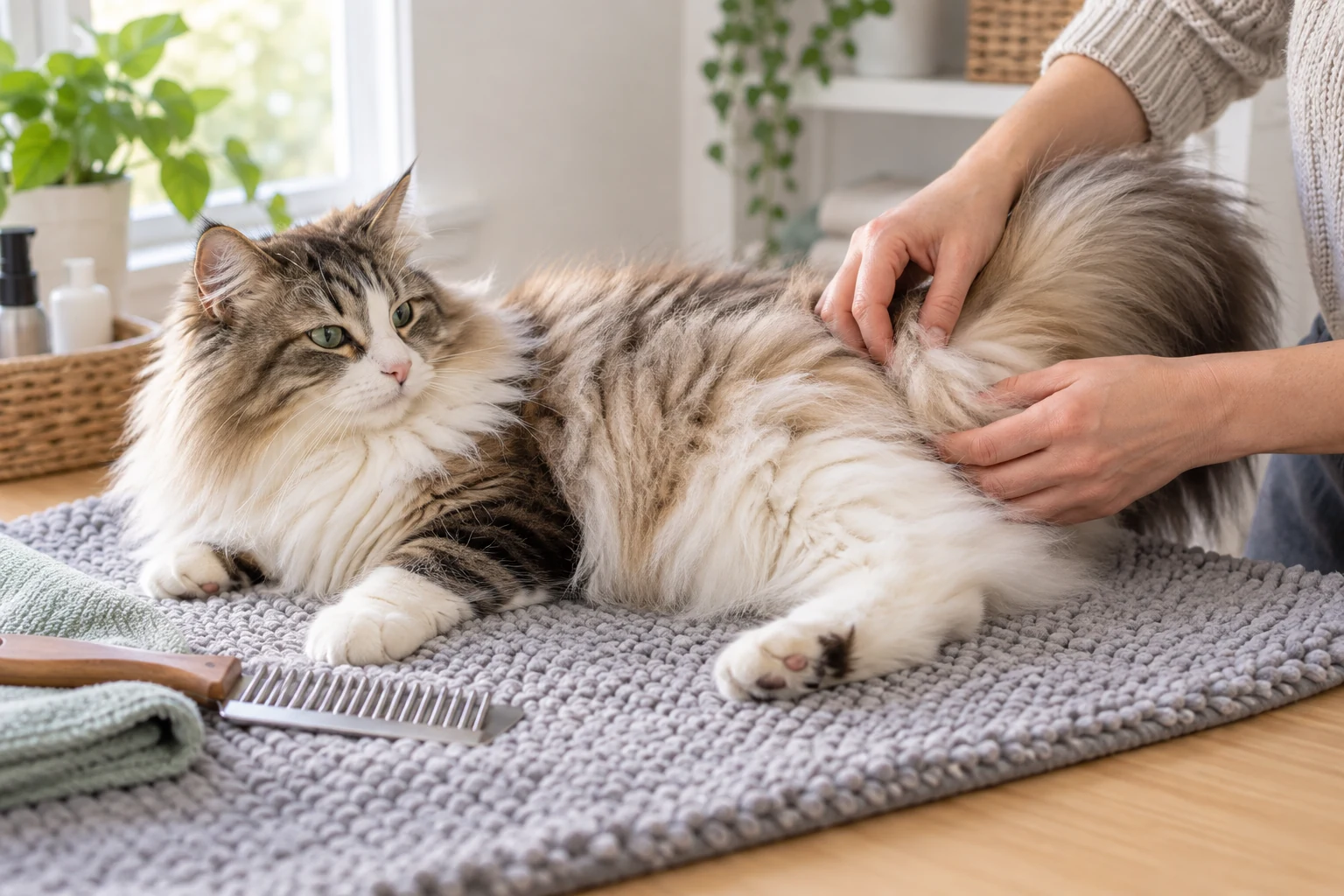
Weigh most adult cats once a week during a routine food switch, using the same scale, time of day, and method when possible. Daily weight changes are noisy. Weekly checks make the trend easier to read.
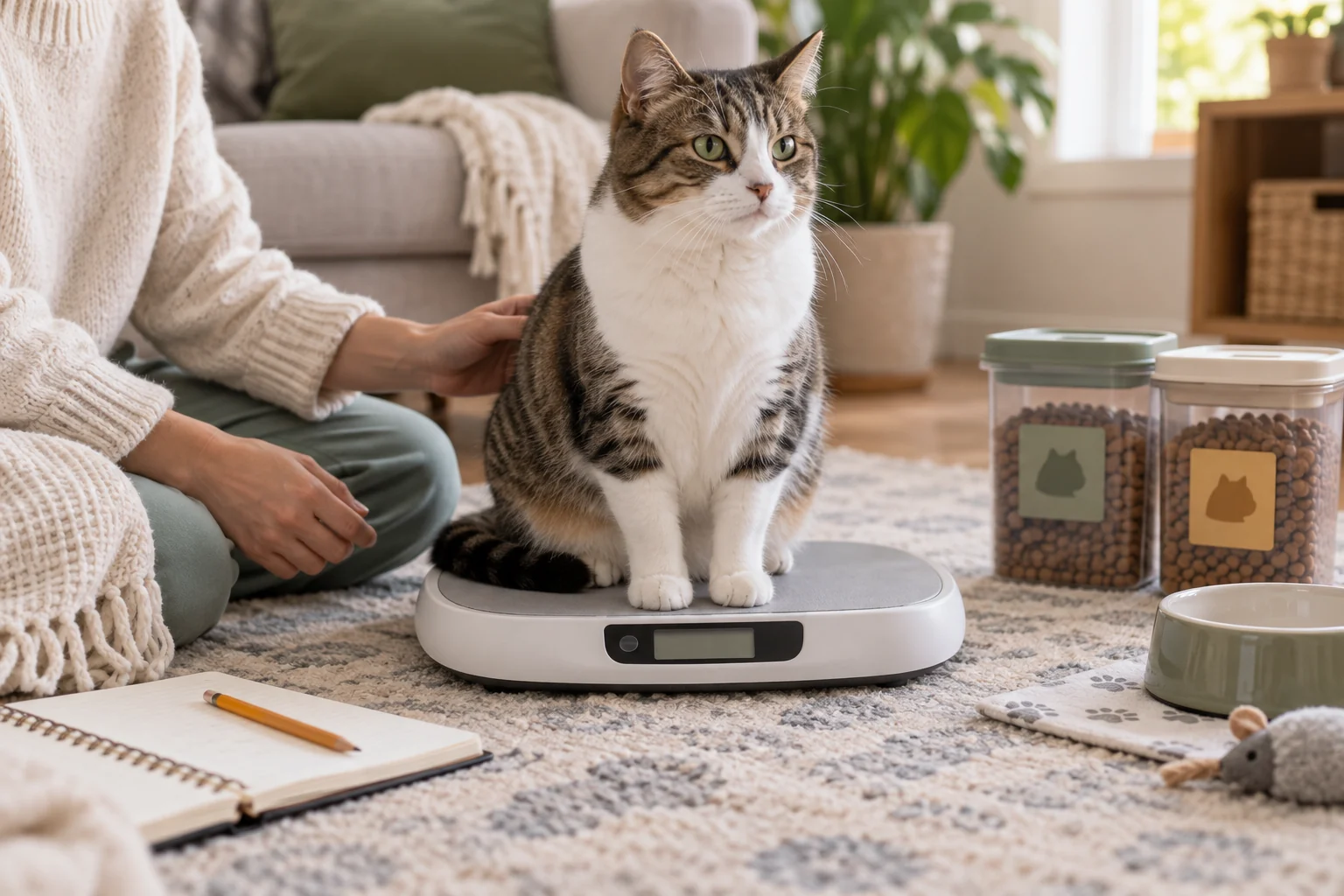
Weekly weight checks can show whether the new portion is working before small daily changes become a bigger trend.
WSAVA nutrition resources emphasize body condition tools, muscle condition tools, diet history forms, and calorie resources as part of nutritional assessment 3. At home, you do not need to turn this into a clinic exam. You can simply record the number, whether your cat feels leaner or rounder, and whether the same harness, carrier, or baby scale method was used.
Pet Nutrition Alliance recommends reassessing body weight and condition in two to four weeks after a diet change 5. For a short food switch, weekly home weights give you early clues. For a calorie plan, weight loss plan, senior cat, kitten, or medical diet, let your veterinarian set the weigh-in schedule.
To reduce stress:
- put the scale on a non-slip floor
- let your cat sniff it before weighing
- use a treat only if treats are part of the daily log
- weigh in a carrier if your cat will not sit calmly
- subtract the carrier weight if needed
- stop if the process scares your cat
How do you use the log to adjust the portion?
Use the log to adjust slowly, not react to one odd meal. Look for a pattern across several days: steady leftovers, increasing hunger, soft stool after ratio changes, weight gain, or weight loss.
If the log shows your cat is eating well, stool is normal, vomiting is absent, and weight is stable, continue the transition plan. If your cat is leaving food but otherwise acting normal, check whether the new food is too cold, too dry, too different in texture, or served in a stressful location. If your cat is hungry and gaining weight, treats or calorie density may be higher than you realized.
When calories are the core question, revisit the SnuggleSouls guide on ¿Cuánto debo darle de comer a mi gato? and compare it with your veterinarian's advice. Do not cut portions sharply on your own, especially for overweight cats. Cats need safe, gradual weight management.
Use these decision rules:
| If your log shows | Do this first | Avoid this |
|---|---|---|
| Normal appetite and stool | Continue the planned ratio change | Changing several things at once |
| Mild soft stool | Hold or step back to the last tolerated ratio | Rushing to 100% new food |
| Refusing the new food | Offer a smaller amount of new food separately | Waiting days while intake drops |
| Weight creeping up | Recheck calories, treats, and grams served | Guessing with a smaller scoop |
| Weight dropping | Call your veterinarian if the trend continues | Assuming weight loss is automatically good |
When should you stop the switch and call the vet?
Stop the food switch and call your veterinarian if your cat refuses food, eats much less than usual, vomits repeatedly, has watery or bloody diarrhea, seems weak, hides, loses weight, strains in the litter box, shows urinary signs, or declines quickly. A food switch should not make your cat miserable or unsafe.
Also get veterinary guidance before switching food if your cat is a kitten, pregnant, nursing, senior with muscle loss, overweight and starting a weight plan, underweight, diabetic, living with kidney disease, prone to urinary problems, on a prescription diet, or suspected of having food allergies. These cats may need a specific diet, pace, calorie target, or monitoring plan.
Bring the log to the appointment or send a photo before you go. It can show the exact food ratio, intake, stool changes, vomiting timing, treats, and weight trend. That saves everyone from reconstructing the week from memory.
Conclusion: Keep the Log Simple Enough to Use
A cat food switch log only works if it is easy enough to keep. Track the food ratio, amount offered, amount eaten, stool, vomiting, treats, behavior, and weekly weight. Those few details can show whether your cat is accepting the new food, whether the transition pace is comfortable, and whether the portion still fits.
If the log stays boring, that is good news. If it starts showing a pattern, you will have the information you need to slow down, adjust carefully, or call your veterinarian with clear details.
Preguntas frecuentes
How long should I keep a cat food switch log?
Keep it through the full transition and for one to two weeks after your cat reaches 100 percent of the new food. Continue longer if your cat is on a weight plan, has a sensitive stomach, is a senior, or your veterinarian asked you to monitor appetite or stool.
What is the simplest cat food switch log format?
The simplest format is one line per day with food ratio, amount eaten, stool, vomiting, treats, behavior, and weight if it is weigh-in day. A notebook is fine. The best format is the one you will actually fill in.
Should I log treats during a food switch?
Yes. Treats can affect calories, appetite, stool, and vomiting patterns. Write down the number or approximate calories of treats, pill pockets, toppers, table scraps, or food used for training.
What stool changes are normal when switching cat food?
Some cats may have a brief softer stool when the ratio changes, especially if the switch is fast. Watery diarrhea, blood, repeated accidents, straining, lethargy, vomiting, or diarrhea that does not improve should prompt a call to your veterinarian.
Can I switch cat food without a log?
You can, but a log makes problems easier to catch early. It is especially helpful for multi-cat homes, mixed feeding, sensitive stomachs, picky cats, weight changes, or any switch where more than one person feeds the cat.
Referencias
[1] Centro de Salud Felina de Cornell. (2026). Cómo alimentar a tu gato. URL
[2] American Animal Hospital Association. (2021). 2021 AAHA Nutrition and Weight Management Guidelines for Dogs and Cats Executive Summary. URL
[3] World Small Animal Veterinary Association. (2026). Directrices mundiales sobre nutrición. URL
[4] VCA Animal Hospitals. (2024). Creating a Weight Reduction Plan for Cats. URL
[5] Pet Nutrition Alliance. (2026). Creating A Nutritional Plan. URL
 EN
EN DE
DE ES
ES PT
PT