
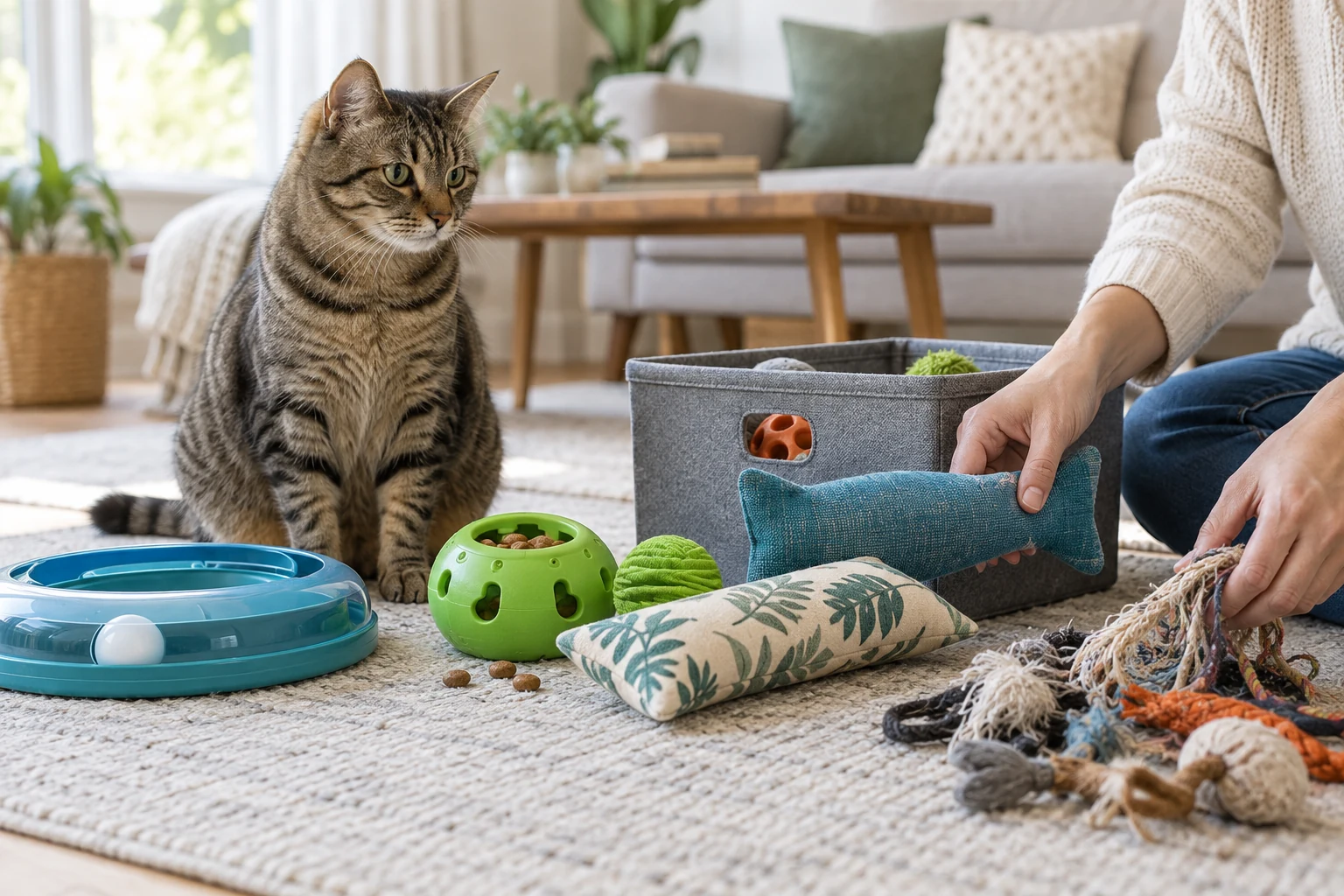
The safest cat toys for heavy chewers are large enough not to be swallowed, sturdy enough not to shed pieces quickly, easy to clean, and simple to inspect after every play session.
No cat toy is truly indestructible. A toy that works beautifully for a gentle cat may be a poor match for a cat who bites, shreds, carries toys off, or tries to eat loose parts. Cornell Feline Health Center recommends avoiding toys with small pieces or strand-like parts that can separate and be ingested, especially when chewed 1.
That does not mean your cat should have a boring toy box. It means every toy needs a job: safe solo play, supervised chase, washable food enrichment, or retirement.
Índice
- What makes a toy safer for cats who chew hard?
- Which materials and shapes are better for heavy chewers?
- What toys should heavy-chewing cats use only with supervision?
- How do you size-check a toy before your cat plays?
- What safety checks should you do after each play session?
- What if your cat chews or swallows part of a toy?
- How do you keep enrichment high without risky toys?
- Conclusion: Safer toys are managed, not assumed
- Preguntas frecuentes
- Referencias
What makes a toy safer for cats who chew hard?
A safer toy for a heavy-chewing cat is not just tough. It is sturdy, oversized for the individual cat, free of detachable decorations, washable when needed, and easy for you to inspect before and after play.
Think of safety as a system, not a product label. A good toy can become risky after one determined chewing session. A flimsy toy can become dangerous the first time a bell, feather shaft, ribbon, foam chunk, plastic eye, or seam thread comes loose.
Use this quick decision rule:
| Safety question | Better answer | Red flag |
|---|---|---|
| Can I inspect it easily? | Smooth surfaces, visible stitching, simple shape | Hidden seams, glued-on decorations, tiny parts |
| Can my cat swallow any piece? | Too large to fit fully in the mouth | Small balls, foam chunks, bells, beads, thin attachments |
| What happens if my cat chews it? | Surface dents or tooth marks only | Pieces break off, fibers unravel, stuffing appears |
| Can I clean it? | Washable hard plastic, rubber, or washable fabric | Damp plush, dirty catnip toy, trapped food residue |
| Does it require a person? | Safe solo toy or clear supervised-only toy | Wand, string, ribbon, elastic, feather teaser left out |
The Feline Veterinary Medical Association's Cat Friendly guidance encourages toys that mimic prey and support natural play, while warning that string, yarn, rubber bands, tinsel, ribbon, streamers, loose pieces, and similar materials can be swallowed and cause serious intestinal problems 2. For heavy chewers, that warning deserves extra weight.
Which materials and shapes are better for heavy chewers?
Better choices are simple, sturdy, and boring in the right ways: fewer decorative pieces, fewer seams, fewer dangling parts, and fewer places for teeth to pry something loose.
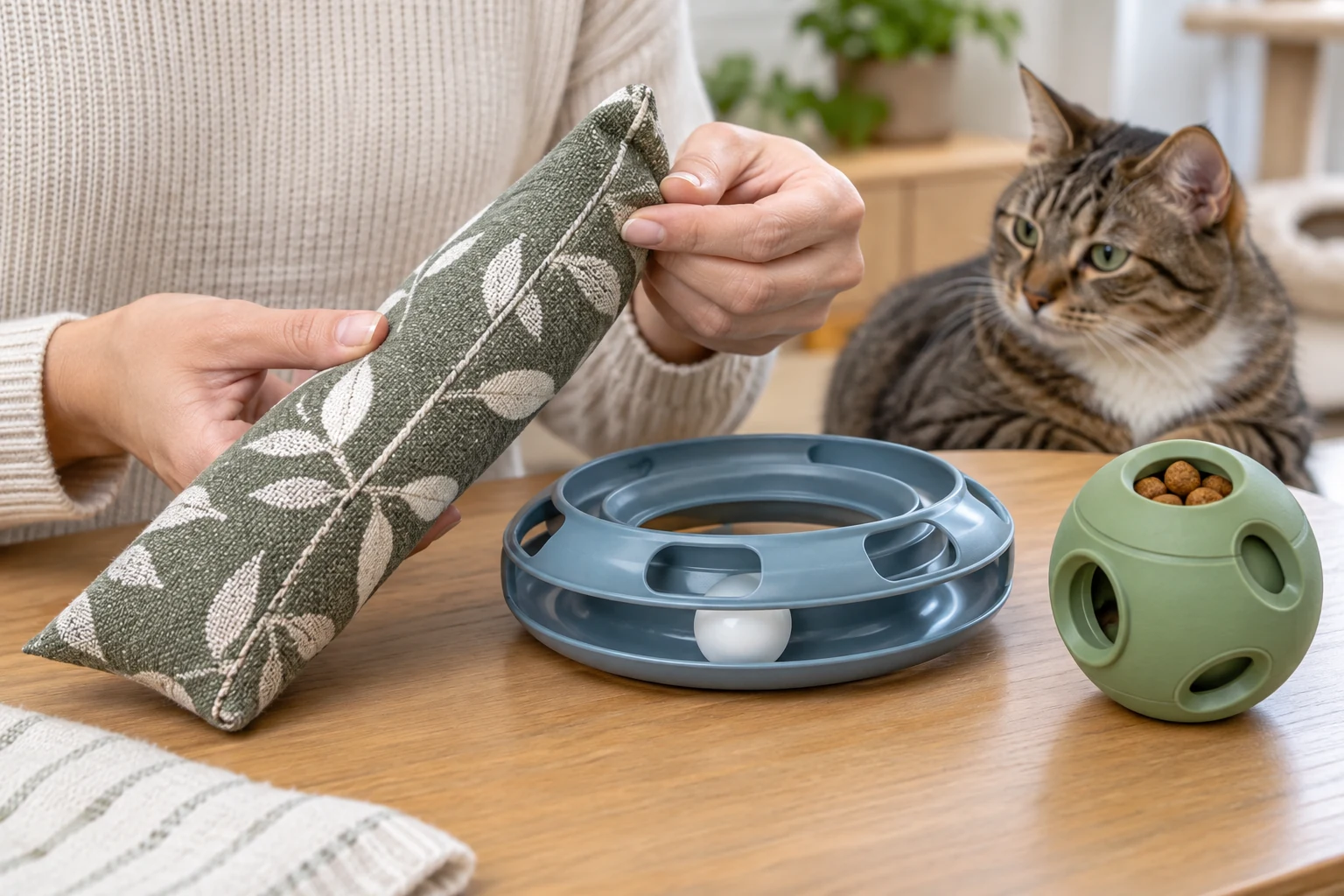
Start with these safer categories:
- Large stitched kicker toys with tight seams and no loose tails, eyes, buttons, or bells.
- Smooth hard plastic track toys where the ball is captive and cannot be swallowed.
- Washable rubber or hard-plastic food puzzles sized for cats, used under light supervision at first.
- Plain cardboard boxes or paper bags with handles removed, replaced as soon as they are shredded.
- Durable batting balls that are too large to swallow and do not crack under pressure.
- Fabric toys with one solid body instead of many tiny sewn-on parts.
Avoid judging by marketing language alone. "Durable," "tough," "dental," and "chew resistant" do not tell you how your cat will use the toy. Your cat's behavior is the real test.
For new toys, buy one or two at a time, then watch what your cat does:
| If your cat… | Choose more of… | Avoid or supervise… |
|---|---|---|
| Bites and bunny-kicks | Large kickers, sturdy fabric tubes | Small plush mice with glued parts |
| Bats and chases | Track toys, larger balls, tunnels | Foam balls that dent or crumble |
| Carries toys around | Larger soft toys with secure stitching | Tiny toys that can be mouthed whole |
| Shreds fabric | Harder washable toys, cardboard you can replace | Plush with stuffing, crinkle film, feathers |
| Loves food puzzles | Easy-clean treat balls or puzzle trays | Soft food toys that trap residue |
If your cat needs more variety, choose from durable styles in SnuggleSouls' guide to interactive cat toys for indoor cats, then apply the heavy-chewer inspection rules here before you leave anything out.
What toys should heavy-chewing cats use only with supervision?
Heavy-chewing cats should use string, wand, ribbon, feather, elastic, battery, and food-stuffed toys only when a person is actively watching. These toys can be wonderful enrichment, but they should not be treated like all-day floor toys.
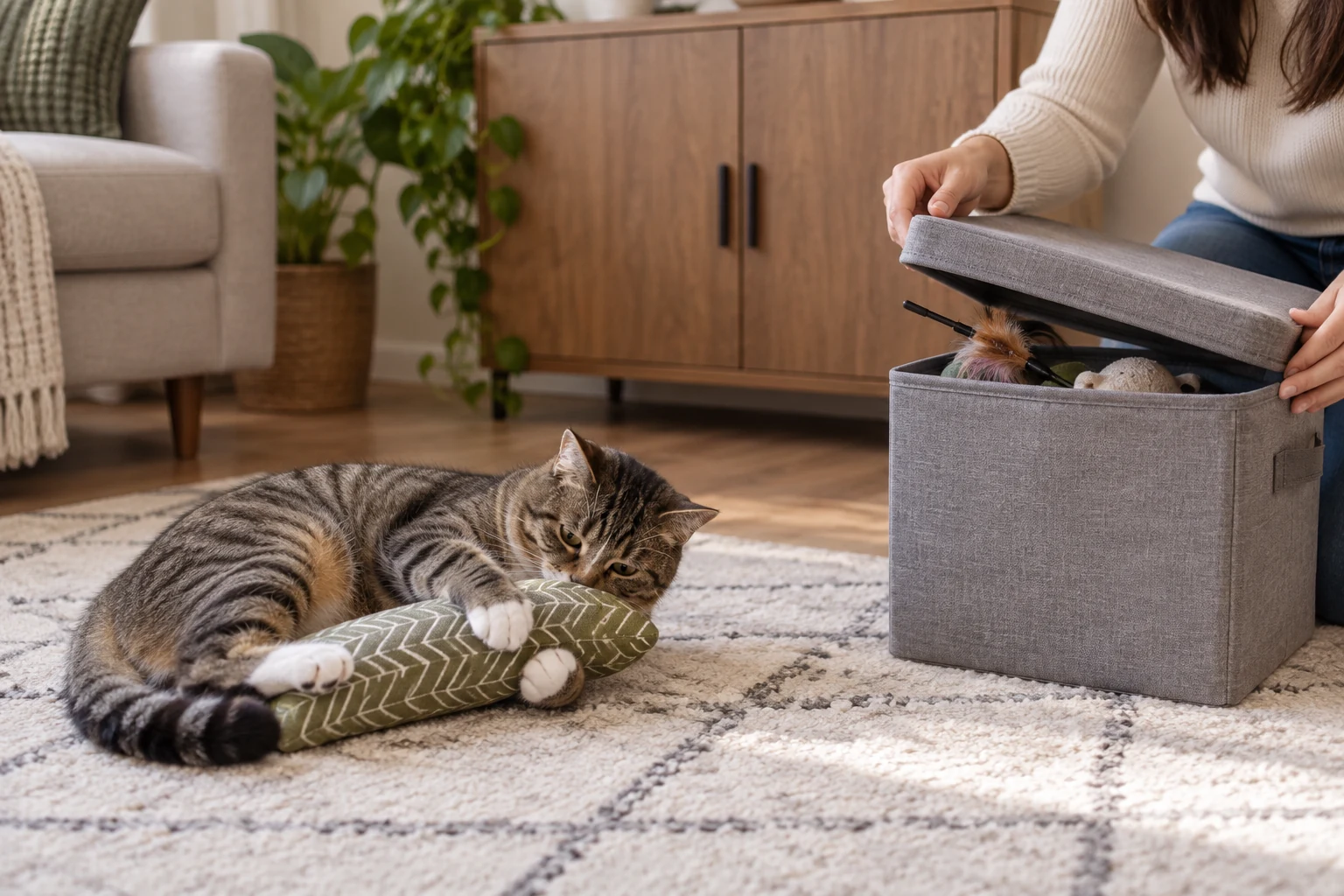
Use this supervision guide:
| Toy type | Why supervise it? | After-play rule |
|---|---|---|
| Wand toys and teasers | String, feathers, connectors, and lures can be chewed | Inspect, coil loosely, and store behind a lid or door |
| Ribbon, yarn, tinsel, elastic, or streamers | Linear materials are especially risky if swallowed | Do not leave out as solo toys |
| Feather toys | Shafts and glued bundles can loosen | Retire when feathers loosen or break |
| Toys with bells, beads, eyes, or small plastic parts | Parts can detach during chewing | Tug-test, then store or retire |
| Battery toys | Battery covers and wiring can be damaged | Remove immediately if cracked or loose |
| Food puzzles and treat toys | Food residue can encourage harder chewing | Empty, wash, dry, and inspect |
Good supervision is not hovering anxiously. It is setting up the game, watching the high-risk toy, letting your cat catch and release safely, then putting that toy away. A safe cat toy storage routine makes this easier because the exciting toys have a closed home after play.
If your cat gets too intense with a wand or feather toy, slow the game down. Move the toy away like prey, pause behind furniture, and let your cat catch a safer target often enough to prevent frustration. SnuggleSouls' guide on Cómo jugar con tu gato can help you keep the session satisfying without turning it into frantic chewing.
How do you size-check a toy before your cat plays?
Size-check a cat toy by asking whether your specific cat can fit the whole item, or a detachable part, into their mouth. If the answer is yes, the toy needs supervision or should be replaced with a larger option.
The AVMA warns that small household items such as buttons, batteries, small children's toys, jewelry, nails, and screws can be swallowed by curious pets and may damage the digestive tract or require surgery 3. Cat toys can create the same kind of problem when they include tiny hard parts or break into small pieces.
Use this at-home size check:
- Hold the toy next to your cat's mouth, not just your hand.
- Look for any piece smaller than the toy's main body: bells, plastic eyes, beads, feather tips, foam nubs, knots, clips, and cords.
- Tug gently on every attachment.
- Bend hard plastic lightly to check for cracking.
- Press soft rubber or foam to see whether tooth marks would tear pieces away.
- Ask whether the toy would still be safe if your cat played with it at 2 a.m. while you were asleep.
For many heavy chewers, bigger and simpler is safer. A large fabric kicker with secure seams is easier to monitor than a tiny plush mouse with ears, tail, whiskers, eyes, and a bell. A track ball that stays inside a track is easier to trust than a loose foam ball that can be chewed flat.
Kittens, highly playful young adults, cats with a history of eating non-food items, and cats who hide toys under furniture need stricter sizing. Do not assume a toy is safe because it came from the cat aisle.
What safety checks should you do after each play session?
After each play session, check for missing parts, new chew marks, weakened seams, cracked surfaces, trapped food, and damp spots. If you cannot account for a missing piece, treat the situation as a possible ingestion risk.
Use a two-minute post-play routine:
- Count the obvious parts: bell, lure, feather bundle, toy tail, foam insert, battery cover, and treat pieces.
- Tug seams and decorations gently.
- Squeeze fabric toys to feel for exposed stuffing or crinkle film.
- Look for bite grooves in rubber, plastic, foam, or cardboard.
- Smell food puzzles and plush toys for sour or stale odors.
- Put supervised toys into closed storage immediately.
- Move damaged toys to a retire bin before they drift back into play.
This is where the next article in the cluster fits naturally: if a toy has loose parts, exposed stuffing, chewed seams, or anything missing, use SnuggleSouls' guide on how to retire damaged cat toys instead of trying to stretch one more week out of it.
Cleaning is part of the safety check too. CDC guidance says pet toys can carry germs, gives monthly toy cleaning as an example schedule, and recommends cleaning more often when items look dirty or smell bad 5. Food puzzles, lick mats, and treat toys need faster cleaning because leftover food can make a chewing cat work harder at edges and seams.
Do not return damp plush, sour-smelling toys, cracked plastic, or anything with a mystery missing part to your cat.
What if your cat chews or swallows part of a toy?
If you think your cat swallowed string, ribbon, elastic, foam, stuffing, plastic, a bell, a battery, or any unidentified toy piece, call your veterinarian or an emergency clinic for advice. Do not wait for severe symptoms if the missing piece could cause obstruction.
Merck Veterinary Manual describes gastrointestinal obstruction as an emergency condition, with signs that may include vomiting, pain, diarrhea, not eating, lethargy, shock, or dehydration depending on the case 4. Linear objects such as string or yarn are especially concerning in cats.
Treat these signs as urgent:
- Repeated vomiting, retching, drooling, or gagging.
- Refusing food or sudden major appetite loss.
- Lethargy, hiding, collapse, or rapid decline.
- A tense, painful, or swollen belly.
- Straining to poop, diarrhea, or very little stool.
- String visible from the mouth, under the tongue, or from the anus.
- Breathing trouble, severe weakness, or signs of shock.
Do not pull a visible string. Keep your cat calm, prevent more chewing, collect the remaining toy pieces, photograph the toy if it helps show what is missing, and contact a veterinary professional.
If every piece is accounted for and your cat seems normal, retire that toy anyway. A cat who chewed it once may chew it faster next time.
How do you keep enrichment high without risky toys?
Keep enrichment high by replacing the play function, not the exact toy. Heavy chewers still need stalking, chasing, pouncing, problem-solving, scratching, climbing, resting, and choice. The answer is not fewer outlets. It is safer outlets.
Match the need this way:
| Your cat wants… | Safer outlet to try | Management rule |
|---|---|---|
| To bite and kick | Large stitched kicker, sturdy fabric tube | Inspect seams after play |
| To chase fast movement | Wand toy with secure lure | Supervise and store after use |
| To bat alone | Track ball, tunnel, oversized hard ball | Check for cracks weekly |
| To solve for food | Washable puzzle feeder | Count calories and clean after use |
| To shred | Plain cardboard box or paper bag without handles | Replace before pieces are eaten |
| To rediscover novelty | Rotated safe toy set | Inspect before every rotation |
En cat toy rotation schedule is especially helpful for heavy chewers because it limits how many toys are available to destroy at once. Keep a few sturdy solo toys out, supervise the exciting toys, and rotate clean, intact options back in.
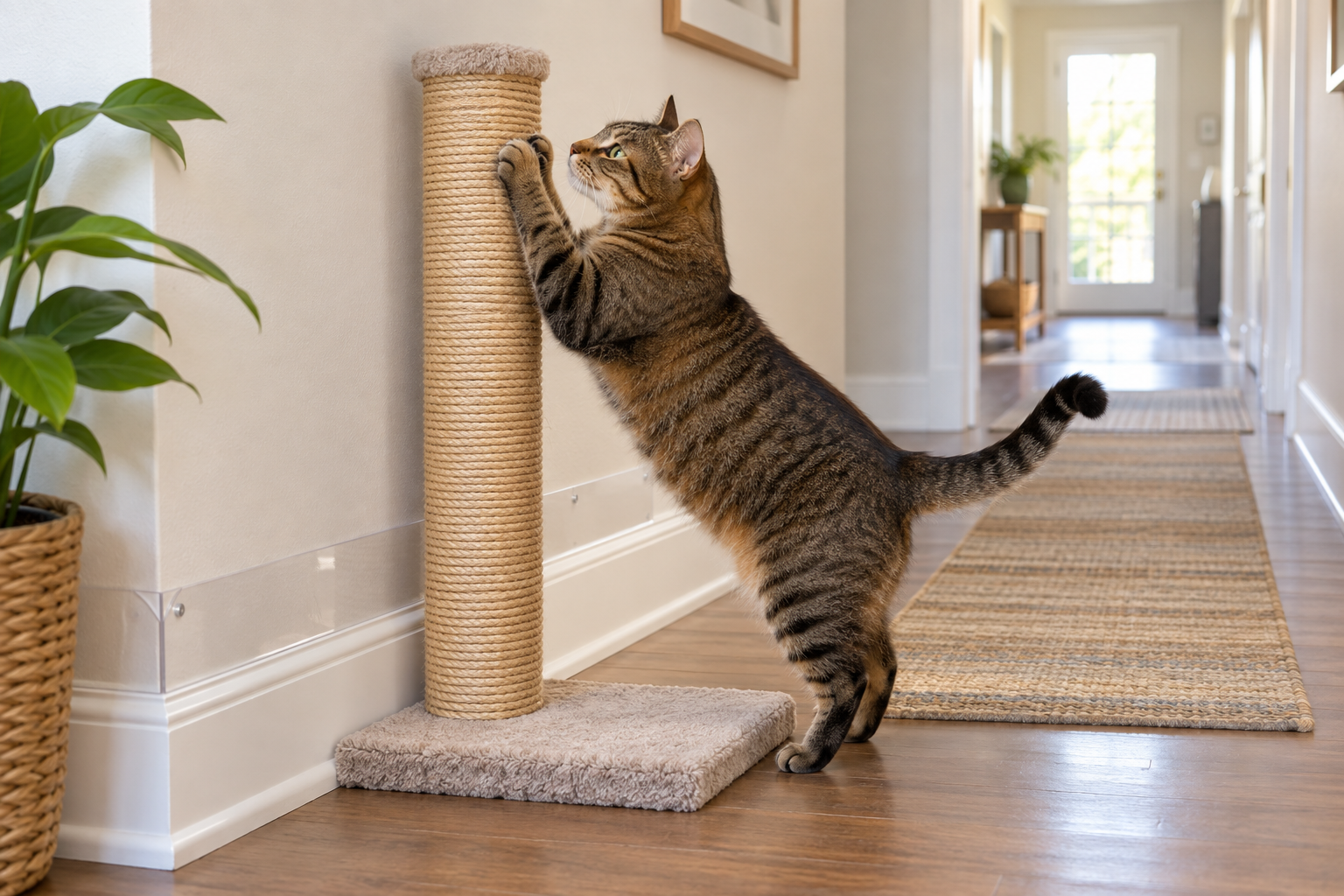
You can also add non-toy enrichment: a window perch, climbing path, scratching post, food scatter game, clicker training, or cardboard hideout. These reduce pressure on any one chewable object.
If chewing seems sudden, obsessive, or tied to eating non-food objects, talk with your veterinarian. Pain, stress, nausea, dietary issues, or behavior concerns can change how a cat mouths objects. The toy rules help manage risk, but they do not replace medical advice for an individual cat.
Conclusion: Safer toys are managed, not assumed
For heavy-chewing cats, the best toy is not the flashiest or the one labeled toughest. It is the toy you can size-check, inspect, clean, supervise appropriately, and retire before pieces go missing.
Choose large, simple, sturdy toys for solo play. Save wand, string, feather, and food toys for supervised sessions. Check every toy after play, clean washable items, and remove anything cracked, frayed, damp, smelly, or missing a part. For more everyday routines like this, browse the SnuggleSouls daily care guides.
Preguntas frecuentes
Are there truly chew-proof cat toys?
No cat toy should be treated as chew-proof. Some toys are sturdier than others, but a determined cat can damage fabric, foam, rubber, plastic, feathers, and string. Inspect toys often and retire them as soon as pieces loosen.
Are dog chew toys safe for heavy-chewing cats?
Not automatically. Some dog toys are too hard, too heavy, too large, scented for dogs, or shaped in ways that do not suit cat play. Ask your veterinarian before using a dog chew product for a cat, and avoid anything your cat can chip, shred, or swallow.
Should I leave kicker toys out for a cat who chews?
Only if the kicker is large, intact, tightly stitched, and your cat does not remove fabric or stuffing. If your cat opens seams, chews corners, or pulls threads, use kicker toys during supervised play and store them afterward.
Are feather toys bad for heavy chewers?
Feather toys can be fun, but they are usually supervised-only for heavy chewers. Feather shafts, glued bundles, string, and small connectors can loosen. Put feather toys away after play and retire them when pieces start to detach.
What should I do if my cat destroys every toy?
Switch to a stricter routine: sturdy solo toys only, supervised wand play, plain cardboard that is replaced early, and a weekly inspection bin. If your cat eats pieces or chews compulsively, schedule a veterinary visit to discuss medical and behavior possibilities.
Referencias
[1] Centro de Salud Felina de Cornell. (2026). Safe toys and gifts. https://www.vet.cornell.edu/departments-centers-and-institutes/cornell-feline-health-center/health-information/feline-health-topics/safe-toys-and-gifts
[2] Feline Veterinary Medical Association. (2026). Playing With Your Cat. https://catfriendly.com/be-a-cat-friendly-caregiver/playing-with-your-cat/
[3] American Veterinary Medical Association. (2022). Household Hazards. https://ebusiness.avma.org/files/productdownloads/mcm-client-brochures-household-hazards-2022.pdf
[4] Merck Veterinary Manual. (2025). Gastrointestinal Obstruction in Small Animals. https://www.merckvetmanual.com/digestive-system/surgical-problems-of-the-gastrointestinal-tract-in-small-animals/gastrointestinal-obstruction-in-small-animals
[5] Centers for Disease Control and Prevention. (2026). About Cleaning and Disinfecting Pet Supplies. https://www.cdc.gov/healthy-pets/about/cleaning-and-disinfecting-pet-supplies.html
 EN
EN DE
DE ES
ES PT
PT