
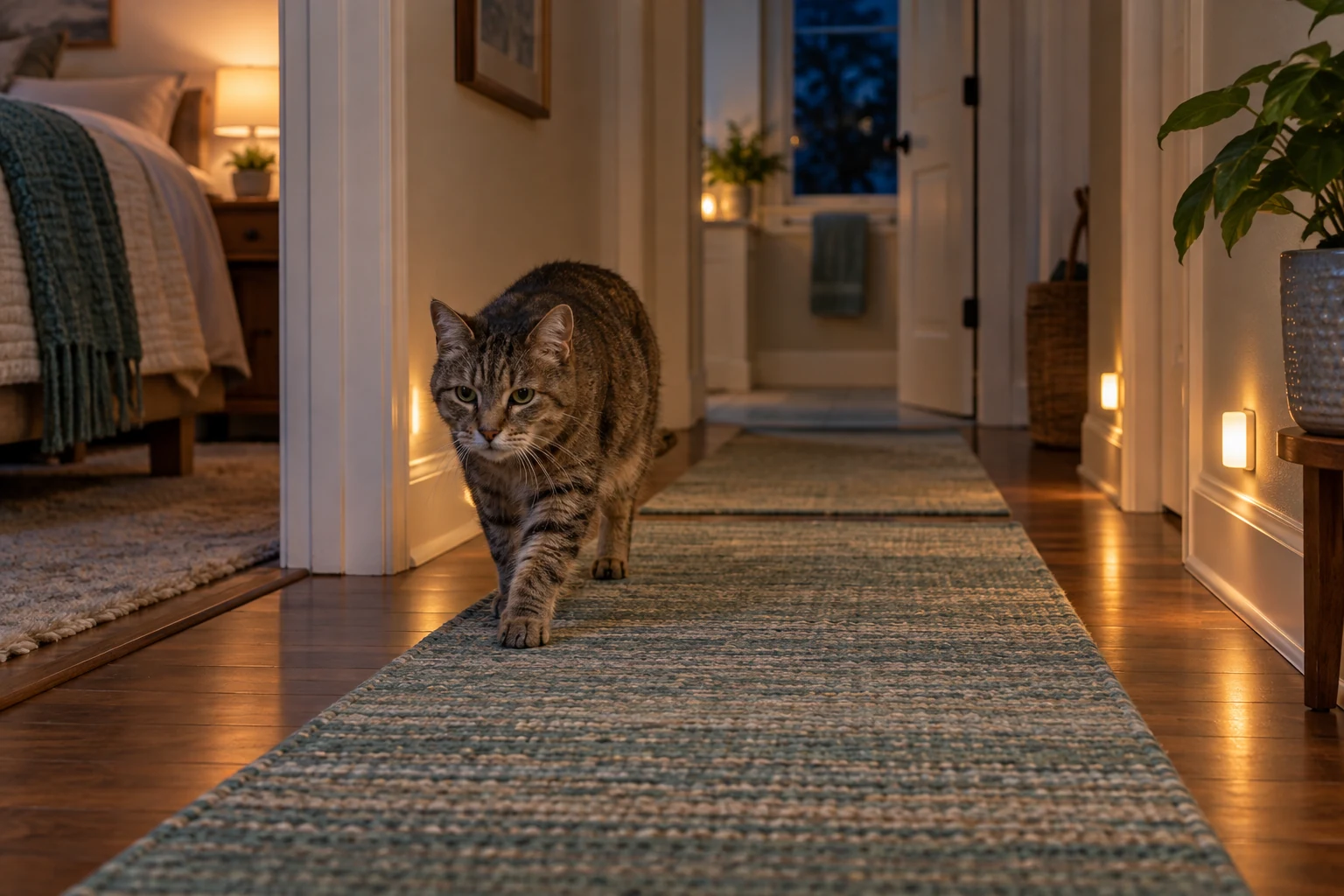
A senior cat's night route should feel boringly stable: flat rugs that do not slide, low thresholds that are easy to see, dry floors, and no surprise clutter between sleep, water, and the litter box. The goal is not to remodel the house. It is to remove the small slips and hesitations that can make an older cat avoid an important route after dark.
This guide focuses only on traction: rug grips, threshold transitions, edge checks, and cleaning habits. For the full route plan with lights, door access, and litter box distance, use the SnuggleSouls guide to a senior cat litter box route at night as the companion piece.
Índice
- How is this different from a whole nighttime litter box route?
- What makes a night route slippery for an older cat?
- Which rug materials work best for senior cat footing?
- How do you secure rug edges, corners, and thresholds?
- Where should the non-slip route start and end?
- How do you clean the route without making it slick?
- How do you test the route from your cat's point of view?
- When should slipping or hesitation mean a vet call?
- Conclusion: Make every step predictable
- Preguntas frecuentes
- Referencias
How is this different from a whole nighttime litter box route?
A nighttime route guide asks whether your cat can reach food, water, rest areas, and the litter box. A non-slip guide asks a narrower question: does every step of that route feel stable under aging paws?
That distinction matters because a route can be short, softly lit, and still difficult if the floor slides. Cornell's senior-cat guidance recommends easy access to food, water, litter boxes, favorite resting places, ramps, and firm footing as cats age 2. The 2021 AAHA/AAFP life stage guidelines also note that senior cats may benefit when resources are closer so they do not need to travel as far to reach food, water, or the litter box 3.
So think of traction as the layer underneath the rest of the setup. A good senior-cat night route is not only about distance. It is about the cat trusting each surface: bedroom rug, hallway runner, doorway threshold, mat near water, and the final step into the litter area.
Use this article when your cat already has a reasonable route, but you notice:
- pausing before stepping onto shiny floors;
- walking along walls or baseboards for confidence;
- rushing across open hard flooring;
- avoiding one doorway or threshold;
- slipping when turning near water or the litter box;
- catching claws on thick rug loops;
- choosing a longer route that has more carpet.
What makes a night route slippery for an older cat?
A night route becomes slippery when the cat cannot predict what will happen underfoot. Slick flooring, loose mats, curled edges, thick pile, damp cleaning residue, and raised thresholds can all make an older cat hesitate.
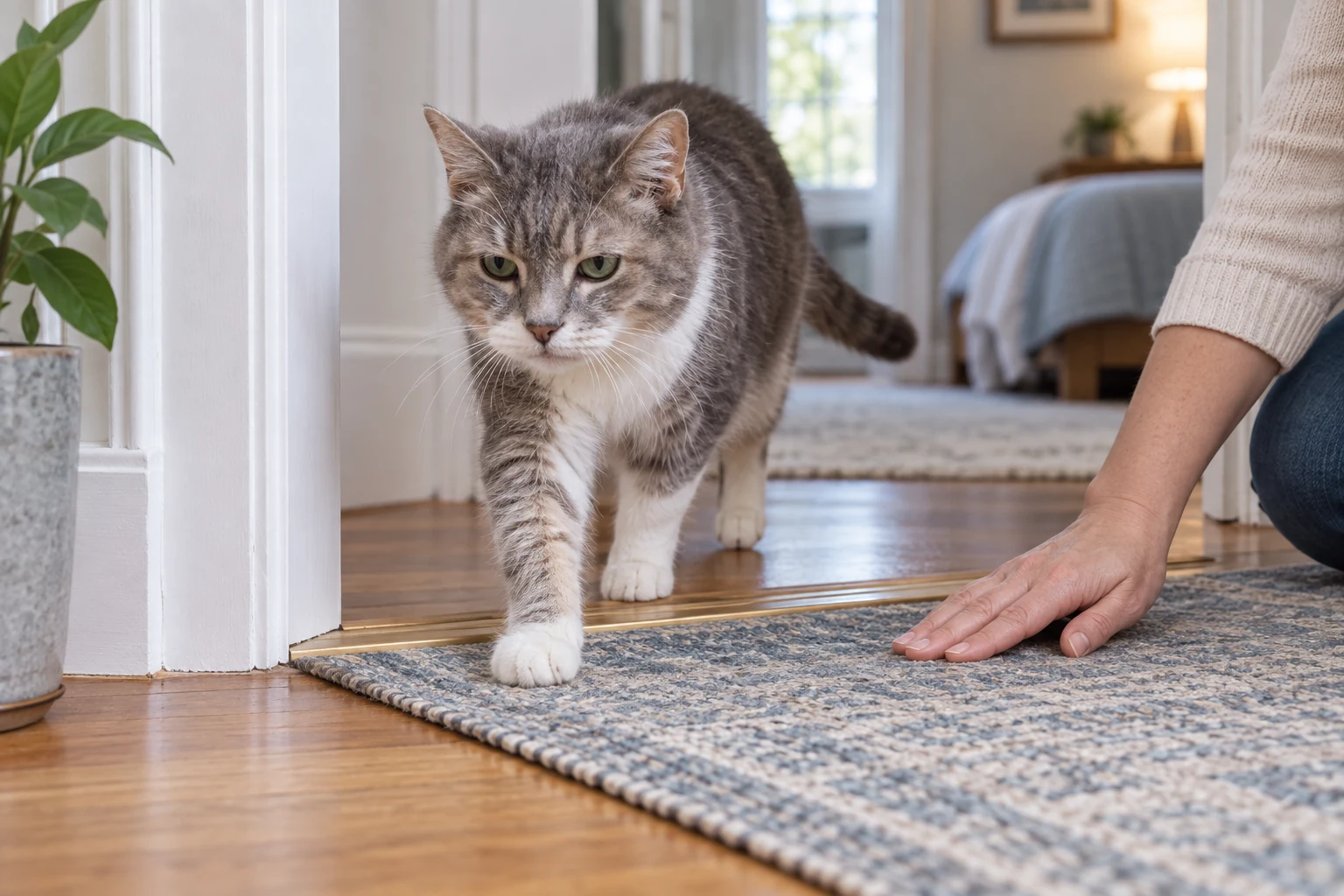
Senior cats may also be dealing with reduced muscle mass, arthritis, weaker balance, vision changes, or pain. The AAHA/AAFP guidelines note that changes in litter box use can be linked with urinary or metabolic disease, but can also be associated with reduced musculoskeletal strength, impaired balance, or pain 3. That is why a slippery route is not just a housekeeping issue. It can be the barrier that changes where a cat drinks, rests, or eliminates.
Common traction problems include:
| Route problem | What your cat may do | Better setup |
|---|---|---|
| Shiny wood, laminate, or tile | Rush, crouch, or avoid the open floor | Add a flat runner with a secure backing |
| Loose towel or bath mat | Step on it, slide, then avoid it later | Use a real rug pad or rubber-backed mat that stays flat |
| Curled rug corner | Lift paws high, catch claws, or detour | Replace, flatten, or remove the rug |
| Thick plush rug | Sink in, stumble, or snag nails | Choose low-pile, firm-weave surfaces |
| Damp cleaned floor | Lick paws, slip, or avoid the area | Keep cats away until the surface is fully dry |
| Raised threshold | Pause, hop awkwardly, or turn back | Keep it visible and bridge the transition if safe |
International Cat Care's caregiver guide on home modifications for cats with muscle or joint pain emphasizes that environmental changes can support comfort and quality of life alongside veterinary care 1. For night routes, that support often starts with the surface under the cat's paws.
Which rug materials work best for senior cat footing?
The best route surface is low-pile, stable, washable, and grippy without being sticky. You want traction that helps a cat walk normally, not a surface that catches claws or shifts when the cat turns.
Good choices often include:
- low-pile runner rugs with a non-slip pad underneath;
- rubber-backed washable mats that lie completely flat;
- firm woven cotton or synthetic runners with no fringe;
- yoga-mat-style strips for temporary testing, if they do not curl or smell strongly;
- carpeted ramp or step covers for vertical transitions.
Avoid anything that behaves like a surprise. Loose towels can slide. High-pile rugs can catch claws. Small mats can scoot. Fringe can tangle around toes. Plastic runners can feel slick or make odd sounds that worry a cautious cat.
If your cat has known stiffness or arthritis signs, pair traction with the broader setup in SnuggleSouls' guide to help an arthritic cat at home. A rug helps, but it cannot solve a route that still requires painful jumps, long walks, or stairs.
Use the paw-turn test before you trust a rug overnight:
- Put the runner exactly where it will be used.
- Press your hand down and push gently forward, backward, and sideways.
- Step on each corner with your foot and twist lightly.
- Check whether the edge lifts when a paw would drag across it.
- Repeat after vacuuming or washing because some pads lose grip over time.
If the rug moves for you, assume it can move for your cat.
How do you secure rug edges, corners, and thresholds?
Secure the route by making every edge flat, visible, and boring. The cat should be able to walk half-asleep from one surface to the next without needing to jump, brace, or solve a puzzle.
Start with the edges. A rug pad should cover most of the underside, not just the center. If the corners curl, replace the rug or use a safer flat option. Do not leave temporary tape ridges, loose adhesive strips, or exposed gripper corners in the walking path.
Doorway thresholds need a separate look. A low strip between rooms may be easy for you to ignore, but a senior cat with stiff hips or reduced vision may treat it like an obstacle. Make the landing on both sides stable. If there is a height difference between rooms, keep the transition clear and well lit, and avoid placing a squishy mat right against the lip.
Use this quick threshold checklist:
| Checkpoint | Pass | Fix |
|---|---|---|
| Rug edge | Lies flat when brushed by hand | Replace curled runner or add a full-size non-slip pad |
| Threshold lip | Visible and not hidden by a bunched mat | Move the rug edge back or use a flatter transition |
| Turning space | Cat can turn without stepping partly off the rug | Widen the runner area near doors and corners |
| Door swing | Door cannot push the rug into a ridge | Shift the runner or secure the door safely |
| Claw safety | No loops, fringe, or loose threads | Trim threads or choose a different surface |
If another pet blocks the route, traction alone will not fix the problem. Keep exits open and avoid dead-end rug paths where one cat can trap another.
Where should the non-slip route start and end?
Start the non-slip route at the place your cat actually wakes up, not where you wish your cat slept. End it at the resources your cat uses at night: water, litter box, favorite bed, doorway, or safe resting spot.
If your cat sleeps in the bedroom, connect the bed area to the door first. SnuggleSouls' senior cat bedroom arthritis-friendly guide can help you think through low beds, warmth, water, and night paths without crowding every resource together. If your cat wakes to drink, pair the route with the guide to helping a senior cat reach bedroom water at night.
For many homes, the highest-value traction zones are:
- the first few steps after a favorite bed or sofa;
- the turn out of the bedroom;
- shiny hallway stretches;
- doorway thresholds;
- the area around water bowls;
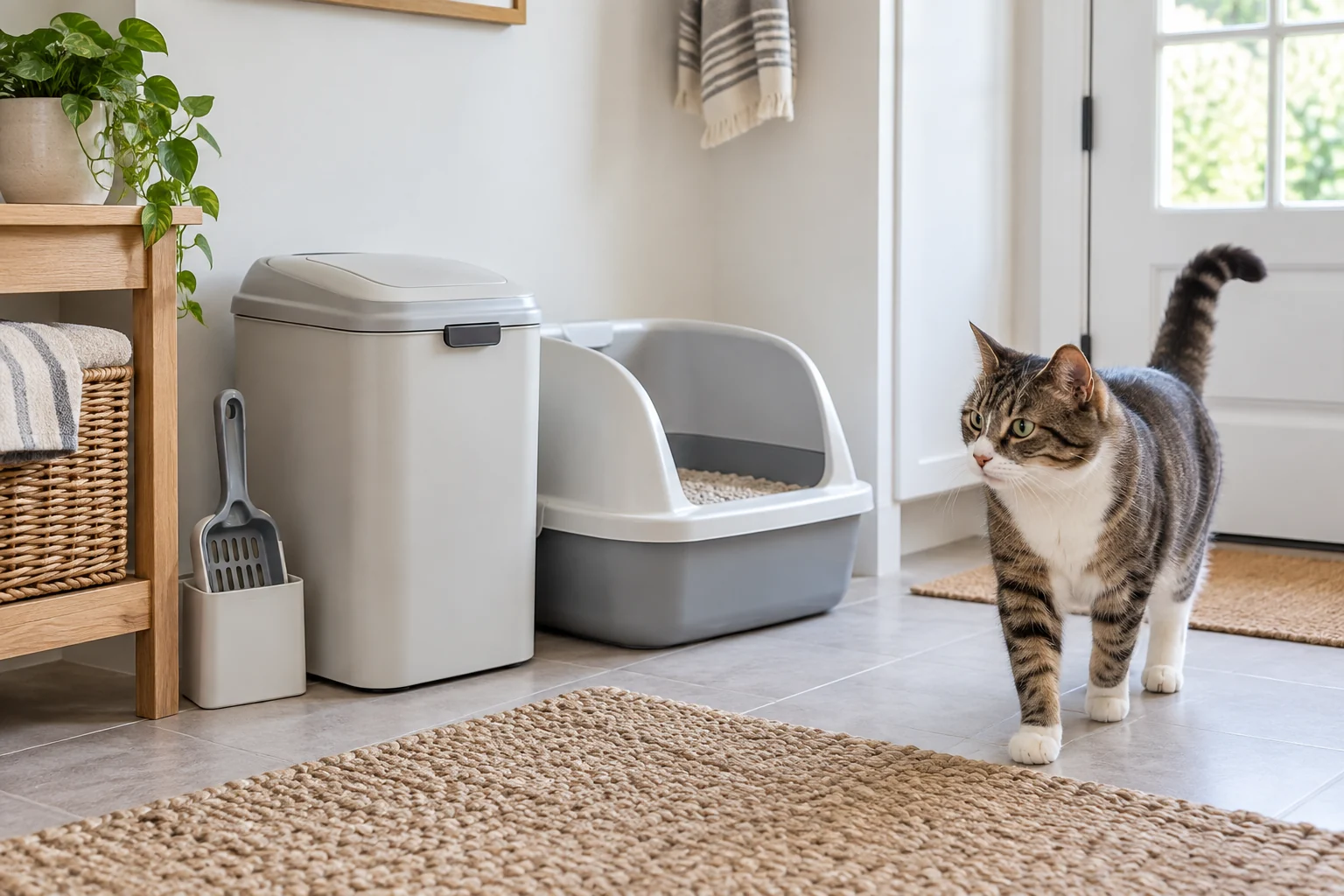
- the approach to the litter box;
- the landing at the top or bottom of a short step;
- the space where your cat turns around after using the box.
Do not cover every inch of flooring on the first night. Make the most important route stable, then watch whether your cat chooses it. Senior cats often prefer familiar routines, and Cornell notes that older cats may find changes harder as they age 2. A small reliable path usually beats a dramatic layout change.
How do you clean the route without making it slick?
Clean the route in a way that keeps traction, removes odor, and avoids wet chemical exposure. A perfectly polished floor can be the opposite of cat-friendly if it becomes slick or leaves residue on paws.
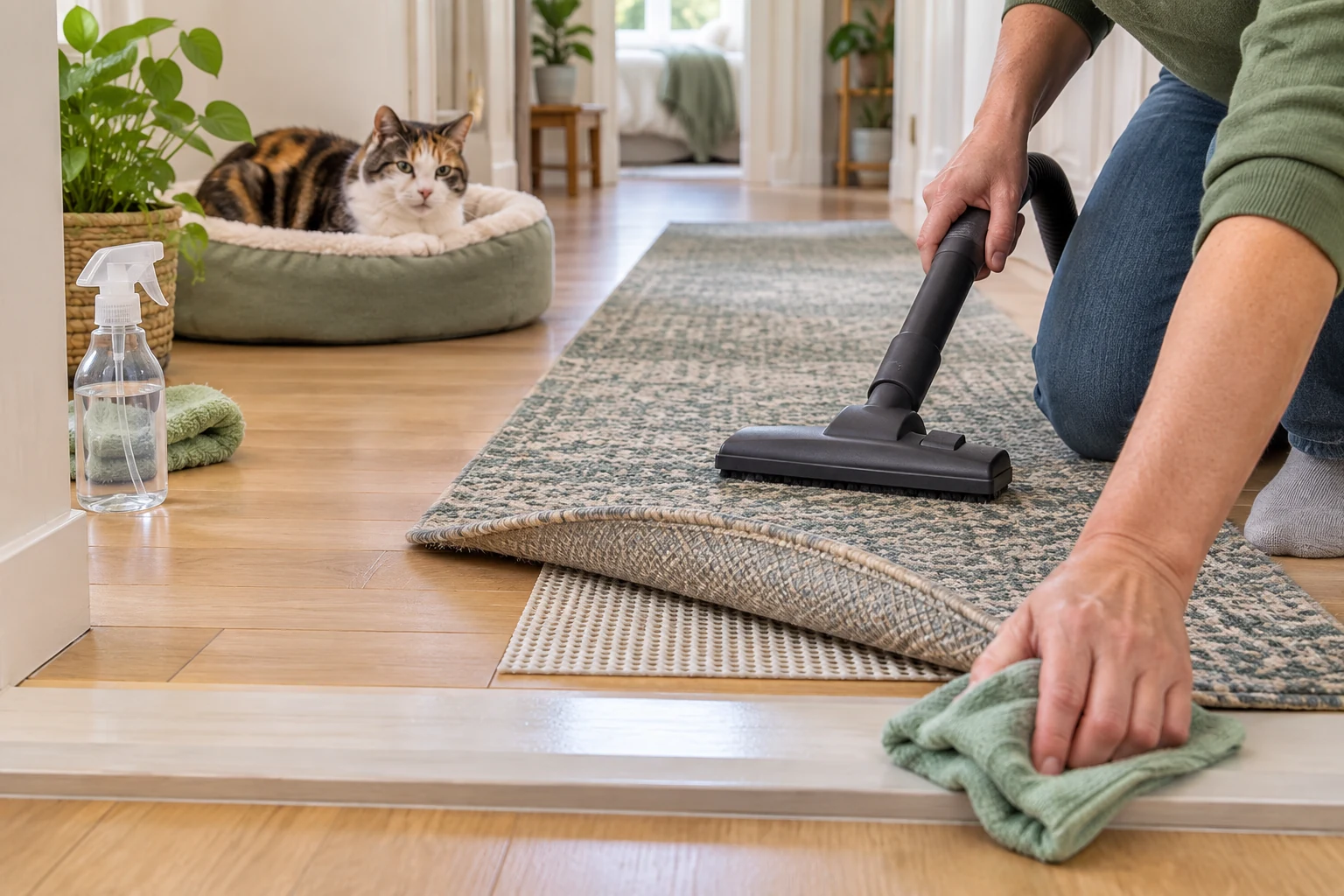
Vacuum rug runners often enough that litter dust, fur, and grit do not reduce grip. Shake or wash small washable mats only if they still lie flat afterward. If a backing cracks, curls, or leaves residue, replace it instead of trying to stretch its life on a senior cat's main route.
For hard floors, use the mildest effective cleaning routine and let surfaces dry fully before your cat walks there. The CDC advises following cleaner and disinfectant labels, keeping pets away during cleaning and disinfecting, and letting disinfectants dry fully before pets use the area 4. The CDC also warns cat owners not to use disinfectants with phenol ingredients because phenols are very toxic to cats 4.
The ASPCA gives similar practical advice: follow label directions, keep products out of paws' reach, and keep pets away from areas where potentially toxic substances are being used 5. If litter odor is part of the reason you are cleaning more aggressively, read SnuggleSouls' guide to reducing litter area smell without scented products so fragrance does not become another barrier.
Simple route maintenance schedule:
| Tarea | How often | Por qué es importante |
|---|---|---|
| Check rug corners | Daily at bedtime | Corners can curl after foot traffic or vacuuming |
| Vacuum runners | A few times weekly, or as needed | Fur, litter, and grit can change traction |
| Wipe thresholds | Weekly, or after spills | Sticky or dusty lips can make cats hesitate |
| Wash mats | As directed by the label | Washing can change backing grip and edge shape |
| Dry hard floors | Every cleaning session | Wet surfaces can be slippery and expose paws to residue |
| Re-test rug pads | Monthly | Pads compress, shift, or lose grip over time |
Never block the only route while the floor dries. If you clean at night, provide a dry alternate path to water and the litter box.
How do you test the route from your cat's point of view?
Test the route at cat height, in the lighting your cat actually uses, and at the speed of a sleepy senior cat. A route that looks fine from standing height may reveal raised edges, glare, shadows, or narrow turns when you lower your view.
Start in the evening. Turn on only the night lights or hallway lights your cat normally has. Walk the route slowly and look for shine on hard floors, dark threshold lines, plant pots, cords, shoes, laundry, and furniture legs that narrow the path.
Then watch your cat without forcing a performance. Place yourself quietly nearby and note where your cat slows, turns wide, walks along the wall, sniffs the floor, or steps off the runner. If your senior cat walks along walls, the wall may be part of the route your cat trusts. You can make that edge safer instead of trying to move the cat into the center of the hallway.
Record short videos if you can. Useful clips show your cat:
- standing up after rest;
- stepping from bed or rug onto hard floor;
- crossing a threshold;
- turning near the water bowl;
- approaching and leaving the litter box;
- walking the same route in daylight and at night.
Change one thing at a time. If you add a new runner, move the water bowl, swap mats, and clean the floor on the same day, you may not know which change helped or bothered your cat.
When should slipping or hesitation mean a vet call?
Call your veterinarian if slipping, hesitation, route avoidance, accidents, or stiffness is new, repeating, or getting worse. Traction helps the home, but it does not diagnose pain, arthritis, vision loss, urinary disease, constipation, kidney disease, diabetes, cognitive changes, or weakness.
The AAHA/AAFP guidelines specifically note that senior-cat litter box changes may indicate diseases such as urinary tract disease, constipation, or diabetes, and may also relate to balance, pain, or reduced musculoskeletal strength 3. Cornell also warns that behavior or health changes in older cats should not be dismissed as normal aging 2.
Contact a veterinarian promptly if you notice:
- falling, stumbling, or repeated slipping;
- sudden reluctance to walk, jump, use stairs, or enter the litter box;
- urinating beside the box, missing the box, or using a soft surface instead;
- repeated trips to the litter box with little or no urine;
- crying, straining, blood in urine, or licking the urinary area;
- constipation, painful defecation, vomiting, or severe diarrhea;
- new confusion, circling, getting stuck, or seeming lost at night;
- hiding, not eating, breathing trouble, collapse, seizures, trauma, or rapid decline.
A male cat who strains to urinate and passes little or no urine needs urgent veterinary care. Do not wait to see whether a better rug fixes that problem.
If the change is subtle, compare it with common Síntomas de artritis en gatos mayores and bring your videos to the appointment. Home footage can show movement patterns that a stressed cat may hide in the clinic.
Conclusion: Make every step predictable
A good senior-cat night route is not fancy. It is predictable: flat runners, secure rug pads, visible thresholds, dry floors, clean surfaces, and no sudden clutter. The safest route is usually the one your cat already wants to use, made steadier one small section at a time.
Start with the first slippery stretch between sleep and an essential resource. Test the rug, check the threshold, clean without residue, and watch what your cat chooses. If hesitation, slipping, accidents, or pain signs continue, involve your veterinarian and use your route notes as helpful context. For more practical home setup support, browse the SnuggleSouls Guías de cuidados diarios.
Preguntas frecuentes
Are yoga mats safe for senior cat night routes?
They can work as a short-term test if they lie flat, do not smell strongly, and do not curl at the edges. For a permanent route, a low-pile runner with a secure non-slip pad is usually tidier, easier to clean, and less likely to shift.
Should I use rug tape for a senior cat route?
Use caution. Anything that creates a ridge, sticky edge, or exposed strip can become a paw or claw hazard. A full non-slip rug pad, rubber-backed runner, or replacement rug is often safer than patching many corners with tape.
What type of rug is easiest for an older cat to walk on?
A firm, low-pile runner with no fringe is usually easiest. Avoid thick plush rugs, loose towels, curled corners, and looped textures that can catch claws.
How often should I check the rug grips?
Check the main night route every evening for the first week, then at least weekly once the setup is stable. Recheck after vacuuming, washing, moving furniture, or heavy household traffic.
Can floor cleaner make my cat avoid the route?
Yes. Strong odors, wet surfaces, residue, or a slippery polished finish can all make a cat avoid a route. Keep your cat away while cleaning, follow labels, avoid phenol disinfectants around cats, and let the floor dry fully before reopening the path.
Is slipping always a sign of arthritis?
No. Slipping can come from the floor, the rug, nails, vision changes, weakness, pain, neurologic issues, or a sudden illness. Repeated slipping or new hesitation in a senior cat deserves a veterinary conversation.
Referencias
[1] International Cat Care. (2024). Changes to the home environment for cats with muscle/joint pain or mobility problems: a guide for caregivers. Read the caregiver guide
[2] Cornell Feline Health Center. (n.d.). Cuidados cariñosos para gatos mayores. Facultad de Veterinaria de la Universidad de Cornell
[3] Quimby, J., Gowland, S., Carney, H. C., DePorter, T., Plummer, P., & Westropp, J. (2021). 2021 AAHA/AAFP Feline Life Stage Guidelines. American Animal Hospital Association
[4] Centers for Disease Control and Prevention. (2026). About Cleaning and Disinfecting Pet Supplies. CDC Healthy Pets, Healthy People
[5] ASPCA Animal Poison Control Center. (2020). Pet Poisons: Be Mindful of these Household Products and Cleaning Agents. ASPCA
 EN
EN DE
DE ES
ES PT
PT