
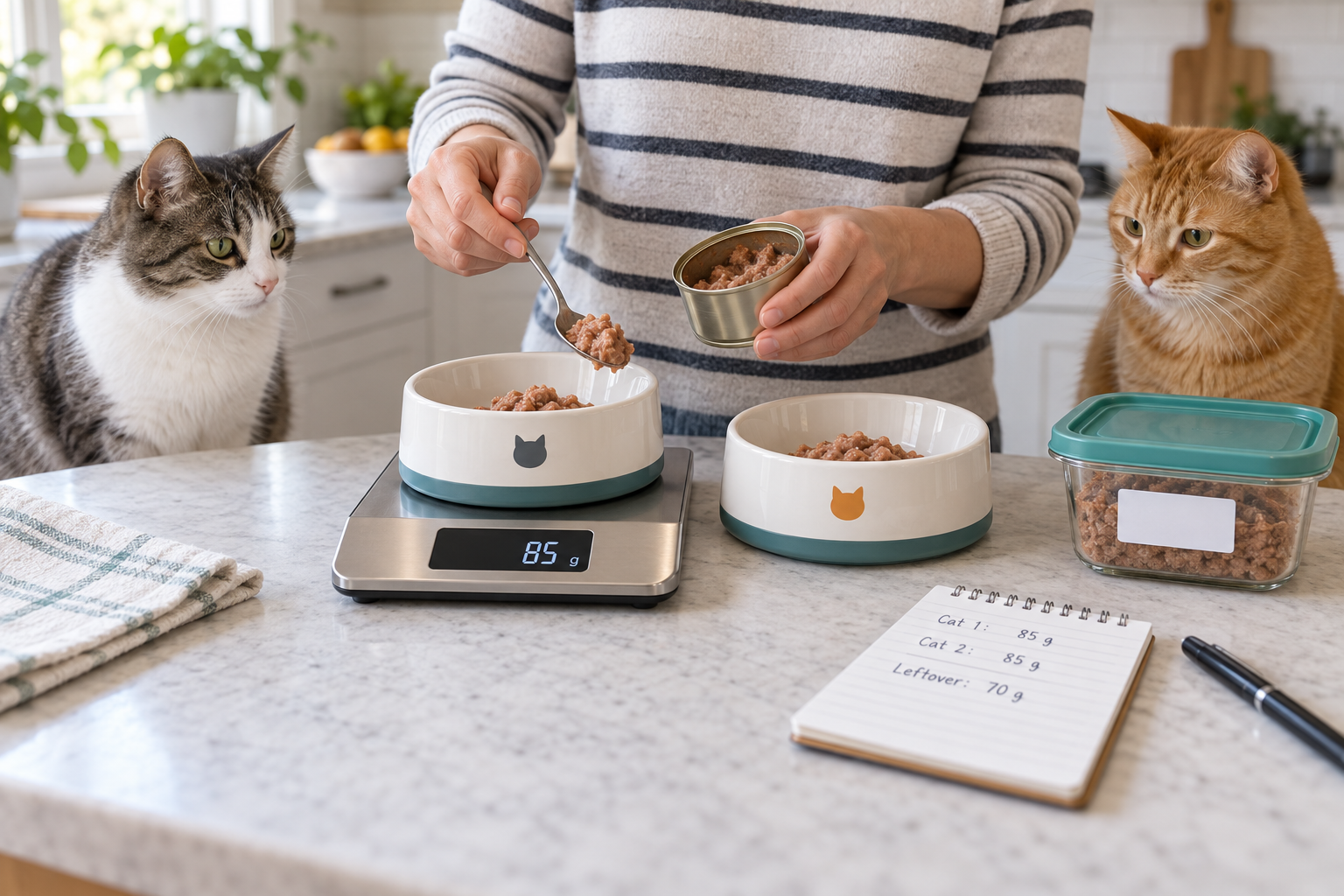
Portioning wet cat food for two cats means giving each cat its own measured bowl, based on that cat's calories, body condition, and eating habits, then labeling any leftovers before they go back in the fridge.
The tricky part is not the math. It is the household reality: one cat may eat faster, one may walk away and come back, one may need fewer calories, and a shared can can disappear into the wrong mouth. A calm two-bowl routine helps you feed both cats more fairly while keeping wet food safer and easier to track.
Índice
- How do you portion wet cat food for two cats?
- What numbers do you need before you split the food?
- Should two cats get equal wet food portions?
- How do you weigh and serve two separate bowls?
- How do you stop one cat from stealing the other cat's wet food?
- How should you label and store leftovers?
- What should you track after you change portions?
- When should your vet set the plan?
- Conclusion: Make Two Bowls Boringly Reliable
- Preguntas frecuentes
- Referencias
How do you portion wet cat food for two cats?
Start by treating the can, pouch, or tray as one pool of calories, then assign each cat a measured share. If both cats are healthy adults with similar body size, body condition, activity, and diet, an equal split may work. If they are different in weight, age, appetite, health, or ideal body condition, each cat needs an individual portion.
The simplest routine is:
- Find the food's calories per container or calories per gram.
- Decide how many wet-food calories each cat should get at that meal.
- Weigh Cat A's serving into Cat A's bowl.
- Tare the scale again.
- Weigh Cat B's serving into Cat B's bowl.
- Feed the cats in separate spots and pick up leftovers.
- Label any refrigerated wet food by cat, food, date, and amount.
That may sound fussy for the first week. Then it becomes a quiet kitchen habit. The payoff is that you can answer the questions that matter: who ate, how much, what is left, and whether one cat is quietly eating the other cat's calories.
What numbers do you need before you split the food?
You need the food's calorie statement, the container weight, and an estimate or veterinary target for each cat's daily calories. AAFCO says pet food calorie statements should appear under "Calorie Content" and include kilocalories per kilogram as fed plus a familiar unit such as per can, cup, or biscuit 1. For wet food, the familiar unit is often the easiest starting point.
If the label says 90 kcal per 85 g can, the food has about 1.06 kcal per gram. From there, you can convert any meal calorie target into grams.
“`text calories per gram = calories per container / grams per container
grams for one cat = that cat's meal calories / calories per gram “`
Use this table as a household worksheet:
| Paso | Cat A example | Cat B example |
|---|---|---|
| Daily calorie target | 220 kcal/day | 180 kcal/day |
| Wet-food share for the day | 110 kcal | 90 kcal |
| Number of wet meals | 2 meals | 2 meals |
| Wet calories per meal | 55 kcal | 45 kcal |
| Food calorie density | 1.06 kcal/g | 1.06 kcal/g |
| Grams per wet meal | about 52 g | about 42 g |
If you do not know the daily target yet, use the SnuggleSouls calculadora de calorías para gatos as a starting point, then confirm with your veterinarian if your cat is overweight, underweight, growing, senior, pregnant, nursing, or living with a medical condition. For a single-cat gram workflow before you add the two-cat layer, see our guide to weigh wet cat food portions.
Should two cats get equal wet food portions?
Two cats should get equal wet food portions only when equal portions fit both cats. Equal bowls are convenient, but they are not automatically fair.
Cornell Feline Health Center explains that cats' nutritional requirements change through life stages and that maintaining a healthy weight is important because obesity is a common nutrition-related problem in cats 2. That means the right portion depends on the individual cat, not the number of cats in the kitchen.
Equal portions may be reasonable when:
- both cats are healthy adults
- both eat the same complete wet food
- both have similar ideal body size
- both are at a healthy body condition
- both eat similar amounts of dry food, treats, and toppers
- neither cat steals food
Unequal portions are often better when:
- one cat is overweight or underweight
- one cat is a kitten, senior, pregnant, or nursing
- one cat eats a prescription or therapeutic diet
- one cat gets more dry food or treats
- one cat is much more active
- one cat steals from the other bowl
- one cat walks away and returns later
Mixed feeding adds another layer. If Cat A gets wet food plus dry food and Cat B gets mostly wet food, the wet portions may not look equal even when the daily calories are appropriate. Use the same daily calorie budget for all food, treats, pill pockets, toppers, and snacks. The SnuggleSouls guide to mix wet and dry cat food can help you avoid accidentally feeding a full wet portion on top of a full dry portion.
How do you weigh and serve two separate bowls?
Weigh one bowl at a time, write down each cat's target, and feed the bowls in consistent locations. The goal is not restaurant precision. It is a repeatable routine that keeps Cat A's calories from becoming Cat B's bonus snack.
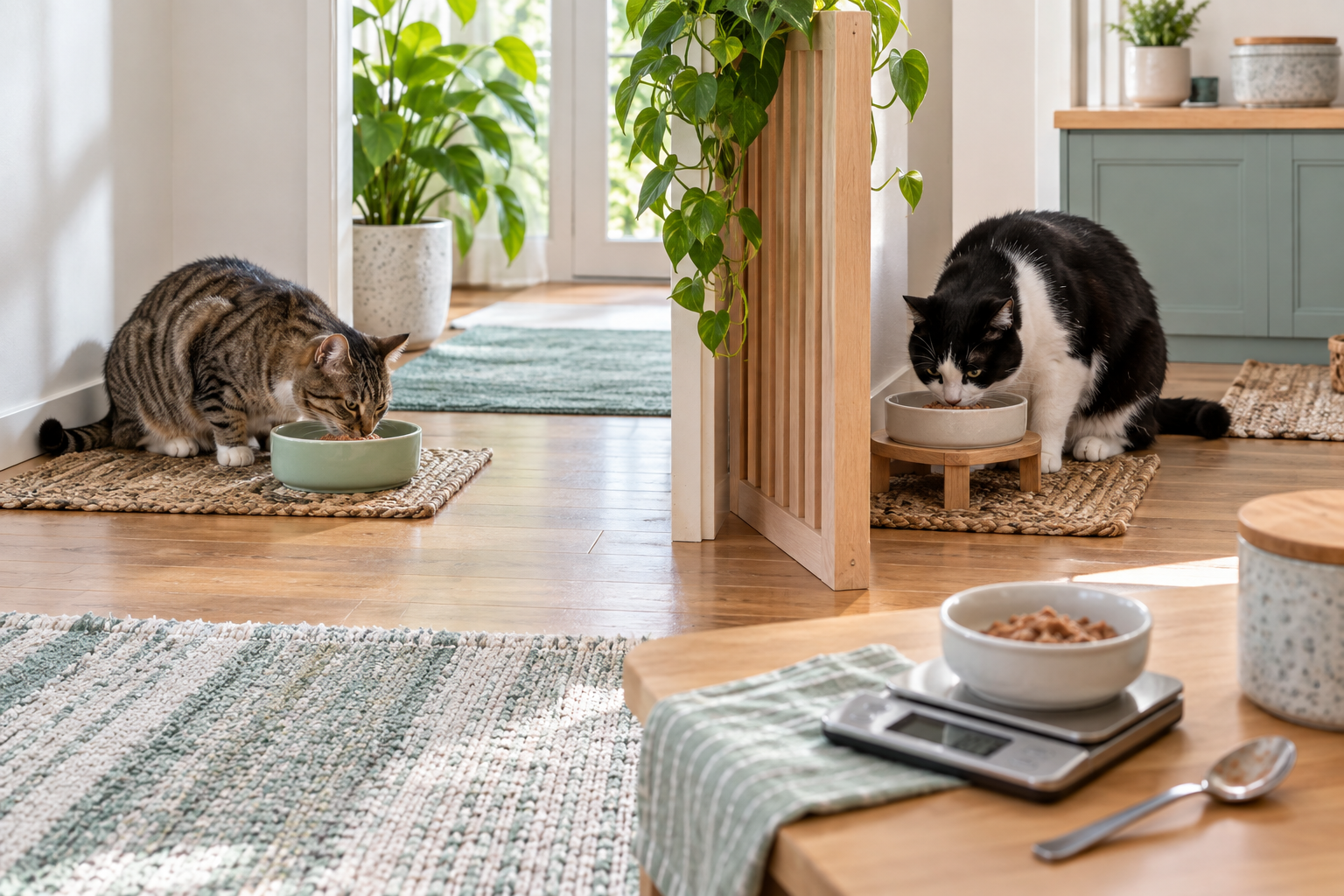
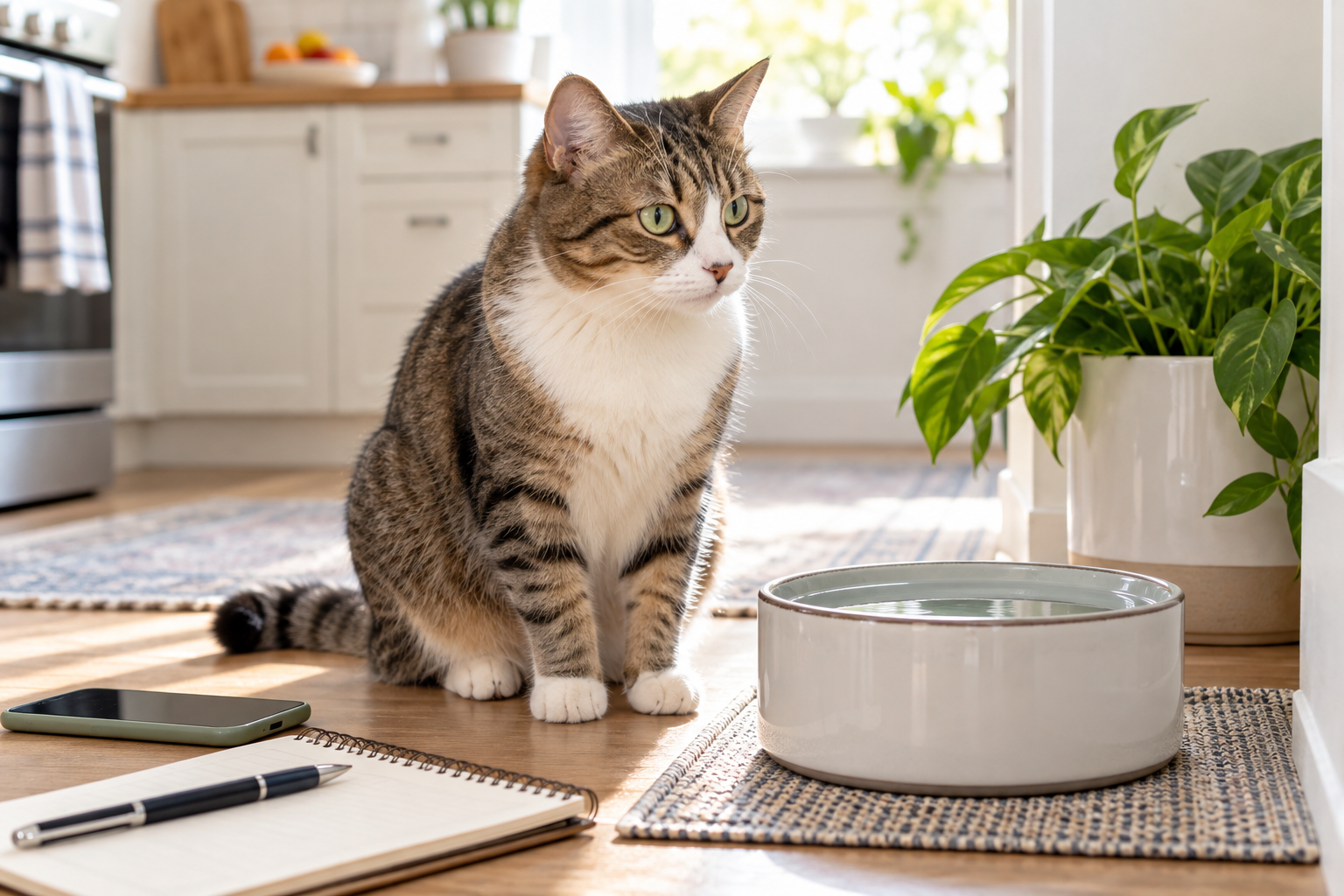
Separate feeding stations make it easier to see what each cat eats and reduce bowl stealing.
Use this two-bowl workflow:
- Wash your hands before handling pet food.
- Put Cat A's clean bowl on the scale.
- Press tare or zero.
- Add wet food until you reach Cat A's gram target.
- Move Cat A's bowl to Cat A's feeding station.
- Put Cat B's clean bowl on the scale and tare again.
- Add Cat B's gram target.
- Feed both cats where you can see them, at least until the routine is reliable.
- Pick up unfinished food when the meal window ends.
- Wash bowls and utensils after the meal.
FDA advises washing pet food bowls and measuring utensils with soap and hot water after each use, and not using a pet's bowl as the scoop or measuring utensil 3. If you need a broader scale routine, including dry food and treats, read how to use a kitchen scale for cat food portions.
For the first few days, stay nearby and observe. Does one cat finish fast and hover? Does one cat freeze when the other cat looks over? Does one cat leave food, then lose access when the other cat arrives? Those behavior clues matter as much as the grams.
How do you stop one cat from stealing the other cat's wet food?
Stop wet-food stealing by increasing separation before you buy complicated gear. Feed each cat in a predictable place, add distance, block sightlines, close a door if needed, and remove bowls when the meal is over.
The Feline Veterinary Medical Association's feeding guidance says cats often prefer to eat alone, and in multi-cat homes, separate feeding stations with distance and visual separation can reduce stress between cats 4. That advice is especially useful with wet food because wet meals are short enough to supervise.
Try these setups from simplest to strongest:
| Problema | Setup to try | Por qué es útil |
|---|---|---|
| One cat hovers beside the other | Bowls on opposite sides of the kitchen | Creates space without changing rooms |
| One cat stares or blocks | Visual divider, corner placement, or feeding around a doorway | Reduces pressure while eating |
| One cat finishes fast and steals | Feed the fast eater in a separate room until both are done | Protects the slower cat's portion |
| One cat needs a different diet | Closed-door meals or a microchip feeder | Prevents diet mix-ups |
| One cat is senior or arthritic | Easy-access station with a low bowl and no jumping | Keeps the plan comfortable |
| One cat grazes slowly | Short supervised meals, then refrigerate leftovers | Prevents all-day wet-food exposure and stealing |
For persistent food stealing, microchip feeders for cats can help, but they are not magic. A determined cat may wait nearby, crowd the feeder, or stress the cat who owns the bowl. Start with layout, routine, and supervision first. Gear works best when it supports a calm plan rather than replacing one.
How should you label and store leftovers?
Label wet food leftovers by cat, food, amount, and date before refrigerating. In a two-cat home, "leftover wet food" is too vague. You want to know whether the container belongs to Cat A's smaller portion, Cat B's larger meal, a prescription food, or a shared can waiting to be split again.
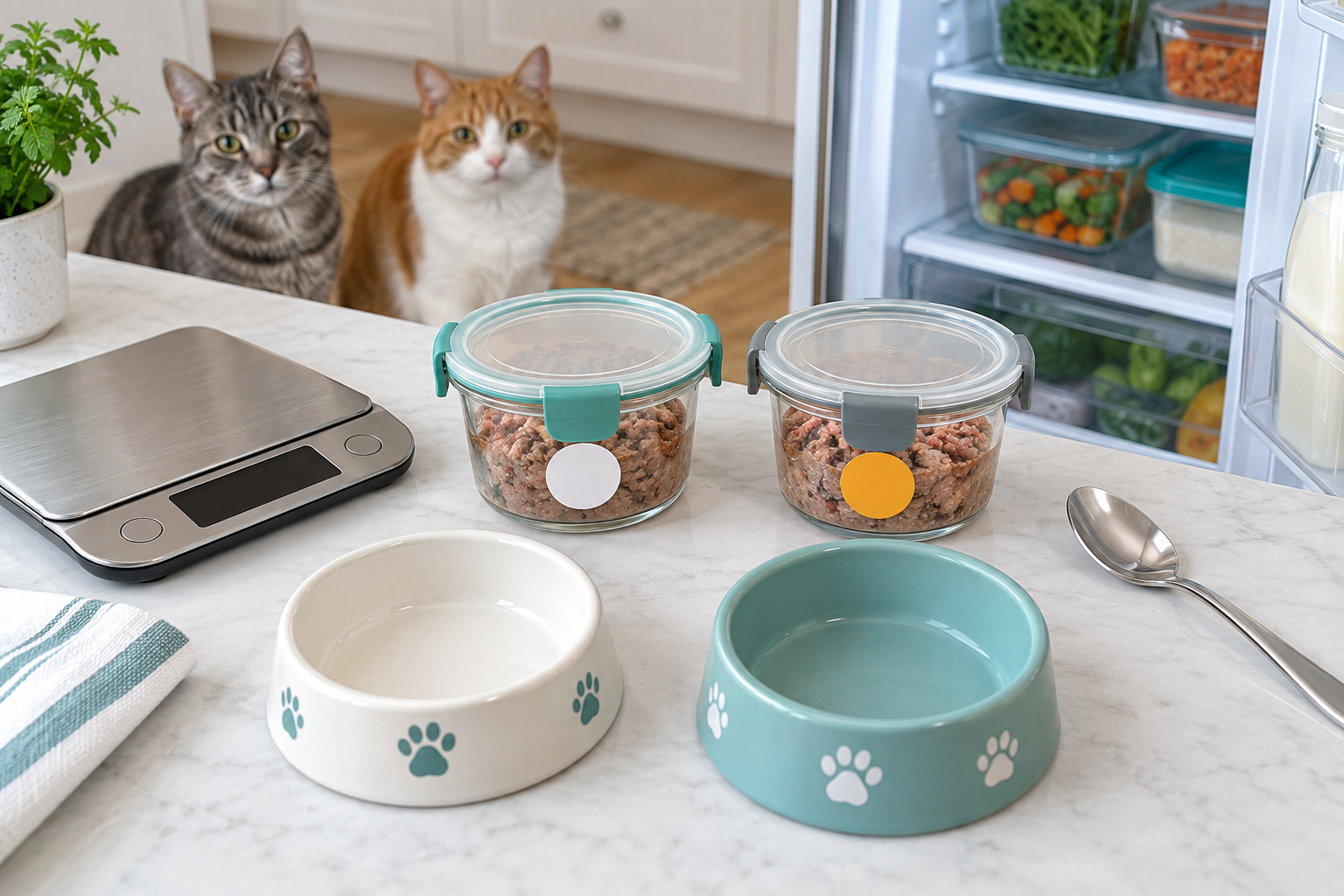
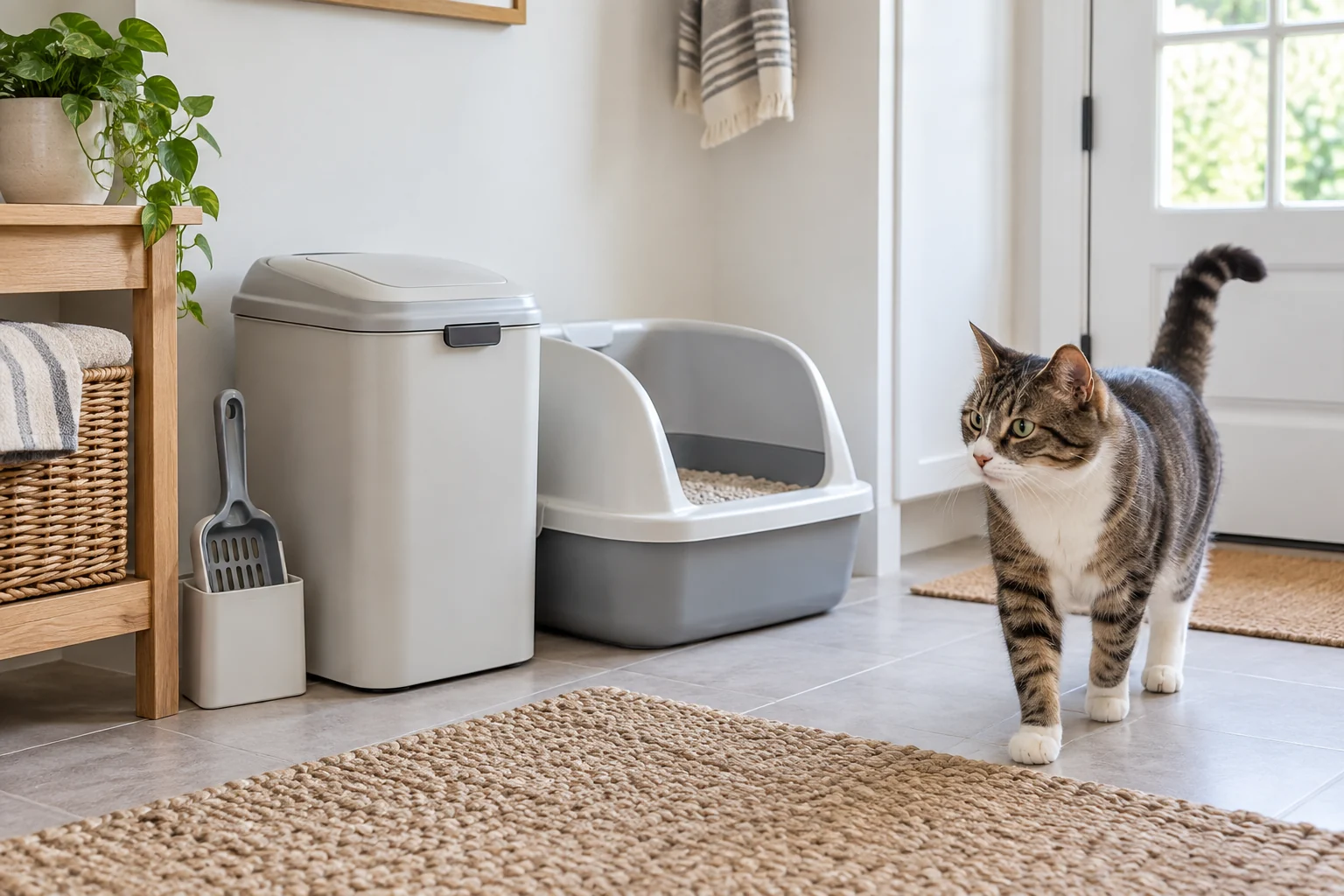
Labeled leftover containers prevent tomorrow's portion from becoming guesswork.
FDA advises pet owners to promptly refrigerate or throw out unused or leftover canned and pouched pet food, tightly cover refrigerated pet food, and keep the refrigerator at 40 F or below 3. Cornell also notes that unused opened canned cat food should be refrigerated to maintain quality and prevent spoilage 2.
Use short labels like these:
| Label field | Example | Por qué es importante |
|---|---|---|
| Gato | Milo or Luna | Prevents one cat's portion from going to the other |
| Alimentación | Turkey pate or renal diet | Prevents flavor or prescription mix-ups |
| Amount | 38 g left | Makes the next meal easier |
| Date opened | Sep 25 | Helps you avoid mystery leftovers |
| Notas | Add 10 g fresh food | Keeps partial containers clear |
Keep the system simple enough to use when you are tired. Color dots, painter's tape, or a small fridge note can work. For storage timing, covers, and toss-it clues, use the SnuggleSouls wet cat food storage guide.
What should you track after you change portions?
Track appetite, leftovers, stool, vomiting, weight trend, and body condition after you change portions. A two-cat feeding plan is working only if each cat is eating the intended food and staying well.
WSAVA nutrition resources emphasize diet history, body condition scoring, muscle condition, calorie needs, and feeding instructions as part of nutritional assessment 5. At home, you can support that assessment with ordinary notes.
Watch these practical signals:
| Lo que se nota | Qué puede significar | ¿Qué hacer ahora? |
|---|---|---|
| One cat always leaves food | Portion may be too large, timing may be wrong, or appetite may be low | Track leftovers and call your vet if appetite drops |
| One cat finishes and raids | Portion, speed, boredom, or food competition may be involved | Add distance, supervision, or a slower routine |
| Weight drifts up | Calories may be too high or stealing is happening | Recheck all meals, treats, and dry food |
| Weight drops without a plan | Cat may be underfed or unwell | Póngase en contacto con su veterinario |
| Vomiting, diarrhea, hiding, or low energy | Not just a portioning issue | Seek veterinary advice |
| Stool changes after a food switch | Transition may be too fast or food may not suit the cat | Review the change with your vet if it persists |
Do not judge the plan by bowls alone. Also check the label and feeding directions, especially after changing flavors or brands. Our guide to cat food feeding directions explains why package ranges are starting points, not custom plans.
When should your vet set the plan?
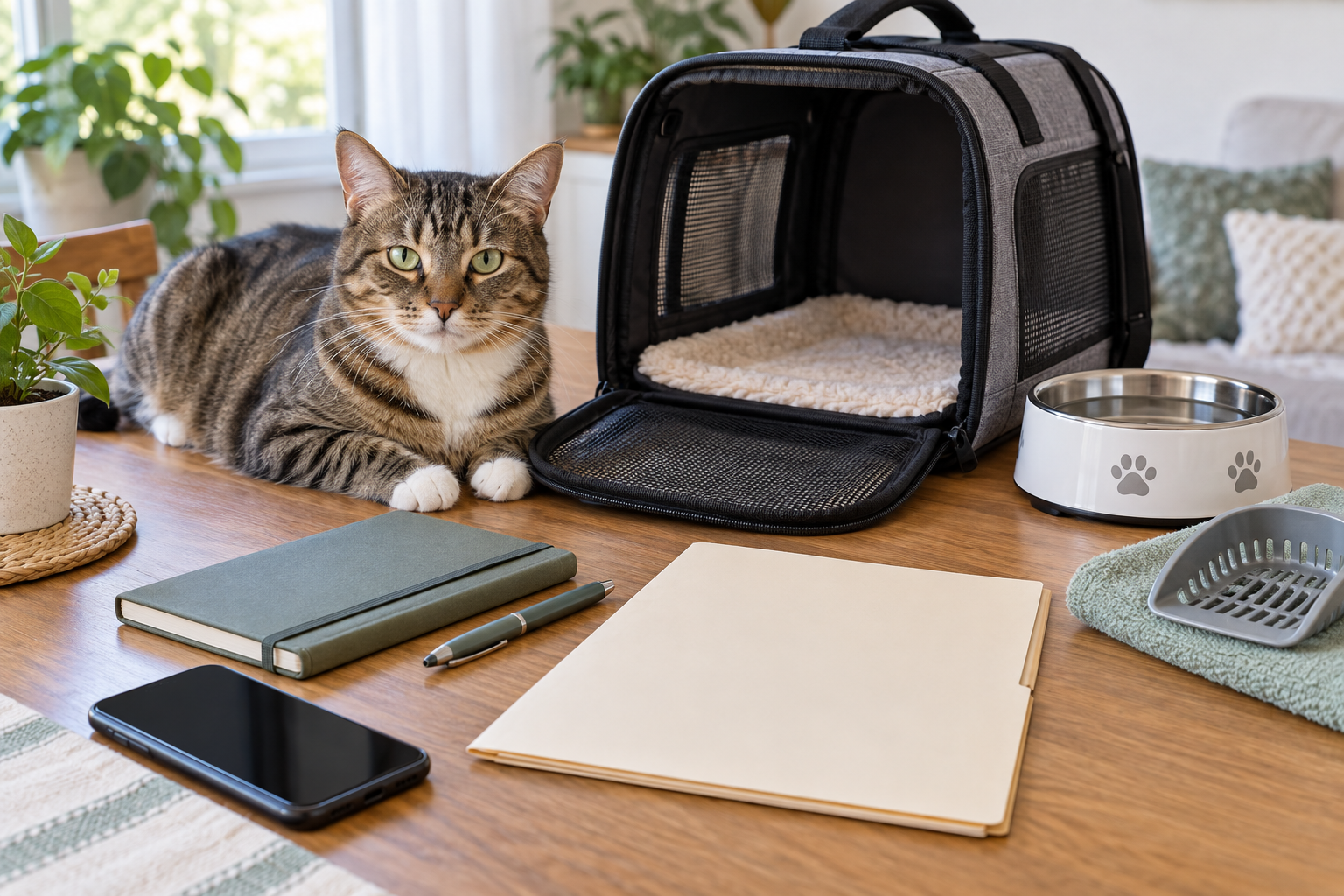
Your veterinarian should set or approve the plan when either cat has a medical condition, needs weight loss, is underweight, is a kitten, is senior with muscle loss, is pregnant or nursing, eats a therapeutic diet, or has a sudden appetite change.
Call your veterinarian promptly if a cat:
- eats much less than usual or refuses food
- loses weight without a plan
- vomits repeatedly
- has severe or persistent diarrhea
- seems weak, painful, hidden, or unusually quiet
- drinks or urinates much more than usual
- strains to urinate or produces little urine
- needs a prescription diet separated from another cat's food
Cats should not be crash-dieted. If one cat is overweight, the solution is a measured, gradual plan, not suddenly cutting the bowl in half. Cornell notes that a veterinarian can help determine ideal body weight and guide diet adjustments 2. You can use the SnuggleSouls cat body condition score calculator as a home check, then use your veterinarian's advice for the actual feeding decision.
Conclusion: Make Two Bowls Boringly Reliable
The best two-cat wet food routine is boring in the nicest way: each cat has a measured bowl, each bowl goes in a predictable place, food stealing is prevented early, and leftovers are labeled before they become a fridge mystery.
Start with the label calories and container weight. Decide each cat's wet-food calories, weigh the bowls separately, feed with enough distance, and track what actually happens. When the routine is clear, you can spot problems faster: one cat stealing, one cat not eating, a portion that no longer fits, or a leftover container that needs to be tossed.
Preguntas frecuentes
Can two cats share one can of wet food?
Yes, two cats can share one can if the food suits both cats and the portions match their individual needs. Weigh each cat's share instead of placing one shared bowl on the floor.
Is it okay to split wet food exactly in half?
It is okay only when both cats should receive the same calories from that food. If one cat is larger, smaller, overweight, underweight, more active, younger, older, or on a different diet, equal halves may be wrong.
How do I feed one fast cat and one slow cat?
Use separate stations and supervise the meal. If the fast cat steals, feed behind a closed door, use a visual divider, or remove bowls when the meal window ends.
Should I label leftovers by cat or by food?
Use both when possible. A simple label with cat name, food, grams left, and date opened prevents mix-ups, especially when one cat eats a prescription food or a smaller portion.
What if one cat refuses the measured portion?
Do not force the meal or leave wet food out all day. Note how much was eaten, refrigerate or discard leftovers safely, and call your veterinarian if appetite is reduced, repeated, or paired with vomiting, diarrhea, hiding, pain, or weight loss.
Can microchip feeders solve wet food stealing?
They can help in some homes, especially when cats eat different diets, but they still need cleaning, training, and calm placement. Try separation, routine, and supervision first, then use a feeder if it solves a real access problem.
Referencias
[1] Association of American Feed Control Officials. (2025). Calorías. Calorías
[2] Cornell Feline Health Center. (2026). Cómo alimentar a tu gato. Cómo alimentar a tu gato
[3] U.S. Food and Drug Administration. (2026). Tips for Safe Handling of Pet Food and Treats. Tips for Safe Handling of Pet Food and Treats
[4] Feline Veterinary Medical Association. (2024). How to Feed a Cat. How to Feed a Cat
[5] World Small Animal Veterinary Association. (2026). Directrices mundiales sobre nutrición. Directrices mundiales sobre nutrición
 EN
EN DE
DE ES
ES PT
PT