
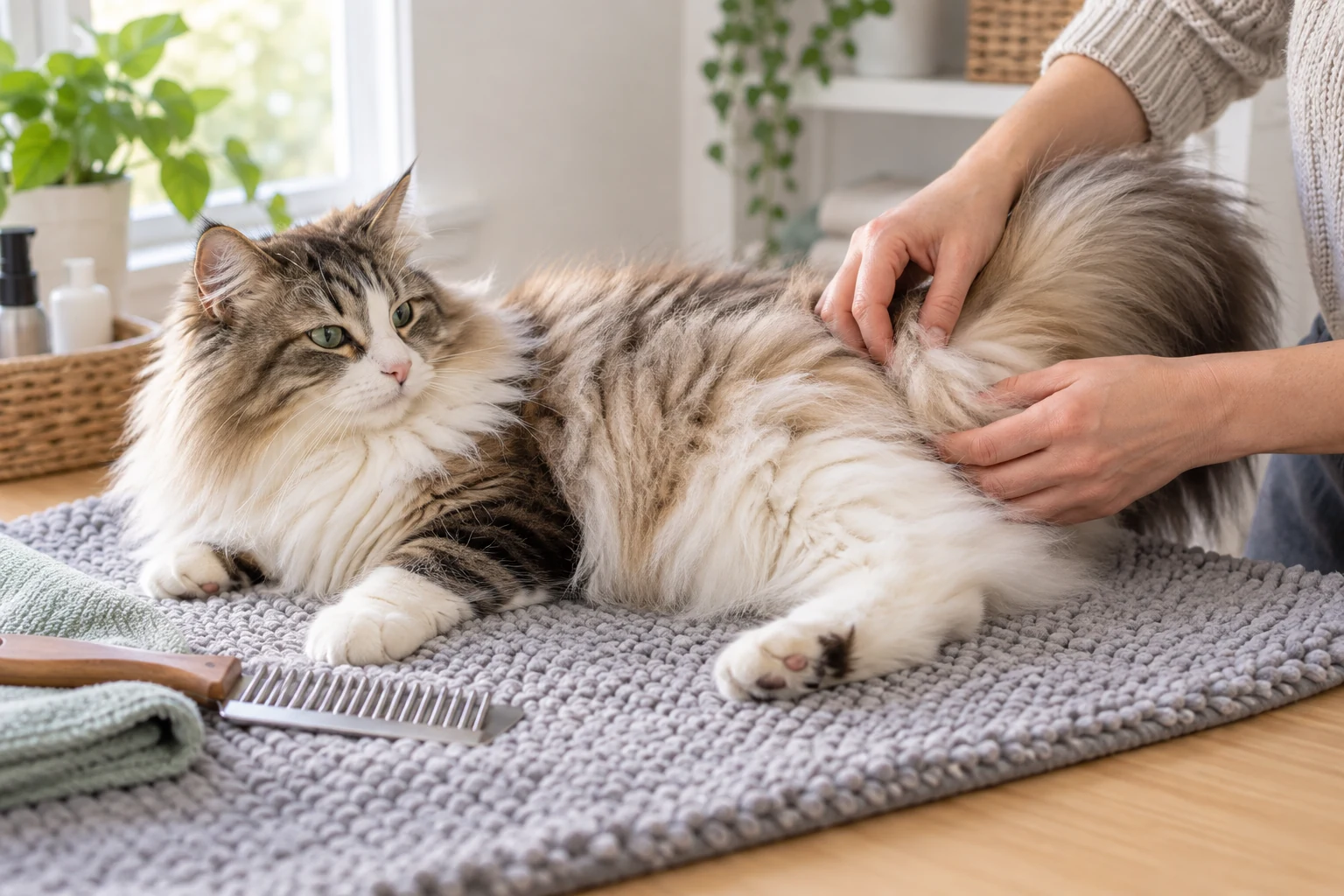
To prevent cat mats around the back legs and tail base, check those friction zones with your fingers before you comb, keep sessions short, and stop before a small tangle tightens near the skin. These spots mat easily because loose undercoat collects where the legs move, the tail lifts, and some cats cannot groom comfortably.
Back-leg and tail-base mats are easy to miss. A cat can look smooth along the shoulders while knots are forming beside the hind legs, under the tail, or across the lower back. VCA notes that long, silky, or curly coats often need daily brushing to prevent tangles, especially around the ears, armpits, and back legs 1.
This guide focuses on the rear trouble spots: back legs, haunches, tail base, and lower rump. For the other high-friction zones, pair it with SnuggleSouls' guides to prevent cat mats around the armpits and belly y prevent cat mats behind the ears and collar area.
Índice
- Where do back-leg and tail-base mats usually start?
- How can you check the tail base and back legs without pulling?
- Which tools work best for the back legs and tail base?
- What weekly routine prevents tail-base mats from coming back?
- When is a tail-base mat too close to handle at home?
- Which cats need extra tail-base and back-leg checks?
- How can you make rear-end grooming less stressful?
- Conclusion: Keep Tail-Base Mats Small and Loose
- Preguntas frecuentes
- Referencias
Where do back-leg and tail-base mats usually start?
Back-leg and tail-base mats usually start where fur bends, rubs, and traps loose undercoat: behind the thighs, along the haunches, at the base of the tail, and under the tail where sanitary fur can clump. The earlier you feel these areas, the easier they are to keep comfortable.
Virginia Tech's veterinary teaching hospital explains that mats often occur in friction areas such as collars and legs, and that regular grooming helps catch them before they grow painful or difficult to remove 3. Around the back end, friction comes from walking, sitting, litter box posture, tail movement, naps, and repeated rubbing against bedding.
Use this map during calm checks:
| Trouble spot | Why mats begin there | Best first check |
|---|---|---|
| Back of the thighs | Fur bends with every step and sit | Feel from the knee area upward with flat fingers |
| Tail base | Dense undercoat collects where the tail lifts | Part the fur beside the tail before combing |
| Lower rump | Loose undercoat can flatten during naps | Stroke both with and against the coat growth |
| Under-tail fringe | Moisture, litter dust, or stool can clump fur | Inspect only when your cat is relaxed and clean |
| Haunch sides | Brushing the back may skim over hidden knots | Lift the outer coat gently and check beneath it |
These rear spots overlap with whole-coat prevention, but they need their own routine because cats may be sensitive about tail and hind-leg handling. If your cat has a long coat, start with the broader guide to prevent mats in longhaired cats, then use this article as the tail-base checklist.
How can you check the tail base and back legs without pulling?
Check the tail base and back legs by using fingertips first, then a wide-tooth comb only when the fur already separates easily. Your goal is to find tiny knots while they still move freely, not to drag a tool through a hidden mat.
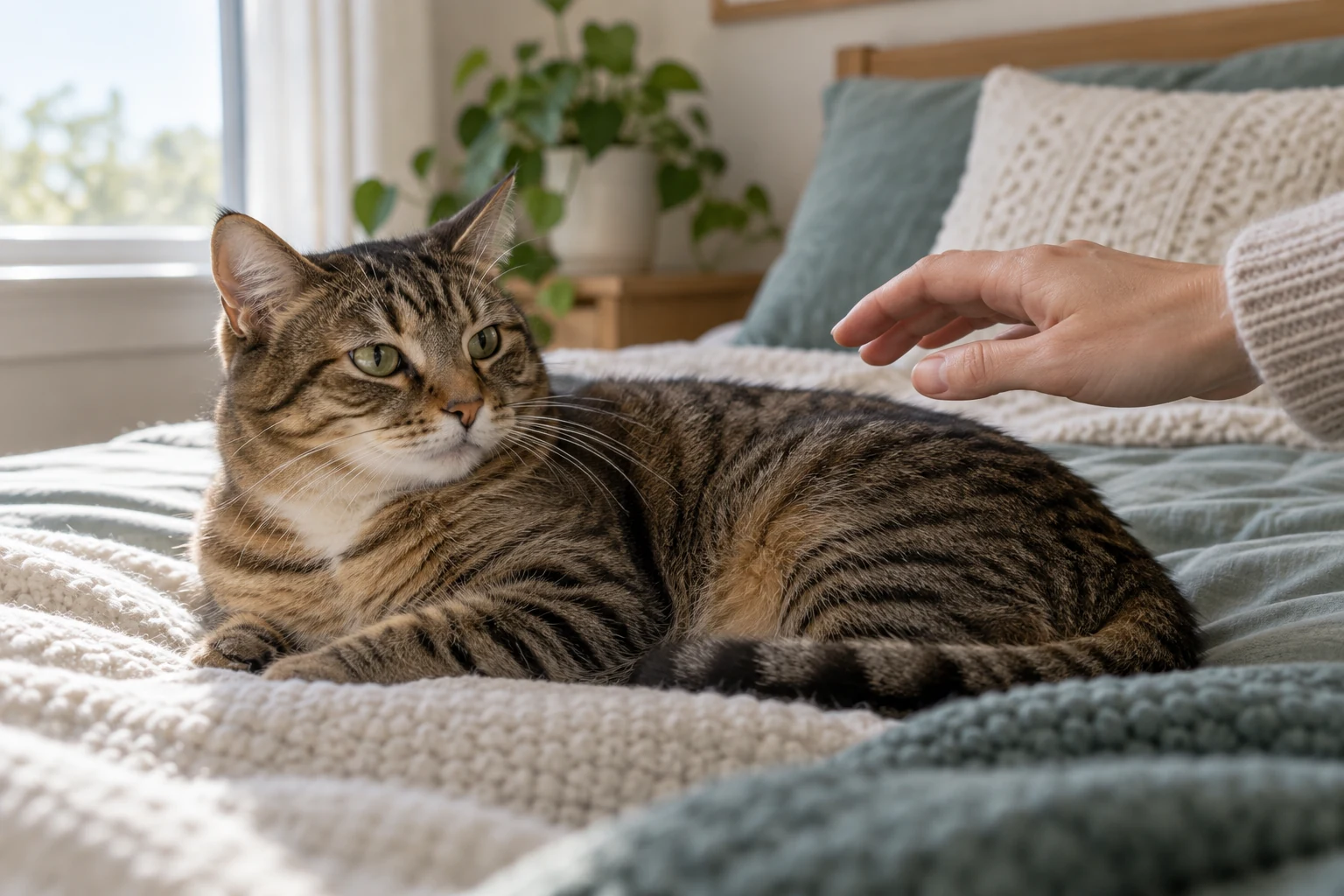
Choose a quiet moment when your cat is standing, loafing, or lying on one side by choice. Pet the back normally for a few seconds, then slide your fingers down toward the haunches and tail base. If the coat feels smooth, part it once and stop. If you feel a pea-sized bump, fuzzy ridge, or flattened patch, pause before using a comb.
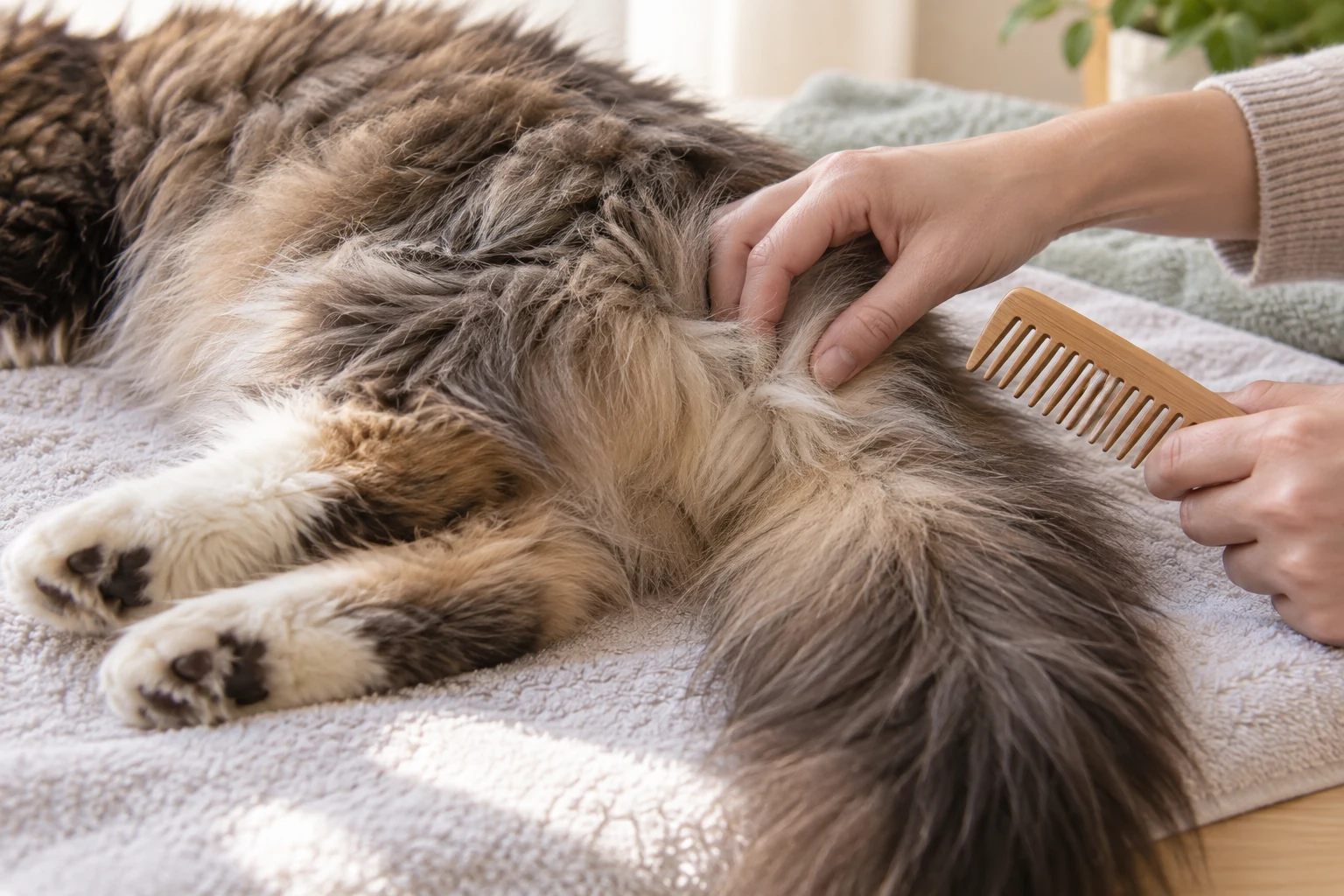
Use your fingers first around the tail base and back legs so you can feel tiny knots before a comb pulls on the skin.
Use this gentle sequence:
- Let the tail sit naturally instead of lifting it high.
- Touch the rump and haunches with flat fingers.
- Part one small area at the tail base.
- Feel behind one back leg for tiny knots.
- Use a comb only on hair that separates without resistance.
- Reward your cat and stop before they become irritated.
Do not pin your cat, hold the tail straight up, or pull a hind leg outward to "get a better look." That kind of handling can make the next session harder, and it may hurt cats with stiff hips, a sore back, or skin irritation.
Which tools work best for the back legs and tail base?
The best tools are your fingers, a wide-tooth metal comb, a soft brush, and good lighting. Avoid scissors around mats, because cat skin is flexible and can be pulled into a tangle where it is hard to see.
VCA says long-toothed metal combs or brushes can help remove loose hair and smooth minor tangles in medium and longhaired cats, but the work should be gentle and avoid excessive pulling 1. If you need a basic kit, start with SnuggleSouls' cat grooming guide and the step-by-step routine to brush a longhaired cat without pulling.
| Tool | Best use | Avoid using it when |
|---|---|---|
| Fingers | Finding knots, checking skin, separating loose fur | The area is sore, wet, scabby, or painful |
| Wide-tooth comb | Working through loose surface tangles | The mat is flat or close to skin |
| Soft slicker or brush | Smoothing the coat after checks | It skims over hidden knots without finding them |
| Fine comb | Final check after a tangle is already loose | It catches or makes your cat flinch |
| Clippers | Professional mat removal when needed | You are untrained or the mat is near delicate skin |
| Scissors | Not recommended for mats | Any mat is near the skin, tail, belly, or sanitary area |
For longhaired cats, VCA warns not to use scissors to cut mats because mats can adhere closely to the skin and accidental cuts can cause serious pain and injury 2. If a mat seems to require cutting, book a veterinarian or qualified groomer instead of trying to solve it with household tools.
What weekly routine prevents tail-base mats from coming back?
A simple weekly routine prevents most tail-base mats: check the haunches, part the tail-base fur, feel behind the back legs, comb only loose sections, and end with a reward. Longhaired cats, shedding cats, and cats with recurring mats may need shorter checks several times a week.
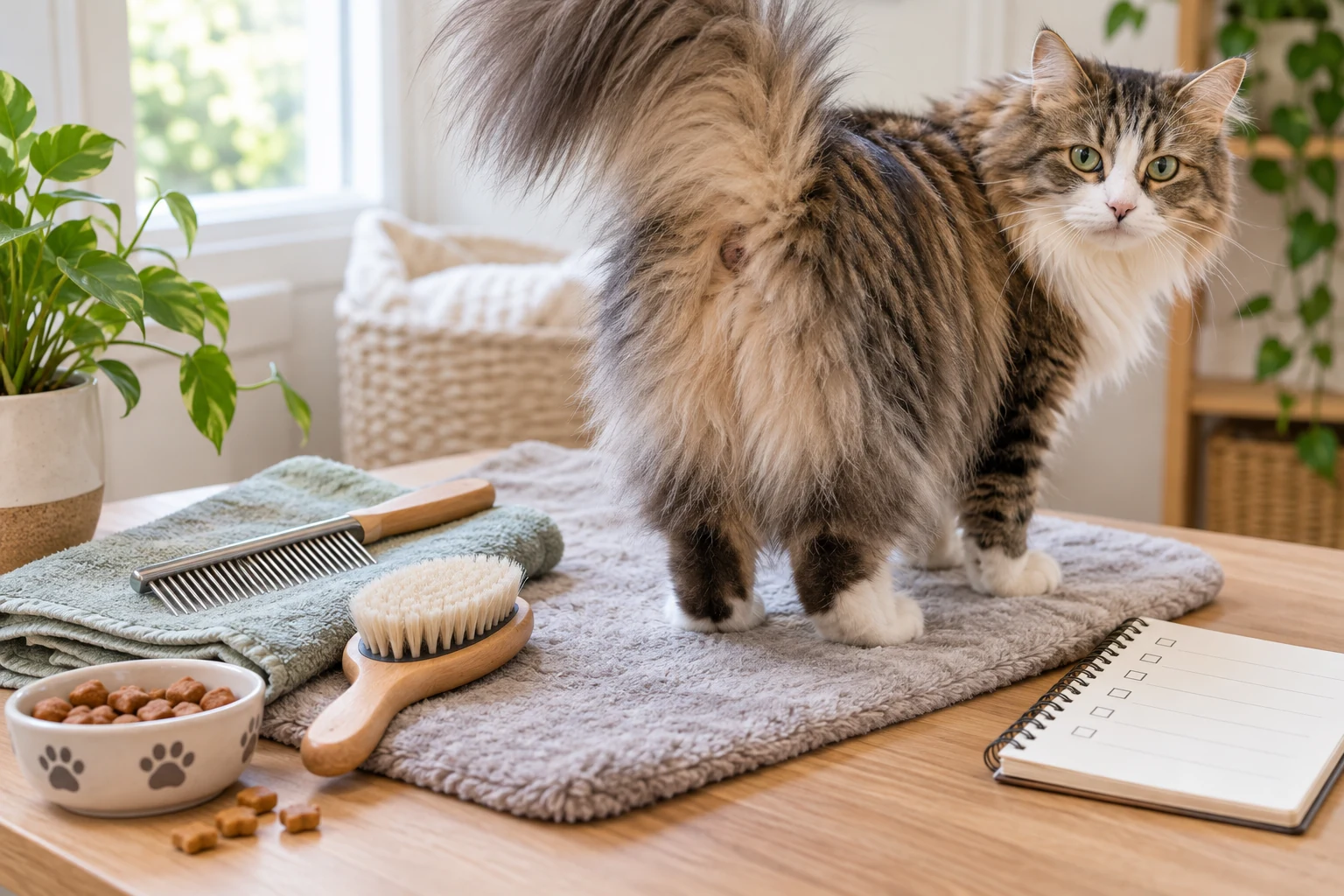
A small grooming station makes weekly tail-base and back-leg checks predictable, quick, and easier to repeat.
Try this five-minute routine:
- Put a towel, comb, soft brush, and treats in one familiar spot.
- Pet your cat's shoulders and back before touching the rear coat.
- Check the left haunch, tail base, then right haunch.
- Feel behind each back leg with your fingertips.
- Comb only hair that is loose, dry, and easy to separate.
- Smooth the coat back into place.
- Stop while your cat is still calm.
Keep the routine boring in the best way. Same room, same towel, same light touch, same reward. If your cat dislikes rear-end handling, split the routine: tail base today, left back leg tomorrow, right back leg after the next relaxed nap.
ASPCA grooming guidance says longhaired indoor cats may need grooming every few days to remove dead hair and prevent tangles 5. That does not mean every session has to be a full brushing. A 30-second trouble-spot check can be enough to catch a small knot before it becomes a mat.
When is a tail-base mat too close to handle at home?
A tail-base mat is too close to handle at home when it is flat, hard, stuck near skin, damp, smelly, painful, or located near the anus, groin, or irritated skin. Stop immediately if your cat flinches, growls, freezes, swats, pants, or tries to bite.
The tail base and back legs can hide skin problems under dense fur. VCA advises professional care from a groomer or veterinarian when tangles are severe or extensive, and veterinary care if a mat has caused skin irritation 1. For a decision tree once a mat already exists, use SnuggleSouls' guide on how to remove small cat mats safely.
Stop and get help if you notice:
- Skin lifting with the mat.
- Redness, scabs, swelling, odor, moisture, bleeding, or warmth.
- Litter, urine, feces, plant material, or sticky residue trapped in the fur.
- A mat beside the anus, genitals, tail base, or inner thigh.
- Several mats grouped together across the back end.
- Sudden repeated matting in the same rear area.
- Any sign your cat may be painful, weak, stiff, or unable to groom normally.
Bathing is not a fix for rear-end mats. Wet fur can make tangles tighten as they dry, and washing a matted area can hide irritation until it is worse. If the back end is dirty and matted, call your veterinarian or groomer for the safest order of care.
Which cats need extra tail-base and back-leg checks?
Longhaired cats need extra checks, but shorthaired cats can mat too when loose hair, friction, moisture, or reduced self-grooming builds up. Any cat who cannot comfortably reach the back end deserves a closer routine.
VCA notes that medical conditions, obesity, painful mouth disease, and arthritis can contribute to mats because a cat may groom less or have trouble reaching the hind end 2. Virginia Tech also notes that arthritic or overweight cats may struggle to reach all areas even though cats are natural self-groomers 3.
Be especially consistent with checks if your cat is:
- Longhaired, curly-coated, cottony-coated, or dense-coated.
- Senior, arthritic, overweight, or recovering from illness.
- Prone to dandruff, greasy fur, or seasonal shedding.
- Wearing a diaper, recovery suit, harness, or other gear that changes fur movement.
- Getting litter, stool, or urine in the back-end fur.
- Grooming less than usual or overgrooming one area.
- Sensitive when touched over the hips, rump, or lower back.
Repeated mats can be a clue, not just a grooming nuisance. If your cat's coat changes suddenly, or you notice a new pattern of undergrooming, read SnuggleSouls' guide to grooming changes and ask your veterinarian what may be affecting your cat's comfort. For stiff older cats, small home changes from the arthritic cat at home guide can make grooming positions easier.
How can you make rear-end grooming less stressful?
Make rear-end grooming less stressful by giving your cat control, using short sessions, and stopping at the first signs of tension. A calm cat gives you better information than a restrained cat because you can feel early knots without adding fear or pain.
The AAFP/ISFM Cat Friendly Veterinary Interaction Guidelines emphasize understanding the cat's emotional state, responding appropriately, and giving cats a sense of control during handling 4. At home, that means you should not wait until the mat is urgent and then force a long session.
Watch for early stress signals:
- Tail thumping or tight tail wrapping.
- La piel se me eriza por la espalda.
- Head turning toward your hand.
- Ears flattening or rotating sideways.
- Sudden grooming, freezing, growling, or trying to leave.
If any of those appear, pause. Touch an easier area, reward, or end the session. You can build tolerance by pairing one-second tail-base touches with treats, then slowly adding a finger check, then a single comb stroke on a different day.
Do not combine every care task at once. Nail trimming, bathing, mat checks, and brushing can each be stressful. Keep the back-leg and tail-base routine separate until your cat already accepts it calmly.
Conclusion: Keep Tail-Base Mats Small and Loose
Back-leg and tail-base mats are easiest to prevent when you check before you brush, use fingers before tools, and stop before your cat feels trapped. The safest routine is not dramatic. It is a short, repeatable check that catches tiny knots while they are still loose.
If the mat is tight, painful, dirty, near delicate skin, or emotionally too much for your cat, professional help is the kind choice. Protect the skin, protect trust, and use weekly trouble-spot checks to keep the back end comfortable.
Preguntas frecuentes
Why does my cat get mats near the base of the tail?
Cats get mats near the tail base because loose undercoat collects where the tail moves and the coat rubs during walking, sitting, and sleeping. Older, overweight, stiff, or longhaired cats may also have trouble grooming that area thoroughly.
Can I cut a tail-base mat with scissors?
No. Do not cut a tail-base mat with scissors because cat skin can pull up into the mat and be cut even when you think you can see the edge. If a mat needs cutting or shaving, use a qualified groomer or veterinarian.
How often should I check my cat's back legs for mats?
Check longhaired cats at least weekly, and more often during shedding season or if your cat has recurring mats. For cats who dislike handling, use very short checks on different days instead of one long session.
Are mats around the back legs a sign my cat is sick?
Not always. Some mats come from coat type and friction, but new or repeated mats can point to pain, stiffness, obesity, dental pain, skin irritation, or reduced grooming. Ask your veterinarian if the pattern is sudden, worsening, or paired with behavior changes.
Should I bathe my cat before removing mats?
Usually no. Bathing can make tangles tighter as the coat dries and may hide skin irritation. Brush or evaluate tangles before any bath, and get professional help for tight, dirty, painful, or sanitary-area mats.
Referencias
[1] Hospitales veterinarios VCA. (2026). Grooming and Coat Care for Your Cat. URL
[2] Hospitales veterinarios VCA. (2026). How To Groom A Long-Haired Cat. URL
[3] Virginia Tech Veterinary Teaching Hospital. (2026). How to Keep Your Pet's Coat Healthy. URL
[4] AAFP and ISFM. (2022). 2022 AAFP/ISFM Cat Friendly Veterinary Interaction Guidelines: Approach and Handling Techniques. URL
[5] ASPCA. (2026). Cat Grooming Tips. URL

 EN
EN DE
DE ES
ES PT
PT