
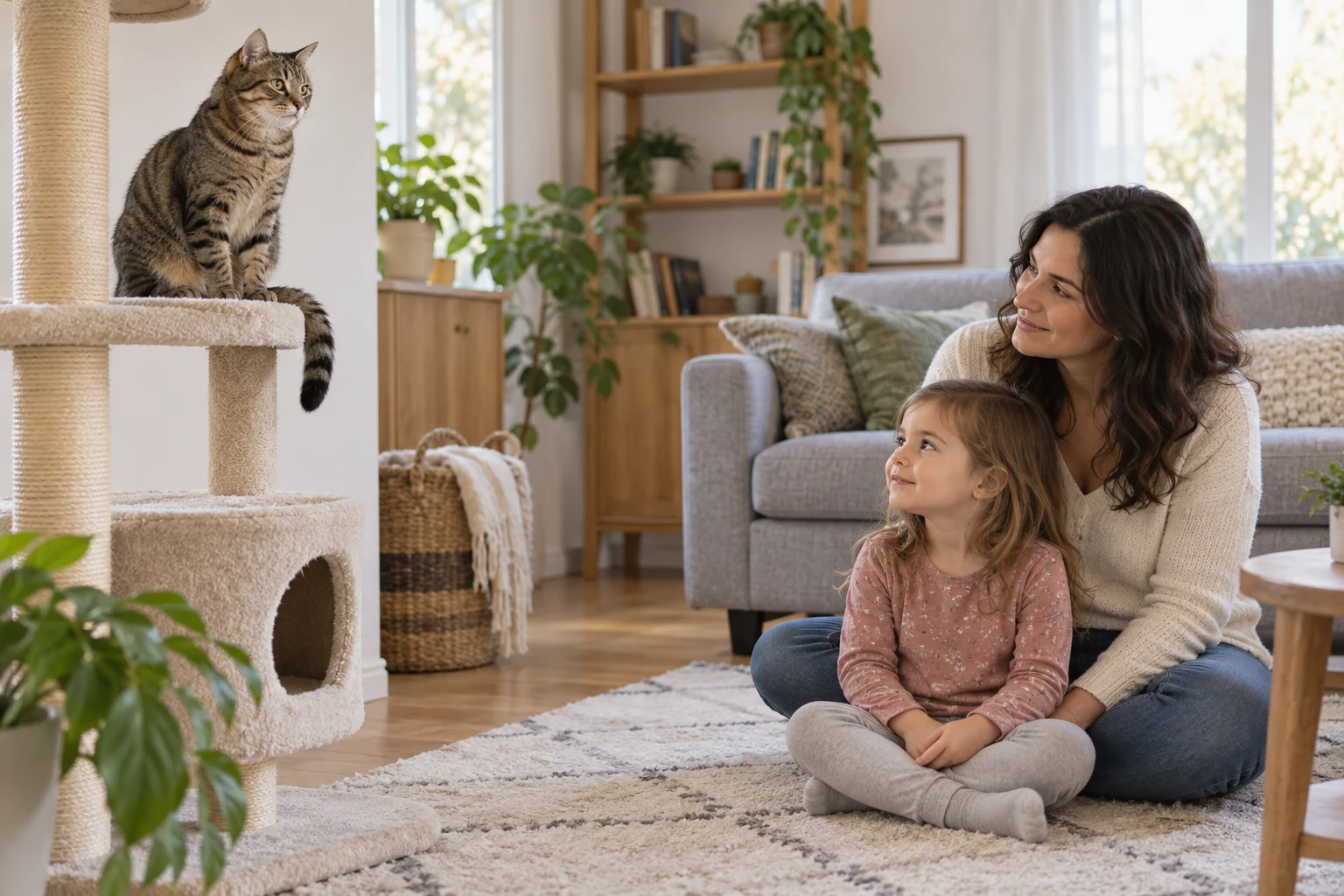
Helping preschoolers read cat body language starts with one rule: the child stops before the cat has to hiss, swat, scratch, or bite. Tail, ear, eye, and body clues are useful only when an adult turns them into simple actions the child can practice.
Preschoolers are old enough to notice patterns. They can learn that a relaxed cat looks loose, chooses to come closer, and can leave at any time. They can also learn that a tail flick, sideways ears, crouched body, hiding, or walking away means "all done."
This guide focuses on reading stop signals, not building the whole house rule system from scratch. If your child still needs the basic rules for calm voices, doorways, and safe play, start with how to teach preschoolers cat boundaries. If your child is younger and still working on touch control, the guide to teach a toddler gentle hands with cats will fit better.
Índice
- What should preschoolers learn before reading cat body language?
- Which cat body language signs mean stop now?
- How do you teach tail, ear, and body clues without scaring the cat?
- What should your child do when the cat walks away?
- How can adults supervise practice in real rooms?
- What mistakes make cat body language lessons unsafe?
- When should cat behavior or injuries get extra help?
- Conclusion: Make the cat's no easy to honor
- Preguntas frecuentes
- Referencias
What should preschoolers learn before reading cat body language?
Preschoolers should learn that cat body language is a stoplight, not a test. Green means an adult may allow a short, calm interaction. Yellow means pause and watch. Red means hands back, body back, and let the cat leave.
Cats Protection recommends supervision between children and cats, safe places where the cat can hide, and teaching children to understand cat body language 1. That adult role matters because preschoolers can identify a sign and still act too quickly. The child may say "her tail is moving" while reaching for the same tail.
Start with three rules before you name any body parts:
- The cat is allowed to say no.
- The cat says no with movement and body clues.
- The adult helps the child stop right away.
Then teach the child a simple phrase: "Look, ask, wait." Look at the cat's whole body. Ask the adult, not the cat. Wait for the adult to decide whether the interaction should continue.
Avoid asking the child to "be careful" in a vague way. A useful preschool script is more concrete: "Hands on your belly. Cat is thinking. We wait." That gives the child a place to put their body while the adult reads the cat.
Which cat body language signs mean stop now?
Stop the interaction when the cat turns away, walks away, hides, crouches, flicks or lashes the tail, flattens or turns the ears sideways, growls, hisses, swats, bites, freezes, arches the back, bares teeth, or tries to leave. The lesson is not to wait for the loudest warning. It is to notice the earlier ones.
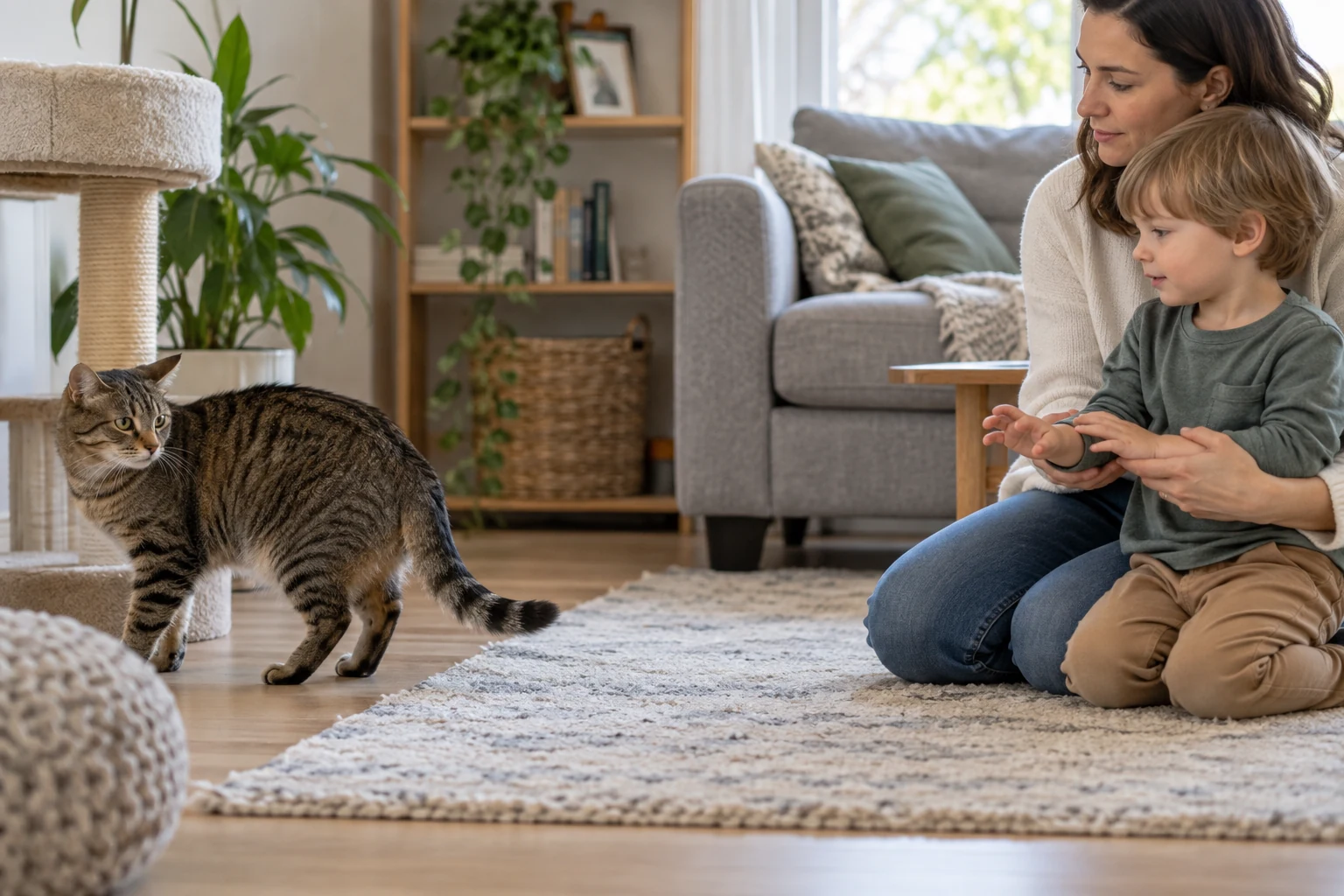
The Health Service Executive's child-safety guidance tells caregivers to supervise children around cats, teach calm and quiet behavior, avoid rough play, and leave cats alone when they are eating, sleeping, or toileting 2. It also lists body-language warnings such as hissing, yowling, an arched back, bared teeth, and ears flattened back 2.
For a preschooler, translate those signs into a short table:
| Cat clue | What the child hears | What the adult does |
|---|---|---|
| Tail flicks, thumps, or lashes | "Tail says stop." | Move the child back |
| Ears turn sideways or flatten | "Ears need quiet." | End touching or play |
| Cat turns head or body away | "Cat is done." | Block following |
| Cat crouches, hides, or freezes | "Cat needs space." | Clear the room around the cat |
| Hiss, growl, swat, scratch, or bite | "We are already too close." | Separate calmly and check injuries |
If your cat has already bitten or scratched during child interactions, do not treat it as misbehavior alone. Read the warning pattern, change the setup, and review Por qué muerden los gatos so you can separate play, fear, pain, and overstimulation.
How do you teach tail, ear, and body clues without scaring the cat?
Teach cat body language when the cat is already calm and out of reach. Pointing, chasing, crowding, or making the cat "show" a signal turns the lesson into pressure for the cat.
The AAFP/ISFM cat-friendly interaction guidelines emphasize observing the cat's current emotional state and responding to it, while giving the cat a sense of control during interaction 3. At home, that means the adult narrates softly from a distance:
- "Her ears are forward. She looks relaxed."
- "Her tail is moving fast. We are stopping."
- "He looked away. That means we wait."
- "She walked to the cat tree. We wave goodbye."
Use one cue at a time. Preschoolers do not need a full feline behavior lecture. They need a reliable connection between what they see and what they do next.
Start with tail clues because they are easy to see from across the room. Then add ears. Then add body direction and movement. Save more subtle clues, such as whisker tension or pupil size, for older children or adults. The child does not need to judge every detail to be safe.
Keep your wording neutral. Do not say "bad tail" or "mean ears." Try "busy tail," "sideways ears," "cat is unsure," or "cat needs more room." This helps the child see the signal as communication, not as the cat being naughty.
For more adult-level behavior context, browse the SnuggleSouls Guías sobre el comportamiento de los gatos and then convert what you learn into preschool-sized rules.
What should your child do when the cat walks away?
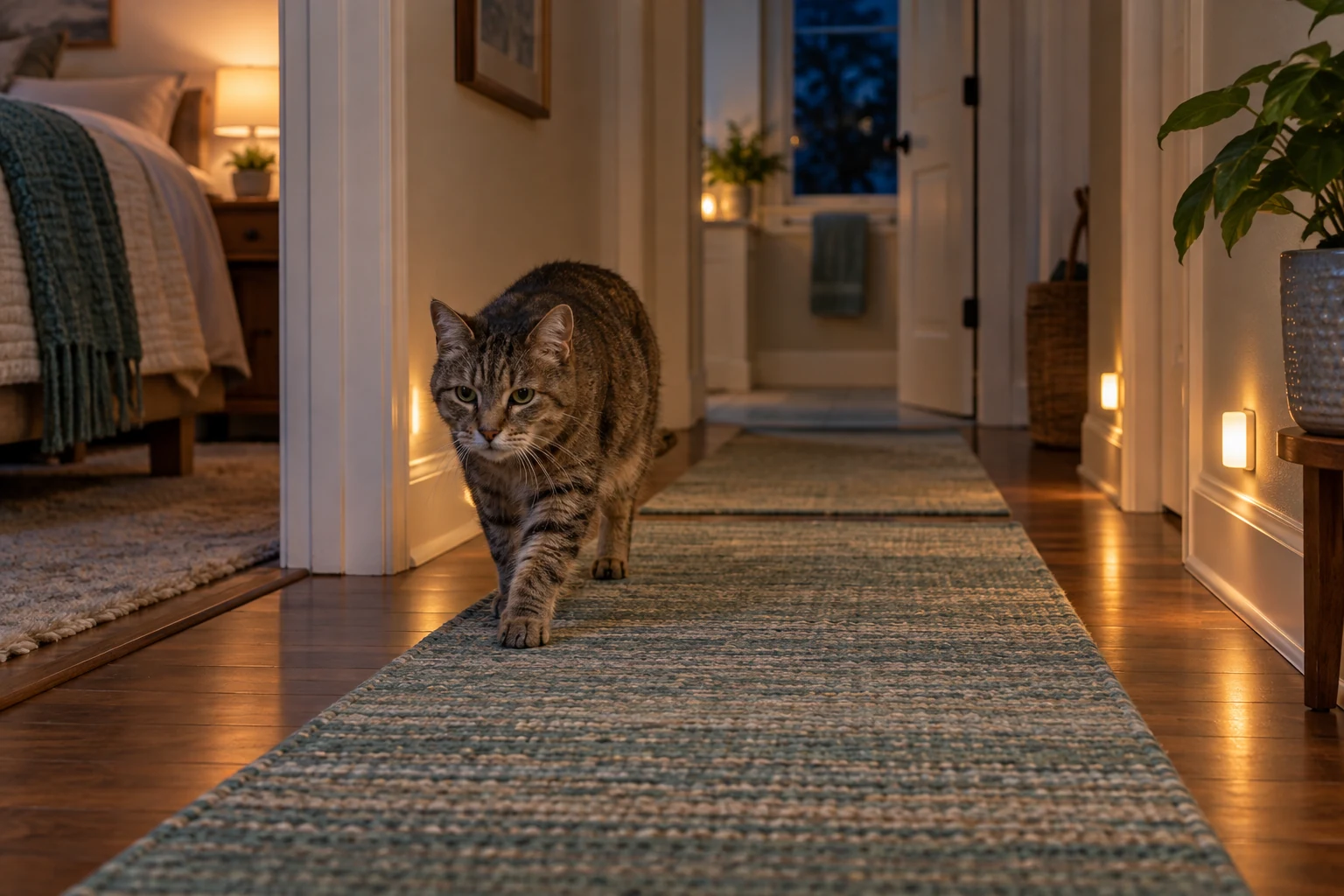
When the cat walks away, the child should stop, keep hands back, and wave goodbye. No following, calling, grabbing, blocking doorways, or trying one more pet.
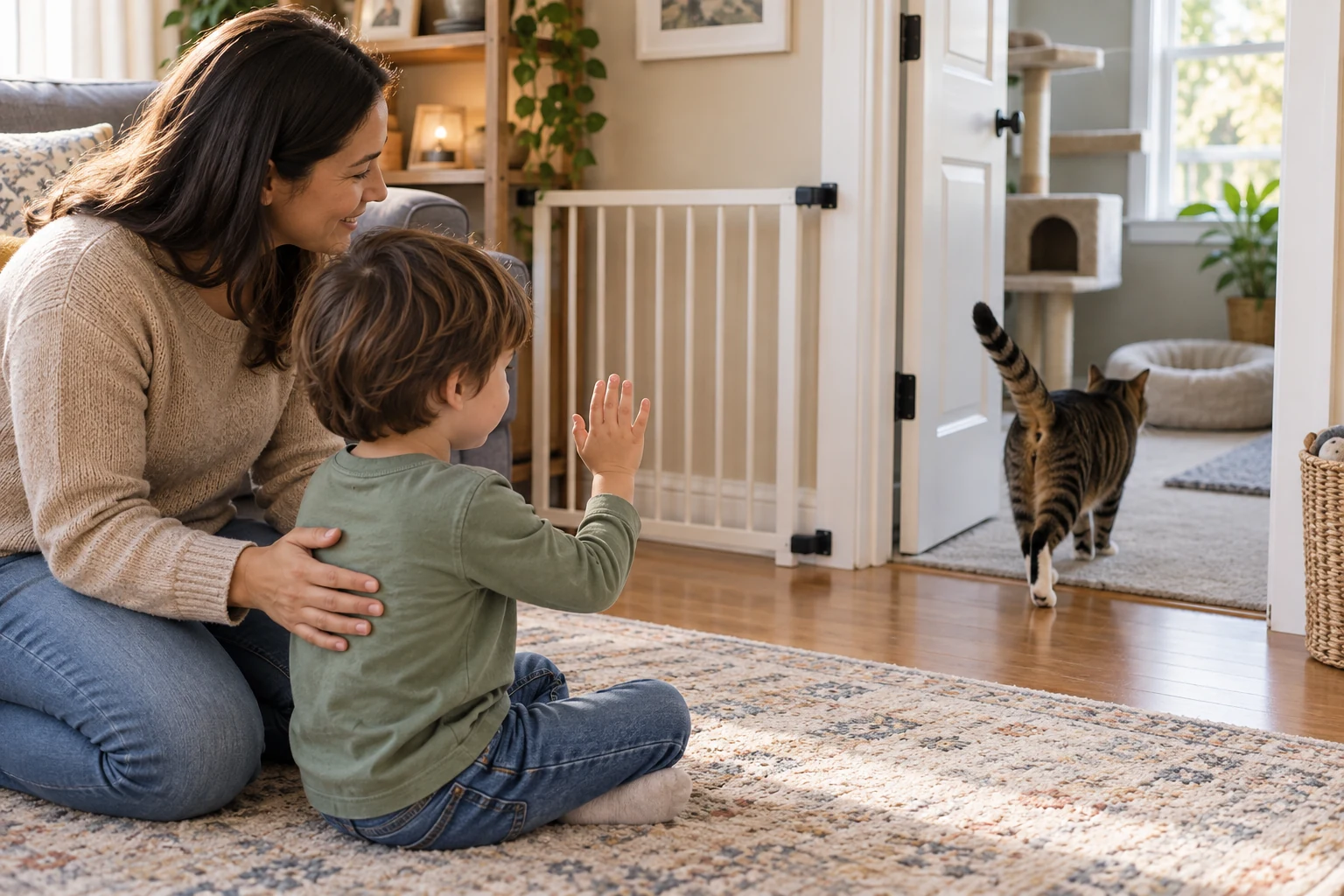
The AAFP/ISFM environmental needs guidelines describe positive human-cat interaction as contact the cat can initiate, control, and end. They specifically support letting the cat move away without forced contact 4. That idea is abstract for preschoolers, so turn it into a ritual:
- Cat moves away.
- Adult says, "Cat said all done."
- Child puts hands on belly.
- Child waves goodbye.
- Adult redirects the child to another activity.
Practice this when nothing is wrong. A plush cat can "walk away" from the child. A parent can pretend to be the cat leaving a room. The goal is to make stopping feel normal before the real cat needs it.
If your child has a habit of following fast-moving pets, use gates, furniture placement, and adult positioning from stop a toddler from chasing the cat. Preschoolers are older than toddlers, but excitement can still outrun impulse control.
Praise the stop, not the petting. Say, "You let him leave. That was kind." This teaches that a successful interaction can end after five calm seconds.
How can adults supervise practice in real rooms?
Adults should set up the room so the right choice is easy: child seated or standing beside the adult, cat above or several feet away, an open exit route, and a clear plan for ending the interaction.
Before practice, check the room:
- The cat has a high perch, doorway, or safe room available.
- The child is not between the cat and the exit.
- Food bowls, litter boxes, resting spots, and hiding places are off limits.
- The adult can reach the child faster than the child can reach the cat.
- The session has a planned ending after one short look, toss, or stroke.
The Frontiers study on human-cat interaction guidelines used the simple idea of giving the cat choice and control, paying attention to the cat's behavior and body language, and limiting touch. In that study, people who received brief best-practice guidance interacted in ways linked with more positive cat behavior and less aggression or conflict behavior 5.
At home, that becomes "watch more than touch." A preschooler can help toss a soft toy away from the cat, choose which wand toy the adult uses, or sit with hands in lap while the adult plays. If you need a safer play structure, use the SnuggleSouls guide on Cómo jugar con tu gato and keep the child as a helper, not the toy handler, until they are steady.
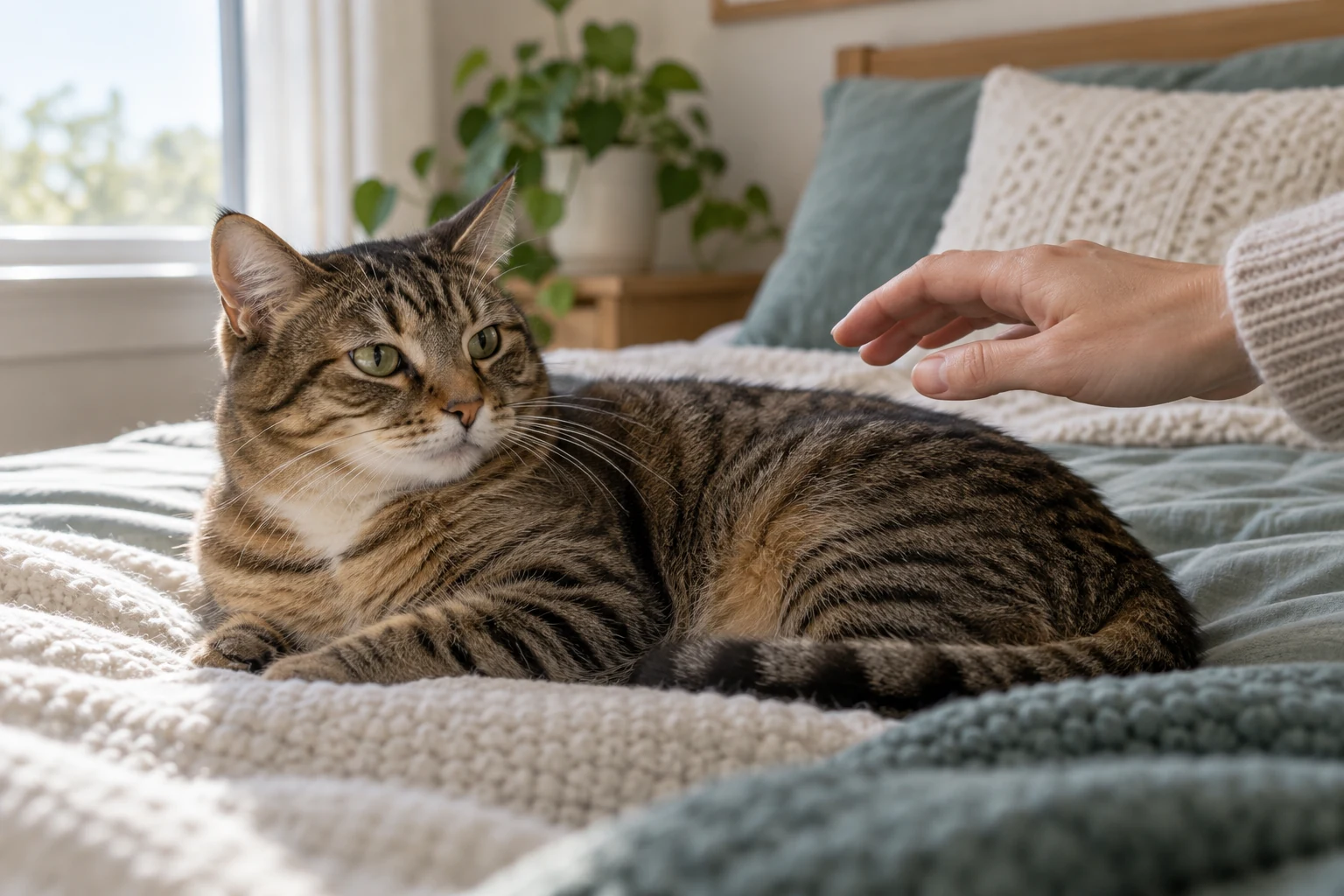
Limit touch to one or two calm strokes on the shoulder or upper back only when the cat stays relaxed and free to leave. Do not allow tail touching, belly rubbing, paw holding, face-to-face contact, hugging, carrying, kissing, or trapping. These are too risky for many preschoolers and too restrictive for many cats.
What mistakes make cat body language lessons unsafe?
The biggest mistake is using the cat as the practice tool before the child understands the stop routine. Teach the words, body position, and goodbye routine first, then involve the cat only when the adult can control the distance.
Common mistakes include:
- Asking the child, "Do you think the cat wants pets?" while the child is already reaching.
- Letting the child follow the cat to "check" if the cat still wants attention.
- Treating a tail flick as cute instead of ending the interaction.
- Laughing when the cat warns the child.
- Allowing one more pet after the cat turns away.
- Teaching only "gentle hands" without teaching "hands away."
- Expecting the cat to tolerate noise because the child means well.
Do not punish the cat for communicating. A hiss, growl, swat, scratch, or bite usually means the earlier signals were missed or the cat felt cornered. Your response should be calm separation, not scolding or forced handling.
Do not shame the child either. Preschoolers learn through repetition. Use the same script every time: "Cat said stop. Hands back. We wave goodbye." Then help them succeed with a new job, such as putting a toy in a basket or choosing a book to read away from the cat.
When should cat behavior or injuries get extra help?
Get extra help if your cat repeatedly hisses, swats, scratches, bites, hides from the child, guards routes, stops eating normally, avoids the litter box, or seems painful when touched. Also get medical care promptly for any bite, deep scratch, puncture, swelling, redness, fever, or injury near the eye or face.
Some stop signals are about the child's behavior. Others may reflect pain, illness, fear, or chronic stress. A cat who suddenly flinches, growls, hides, or reacts to touch may need a veterinary exam, especially if the pattern is new.
Call your veterinarian if your cat's reactions change quickly, if the cat seems painful, or if the cat cannot relax around normal household movement. Consider a qualified feline behavior professional if the cat is healthy but the home setup, child behavior, or escape routes need a safer plan.
For the child, treat scratches and bites seriously. Wash minor wounds with soap and water, follow local medical guidance, and contact a healthcare professional if you are unsure. A preschooler should also learn to tell an adult immediately if they were scratched or bitten, even if they were breaking a rule.
Conclusion: Make the cat's no easy to honor
Preschoolers can learn cat body language when adults keep the lesson simple: watch the whole cat, stop early, hands back, and wave goodbye when the cat leaves. The goal is not a child who can label every signal. The goal is a cat who does not need to escalate and a child who learns that the cat's no counts.
Start with one cue this week. Tail says stop. Ears need quiet. Cat walked away, so we wave goodbye. Small, repeated routines protect the cat, lower the chance of scratches or bites, and help your child build real empathy instead of just memorizing pet rules.
Preguntas frecuentes
Can a preschooler really understand cat body language?
Yes, but only in simple action-based terms. A preschooler can learn "tail moving fast means stop" or "cat walked away means wave goodbye." They should not be expected to judge subtle stress signs without an adult.
What is the easiest cat body language sign to teach first?
Start with walking away because the action is obvious and the rule is clear. When the cat leaves, the child stops and waves goodbye. After that, teach tail flicking and sideways or flattened ears as early stop signs.
Should I let my child pet the cat if the cat looks relaxed?
Only if an adult is close, the cat is awake and free to leave, and the child can stop after one or two gentle strokes. A relaxed cat still needs choice. If the cat turns away, crouches, flicks the tail, or walks off, the interaction ends.
What if my child keeps following the cat?
Use gates, closed doors, adult positioning, and shorter practice sessions. Do not rely on reminders alone. The setup should stop the chase before it starts, then you can practice "hands back" and "wave goodbye" when everyone is calm.
Is hissing always a bad sign?
Hissing is communication that the cat feels threatened, crowded, or overwhelmed. It is not something to punish. Treat it as a sign that the adult needs to create more distance, protect the cat's exit, and review earlier body-language cues.
Referencias
[1] Cats Protection. (2026). Cats and Children. Cats and Children
[2] Health Service Executive. (2022). Cats – teaching your child to be safe. Cats – teaching your child to be safe
[3] Rodan, I., Dowgray, N., Carney, H. C., Carozza, E., Ellis, S. L. H., Heath, S., Niel, L., St Denis, K., & Taylor, S. (2022). 2022 AAFP/ISFM Cat Friendly Veterinary Interaction Guidelines: Approach and Handling Techniques. Revista de Medicina y Cirugía Felina
[4] Ellis, S. L. H., Rodan, I., Carney, H. C., Heath, S., Rochlitz, I., Shearburn, L. D., Sundahl, E., & Westropp, J. L. (2013). Directrices de la AAFP y la ISFM sobre las necesidades ambientales de los gatos. Revista de Medicina y Cirugía Felina
[5] Haywood, C., Ripari, L., Puzzo, J., Foreman-Worsley, R., & Finka, L. R. (2021). Providing Humans With Practical, Best Practice Handling Guidelines During Human-Cat Interactions Increases Cats' Affiliative Behaviour and Reduces Aggression and Signs of Conflict. Frontiers in Veterinary Science
 EN
EN DE
DE ES
ES PT
PT