
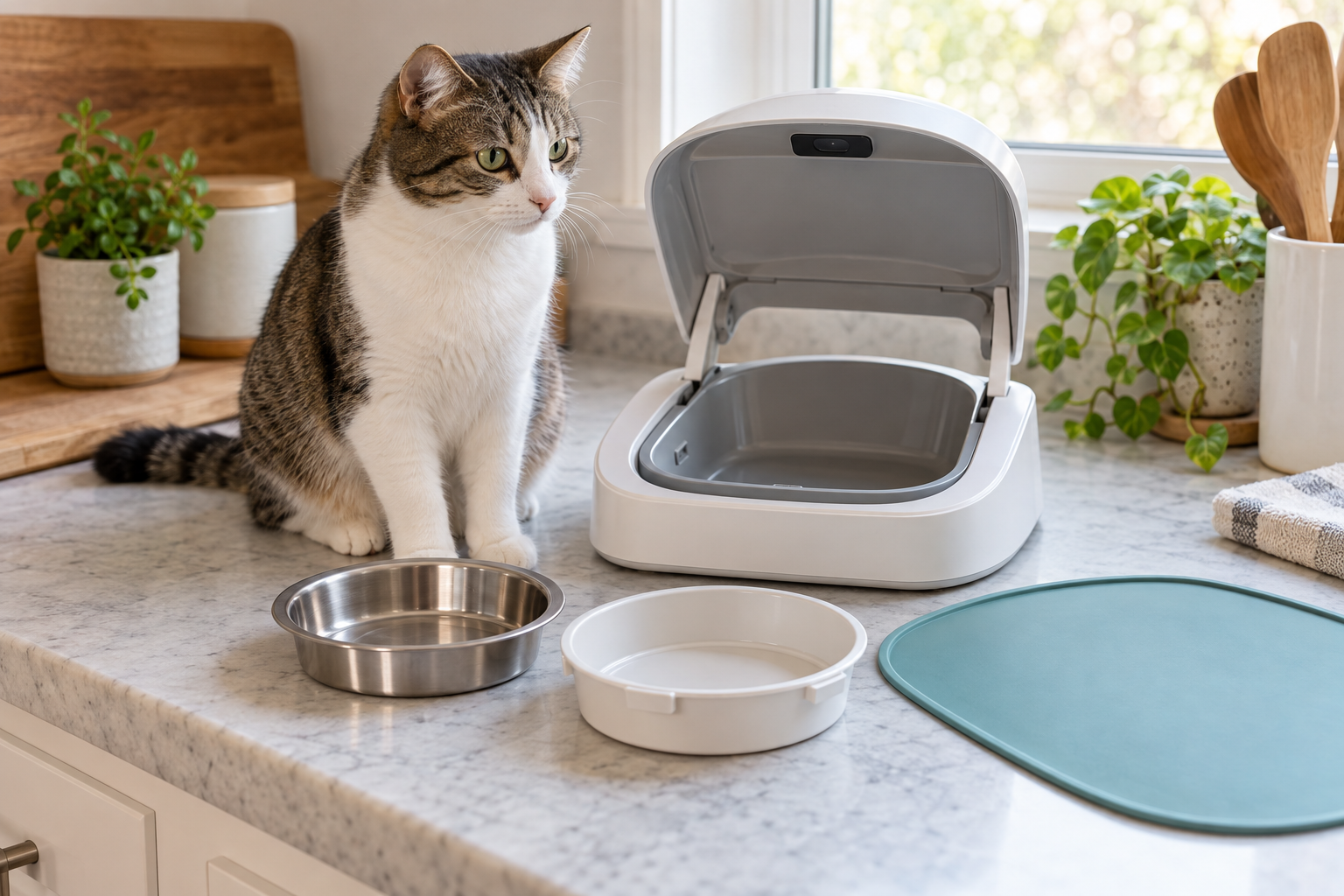
Microchip feeder bowl inserts for cats should be easy to clean, secure in the feeder, comfortable for your cat, and replaced when scratches, odor, warping, or poor fit make them hard to keep fresh.
Stainless steel is often the easiest everyday choice for wet food and odor control. Plastic inserts can still be useful when they fit the feeder well or help you color-code cats, but they need closer inspection and replacement sooner if they become scratched, cloudy, stained, or smelly.
Índice
- Should you choose stainless steel or plastic inserts?
- When is a plastic insert still okay?
- How do you keep odor from building up?
- What replacement clues mean the insert is done?
- How do you check that a replacement insert fits?
- What should you do with wet food inserts?
- How do you keep the feeder routine working?
- When should you call your vet or the feeder maker?
- Conclusion: Choose the Insert You Can Keep Truly Clean
- Preguntas frecuentes
- Referencias
Should you choose stainless steel or plastic inserts?
Choose stainless steel if odor control, frequent wet-food washing, and easy visual inspection are your priorities. Choose plastic only when it is smooth, intact, compatible with the feeder, and easy enough for you to wash thoroughly after meals.
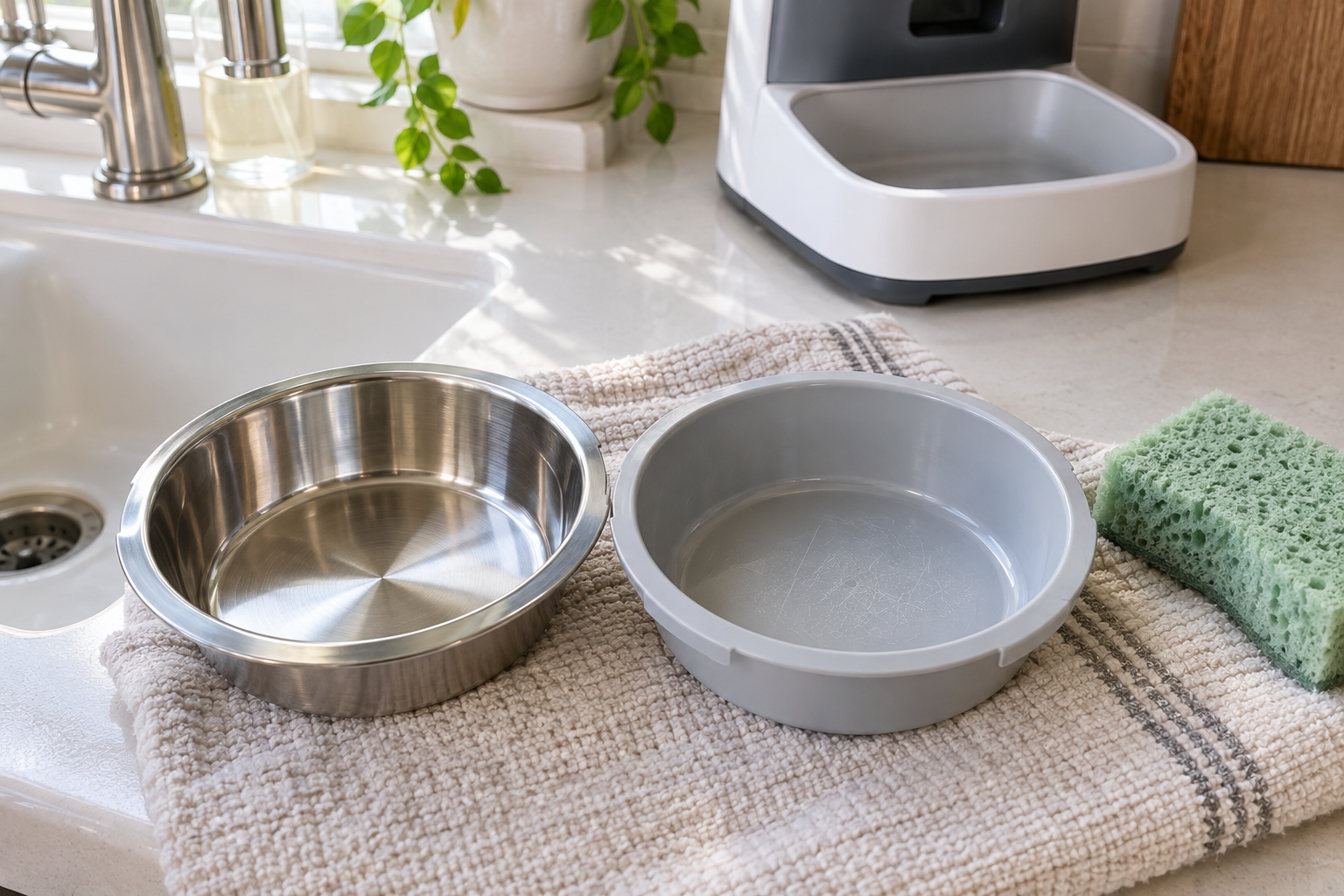
Stainless steel is often easier to inspect, while plastic inserts need closer checks for scratches, staining, and lingering odor.
The insert is a small part of the feeder, but it is the part your cat's food and saliva touch every day. FDA pet-food safety guidance says pet food bowls and measuring utensils should be washed with soap and hot water after each use 1. CDC pet-supply guidance gives a practical schedule: clean bowls after every wet-food use and daily for dry food and water 2.
That cleaning load is why material matters. Stainless steel inserts tend to be durable, smooth, and easy to check for leftover film. They also make sense if you feed wet food, prescription food, or mixed meals and need a bowl that survives frequent washing.
Plastic inserts have two main advantages: fit and convenience. Original plastic inserts may sit perfectly in the feeder, match divided-bowl accessories, or let you assign a color to each cat. The tradeoff is that plastic can show wear in ways that matter for hygiene: scratches, rough edges, cloudiness, staining, and odor that remains after washing.
Use this quick comparison:
| Insert choice | Best fit for | Watch closely for |
|---|---|---|
| Stainless steel | Wet food, frequent washing, odor-sensitive homes | Bent rim, loose fit, noisy movement, damaged silicone edge if present |
| Plástico | Color-coding, original manufacturer fit, quieter bowls | Scratches, cloudy surface, stains, sticky feel, lingering smell |
| Divided insert | Wet/dry split or medication separation | Food trapped in corners, uneven cleaning, cat avoiding one side |
| Spare insert set | Rotating clean bowls through the day | Mixing up cats, using a damaged spare too long |
If your cat has a history of chin acne, plastic bowls deserve extra caution. PetMD notes that cats eating or drinking from plastic bowls may be at risk for cat acne, and its treatment guidance includes switching plastic bowls to stainless steel, glass, or ceramic and cleaning dishes more often 4. That does not mean every cat reacts to every plastic bowl, but it is a strong reason to replace worn plastic sooner and involve your veterinarian if chin bumps, redness, crusts, or pain appear.
When is a plastic insert still okay?
A plastic insert is still okay when it is made for your feeder, sits flat, has a smooth intact surface, washes clean without odor, and does not irritate your cat's chin or change your cat's willingness to eat.
Plastic is not automatically a disaster. Many microchip feeders ship with plastic inserts because they are light, quiet, shaped for the lid, and easy to color-code. If your cat is nervous around clanking sounds, a quiet plastic insert may even help while you are training the feeder.
Keep plastic in the rotation only when it passes all of these checks:
- The insert fits the feeder without rocking.
- The rim feels smooth under your finger.
- There are no cracks, chips, rough seams, or peeling areas.
- Scratches are faint and do not hold residue.
- Wet food washes away without a greasy film.
- The bowl smells neutral after washing and drying.
- Your cat's chin looks normal after meals.
- The insert does not interfere with the feeder lid.
Replace plastic sooner if it becomes the bowl you keep apologizing for in your head. If you have to scrub harder each week, if the bowl smells like old food after washing, or if gravy collects in a worn corner, the insert has stopped doing its job.
How do you keep odor from building up?
Prevent odor by removing leftovers promptly, washing the insert after wet-food meals, drying it fully, and keeping the feeder body dry. Odor usually comes from residue, saliva, old wet food, trapped moisture, or scratches that are harder to clean.
The basic cleaning rhythm is simple: food out, bowl washed, bowl dried, feeder checked. FDA guidance says unused or leftover canned and pouched pet food should be refrigerated or thrown out promptly, and refrigerated pet food should be tightly covered 1. CDC explains that cleaning removes dirt and germs with soap or detergent, while disinfecting is a separate chemical step for situations that need it 2.
For a microchip feeder, follow the manufacturer first. Sure Petcare's feeder cleaning guidance says to remove the mat and bowl, wash them in warm soapy water, remove and wash the lid, pat all pieces dry, and never place the feeder body in water 3. It also recommends cleaning the bowl after every feeding and before adding more food 3.
Use this odor-control routine:
- Throw away questionable leftovers instead of topping them up.
- Rinse the insert before wet food dries into the corners.
- Wash with warm soapy water and a soft sponge.
- Use a soft brush for seams or divided-bowl corners.
- Rinse until no soap film remains.
- Dry completely before putting the insert back.
- Wipe the feeder deck if food touched it.
- Keep the electronic body away from running water.
For a full feeder cleaning sequence, use the SnuggleSouls guide on how to clean a microchip feeder for cats. The insert can be spotless while the lid groove or mat edge still holds food odor, so check the whole feeding station when smells linger.
What replacement clues mean the insert is done?
Replace a microchip feeder bowl insert when it is cracked, chipped, warped, rough, cloudy, permanently stained, smelly after washing, unstable in the feeder, or irritating your cat's chin. Do not wait for the bowl to look dramatic.
Small damage matters because the insert touches food every day. A worn insert can hold residue, make wet food smell stale, or change how the feeder lid closes. A sharp or rough rim can also make some cats avoid the bowl.
Use this replacement table:
| Clue | Qué puede significar | Un siguiente paso más seguro |
|---|---|---|
| Lingering odor after washing and drying | Residue is trapped in scratches or seams | Replace the insert and clean the feeder deck |
| Cloudy plastic or sticky feel | Surface wear or film remains after washing | Retire that insert from food use |
| Visible scratches inside the bowl | Food and saliva may cling more easily | Replace, especially for wet food |
| Cracked rim or chipped corner | Cleaning and safety problem | Stop using it |
| Insert rocks or sits unevenly | Poor fit, warped insert, or crumbs underneath | Clean the base, then replace if still unstable |
| Lid catches near the bowl | Insert may be mis-seated or incompatible | Do not use until fit is corrected |
| Chin bumps or redness | Possible acne or irritation | Switch bowl material and call your vet if signs persist |
Avoid sanding, trimming, heating, gluing, or filing a food bowl insert unless the manufacturer specifically provides that repair. Homemade fixes can leave rough edges or materials that are not meant for food contact. If an insert no longer fits safely, replacing it is the cleaner decision.
How do you check that a replacement insert fits?
Check a replacement insert with the feeder empty before you add food. It should sit flat, match the bowl recess, leave the lid path clear, and lift out easily for cleaning without scraping, wobbling, or jamming.
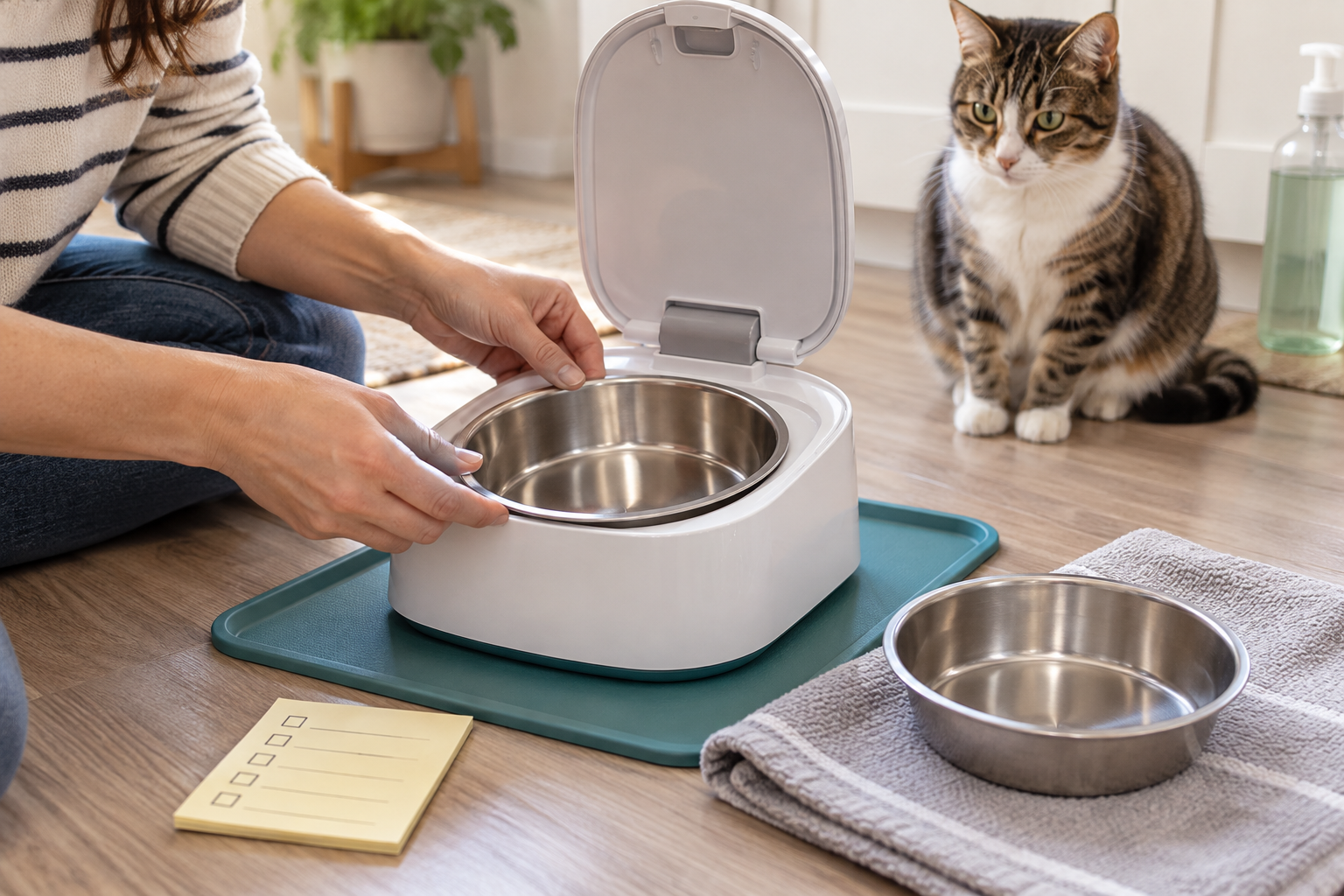
A replacement insert should sit flat, leave the lid path clear, and feel smooth around every edge before food goes in.
A bowl insert can look close enough and still be wrong for daily use. Microchip feeders rely on the bowl, mat, lid, and sensor area working together. If the insert sits too high, shifts forward, or blocks the lid, your cat may get a startling close, a delayed open, or a feeding station that no longer feels safe.
Use this fit test:
- Place the clean empty insert in the feeder.
- Press gently around the rim to confirm it sits flat.
- Open and close the lid through its normal motion.
- Check that the lid does not touch the bowl rim.
- Lift the insert out and put it back twice.
- Run a finger around the rim for rough spots.
- Add a small amount of food and check for rocking.
- Watch your cat's first meal without crowding them.
If the feeder has a scale, app tracking, or meal-weight feature, be more conservative. A non-original insert that changes weight distribution could affect tracking. If the feeder starts logging oddly, opening late, or closing unevenly after a bowl swap, return to the original insert and ask the manufacturer about compatible replacements.
What should you do with wet food inserts?
Wet food inserts need the strictest routine: serve measured portions, pick up leftovers, refrigerate unused canned or pouched food, and wash the insert before adding more. Do not use a protected feeder as permission to leave wet food out indefinitely.
Wet food dries, smells, and sticks faster than dry food. It also makes it harder to tell whether odor is coming from the food, the insert, the mat, or the lid area. If your cat eats slowly from a protected feeder, use a smaller portion and refill with a clean insert rather than building a long-running pile of old and new food.
Helpful wet-food habits:
- Use one clean insert per wet-food meal when possible.
- Keep a spare insert so a washed bowl can dry fully.
- Measure portions before loading the feeder.
- Label leftover food before refrigerating it.
- Toss food if timing is uncertain.
- Wash the insert before adding the next serving.
- Check divided bowls carefully because corners trap food.
For storage timing and toss-it clues, use the SnuggleSouls wet cat food storage guide. If you are adjusting amounts, the guides to cat food feeding directions, how to weigh wet cat food portions, and how to use a kitchen scale for cat food portions can help you keep the feeder from becoming a guesswork bowl.
How do you keep the feeder routine working?
Keep the routine working by treating inserts as part of the whole feeding system: correct cat, correct food, clean bowl, calm location, and a feeder that opens reliably. Bowl swaps should make the routine easier, not louder, smellier, or more confusing.
Merck Veterinary Manual notes that automatic feeders can help manage a cat's daily intake and prevent overfeeding or underfeeding, while also emphasizing that cats often prefer quiet eating areas and separate stations in multi-pet homes 5. That is exactly where microchip feeders can help, as long as the insert does not create a new problem.
If the feeder is solving food stealing or different diets, read the broader SnuggleSouls guide to microchip feeders for cats. If your cat is still nervous around the lid, bowl noise, or feeding station, go back to gradual training with the guide on how to introduce a microchip feeder to a scared cat.
Watch for these routine clues:
| What changes after a new insert | Likely issue | Qué probar |
|---|---|---|
| Cat stretches but will not put head in | Bowl noise, smell, or lid concern | Return to training mode and use a familiar insert |
| Lid bumps or pauses | Insert is too high or mis-seated | Remove, reseat, and test empty |
| Food thief hovers again | Station layout problem | Add distance, barrier, or supervision |
| App or scale readings seem odd | Bowl weight or fit changed | Use approved inserts or ask manufacturer |
| Cat eats less from every bowl | May be medical, not feeder related | Call your veterinarian |
The goal is a boring routine: clean insert, correct portion, calm cat, predictable lid. If a new bowl makes every meal feel like a troubleshooting session, it is not the right insert for that household.
When should you call your vet or the feeder maker?
Call the feeder maker for fit, lid, sensor, water-damage, scale, app, or replacement-part questions. Call your veterinarian for appetite changes, vomiting, diarrhea, weight loss, chin pain, skin lesions, or any sign that the feeding problem may be medical.
Use this split:
| Situación | Póngase en contacto con |
|---|---|
| Replacement insert rocks, jams, or blocks the lid | Feeder manufacturer |
| Sensor stops recognizing the correct cat after cleaning | Feeder manufacturer |
| Feeder body got wet | Feeder manufacturer before reuse |
| Cat develops chin bumps, redness, crusts, or pain | Veterinarian |
| Cat refuses food for a day or seems weak | Veterinarian promptly |
| Cat vomits repeatedly or has severe diarrhea | Veterinarian promptly |
| Cat strains to urinate or produces little urine | Emergency veterinary care |
| Cat on prescription food is losing access to meals | Veterinarian and feeder manufacturer if device-related |
Do not assume a feeder or insert caused every change. A cat may avoid a bowl because it smells odd, but reduced appetite can also come from dental pain, nausea, stress, kidney disease, diabetes, infection, or another health problem. Feeding tools support care; they do not diagnose a cat.
Conclusion: Choose the Insert You Can Keep Truly Clean
The best microchip feeder bowl insert is not just the one that looks tidy on day one. It is the one that fits the feeder, feels comfortable to your cat, washes clean after real meals, and gets replaced before wear turns into odor or residue.
For many homes, stainless steel is the simplest upgrade. For others, a smooth original plastic insert is fine while it is intact and easy to clean. Either way, keep a spare, wash after wet-food meals, dry fully, and inspect the rim, corners, and lid path often. A small bowl insert can make the whole feeder routine calmer when it stays clean, secure, and predictable.
Preguntas frecuentes
Are stainless steel inserts better than plastic for microchip feeders?
Often, yes. Stainless steel inserts are usually easier to inspect, durable, and well suited to frequent washing. Plastic can still work if it is smooth, clean, undamaged, and compatible with the feeder.
How often should I replace plastic microchip feeder bowls?
Replace plastic inserts when they become scratched, cloudy, stained, smelly after washing, warped, or rough around the rim. If your cat has chin acne or skin irritation, ask your veterinarian whether to switch away from plastic sooner.
Can I put microchip feeder inserts in the dishwasher?
Only if the insert is labeled dishwasher-safe by the feeder maker. Some feeder guidance allows bowl inserts in the dishwasher but requires mats, lids, and feeder bodies to be hand washed or wiped only.
Why does my feeder bowl smell even after washing?
Odor can come from dried wet food, scratches, residue under the rim, a dirty mat, lid grooves, or food left too long before pickup. Replace the insert if the smell remains after careful washing and drying.
Can I use a third-party replacement insert?
Only if it fits safely and does not interfere with the lid, sensor, scale, or app functions. Test it empty first, watch the first meals, and use manufacturer-approved parts when your feeder has weight tracking or a moving lid.
What bowl material is best for cats with chin acne?
Many veterinary resources recommend switching away from plastic to stainless steel, glass, or ceramic for cats with chin acne concerns. Call your veterinarian if your cat has chin bumps, redness, crusts, swelling, pain, or repeated flare-ups.
Referencias
[1] U.S. Food and Drug Administration. (2024). Tips for Safe Handling of Pet Food and Treats. Tips for Safe Handling of Pet Food and Treats
[2] Centers for Disease Control and Prevention. (2026). About Cleaning and Disinfecting Pet Supplies. About Cleaning and Disinfecting Pet Supplies
[3] Sure Petcare. (2026). How to Clean Your SureFeed Microchip Pet Feeder and Microchip Pet Feeder Connect. How to Clean Your SureFeed Microchip Pet Feeder and Microchip Pet Feeder Connect
[4] PetMD. (2024). Cat Acne. Cat Acne
[5] Manual Veterinario de Merck. (2025). Proper Nutrition for Cats. Proper Nutrition for Cats

 EN
EN DE
DE ES
ES PT
PT