
If you are wondering how long are cats pregnant, the short answer is that most queens carry their kittens for about 63–65 days, or roughly nine weeks. That said, the exact due date is not always easy to predict at home because many owners are counting from the first mating they noticed, not from ovulation or a confirmed conception date. Research and veterinary sources therefore describe both a practical owner-facing average and a broader observed range.
What matters most is not chasing a perfect calendar day. It is understanding what changes are normal in each stage of cat pregnancy, when a veterinarian can confirm how far along your cat is, and which signs mean you should stop monitoring at home and get help quickly. This guide brings those answers together in one cleaner, more useful format.
Quick Answer / Key Takeaways
- Most cats are pregnant for 63–65 days, though timing can vary depending on how the pregnancy is dated.
- Early signs are often subtle, but pinking of the nipples, a mild appetite change, and a gradually rounding belly are common clues.
- A veterinarian may estimate pregnancy stage through palpation, ultrasound, or X-ray, depending on the week of pregnancy.
- In the last days before labor, many cats become more restless, spend more time nesting, and may eat less.
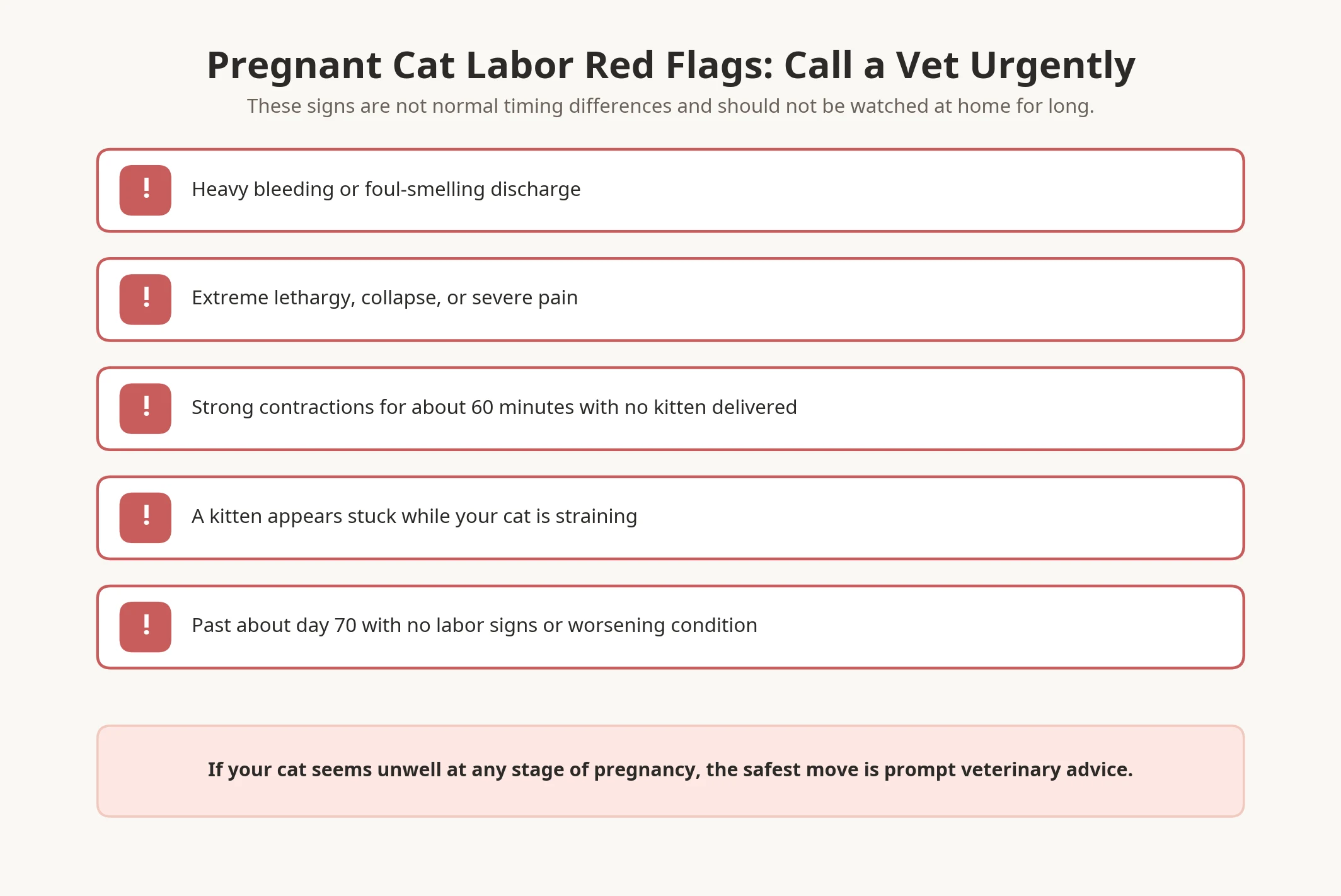
- Heavy bleeding, foul-smelling discharge, collapse, severe pain, or strong contractions with no kitten delivered are urgent reasons to call a veterinarian.
Table of Contents
What Is a Normal Cat Pregnancy Length?
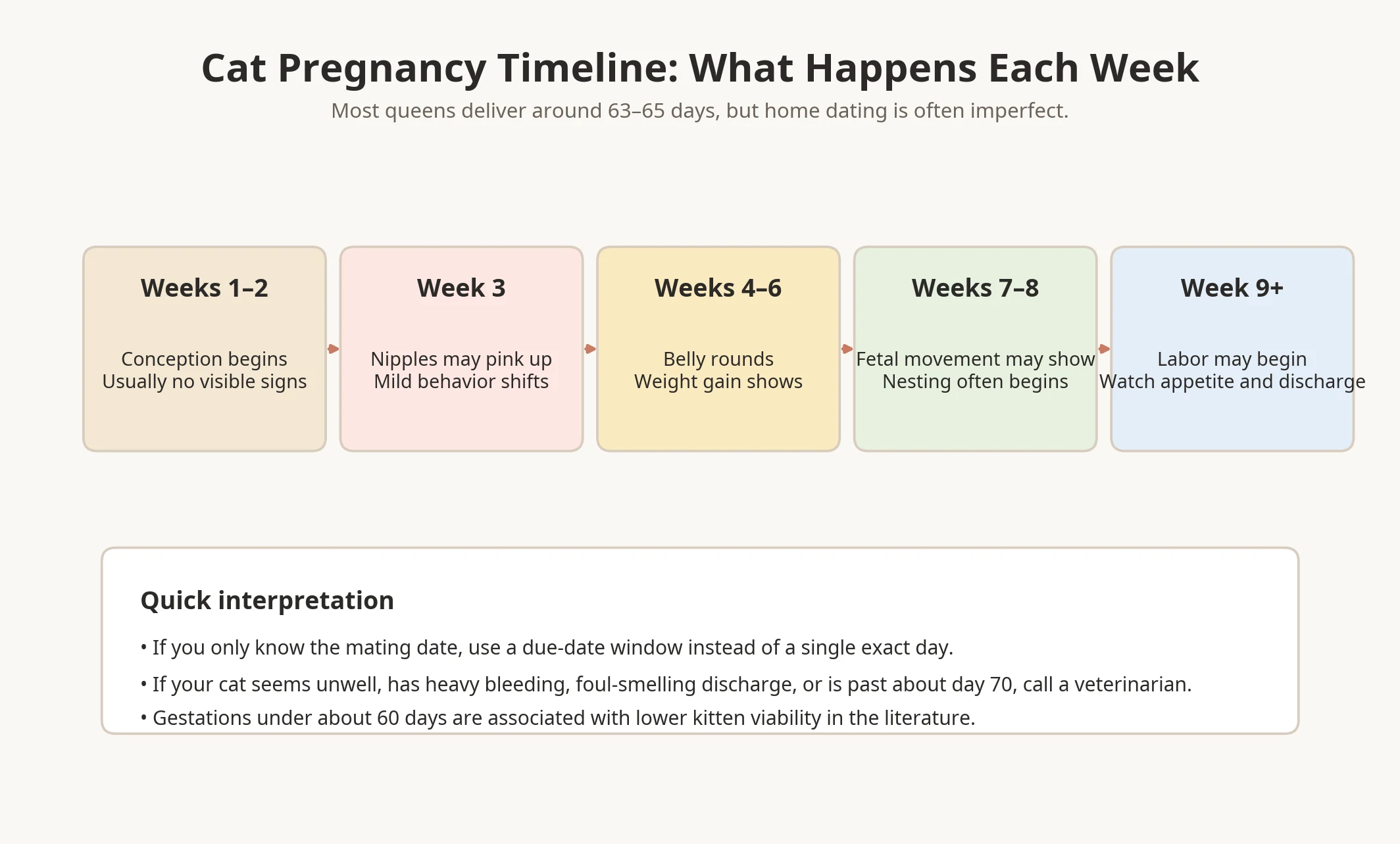
A normal cat pregnancy usually lasts around 63–65 days, which is why most owner guides translate feline gestation to “about nine weeks.” PetMD uses that average for practical home guidance, while a clinical review in Theriogenology reports an average gestation length of 65.6 days in domestic cats when counted from first or last mating.
The reason these numbers can look slightly different is that dating method matters. If an owner counts from a mating date, the range appears wider because cats may mate multiple times during a heat cycle, and ovulation does not always occur exactly when people assume it did. That is why scientific literature can report a broader range than the cleaner owner-facing answer you see in veterinary guides.
The table below shows the difference between a practical timeline and a broader research range.
| Timing frame | What it means for owners |
|---|---|
| 63–65 days | The most useful everyday answer for a typical healthy cat pregnancy. |
| About 58–70 days | A commonly cited practical range in consumer-facing veterinary guidance when exact dating is uncertain. |
| Broader research range up to 74 days | Seen in studies counting from first or last mating, which can overestimate how “late” a pregnancy truly is. |
One clinical point is worth remembering: gestations of less than about 60 days are associated with poorer kitten viability in the literature. In other words, a very early delivery is not just “a short pregnancy”; it can be a warning sign that the kittens may need urgent veterinary support.
Breed may also influence average timing slightly. One cited study found a mean gestation length of about 63 days in Siamese queens and 65 days in Persian queens, although the difference is not large enough to treat breed as a perfect due-date calculator. If your cat is older, has an unknown breeding date, or you are trying to estimate how far along she is, tools like this cat age calculator can help you think about life stage, but they should never replace a veterinary exam.
Cat Pregnancy Week by Week
The clearest way to understand cat pregnancy week by week is to think of it in three broad stages: early pregnancy, middle pregnancy, and the final stretch before labor. That is also how many veterinary references organize the topic, even when the exact signs vary from cat to cat.
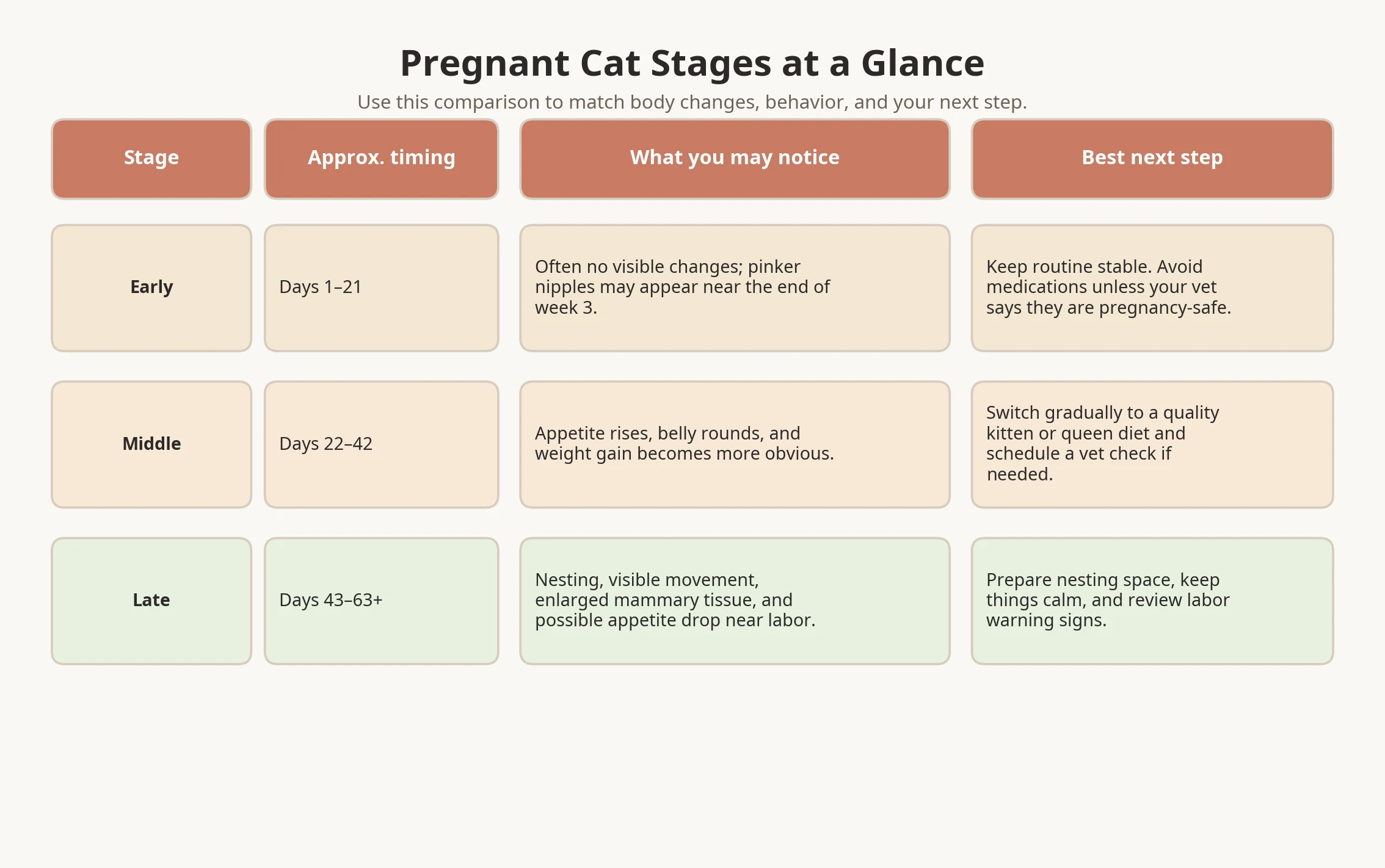
| Stage | Approximate timing | What is happening |
|---|---|---|
| Early stage | Days 1–21 | Fertilization, implantation, and early embryonic development. External changes may be minimal. |
| Middle stage | Days 22–42 | The abdomen begins to round, appetite often increases, and body changes become easier to spot. |
| Late stage | Days 43–63+ | Kittens grow rapidly, nesting behavior increases, and labor signs may begin as term approaches. |
In the first two to three weeks, many cats look completely normal. This is why owners are often caught off guard. One of the earliest clues is “pinking up,” when the nipples become pinker and slightly more prominent around the third week. Some cats also become more affectionate, calmer, or mildly nauseated, but these signs are easy to miss.
By weeks four to six, pregnancy usually becomes easier to recognize. The belly starts to round, your cat may gain weight more noticeably, and her appetite often rises. At this point, feeding becomes more than a comfort issue; it becomes part of pregnancy management. If you are reviewing food choices, it helps to compare them with guidance on what cats can safely eat and to monitor intake more deliberately, especially if your cat was very lean or overweight before pregnancy.
By weeks seven to nine, the pregnancy is often obvious even to someone who did not know the cat had been bred. Some owners can see gentle fetal movement when the cat is resting. Nesting behavior becomes more pronounced, the mammary glands enlarge, and many queens prefer quiet, hidden spaces. This is also when it is smart to read through signs a cat is giving birth before the first contraction starts, rather than trying to learn everything in the moment.
How To Tell How Far Along Your Cat Is
If the mating date is uncertain, the safest and most accurate answer comes from a veterinarian. Home clues are useful, but they are estimates. Veterinary sources note that pregnancy stage can be assessed through a combination of physical exam, ultrasound, and later X-ray findings.
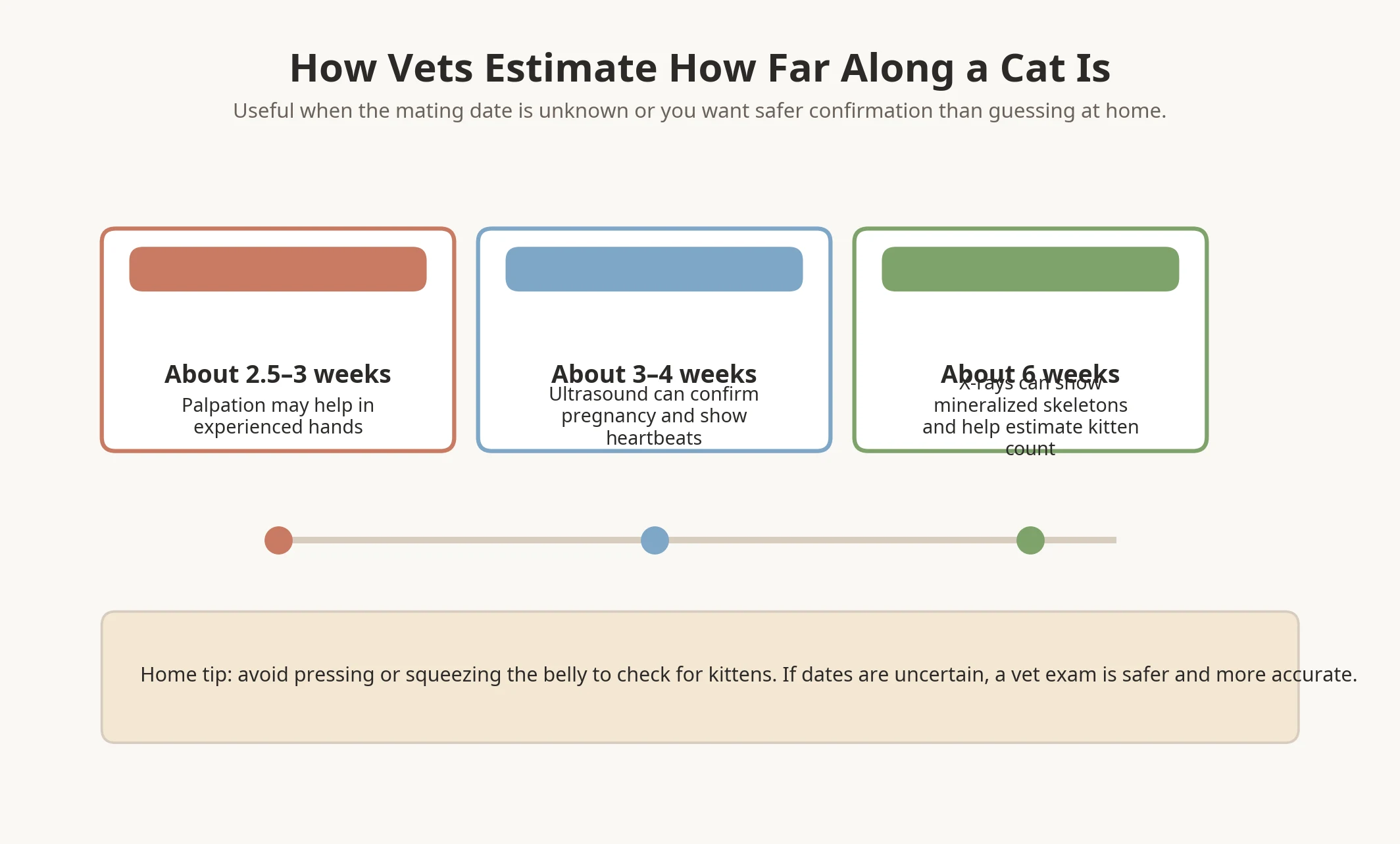
| Time in pregnancy | What a vet may use | Why it helps |
|---|---|---|
| About 2.5–3 weeks | Careful palpation in experienced hands | May help identify pregnancy without waiting for obvious body changes. |
| About 3–4 weeks | Ultrasound | Can confirm pregnancy and may show fetal heartbeats. |
| About 6 weeks | X-ray | Helps show mineralized skeletons and can estimate kitten count more reliably. |
This matters because owners often try to “check” the abdomen themselves. That is not a good idea. Pressing or squeezing a pregnant cat’s belly can cause pain and is not a reliable way to estimate fetal development. If dates are unclear, a veterinary visit is safer and more informative.
A veterinary exam is especially useful if you are trying to distinguish real pregnancy from a rare false pregnancy, or pseudopregnancy. Cats with pseudopregnancy can show mammary changes and even lactation without actually carrying kittens. That is one reason the article should not treat every pink nipple or appetite change as proof of pregnancy.
If your cat’s body condition is changing quickly, it can also help to keep a simple feeding and weight log. A tool like this cat calorie calculator can make monitoring easier, although calorie targets during pregnancy should still be confirmed with your veterinarian.
What Are the Most Common Signs of a Pregnant Cat?
The signs of pregnancy are easier to understand when grouped by what owners can observe at home instead of by isolated body parts. Veterinary guidance and competitor articles agree on the same main pattern: subtle early body changes, a more obvious mid-pregnancy belly, and late-pregnancy nesting plus mammary development.
The most recognizable early sign is pinking of the nipples, usually around the third week. Soon after that, many cats show a gradual rise in appetite, modest weight gain, and a fuller abdomen. Some become more affectionate and some become more withdrawn; both can be normal. By late pregnancy, the mammary glands enlarge, the belly is clearly round, and nesting behavior becomes easier to spot.
The table below can help separate common pregnancy signs from situations that deserve more caution.
| Sign | Often normal? | What to do |
|---|---|---|
| Pinker, more visible nipples around week 3 | Usually yes | Observe gently; do not squeeze or manipulate them. |
| Increased appetite in mid-pregnancy | Usually yes | Offer a complete, high-quality growth or pregnancy/lactation diet. |
| Gradual weight gain and a rounding belly | Usually yes | Monitor comfortably at home and mention changes at the next vet visit. |
| Nesting, hiding, or searching for quiet places late in pregnancy | Usually yes | Prepare a nesting area and read about why cats hide before labor. |
| Frequent vomiting, collapse, foul discharge, or severe pain | No | Contact a veterinarian promptly. |
One area that confuses many owners is milk. Some queens leak a small amount of milk or colostrum in the day or two before birth, but not every cat does. You may also see crusting around the nipples. That can be normal near term, but it does not mean you should offer dairy products. If you have questions about that myth, see this guide on can cats drink milk.
How To Care for a Pregnant Cat Safely at Home
Most pregnant cats do not need dramatic intervention. What they need is quiet structure, good nutrition, and thoughtful observation. That sounds simple, but it has a real effect on pregnancy comfort and kitten health.
Nutrition is the first priority. Purina Institute recommends transitioning queens to a highly digestible, nutritionally complete food designed for growth or pregnancy and nursing, such as a quality kitten formula or all-life-stages formula, ideally at or before breeding when possible. The food change should be made gradually over about seven days to reduce digestive upset. VCA similarly advises feeding a nutrient-dense growth diet during pregnancy and lactation.
A practical home rule is this: as the belly gets larger, smaller, more frequent meals often work better than one or two large meals. Late in pregnancy, the abdomen takes up space that would otherwise be available for the stomach, so splitting meals can keep your cat more comfortable. Wet food can also help support hydration.
Environment matters, too. Set up a quiet nesting area before labor begins so your cat does not choose the back of a closet, a laundry basket, or somewhere harder to supervise. A low-traffic room, clean towels, and easy access to food, water, and a litter box usually work well. If you want a more detailed care checklist, you can pair this guide with how to care for a pregnant cat.
Keep daily life calm. Avoid introducing new pets, loud house changes, or unnecessary travel late in pregnancy. Keep your cat indoors, and do not give medications, flea products, supplements, or dewormers unless your veterinarian says they are safe during pregnancy.
Cats Protection also emphasizes the importance of preparing for care after birth, especially if the queen is young, stressed, or inexperienced. In other words, pregnancy care is not only about the due date. It is about setting up the mother for a smoother delivery and better early nursing.
Labor Signs and When To Call a Vet
As term approaches, most queens begin to act differently. They may spend more time in the nesting area, become restless, groom their belly or rear more often, vocalize, or stop eating for a short period before labor. Veterinary sources also note that milk may appear in the mammary glands shortly before delivery.
These pre-labor signs can feel dramatic, but many of them are still normal. The real challenge is knowing when behavior has crossed the line from “labor is close” into “something is wrong.”
| Near-labor sign | Usually expected? | Why it matters |
|---|---|---|
| Nesting, pacing, or restlessness | Often yes | Many cats become unsettled as labor approaches. |
| Reduced appetite in the last day or so | Often yes | A short appetite drop can happen before labor. |
| Licking the genital area more often | Often yes | Part of pre-labor grooming and discomfort. |
| Heavy bleeding or foul-smelling discharge | No | Can suggest distress, infection, or labor complications. |
| Strong contractions for about an hour with no kitten | No | Needs urgent veterinary guidance. |
| Past about day 70 with no labor signs and your cat seems unwell | No | A veterinarian should assess the pregnancy promptly. |
If you remember only one section of this article, make it this one: normal late-pregnancy discomfort should not look like collapse, severe pain, or foul discharge. Those are not harmless timing differences.
Conclusion
So, how long are cats pregnant? In most cases, the most useful answer is about 63–65 days, or roughly nine weeks. That simple number is still the best starting point, but the fuller story is that dating can vary, visible changes do not always appear early, and the safest way to estimate how far along a cat is comes from a veterinary exam.
If you focus on the essentials—good nutrition, a calm indoor environment, a prepared nesting area, and clear awareness of urgent red flags—you will do a great deal to support both the queen and her kittens. And if something feels off, trust that instinct. It is always better to make one cautious vet call than to wait too long.
FAQ
How long is a cat pregnant in weeks?
Most domestic cats have a gestation period of 63 to 65 days (approximately nine weeks). However, because ovulation is induced by mating and can occur at different times during a heat cycle, a “normal” range is technically considered 58 to 70 days. If your cat exceeds 70 days from the last known mating, a veterinary consultation is essential to ensure the kittens have not become too large for a safe delivery.
What is the earliest sign that my cat may be pregnant?
One of the earliest visible signs is often pinking up of the nipples around the third week, although some cats show only subtle changes at first.
Can I tell how far along my cat is without a vet?
You can estimate based on appetite, belly shape, nipple changes, and nesting behavior, but the most accurate answer comes from palpation, ultrasound, or X-ray at the appropriate stage.
How many kittens do cats usually have?
A commonly cited average is about four kittens, though litter size can vary widely.
When should I worry that labor is not normal?
Call a veterinarian urgently if your cat has heavy bleeding, foul-smelling discharge, severe pain, collapse, or strong contractions for about an hour with no kitten delivered.
Can the breed of the cat affect the length of the pregnancy?
Yes. Clinical studies suggest slight variations: Siamese queens often have slightly shorter gestations (averaging 63 days), while Persian queens may lean toward the longer end (averaging 65 days). While these differences are marginal, they are useful for breeders tracking precise delivery windows.
Is there a “temperature drop” in cats like there is in dogs before labor?
While many owners use rectal temperature to predict labor in dogs, it is less reliable in cats. A cat’s temperature may drop below 100°F(37.8°) about 12 to 24 hours before labor, but many cats do not show this dip clearly, or the stress of taking the temperature may cause a spike, masking the sign. Monitoring behavioral changes (nesting/vocalizing) is generally more effective.
What is “pinking up” and when does it happen?
“Pinking up” is the most reliable early physical sign of feline pregnancy. Around day 15 to 18 (the third week), the nipples become larger and take on a deep pink or reddish color. This occurs as the body prepares for lactation and is often the first clue before the abdomen begins to distend.
Do cats get “morning sickness”?
Yes, though it is usually brief. Between weeks 3 and 4, some queens experience a period of nausea, lack of appetite, or occasional vomiting due to hormonal shifts and the stretching of the uterus. If vomiting persists for more than 48 hours or is accompanied by lethargy, contact a vet, as it may indicate an underlying issue rather than a normal pregnancy symptom.
Can I tell how many kittens are coming by looking at the belly?
No. External observation or “feeling” the belly (palpation) is highly inaccurate for counting. A veterinarian can provide a reliable count via X-ray after Day 45 (once fetal skeletons have mineralized). Knowing the count is vital so you know when labor is truly finished and no kittens are “trapped” inside.
Can a cat get pregnant again while she is already pregnant?
Though rare, a phenomenon called superfetation can occur. If a pregnant queen enters heat again and mates, she can conceive a second litter of a different age. This is dangerous, as the younger kittens are often born prematurely when the older litter goes into labor. Keeping a pregnant cat strictly indoors and away from intact males is the only way to prevent this complication.
References
[1] Clinical management of pregnancy in cats
[2] Cat Pregnancy: Signs, Stages and Care | PetMD
[3] Nutrition for Pregnant and Lactating Cats and Their Nursing Kittens | Purina Institute
[4] Feeding the Pregnant Cat | VCA Animal Hospitals
[5] Pregnancy and Kitten Care | Cats Protection
[6] 5 Signs Your Cat Is in Labor | Veterinary Emergency Group
 EN
EN DE
DE ES
ES PT
PT