
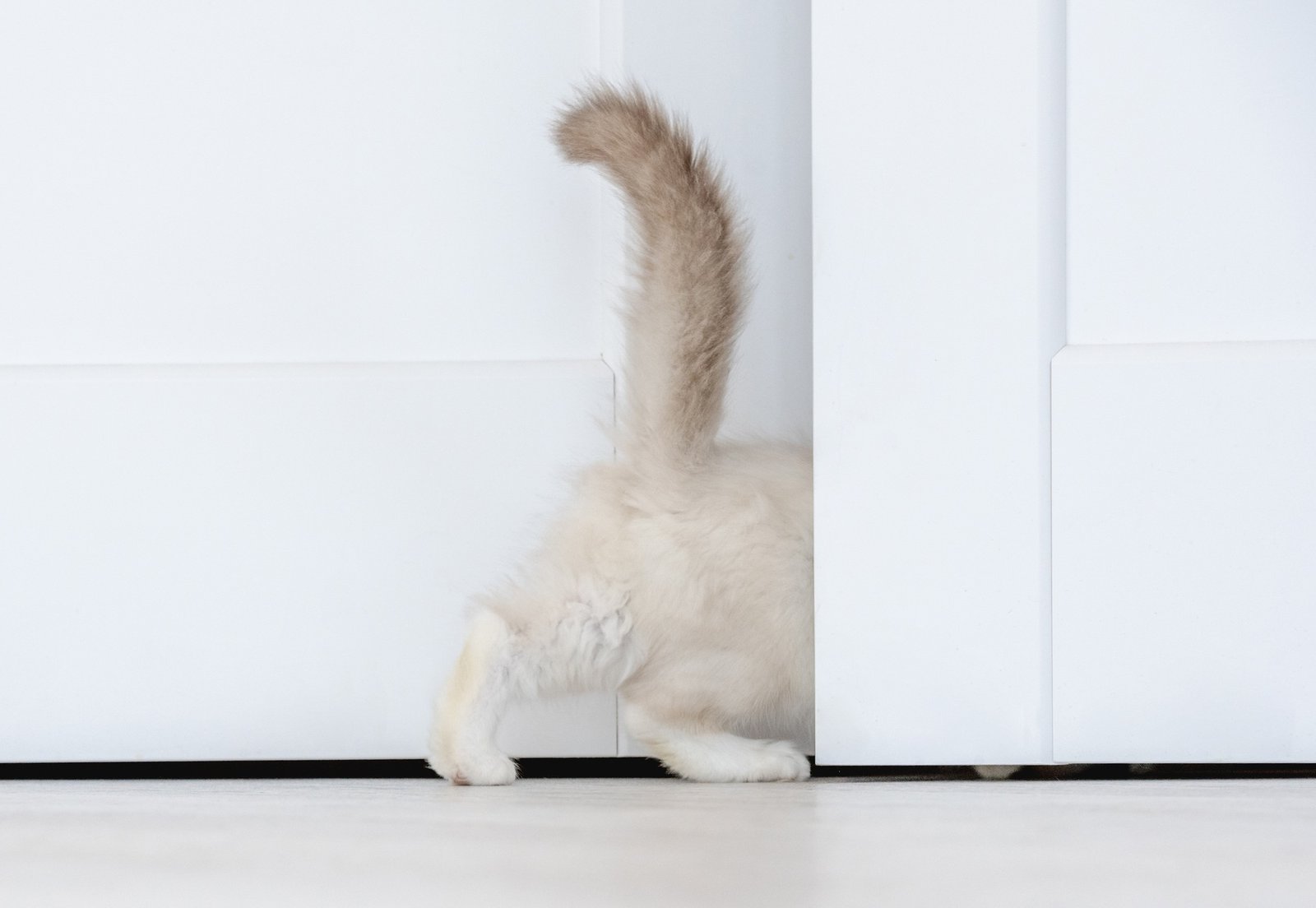
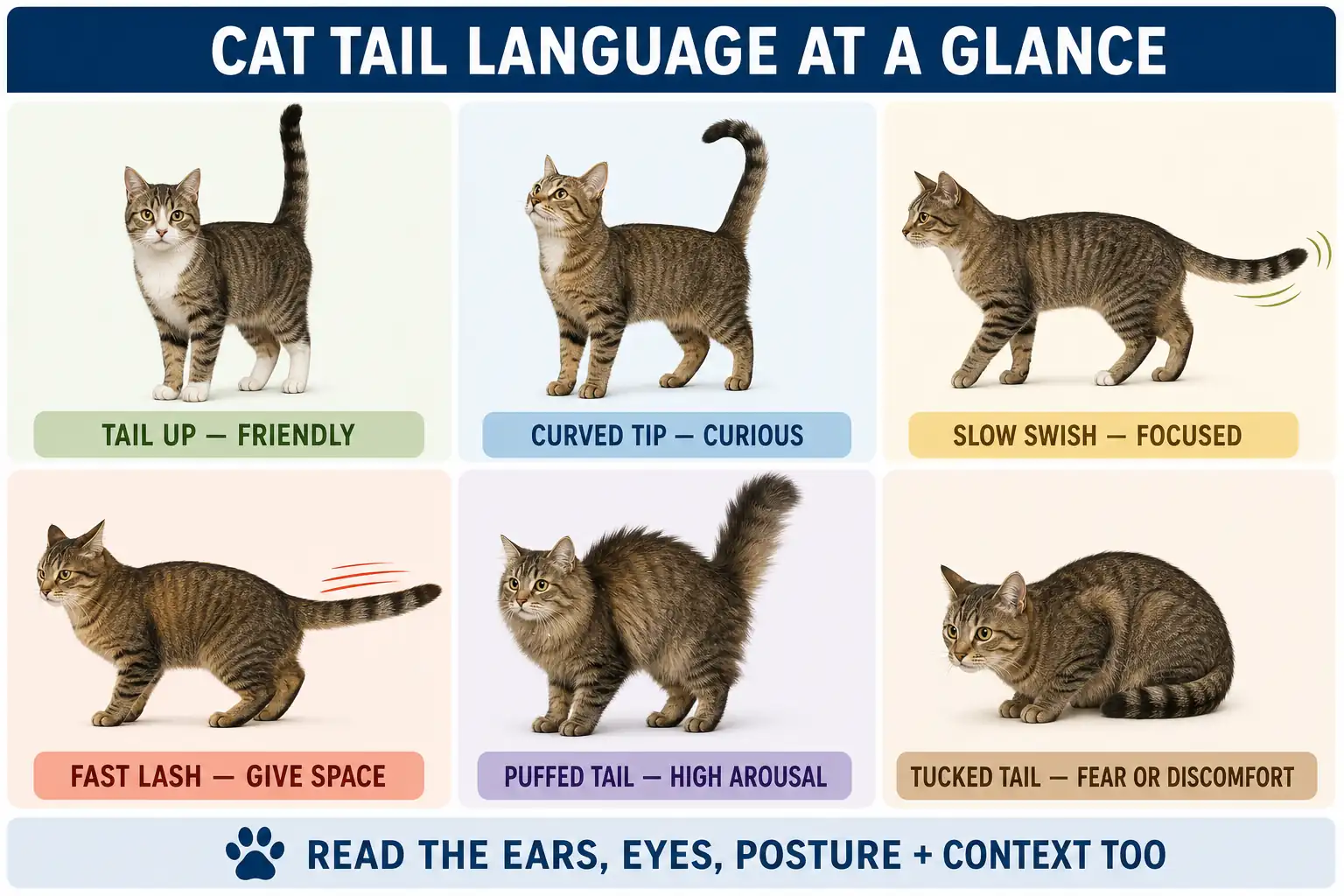
Cat tail language is most useful as a clue, not a dictionary. An upright tail often accompanies a friendly greeting, while a fast-lashing, puffed, or tightly tucked tail can signal high arousal, fear, or discomfort. Always read the tail together with the cat’s ears, eyes, posture, movement, recent behavior, and immediate surroundings.
Table of Contents
- What do common cat tail positions mean?
- What does an upright cat tail mean?
- What do tail flicks, swishes, and lashes mean?
- What do puffed, tucked, or wrapped tails mean?
- How do I read the whole cat, not just the tail?
- What should I do when my cat’s tail signals tension?
- When can a tail change mean pain or a medical problem?
- Conclusion
- Frequently Asked Questions
- References
What do common cat tail positions mean?
The same tail position can mean different things in different moments. Start with the likely meaning below, then confirm it by checking the rest of the cat and what happened immediately before the signal.
| Tail signal | Common interpretation | Context clues | Helpful response |
|---|---|---|---|
| Upright tail | Friendly greeting or social confidence | Relaxed body, forward or neutral ears, approaching voluntarily | Greet calmly and let the cat choose contact |
| Upright tail with curved tip | Interest, curiosity, or friendly engagement | Exploring, looking toward a person or object | Allow investigation without crowding |
| Slow tip twitch or gentle swish | Focus or mild stimulation | Watching prey, a toy, birds, or movement | Observe; avoid interrupting intense focus |
| Fast side-to-side lash | Rising irritation, conflict, or overstimulation | Tense body, sideways ears, skin twitching, interrupted petting | Stop touching and give space |
| Puffed tail | Sudden high arousal, fear, or defensive readiness | Arched or tense posture, flattened ears, startling event | Increase distance and remove pressure |
| Tail held low or tucked | Fear, insecurity, or discomfort | Crouching, hiding, avoiding contact | Reduce noise and let the cat retreat |
| Tail wrapped around the body | Resting position or possible unease | Relaxed face versus tense crouch makes the difference | Read the whole posture before approaching |
| Tail wrapped around another cat or person | Social contact in some contexts | Relaxed proximity and voluntary approach | Let the interaction continue without forcing it |
Cats Protection similarly advises reading the tail alongside the cat’s ears, eyes, body position, and situation rather than interpreting one body part in isolation.1
What does an upright cat tail mean?
An upright tail commonly appears during a friendly approach or greeting. It usually suggests the cat feels comfortable enough to move toward a person, animal, or familiar area, especially when the body is loose and the ears are neutral or forward.
A small curve at the tip can accompany curiosity or friendly attention. A slight quiver may occur during an excited greeting, but context matters: a cat backing up to a vertical surface with a quivering tail may be urine marking rather than simply saying hello.
Look for these supporting signs before assuming the cat wants petting:
- the cat approaches voluntarily
- the muscles and whiskers look relaxed
- the ears remain neutral or forward
- the cat rubs against you or stays nearby
- the cat can move away freely
An upright tail is an invitation to notice the cat, not permission to pick up, restrain, or keep touching. If the cat is especially affectionate, the guide to why cats become cuddly can help you consider routine, comfort, and behavior changes together.
What do tail flicks, swishes, and lashes mean?
The speed, size, and timing of tail movement matter. A slow twitch while watching a toy can show concentration, while a broad, fast lash during petting often means the interaction is becoming too intense.
Slow tip twitch
A small tip movement often appears when a cat is focused on a sound, toy, bird, or possible prey. Look for forward attention and a body ready to move. During play or stalking, the tail may twitch as the cat prepares to pounce; our guide to why cats wiggle before pouncing explains that hunting context in more detail.
Gentle side-to-side swish
A measured swish can mean focus, decision-making, or growing stimulation. Pause and observe rather than immediately touching the cat. The signal becomes more concerning when the movement grows faster and the body becomes tense.
Fast or forceful lashing
A forceful lash is a practical cue to stop and create space. During petting, it can be an early warning before the cat turns, swats, or bites. This does not make the cat aggressive or spiteful; it means the current interaction needs to change.
If lashing is followed by biting, review the guide to play, fear, and overstimulation biting rather than punishing the cat.
What do puffed, tucked, or wrapped tails mean?
A puffed or tucked tail usually deserves more caution than a relaxed upright tail. These positions often appear when a cat feels threatened, startled, insecure, or uncomfortable, but the surrounding posture still determines the safest interpretation.
Puffed tail
The fur stands out when a cat is highly aroused. The cat may be frightened, surprised, or preparing to defend itself. Do not approach, corner, or pick up the cat. Reduce the trigger if it is safe to do so and leave a clear escape route.
Tucked or very low tail
A tail held tightly beneath the body can accompany fear or discomfort. A crouched cat with wide pupils, flattened ears, and a tucked tail needs distance and a quiet route to safety. If this posture is new or persists without an obvious trigger, consider whether the cat may be unwell.
Tail wrapped around the body
This can simply be a comfortable resting position. Compare a loose body and soft eyes with a tense crouch, tight muscles, or repeated attempts to avoid interaction. The cat loafing guide offers more context for interpreting resting posture.
Tail wrapped around another cat or a person
Some cats use the tail during relaxed social contact, but do not treat the gesture as proof of affection on its own. Confirm that both animals remain loose, can move away, and are not showing tension elsewhere.
How do I read the whole cat, not just the tail?
Use a three-part check: read the whole body, identify the situation, and watch how the signal changes over the next few seconds. A tail signal becomes more reliable when several clues point in the same direction.
| What to check | More relaxed or engaged | More tense or concerned |
|---|---|---|
| Ears | Neutral or forward | Sideways, rotating back, or flattened |
| Eyes | Soft gaze, normal blinking | Fixed stare, very wide pupils, or narrowed tense eyes |
| Body | Loose movement, normal height | Crouched, frozen, arched, or rigid |
| Whiskers | Neutral position | Pulled tightly back or thrust sharply forward |
| Movement | Approaches or remains by choice | Retreats, freezes, hides, or blocks access |
| Context | Familiar greeting, play, exploration | Unexpected handling, conflict, loud noise, pain, or escape blocked |
Cats Protection notes that behavior develops through multiple influences and that changes in normal behavior can be meaningful.2 Learn your individual cat’s baseline instead of comparing every movement with a universal chart.
For example:
- A twitching tail during stalking may show focus.
- The same twitch during petting may be the first sign to pause.
- A low tail in a cautious new environment may reflect uncertainty.
- A suddenly limp or painful-looking tail after an accident may require veterinary care.
What should I do when my cat’s tail signals tension?
When the tail starts lashing, puffing, or tucking alongside tense body language, lower the pressure immediately. The goal is to prevent escalation and let the cat regain choice and distance.
- Stop touching. Move your hands away calmly.
- Create space. Step back or turn slightly sideways instead of looming over the cat.
- Keep an exit open. Never block the path to a hiding place, perch, or doorway.
- Reduce the trigger. Lower noise, pause play, or separate animals safely if needed.
- Wait for voluntary re-engagement. Let the cat decide whether to approach again.
- Review the pattern later. Note where, when, and during which interaction the signal appeared.
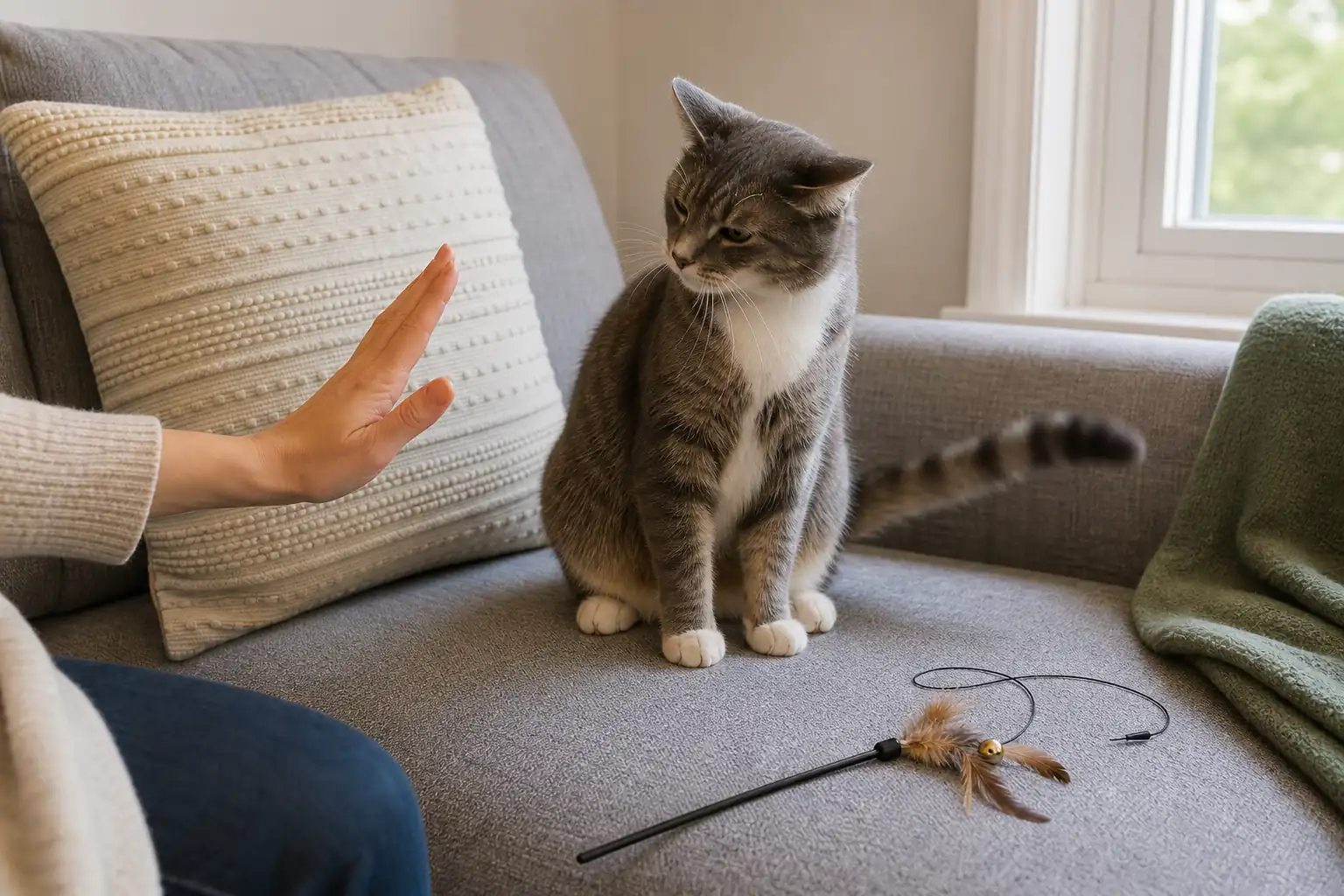
Do not scold, restrain, chase, spray, or force handling. If the cat retreats, let the hiding place work as a coping option. The guide to why cats hide can help distinguish normal retreat from a concerning behavior change.
When can a tail change mean pain or a medical problem?
A sudden, persistent change in tail movement or carriage can sometimes reflect pain, injury, or illness rather than communication alone. Contact a veterinarian when the tail appears injured, limp, unusually painful, or paired with other changes.
Seek prompt veterinary advice if you notice:
- a limp tail or inability to lift or move it normally
- swelling, a wound, bleeding, or a recent accident
- pain when the tail or lower back is approached
- difficulty walking, urinating, or passing stool
- repeated frantic tail chasing or self-injury
- sudden hiding, appetite loss, weakness, or major behavior change
- intense skin rippling or episodes that seem abnormal for your cat
Cats Protection advises contacting a veterinarian after injuries and warns against giving human medicines to cats.3 Do not pull, straighten, splint, or repeatedly test a painful tail at home.
Occasional skin or tail twitching can occur during normal focus or stimulation. When episodes are intense, frequent, or accompanied by distress or self-injury, the feline hyperesthesia syndrome guide can help you record useful observations before speaking with a veterinarian.
Conclusion
A cat’s tail can reveal where attention, comfort, or tension is heading, but it rarely tells the whole story by itself. Use the tail as your first clue, then confirm the message through the ears, eyes, posture, movement, and immediate context.
The most useful response is often simple: welcome a relaxed voluntary approach, pause when stimulation rises, and give space when the body becomes tense. Learning these early signals can make play, petting, and everyday interaction safer and more predictable for both you and your cat. If a tail change is sudden, painful, persistent, or follows an injury, treat it as a health concern rather than a behavior puzzle and contact a veterinarian.
Frequently Asked Questions
Why does my cat flick the tip of its tail?
A small tip flick often shows focus or mild stimulation. Check what the cat is watching and whether the rest of the body remains relaxed. If the flick becomes a fast lash during touch, pause the interaction.
Why does my cat wag its tail while lying down?
Cats may move their tails while resting because they are tracking something, responding to touch, or becoming overstimulated. Read the speed of the movement and check the ears, eyes, and body tension.
Does an upright tail always mean a cat is happy?
No. An upright tail often accompanies a friendly greeting, but context still matters. Check whether the body is loose, the cat approaches voluntarily, and no other signs suggest tension.
Why does my cat wrap its tail around me?
It can occur during relaxed social contact, but it is not a guaranteed declaration of affection. Consider whether the cat remains comfortable, loose-bodied, and free to leave.
What does a puffed-up tail mean?
A puffed tail indicates high arousal and commonly appears with fear, surprise, or defensive tension. Give the cat space and remove pressure rather than approaching.
When should I call a vet about my cat’s tail?
Call a veterinarian for a limp, painful, swollen, wounded, or suddenly immobile tail, especially after trauma or when accompanied by walking, urination, stool, appetite, or behavior changes.
References
[1] Cats Protection. Cat body language.
[2] Cats Protection. Understanding your cat’s behaviour.
[3] Cats Protection. Cat first aid.
 EN
EN DE
DE ES
ES PT
PT