

Many of us have marveled at those glowing cat eyes peering out of the night. It is a common belief that cats can see as clearly in pitch-black darkness as Superman. When your cat gets the 3 AM zoomies or perfectly navigates a dark hallway, it is easy to assume they have built-in night-vision goggles.
In reality, cats cannot see in total darkness. However, they can see in very low light—much better than humans can. Their vision has been tuned by millions of years of evolution for twilight hunting, not midnight strolls.
In this comprehensive, vet-reviewed guide, we will untangle myth from fact: How do cats really see at night? We will look inside the feline eye, compare their vision directly to our own, and explain what the world actually looks like through a cat’s eyes. Along the way, we will share practical tips on whether you should leave a night-light on and the subtle signs of feline vision loss every owner should watch for.
Quick Answer: No, cats cannot see in absolute, pitch-black darkness. Like humans, they require at least a small amount of ambient light to form an image. However, thanks to specialized eye anatomy, a cat only needs about one-sixth the amount of light that a human requires to see clearly.
Table of Contents
The Myth of the “Nocturnal” Cat
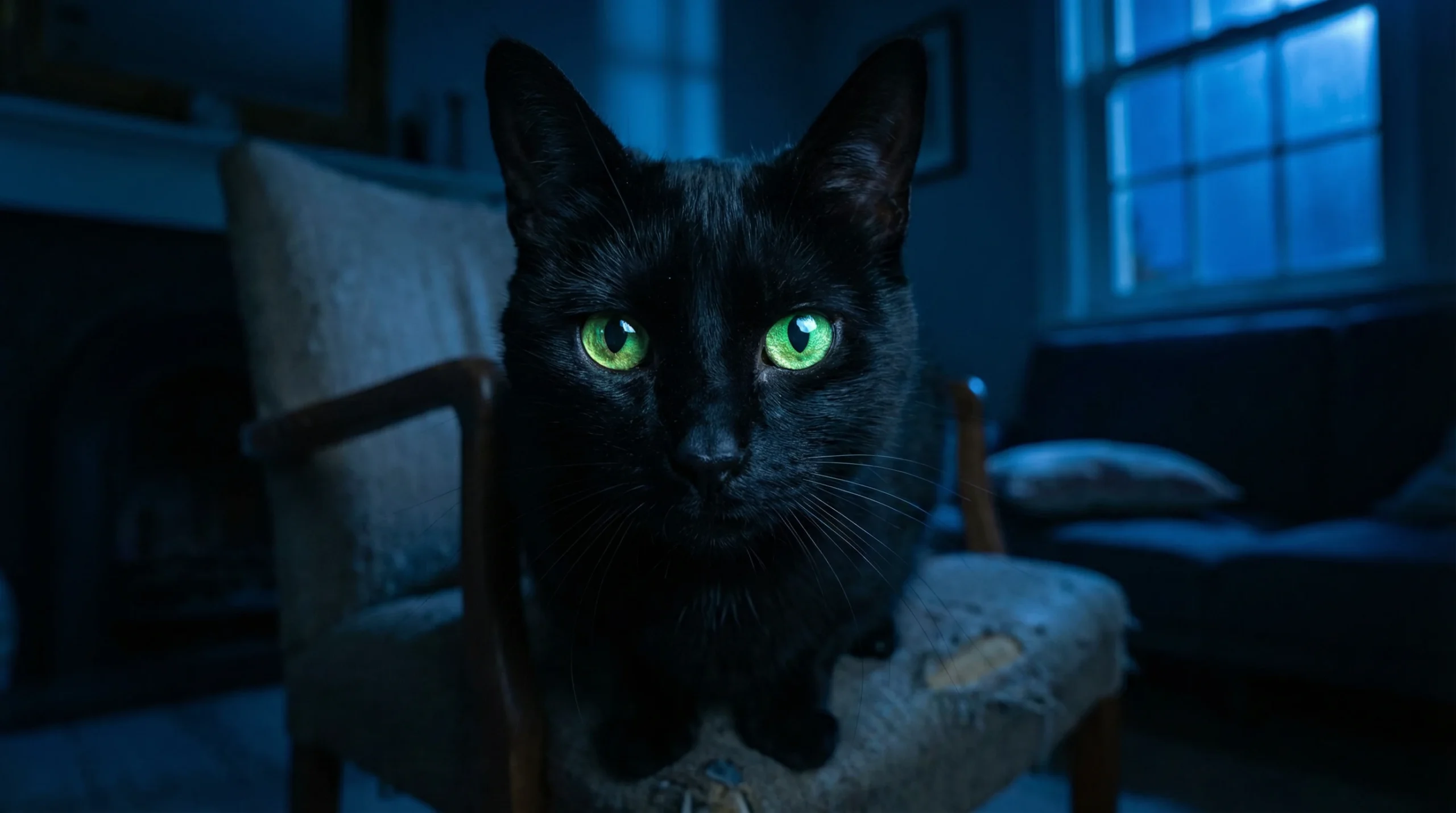
Cats certainly seem most playful after dark. Many cat owners can tell you about mysterious zoomies at 3 AM, or those “gifts” left on the doorstep at dawn. It is easy to jump to the conclusion that cats are truly nocturnal like owls or bats—that they thrive in total darkness.
In truth, however, cats are crepuscular. This means their wild ancestors were most active at dawn and dusk, not in the dead of night. By hunting in the twilight hours, cats took advantage of cooler temperatures and the activity of their natural prey (mice, birds, and rabbits) that also come out at those times.
We pet owners often see nocturnal behavior because we keep our cats indoors, and their natural schedule shifts to match ours. But as Stephen Quandt, a certified cat behaviorist, explains: “Birds and mice are very active at dawn, and cats evolved to take advantage of this by developing the ability to see in low-light conditions.”
Because cats hunt in dim light rather than dead darkness, their eyes strike a biological balance. If cats were truly nocturnal, they might sacrifice even more daylight vision or color perception. Instead, cats can still see reasonably well in daylight while dramatically excelling in the low light of dusk and dawn.
Inside the Feline Eye: Built for Low Light
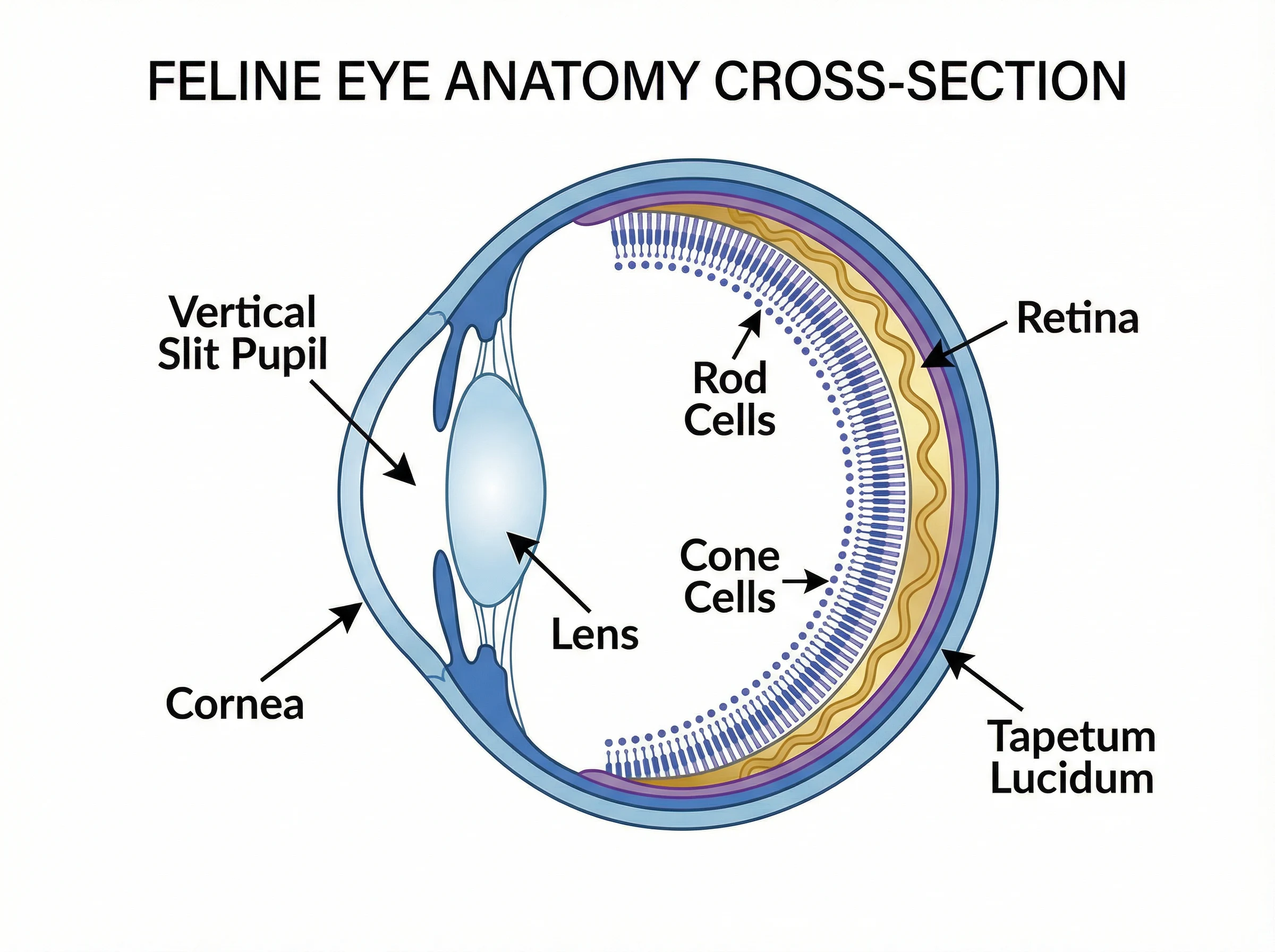
To understand how cats navigate the dark so effortlessly, we have to look at their unique eye anatomy. A cat’s eye has several specialized features that capture and maximize any available light in the environment.
1. The Tapetum Lucidum (The “Eye Glow”)
Behind the retina of a cat’s eye lies a highly reflective layer of tissue called the tapetum lucidum. Think of it as a biological mirror. When light enters the eye and passes through the retina, the tapetum lucidum reflects it back through the retina a second time. This gives the photoreceptor cells a second chance to absorb the light, effectively doubling the light capture at night.
This reflective layer is exactly why flash photos of cats often show those eerie glowing eyes. You are actually seeing the light from your camera flash reflecting off the tapetum lucidum.
2. A High Density of Rod Cells
The retina is the light-sensitive lining at the back of the eye. It contains two main types of photoreceptor cells: rods and cones. Rods are highly sensitive to dim light and motion, while cones are responsible for color and sharp detail.
Cats have an incredibly high concentration of rod cells—up to six to eight times more than humans. This massive density of rods means a cat can pick up very faint light and the slightest movements when it is dark out, making them exceptional ambush predators.
3. Vertical Slit Pupils
Unlike the round pupils of humans, cats have vertical slit pupils. Research from the University of California, Berkeley, found that vertical slit pupils are a common trait among ambush predators that hunt close to the ground.
These slit pupils can undergo massive changes in size. In bright sunlight, they constrict to narrow slits to protect the sensitive retina. But in low light, a cat’s pupils can dilate to become almost fully round, covering most of the eye to let in maximum light. A cat has the capacity to alter the area of its pupil by a factor of 135, compared to just a 15-fold change in humans.
4. Large Corneas
Relative to the size of their heads, cats have exceptionally large eyes. They possess large, curved corneas (the clear front surface of the eye) and large lenses. This larger surface area gathers more light from the environment, funneling it directly toward the retina.
Comparison: Cat Vision vs. Human Vision
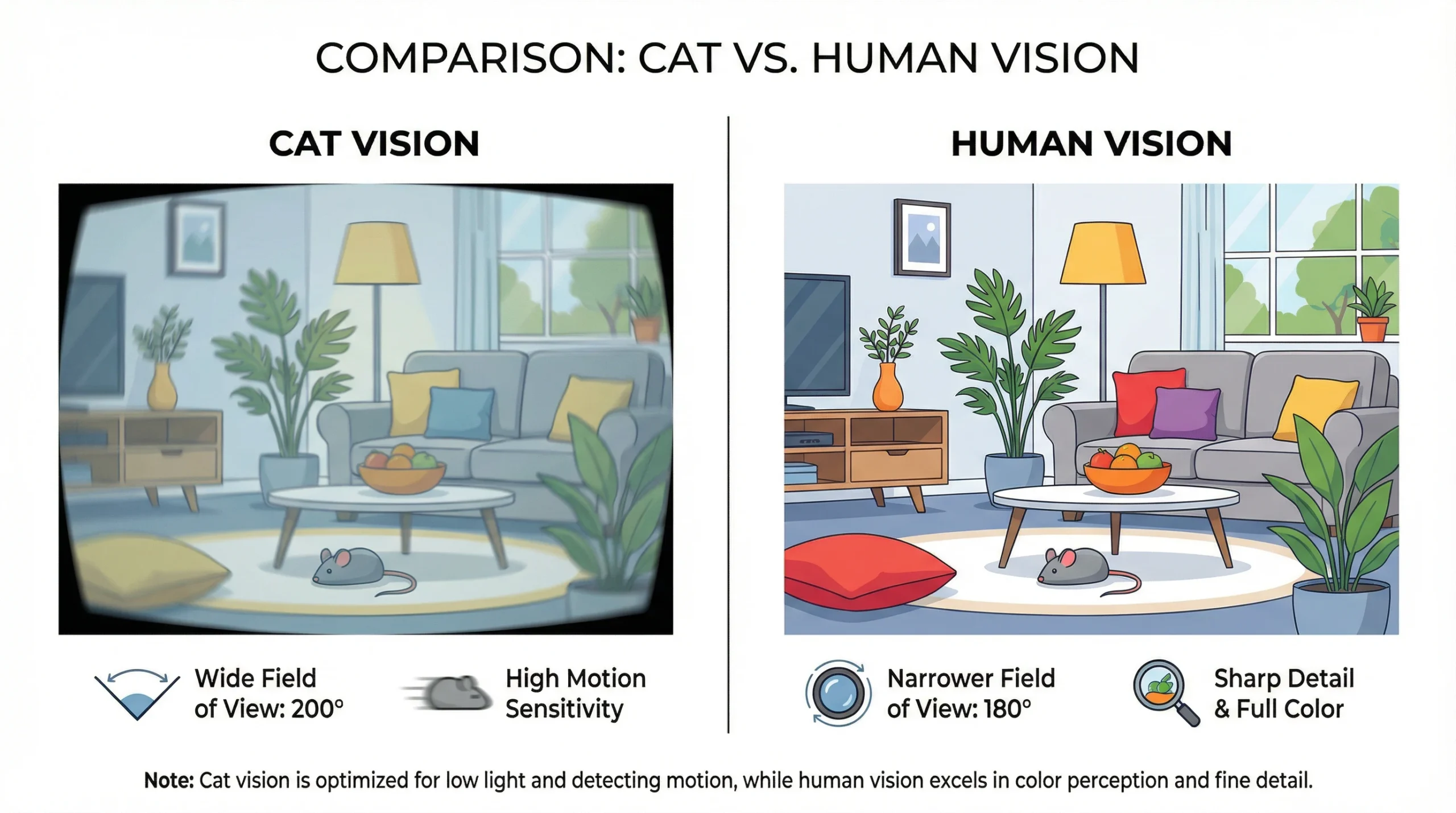
While cats dominate in the dark, human vision is actually superior in several other categories. Here is a direct comparison of how our visual capabilities stack up against our feline friends.
Visual Acuity (Sharpness)
In daylight, human eyesight is significantly crisper. Visual acuity is measured by what we can clearly see at a distance. A normal human has 20/20 vision. A cat’s visual acuity is estimated to be between 20/100 and 20/200.
This means that an object a human can see clearly from 100 to 200 feet away, a cat would need to be just 20 feet away to see with the same sharpness. To a cat, fine details at a distance are quite blurry. However, this nearsightedness is perfectly suited for an ambush predator that needs to focus on prey just a few feet away.
Field of View
Cats see more of the world around them at any given moment. A cat has a visual field of about 200 degrees, compared to the average human visual field of 180 degrees. This wider peripheral vision helps them spot the subtle movements of prey (or toys) darting out of the corner of their eye.
Motion Sensitivity
Because of their high concentration of rod cells, cats are masters at detecting rapid, jerky movements—the exact type of movement a frightened mouse makes. However, they struggle to detect very slow-moving objects. To a cat, a very slow-moving object might actually appear stationary.
The Ultimate Comparison Table
| Feature | Cat Vision | Human Vision | The Winner |
|---|---|---|---|
| Low-Light Sensitivity | Needs only 1/6th the light of humans | Needs significant light | Cats |
| Visual Acuity (Sharpness) | 20/100 to 20/200 (Nearsighted) | 20/20 (Sharp at distance) | Humans |
| Field of View | 200 degrees | 180 degrees | Cats |
| Pupil Dilation Factor | 135-fold change | 15-fold change | Cats |
| Color Perception | Muted, mostly blues/greens | Vibrant, full spectrum | Humans |
Can Cats See Color?
A persistent myth is that cats see the world in black and white. This is false. Cats can see color, but their color spectrum is much more limited than ours.
Humans are trichromats, meaning we have three types of cone cells that allow us to see reds, greens, and blues in vibrant detail. Cats are thought to be dichromats, meaning they only have two types of cone cells.
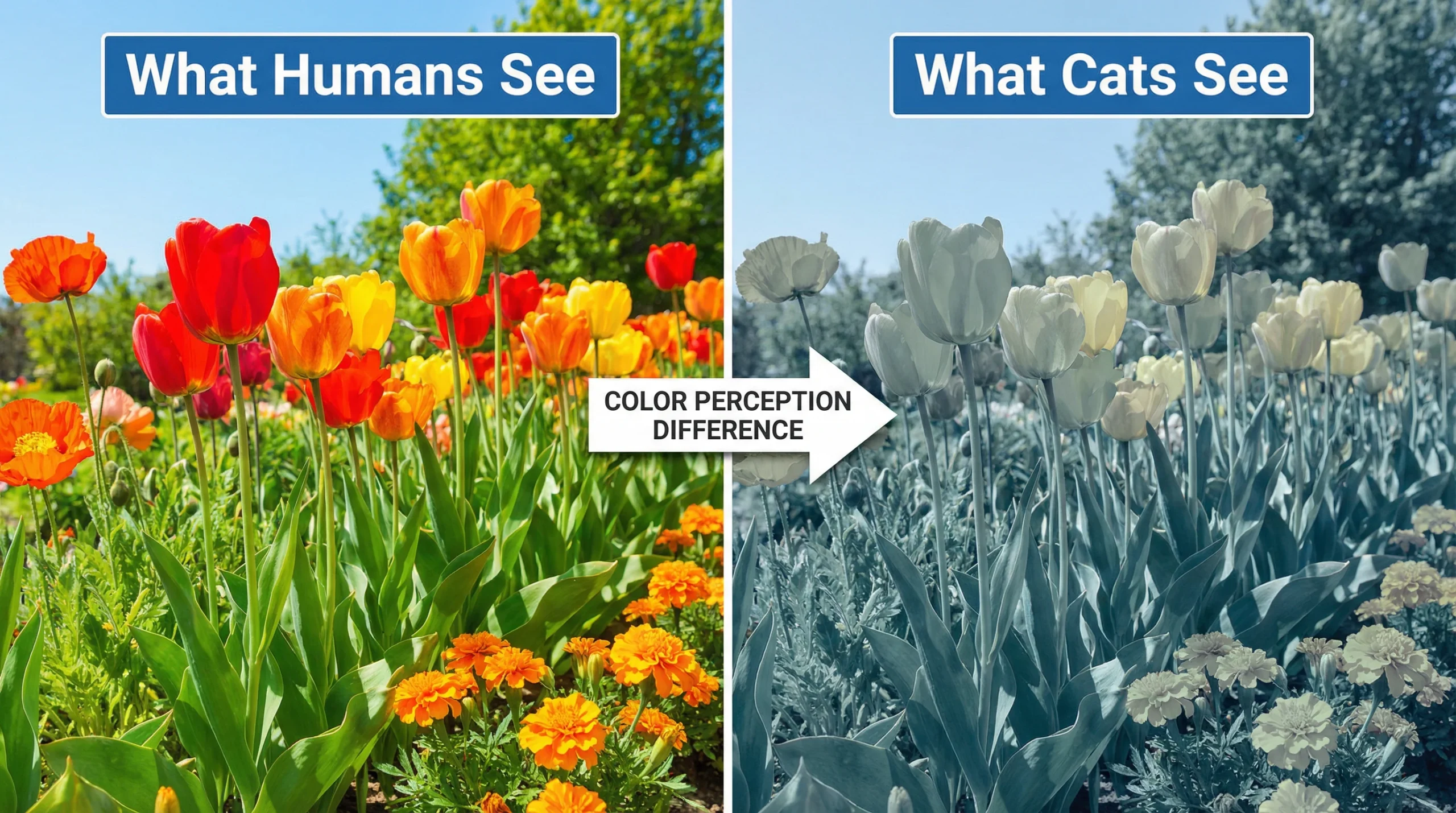
To a cat, the world looks similar to a human who is red-green colorblind. They see blues, greens, and yellows quite well, but they cannot distinguish reds and pinks. To a cat, a bright red laser pointer dot likely looks like a pale yellowish-green or gray blur. Overall, the feline world is more muted and pastel-toned, which is a worthwhile trade-off for their incredible night vision.
Do Cats Need Night-Lights?
Now let us answer a question many cat owners wonder: Should you leave a light on for your cat at night?
For the vast majority of healthy adult cats, the answer is no. Under normal circumstances, the ambient glow from streetlights filtering through the blinds, moonlight, and even the tiny LED lights on your electronics provides more than enough illumination for a healthy cat to navigate the house safely.
In fact, leaving bright lights on can actually backfire. Like humans, cats have a circadian rhythm and produce melatonin in darkness. Constant bright light at night could disrupt their natural sleep cycles. (If you are curious about your cat’s sleep habits, check out our guide on How Long Do Cats Sleep?).
When to Use a Night-Light
There are, however, important exceptions where a night-light is beneficial:
- Senior Cats: As cats age, the lenses in their eyes can become cloudy (nuclear sclerosis), and their tapetum lucidum may become less reflective. A dim night-light can help older cats navigate without anxiety.
- Cats with Vision Loss: If your cat has been diagnosed with cataracts, glaucoma, or progressive retinal atrophy, soft lighting near their essential resources is crucial.
- New Environments: If you have just moved or adopted a new cat, a temporary night-light can help them learn the layout of the house without bumping into unfamiliar objects.
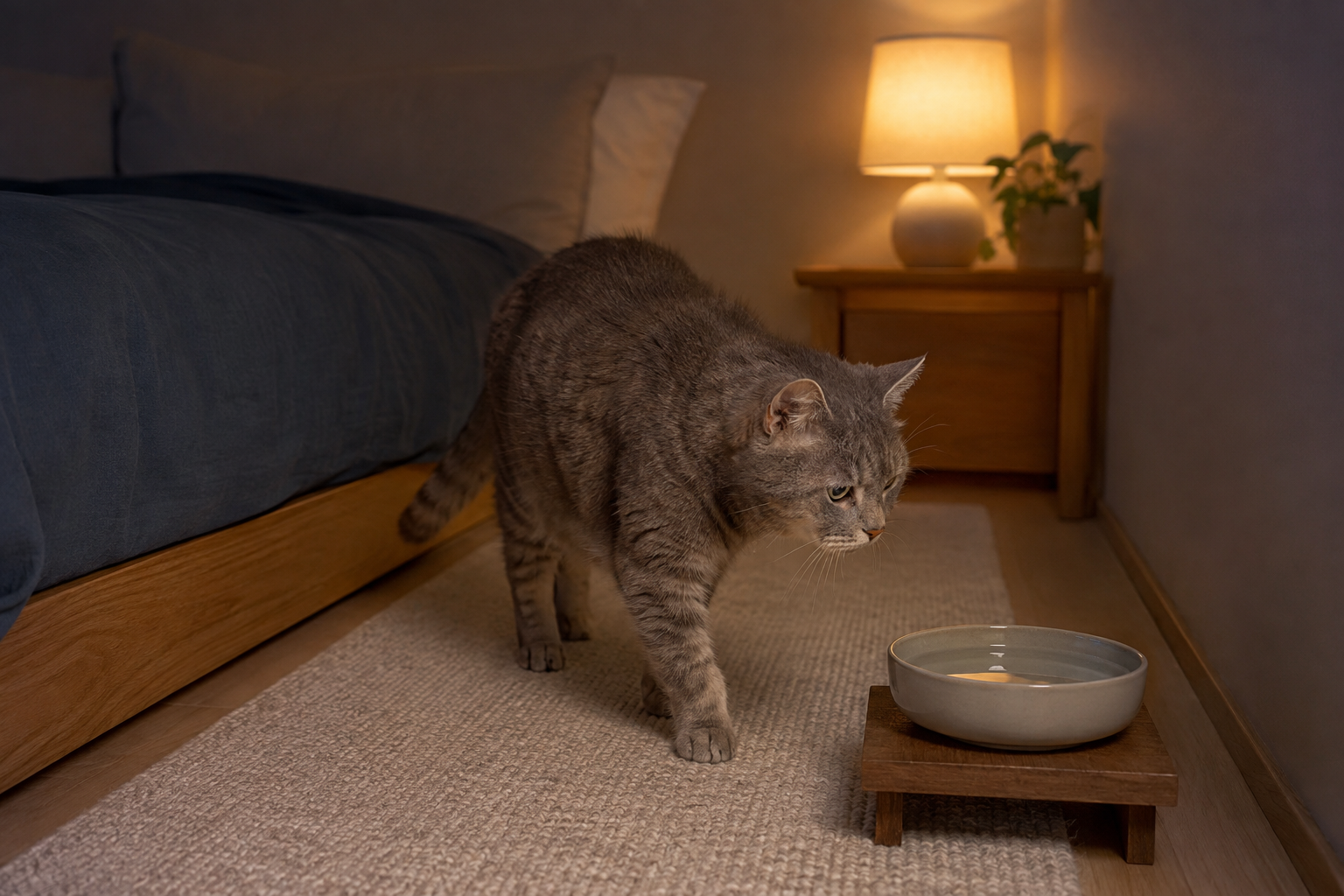
If you do use a night-light, place it strategically near the litter box or food and water bowls. Use a dim, warm-toned light (like amber or red) rather than a bright blue or white light, as warm tones are less disruptive to sleep.
Signs Your Cat is Losing Their Vision
Cats are incredibly resilient and stoic creatures. Because they have such excellent hearing and sensitive whiskers, they can often navigate a familiar house perfectly even if they are going blind. They memorize the layout of the furniture and rely on their other senses to compensate.
Because they hide disabilities so well, vision loss often goes unnoticed by owners until it is quite advanced.
Red Flags to Watch For
If you notice any of the following signs, schedule an appointment with your veterinarian immediately:
- Hesitancy in the Dark: If your previously confident cat suddenly refuses to go into dark rooms or seems anxious at night, their low-light vision may be failing.
- Bumping into Things: Especially if you recently moved a piece of furniture or left a box in the hallway.
- Dilated Pupils: If your cat’s pupils remain widely dilated even in bright, well-lit rooms, it indicates the eye is struggling to process light.
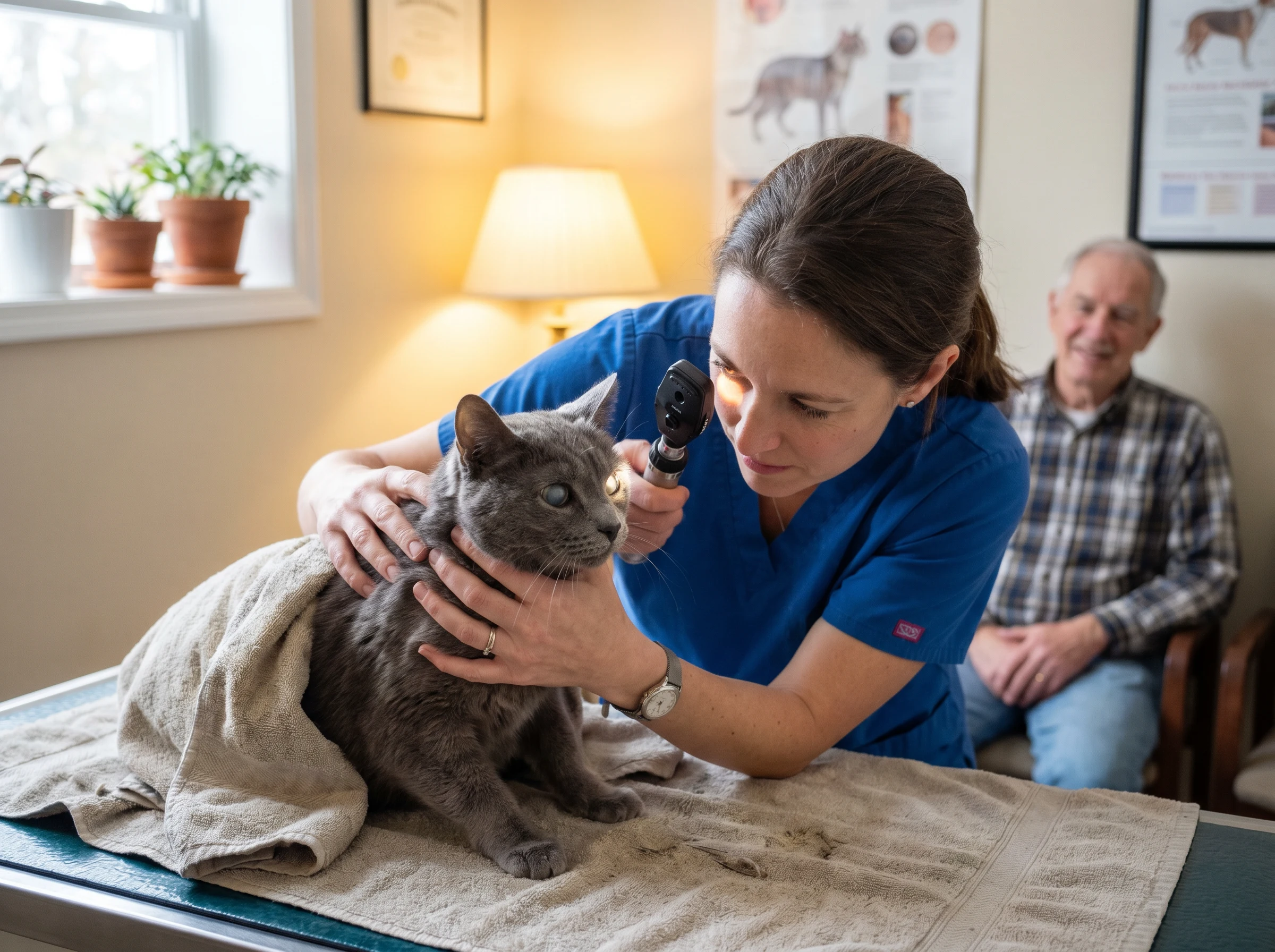
- Cloudy or Discolored Eyes: A milky, hazy, or bluish tint to the eye lens can indicate cataracts or normal aging changes.
- Reluctance to Jump: Misjudging distances or refusing to jump onto their favorite window perch.
- Easily Startled: Acting unusually jumpy when approached, as they may not see you coming until you touch them or speak.
Many causes of feline vision loss, such as high blood pressure (hypertension) or diabetes, are treatable if caught early. Regular veterinary check-ups are essential, especially for cats over the age of 10.
Frequently Asked Questions (FAQ)
Why do cats stare at the wall in the dark?
Because cats have such acute motion sensitivity and excellent hearing, they are likely tracking something you cannot perceive. They might be watching a tiny dust mote floating in the air, a microscopic spider on the wall, or listening to mice moving inside the drywall.
Can cats see TV screens?
Yes, cats can see the images on a television screen. However, because their eyes process images faster than ours, older televisions might look like a flickering strobe light to them. Modern high-definition TVs have faster refresh rates, which is why many cats enjoy watching “cat TV” videos of birds and squirrels.
Do cats need total darkness to sleep?
While they do not need pitch-black darkness, cats do benefit from a dark, quiet environment for deep, restorative sleep. If your cat sleeps in a brightly lit room, you will often see them cover their eyes with their paws to block out the light. (For more on adorable sleeping habits, read Why Do Cats Loaf?).
Why do my cat’s eyes look different colors in photos?
The tapetum lucidum reflects light back, but the color of that reflection (the “eye shine”) varies depending on the cat’s genetics and the amount of pigment in their eye. Most cats have a green or yellow-green eye shine, but blue-eyed cats (like many Siamese) often lack pigment in the tapetum, resulting in a red or pink eye shine.
Conclusion: The Twilight Hunter
Understanding how cats see is more than just biological trivia; it is a way to connect more deeply with our feline friends.
While the myth of the nocturnal, night-vision cat is technically false, the reality is equally fascinating. Their eyes are evolutionary marvels, packed with rods and built-in mirrors that grab every available photon of light. They sacrifice the bright colors and sharp distance vision that humans enjoy in exchange for the ability to detect the slightest movement in the dim light of dusk.
So the next time you see your cat creeping around the living room at night, you will know exactly what they see: a muted, slightly blurry world illuminated by motion, perfectly designed for the ultimate twilight hunter.
References
[1] Purina. “Can Cats See in the Dark? Cat Night Vision Facts.” Purina US.
[2] Hill’s Pet Nutrition. “Can Cats See in the Dark? Feline Night Vision Facts.” Hill’s Pet.
[3] Quandt, S. (2022). “Understanding Your Cat’s Crepuscular Instincts.” Cat Behavior Associates.
[4] The International Cat Association (TICA). “Can Cats See in the Dark?” TICA Blogs.
[5] Merck Veterinary Manual. “Structure and Function of the Eye in Cats.”
[6] Business Insider. (2013). “Photos Show How Cats See the World Compared to Humans.”
[7] University of California, Berkeley. (2015). “Pupil Shape and Hunting Strategy in Predators.” Science Advances, 1(7).
[8] The New York Times. “The Secrets of the Feline Eye.”
[9] PetMD. “How Do Cats See the World? What To Know about Cat Vision.”
[10] VCA Animal Hospitals. “Vision in Cats.”






 EN
EN DE
DE ES
ES PT
PT