

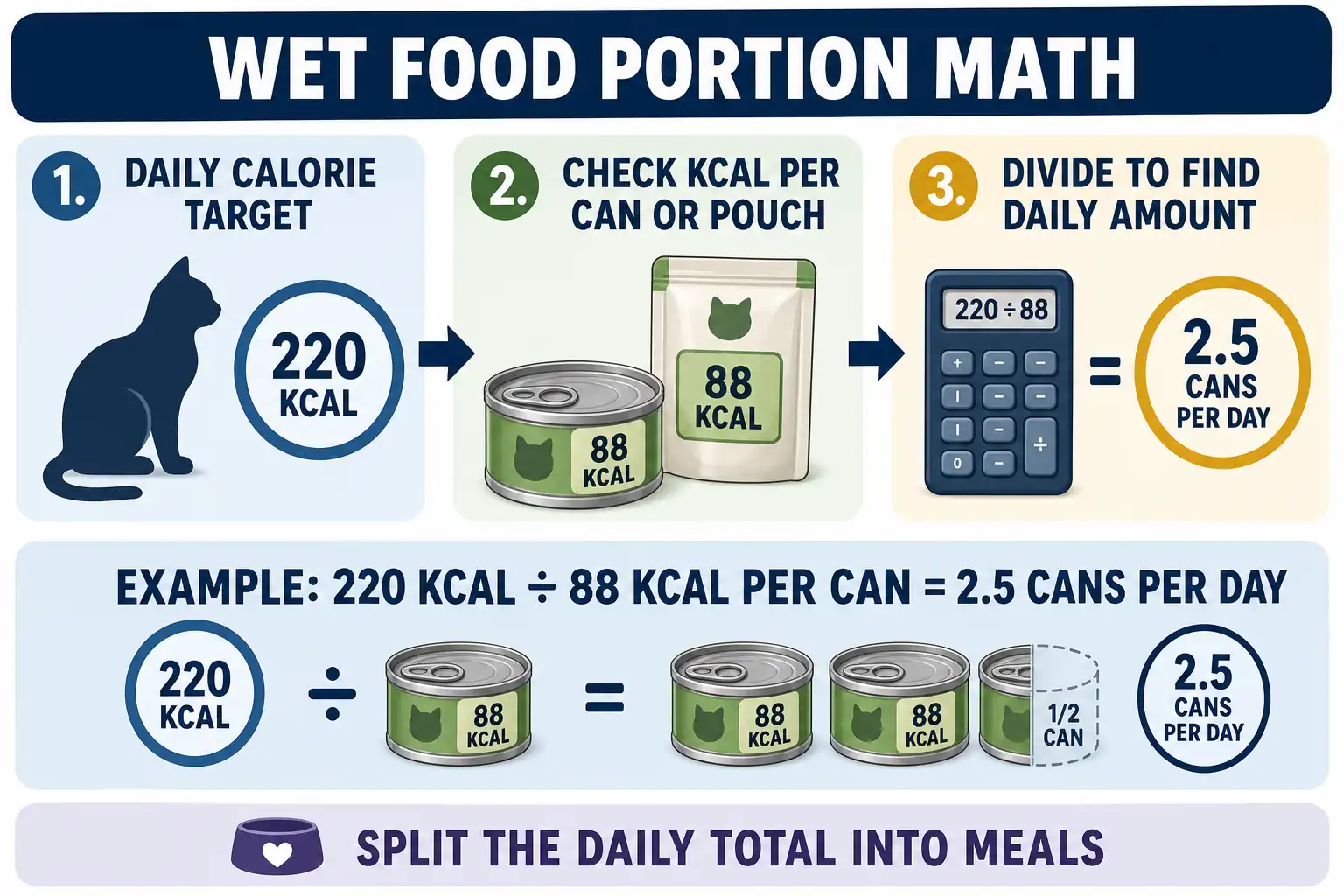
To calculate how much wet food to feed your cat, divide the cat’s estimated daily calorie target by the calories in one can, tray, or pouch. For example, 220 kcal per day divided by 88 kcal per can equals 2.5 cans per day. That is only a starting example: life stage, body condition, activity, health, treats, and any dry food can change the right amount.
This guide is educational. Ask your veterinarian to set the calorie target for kittens, pregnant or nursing cats, cats on a weight-loss plan, and cats with medical conditions.
Table of Contents
- How do I calculate how much wet food to feed my cat?
- How many cans of wet food should a cat eat per day?
- How do weight, age, and body condition change the amount?
- How do I calculate mixed wet and dry feeding?
- How often should I serve wet food?
- How do I know whether the portion is working?
- When should I ask a veterinarian about feeding amounts?
- Conclusion
- Frequently Asked Questions
- References
How do I calculate how much wet food to feed my cat?
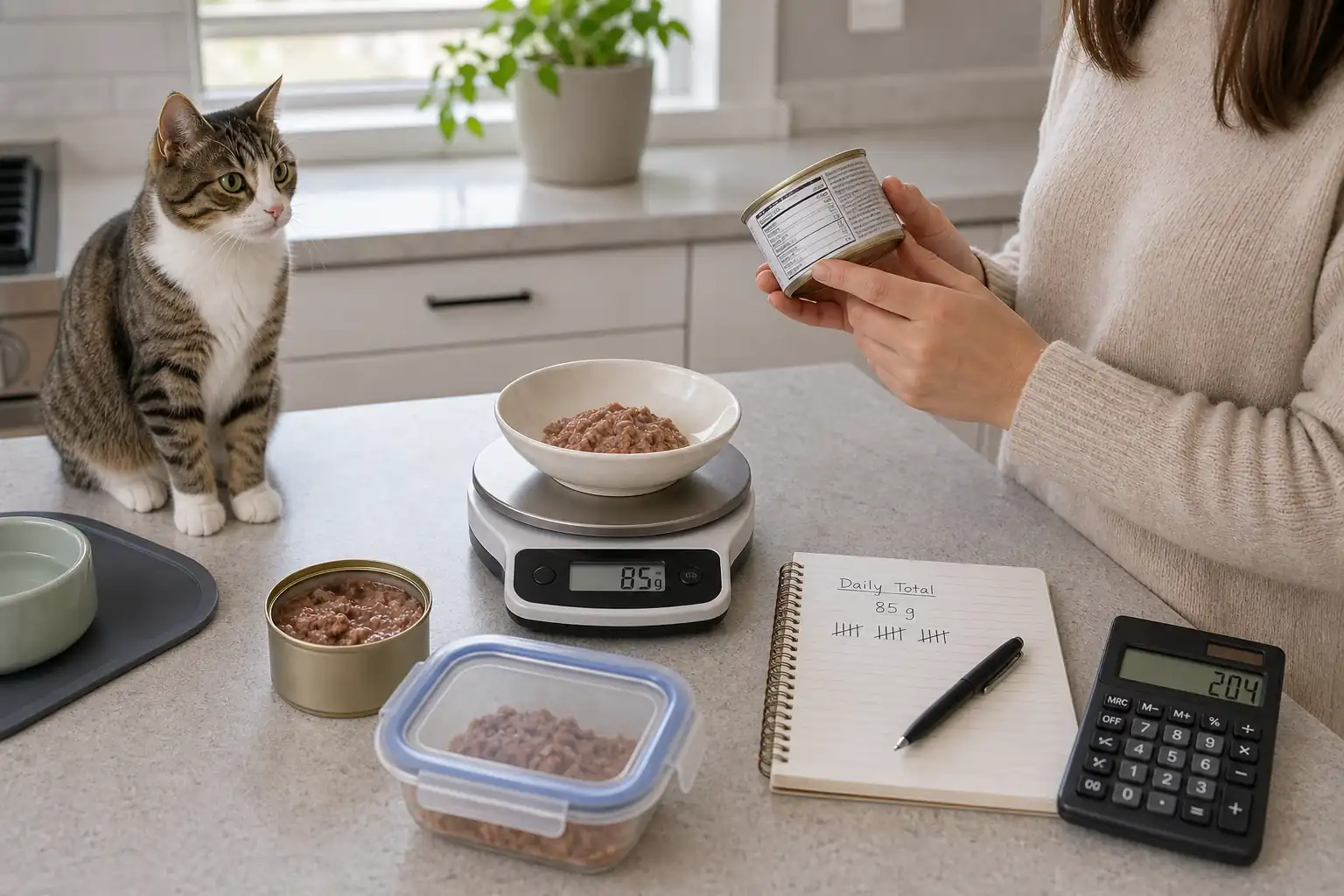
Use calories, not can size alone. Wet foods vary widely in calorie density, so two cans of the same size may provide very different daily totals.
The basic calculation
Estimated daily calorie target ÷ calories per can or pouch = daily number of cans or pouches
Follow these steps:
- Estimate your cat’s daily calorie target with your veterinarian or the SnuggleSouls cat calorie calculator.
- Find
kcal per can,kcal per tray, orkcal per pouchon the label or manufacturer’s product information. - Divide the daily target by the calories in one container.
- Subtract calories from treats and dry food.
- Split the remaining wet-food amount into meals.
- Recheck weight and body condition, then adjust with veterinary guidance.
| Example only | Calculation | Starting daily amount |
|---|---|---|
| Daily target 180 kcal; food 90 kcal per can | 180 ÷ 90 | 2 cans |
| Daily target 220 kcal; food 88 kcal per can | 220 ÷ 88 | 2.5 cans |
| Daily target 250 kcal; food 125 kcal per pouch | 250 ÷ 125 | 2 pouches |
| Daily target 200 kcal; food 100 kcal per can; treats provide 20 kcal | (200 – 20) ÷ 100 | 1.8 cans |
These numbers demonstrate the math, not what your individual cat should eat. Cornell emphasizes matching food and feeding amount to life stage, health, and body condition.1
How many cans of wet food should a cat eat per day?
There is no reliable universal answer such as “one can per three pounds.” The correct number depends on both your cat’s calorie target and the calories in that specific can.
| What the container tells you | Why it matters |
|---|---|
| Net weight or ounces | Describes food weight, not calorie content |
| Calories per can, tray, or pouch | Lets you calculate the number of containers per day |
| Calories per kilogram | Useful if you weigh portions in grams |
| Feeding directions | A starting estimate, not a guarantee |
| Nutritional adequacy statement | Shows whether the food is complete and balanced for a stated life stage |
FDA explains that pet-food labels contain information such as product identity, quantity, ingredients, nutritional adequacy, and feeding directions.2 AAFCO also explains that a complete-and-balanced claim identifies the species and life stage for which the product is intended.3
Do not compare foods by can count without comparing calories. A small calorie-dense can can provide more energy than a larger can with more water.
How do weight, age, and body condition change the amount?
Weight helps estimate a starting calorie target, but body condition and life stage show whether that target makes sense. Two cats at the same weight may need different portions because one is lean and active while the other is overweight, older, or less active.
| Cat or situation | Feeding consideration |
|---|---|
| Healthy adult at ideal body condition | Start with an estimated calorie target and monitor results |
| Kitten | Needs growth-formulated complete-and-balanced food and more frequent reassessment |
| Senior cat | Monitor muscle condition, weight trend, appetite, and health changes |
| Overweight cat | Use a veterinarian-guided calorie and weight-loss plan; do not crash-diet |
| Underweight or losing weight | Arrange a veterinary assessment instead of simply increasing food |
| Pregnant or nursing cat | Needs an individualized, life-stage-appropriate feeding plan |
| Cat with kidney, urinary, diabetes, digestive, or other medical needs | Follow the veterinarian’s diet and portion instructions |
WSAVA includes body condition and muscle condition assessment as important parts of nutritional evaluation.4 Use the SnuggleSouls body condition and weight calculator as an observation aid, then discuss concerns with your veterinarian.
The label’s feeding guide is useful as a starting point, but your cat’s real-world weight and body condition determine whether the amount is working.
How do I calculate mixed wet and dry feeding?
For mixed feeding, use one daily calorie budget. Calculate the wet-food calories first, then subtract them from the daily target before measuring dry food.
Daily calorie target – wet food calories – treat calories = calories available for dry food
Example:
- Hypothetical daily target: 220 kcal
- One wet-food can: 90 kcal
- Treats: 10 kcal
- Calories remaining for dry food: 120 kcal
If the dry food contains 400 kcal per cup, 120 kcal equals 0.3 cup. A kitchen scale can be more consistent than estimating partial cups.
The common mistake is adding wet food on top of a full dry-food ration. That turns two individually reasonable portions into an excessive combined total. For format comparisons, read wet vs dry cat food.
How often should I serve wet food?
Divide the daily wet-food total into a schedule your cat and household can maintain. Many adult cats do well with at least two measured meals, while kittens and cats with specific health needs may need a different schedule.
| Daily wet-food amount | Example meal split |
|---|---|
| 2 cans per day | 1 can in the morning and 1 in the evening |
| 2.5 cans per day | 1 can morning, 0.5 can midday, 1 can evening |
| 3 pouches per day | 1 pouch at each of three meals |
| Mixed feeding | Measured wet meals plus a measured dry-food allocation |
This table shows ways to divide an already-calculated daily total; it does not set the total. For schedule planning, see how often to feed cat wet food.
Serve wet food fresh, use clean bowls, and store leftovers according to the package instructions. The SnuggleSouls wet cat food storage guide covers practical storage steps.
How do I know whether the portion is working?
The right portion maintains an appropriate body condition, stable weight, normal energy, and a consistent appetite. Do not judge only by whether the bowl looks full or the cat asks for more food.
Use this monitoring routine:
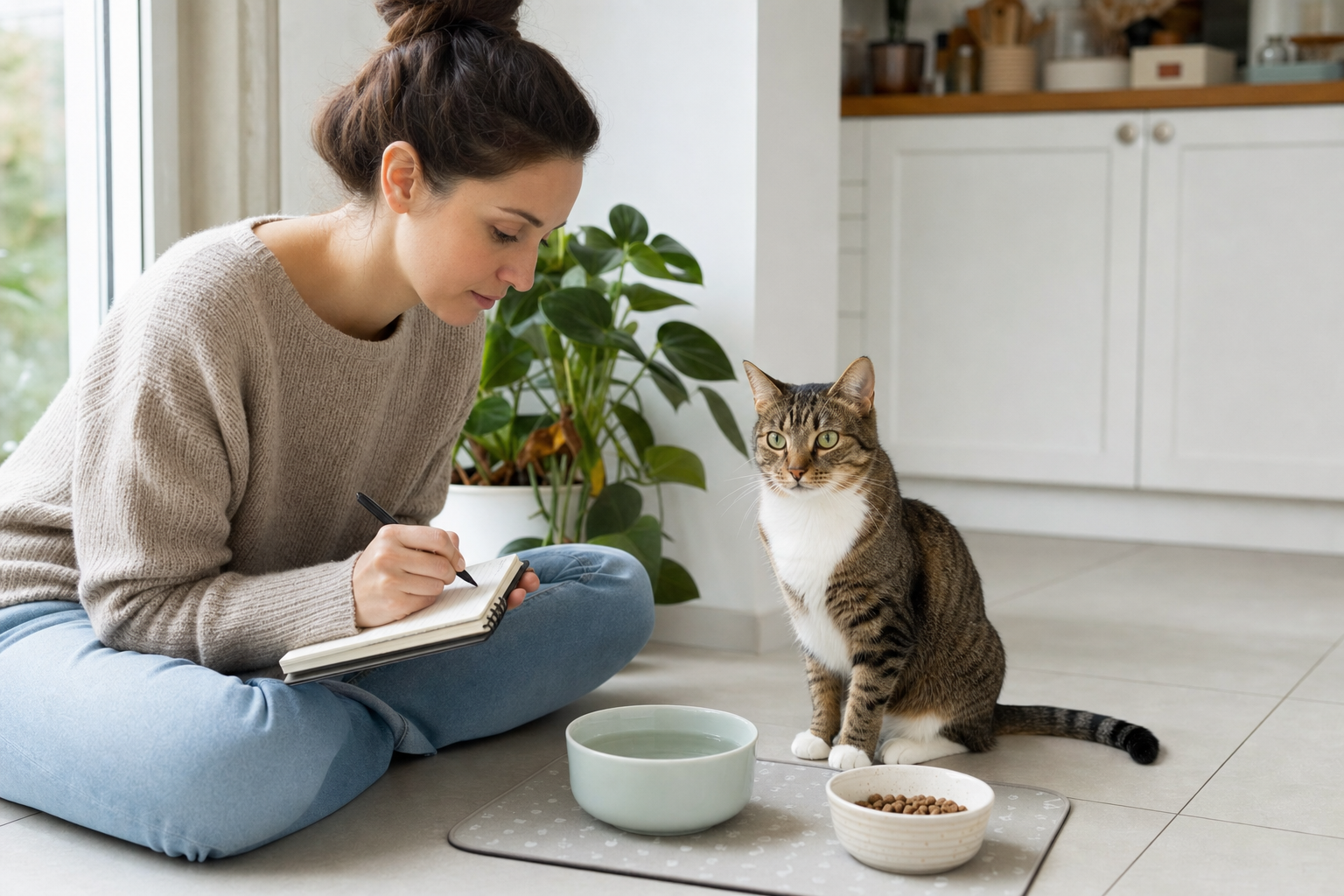
- Measure every meal and include treats.
- Record the daily amount for at least one typical week.
- Weigh your cat regularly using the same method.
- Check ribs, waist, abdominal shape, and muscle condition.
- Review the trend every few weeks rather than reacting to one day.
- Ask your veterinarian before making a major calorie reduction.
| What you observe | What to do next |
|---|---|
| Stable weight and appropriate body condition | Keep the routine and continue monitoring |
| Gradual unwanted weight gain | Confirm all calories, then discuss a modest adjustment |
| Weight loss without a planned diet | Contact a veterinarian |
| Persistent hunger despite measured adequate intake | Review calories and arrange a health check if it continues |
| Leftovers, reduced appetite, vomiting, or diarrhea | Do not keep reducing or switching food blindly; contact a veterinarian |
For broader portion planning, use the guide on how much to feed a cat. If you are choosing a product, look for a complete-and-balanced food appropriate for the cat’s life stage; the guide to choosing healthy cat food explains what to check.
When should I ask a veterinarian about feeding amounts?
Ask a veterinarian when a generic calculation may be unsafe or when appetite, weight, or health changes suggest the current plan is not working.
Seek veterinary guidance if your cat:
- is a kitten, pregnant, nursing, underweight, or on a weight-loss plan
- has kidney, urinary, diabetes, heart, digestive, dental, allergy, or other medical concerns
- refuses food, eats much less than usual, or has a sudden appetite change
- loses weight unexpectedly or gains weight despite measured portions
- vomits repeatedly or develops persistent diarrhea
- needs a therapeutic or prescription diet
- is switching diets after illness or surgery
Do not use online calorie math to override a veterinary diet plan. Do not sharply restrict food to make weight loss happen faster, and do not assume persistent hunger is only a behavior problem.
Conclusion
The most reliable answer to “how much wet food should I feed my cat?” is not a fixed number of cans. Start with a sensible daily calorie target, check the calories in the exact product, subtract treats and other foods, and divide the result into measured meals.
Then let your cat’s body condition, weight trend, appetite, and health tell you whether the starting amount is working. Consistent measuring matters more than perfect math on day one. When the cat is growing, losing weight, unwell, or following a therapeutic diet, bring the veterinarian into the calculation instead of guessing.
Frequently Asked Questions
Is one can of wet food enough for a cat per day?
It depends on the can’s calories and the cat’s daily calorie target. One can may be only part of a day’s food, or it may be a substantial portion if the can is large and calorie-dense.
How much wet food should a 10-pound cat eat?
Weight alone cannot determine the amount. Estimate the cat’s calorie target using weight, body condition, age, activity, and health, then divide by the food’s calories per can or pouch.
Should I follow the feeding directions on the can?
Use them as a starting point. Monitor body condition and weight, because individual cats may need more or less than the label estimate.
Can I feed wet food and dry food together?
Yes, if both foods fit one daily calorie budget. Subtract wet-food and treat calories before measuring the dry-food portion.
Does wet food help a cat lose weight?
Wet food can be part of a weight-management plan, but weight loss depends on the total calorie plan and veterinary oversight. Do not begin a severe calorie restriction without veterinary guidance.
What if my cat does not finish the calculated amount?
Do not force-feed or assume the calculation is more important than the cat’s behavior. A persistent appetite decrease, weight loss, vomiting, diarrhea, or other change warrants veterinary advice.
References
[1] Cornell Feline Health Center. Feeding Your Cat.
[2] U.S. Food and Drug Administration. Pet Food Labels – General.
[3] Association of American Feed Control Officials. Understanding Pet Food.
[4] World Small Animal Veterinary Association. Global Nutrition Guidelines.

 EN
EN DE
DE ES
ES PT
PT