
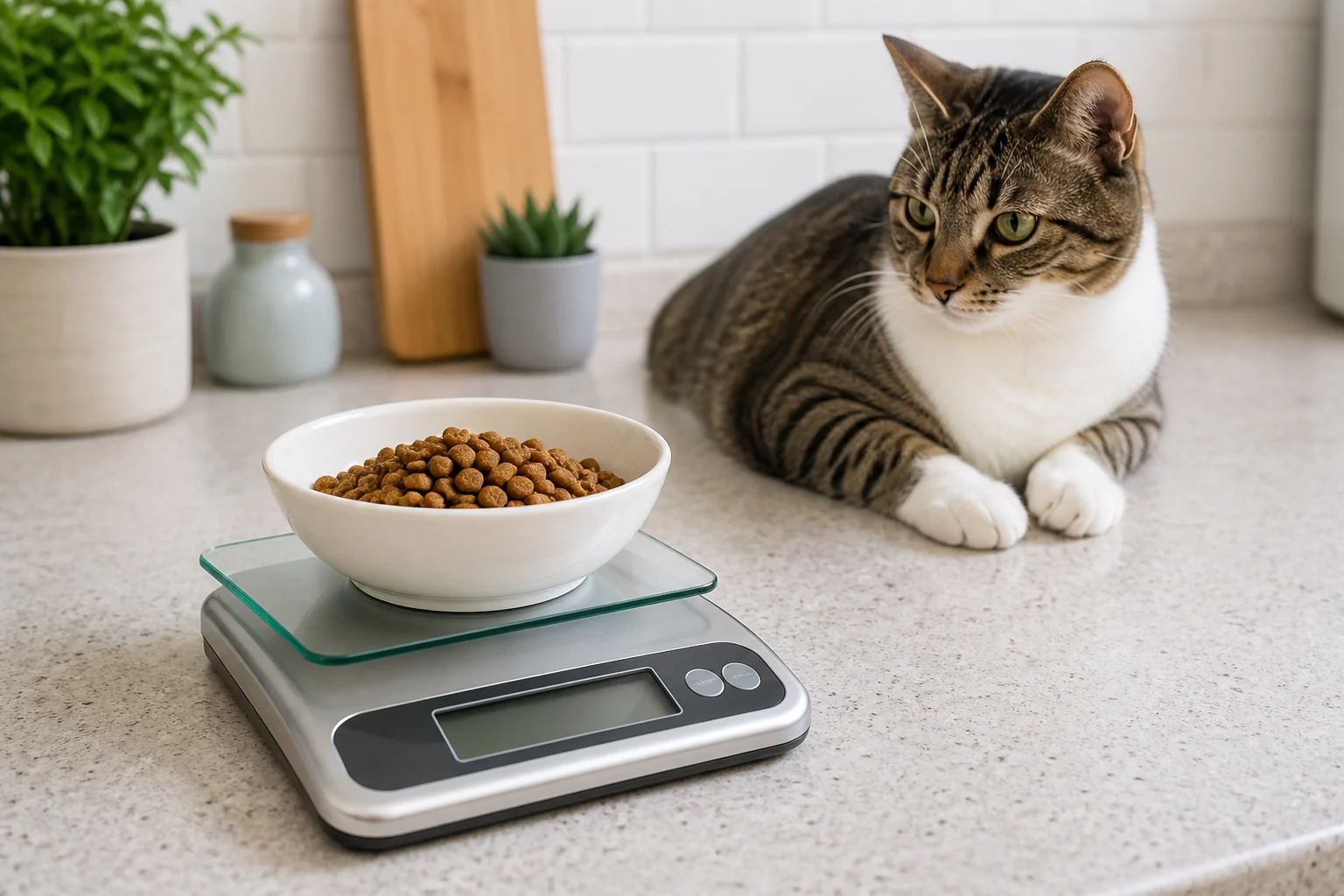
Using a kitchen scale for cat food portions means you first choose a daily calorie target, find the food's calories on the label, convert those calories into grams, and then weigh each meal the same way every day. It is not about making feeding fussy; it is about removing the guesswork that happens when a scoop, heaped cup, or "about half a can" changes from day to day.
This method is especially useful if your cat gains weight easily, eats both wet and dry food, steals from another bowl, or needs a clearer plan after a veterinary visit. A scale cannot replace your veterinarian's advice for obesity, diabetes, kidney disease, urinary disease, food allergies, or kitten growth, but it can make the plan you are given much easier to follow.
Table of Contents
- Why use a kitchen scale for cat food portions?
- What numbers do you need from the label?
- How do you turn a calorie target into grams?
- How do you weigh cat food in grams?
- How do you split calories between wet food, dry food, and treats?
- Should you follow the bag, the calculator, or your vet?
- What mistakes make scale feeding harder?
- How often should you adjust the gram amount?
- Conclusion
- Frequently Asked Questions
- References
Why use a kitchen scale for cat food portions?
A kitchen scale makes cat food portions more repeatable because grams are more precise than scoops or visual estimates. That matters most when the portion is small, the food is calorie-dense, or the cat's weight is slowly drifting up or down.
Veterinary nutrition guidelines emphasize regular nutritional assessment, including diet history, body weight, body condition, and calorie density of the food being fed 1. A scale supports that process because it gives you a number you can write down: not "a little less kibble," but "26 grams of this kibble at breakfast."
Measuring cups can still be useful as a quick household tool, but they are easy to overfill, underfill, shake level, pack tightly, or change with kibble shape. A controlled study in dog owners found large variation when people used different measuring devices for dry food, and the authors highlighted gram scales as a way to improve measuring accuracy 5. That study was in dogs, so it should not be treated as a cat-specific calorie rule, but the measuring problem applies to small dry-food portions too.
For cats, small differences add up quickly. If an indoor cat needs only a modest daily calorie target, an extra spoonful of kibble every day can quietly erase a weight plan. Cornell also identifies free feeding as a major contributor to feline obesity, because a constantly available bowl makes actual intake hard to see 4.
What numbers do you need from the label?
You need the calorie statement, the feeding directions, and the life-stage statement before you calculate a gram portion. The most useful number is usually listed as kcal per cup, kcal per can, kcal per tray, kcal per pouch, or kcal per kilogram.
AAFCO explains that pet food labels include a calorie statement under "Calorie Content," often shown as kilocalories per familiar unit such as per cup or per can 2. If your label gives kcal/kg, you can convert it to kcal per gram by dividing by 1,000.
Use this quick label checklist:
| Label item | What to look for | Why it matters |
|---|---|---|
| Calorie Content | kcal/cup, kcal/can, kcal/pouch, or kcal/kg | Lets you convert the food into daily calories |
| Feeding Directions | suggested amount by weight or life stage | Gives a starting range, not a perfect personal dose |
| Life Stage | growth, adult maintenance, all life stages, senior positioning | Kittens and adults do not have the same needs |
| Complete and Balanced statement | AAFCO nutritional adequacy wording | Helps confirm the food is meant as a main diet |
| Treat calories | kcal per treat or per piece when available | Prevents treats from becoming hidden meals |
If label terms feel confusing, use SnuggleSouls' guide to read cat food labels before you do the math. If your main issue is that the package amount seems vague or too generous, compare it with our guide to cat food feeding directions.
How do you turn a calorie target into grams?
Start with a daily calorie target, then divide that target by the food's calories per gram. If you do not already have a veterinary target, use a cautious estimate from your veterinarian, your cat's current body condition, and a tool such as the SnuggleSouls cat calorie calculator.
The basic formula is:
“text food calories per gram = kcal per kg / 1,000 daily grams = daily calorie target / food calories per gram grams per meal = daily grams / number of meals “
Here is a simple dry-food example:
| Step | Example number | Math |
|---|---|---|
| Daily target | 220 kcal/day | Starting estimate for this individual cat |
| Food label | 3,800 kcal/kg | Divide by 1,000 |
| Calories per gram | 3.8 kcal/g | 3,800 / 1,000 |
| Daily dry-food amount | 58 g/day | 220 / 3.8 |
| Two meals per day | 29 g per meal | 58 / 2 |
For a broader feeding starting point, read how much should I feed my cat first, then use the scale to make the portion repeatable. The scale does not decide what your cat should eat; it helps you deliver the chosen amount consistently.
How do you weigh cat food in grams?
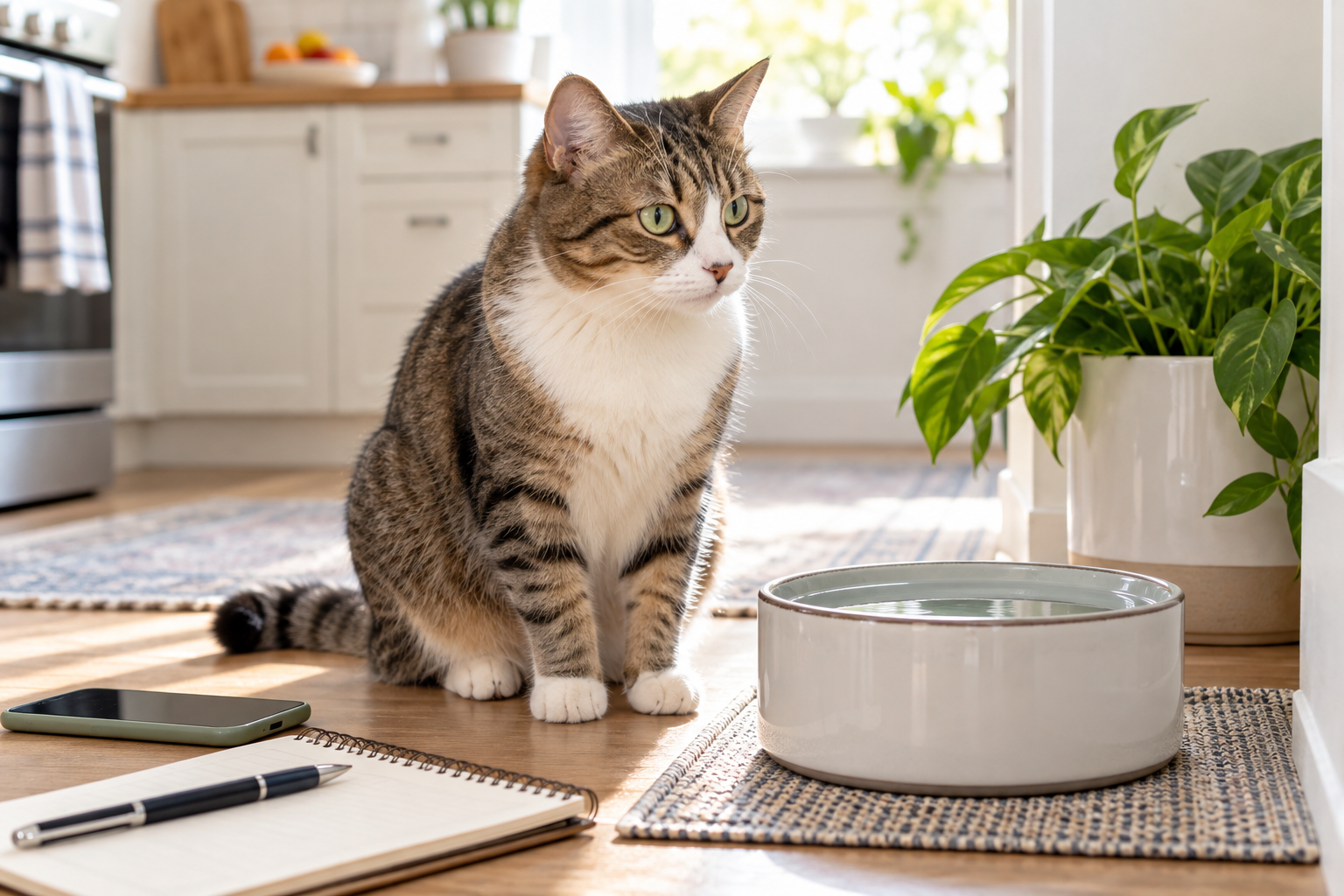
Put the empty bowl on the scale, press tare or zero, add food until the display reaches the gram amount, then feed the cat. Taring matters because a ceramic bowl may weigh several hundred grams, while the food may weigh only 20 to 40 grams.
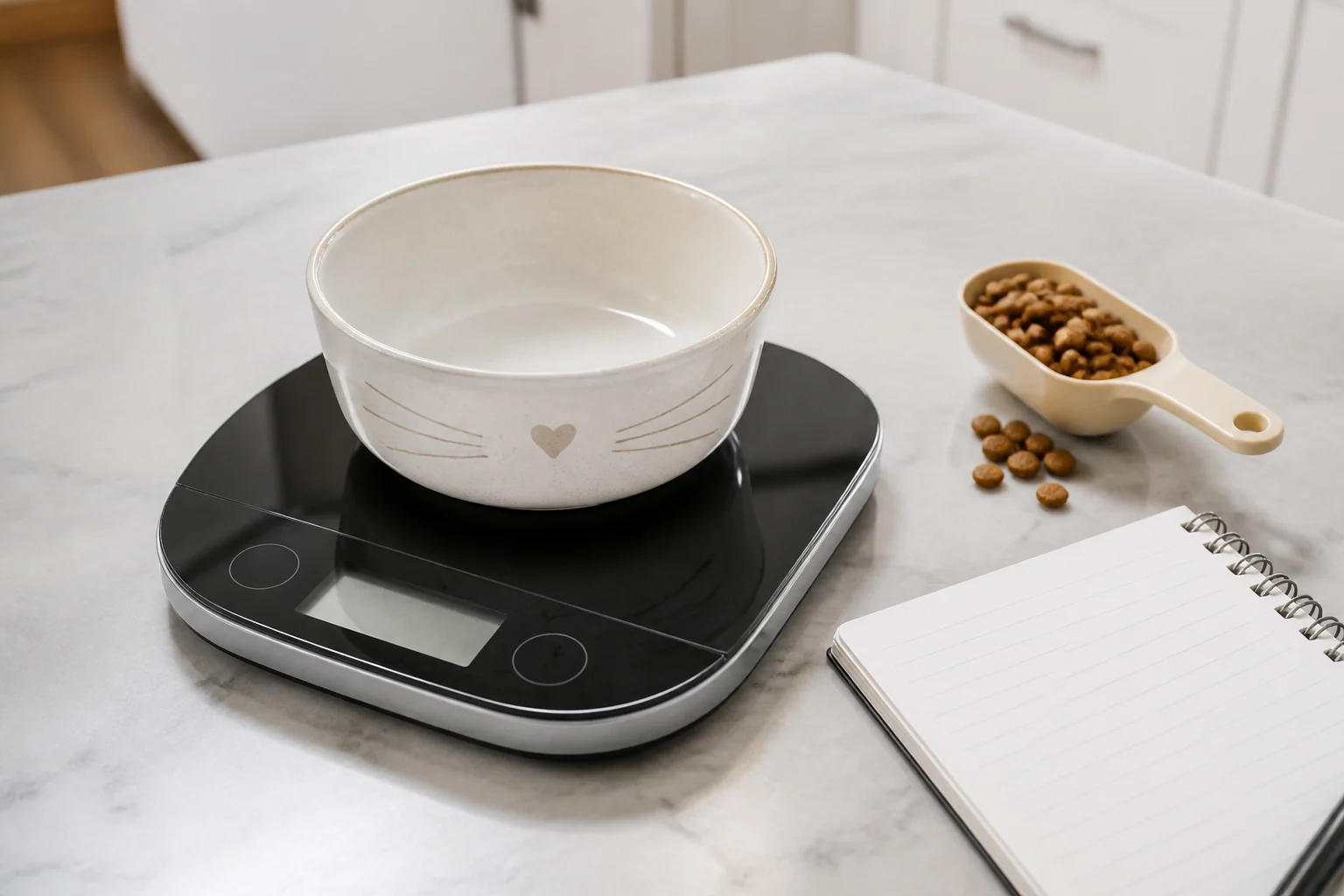
Use the same routine each time:
- Place the scale on a flat, dry counter.
- Switch the unit to grams.
- Put the empty cat bowl or prep container on the scale.
- Press tare or zero.
- Add the food slowly until you reach the target grams.
- Write down the amount if your cat is on a weight plan.
- Wash wet-food bowls promptly and keep the scale clean.
For dry food, you can weigh several meals into small containers if your routine is busy. For wet food, weigh the portion into the bowl, refrigerate the remaining food safely, and avoid leaving wet food out for long periods. Cornell notes that treats are not complete and balanced foods and should generally stay occasional rather than becoming a large share of daily calories 3.
How do you split calories between wet food, dry food, and treats?
Mixed feeding works best when every item comes out of the same daily calorie budget. Decide the wet-food calories first, subtract them from the daily target, subtract treat calories, and use the remaining calories for dry food.
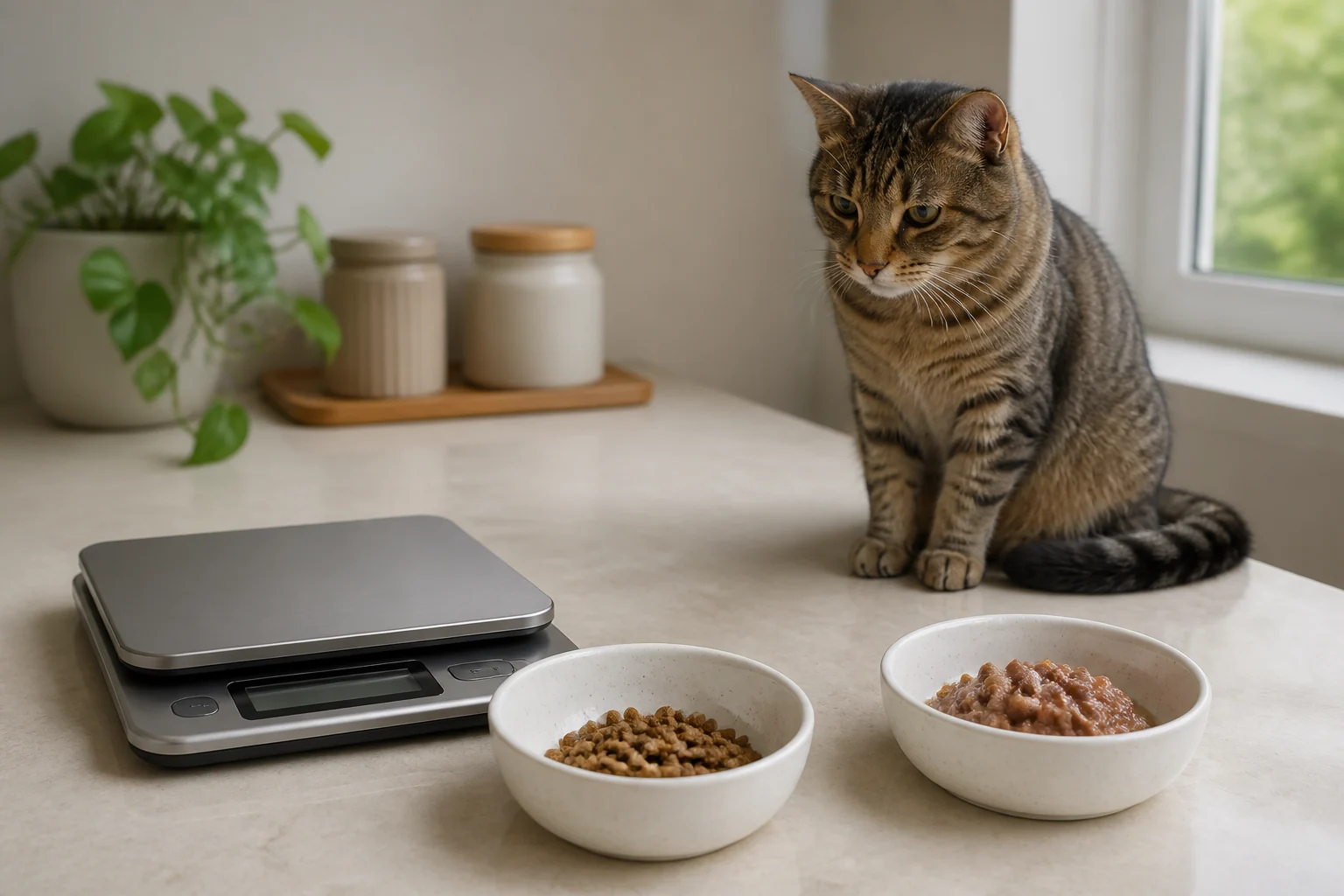
Here is an example for a cat with a 220 kcal daily target:
| Food | Label calories | Amount | Calories used |
|---|---|---|---|
| Wet food | 95 kcal per tray | 1 tray | 95 kcal |
| Treats | 2 kcal each | 5 treats | 10 kcal |
| Dry food | 3.8 kcal/g | 30 g | 114 kcal |
| Daily total | 219 kcal |
This is the same logic you would use to mix wet and dry cat food without accidentally feeding a full wet-food portion plus a full dry-food portion. If your cat eats prescription food, has a medical condition, or needs weight loss, ask your veterinarian which food should carry most of the calories.
Should you follow the bag, the calculator, or your vet?
Follow your veterinarian first when your cat has a health condition, is underweight, overweight, pregnant, nursing, growing, senior with muscle loss, or on a therapeutic diet. Use package feeding directions and calculators as starting tools, then use body condition and weight trends to adjust.
Package directions are usually written for broad groups of cats. They cannot know whether your cat is neutered, sedentary, highly active, recovering from illness, stealing from another cat, or getting daily treats. WSAVA's nutrition guidance supports an individualized nutrition plan rather than a one-size feeding amount 1.
Use this decision table:
| Situation | Best starting point | What the scale helps with |
|---|---|---|
| Healthy adult, stable weight | Label range plus calorie estimate | Keep meals consistent while monitoring weight |
| Indoor cat gaining weight | Vet or calorie estimate based on ideal condition | Stop hidden overfeeding from scoops and free feeding |
| Kitten | Veterinarian or kitten food directions | Track meals without restricting growth casually |
| Prescription diet | Veterinarian's written plan | Deliver the exact food amount prescribed |
| Multi-cat home | Individual feeding plan | See who is eating what, especially with feeders or separate rooms |
Never crash-diet a cat. Rapid or severe food restriction can be dangerous, and cats with sudden appetite loss should be treated as a veterinary concern rather than a portion-control problem.
What mistakes make scale feeding harder?
The biggest mistake is weighing accurately but using the wrong calorie target. A perfect gram amount is still wrong if it is based on another cat's needs, an old food label, or a plan that ignores treats.
Watch for these common problems:
- Using kcal per cup when the math needs kcal per gram.
- Forgetting to subtract treats, toppers, pill pockets, or lickable snacks.
- Switching food brands without recalculating because kcal/g can change.
- Feeding from a shared bowl in a multi-cat home.
- Letting one family member scoop "just a little extra."
- Reducing food sharply because the cat looks overweight.
- Measuring dry food but free-feeding overnight.
If your cat has been grazing all day, use a gradual routine change instead of suddenly removing food and guessing at meals. Our guide to transition an overweight cat from free feeding to measured meals can help you make that change more calmly.
How often should you adjust the gram amount?
For a healthy adult cat, check body weight and body condition every two to four weeks when you change portions, then adjust slowly if the trend is clearly wrong. For weight loss, chronic disease, kittens, seniors, or cats with appetite changes, follow your veterinarian's monitoring schedule.
Use the scale as part of a feedback loop:
| What you notice | What it may mean | What to do next |
|---|---|---|
| Weight stable and body condition ideal | Portion likely fits current needs | Keep weighing the same amount |
| Slow weight gain | Calories may be too high, treats may be missed, activity may be low | Recheck all calories and ask your vet if weight gain continues |
| Slow weight loss in an overweight cat | Plan may be working | Continue only if the rate is vet-approved and the cat acts well |
| Sudden weight loss | Possible illness or underfeeding | Call your veterinarian promptly |
| Not eating, hiding, vomiting, or acting weak | Not a normal portion issue | Seek veterinary advice urgently |
Body condition matters because the number on the scale does not show whether your cat is carrying enough muscle or too much fat. You can use the SnuggleSouls cat body condition score calculator as a home check, then confirm concerns with your veterinarian.
Conclusion: Making Cat Food Portions Consistent
A kitchen scale is one of the simplest tools for making cat food portions more consistent. Find the calorie number on the label, convert calories into grams, tare the bowl, weigh each meal, and track your cat's weight and body condition over time.
The goal is not perfect math for its own sake. The goal is a calmer feeding routine where your cat gets a measured, appropriate amount and you can spot real changes before they become bigger problems.
Frequently Asked Questions
Is it better to weigh cat food in grams or use a cup?
Grams are usually more consistent because they measure weight, while cups measure volume and can change with kibble size, scoop shape, and how full the cup is. Cups can be convenient, but a gram scale is better when you are managing weight, mixed feeding, or small portions.
Can I weigh wet cat food on a kitchen scale?
Yes. Put the bowl on the scale, press tare, then spoon in the wet food until you reach the target grams or calories. Clean the bowl and scale surface carefully afterward, and follow safe storage directions for opened wet food.
How do I convert kcal/kg to kcal per gram?
Divide kcal/kg by 1,000. For example, a dry food listed at 3,800 kcal/kg has 3.8 kcal per gram. If your cat's dry-food budget is 114 kcal, 114 divided by 3.8 equals 30 grams.
Should I weigh treats too?
You do not need to weigh every tiny treat if the label gives calories per treat, but you should count treat calories. If the treat label gives kcal/kg or the pieces vary in size, weighing can help keep treats from quietly replacing balanced food.
What if my cat seems hungry after the measured portion?
Do not automatically add food without checking the full picture. Hunger can come from habit, fast eating, boredom, food stealing, an underestimated calorie need, or a medical problem. If hunger is new, intense, paired with weight loss, vomiting, diarrhea, or behavior change, call your veterinarian.
References
[1] World Small Animal Veterinary Association. (2021). Global Nutrition Guidelines. Global Nutrition Guidelines
[2] Association of American Feed Control Officials. (2026). Reading Labels. Reading Labels
[3] Cornell Feline Health Center. (2026). Feeding Your Cat. Feeding Your Cat
[4] Cornell Feline Health Center. (2026). Obesity. Obesity
[5] Coe, J. B., Rankovic, A., Edwards, T. R., & Parr, J. M. (2019). Dog owner's accuracy measuring different volumes of dry dog food using three different measuring devices. Veterinary Record. Article on PubMed Central
 EN
EN DE
DE ES
ES PT
PT