
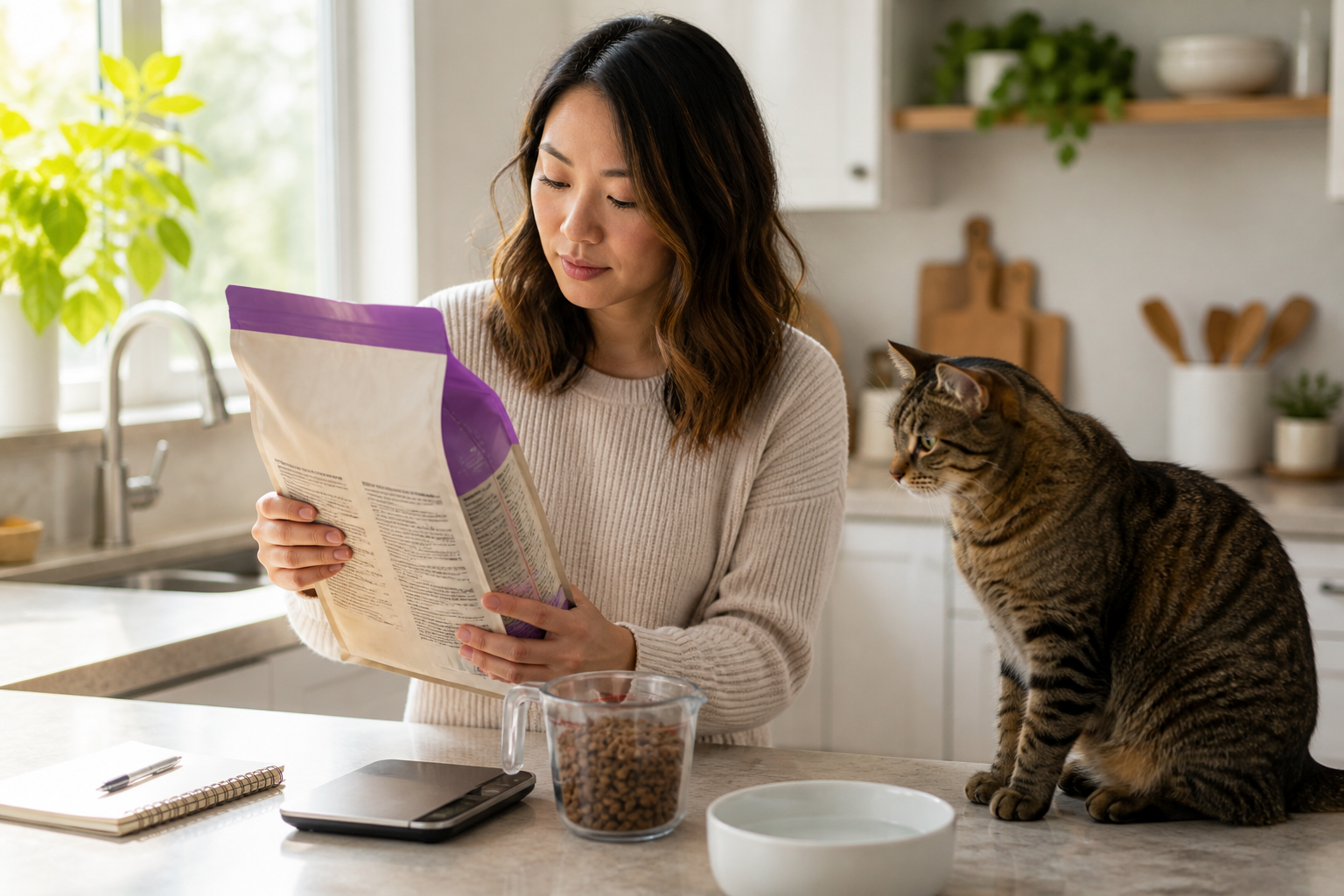
Cat food feeding directions are a useful starting estimate, but your cat's calories, body condition, weight trend, and health decide the real portion.
That can feel frustrating when the bag or can seems to promise a simple answer. One label may tell you to feed a broad range, another may use cups, and wet food may use cans or trays instead of calories per meal. The useful part is that the label gives you a baseline. The missing part is your individual cat.
This guide explains how to read feeding directions without overtrusting them. If you are still learning the rest of the package, start with SnuggleSouls' guide on how to read cat food labels first, then come back here to turn the feeding chart into a safer home routine.
Table of Contents
- What do cat food feeding directions actually mean?
- Why are package portions only a starting point?
- How do you turn label directions into measured cat portions?
- How do you know if the package amount is too much or too little?
- What mistakes make feeding directions unreliable?
- How should kittens, seniors, and special situations use feeding directions?
- How do you adjust portions safely over time?
- Conclusion: Feeding Directions Are a Useful First Draft
- Frequently Asked Questions
- References
What do cat food feeding directions actually mean?
Cat food feeding directions tell you the manufacturer's suggested daily amount for a cat of a certain weight, life stage, or condition. AAFCO explains that complete and balanced pet foods need directions that state at least how much food to give for the animal's life stage, usually by body weight and time period 2.
Those directions are not random. They are connected to the food's calorie density, nutritional profile, and intended life stage. A food for kittens, for example, may have different directions from an adult maintenance food because growing cats need different nutrition than healthy adult cats. The FDA also emphasizes that the nutritional adequacy statement is the label clue that tells you whether a food is intended to meet nutritional needs for a life stage or feeding purpose 3.
The label still cannot know your cat's metabolism, activity level, neuter status, muscle condition, medical history, or whether treats are sneaking into the day. That is why feeding directions should be treated like the first draft of a plan.
Why are package portions only a starting point?
Package portions are broad because cats are individual. Two adult cats can weigh the same but need different calories because one is lean, active, and playful while the other is sedentary, neutered, older, or already gaining weight.
Cornell Feline Health Center describes cats as obligate carnivores with specific nutrient needs and explains that feeding choices depend on the cat's age, health, and individual situation 4. WSAVA nutrition guidance also frames nutrition as an individualized assessment rather than a label-only decision 5.
A label may also use ranges. If the chart says a 10-pound cat should eat one-half to three-quarters cup per day, the lower end and higher end are very different amounts over a week. A small measuring error repeated every day can become weight gain, hunger, or underfeeding over time.
The safest mindset is simple: start with the label, measure the real amount, watch the cat, then refine.
| Label clue | What it helps with | What it cannot decide alone |
|---|---|---|
| Cat weight range | Gives a starting row on the chart | Whether your cat is lean, overweight, or losing muscle |
| Cups, cans, trays, or grams | Gives a measurable daily amount | Whether your scoop or portion is accurate |
| Calories per cup, can, or kilogram | Lets you calculate daily calories | Whether those calories match your cat's current need |
| Life-stage wording | Shows whether the food is meant for growth, adult maintenance, or all life stages | Whether it is right for a cat with disease, weight loss, or a prescription diet need |
How do you turn label directions into measured cat portions?
Turn the package direction into a daily calorie and meal plan. First find the suggested daily amount, then find the calorie content, then divide the daily total into meals your cat can finish comfortably.
If your cat's label gives cups, weigh your normal scoop once or twice so you know what that "cup" actually means in grams. If the label gives cans or trays, note whether it means a full container per day, per meal, or per certain body weight. For a broader daily estimate, compare the label with SnuggleSouls' how much should I feed my cat guide or use the cat calorie calculator as a planning tool.
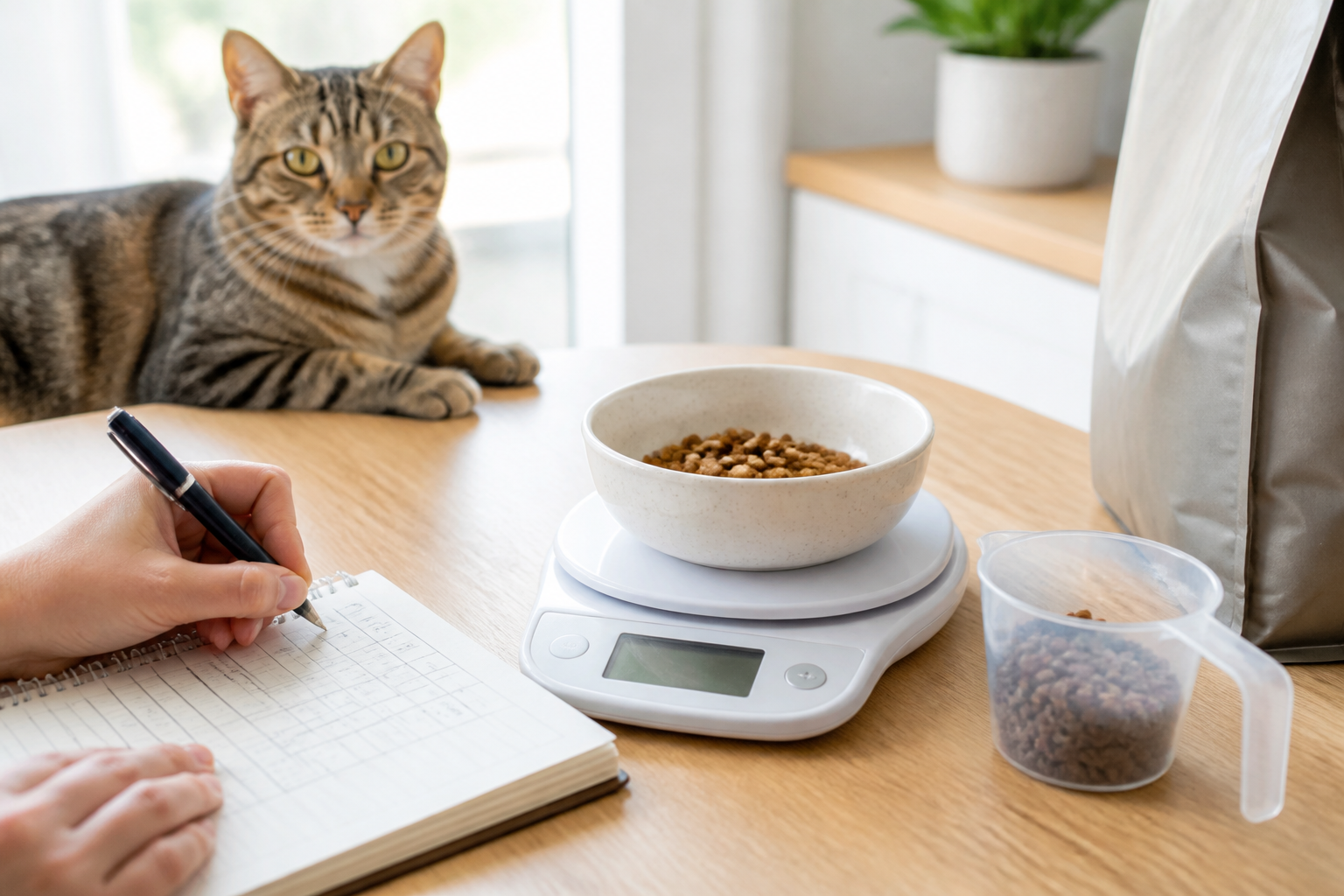
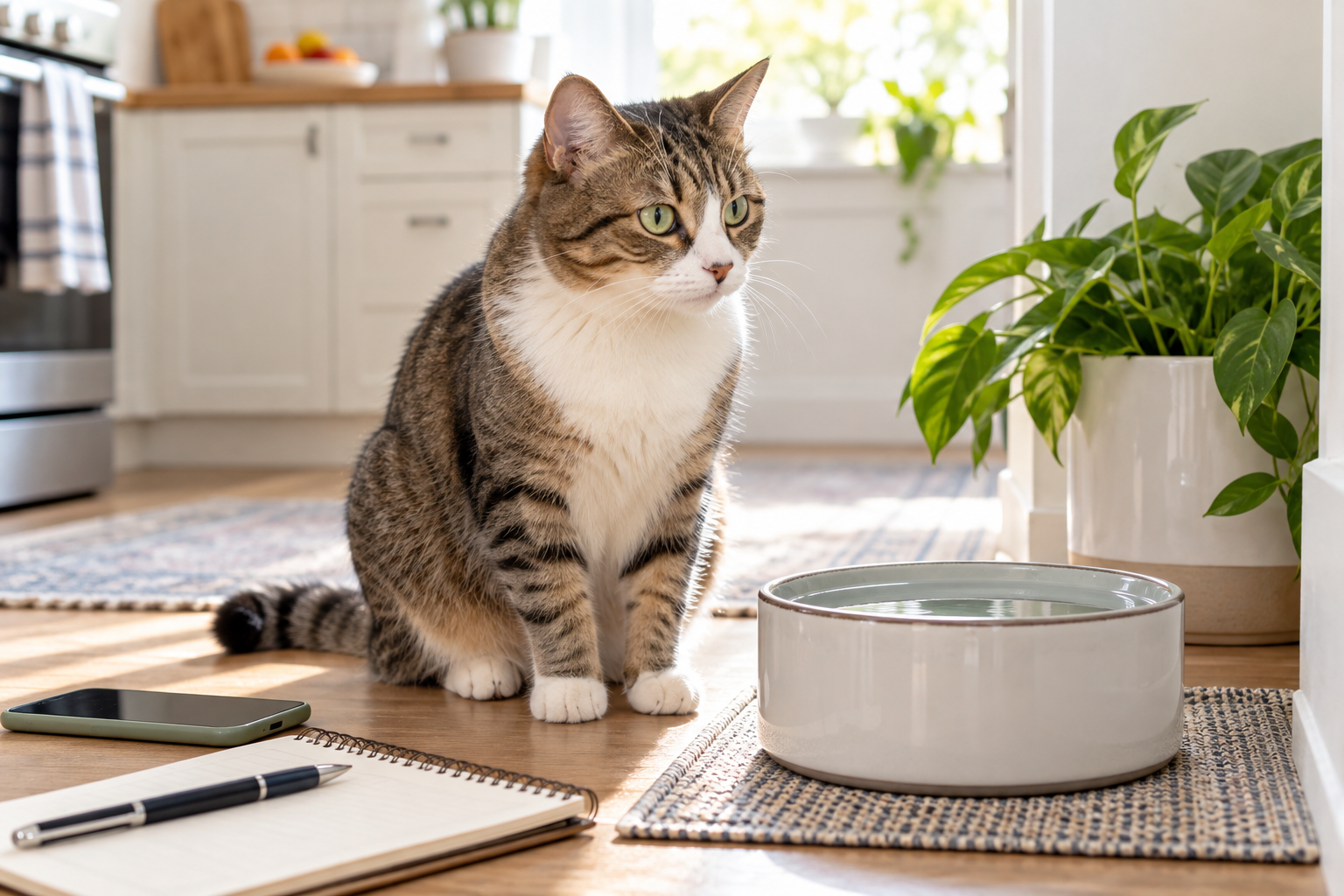
Turning a label amount into measured meals helps prevent scoop drift and makes portion changes easier to track.
A practical setup looks like this:
- Write down the exact food name, flavor, and form.
- Copy the calorie content from the package.
- Choose the label's starting amount for your cat's current weight or target weight if your veterinarian has provided one.
- Measure that amount with the same scoop, scale, can size, or tray size every day.
- Divide it into meals that fit your cat's routine.
- Record treats, toppers, dental snacks, and food used in puzzles.
If you feed both wet and dry food, avoid adding each package's full suggested amount together. That is a common way to double calories by accident. Use the wet and dry labels as pieces of one daily budget, and use SnuggleSouls' guide on how to mix wet and dry cat food if you need a step-by-step split.
How do you know if the package amount is too much or too little?
Your cat's body condition and weight trend tell you whether the starting amount is working. A package chart may be reasonable on paper but too much for a cat who is slowly gaining fat, or too little for a cat who is losing weight without explanation.
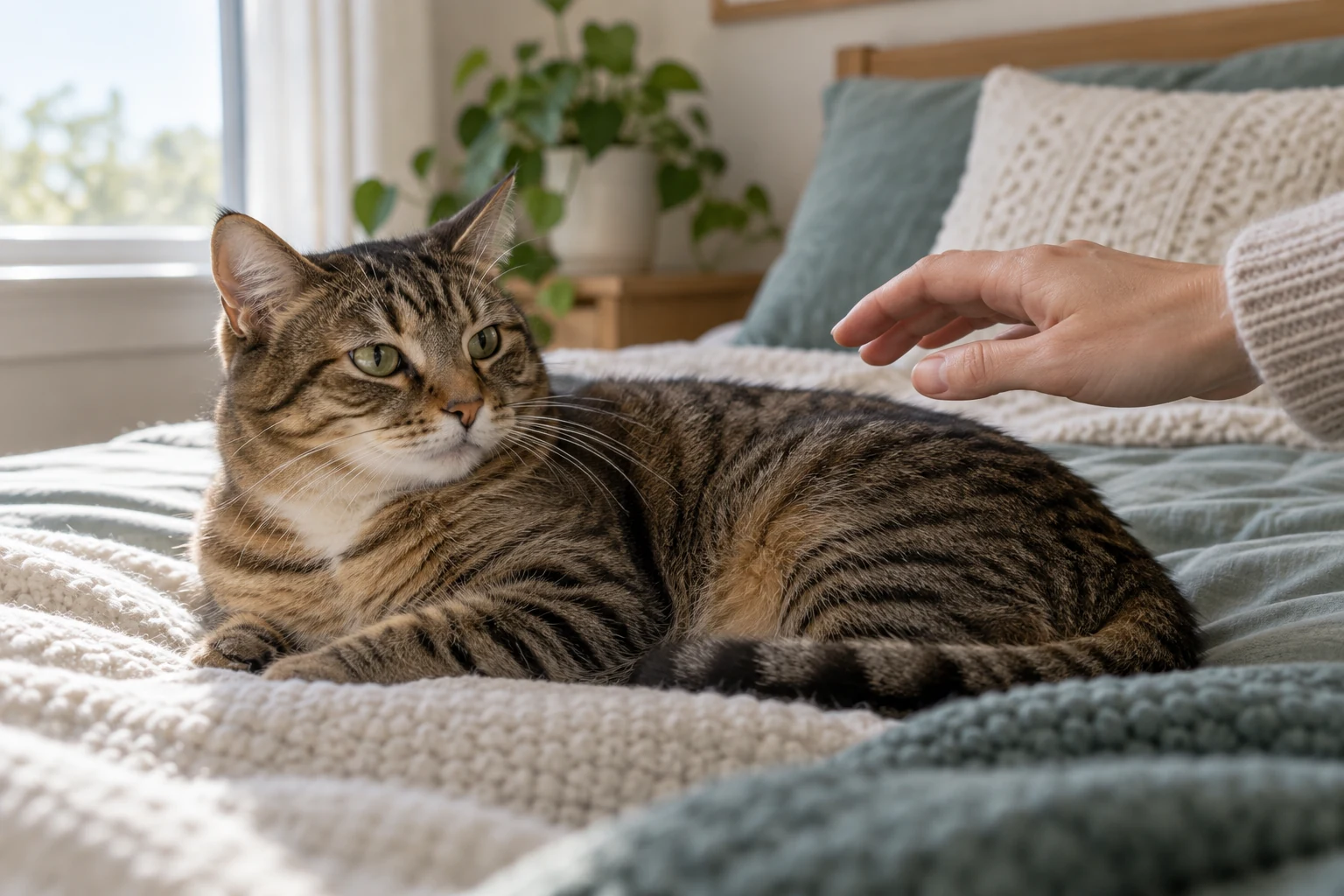
Check more than the bowl. Look at your cat from above and from the side, feel the ribs gently, and track weight on the same scale when possible. SnuggleSouls' cat body condition and weight calculator can help organize what you notice, but a veterinarian should guide weight-loss plans, underweight cats, kittens, seniors, and cats with chronic disease.
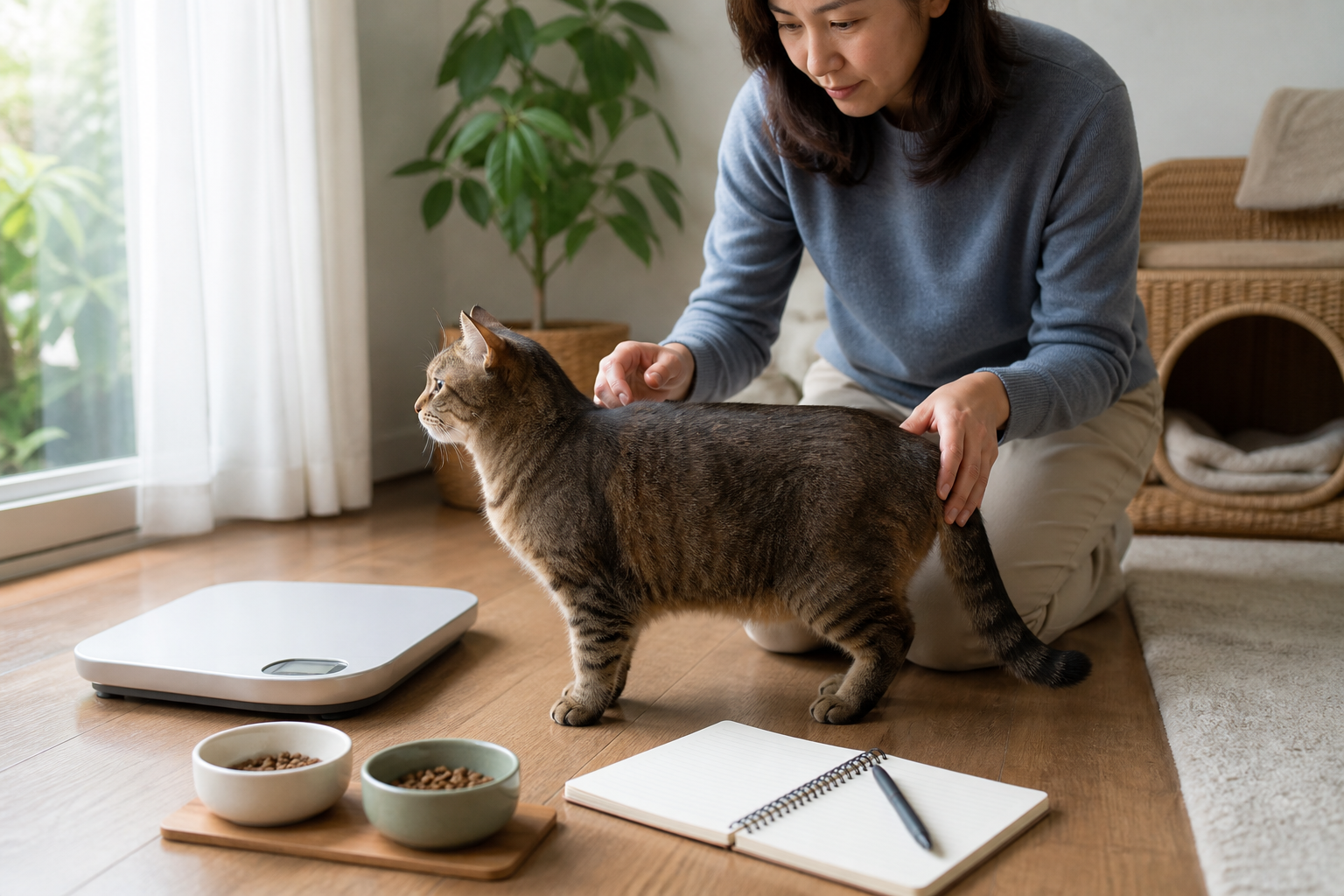
Your cat's weight trend and body condition show whether the starting portion is working better than the package chart alone.
Use this pattern after two to four weeks on a measured routine:
| What you notice | Possible meaning | Safer next step |
|---|---|---|
| Slow weight gain | Starting amount may be too high, or treats are not counted | Confirm measuring accuracy and ask your vet about a small reduction |
| Slow weight loss in an overweight cat | May be appropriate if veterinarian-guided | Keep tracking and avoid sharp cuts |
| Weight loss in a normal or thin cat | Could be underfeeding or a health problem | Call your veterinarian, especially if appetite changes |
| Constant hunger with stable weight | Meal timing, boredom, fast eating, or too low a portion may be involved | Review calories, enrichment, and meal split |
| Vomiting, diarrhea, thirst, weakness, or sudden appetite change | May be a health issue, not a portion issue | Contact your veterinarian promptly |
Do not treat unexplained weight loss as a sign that the label was too low. Weight loss can come from dental disease, digestive problems, kidney disease, diabetes, hyperthyroidism, pain, stress, or other medical issues. The portion plan should support health, not hide symptoms.
What mistakes make feeding directions unreliable?
The most common mistake is using a label amount without measuring the real food. A cup of kibble can vary by how it is scooped, whether the cup is level, and the food's shape. Wet food can drift too if a "half can" becomes a generous half can plus toppers.
Another mistake is forgetting extras. Treats, lickable snacks, pill pockets, table food, dental treats, and food hidden in toys all count. AAFCO's label resources separate feeding directions, calories, and descriptors because each part gives different information 1. You need all three to understand what your cat is actually eating.
Watch for these portion traps:
- Free-feeding from a bowl that is topped off before it empties.
- Feeding multiple cats from one shared bowl.
- Letting one cat steal from another cat's prescription or weight-control food.
- Using the kitten direction after the cat has moved into adult maintenance.
- Mixing wet and dry food by using the full label amount of both.
- Cutting food sharply without veterinary guidance.
- Ignoring a sudden change in appetite, thirst, vomiting, diarrhea, or weight.
If your cat is currently overweight and has been grazing all day, the switch to measured meals should be gradual and deliberate. SnuggleSouls' guide to transition from free feeding to measured meals walks through that change without turning meals into a daily battle.
How should kittens, seniors, and special situations use feeding directions?
Kittens, seniors, pregnant or nursing cats, underweight cats, overweight cats, and cats with medical conditions need extra caution. The label may offer a life-stage starting point, but it may not be enough for a growing kitten or appropriate for a senior cat losing muscle.
Kittens often need more frequent meals and food labeled for growth or all life stages. Adult cats usually need a routine that maintains a lean body condition. Seniors may need closer monitoring because weight loss, muscle loss, dental pain, kidney disease, thyroid disease, arthritis, and appetite changes can all affect feeding. For timing by life stage, see the SnuggleSouls cat feeding schedule by age.
Prescription diets and therapeutic diets are different from everyday label troubleshooting. If a veterinarian prescribed a food for urinary disease, kidney disease, diabetes, gastrointestinal disease, allergies, or weight loss, do not substitute package math for the veterinary plan. Ask the clinic how much to feed, how to transition, and when to recheck weight or lab work.
How do you adjust portions safely over time?
Make small, trackable changes instead of large guesses. For many healthy adult cats, a measured plan can be adjusted gradually after you confirm the starting amount, count treats, and watch body condition. For cats who are obese, underweight, ill, senior, pregnant, nursing, or on medication, ask your veterinarian before changing the amount.
A simple home review can work like this:
- Feed the measured starting amount for two weeks unless your veterinarian gave a different schedule.
- Track meal amounts, treats, appetite, stool, vomiting, water intake, and weight.
- Compare body condition and weight trend.
- If your cat is gaining or losing unexpectedly, call your veterinarian before making a major change.
- If your cat is otherwise healthy but trending slightly up or down, make a small adjustment and recheck.
Never crash-diet a cat. Rapid food restriction can be dangerous, and refusing food for 24 to 48 hours is a reason to contact a veterinarian. Also call urgently for repeated vomiting, severe diarrhea, collapse, breathing trouble, blocked urination signs, seizures, suspected poisoning, or rapid decline.
The best portion plan is boring in a good way: same food, same measuring method, steady records, and changes that are small enough to evaluate.
Conclusion: Feeding Directions Are a Useful First Draft
Cat food feeding directions give you a sensible place to start, but they are not the final answer for every cat. The real plan comes from combining the label with calories, accurate measuring, life stage, body condition, weight trend, treats, and your veterinarian's advice when health or weight is involved.
If you take only one step today, measure the amount you already feed and write it down. That single habit turns a vague label chart into a care routine you can actually adjust.
Frequently Asked Questions
Should I feed exactly what the cat food bag says?
Not always. Use the bag or can as a starting point, then adjust based on your cat's body condition, weight trend, age, activity, treats, and veterinary guidance. If your cat is gaining or losing weight unexpectedly, ask your veterinarian before making a large change.
Are feeding directions per day or per meal?
Most feeding directions are written as a daily amount, but labels vary. Read the wording carefully and check whether the amount is listed per day, per meal, per body weight range, or per can or cup. If the label is unclear, contact the manufacturer or ask your veterinary team.
Is a measuring cup accurate enough for cat food?
A level measuring cup is better than guessing, but a kitchen scale is usually more consistent for dry food. Kibble shape and scoop style can change how much food fits in a cup. Weighing the portion in grams helps keep daily calories steadier.
How often should I change my cat's portion?
Do not change portions every day based on mood or begging. Track a measured plan for a couple of weeks, then review weight, body condition, appetite, and stool. Make small adjustments unless your veterinarian gives a different plan.
What if my cat still seems hungry on the label amount?
First confirm that the measured amount is accurate and that treats are counted. Hunger can also come from fast eating, boredom, long meal gaps, food competition, or medical problems. Call your veterinarian if hunger is sudden, intense, or paired with weight loss, thirst, vomiting, diarrhea, or behavior change.
References
[1] AAFCO. (2026). Reading Labels. AAFCO Reading Labels
[2] AAFCO. (2026). Selecting the Right Pet Food. AAFCO Selecting the Right Pet Food
[3] U.S. Food and Drug Administration. (2024). Complete and Balanced Pet Food. FDA Complete and Balanced Pet Food
[4] Cornell Feline Health Center. (2026). Feeding Your Cat. Cornell Feeding Your Cat
[5] WSAVA Global Nutrition Committee. (2024). Global Nutrition Guidelines. WSAVA Global Nutrition Guidelines
 EN
EN DE
DE ES
ES PT
PT