

To read a cat food label well, start with four things: the nutritional adequacy statement, guaranteed analysis, calorie content, and feeding directions. Then use the ingredient list and marketing claims as context, not as the main proof that the food is right for your cat.
Cat food labels can feel designed to make caring people second-guess themselves. A bag may say "natural," a can may highlight meat first, and the guaranteed analysis may make wet food look low in protein simply because it contains far more water. The goal is not to find one perfect label. It is to know what each panel can and cannot tell you.
This guide walks through the label in the order that usually matters most: life stage first, nutrient comparison second, calories third, claims last. If your cat has kidney disease, diabetes, urinary issues, food allergies, chronic vomiting or diarrhea, weight loss, or any prescription diet recommendation, use this as a question list for your veterinarian rather than a reason to change food on your own.
Table of Contents
- What should you read first on a cat food label?
- How do you compare wet and dry cat food fairly?
- How do calories on the label help with portion control?
- What does the ingredient list actually tell you?
- Which label claims matter and which ones need a second look?
- How do carbohydrates fit into label reading?
- When should a label send you to your veterinarian?
- Conclusion
- Frequently Asked Questions
- References
What should you read first on a cat food label?
Read the nutritional adequacy statement first because it tells you whether the food is meant to be complete and balanced for your cat's life stage. The FDA notes that this statement is the place to check whether a pet food is designed to meet a pet's nutritional needs rather than act only as a treat, topper, or intermittent food 2.
Look for wording that matches your cat:
- Adult maintenance for a healthy adult cat.
- Growth or kitten wording for kittens, pregnant cats, or nursing cats.
- All life stages only when you understand that the food must meet growth needs, which can be richer than some adult cats require.
- Intermittent or supplemental feeding only for treats, toppers, broths, or products that should not be your cat's main diet.
This first step prevents a common mistake: judging a food by ingredients before checking whether it is even intended to be the main diet. A beautiful-looking topper can still be incomplete. A plain-looking can may be the more appropriate daily food.
After that, read the guaranteed analysis. AAFCO explains that pet food labels commonly list minimum crude protein and crude fat, plus maximum crude fiber and moisture 1. "Crude" describes the testing method, not poor-quality nutrients. These numbers are useful, but they are not a full nutrient profile and they are not automatically comparable between wet and dry foods.
If you are still choosing between broad diet types, start with a bigger decision framework for choosing healthy cat food before comparing small label differences.
How do you compare wet and dry cat food fairly?
Compare wet and dry food on a dry-matter basis when you want a fairer nutrient comparison. The label's guaranteed analysis is usually listed "as fed," meaning it includes the water in the food; wet food can look low in protein or fat simply because much of the can is moisture.
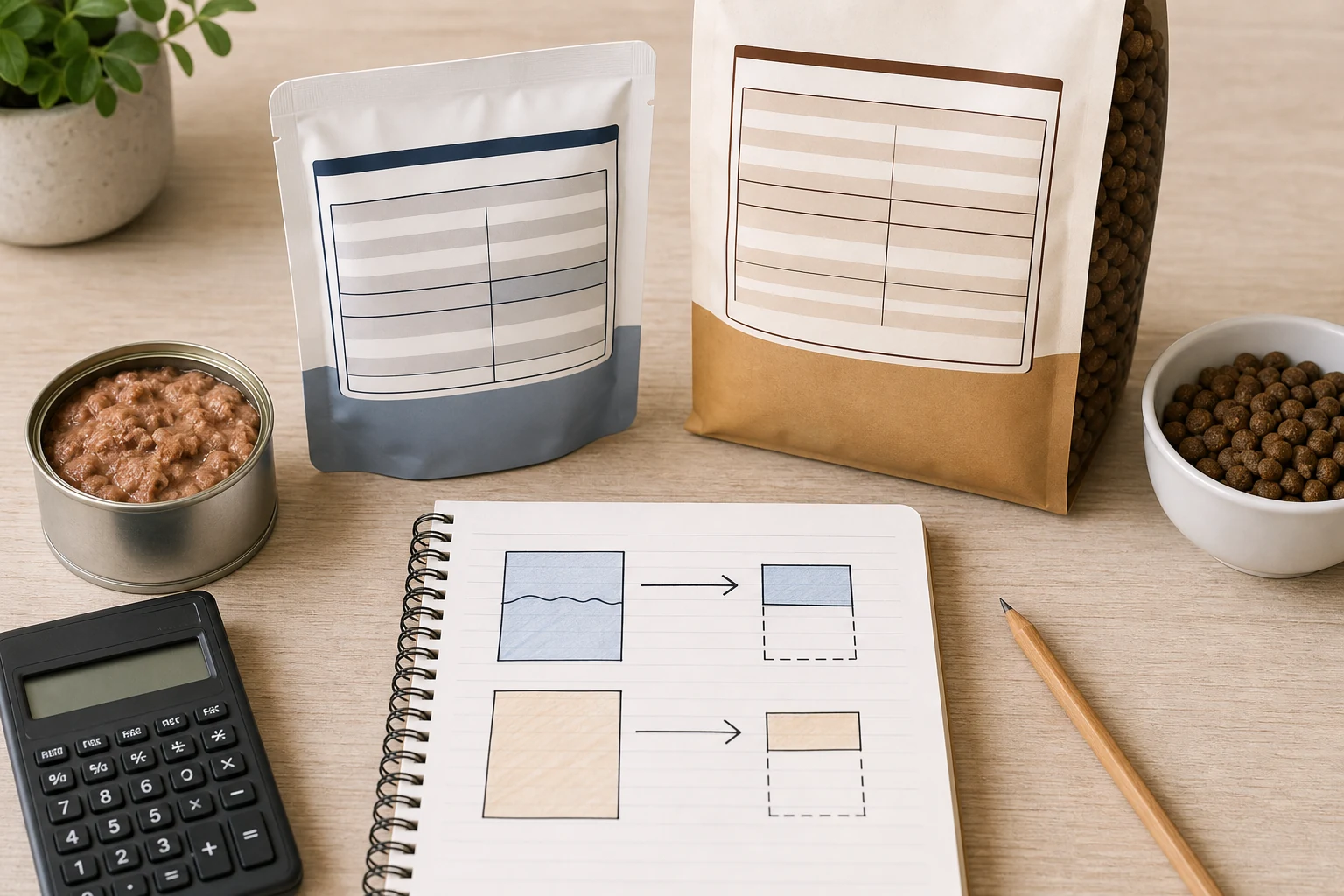
Dry matter means the food after water is removed from the math. Here is the basic formula:
| Step | What to do | Example |
|---|---|---|
| 1 | Find moisture percentage | A wet food lists 78% moisture |
| 2 | Subtract moisture from 100 | 100 – 78 = 22% dry matter |
| 3 | Divide the nutrient by dry matter | 10% protein / 22 = 45.5% |
| 4 | Compare that result with another food | Now compare against dry food on the same basis |
This is why a canned food labeled 10% protein can be much higher in protein on a dry-matter basis than it first appears. A dry food labeled 32% protein may contain only about 10% moisture, so the dry-matter result is closer to the label number.
Dry-matter math is especially helpful when comparing wet vs dry cat food, checking fiber, or understanding why moisture-rich foods can support hydration while still delivering meaningful nutrients. It does not tell you digestibility, amino acid balance, mineral balance, or whether a therapeutic diet is appropriate for a medical condition. For those questions, a veterinarian or veterinary nutritionist matters.
How do calories on the label help with portion control?
Calories tell you how much energy your cat gets from each can, cup, pouch, or gram. They are often more useful for daily portion control than ingredient order or front-of-package claims.
Look for the calorie statement, often written as kcal per can, kcal per cup, kcal per kilogram, or kcal per pouch. Then compare it with your cat's daily calorie target. If you are not sure where to start, use a cat calorie calculator as an estimate and confirm the plan with your veterinarian, especially if your cat is underweight, overweight, senior, growing, pregnant, nursing, or medically fragile.
Calories matter because two foods with similar labels can feed very differently:
| Label detail | Why it matters | Cat-parent move |
|---|---|---|
| Kcal per cup | Dry food portions can become calorie-dense quickly | Measure with a real measuring cup or gram scale |
| Kcal per can | Wet foods vary widely by can size and recipe | Count cans or partial cans across the whole day |
| Feeding directions | Directions are broad starting points | Adjust to body condition and vet advice |
| Treat calories | Treats can quietly crowd out balanced food | Keep treats modest and included in the daily total |
If your cat is gaining weight while eating a mix of wet and dry food, label calories help you avoid accidental doubling. Our guide to how much should I feed my cat can help you think through meal amounts by age and activity, while mixing wet and dry cat food explains how to combine formats without overfeeding.
What does the ingredient list actually tell you?
The ingredient list tells you what ingredients are present by weight before processing, but it does not prove the final nutrient balance by itself. It is useful for identifying protein sources, avoiding known allergens, and understanding whether a food relies heavily on certain starches, fibers, or by-products, but it should be read after the adequacy statement and guaranteed analysis.
Cats are obligate carnivores, and Cornell's Feline Health Center explains that cats rely on nutrients found in animal products and need nutrients such as amino acids, fatty acids, vitamins, and minerals in appropriate amounts 3. That does not mean every good food must have a trendy ingredient list. It means the finished diet must meet feline nutrient needs.
Ingredient order can also mislead. Fresh meat contains water, so it may appear high on the list before cooking. Split ingredients, such as several types of starch or legume ingredients, can make each one appear lower even when the combined category is substantial. Named animal proteins are useful to notice, but they are not the whole story.
Use the ingredient list for practical questions:
- Does the food contain a protein your cat has reacted to before?
- Are there many toppers, gravies, or flavor enhancers that may affect picky eating?
- Is the food complete and balanced, or is it a topper?
- Are fiber sources included for hairball, stool, or weight-control reasons?
- Does the brand provide deeper nutrient information when asked?
If you are specifically comparing protein claims, our high-protein cat food guide explains when protein level matters, when it can be over-marketed, and why medical history changes the answer.
Which label claims matter and which ones need a second look?
Label claims can be helpful clues, but they should never outweigh the adequacy statement, calories, or your cat's individual needs. Words like natural, premium, indoor, weight control, grain-free, and high protein can mean very different things depending on the full formulation.

Use this quick filter:
| Claim | What to check next | Why it matters |
|---|---|---|
| Complete and balanced | Life stage statement | Confirms whether it is a main diet |
| Indoor | Calories, fiber, and feeding directions | Indoor cats vary widely in activity |
| Grain-free | Full nutrient profile and carb sources | Grain-free does not mean carbohydrate-free |
| Weight control | Kcal per serving and satiety strategy | Lower calories only help if portions are measured |
| High protein | Dry-matter protein and medical fit | Some cats benefit; some need individualized advice |
| Limited ingredient | Actual protein source and adequacy | Useful for some cats, but not a diagnosis tool |
WSAVA's pet food selection guidance encourages looking beyond marketing by asking who formulates the diet, what quality-control steps are used, whether the diet is tested by feeding trials or formulation, and whether the company can provide detailed nutrient information 4. These questions are especially useful when two labels look similar but one brand is more transparent.
Be careful with any claim that sounds like a treatment promise. Food labels are not a diagnosis. If a food implies help for urinary health, digestion, skin, hairballs, or weight, check whether it is an everyday maintenance food, an over-the-counter diet, or a veterinary therapeutic diet that should be used with professional guidance.
How do carbohydrates fit into label reading?
Carbohydrate content is usually not listed directly on cat food labels, so you may need to estimate it from the guaranteed analysis. The rough "nitrogen-free extract" estimate uses protein, fat, fiber, moisture, and ash; if ash is not listed, the result is only an approximation.
Cats evolved eating prey with high protein, moderate fat, and relatively little carbohydrate, and Merck's nutrition guidance discusses feline requirements on a dry-matter basis for different life stages 5. Still, the best carbohydrate level is not the same for every cat. Palatability, calories, body condition, health history, moisture intake, and whether the diet is complete all matter.
For everyday label reading, ask:
- Is this food complete and balanced for my cat's life stage?
- Are the calories appropriate for my cat's body condition?
- Is the carbohydrate estimate relevant to a real concern, such as diabetes risk, weight management, or personal feeding goals?
- Am I comparing wet and dry foods on a dry-matter basis rather than label percentages alone?
If carbohydrate level is your main concern, read our deeper guide to low-carb cat food before changing diets. Cats with diabetes, pancreatitis history, kidney disease, urinary problems, gastrointestinal disease, or appetite loss need individualized veterinary advice rather than a label-only decision.
When should a label send you to your veterinarian?
A label should send you to your veterinarian when the food choice is connected to symptoms, chronic disease, rapid weight change, or a major life-stage change. Label reading is useful, but it cannot replace a physical exam, lab work, medication review, or a therapeutic nutrition plan.
Call your veterinarian before changing diets if your cat has:
- Diabetes, kidney disease, heart disease, urinary crystals, bladder stones, pancreatitis, liver disease, or inflammatory bowel disease.
- Repeated vomiting, chronic diarrhea, constipation, poor appetite, or unexplained weight loss.
- A history of food allergy testing, elimination diets, or prescription diet use.
- Senior-cat weight loss, muscle loss, or sudden appetite change.
- Kitten growth concerns, pregnancy, nursing, or recovery from illness.
Seek urgent veterinary care if your cat cannot urinate, is straining in the litter box with little or no urine, has breathing trouble, collapses, has seizures, has repeated vomiting, has severe diarrhea, may have eaten a toxin, stops eating for 24 to 48 hours, or declines rapidly. In those moments, the right food label is not the priority; medical assessment is.
For routine diet decisions, bring photos of the front label, adequacy statement, guaranteed analysis, calorie statement, ingredient list, and feeding directions to your appointment. That gives your veterinary team enough information to compare the food against your cat's body condition and health history.
Conclusion:
The most useful cat food label routine is simple: confirm the food is complete and balanced for the right life stage, compare nutrients on a dry-matter basis when moisture differs, check calories before portions, and treat ingredient claims as supporting context. That order helps you avoid being pulled around by marketing language while still making thoughtful choices for your cat.
If your cat is healthy, label reading can help you choose a steady everyday diet and feed it more accurately. If your cat has symptoms or a diagnosed condition, use the label to ask better questions at the vet, not to make a high-stakes diet change alone.
Frequently Asked Questions
What is the guaranteed analysis on cat food?
The guaranteed analysis is the nutrient panel that commonly lists minimum crude protein and crude fat, plus maximum crude fiber and moisture. It is useful for comparison, but it is usually shown as-fed, so wet and dry foods need dry-matter math for a fairer comparison.
Is the first ingredient the most important part of a cat food label?
No. The first ingredient matters, but it is not more important than the nutritional adequacy statement, calories, and the full nutrient profile. Ingredients are listed by weight before processing, so moisture-heavy ingredients can appear higher than expected.
How do I know if cat food is complete and balanced?
Look for the nutritional adequacy statement. It should say whether the food is complete and balanced for adult maintenance, growth, all life stages, or another intended use. If it says intermittent or supplemental feeding only, it should not be your cat's main diet unless your veterinarian specifically directs it.
Why does wet cat food look low in protein on the label?
Wet cat food often looks low in protein because the label includes moisture. Once you remove water from the comparison using dry-matter math, many wet foods show a much higher protein percentage than the as-fed label suggests.
Should I choose grain-free cat food?
Grain-free is not automatically better. Some grain-free foods still contain other carbohydrate sources, and the bigger questions are whether the food is complete and balanced, appropriate in calories, transparent in formulation, and suitable for your individual cat.
Can I switch cat food after reading a better label?
For a healthy cat, a gradual transition over several days is usually easier on appetite and digestion than a sudden switch. If your cat has a medical condition, is losing weight, vomiting, having diarrhea, or eating a prescription diet, ask your veterinarian before changing foods.
References
[1] AAFCO. (2023). Reading Labels. AAFCO reading labels
[2] U.S. Food and Drug Administration. (2023). Complete and Balanced Pet Food. FDA complete and balanced pet food
[3] Cornell Feline Health Center. (2026). Feeding Your Cat. Cornell feeding your cat
[4] WSAVA Global Nutrition Committee. (2021). Selecting a Pet Food for Your Pet. WSAVA selecting a pet food PDF
[5] Merck Veterinary Manual. (2025). Nutritional Requirements of Small Animals. Merck Veterinary Manual nutrition requirements


 Why Does My Cat Jerk Awake Suddenly? Startle Reflexes, Sleep Starts, and Vet Clues">
 Cat Scratching Door Frame: How to Protect Trim">
 EN
EN DE
DE ES
ES PT
PT