
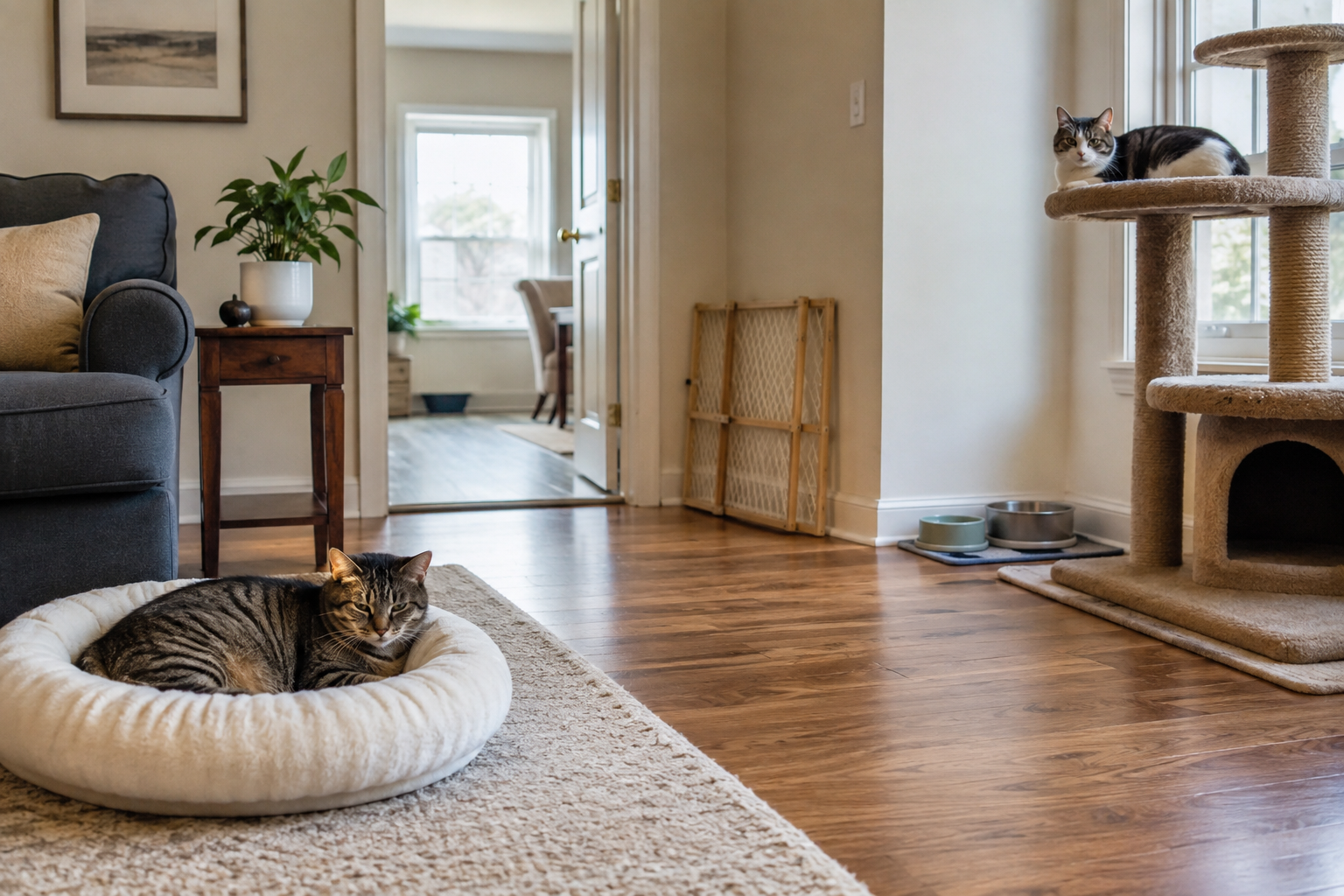
To prevent a cat bullying relapse, monitor old trouble spots, keep resources separated, and step back early when blocking, chasing, or avoidance returns.
This stage can be frustrating because the worst behavior may already be gone. One cat is no longer chasing daily, the bullied cat is coming out more, and everyone wants the home to feel normal. But many relapses start quietly: a hard stare near a hallway, one cat waiting by the litter box, a rushed pass through a doorway, or the target cat slowly giving up a room again.
Table of Contents
- When is a cat bullying relapse most likely?
- What should you monitor after the cats seem better?
- How do you keep resources from becoming pressure points again?
- What early warning signs mean you should step back?
- How should you handle calm shared time?
- What should you do after a relapse?
- How long should you keep monitoring?
- When should you call a veterinarian or behavior professional?
- Conclusion: keep calm boring and repeatable
- Frequently Asked Questions
- References
When is a cat bullying relapse most likely?
A relapse is most likely when the household relaxes management too quickly or when a new stressor changes the cats' normal routes, scents, or resources. Vet visits, visitors, renovations, schedule changes, closed doors, moved furniture, new litter box locations, and outdoor cats at windows can all make an old pressure pattern return.
The 2024 AAFP intercat tension guidelines describe intercat tension as common and often subtle in multi-cat homes, with signs such as staring, blocking, avoidance, and overt conflict 1. That matters after improvement because "no fights this week" does not always mean both cats feel safe. The target cat may still be changing their routine to avoid pressure.
Relapse risk is also higher after people stop the boring support steps that made the home safer. If separate meals, protected litter routes, visual barriers, and private play helped the cats improve, remove them slowly if you remove them at all.
If your target cat is still rebuilding confidence, use this guide alongside SnuggleSouls' article on how to rebuild confidence in a bullied cat. Confidence work and relapse prevention overlap, but relapse prevention focuses on catching small pressure patterns before they become repeated chasing or guarding again.
What should you monitor after the cats seem better?
Monitor movement, access, recovery time, and resource use. The most useful question is not "Did they fight?" but "Can each cat get what they need without being watched, blocked, rushed, or displaced?"
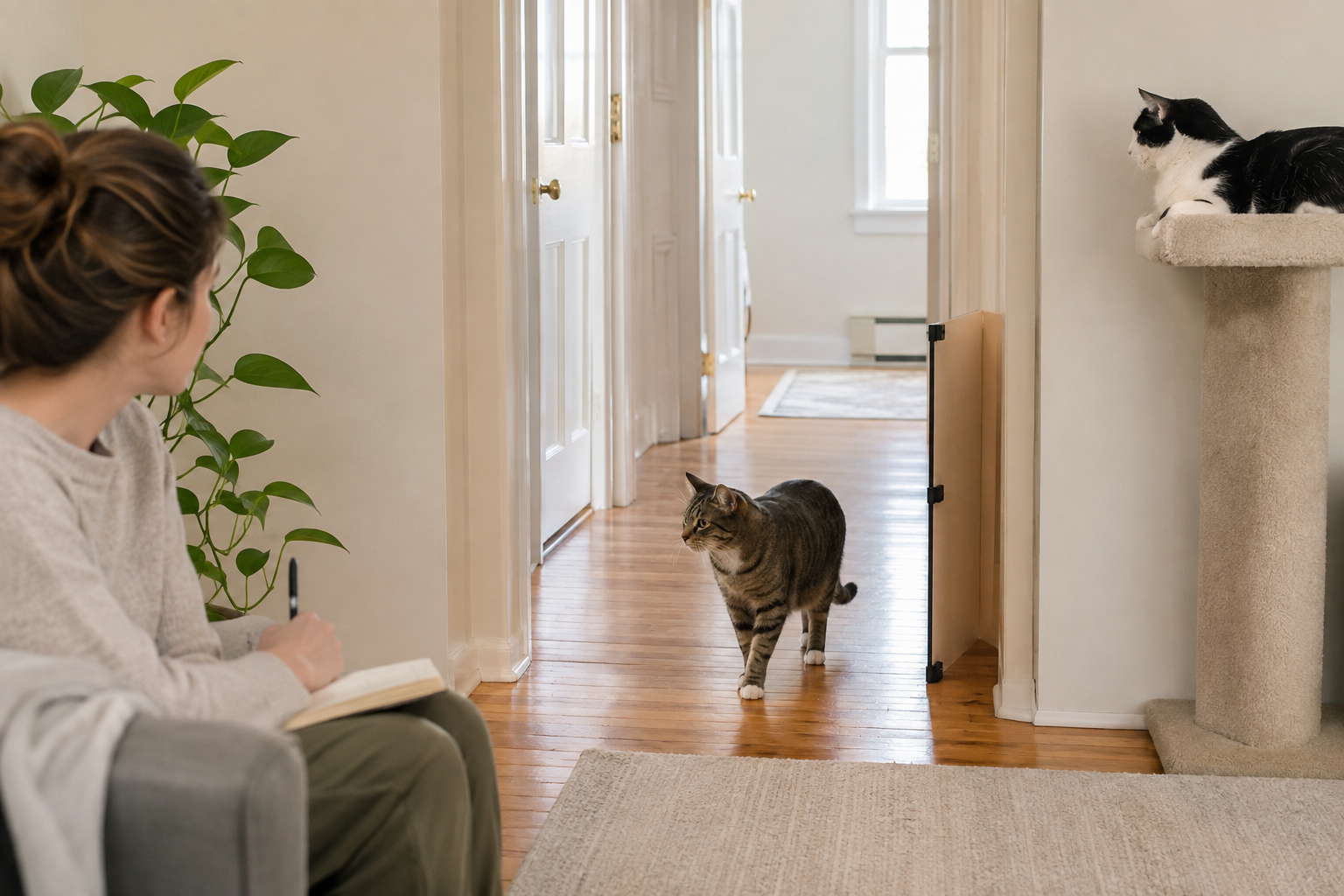
Route monitoring helps catch blocking, staring, and doorway pressure before a bullied cat loses safe access again.
Start with the old trouble spots. Watch where the confident cat used to sit, stare, or chase. Then watch where the target cat used to hesitate, crouch, sprint, hide, or turn around. Doorways and hallways deserve special attention because a cat can control a route simply by sitting in the wrong place.
Use a short daily check:
| What to watch | Good sign | Relapse clue |
|---|---|---|
| Doorways and halls | Both cats pass, pause, or turn away easily | One cat waits, stares, blocks, or follows |
| Food and water | Each cat eats at a normal pace | One cat leaves, rushes, or eats only when alone |
| Litter access | Normal box use in normal locations | Accidents, holding urine or stool, or sprinting from the box |
| Resting places | The target cat uses more than one safe spot | The target cat gives up beds, windows, or rooms |
| Recovery time | Startles resolve in minutes | Hiding, tension, or appetite changes last hours |
| Human attention | Both cats can approach without pressure | One cat interrupts, crowds, or drives the other away |
Take notes for patterns, not perfection. A single awkward moment may not be a relapse if both cats recover quickly. Repeated pressure in the same location is more important than one hiss that ends with both cats disengaging.
How do you keep resources from becoming pressure points again?
Keep important resources duplicated and separated for longer than you think you need. Food, water, litter boxes, beds, scratchers, perches, and favorite human areas should not be so clustered that one cat can control them from one doorway or one central perch.
The AAFP/ISFM environmental needs guidelines frame separated resources, safe places, play, predictable social interaction, and scent as core feline needs 2. In a multi-cat home with a bullying history, those needs are not optional extras. They are the structure that keeps the target cat from losing choices again.
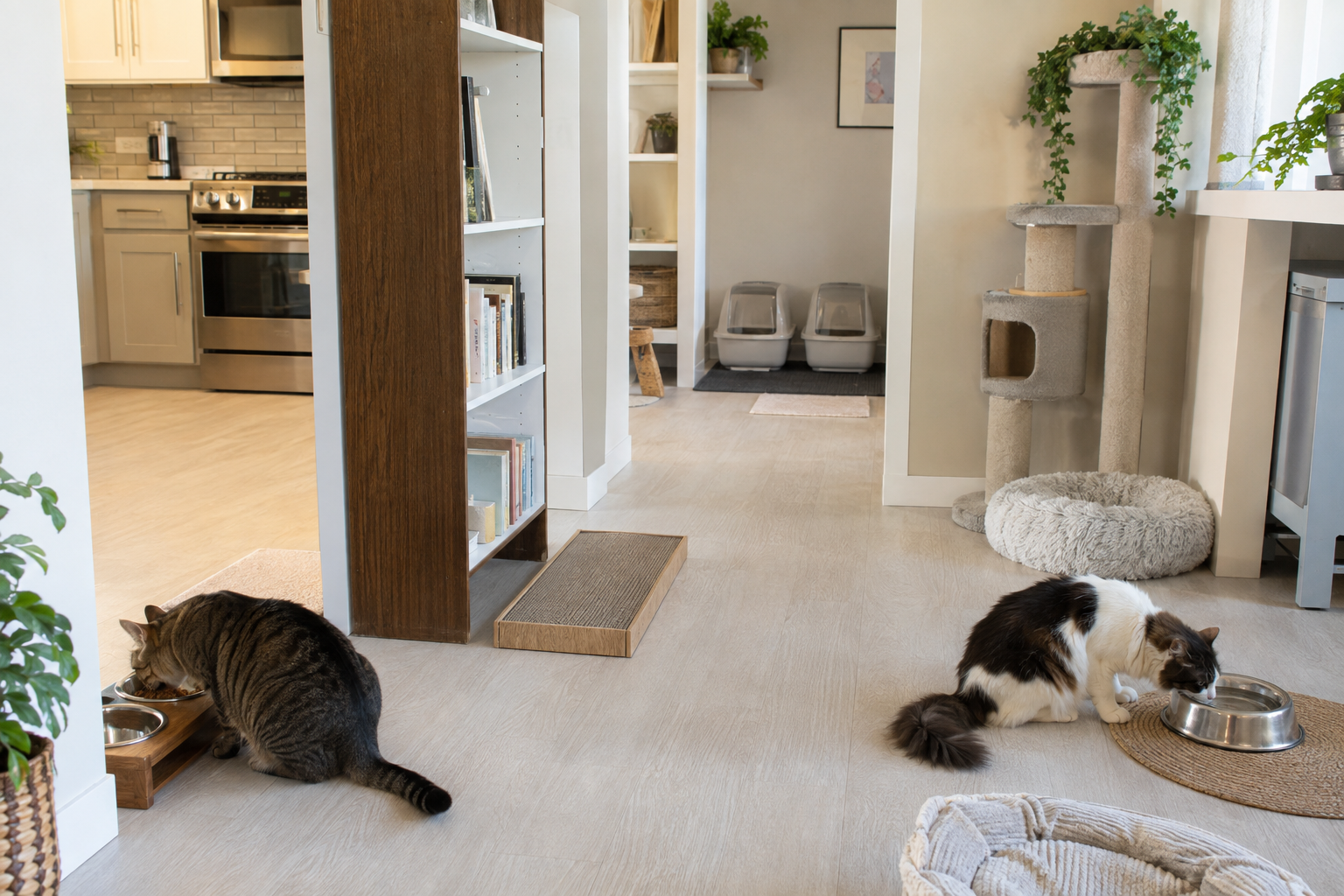
A resource map makes it easier to see whether one cat can still guard food, litter, resting places, or routes.
Make a quick resource map:
- Write down each cat's food, water, litter, sleeping, scratching, play, and hiding locations.
- Mark narrow paths, doors, stairs, and favorite ambush spots.
- Circle any location where the target cat has only one route in or out.
- Add a second option on the target cat's side of the home.
- Watch whether the target cat actually uses the new option.
If a safe room helped, do not close it permanently at the first sign of peace. Keep at least part of that setup available: a bed, water, litter access, scratcher, and a door or barrier you can use if tension returns. SnuggleSouls' guide to safe zones for a bullied cat can help you decide which pieces should stay long term.
Pay attention to food and litter most of all. A cat who cannot eat calmly or reach the box safely is not living in a stable truce. Move stations apart, add visual barriers, and avoid lining all resources along the same wall or in the same room.
What early warning signs mean you should step back?
Step back when you see repeated staring, stalking, blocking, rushing, guarding, crouching, freezing, swatting, hissing, growling, or the target cat avoiding normal rooms again. These signs mean the setup is too intense or the old route/resource problem has returned.
Cornell Feline Health Center notes that recognizing fear and aggression signals can help prevent injury, and those cues may include changes in pupils, ears, whiskers, tail, and body posture 4. Look at the whole pattern rather than one body part. A cat with flat ears, a low body, a tucked tail, and a blocked exit needs distance, not more exposure.
Use this step-back scale:
| Warning level | What you may see | What to do |
|---|---|---|
| Mild | One hard stare, brief hiss, or quick retreat | Add distance, redirect calmly, end the interaction early |
| Moderate | Repeated doorway waiting, following, crouching, tail lashing, or resource guarding | Return to supervised access only and restore barriers |
| Serious | Chasing, pinning, screaming, swatting, fur flying, bites, or one cat hiding for long periods | Separate fully, check for injuries, and restart from an earlier plan |
| Health concern | Not eating, painful movement, litter changes, vomiting, wounds, or rapid behavior change | Call a veterinarian promptly |
If the target cat is being actively controlled again, return to the immediate safety steps in SnuggleSouls' guide on how to stop one cat from bullying another. Do not wait for a full fight to call it a setback.
How should you handle calm shared time?
Handle calm shared time like a maintenance routine, not a final exam. Keep sessions short, predictable, and easy to end until both cats have repeated calm days in different rooms and at different times.
The ASPCA recommends keeping sessions short and separating cats between reintroduction sessions to prevent relapse when aggression has been severe or persistent 3. That advice fits the relapse-prevention phase: calm time is useful, but unsupervised freedom should expand gradually.
Good shared time often looks uneventful:
- One cat looks at the other and then looks away.
- The target cat walks through instead of sprinting.
- Both cats use separate resting spots.
- Each cat takes treats without crowding the other.
- A person can redirect attention without raising their voice.
- The session ends while both cats are still calm.
Avoid the common mistake of stretching every good moment until it fails. If the cats have five calm minutes, end at four. Several easy repetitions build a stronger pattern than one long session that ends with a chase.
Use rewards carefully. Treats, meals, and play should support calm choices, not pull the cats into competition. If one cat steals treats, crowds the target cat, or becomes too excited with a toy, split the rewards and return to more distance.
What should you do after a relapse?
After a relapse, separate the cats calmly, check for injuries, and return to the last stage where both cats were truly relaxed. Do not punish either cat, force an apology-style meeting, or put them back together immediately to see whether they are "over it."
MSD Veterinary Manual describes environmental management, prevention of unsafe situations, reinforcement-based behavior modification, and gradual reintroduction as key parts of managing behavior problems and aggression in cats 5. The practical takeaway is simple: lower the difficulty, rebuild calm, and prevent another rehearsal of the same conflict.
Use this reset sequence:
- Put each cat in a calm, familiar area with food, water, litter, bedding, and hiding.
- Check both cats for bites, scratches, limping, eye injury, pain, or shock.
- Give them a cooling-off period until eating, grooming, resting, and litter use are normal.
- Identify the trigger: route, resource, visitor, sound, outdoor cat, meal, play, or scent.
- Fix the setup before trying shared time again.
- Restart with scent, barrier, or distance sessions instead of open-room access.
If the relapse came after a rushed reset, revisit the slower steps in SnuggleSouls' guide to introduce two cats without fighting. Reintroduction is not only for new cats. It can help after a fight, a vet visit, a move, or a period of repeated household tension.
One relapse does not mean the whole plan failed. It means the current difficulty level was too high or one environmental pressure point was still active.
How long should you keep monitoring?
Keep close monitoring for at least several weeks after the last clear pressure pattern, then keep light monitoring as part of normal multi-cat care. A bullying history means you already know where the household can become fragile.
Track the same few signals weekly:
- Can the target cat use food, water, litter, beds, and people without pressure?
- Are routes still open, or has furniture, clutter, or a closed door created a bottleneck?
- Does either cat fixate on windows, outdoor cats, or household sounds?
- Do the cats recover quickly after surprises?
- Has one cat quietly stopped using a favorite room?
Use SnuggleSouls' broader cat behavior guides when a new signal appears, but keep the main standard grounded in everyday access. A peaceful multi-cat home is measured by normal eating, toileting, resting, play, movement, and recovery, not by whether the cats sleep together.
Some homes need permanent management. That can still be a humane success if the cats are relaxed and each cat has secure access to what they need. Separate feeding spots, nighttime separation, closed doors during visitors, or private play sessions may be easier and kinder than repeatedly testing the cats past their comfort.
When should you call a veterinarian or behavior professional?
Call a veterinarian promptly if either cat has a bite wound, bleeding, limping, eye injury, sudden hiding, appetite loss, weight loss, repeated vomiting, diarrhea, painful movement, or litter box changes. Medical pain, sensory decline, urinary problems, dental disease, arthritis, or other illness can make a cat more defensive or less able to tolerate normal contact.
Veterinary help also matters if aggression appears suddenly in cats who used to be stable. Behavior can change when one cat smells different after a clinic visit, feels painful, hears an outdoor cat, or becomes more anxious after a household change.
Ask for qualified behavior help if:
- The cats keep relapsing despite separation and resource changes.
- One cat stalks, blocks, or traps the other repeatedly.
- The target cat cannot use food, water, litter, or resting places normally.
- You cannot safely interrupt tension.
- You are considering permanent separation or rehoming.
- The household needs a detailed plan that fits its layout and schedule.
Avoid punishment, yelling, spray bottles, forced holding, and "let them work it out" methods. These can add fear and make the other cat's presence more threatening. A good plan reduces pressure before it asks either cat to cope with more.
Conclusion: keep calm boring and repeatable
Preventing a cat bullying relapse is mostly about consistency. Keep the routes open, resources separated, safe zones available, and shared time short enough that the cats can keep succeeding.
The goal is not to prove that the cats are cured. The goal is a home where both cats can eat, drink, rest, use the litter box, play, approach people, and move through rooms without being controlled by the other cat. If the small warning signs return, step back early and rebuild from the last calm stage.
Frequently Asked Questions
Is one hiss a cat bullying relapse?
One brief hiss is not always a relapse if both cats disengage and recover quickly. Repeated hissing, stalking, blocking, chasing, swatting, or hiding afterward means the setup needs more distance or a return to barriers.
When can I stop separating cats at night?
Stop nighttime separation only after the cats have had many calm evenings and mornings with no chasing, guarding, or target-cat avoidance. If tension usually happens after dark, keep night separation longer and use daytime supervised practice first.
Should I remove the bullied cat's safe room once things improve?
Not right away. Keep the safe room or safe zone available while the cats build a longer pattern of calm access. Removing it too soon can take away the target cat's best escape and recovery option.
What if the confident cat starts blocking the hallway again?
Treat hallway blocking as an early warning sign. Add another route if possible, interrupt with a calm redirect, use a visual barrier, and return to supervised access until the target cat can pass without crouching, sprinting, or turning back.
Can cats live peacefully after bullying without becoming friends?
Yes. Some cats recover into friendly companions, while others do best as calm housemates with distance. Peaceful access to food, litter, rest, play, and people is a better welfare goal than forced closeness.
References
[1] American Association of Feline Practitioners. (2024). 2024 AAFP Intercat Tension Guidelines: Recognition, Prevention and Management. URL
[2] American Association of Feline Practitioners and International Society of Feline Medicine. (2013). 2013 AAFP/ISFM Environmental Needs Guidelines. URL
[3] ASPCA. (n.d.). Aggression Between Cats in Your Household. URL
[4] Cornell Feline Health Center. (2016). Feline Behavior Problems: Aggression. URL
[5] MSD Veterinary Manual. (2025). Behavior Problems of Cats. URL
 EN
EN DE
DE ES
ES PT
PT